
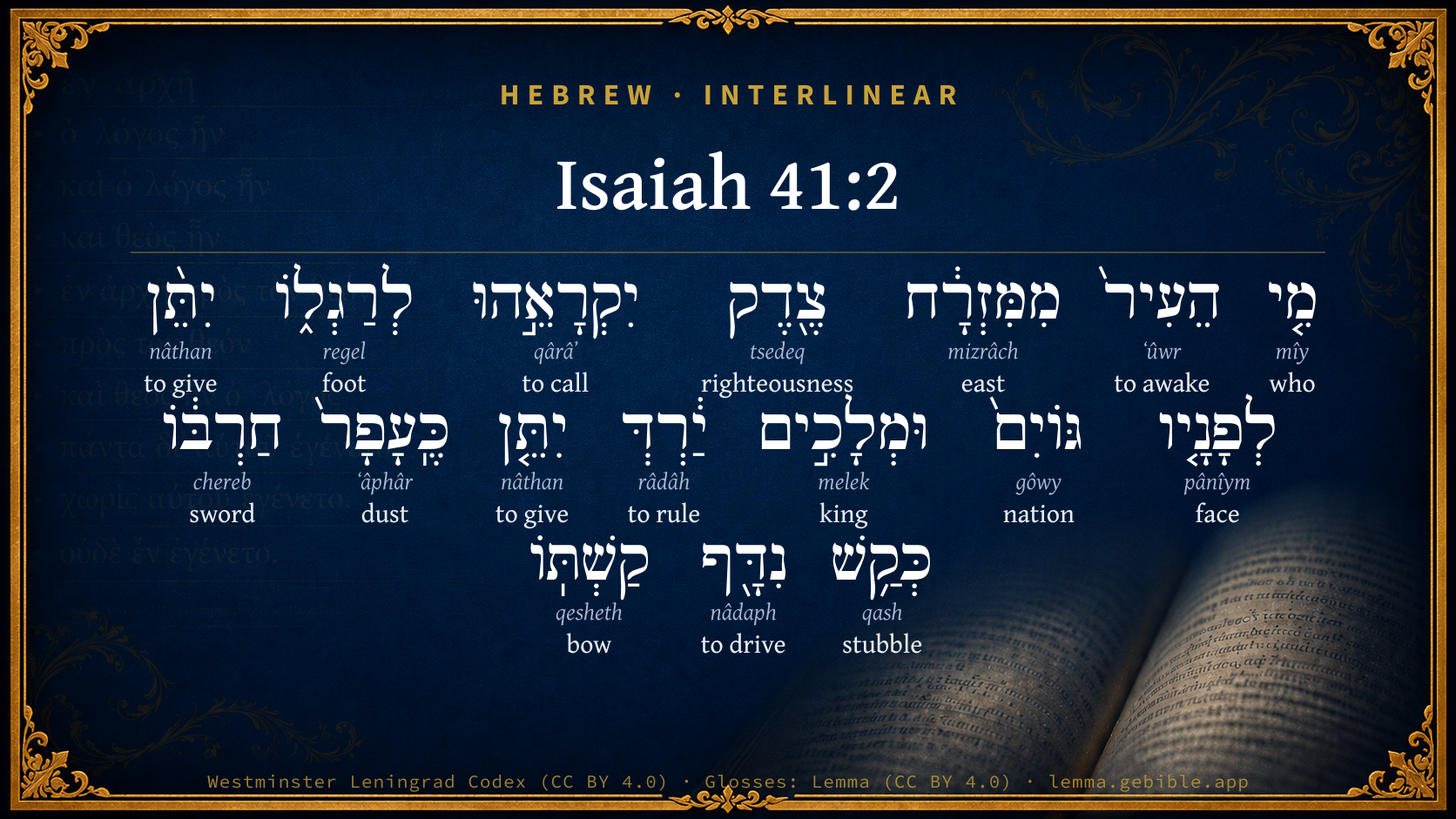
Isaiah 41:2

Hebrew (Westminster Leningrad Codex) Isaiah 41:2 appears in the Hebrew Old Testament. The text above is from the Westminster Leningrad Codex. Each word links to its Strong’s number, a concise gloss, and parsing drawn from the Open Scriptures Hebrew Bible morphology. Click any word for its full Brown-Driver-Briggs (BDB) entry.
Download image
Cite this verse

Isaiah 41:2 (World English Bible). Public Domain. Lemma interlinear Bible study tool, https://lemma.gebible.app/v/isaiah/41/2.

Show BibTeX & RIS
BibTeX
RIS
English Translation
Who has raised up one from the east, whom he calls in righteousness to his foot? he gives nations before him, and makes him rule over kings; he gives them as the dust to his sword, as the driven stubble to his bow.
World English Bible · Public Domain
Download a study sheet

One document with this verse’s original text, its word-by-word gloss line, the meaning frame, cross-references with their text, attributed commentary, and full source and license credits — printable, and it pastes into notes with its structure intact.

This verse Autodidact and up

Study sheet (.html) Plain text (.txt)

A passage Seminary Student

Up to 50 verses in one chapter. A passage sheet keeps up to 6 commentary sources and 12 cross-references per verse, in the order this page ranks them, and says so on the sheet whenever that leaves anything out. Ask for a single verse and you get the Autodidact verse sheet above.

Everything on this page stays free to read, with no account — the sheet is a download of what is already on screen, not access to it.

Want to remove ads? Support Godless Engineer
Compare translations 3

The same verse in 3 English versions, stacked beneath the original-language interlinear above. Click any original word for its lexicon entry.

Each is an independent rendering of the whole verse — the interlinear is not word-aligned to these translations.

Highlighted words mark where these versions differ — a whole-verse word diff, not a word-by-word alignment.

  • World English Bible Public Domain
    Who has raised up one from the east, whom he calls in righteousness to his foot? he gives nations before him, and makes him rule over kings; he gives them as the dust to his sword, as the driven stubble to his bow.
  • King James Version Public Domain
    Who raised up the righteous man from the east, called him to his foot, gave the nations before him, and made him rule over kings? he gave them as the dust to his sword, and as driven stubble to his bow.
  • unfoldingWord Literal Text CC BY-SA 4.0
    Who has awakened righteousness from the rising, calling it to his foot? He gives nations to his face, and he tramples kings. He makes like dust his sword, like driven straw his bow.

unfoldingWord Literal Text — © unfoldingWord, licensed CC BY-SA 4.0. Word-aligned USFM3 via Door43 (git.door43.org/unfoldingWord/en_ult).

Versions to compare (up to 4)

3 of 4 selected

Show all 18 translations

Every available English version of this verse, each an independent rendering of the whole verse.

  • World English Bible Public Domain
    Who has raised up one from the east, whom he calls in righteousness to his foot? he gives nations before him, and makes him rule over kings; he gives them as the dust to his sword, as the driven stubble to his bow.
  • Berean Standard Bible Public Domain
    Who has aroused one from the east and called him to his feet in righteousness? He hands nations over to him and subdues kings before him. He turns them to dust with his sword, to windblown chaff with his bow.
  • Majority Standard Bible Public Domain
    Who has aroused one from the east and called him to his feet in righteousness? He hands nations over to him and subdues kings before him. He turns them to dust with his sword, to windblown chaff with his bow.
  • King James Version Public Domain
    Who raised up the righteous man from the east, called him to his foot, gave the nations before him, and made him rule over kings? he gave them as the dust to his sword, and as driven stubble to his bow.
  • American Standard Version (1901) Public Domain
    Who hath raised up one from the east, whom he calleth in righteousness to his foot? he giveth nations before him, and maketh him rule over kings; he giveth them as the dust to his sword, as the driven stubble to his bow.
  • Revised Version (1885) Public Domain
    Who hath raised up one from the east, whom he calleth in righteousness to his foot? he giveth nations before him, and maketh him rule over kings; he giveth them as the dust to his sword, as the driven stubble to his bow.
  • Geneva Bible (1599) Public Domain
    Who raised vp iustice from the East, and called him to his foote? and gaue the nations before him, and subdued the Kings? he gaue them as dust to his sword, and as scattered stubble vnto his bowe.
  • Douay-Rheims (1899) Public Domain
    Who hath raised up the just one from the east, hath called him to follow him? he shall give the nations in his sight, and he shall rule over kings: he shall give them as the dust to his sword, as stubble driven by the wind, to his bow.
  • Young's Literal Translation Public Domain
    Who stirred up from the east a righteous one? He calleth him to His foot, He giveth before him nations, And kings He causeth him to rule, He giveth `them' as dust `to' his sword, As driven stubble `to' his bow.
  • Literal Standard Version CC BY-SA 4.0
    Who stirred up a righteous one from the east? He calls him to His foot, || He gives nations before him, || And He causes him to rule kings, || He gives [them] as dust [to] his sword, || As driven stubble [to] his bow.
  • Unlocked Literal Bible CC BY-SA 4.0
    Who has stirred up one from the east, calling him in righteousness to his service? He hands nations over to him and helps him subdue kings. He turns them to dust with his sword, like windblown stubble with his bow.
  • unfoldingWord Literal Text CC BY-SA 4.0
    Who has awakened righteousness from the rising, calling it to his foot? He gives nations to his face, and he tramples kings. He makes like dust his sword, like driven straw his bow.
  • Darby Bible Public Domain
    Who raised up from the east him whom righteousness calleth to its foot? He gave the nations before him, and caused him to have dominion over kings; he gave them as dust to his sword, as driven stubble to his bow.
  • World Messianic Bible Public Domain
    Who has raised up one from the east? Who called him to his feet in righteousness? He hands over nations to him and makes him rule over kings. He gives them like the dust to his sword, like the driven stubble to his bow.
  • Webster's Bible Public Domain
    Who raised up the righteous man from the east, called him to his foot, gave the nations before him, and made him rule over kings? he gave them as the dust to his sword, and as driven stubble to his bow.
  • Free Bible Version CC BY-SA 4.0
    Who has encouraged this one from the east who is called into God's service to do what is right? He gives him nations, and helps him trample kings underfoot. He makes them like dust with his sword, and turns them into chaff with his bow, blown before him on the wind.
  • Bible in Basic English Public Domain
    Who sent out from the east one who is right wherever he goes? he gives the nations into his hands, and makes him ruler over kings; he gives them as the dust to his sword, as dry stems before the wind to his bow.
  • JPS Tanakh (1917) Public Domain
    Who hath raised up one from the east, at whose steps victory attendeth? He giveth nations before him, and maketh him rule over kings; his sword maketh them as the dust, his bow as the driven stubble.

Literal Standard Version (2020), Covenant Press — licensed CC BY-SA 4.0. Text via the HelloAO Bible API (eBible.org). Unlocked Literal Bible (unfoldingWord) — licensed CC BY-SA 4.0. Text via the HelloAO Bible API (eBible.org). unfoldingWord Literal Text — © unfoldingWord, licensed CC BY-SA 4.0. Word-aligned USFM3 via Door43 (git.door43.org/unfoldingWord/en_ult). Free Bible Version, Dr. Jonathan Gallagher — licensed CC BY-SA 4.0. Text via the HelloAO Bible API (eBible.org).

Word by word

More ways to search: Search by grammar → Find every occurrence → Compare this word →

Practice this passage: Drill this verse → Learn its vocabulary →

נִדָּ֖ף
nâdaph
H5086
“driving”
Verb, Niphal, Participle Active, Masculine, Singular, Absolute
Part of Speech
Verb
Stem
Niphal
Form
Participle Active
Gender
Masculine
Number
Singular
State
Absolute
Full BDB Definition

Origin: a primitive root

TWOT: 1307

to drive, drive away, drive asunder - (Qal) to drive about - (Niphal) to be driven, be driven about
  1. מִ֤י mîy H4310 “who” Particle, Interrogative
  2. הֵעִיר֙ ʻûwr H5782 “to awake” Verb, Hiphil, Perfect, 3rd Person, Masculine, Singular
  3. מִמִּזְרָ֔ח mizrâch H4217 “from · east” Preposition + Noun, Common, Masculine, Singular, Absolute
  4. צֶ֖דֶק tsedeq H6664 “righteousness” Noun, Common, Masculine, Singular, Absolute
  5. יִקְרָאֵ֣הוּ qârâʼ H7121 “to call · him” Verb, Qal, Imperfect, 3rd Person, Masculine, Singular + Suffix, Personal, 3rd Person, Masculine, Singular
  6. לְרַגְל֑וֹ regel H7272 “to/for · foot · his” Preposition + Noun, Common, Feminine, Singular, Construct + Suffix, Personal, 3rd Person, Masculine, Singular
  7. יִתֵּ֨ן nâthan H5414 “to give” Verb, Qal, Imperfect, 3rd Person, Masculine, Singular
  8. לְפָנָ֤יו pânîym H6440 “to/for · face(s) · his” Preposition + Noun, Common, Both, Plural, Construct + Suffix, Personal, 3rd Person, Masculine, Singular
  9. גּוֹיִם֙ gôwy H1471 “nations” Noun, Common, Masculine, Plural, Absolute
  10. וּמְלָכִ֣ים melek H4428 “and · kings” Conjunction + Noun, Common, Masculine, Plural, Absolute
  11. יַ֔רְדְּ râdâh H7287 “to rule” Verb, Hiphil, Imperfect, 3rd Person, Masculine, Singular
  12. יִתֵּ֤ן nâthan H5414 “to give” Verb, Qal, Imperfect, 3rd Person, Masculine, Singular
  13. כֶּֽעָפָר֙ ʻâphâr H6083 “like/as the · dust” Preposition, Determined + Noun, Common, Masculine, Singular, Absolute
  14. חַרְבּ֔וֹ chereb H2719 “sword · his” Noun, Common, Feminine, Singular, Construct + Suffix, Personal, 3rd Person, Masculine, Singular
  15. כְּקַ֥שׁ qash H7179 “like/as · stubble” Preposition + Noun, Common, Masculine, Singular, Absolute
  16. קַשְׁתּֽוֹ qesheth H7198 “bow · his” Noun, Common, Feminine, Singular, Construct + Suffix, Personal, 3rd Person, Masculine, Singular

About this verse

These counts appear in no published source. They are computed here, from the morphology-tagged text and Lemma’s own curated glosses. What Lemma adds →

17
words
16
distinct lemmas
Prophets
section

Notable vocabulary

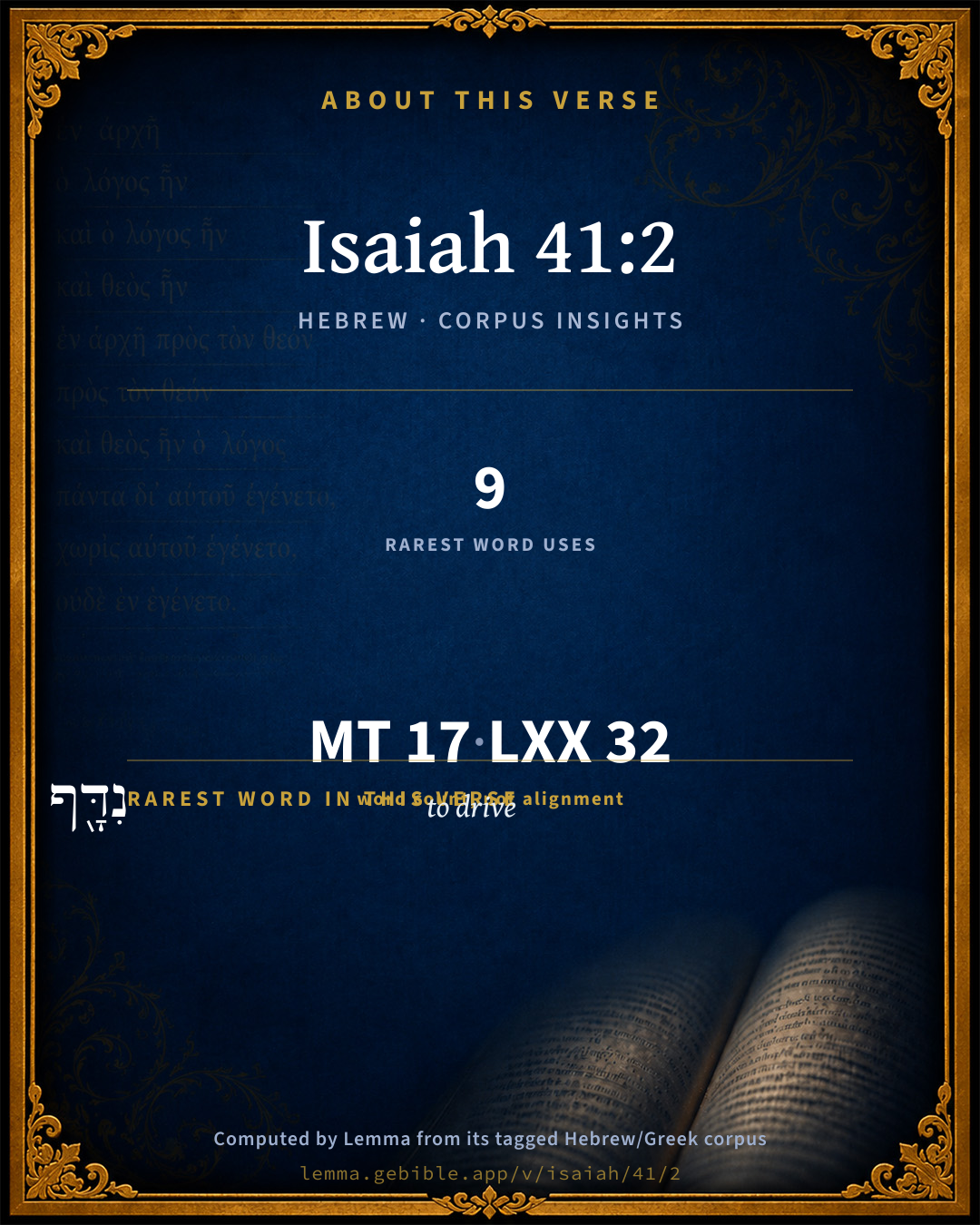
The rarest word here is נִדָּ֖ף to drive H5086 — appearing just 9 times in the whole Hebrew Bible.

Shared distinctive vocabulary

נִדָּ֖ף to drive H5086 occurs in 8 verses of the Hebrew Bible. Also found in:

Grammatical profile

  • 6 verbs
  • 10 nouns
  • 1 particle

Verb forms

  • הֵעִיר֙ Hiphil · Perfect
  • יִקְרָאֵ֣הוּ Qal · Imperfect
  • יִתֵּ֨ן Qal · Imperfect
  • יַ֔רְדְּ Hiphil · Imperfect
  • יִתֵּ֤ן Qal · Imperfect
  • נִדָּ֖ף Niphal · Participle Active

Repetition

A word recurs within this verse — often emphatic in Hebrew:

  • יִתֵּ֨ן to give H5414 ×2

Hebrew & Septuagint length

In English translation the verse runs 43 words from the Hebrew and 45 from the Septuagint (LXX English) — closely comparable.

A rough comparison of the two English renderings, which tokenize alike — not a word-level alignment.

Word counts can differ between the Hebrew and the Greek without any difference in meaning — e.g. the Hebrew direct-object marker אֵת has no separate Greek word, and Greek often adds the article ὁ.

In the original languages it is 17 Hebrew tokens and 32 Greek tokens — but the two are counted differently (Hebrew bundles its prefixes and suffixes into one token; the Greek is in lemma form), so that isn’t a like-for-like length.

Cross-references

16

Topical passages linked to Isaiah 41:2 in the Treasury of Scripture Knowledge — connected by theme and wording, ordered by reader-vote popularity; previews shown in the World English Bible.

  • Isaiah 45:1 Thus says Yahweh to his anointed, to Cyrus, whose right hand I have held, to subdue nations before him, and I will loose the loins of kings; to open the doors before him, and the gates shall not be shut:
  • 2 Samuel 22:43 Then did I beat them small as the dust of the earth, I did crush them as the mire of the streets, and did spread them abroad.
  • Ezra 1:2 Thus says Cyrus king of Persia, All the kingdoms of the earth has Yahweh, the God of heaven, given me; and he has charged me to build him a house in Jerusalem, which is in Judah.
  • Isaiah 40:24 Yes, they have not been planted; yes, they have not been sown; yes, their stock has not taken root in the earth: moreover he blows on them, and they wither, and the whirlwind takes them away as stubble.
  • Isaiah 41:25 I have raised up one from the north, and he has come; from the rising of the sun one who calls on my name: and he shall come on rulers as on mortar, and as the potter treads clay.
  • Isaiah 46:11 calling a ravenous bird from the east, the man of my counsel from a far country; yes, I have spoken, I will also bring it to pass; I have purposed, I will also do it.
  • 2 Chronicles 36:23 Thus says Cyrus king of Persia, All the kingdoms of the earth has Yahweh, the God of heaven, given me; and he has charged me to build him a house in Jerusalem, which is in Judah. Whoever there is among you of all his people, Yahweh his God be with him, and let him go up.
  • Isaiah 45:13 I have raised him up in righteousness, and I will make straight all his ways: he shall build my city, and he shall let my exiles go free, not for price nor reward, says Yahweh of Hosts.
  • Genesis 11:31 Terah took Abram his son, Lot the son of Haran, his son's son, and Sarai his daughter-in-law, his son Abram's wife. They went forth from Ur of the Chaldees, to go into the land of Canaan. They came to Haran, and lived there.
  • Genesis 12:1–3 Now Yahweh said to Abram, "Get out of your country, and from your relatives, and from your father's house, to the land that I will show you.
  • Genesis 14:14–15 When Abram heard that his relative was taken captive, he led forth his trained men, born in his house, three hundred and eighteen, and pursued as far as Dan.
  • Genesis 17:1 When Abram was ninety-nine years old, Yahweh appeared to Abram, and said to him, "I am God Almighty. Walk before me, and be blameless.
  • 2 Kings 13:7 For he didn't leave to Jehoahaz of the people save fifty horsemen, and ten chariots, and ten thousand footmen; for the king of Syria destroyed them, and made them like the dust in threshing.
  • Hebrews 7:1 For this Melchizedek, king of Salem, priest of God Most High, who met Abraham returning from the slaughter of the kings and blessed him,
  • Hebrews 11:8–10 By faith, Abraham, when he was called, obeyed to go out to the place which he was to receive for an inheritance. He went out, not knowing where he went.
  • Isaiah 41:15–16 Behold, I have made you [to be] a new sharp threshing instrument having teeth; you shall thresh the mountains, and beat them small, and shall make the hills as chaff.

Cross-references courtesy of OpenBible.info (CC BY 4.0).

Hebrew and Greek witnesses Masoretic Hebrew ↔ Greek Septuagint

The same verse in the two great witnesses to the Old Testament, shown verse-for-verse.

These are two independent witnesses, not word-aligned to each other, and the Septuagint is shown in lemma (dictionary) form.

Hebrew Isaiah 41:2 Masoretic · Westminster Leningrad Codex

מִ֤י הֵעִיר֙ מִמִּזְרָ֔ח צֶ֖דֶק יִקְרָאֵ֣הוּ לְרַגְל֑וֹ יִתֵּ֨ן לְפָנָ֤יו גּוֹיִם֙ וּמְלָכִ֣ים יַ֔רְדְּ יִתֵּ֤ן כֶּֽעָפָר֙ חַרְבּ֔וֹ כְּקַ֥שׁ נִדָּ֖ף קַשְׁתּֽוֹ

Who has raised up one from the east, whom he calls in righteousness to his foot? he gives nations before him, and makes him rule over kings; he gives them as the dust to his sword, as the driven stubble to his bow.

World English Bible · Public Domain

Greek LXX Isaiah 41:2 Septuagint · lemma form

τίς ἐκἀγείρω ἀπό ἀνατολή δικαιοσύνη καλέω αὐτός κατά πούς αὐτός καί πορεύομαι δίδωμι ἐναντίον ἔθνος καί βασιλεύς ἐκἵστημι καί δίδωμι εἰς γῆ ὁ μάχαιρα αὐτός καί ὡς φρύγανον ἐκὠθέω ὁ τόξον αὐτός

Who raised up righteousness from the east, and called it to his feet, so that it should go? shall appoint it an adversary of Gentiles, and shall dismay kings, and bury their swords in the earth, and cast forth their bows and arrows as sticks?

LXX2012 (modern English Septuagint) · Public Domain

On this verse, Jamieson, Fausset & Brown discusses the Septuagint’s reading. Read the note in Commentary ↓

Hebrew: Westminster Leningrad Codex (CC BY 4.0). Greek: Septuagint (public domain); English from LXX2012 (modern English Septuagint) (Public Domain). How the Septuagint differs from the Hebrew →

Targum (Aramaic paraphrase)

1

The Targum is the ancient Jewish Aramaic paraphrase of the Hebrew Scriptures — an interpretive translation, not the Hebrew text itself. Onkelos (literal) and Pseudo-Jonathan (expansive) render the Torah, and Jonathan the Prophets. Coverage is partial: where no permissively-licensed English translation exists for a verse, only the Aramaic is shown. This is verse-level text, not a word-by-word alignment to the Hebrew.

  1. Targum Jonathan Prophets (Joshua–Malachi)
    מַן אַיְתֵי בִגְלַאי מִמַדִינְחָא אַבְרָהָם בְּחִיר צַדִיקַיָא בִּקְשׁוֹט קַרְבֵהּ לְאַתְרֵהּ מְסַר קֳדָמוֹהִי עַמְמִין וּמַלְכִין תַּקִיפִין תְּבַר רְמָא כְּעַפְרָא קָטוֹלִין קֳדָם חַרְבֵּהּ כְּקַשָׁא רְדוֹפִין קֳדָם קַשְׁתֵּהּ:

    Who openly brought Abraham from the east? He brought the chosen of the righteous in truth to his place, He delivered up nations before him, and broke in pieces mighty kings, he cast the slain down like the dust before his sword, and he pursued them? like stubble before his bow.

    Targum Jonathan — Aramaic: “Mikraot Gedolot” (public domain). English: “Sefaria Community Translation” (CC0 1.0 (public-domain dedication)); “London "Chaldee Paraphrase," 1871” (public domain). Text via Sefaria.

Commentary

Notes on Isaiah 41:2 from classic Christian and Jewish commentators (each source and its license shown beneath its notes). The classic Christian expositions comment on the surrounding passage and are grouped to its opening verse, so a note may address several verses; the Jewish commentaries on the Tanakh (Rashi and others) are per-verse, so they appear only where the commentator wrote on this verse.

Lemma curates 59 commentaries, every one of them public domain or Creative Commons licensed, each selected and text-cleaned for this edition rather than reprinted as found. About our sources →

Trapp's Complete Commentary

John Trapp

Isa 41:2 Who raised up the righteous [man] from the east, called him to his foot, gave the nations before him, and made [him] rule over kings? he gave [them] as the dust to his sword, [and] as driven stubble to his bow.

Ver. 2. Who raised up the righteous man from the east?] Who but myself? Which of your idols can boast of such a man as Abraham was, like as I can?

Called him to his foot.] Making him follow his call with a blind obedience, for he winked and put himself into God’s holy hand, to be led at his pleasure. He "knew not whither he went," {Heb 11:8} nor much cared, so long as he had God by the hand, or might follow him as a guide, step after step.

He gave the nations before him.] Gen 14:14. His posterity also prevailed exceedingly. And thus God stoppeth the mouths of those idolaters who insulted over the Israelites, because afflicted and subdued by other nations, as Cicero doth in his oration for Quintus Flaccus, extolling therefore their idols above the true God.

John Trapp, A Commentary or Exposition upon All the Books of the Old and New Testament (1647–1656) — public domain. Text from a community e-Sword module.

The Biblical Illustrator

Joseph S. Exell

Isa_41:2

The righteous man from the East

The righteous man from the East

The question, whose appearance is predicted, has been always a subject of dispute.

Eusebius, Theodoret, and Procopius understand it as describing the triumphs of the true religion, or the Gospel, here called righteousness. Cyril and Jerome apply it to the Lord Jesus Christ Himself, as the Righteous One, or the Lord our Righteousness. Cocceius stands alone in his application of the verso to the apostle Paul. The Jews make Abraham the subject of the passage, excepting Aben Ezra, who, with Vitringa and all the latest writers, understands it as a prophecy of Cyrus. The inappropriateness of the terms employed to our Saviour or the Gospel, to Abraham or Paul, is almost self-evident, and equally clear is its appropriateness to the case of Cyrus. The argument in favour of the latter application, drawn from the analogy of Isa_45:1; Isa_46:11, is less conclusive, because he is there expresslynamed. The truth appears to be that this is a more general intimation of a great eventful movement from the East, which is afterwards repeated with specific reference to Cyrus and his conquests. It might even be supposed without absurdity that there is here an allusion to the general progress of the human race, of conquest, civilisation, and religion from the East to the West. Umbreit supposes a specific reference to the course of the sun, from which the name of Cyrus was derived. (J. A. Alexander.)

Cyrus raised up by God

Stirred up the sense is impelled into activity. (Prof. S. R. Driver, D. D.)

Cyrus from the East, yet from the North

From the East; Cyrus home, Susiania being to the east of Babylonia. From the North (Isa_41:25), alludes to the Medes, who united with the Persians under Cyrus, and whose home was to the north or north-east of Babylonia. (Prof. S. R. Driver, D. D.)

Cyrus called in righteousness

(see R.V.):--Cyrus career being a furtherance of Gods righteous purpose for the government of the world. (Prof. S. R. Driver, D. D.)

Cyrus called to Gods foot

To call to ones foot is a Hebrew idiom for calling to ones service, or summoning to take a place among ones followers. (J. A. Alexander.)

The Biblical Illustrator, edited by Joseph S. Exell (c. 1880s–1900s) — public domain. Text from a community e-Sword module.

Joseph Benson's Commentary

Isa 41:2-3. Who raised up — Into being and power? Was it not my work alone? The righteous man — Many expositors understand this of Abraham, who was a person eminently righteous, and was called from the other side of the Euphrates, which lay eastward from Judea, and who performed the things here mentioned, partly in his own person, conquering five kings and their people with them, (Genesis 14.,) and following God he knew not whither; and partly by his posterity, whose exploits may well be ascribed to him, not only because they came out of his loins, but also, and especially, because all their successes and victories were given to them for Abraham’s sake, and by the virtue of God’s covenant made with him. And this interpretation seems to receive some countenance from Isa 41:5-6, which agree well with the practice of the Canaanites and neighbouring nations; who, upon Israel’s march toward them, were filled with great consternation, and used all possible diligence in seeking both to their idols and to men for help against them. To which may be added, that Abraham was called out of the east; and his posterity were introduced into the land of Canaan, in order to destroy the idolaters of that country; and they were established there on purpose to stand as a barrier against idolatry, then prevailing, and threatening to overrun the whole face of the earth. But though the particulars here mentioned by the prophet are most, or all of them, applicable to Abraham, yet Lowth, Vitringa, and many other commentators of great authority, think that they more exactly belong to Cyrus, and that upon a comparison of them with what is asserted Isa 41:25; Isa 45:1; Isa 45:13; and Isa 46:11, there can be no doubt that he is here meant. Cyrus might be called a righteous man, or, a man of righteousness, as the Hebrew rather means, because he was raised up in righteousness, as is said of him Isa 45:13, and was God’s great instrument, to manifest his faithfulness in fulfilling his promise of delivering his people out of Babylon, and his justice in punishing the enemies and oppressors of his people, the Babylonians; upon which account the Medes, who served under Cyrus in his expedition, are called God’s sanctified ones, Isa 13:3; Isa 13:17. And all the other expressions here used are very applicable to him, and were verified in him. He came from the east, from Persia, which was directly eastward from Judea and from Babylon. He was raised up by God in an eminent and extraordinary manner, as is observed both by sacred and profane historians. To him also all the following particulars agree, as we shall see. And although these things were yet to come, yet the prophet speaks of them as if they were already past, a practice not unusual with the prophets. And as in the former chapter, (Isa 41:27,) he speaks of God’s people as if they were actually in captivity in Babylon, so here he speaks of them as if they were actually brought out of it by Cyrus. And by this instance he pleads his cause against the Gentiles and their idols; because this was an evident proof of God’s almighty power, (as the prediction of it was of his infinite wisdom,) and of the vanity and weakness of idols, which eminently appeared in the destruction of the Babylonians, who were a people mad upon their idols, and yet were destroyed together with their idols, Jer 50:38; Jer 51:47. Called him to his foot — To march after him, and under his banner against Babylon. Thus Barak’s army is said to be at his feet, Jdg 4:10. Gave the nations before him, &c. — Subdued nations and kings before him. Gave them as the dust to his sword — To be put to flight as easily as the dust is scattered by the wind. He pursued them, and passed safely — Went on in the pursuit with great ease, safety, and success; even by the way that he had not gone — By unknown paths; which is added as a further evidence of God’s providential care of him. This was verified both in Abraham and in Cyrus.

Joseph Benson's Commentary on the Old and New Testaments (1811–1818) — public domain. Text from a community e-Sword module.

Keil & Delitzsch

C. F. Keil & F. Delitzsch

The parties invited are now to be thought of as present, and Jehovah commences in Isa 41:2 : "Who hath raised up the man from the rising of the sun, whom justice meets at his foot, He giveth up nations before him, and kings He subdues, giveth men like the dust to his sword, and like driven stubble to his bow?" The sentence governed by "who" (mı̄) ends at leraglō (at his foot); at the same time, all that follows is spoken with the echo of the interrogative accent. The person raised up is Cyrus, who is afterwards mentioned by name. The coming one (if, that is to say, we adhere to the belief in Isaiah's authorship of these addresses) first approaches gradually within the horizon of the prophet's ideal present; and it is only little by little that the prophet becomes more intimately acquainted with a phenomenon which belongs to so distant a future, and has been brought so close to his own eyes. Jehovah has raised up the new great hero "from the east" (mimmizrâch), and, according to Isa 41:25, "from the north" also. Both of these were fulfilled; for Cyrus was a Persian belonging to the clan of Achaemenes (Hakhâmanis), which stood at the head of the tribe, or of the Pasargadae. He was the son of Cambyses; and even if the Median princess Mandane were not his mother, yet, according to nearly all the ancient accounts, he was connected with the royal house of Media; at any rate, after Astyages was dethroned, he became head and chief of the Medes as well as of the Persians (hence the name of "Mule" which was give to him by the oracle, and that given by Jerome, "agitator bigae"). Now Media was to the north of Babylonia, and Persia to the east; so that his victorious march, in which, even before the conquest of Babylon, he subjugated all the lands from the heights of Hinduku to the shores of the Aegean Sea, had for its starting-point both the east and north.

(Note: See Pahl'es Geschichte des Oriental. Alterthums. (1864), p. 170ff.)

The clause לרגלו יקראהוּ צדק is an attributive clause, and as such a virtual object: "him whom (supply עת־אשׁר) justice comes to meet (קרא) = קרה, Ges. 75, vi.) on his track" (cf., Gen 30:30; Job 18:11; Hab 3:5). The idea of tsedeq is determined by what follows: Jehovah gives up nations before him, and causes kings to be trodden down (causative of râdâh). Accordingly, tsedeq is either to be understood here in an attributive sense, as denoting the justice exercised by a person (viz., the justice executed successfully by Cyrus, as the instrument of Jehovah, by the force of arms); or objectively of the justice awarded to a person (to which the idea of "meeting" is more appropriate), viz., the favourable result, the victory which procures justice for the just cause of the combatant. Rosenmller, Knobel, and others, are wrong in maintaining that tsedeq (tsedâqâh) in chapters 40-66 signifies primarily justice, and the prosperity and salvation as its reward. The word means straightness, justice, righteousness, and nothing more (from tsâdaq, to be hard, firm, extended, straight, e.g., rumh-un-tsadq, a hard, firm, and straight lance); but it has a double aspect, because justice consists, according to circumstances, of either wrath of favour, and therefore has sometimes the idea of the strict execution of justice, as in this instance, sometimes of a manifestation of justice in fidelity to promises, as in Isa 41:10. יתּן is repeated here in Isa 41:2 (just like וילמדהו in Isa 40:14) with the same subject, but in a different sense. To make sword and bow the subject, in the sense of "his sword gives (sc., 'the foe')," is a doubtful thing in itself; and as cherebh and qesheth are feminines, it is by no means advisable. Moreover, in other instances, the comparative כ leaves it to the reader to carry out the figure indicated according to his own fancy. And this is the case here: He (Jehovah) makes his sword as if there were dust, his bow as if there were hunted stubble (Bttcher), i.e., pounding the enemy like dust, and hunting it like flying stubble. Our text has כּעפר, but in certain codices we find כּעפר with tzere; and this reading, which is contrary to rule, has in its favour the express testimony of Moses the punctuator.

(Note: In his הנקוד דרכי (rules of pointing), with which the Masora finalis is surrounded.)

Keil & Delitzsch — Biblical Commentary on the Old Testament (1861–1891) — public domain (CC PDM 1.0). Text via the HelloAO Bible API. (Old Testament only.)

Tyndale Open Study Notes

Tyndale Open Resources

41:2 This king from the east was Cyrus, the Persian king who conquered Babylon in 539 BC and permitted the Jews to return to their land and rebuild Jerusalem (538 BC; Ezra 1:1-4). Isaiah’s prophecies about Cyrus (see Isa 44:28–45:13; 48:14-15) encouraged Israel to look to the Lord as sovereign over all of human history, including the actions of great kings. • Who gives this man victory over many nations? As victorious as the conquering Cyrus was, he was still subject to the Lord.

Tyndale Open Study Notes — © Tyndale Open Resources, licensed CC BY-SA 4.0. Text via the HelloAO Bible API.

Geneva Bible (1599)

Geneva Bible translators

Who called Abraham (who was the pattern of God’s justice in delivering his Church) from the idolatry of the Chaldeans to go to and fro at his commandment, and placed him in the land of Canaan.

Geneva Bible (1599) marginal notes — public domain. Text via Bolls.life.

Jamieson, Fausset & Brown

Robert Jamieson, A. R. Fausset & David Brown

Who--else but God? The fact that God "raiseth up" Cyrus and qualifies him for becoming the conqueror of the nations and deliverer of God's people, is a strong argument why they should trust in Him. The future is here prophetically represented as present or past.

the righteous man--Cyrus; as Isa 44:28; Isa 45:1-4, Isa 45:13; Isa 46:11, "from the East," prove. Called "righteous," not so much on account of his own equity [HERODOTUS, 3.89], as because he fulfilled God's righteous will in restoring the Jews from their unjust captivity. Raised him up in righteousness. The Septuagint takes the Hebrew as a noun "righteousness." MAURER translates, "Who raised up him whom salvation (national and temporal, the gift of God's 'righteousness' to the good, Isa 32:17; compare Isa 45:8; Isa 51:5) meets at his foot" (that is, wherever he goes). Cyrus is said to come from the East, because Persia is east of Babylon; but in Isa 41:25, from the north, in reference to Media. At the same time the full sense of righteousness, or righteous, and of the whole passage, is realized only in Messiah, Cyrus' antitype (Cyrus knew not God, Isa 45:4). He goes forth as the Universal Conqueror of the "nations," in righteousness making war (Psa 2:8-9; Rev 19:11-15; Rev 6:2; Rev 2:26-27). "The idols He shall utterly abolish" (compare Isa 7:23, with Isa 2:18). Righteousness was always raised up from the East. Paradise was east of Eden. The cherubim were at the east of the garden. Abraham was called from the East. Judea, the birthplace of Messiah, was in the East.

called . . . to . . . foot--called him to attend His (God's) steps, that is, follow His guidance. In Ezr 1:2, Cyrus acknowledges Jehovah as the Giver of his victories. He subdued the nations from the Euxine to the Red Sea, and even Egypt (says XENOPHON).

dust-- (Isa 17:13; Isa 29:5; Psa 18:42). Persia, Cyrus' country, was famed for the use of the "bow" (Isa 22:6). "Before him" means "gave them into his power" (Jos 10:12). MAURER translates, "Gave his (the enemy's) sword to be dust, and his (the enemy's) bow to be as stubble" (Job 41:26, Job 41:29).

Jamieson, Fausset & Brown — Commentary Critical and Explanatory on the Whole Bible (1871) — public domain (CC PDM 1.0). Text via the HelloAO Bible API.

Adam Clarke's Commentary

Verse 2. The righteous man] The Chaldee and Vulgate seem to have read צדיק tsaddik. But Jerome, though his translation has justum, appears to have read צדק tsedek; for in his comment he expresses it by justum, sive justitiam. However, I think all interpreters understand it of a person. So the Septuagint in MS. Pachom. εκαλεσεν αυτον, "he hath called him;" but the other copies have αυτην, her. They are divided in ascertaining this person; some explain it of Abraham, others of Cyrus. I rather think that the former is meant; because the character of the righteous man, or righteousness, agrees better with Abraham than with Cyrus. Besides, immediately after the description of the success given by God to Abraham and his posterity, (who, I presume, are to be taken into the account,) the idolaters are introduced as greatly alarmed at this event. Abraham was called out of the east; and his posterity were introduced into the land of Canaan, in order to destroy the idolaters of that country, and they were established there on purpose to stand as a barrier against the idolatry then prevailing, and threatening to overrun the whole face of the earth. Cyrus, though not properly an idolater or worshipper of images, yet had nothing in his character to cause such an alarm among the idolaters, Isa 41:5-7. Farther, after having just touched upon that circumstance, the prophet with great ease returns to his former subject, and resumes Abraham and the Israelites; and assures them that as God had called them, and chosen them for this purpose, he would uphold and support them to the utmost, and at length give them victory over all the heathen nations, their enemies; Isa 41:8-16. Kimchi is of the same mind and gives the same reasons.

He gave them as the dust to his sword - "Hath made them like the dust before his sword"] The image is strong and beautiful; it is often made use of by the sacred poets; see Ps 1:4; Ps 35:6; Job 21:18, and by Isaiah himself in other places, Isa 17:13; Isa 29:5. But there is great difficulty in making out the construction. The Septuagint read קשתם חרבם kashtam, charbam, their sword, their bow, understanding it of the sword and bow of the conquered kings: but this is not so agreeable to the analogy of the image, as employed in other places. The Chaldee paraphrast and Kimchi solve the difficulty by supposing an ellipsis of לפני liphney before those words. It must be owned that the ellipsis is hard and unusual: but I choose rather to submit to this, than, by adhering with Vitringa to the more obvious construction, to destroy entirely both the image and the sense. But the Vulgate by gladio ejus, to his sword, and arcui ejus, to his bow, seems to express לחרבו lecharbo, to his sword, and לקשתו lekashto, to his bow, the admission of which reading may perhaps be thought preferable to Kimchi's ellipsis.

Adam Clarke's Commentary on the Bible (1810–1826) — public domain. Text from a community e-Sword/MySword module.

Ellicott's Commentary for English Readers

(2) Who raised up . . .—More accurately, Who hath raised up from the East the man whom Righteousness calls (or, whom He calls in righteousness) to tread in His steps. (Comp. Isa_45:2.) The man so raised up to rule over the “islands” and the “peoples” is none other than Koresh (Cyrus), the future restorer of Israel. The thought of Cyrus as working out the righteousness of God is dominant in these chapters (Isa_42:6; Isa_45:13). In the rapidity of his conquest, the prophet bids men see the proof that he is doing God’s work. So Jeremiah speaks of Nebuchadnezzar as the servant of Jehovah (Jer_27:6). One may notice, if only to reject, the exposition of the Targum, followed by some commentators, which refers the verse to the call of Abraham and the victory of Genesis 14.

He gave them.—Better, He giveth them, the future seen as present. The LXX. and some modern critics follow a reading which gives, he maketh them as dust, their sword as stubble.

A Bible Commentary for English Readers, edited by Charles John Ellicott (1878–1897) — public domain. Text from a community e-Sword module.

The Cambridge Bible for Schools and Colleges

gen. ed. J. J. S. Perowne

2. Who hath stirred up … foot] A much-disputed clause. Two points may be regarded as settled; (1) that the abstract noun çédeq cannot be rendered “righteous man” (A.V. following Vulg.); and (2) that it is not to be treated as obj. to “stirred up” (A.V., LXX., Vulg.), but belongs to the second member of the sentence (Heb. accentuation). On the whole the most satisfactory translation is: Who hath stirred up from the sun-rising (him whom) victory meets at every step? (lit. “at his foot” cf. Gen_30:30). Comp. R.V. marg. The Heb. verbs for “meet” and “call” are distinct in origin, but closely resemble each other; and the forms are constantly interchanged. The bare sense of “victory” is perhaps an extreme use of çédeq (= righteousness) but it is in the line of the prophet’s characteristic use of the expression. It means the outward manifestation that one is in the right, and when, as here, the tribunal is the battle-field, right is equivalent to victory (see Appendix, Note II). If the ordinary sense of “righteousness” is to be retained, the word must be taken as adv. acc., as in R.V.: Who hath raised up one from the east, whom he calleth in righteousness to his foot?

gave] giveth. made him rule over] It is perhaps necessary (with Ewald or Hitzig) to change the vowels, rendering, subdueth (as in ch. Isa_45:1).

he gave them as the dust to his sword] The words would naturally read, “he maketh his sword as dust.” But this is an unnatural figure for the swiftness of Cyrus’s conquests; we must either take “his” as equivalent to “their” (which is obviously objectionable), or with the LXX. change the suffix to plur., he maketh their sword as dust. So the next clause: their bow as driven stubble.

2, 3. The marvellous career of Cyrus is vividly described in highly poetical language. That the reference is to Cyrus (who is first named in ch. Isa_44:28) is unquestionable; although the Jewish exegetes (with the exception of Aben Ezra), and even Calvin, follow the Targ. in applying the verses to Abraham, and his victory over the four kings (Genesis 14).

The Cambridge Bible for Schools and Colleges (gen. ed. J. J. S. Perowne; Cambridge University Press, 1878–1918) — public domain. Text from a community e-Sword module.

John Gill's Exposition

Who raised up the righteous man from the east,.... The Targum interprets this of Abraham; and so the Talmud (h); and this way go most Jewish and Christian commentators, and to him the characters agree; he was a righteous man, believed in Christ for righteousness, had the righteousness of faith when circumcised, did justice, and wrought righteousness himself, and required his children and servants to do the same, Gen 15:6, he was raised up out of an idolatrous family, from Ur of the Chaldees, on the other side the river Euphrates, which lay east of Judea; he was called by the Lord to his foot, as it follows, and was obedient to him; he went forth at his command, not knowing whither he went, Heb 11:8. God gave him by promise the land of Canaan, possessed by several "nations", and which his seed afterwards inherited; yea, he made him, in a spiritual sense, "the father of many nations", even of all believers, in all nations of the world, Gen 15:18, he made him a conqueror "over" the "kings" that had vanquished the kings of Sodom and Gomorrah, and plundered their cities; who were no more able to stand before him, though he had no more than three hundred and eighteen servants of his household, than "dust and stubble" can resist the force of a mighty wind; he "pursued them" in an unknown tract, got an entire victory over them, without being hurt or losing a man; which was so extraordinary an affair, that Melchizedek, priest of the most high God, and a type of Christ, went forth to meet him, and blessed him, Gen 14:14, and who but the mighty God could or did raise up this man, and make him what he was, and do the things he did? some, as Aben Ezra, and several Christian writers also, think that Cyrus is meant, spoken of as raised up already, though to come, in the manner of prophetic language, called the ravenous bird from the east, Isa 46:11, who came from Persia, which lay east of Judea;

whom God called to his foot, and who performed his pleasure, and executed his counsel, and so said to be a "righteous man" in that respect; and is expressly said to be "raised up in righteousness"; before whom the Lord subdued "nations", and loosed the loins of "kings"; see Isa 44:28, some understand it of him as a type of Christ, who is the righteous One, or "righteousness" itself, as the word properly signifies, the Lord our righteousness; whose name is "Oriens", or the east, the rising sun in the east, Zac 3:8, the angel ascending from the east, Rev 7:2, born in the eastern part of the world; called to be the servant of the Lord, and was; to whom he has given the Heathen for his inheritance, and made him his firstborn, higher than the kings of the earth, and whom he will overcome and slay with his twoedged sword: but since rather Christ is the person speaking, and concerning whom the controversy is, therefore some person distinct from him must be meant; and I am inclined to think, with Coeceius, that the Apostle Paul is intended, that wonderful man; though this sense is rejected by Vitringa: he was a "righteous" one, made so by the righteousness of Christ; he believed in it, and was a preacher of it, and lived a holy and righteous life and conversation; whom the Lord raised up for uncommon service and usefulness, and to whom he appeared personally to make him a minister, and send him out to do his work; he was raised up in the eastern part of the world, in Judea, being a Hebrew of the Hebrews, and from thence sent forth into various parts; see Act 26:16,

called him to his foot; and though he was like a furious lion, raging against his saints, breathing out slaughter and threatenings against them, and in the height of his rage and fury; yet was at once, at the call of Christ, made as tame as a lamb, and said, "Lord, what wilt thou have me to do?" he was willing to do anything and everything he pleased, Act 9:1 and when he signified it as his will that he should preach his Gospel, he was not disobedient, he did not confer with flesh and blood, but at once set about it with the greatest zeal and readiness:

gave the nations before him; made him an apostle of the Gentiles, or of the nations, and made those Gentiles or nations obedient by word and deed; he triumphed in Christ everywhere, and diffused the savour of his knowledge in every place, Rom 11:13,

and made him rule over kings? governors, princes, potentates, and kings of the earth; he had power over their spirits, being an instrument either of converting them, as Sergius Paulus the Roman deputy, from whence some think he had his name; or to make them to tremble at his discourses, as Felix the Roman governor; and of bringing them at least to own there was something in the Christian religion, as Agrippa, a crowned head, who was obliged to confess he had almost persuaded him to be a Christian, Act 13:7, and of bringing their kingdoms, and the inhabitants of them, into subjection to Christ:

he gave them as dust to his sword, and as driven stubble to his bow; whose weapons were not carnal, but spiritual, and mighty through God; his sword was the sword of the Spirit, which is the word of God; his bow and arrows were the Gospel, and the truths of it, in whose ministry Christ went forth conquering, and to conquer: and this being attended with the power of God, men could no more stand against them than dust and stubble before the wind.

(h) T. Bab. Sabbat, fol. 156. 2. Bava Bathra, fol. 15. 1. Sanhedrin, fol. 108. 2. and Taanith, fol. 21. 1.

John Gill's Exposition of the Whole Bible (1746–1763) — public domain (CC PDM 1.0). Text via the HelloAO Bible API.

Albert Barnes' Notes on the Bible

Who raised up - This word (העיר hē‛yr) is usually applied to the act of arousing one from sleep Son 2:7; Son 3:5; Son 8:4; Zec 4:1; then to awake, arouse, or stir up to any enterprise. Here it means, that God had caused the man here referred to, to arouse for the overthrow of their enemies; it was by his agency that he had been led to form the plans which should result in their deliverance. This is the first argument which God urges to induce his people to put confidence in him, and to hope for deliverance; and the fact that he had raised up and qualified such a man for the work, he urges as a proof that he would certainly protect and guard his people.

The righteous man from the east - Hebrew, צדק tsedeq - ‘righteousness.’ The Septuagint renders it literally, Δικαιοσὺνην Dikaiosunēn - ‘righteousness.’ The Vulgate renders it, ‘The just;’ the Syriac as the Septuagint. The word here evidently means, as in our translation, the just or righteous man. It is common in the Hebrew, as in other languages, to put the abstract for the concrete. In regard to the person here referred to, there have been three principal opinions, which it may be proper briefly to notice.

1. The first is, that which refers it to Abraham. This is the interpretation of the Chaldee Paraphrast, who renders it, ‘Who has publicly led from the east Abraham, the chosen of the just;’ and this interpretation has been adopted by Jarchi, Kimchi, Abarbanel, and by the Jewish writers generally. They say that it means that God had called Abraham from the east; that he conducted him to the land of Canaan, and enabled him to vanquish the people who resided there, and particularly that he vanquished the kings of Sodom and Gomorrah, and delivered Lot from their hands Gen. 14; and that this is designed by God to show them that he who had thus raised up Abraham would raise up them also in the east. There are, however, objections to this interpretation which seem to be insuperable, a few of which may be referred to.

(a) The country from which Abraham came, the land of Chaldea or Mesopotamia, is not commonly in the Scriptures called ‘the east,’ but the north (see Jer 1:13-15; Jer 4:6; Jer 6:1; Jer 23:8; Jer 25:9, Jer 25:26; Jer 31:8; Jer 46:10; Jer 50:3; Dan 11:6, Dan 11:8, Dan 11:11. This country was situated to the northeast of Palestine, and it is believed is nowhere in the Scriptures called the country of the east.

(b) The description which is here given of what was accomplished by him who was raised up from the east, is not one that applies to Abraham. It supposes more important achievements than any that signalized the father of the faithful. There were no acts in the life of Abraham that can be regarded as subduing the ‘nations’ before him; as ruling over ‘kings;’ or as scattering them like the dust or the stubble. Indeed, he appears to have been engaged but in one military adventure - the rescue of Lot - and that was of so slight and unimportant a character as not to form the peculiarity of his public life. Had Abraham been referred to here, it would have been for some other trait than that of a conqueror or military chieftain.

(c) We shall see that the description and the connection require us to understand it of another - of Cyrus.

2. A second opinion is, that it refers directly and entirely to the Messiah. Many of the fathers, as Jerome, Cyril, Eusebius, Theodoret, Procopius, held this opinion. But the objections to this are insuperable.

(a) It is not true that the Messiah was raised up from the east. He was born in the land of Judea, and always lived in that land.

(b) The description here is by no means one that applies to him. It is the description of a warrior and a conqueror; of one who subdued nations, and scattered them before him.

(c) The connection and design of the passage does not admit of the interpretation. That design is, to lead the Jews in exile to put confidence in God, and to hope for a speedy rescue. In order to this, the prophet directs them to the fact that a king appeared in the east, and that he scattered the nations; and from these facts they were to infer that they would themselves be delivered, and that God would be their protector. But how would this design be accomplished by a reference to so remote an event as the coming of the Messiah?

3. The third opinion, therefore, remains, that this refers to Cyrus, the Persian monarch, by whom Babylon was taken, and by whom the Jews were restored to their own land. In support of this interpretation, a few considerations may be adverted to.

(a) It agrees with the fact in regard to the country from which Cyrus came for purposes of conquest. He came from the land which is everywhere in the Scriptures called the East.

(b) It agrees with the specifications which Isaiah elsewhere makes, where Cyrus is mentioned by name, and where there can be no danger of error in regard to the interpretation (see Isa 44:28; Isa 45:1-4, Isa 45:13). Thus in Isa 46:11, it is said of Cyrus, ‘Calling a ravenous bird from the east, the man that executeth my commandments from a far country.

(c) The entire description here is one that applies in a remarkable manner to Cyrus, as will be shown more fully in the notes at the particular expressions which occur.

(d) This supposition accords with the design of the prophet.

It was to be an assurance to them not only that God would raise up such a man, but that they should be delivered; and as this was intended to comfort them in Babylon, it was intended that when they were apprised of the conquests of Cyrus, they were to be assured of the fact that God was their protector; and those conquests, therefore, were to be regarded by them as a proof that God would deliver them. This opinion is held by Vitringa, Rosenmuller, and probably by a large majority of the most intelligent commentators. The only objection of weight to it is that suggested by Lowth, that the character of ‘a righteous man’ does not apply to Cyrus. But to this it may be replied, that the word may be used nor to denote one that is pious, or a true worshipper of God, but one who was disposed to do justly, or who was not a tyrant; and especially it may be applied to him on account of his delivering the Jews from their hard and oppressive bondage in Babylon, and restoring them to their own land.

That was an act of eminent public justice; and the favors which he showed them in enabling them to rebuild their city and temple, were such as to render it not improper that this appellation should be given to him. It may be added also that Cyrus was a prince eminently distinguished for justice and equity, and for a mild and kind administration over his own subjects. Xenophon, who has described his character at length, has proposed him as an example of a just monarch, and his government as an example of an equitable administration. All the ancient writers celebrate his humanity and benevolence (compare Diod. xiii. 342, and the Cyropedia of Xenophon everywhere). As there will be frequent occasion to refer to Cyrus in the notes at the chapters which follow, it may be proper here to give a very brief outline of his public actions, that his agency in the deliverance of the Jews may be more fully appreciated.

Cyrus was the son of Cambyses, the Persian, and of Mandane, the daughter of Astyages, king of the Medes. Astyages is in Scripture called Ahasuerus. Cambyses was,’ according to Xenophon (Cyr. i.), king of Persia, or, according to Herodotus (i. 107), he was a nobleman. If he was the king of Persia, of course Cyrus was the heir of the throne. Cyrus was born in his father’s court, A.M. 3405, or 595 b.c., and was educated with great care. At the age of twelve years, his grandfather, Astyages, sent for him and his mother Mandane to court, and he was treated, of course, with great attention. Astyages, or Ahasuerus, had a son by the name of Cyaxares, who was born about a year before Cyrus, and who was heir to the throne of Media. Some time after this, the son of the king of Assyria having invaded Media, Astyages, with his son Cyaxares, and his grandson Cyrus, marched against him. Cyrus defeated the Assyrians, but, was soon after retailed by his father Cambyses to Persia, that he might be near him.

At the age of sixteen, indeed, and when at the court of his grandfather, Cyrus signalized himself for his valor in a war with the king of Babylon. Evil-Merodach, the son of Nebuchadnezzar, king of Babylon, had invaded the territories of Media, but was repelled with great loss, and Cyrus pursued him with great slaughter to his own borders. This invasion of Evil-Merodach laid the foundation of the hostility between Babylon and Media, which was not terminated until Babylon was taken and destroyed by the united armies of Media and Persia. When Astyages died, after a reign of thirty-five years, he was succeeded by his son Cyaxares, the uncle of Cyrus. He was still involved in a war with the Babylonians. Cyrus was made general of the Persian troops, and at the head of an army of 30,000 men was sent to assist Cyaxares, whom the Babylonians were preparing to attack. The Babylonian monarch at this time was Neriglissar, who had murdered Evil-Merodach, and who had usurped the crown of Babylon. Cyaxares and Cyrus carried on the war against Babylon during the reigns of Neriglissar and his son Laborosoarchod, and of Nabonadius. The Babylonians were defeated, and Cyrus carried his arms into the countries to the west beyond the river Halys - a river running north into the Euxine Sea - and subdued Cappadocia, and conquered Croesus, the rich king of Lydia, and subdued almost all Asia Minor. Having conquered this country, he returned again, re-crossed the Euphrates, turned his arms against the Assyrians, and then laid siege to Babylon, and took it (see the notes at Isa. 13; 14), and subdued that mighty kingdom.

During the life of Cyaxares his uncle, he acted in conjunction with him. On the death of this king of Media, Cyrus married his daughter, and thus united the crowns of Media and Persia. After this marriage, he subdued all the nations between Syria and the Red Sea, and died at the age of seventy, after a reign of thirty years. Cyaxares, the uncle of Cyrus, is in the Scripture called Darius the Mede Dan 5:31, and it is said there, that it was by him that Babylon was taken. But Babylon was taken by the valor of Cyrus, though acting in connection with, and under Cyaxares; and it is said to have been taken by Cyaxares, or Darius, though it was done by the personal valor of Cyrus. Josephus (Ant. xii. 13) says, that Darius with his ally, Cyrus, destroyed the kingdom of Babylon. Jerome assigns three reasons why Babylon is said in the Scriptures to have been taken by Darius or Cyaxares; first, because he was the older of the two; secondly, because the Medes were at that time more famous than the Persians; and thirdly, because the uncle ought to be preferred to the nephew. The Greek writers say that Babylon was taken by Cyrus, without mentioning Cyaxares or Darius, doubtless because it was done solely by his valor. For a full account of the reign of Cyrus, see Xen. Cyr., Herodotus, and the ancient part of the Universal History, vol. iv. Ed. Lond. 1779, 8vo.

Called him to his foot - Lowth renders this, ‘Hath called him to attend his steps.’ Noyes renders it, ‘Him whom victory meeteth in his march.’ Grotius, ‘Called him that he should follow him,’ and he refers to Gen 12:1; Jos 24:3; Heb 11:8. Rosenmuller renders it, ‘Who hath called from the East that man to whom righteousness occurs at his feet,’ that is, attends him. But the idea seems to be, that God had influenced him to follow him as one follows a guide at his feet, or close to him.

Gave the nations before him - That is, subdued nations before him. This is justly descriptive of the victorious career of Cyrus. Among the nations whom he subdued, were the Armenians, the Cappadocians, the Lydians, the Phrygians, the Assyrians, the Babylonians, comprising a very large portion of the world, known at that time. Cyrus subdued, according to Xenophon, all the nations lying between the Euxine and Caspian seas on the north, to the Red Sea on the south, and even Egypt, so that his own proclamation was true: ‘Yahweh, God of heaven, hath given me all the kingdoms of the earth’ Ezr 1:2.

And made him rule over kings - As the kings of Babylon, of Lydia, of Cappadocia, who were brought into subjection under him, and acknowledged their dependence on him.

He hath given them as the dust to his sword - He has scattered, or destroyed them by his sword, as the dust is driven before the wind. A similar remark is made by David Psa 18:42 :

Then did I beat them small as the dust before the wind,

I did cast them out as the dirt in the streets.

And as driven stubble - The allusion here is to the process of fanning grain. The grain was thrown by a shovel or fan in the air, and the stubble or chaff was driven away. So it is said of the nations before Cyrus, implying that they were utterly scattered.

To his bow - The bow was one of the common weapons of war, and the inhabitants of the East were distinguished for its use The idea in this verse is very beautiful, and is one that is often employed in the Sacred Scriptures, and by Isaiah himself (see Job 21:18; Psa 1:4; Psa 35:5; the notes at Isa 17:13; Isa 29:5; compare Hos 13:3).

Albert Barnes' Notes on the Bible (1834–1885) — public domain. Text from a community e-Sword/MySword module.

Haydock's Catholic Bible Commentary

Just one. Septuagint, "justice." Christ, (Eusebius; St. Jerome) Abraham, (Chaldean; Grotius) or Cyrus, whose conquests were effects of God’s providence, ver. 10., and chap. xlv. --- Kings. Cyrus liberated Persia, conquered Babylon and all Asia.

George Leo Haydock (1774–1849), Haydock's Catholic Family Bible and Commentary, 1859 edition — public domain. Excludes Psalms (Douay-Rheims chapter numbering differs from Protestant) and Deuterocanonical books (Catholic canon only).

Matthew Poole's English Annotations

Who? what man or god? Was it not my alone work? The idols were so far from assisting me, that they did their utmost to oppose me in it.

Raised up into being and power, stirring up his spirit, and strengthening him to the work.

The righteous man, Heb. righteousness, which is put for a man of righteousness, as pride is put for a proud man, Psa 36:11, and deceit for a deceitful man, Psa 109:2; for it is evident from the following words that he spake here of a person. But who this person is, is much disputed by interpreters. Some understand it of Christ. And doubtless the person here spoken of was an eminent type of Christ, and so in a mystical sense it may belong to him. But the things here said to be done by this righteous man, seem to agree much better unto a man of war than unto the Prince of peace. And therefore this place is immediately understood either,

1. Of Abraham, who was a person eminently righteous, and came out of Chaldea, which sometimes seems to be called the east, as Isa 2:6; Zec 8:7, who did the things here mentioned; partly in his own person, conquering five kings, and the nations with them, Ge 14, and following God he knew not whither; and partly by his posterity, whose exploits may well be ascribed to him, not only because they came out of his loins, but also and especially because all their successes and victories were given to them for Abraham’s sake, and by the virtue of God’s promise and covenant made with Abraham, for the giving of Canaan to him and to his seed for ever. And this interpretation may seem to receive some countenance from Isa 41:5,6, which agrees well to the practice of the Canaanites and neighbouring nations; who upon Israel’s march towards them were filled with great consternation, and used all possible diligence in seeking both to their idols and to men for help against them, as we read in that sacred history. And thus God’s argument against idolatry is taken from an illustrious example of God’s infinite power, put forth in saving his people, and destroying their enemies before them; and of the impotency of idols to hinder him in that work. Or,

2. Of Cyrus, who might be called a righteous man; or, as it is in the Hebrew, a man of righteousness; because he was raised up in righteousness, as it is said of him, Isa 14:13, and was God’s great instrument to manifest his righteousness; both his faithfulness, in fulfilling his promise of delivering his people out of Babylon after seventy years (righteousness being often put for faithfulness); and his justice, in punishing the enemies and oppressors of his people, the wicked Babylonians; upon which account the Medes, who served under Cyrus in his expedition against the Babylonians, are called God’s sanctified ones, Isa 13:3. And all the other expressions here used are very applicable to him, and were verified in him. He came from the east; from Persia, which was directly eastward, both from Judea and from Babylon, and which is called the east in this very case, Isa 46:11. He was raised up by God in an eminent and extraordinary manner, as is noted both by sacred and profane historians; and therefore this very word is used concerning him and his army, not only here, but elsewhere; as Isa 13:17; Jer 1:9; 51:1,11. To him also all the following passages agree, as we shall see. And although this great person and action were yet to come, yet the prophet speaks of them as if they were already past, as the prophets most frequently do. And as in the clause of the former chapter he speaks of God’s people as if they were actually in the captivity of Babylon, Isa 41:27, so here he speaks of them as if they were actually brought out of Babylon by Cyrus. And by this instance he pleads his cause against the Gentiles and their idols, because this was an evident proof of God’s almighty power, and of the vanity and weakness of idols, which eminently appeared in the destruction of the Babylonians, who were a people mad upon their idols, as is said, Jer 50:38, and yet were destroyed together with their idols, Jer 51:47. From the east; from a country eastward from Judea, as Chaldea was in part, but Persia more directly. Called him to his foot; to march after him, and under God’s banner, against Babylon. Thus Barak’s army is said to be at his feet, Jdg 4:10. Compare also Gen 30:30.

Gave the nations before him, and made him rule over kings; subdued nations and their kings before him.

He gave them as the dust; to be beaten by him as small as dust, as is said, Psa 18:42. Or, to be put to flight as easily as the dust is scattered by the wind, as the following clause expounds this.

Matthew Poole's English Annotations on the Holy Bible (1683–1685) — public domain. Text from a community e-Sword/MySword module.

Whedon's Commentary on the Bible

Daniel D. Whedon

2, 3. Ideally, the parties in controversy are now together, and Jehovah opens.

Who raised up the righteous — The verb is in the prophetic past tense — not as actually past, but actually certain to take place.

Righteous man — Literally, righteousness; but denoting quality, and hence a righteous man, the hero man; undoubtedly referring to Cyrus the Mede; not here and now, but in Isa_44:28; Isa_45:1, actually so naming him. The argument starts with proof of the divinity of Jehovah in predicting, many years beforehand, that this hero is certain to appear, and on in the argument he twice names his hero Cyrus, who for Israel wrought, though a quasi-heathen, yet wrought under providence in this righteous cause. Observe how the description rushes! Succession of events there is, but so rapid that the time element is scarcely noticeable. Cyrus looms on the horizon for a moment, then disappears. Those who ignore the supernatural in prophecy, may with as little difficulty recognise Isaiah author here, as some other prophet nearer to, but not at, the event. The laws of Hebrew grammar permit, in lively description, scenes yet actually to occur to be transported in thought to a simultaneous past, (or, as some have it, an ideal present,) as here and often in these chapters. It is now rare to find expositors agreeing with Grotius, Lowth, and others, and with former Jewish commentators, in supposing Abraham, and not Cyrus, to be here meant. The great majority adhere to Cyrus as the intended hero, or the coming one. “The coming one first approaches gradually within the horizon of the prophet’s ideal present, and it is only little by little that the prophet becomes more intimately acquainted with a phenomenon which belongs to so distant a future, and has been brought so close to his own eyes. Jehovah has raised the new great hero ‘from the east,’ (mimmizrach,) and, according to Isa_41:25, ‘from the north’ also. Both of these predictions were fulfilled; for Cyrus was a Persian belonging to the clan of Achaemenes, which stood at the head of the tribe of the Pasargardae. He was the son of Cambyses, and, according to all ancient accounts, he was connected with the royal house of Media; at any rate, after Astyages was dethroned, he became head and chief of the Medes as well as of the Persians.” “Now Media was to the north of Babylonia, and Persia to the east.” — Delitzsch.

Daniel D. Whedon (gen. ed.), Commentary on the Old and New Testaments (1874–1909) — public domain. Text from a community e-Sword module.

The Pulpit Commentary

Who raised up the righteous man, etc.? rather, who raised up from the East one whom righteousness will call to his foot. It is generally agreed among moderns that the reference is to Cyrus, who is further referred to in ver. 25, in Isa_44:28 Isa_45:1-4, Isa_45:13; and Isa_46:11. Cyrus, whether we regard him as King of Persia, or as King of Elam (Susiana), would come from a land lying east of Babylon. "Righteousness called him to his foot" when God, the Righteous One, made him his minister, and gave him a certain task to perform. (Isa_44:28) Gave the nations before him; rather, gives, or will give. (On the rapid conquests of Cyrus, see Herod., 1:75-191; and comp. "Ancient Monarchies," vol. 4. pp. 354-377.) That he was God"s instrument must be admitted by all who allow that the course of history is determined by a superintending Providence. Made him rule over kings. Mr. Cheyne translates, "makes him trample upon kings," which seems to give the true sense. It was certainly not the general policy of Cyrus to establish under him a number of subject kings, but rather to rule the conquered countries by means of Persian or Median governors (see Herod., 1:153, 156; "Transactions of the Society of Bibl. Archaeol.," vol. 7. p. 166) He gave them as the dust to his sword, etc.; or, according to some, he maketh their sword as dust, and their bow as driven stubble. The result is the same, whichever we regard as the true construction. The prophecy tells of the ease and completeness with which Cyrus vanquished his enemies.

The Pulpit Commentary (1880–1919), ed. H.D.M. Spence-Jones & Joseph S. Exell — public domain. Text from a community e-Sword module.

John Wesley's Explanatory Notes

Who - Was it not my work alone? Raised - Into being and power, stirring up his spirit, and strengthening him to the work. The man - Cyrus. The east - Persia was directly eastward, both from Judea and from Babylon. He was raised up by God in an eminent manner. And although these things were yet to come; yet the prophet speaks of them as if they were already past. And by this instance he pleads his cause against the Gentiles; because this was an evident proof of God's almighty power, and of the vanity of idols, which eminently appeared in the destruction of the Babylonians, who were a people mad upon their idols. Called him - To march after him, and under God's banner against Babylon.

John Wesley, Explanatory Notes Upon the Whole Bible (1754–1765) — public domain. Text via the GEBible commentary corpus.

J. A. Alexander on Isaiah

Joseph Addison Alexander

“Who hath raised up (or awakened) from the east Righteousness shall call him to its foot; it shall give nations before him, and cause him to tread upon kings; it shall give (them) as dust to his sword, and as driven stubble to his bow.” The simplest construction of the first clause is that which assumes an abrupt transition from the form of interrogation to that of prediction. The speaker, as it were, interrupts his own question before it is complete, in order to supply what must otherwise be presupposed. Instead of going on to ask who brought the event to pass, he pauses to describe the event himself. Here and elsewhere righteousness means the righteousness of God as manifested in His providence, His dealings with His people and their enemies. (See Isa 1:27). To call to one’s foot is a Hebrew idiom for calling to one’s service, or summoning to take a place among one’s followers. This act is here ascribed to the divine righteousness as a personified attribute. The other verbs may agree with the same subject or directly with Jehovah. The question, whose appearance is predicted in this verse, has been always a subject of dispute. The truth appears to be that this is a more general intimation of a great eventful movement from the east, which is afterwards repeated with specific reference to Cyrus and his conquests. It might even be supposed without absurdity that there is here an allusion to the general progress of the human race, of conquest, civilization, and religion, from the east to the west.

Joseph Addison Alexander, The Prophecies of Isaiah (1846–1847; New York: Scribner, 1870–1878) — public domain. Text from a community e-Sword module.

Scofield Reference Notes

C. I. Scofield

the righteous man from the east

The reference here seems to be to Cyrus, whose victories and rapid growth in power are here ascribed to the providence of God. Isa 41:5-7 describe the effect upon the nations of the rise of the Persian power. They heartened each other, and made (Is 41:7) new idols. At Isa 41:8 the prophet addresses Israel. Since it was their God who raised up Cyrus, they should expect good, not evil, from him (Isa 41:8-20). Isa 41:21-24 form a contemptuous challenge to the idols in whom the nations are trusting.

The Scofield Reference Bible (1917 edition), notes by C. I. Scofield — public domain. Text from a community e-Sword module.

Rashi

Rabbi Shlomo Yitzchaki (Rashi)

Who aroused from the East one whom righteousness accompanied? Who aroused Abraham to bring him from Aram which is in the East and the righteousness that he would perform that was opposite his feet wherever he went.

He placed nations before him He, Who aroused him to leave his place to cause him to move, He placed before him four kings and their hosts.

He gave him dominion Heb. יַרְדְּ, like יַרָדֶּה.

He made his sword like dust [Jonathan paraphrases:] He cast slain ones before his sword like dust. He suffered his sword to take its toll of casualties as [numerous as] grains of dust, and his bow He suffered to take its toll of casualties who would fall like wind blown stubble.

Rashi on the Tanakh — English translations: “The Judaica Press complete Tanach with Rashi, translated by A. J. Rosenberg” (CC BY 4.0); “Pentateuch with Rashi's commentary by M. Rosenbaum and A.M. Silbermann, 1929-1934” (public domain); “The Metsudah Tanach series, Lakewood, N.J” (CC BY 4.0); and “The Book of Joshua, Metsudah Publications, 1997” (CC BY 4.0). Text via Sefaria.

Ibn Ezra

Rabbi Abraham ibn Ezra

ממזרח The man from the east. The ancients refer this expression to Abraham, who defeated the kings (Gen. xiv.), and broke the idols; especially because of the words the seed of Abraham, my friend, (ver. 8). This is not impossible, but I refer it rather to Cyrus; because all these chapters are connected by their contents; comp. calling a ravenous bird from the east (46:11) and I have raised up one from the north, and he shall come; from the rising of the sun shall he call upon my name (41:25); besides, the name of Cyrus is distinctly mentioned 44:28 and 45:1.

From the east, Elam was north-east of Babylon.

יקראהו He shall meet it or it shall meet him. לרגלו To his foot. Wherever he goes.

ומלכים ירד He will appoint rulers over hings. יַרְדְּ is Hiphil; he will cause to rule; comp. (the Kal) וירר and he shall have dominion (Num. 24:19)

יתן כעפר חרבו he will turn his sword into dust, that is, the sword of every other king. Others explain it: he will make his swords as numerous as the dust, and his arrows shall fly about as thickly as stubble driven by the wind.

Ibn Ezra on the Tanakh — English translations: “Sefaria Community Translation” (CC0 1.0 (public-domain dedication)); “Yalkut, Sifsei Chachomim Chumash, Metsudah Publications, 2009” (CC BY 4.0); and “Commentary of Ibn Ezra on Isaiah - trans. by M. Friedlander, 1873” (public domain). Text via Sefaria.

Lesson kit

Teaching starters — assembled from the data on this page, not authored interpretation. Every prompt links to the verse data it draws on. Edit before teaching.

Isaiah, in the Prophets, opens this verse with 17 words (16 distinct Hebrew lemmas). Its most distinctive word is nâdaph (“to drive”). A historical commentator’s framing appears above. Read the whole chapter for the surrounding context.

Discussion questions

  1. How does “to drive” (nâdaph) shape what this verse is saying?
  2. Leviticus 26:36 shares the word «to drive» with this verse. How do the two illuminate each other?
  3. “to give” occurs 2× in this one verse. What is the effect of the repetition?
  4. These translations render this verse differently; the difference is in the English rendering, not the original. What questions does that raise?
  5. The verb «הֵעִיר֙» is Hiphil Perfect. How does its form color the action?
  6. Reading how Trapp's Complete Commentary and The Biblical Illustrator read this verse, where do the two commentators agree and where do they part?

Things to notice

Reading settings

Reading text

Shown beneath each verse's original-language words.

Old Testament
Old Testament edition

Read the OT as the Masoretic Hebrew (MT) or the Greek Septuagint (LXX).

English shown for the Greek Septuagint (in the Hebrew ↔ Greek comparison).

Comparing translations? Open the Compare panel on any verse page to stack up to four side by side.