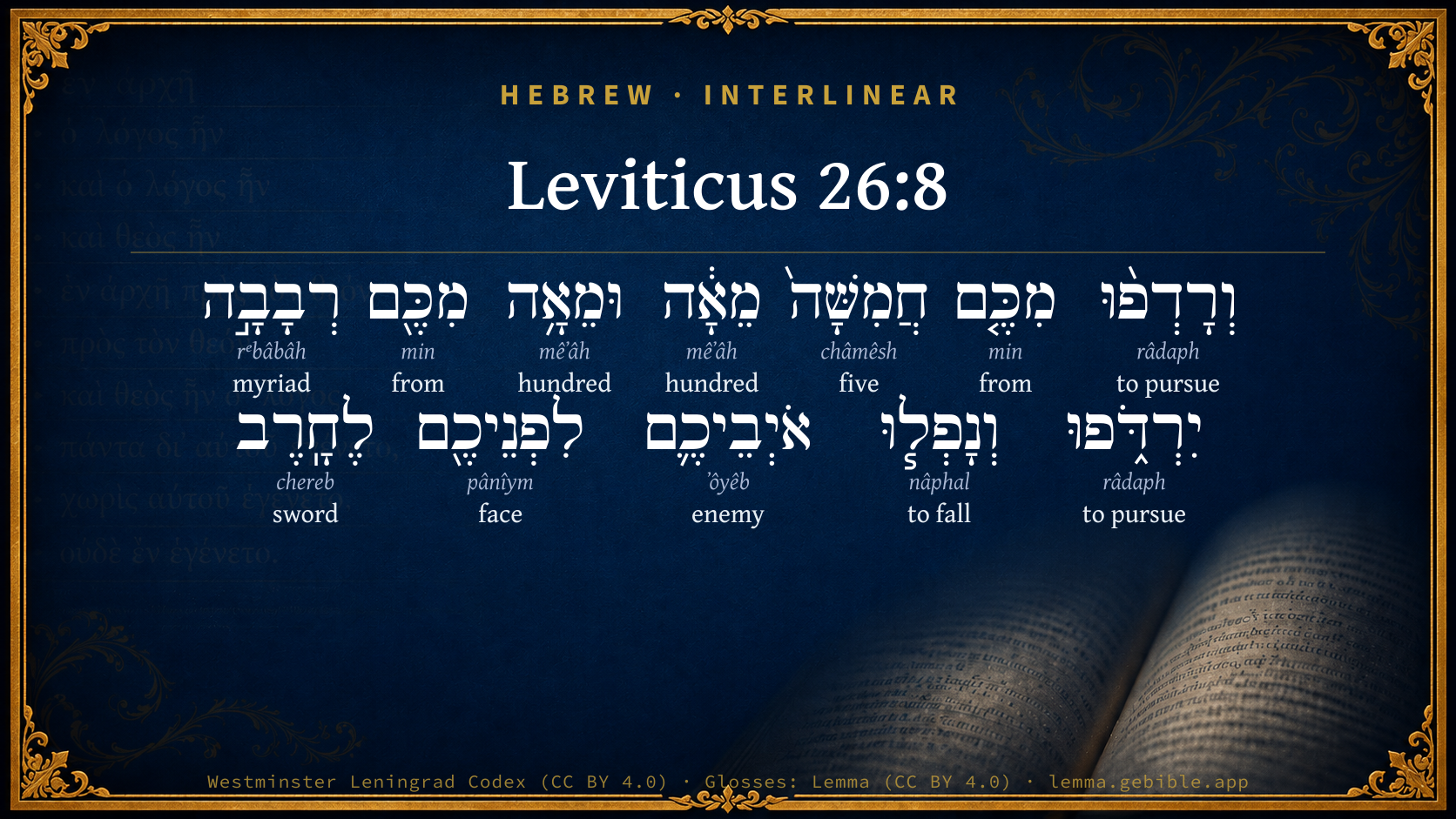
Leviticus 26:8

Hebrew (Westminster Leningrad Codex) Leviticus 26:8 appears in the Hebrew Old Testament. The text above is from the Westminster Leningrad Codex. Each word links to its Strong’s number, a concise gloss, and parsing drawn from the Open Scriptures Hebrew Bible morphology. Click any word for its full Brown-Driver-Briggs (BDB) entry.
Download image
Cite this verse

Leviticus 26:8 (World English Bible). Public Domain. Lemma interlinear Bible study tool, https://lemma.gebible.app/v/leviticus/26/8.

Show BibTeX & RIS
BibTeX
RIS
English Translation
Five of you shall chase a hundred, and a hundred of you shall chase ten thousand; and your enemies shall fall before you by the sword.
World English Bible · Public Domain
Download a study sheet

One document with this verse’s original text, its word-by-word gloss line, the meaning frame, cross-references with their text, attributed commentary, and full source and license credits — printable, and it pastes into notes with its structure intact.

This verse Autodidact and up

Study sheet (.html) Plain text (.txt)

A passage Seminary Student

Up to 50 verses in one chapter. A passage sheet keeps up to 6 commentary sources and 12 cross-references per verse, in the order this page ranks them, and says so on the sheet whenever that leaves anything out. Ask for a single verse and you get the Autodidact verse sheet above.

Everything on this page stays free to read, with no account — the sheet is a download of what is already on screen, not access to it.

Want to remove ads? Support Godless Engineer
Compare translations 3

The same verse in 3 English versions, stacked beneath the original-language interlinear above. Click any original word for its lexicon entry.

Each is an independent rendering of the whole verse — the interlinear is not word-aligned to these translations.

Highlighted words mark where these versions differ — a whole-verse word diff, not a word-by-word alignment.

  • World English Bible Public Domain
    Five of you shall chase a hundred, and a hundred of you shall chase ten thousand; and your enemies shall fall before you by the sword.
  • King James Version Public Domain
    And five of you shall chase an hundred, and an hundred of you shall put ten thousand to flight: and your enemies shall fall before you by the sword.
  • unfoldingWord Literal Text CC BY-SA 4.0
    And five from you will pursue a hundred, and a hundred from you will pursue ten thousand, and your enemies will fall to your faces to the sword.

unfoldingWord Literal Text — © unfoldingWord, licensed CC BY-SA 4.0. Word-aligned USFM3 via Door43 (git.door43.org/unfoldingWord/en_ult).

Versions to compare (up to 4)

3 of 4 selected

Show all 18 translations

Every available English version of this verse, each an independent rendering of the whole verse.

  • World English Bible Public Domain
    Five of you shall chase a hundred, and a hundred of you shall chase ten thousand; and your enemies shall fall before you by the sword.
  • Berean Standard Bible Public Domain
    Five of you will pursue a hundred, and a hundred of you will pursue ten thousand, and your enemies will fall by the sword before you.
  • Majority Standard Bible Public Domain
    Five of you will pursue a hundred, and a hundred of you will pursue ten thousand, and your enemies will fall by the sword before you.
  • King James Version Public Domain
    And five of you shall chase an hundred, and an hundred of you shall put ten thousand to flight: and your enemies shall fall before you by the sword.
  • American Standard Version (1901) Public Domain
    And five of you shall chase a hundred, and a hundred of you shall chase ten thousand; and your enemies shall fall before you by the sword.
  • Revised Version (1885) Public Domain
    And five of you shall chase an hundred, and an hundred of you shall chase ten thousand: and your enemies shall fall before you by the sword.
  • Geneva Bible (1599) Public Domain
    And fiue of you shall chase an hundreth, and an hundreth of you shall put ten thousande to flight, and your enemies shall fall before you vpon the sworde.
  • Douay-Rheims (1899) Public Domain
    Five of yours shall pursue a hundred others, and a hundred of you ten thousand: your enemies shall fall before you by the sword.
  • Young's Literal Translation Public Domain
    and five of you have pursued a hundred, and a hundred of you do pursue a myriad; and your enemies have fallen before you by the sword.
  • Literal Standard Version CC BY-SA 4.0
    and five of you have pursued one hundred, and one hundred of you pursue a myriad; and your enemies have fallen before you by the sword.
  • Unlocked Literal Bible CC BY-SA 4.0
    Five of you will chase away a hundred, and a hundred of you will chase ten thousand; your enemies will fall before you by the sword.
  • unfoldingWord Literal Text CC BY-SA 4.0
    And five from you will pursue a hundred, and a hundred from you will pursue ten thousand, and your enemies will fall to your faces to the sword.
  • Darby Bible Public Domain
    and five of you shall chase a hundred, and a hundred of you shall put ten thousand to flight; and your enemies shall fall beside you by the sword.
  • World Messianic Bible Public Domain
    Five of you shall chase a hundred, and a hundred of you shall chase ten thousand; and your enemies shall fall before you by the sword.
  • Webster's Bible Public Domain
    And five of you shall chase a hundred, and a hundred of you shall put ten thousand to flight: and your enemies shall fall before you by the sword.
  • Free Bible Version CC BY-SA 4.0
    Five of you will kill one hundred, and one hundred of you will kill ten thousand. You will destroy your enemies.
  • Bible in Basic English Public Domain
    Then five of you will put to flight a hundred, and a hundred of you will put to flight ten thousand, and all who are against you will be put to death by your swords.
  • JPS Tanakh (1917) Public Domain
    And five of you shall chase a hundred, and a hundred of you shall chase ten thousand; and your enemies shall fall before you by the sword.

Literal Standard Version (2020), Covenant Press — licensed CC BY-SA 4.0. Text via the HelloAO Bible API (eBible.org). Unlocked Literal Bible (unfoldingWord) — licensed CC BY-SA 4.0. Text via the HelloAO Bible API (eBible.org). unfoldingWord Literal Text — © unfoldingWord, licensed CC BY-SA 4.0. Word-aligned USFM3 via Door43 (git.door43.org/unfoldingWord/en_ult). Free Bible Version, Dr. Jonathan Gallagher — licensed CC BY-SA 4.0. Text via the HelloAO Bible API (eBible.org).

Word by word

More ways to search: Search by grammar → Find every occurrence → Compare this word →

Practice this passage: Drill this verse → Learn its vocabulary →

רְבָבָ֣ה
rᵉbâbâh
H7233
“myriad”
Noun, Common, Feminine, Singular, Absolute
Part of Speech
Noun
Type
Common
Gender
Feminine
Number
Singular
State
Absolute
Full BDB Definition

Origin: from H7231

TWOT: 2099d

multitude, myriad, ten thousand
  1. וְרָדְפ֨וּ râdaph H7291 “and · to pursue” Conjunction + Verb, Qal, Sequential Perfect, 3rd Person, Common, Plural
  2. מִכֶּ֤ם min H4480 “from · you” Preposition + Suffix, Personal, 2nd Person, Masculine, Plural
  3. חֲמִשָּׁה֙ châmêsh H2568 “five” Adjective, Cardinal number, Masculine, Singular, Absolute
  4. מֵאָ֔ה mêʼâh H3967 “hundred” Adjective, Cardinal number, Both, Singular, Absolute
  5. וּמֵאָ֥ה mêʼâh H3967 “and · hundred” Conjunction + Adjective, Cardinal number, Both, Singular, Absolute
  6. מִכֶּ֖ם min H4480 “from · you” Preposition + Suffix, Personal, 2nd Person, Masculine, Plural
  7. יִרְדֹּ֑פוּ râdaph H7291 “to pursue” Verb, Qal, Imperfect, 3rd Person, Masculine, Plural
  8. וְנָפְל֧וּ nâphal H5307 “and · to fall” Conjunction + Verb, Qal, Sequential Perfect, 3rd Person, Common, Plural
  9. אֹיְבֵיכֶ֛ם ʼôyêb H341 “enemy · you” Verb, Qal, Participle Active, Masculine, Plural, Construct + Suffix, Personal, 2nd Person, Masculine, Plural
  10. לִפְנֵיכֶ֖ם pânîym H6440 “to/for · face(s) · your” Preposition + Noun, Common, Both, Plural, Construct + Suffix, Personal, 2nd Person, Masculine, Plural
  11. לֶחָֽרֶב chereb H2719 “to/for the · sword” Preposition, Determined + Noun, Common, Feminine, Singular, Absolute

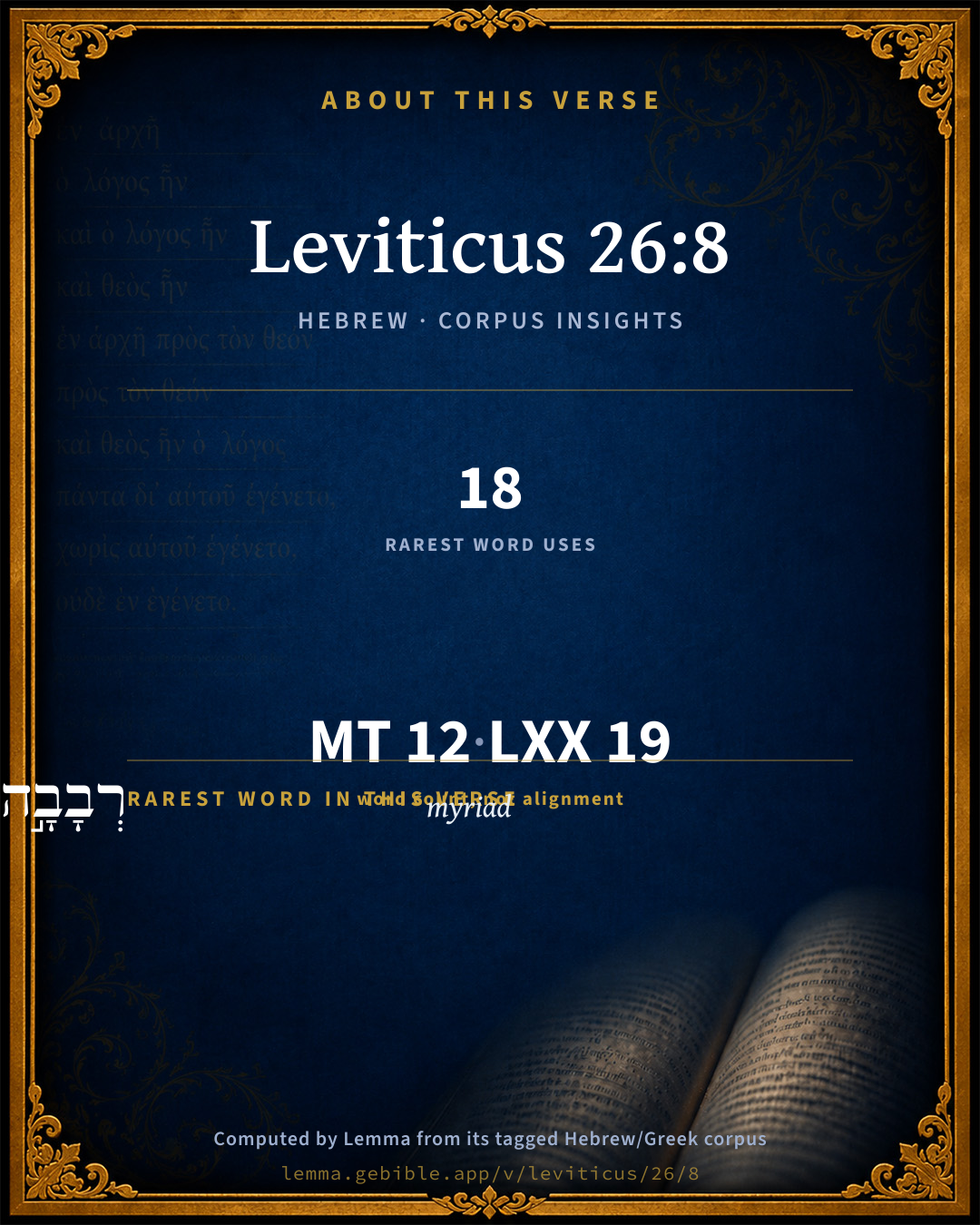
About this verse

These counts appear in no published source. They are computed here, from the morphology-tagged text and Lemma’s own curated glosses. What Lemma adds →

12
words
9
distinct lemmas
Pentateuch
section

Notable vocabulary

The rarest word here is רְבָבָ֣ה myriad H7233 — appearing just 18 times in the whole Hebrew Bible.

Shared distinctive vocabulary

רְבָבָ֣ה myriad H7233 occurs in 16 verses of the Hebrew Bible. Also found in:

Grammatical profile

  • 4 verbs
  • 3 nouns
  • 3 adjectives
  • 2 prepositions

Verb forms

  • וְרָדְפ֨וּ Qal · Sequential Perfect
  • יִרְדֹּ֑פוּ Qal · Imperfect
  • וְנָפְל֧וּ Qal · Sequential Perfect
  • אֹיְבֵיכֶ֛ם Qal · Participle Active

Repetition

Words recur within this verse — often emphatic in Hebrew:

  • וְרָדְפ֨וּ to pursue H7291 ×2
  • מֵאָ֔ה hundred H3967 ×2
  • מִכֶּ֤ם from H4480 ×2

Hebrew & Septuagint length

In English translation the verse runs 26 words from the Hebrew and 28 from the Septuagint (LXX English) — closely comparable.

A rough comparison of the two English renderings, which tokenize alike — not a word-level alignment.

Word counts can differ between the Hebrew and the Greek without any difference in meaning — e.g. the Hebrew direct-object marker אֵת has no separate Greek word, and Greek often adds the article ὁ.

In the original languages it is 12 Hebrew tokens and 19 Greek tokens — but the two are counted differently (Hebrew bundles its prefixes and suffixes into one token; the Greek is in lemma form), so that isn’t a like-for-like length.

Cross-references

10

Topical passages linked to Leviticus 26:8 in the Treasury of Scripture Knowledge — connected by theme and wording, ordered by reader-vote popularity; previews shown in the World English Bible.

  • Joshua 23:10 One man of you shall chase a thousand; for Yahweh your God, he it is who fights for you, as he spoke to you.
  • Deuteronomy 28:7 Yahweh will cause your enemies who rise up against you to be struck before you: they shall come out against you one way, and shall flee before you seven ways.
  • Deuteronomy 32:30 How should one chase a thousand, Two put ten thousand to flight, Except their Rock had sold them, Yahweh had delivered them up?
  • Numbers 14:9 Only don't rebel against Yahweh, neither fear the people of the land; for they are bread for us: their defense is removed from over them, and Yahweh is with us: don't fear them.
  • Judges 7:19–21 So Gideon, and the hundred men who were with him, came to the outermost part of the camp in the beginning of the middle watch, when they had but newly set the watch: and they blew the trumpets, and broke in pieces the pitchers that were in their hands.
  • 1 Chronicles 11:20 Abishai, the brother of Joab, he was chief of the three; for he lifted up his spear against three hundred and killed them, and had a name among the three.
  • 1 Samuel 14:6–16 Jonathan said to the young man who bore his armor, Come, and let us go over to the garrison of these uncircumcised: it may be that Yahweh will work for us; for there is no restraint to Yahweh to save by many or by few.
  • 1 Chronicles 11:11 This is the number of the mighty men whom David had: Jashobeam, the son of a Hachmonite, the chief of the thirty; he lifted up his spear against three hundred and killed them at one time.
  • Psalms 81:14–15 I would soon subdue their enemies, And turn my hand against their adversaries.
  • 1 Samuel 17:45–52 Then said David to the Philistine, You come to me with a sword, and with a spear, and with a javelin: but I come to you in the name of Yahweh of hosts, the God of the armies of Israel, whom you have defied.

Cross-references courtesy of OpenBible.info (CC BY 4.0).

Hebrew and Greek witnesses Masoretic Hebrew ↔ Greek Septuagint

The same verse in the two great witnesses to the Old Testament, shown verse-for-verse.

These are two independent witnesses, not word-aligned to each other, and the Septuagint is shown in lemma (dictionary) form.

Hebrew Leviticus 26:8 Masoretic · Westminster Leningrad Codex

וְרָדְפ֨וּ מִכֶּ֤ם חֲמִשָּׁה֙ מֵאָ֔ה וּמֵאָ֥ה מִכֶּ֖ם רְבָבָ֣ה יִרְדֹּ֑פוּ וְנָפְל֧וּ אֹיְבֵיכֶ֛ם לִפְנֵיכֶ֖ם לֶחָֽרֶב

Five of you shall chase a hundred, and a hundred of you shall chase ten thousand; and your enemies shall fall before you by the sword.

World English Bible · Public Domain

Greek LXX Leviticus 26:8 Septuagint · lemma form

καί διώκω ἐκ σύ πέντε ἑκατόν καί ἑκατόν σύ διώκω μυριάς καί πίπτω ὁ ἐχθρός σύ ἐναντίον σύ μάχαιρα

And five of you shall chase one hundred, and one hundred of you shall chase tens of thousands; and your enemies shall fall before you by the sword.

LXX2012 (modern English Septuagint) · Public Domain

Hebrew: Westminster Leningrad Codex (CC BY 4.0). Greek: Septuagint (public domain); English from LXX2012 (modern English Septuagint) (Public Domain). How the Septuagint differs from the Hebrew →

Targum (Aramaic paraphrase)

2

The Targum is the ancient Jewish Aramaic paraphrase of the Hebrew Scriptures — an interpretive translation, not the Hebrew text itself. Onkelos (literal) and Pseudo-Jonathan (expansive) render the Torah, and Jonathan the Prophets. Coverage is partial: where no permissively-licensed English translation exists for a verse, only the Aramaic is shown. This is verse-level text, not a word-by-word alignment to the Hebrew.

  1. Targum Onkelos Torah (Genesis–Deuteronomy)
    וְיִרְדְפוּן מִנְכוֹן חַמְשָׁא מְאָה וּמְאָה מִנְכוֹן לְרִבּוֹתָא יֵיעִירְקוּן וְיִפְּלוּן בַּעֲלֵי דְבָבֵיכוֹן קֳדָמֵיכוֹן לְחַרְבָּא

    (no public-domain English translation for this verse)

    Targum Onkelos — Aramaic: “Onkelos Genesis” (public domain); “Onkelos Exodus” (public domain); “Onkelos Leviticus” (public domain); “Onkelos Numbers” (public domain); “Onkelos Deuteronomy” (public domain). English: “Sefaria Community Translation” (CC0 1.0 (public-domain dedication)); “J.W. Etheridge. The Targums of Onkelos and Jonathan Ben Uzziel on the Pentateuch. London: Longmans, Green, 1862” (public domain). Text via Sefaria.

  2. Targum Pseudo-Jonathan Torah (Genesis–Deuteronomy)
    וְיִרְדְפוּן מִנְכוֹן חַמְשָׁא לְמָאתָא וּמָאתָא מִנְכוֹן לְרִבְבוּתָא יַעֲרִיקוּן וְיִפְּלוּן בַּעֲלֵי דְבָבֵיכוֹן קֳדָמֵיכוֹן תְּבִירֵי חֶרֶב

    And five of you will chase a hundred, and a hundred of you put a myriad to flight, and your adversaries shall fall before you, broken with the sword.

    Targum Pseudo-Jonathan — Aramaic: “Targum Jonathan on Genesis” (public domain); “Targum Jonathan on Exodus” (public domain); “Targum Jonathan on Leviticus” (public domain); “Targum Jonathan on Numbers” (public domain); “Targum Jonathan on Deuteronomy” (public domain). English: “The Targum of Jonathan ben Uzziel, trans. J. W. Etheridge, London, 1862” (public domain). Text via Sefaria.

Commentary

Notes on Leviticus 26:8 from classic Christian and Jewish commentators (each source and its license shown beneath its notes). The classic Christian expositions comment on the surrounding passage and are grouped to its opening verse, so a note may address several verses; the Jewish commentaries on the Tanakh (Rashi and others) are per-verse, so they appear only where the commentator wrote on this verse.

Lemma curates 59 commentaries, every one of them public domain or Creative Commons licensed, each selected and text-cleaned for this edition rather than reprinted as found. About our sources →

Trapp's Complete Commentary

John Trapp

Lev 26:8 And five of you shall chase an hundred, and an hundred of you shall put ten thousand to flight: and your enemies shall fall before you by the sword.

Ver. 8. And five of you.] God strengthens or weakens the arm of either party, {Eze 30:24} strikes a panic terror oft, as into those Aramites that heard a hurry noise in the air, made by the angels likely, and fled.

John Trapp, A Commentary or Exposition upon All the Books of the Old and New Testament (1647–1656) — public domain. Text from a community e-Sword module.

The Biblical Illustrator

Joseph S. Exell

Lev_26:8

And five of you shall chase an hundred.

Panic among soldiers

During the Italian war a panic occurred in a whole reserve corps darmee of the French forces, and the account is given us by the Hen. Mr. R-- , the editor of a prominent American journal, who was there, partook of the fright, and ran himself with the fugitives. Five Austrians, whose retreat was cut off, rode rapidly into the village where the reserve forces were stationed, with the design of giving themselves up. The frightened inhabitants cried out, The Austrians are coming! and ran for their lives. The soldiers followed suit--horse, foot, and dragoons, pell-mell, without waiting to take care of the wounded, ran fifteen miles without stopping. One wounded French general offered a large reward to be carried to a place of safety. Mr. R--confesses to have run ten miles on foot before he stopped. A panic among the loyal troops in the first battle of Bulls Run in the American civil conflict, if not the cause of their defeat, greatly aggravated the disasters of the battle. (Lowrie.)

The Biblical Illustrator, edited by Joseph S. Exell (c. 1880s–1900s) — public domain. Text from a community e-Sword module.

Joseph Benson's Commentary

Lev 26:8-9. Five of you shall chase a hundred — A proverbial expression, signifying that a small number of them should be an over-match for many of their enemies. I will establish my covenant — Will actually perform all that I have promised in my covenant made with you.

Joseph Benson's Commentary on the Old and New Testaments (1811–1818) — public domain. Text from a community e-Sword module.

Ellicott's Commentary for English Readers

(8) And five of you shall chase an hundred.—This is a proverbial saying, corresponding to our phrase “A very small number, or a mere handful, shall be more than a match for a whole regiment.” The same phrase, with different proportions to the numbers, occurs in other parts of the Bible (Deu_32:30; Jos_23:10; Isa_30:17).

A Bible Commentary for English Readers, edited by Charles John Ellicott (1878–1897) — public domain. Text from a community e-Sword module.

John Gill's Exposition

For I will have respect unto you,.... Look at them with delight and pleasure, and with a careful eye on them, watch over them to do them good, and protect them from all evil; or turn himself to them from all others, having a particular regard for them and special care of them:

and make you fruitful and multiply you; increase their number, as he did in Egypt, even amidst all their afflictions; and much more might they expect this blessing in the land of Canaan, when settled there, which is the original blessing of mankind, see Gen 1:28,

and establish my covenant with you; not the new covenant spoken of in Jer 31:31; as Jarchi and other Jewish writers (l) suggest; for that was not to take place but in future time, under the Gospel dispensation; but rather the covenant made with them at Sinai, though perhaps it chiefly respects the covenant made with their ancestors concerning multiplication of their seed as the stars of heaven and the sand of the sea, Gen 15:5, since it follows upon the promise of an increase of them.

(l) Torat Cohenim, apud Yalkut, par. 1. fol. 196. 3.

John Gill's Exposition of the Whole Bible (1746–1763) — public domain (CC PDM 1.0). Text via the HelloAO Bible API.

Haydock's Catholic Bible Commentary

Five. Thus Gedeon’s 300 men put to flight the great army of the Madianites; (Judges vii. 22,) and the Machabees destroyed vast numbers with a small force.

George Leo Haydock (1774–1849), Haydock's Catholic Family Bible and Commentary, 1859 edition — public domain. Excludes Psalms (Douay-Rheims chapter numbering differs from Protestant) and Deuterocanonical books (Catholic canon only).

Matthew Poole's English Annotations

Five of you, i.e. a small number; a certain number for an uncertain.

Matthew Poole's English Annotations on the Holy Bible (1683–1685) — public domain. Text from a community e-Sword/MySword module.

Whedon's Commentary on the Bible

Daniel D. Whedon

8. Five… shall chase a hundred — So great would be the prestige of the Hebrew name that a panic would seize the myriads of their foes on the battle field when confronted by a household of Israelites. This was true of the Canaanites when the spies visited Jericho, (see Jos_2:9-11, note,) and of the hosts of Midian who decamped in confusion before Gideon and his select band of three hundred men. See also 2Sa_23:8; 2Sa_23:18; 1Ch_11:18. Many are the parallel instances in Christian history in which hosts of foes to Christ have been overcome by simple faith in him exercised by a few believers.

A hundred… ten thousand — The ratio of efficiency increases with the number. Of five, each one routs twenty; of a hundred, each puts to flight a hundred. At this rate an aggressive Christianity would soon conquer the whole world.

By the sword — They would not be delivered from foreign wars, but they would conquer the enemy in his own country, since the sword should not go through their land.

Daniel D. Whedon (gen. ed.), Commentary on the Old and New Testaments (1874–1909) — public domain. Text from a community e-Sword module.

The Pulpit Commentary

And five of you shall chase a hundred. Cf. Jos_23:10, "One man of you shall chase a thousand." For examples, see Jud_1:3:31 15:15 1Sa_14:6-16 2Sa_23:8.

The Pulpit Commentary (1880–1919), ed. H.D.M. Spence-Jones & Joseph S. Exell — public domain. Text from a community e-Sword module.

John Wesley's Explanatory Notes

Five - A small number; a certain number for an uncertain.

John Wesley, Explanatory Notes Upon the Whole Bible (1754–1765) — public domain. Text via the GEBible commentary corpus.

Rashi

Rabbi Shlomo Yitzchaki (Rashi)

ורדפו מכם [AND FIVE] OF YOU SHALL PURSUE [A HUNDRED] — five of the weakest among you — and not alone of the most robust among you (Sifra, Bechukotai, Chapter 2 4).

‎חמישה מאה ומאה מכם רבבה FIVE [OF YOU SHALL PURSUE] A HUNDRED AND A HUNDRED… TEN THOUSAND — But is this the right proportion? Surely it should have stated only “and a hundred of you shall pursue two thousand (and not ten thousand)!? But the explanation is: a few who fulfill the commandments of the Torah cannot compare with the many who fulfill the commandments of the Torah (i. e. the greater the group of those loyal to the Torah, the greater is the morale and, under God’s blessing, the physical strength of each individual belonging to the group) (Sifra, Bechukotai, Chapter 2 4).

'ונפלו איביכם וגו AND YOUR ENEMIES SHALL FALL etc. — The repetition of this promise already expressed in v. 7 suggests that they will fall before you in a supernatural way (lit., not in the way of the world) (Sifra, Bechukotai, Chapter 2 4).

Rashi on the Tanakh — English translations: “The Judaica Press complete Tanach with Rashi, translated by A. J. Rosenberg” (CC BY 4.0); “Pentateuch with Rashi's commentary by M. Rosenbaum and A.M. Silbermann, 1929-1934” (public domain); “The Metsudah Tanach series, Lakewood, N.J” (CC BY 4.0); and “The Book of Joshua, Metsudah Publications, 1997” (CC BY 4.0). Text via Sefaria.

Ramban (Nachmanides)

Rabbi Moshe ben Nachman (Ramban / Nachmanides)

AND YOUR ENEMIES SHALL FALL BEFORE YOU BY THE SWORD. He assured them at first that they would chase their enemies and that they would fall by their sword, and then He stated again by way of repetition [in the verse before us], and your enemies shall fall before you by the sword, in order to give them fortitude of heart and strength so that five [of them would not be afraid] to pursue a hundred. He [furthermore promised that He] would put faintness into the heart of their enemies, so that a hundred would [in fact] flee before five, and would all fall by the sword of the five, for it would be possible that they [a hundred people] would flee because of the sword and because of their fear, but that they would not be able to kill them by the sword because of their few numbers [therefore He mentioned specifically that they would be able to put them to the sword too]. Rabbi Abraham ibn Ezra has said that this repetition [in our verse] means that they [the enemies] will fall continually, time after time, without regaining [their strength].

Ramban (Nachmanides) on the Tanakh — English translation: “Commentary on the Torah by Ramban (Nachmanides). Translated and annotated by Charles B. Chavel. New York, Shilo Pub. House, 1971-1976” (CC BY 4.0). Text via Sefaria.

Lesson kit

Teaching starters — assembled from the data on this page, not authored interpretation. Every prompt links to the verse data it draws on. Edit before teaching.

Leviticus, in the Pentateuch, opens this verse with 12 words (9 distinct Hebrew lemmas). Its most distinctive word is rᵉbâbâh (“myriad”). A historical commentator’s framing appears above. Read the whole chapter for the surrounding context.

Discussion questions

  1. The word rᵉbâbâh carries the sense “myriad.” How does it shape the verse?
  2. Genesis 24:60 shares the word «myriad» with this verse. How do the two illuminate each other?
  3. “to pursue” occurs 2× in this one verse. What is the effect of the repetition?
  4. These translations render this verse differently; the difference is in the English rendering, not the original. What questions does that raise?
  5. The verb «וְרָדְפ֨וּ» is Qal Sequential Perfect. How does its form color the action?
  6. Reading how Trapp's Complete Commentary and The Biblical Illustrator read this verse, where do the two commentators agree and where do they part?

Things to notice

Reading settings

Reading text

Shown beneath each verse's original-language words.

Old Testament
Old Testament edition

Read the OT as the Masoretic Hebrew (MT) or the Greek Septuagint (LXX).

English shown for the Greek Septuagint (in the Hebrew ↔ Greek comparison).

Comparing translations? Open the Compare panel on any verse page to stack up to four side by side.