
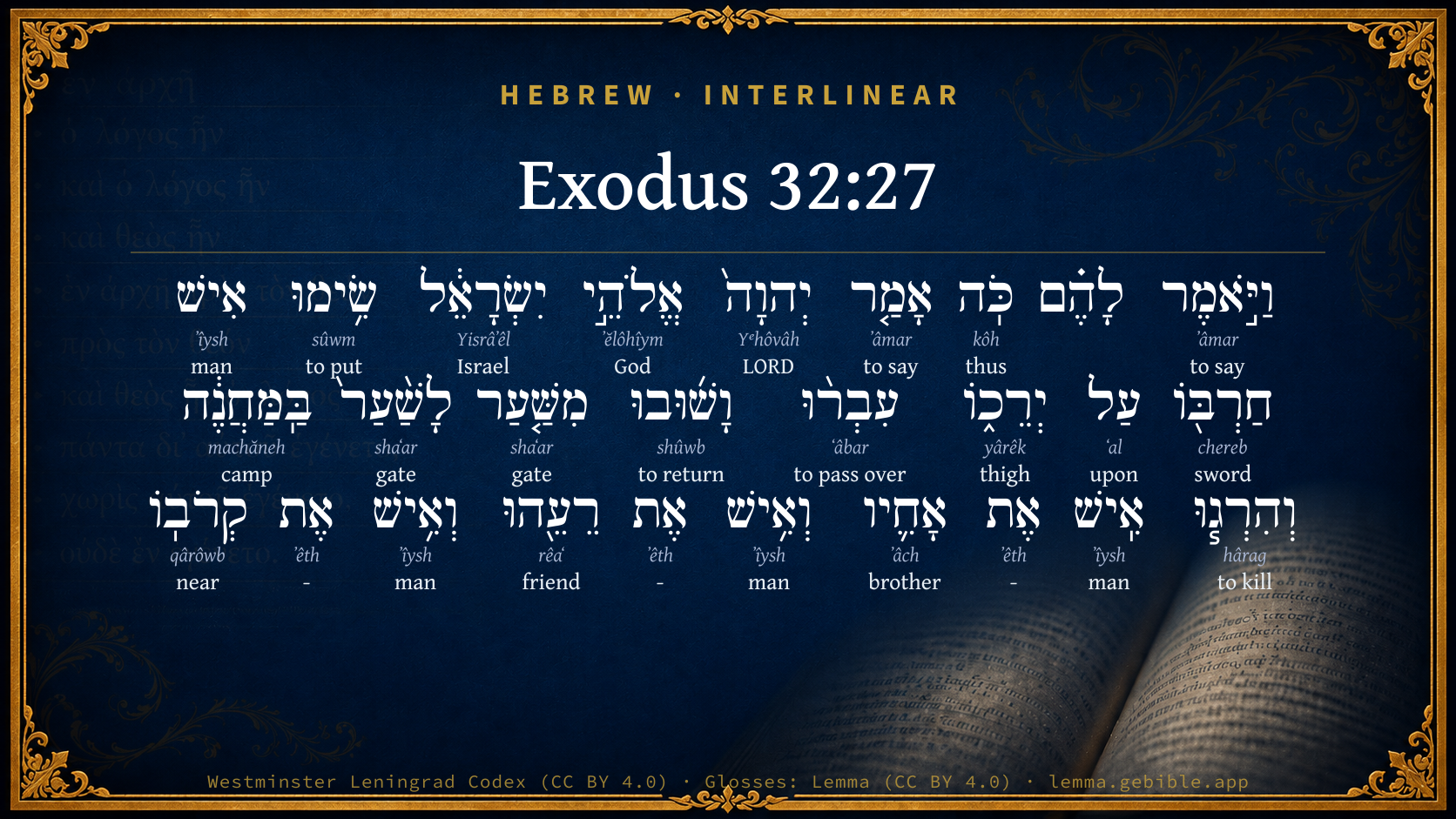
Exodus 32:27

Hebrew (Westminster Leningrad Codex) Exodus 32:27 appears in the Hebrew Old Testament. The text above is from the Westminster Leningrad Codex. Each word links to its Strong’s number, a concise gloss, and parsing drawn from the Open Scriptures Hebrew Bible morphology. Click any word for its full Brown-Driver-Briggs (BDB) entry.
Download image
Cite this verse

Exodus 32:27 (World English Bible). Public Domain. Lemma interlinear Bible study tool, https://lemma.gebible.app/v/exodus/32/27.

Show BibTeX & RIS
BibTeX
RIS
English Translation
He said to them, "Thus says Yahweh, the God of Israel, 'Every man put his sword on his thigh, and go back and forth from gate to gate throughout the camp, and every man kill his brother, and every man his companion, and every man his neighbor."
World English Bible · Public Domain
Download a study sheet

One document with this verse’s original text, its word-by-word gloss line, the meaning frame, cross-references with their text, attributed commentary, and full source and license credits — printable, and it pastes into notes with its structure intact.

This verse Autodidact and up

Study sheet (.html) Plain text (.txt)

A passage Seminary Student

Up to 50 verses in one chapter. A passage sheet keeps up to 6 commentary sources and 12 cross-references per verse, in the order this page ranks them, and says so on the sheet whenever that leaves anything out. Ask for a single verse and you get the Autodidact verse sheet above.

Everything on this page stays free to read, with no account — the sheet is a download of what is already on screen, not access to it.

Want to remove ads? Support Godless Engineer
Compare translations 3

The same verse in 3 English versions, stacked beneath the original-language interlinear above. Click any original word for its lexicon entry.

Each is an independent rendering of the whole verse — the interlinear is not word-aligned to these translations.

Highlighted words mark where these versions differ — a whole-verse word diff, not a word-by-word alignment.

  • World English Bible Public Domain
    He said to them, "Thus says Yahweh, the God of Israel, 'Every man put his sword on his thigh, and go back and forth from gate to gate throughout the camp, and every man kill his brother, and every man his companion, and every man his neighbor."
  • King James Version Public Domain
    And he said unto them, Thus saith the LORD God of Israel, Put every man his sword by his side, and go in and out from gate to gate throughout the camp, and slay every man his brother, and every man his companion, and every man his neighbor.
  • unfoldingWord Literal Text CC BY-SA 4.0
    And he said to them, “Thus says Yahweh, the God of Israel: ‘Each man put his sword on his side. Pass through and return from gate to gate in the camp and kill each his brother and each his companion and each his neighbor.’”

unfoldingWord Literal Text — © unfoldingWord, licensed CC BY-SA 4.0. Word-aligned USFM3 via Door43 (git.door43.org/unfoldingWord/en_ult).

Versions to compare (up to 4)

3 of 4 selected

Show all 18 translations

Every available English version of this verse, each an independent rendering of the whole verse.

  • World English Bible Public Domain
    He said to them, "Thus says Yahweh, the God of Israel, 'Every man put his sword on his thigh, and go back and forth from gate to gate throughout the camp, and every man kill his brother, and every man his companion, and every man his neighbor."
  • Berean Standard Bible Public Domain
    He told them, “This is what the LORD, the God of Israel, says: ‘Each of you men is to fasten his sword to his side, go back and forth through the camp from gate to gate, and slay his brother, his friend, and his neighbor.’”
  • Majority Standard Bible Public Domain
    He told them, “This is what the LORD, the God of Israel, says: ‘Each of you men is to fasten his sword to his side, go back and forth through the camp from gate to gate, and slay his brother, his friend, and his neighbor.’”
  • King James Version Public Domain
    And he said unto them, Thus saith the LORD God of Israel, Put every man his sword by his side, and go in and out from gate to gate throughout the camp, and slay every man his brother, and every man his companion, and every man his neighbor.
  • American Standard Version (1901) Public Domain
    And he said unto them, Thus saith Jehovah, the God of Israel, Put ye every man his sword upon his thigh, and go to and fro from gate to gate throughout the camp, and slay every man his brother, and every man his companion, and every man his neighbor.
  • Revised Version (1885) Public Domain
    And he said unto them, Thus saith the LORD, the God of Israel, Put ye every man his sword upon his thigh, and go to and fro from gate to gate throughout the camp, and slay every man his brother, and every man his companion, and every man his neighbour.
  • Geneva Bible (1599) Public Domain
    Then he said vnto them, Thus sayth ye Lord God of Israel, Put euery man his sworde by his side: go to and from, from gate to gate, through the hoste, and slay euery man his brother, and euery man his companion, and euery man his neighbour.
  • Douay-Rheims (1899) Public Domain
    And he said to them: Thus saith the Lord God of Israel: Put every man his sword upon his thigh: go, and return from gate to gate through the midst of the camp, and let every man kill his brother, and friend, and neighbour.
  • Young's Literal Translation Public Domain
    and he saith to them, `Thus said Jehovah, God of Israel, Put each his sword by his thigh, pass over and turn back from gate to gate through the camp, and slay each his brother, and each his friend, and each his relation.'
  • Literal Standard Version CC BY-SA 4.0
    and he says to them, “Thus said YHWH, God of Israel: Each put his sword by his thigh, pass over and turn back from gate to gate through the camp, and each slay his brother, and each his friend, and each his relation.”
  • Unlocked Literal Bible CC BY-SA 4.0
    He said to them, “Yahweh, the God of Israel, says this: 'Let each man fasten his sword on his side and go back and forth from entrance to entrance throughout the camp, and kill his brother, his companion, and his neighbor.'”
  • unfoldingWord Literal Text CC BY-SA 4.0
    And he said to them, “Thus says Yahweh, the God of Israel: ‘Each man put his sword on his side. Pass through and return from gate to gate in the camp and kill each his brother and each his companion and each his neighbor.’”
  • Darby Bible Public Domain
    And he said to them, Thus saith Jehovah, the God of Israel: Put every man his sword upon his hip; go and return from gate to gate through the camp, and slay every man his brother, and every man his friend, and every man his neighbour.
  • World Messianic Bible Public Domain
    He said to them, “The LORD, the God of Israel, says, ‘Every man put his sword on his thigh, and go back and forth from gate to gate throughout the camp, and every man kill his brother, and every man his companion, and every man his neighbor.’”
  • Webster's Bible Public Domain
    And he said to them, Thus saith the LORD God of Israel, Put every man his sword by his side, and go in and out from gate to gate throughout the camp, and slay every man his brother, and every man his companion, and every man his neighbor.
  • Free Bible Version CC BY-SA 4.0
    Moses told them, “This is what the Lord, the God of Israel says: Each of you strap on a sword. Then go all through the camp from one end to the other and kill your brothers, friends, and neighbors.”
  • Bible in Basic English Public Domain
    And he said to them, This is the word of the Lord, the God of Israel: Let every man take his sword at his side, and go from one end of the tents to the other, putting to death his brother and his friend and his neighbour.
  • JPS Tanakh (1917) Public Domain
    And he said unto them: 'Thus saith the LORD, the God of Israel: Put ye every man his sword upon his thigh, and go to and fro from gate to gate throughout the camp, and slay every man his brother, and every man his companion, and every man his neighbour.'

Literal Standard Version (2020), Covenant Press — licensed CC BY-SA 4.0. Text via the HelloAO Bible API (eBible.org). Unlocked Literal Bible (unfoldingWord) — licensed CC BY-SA 4.0. Text via the HelloAO Bible API (eBible.org). unfoldingWord Literal Text — © unfoldingWord, licensed CC BY-SA 4.0. Word-aligned USFM3 via Door43 (git.door43.org/unfoldingWord/en_ult). Free Bible Version, Dr. Jonathan Gallagher — licensed CC BY-SA 4.0. Text via the HelloAO Bible API (eBible.org).

Word by word

More ways to search: Search by grammar → Find every occurrence → Compare this word →

Practice this passage: Drill this verse → Learn its vocabulary →

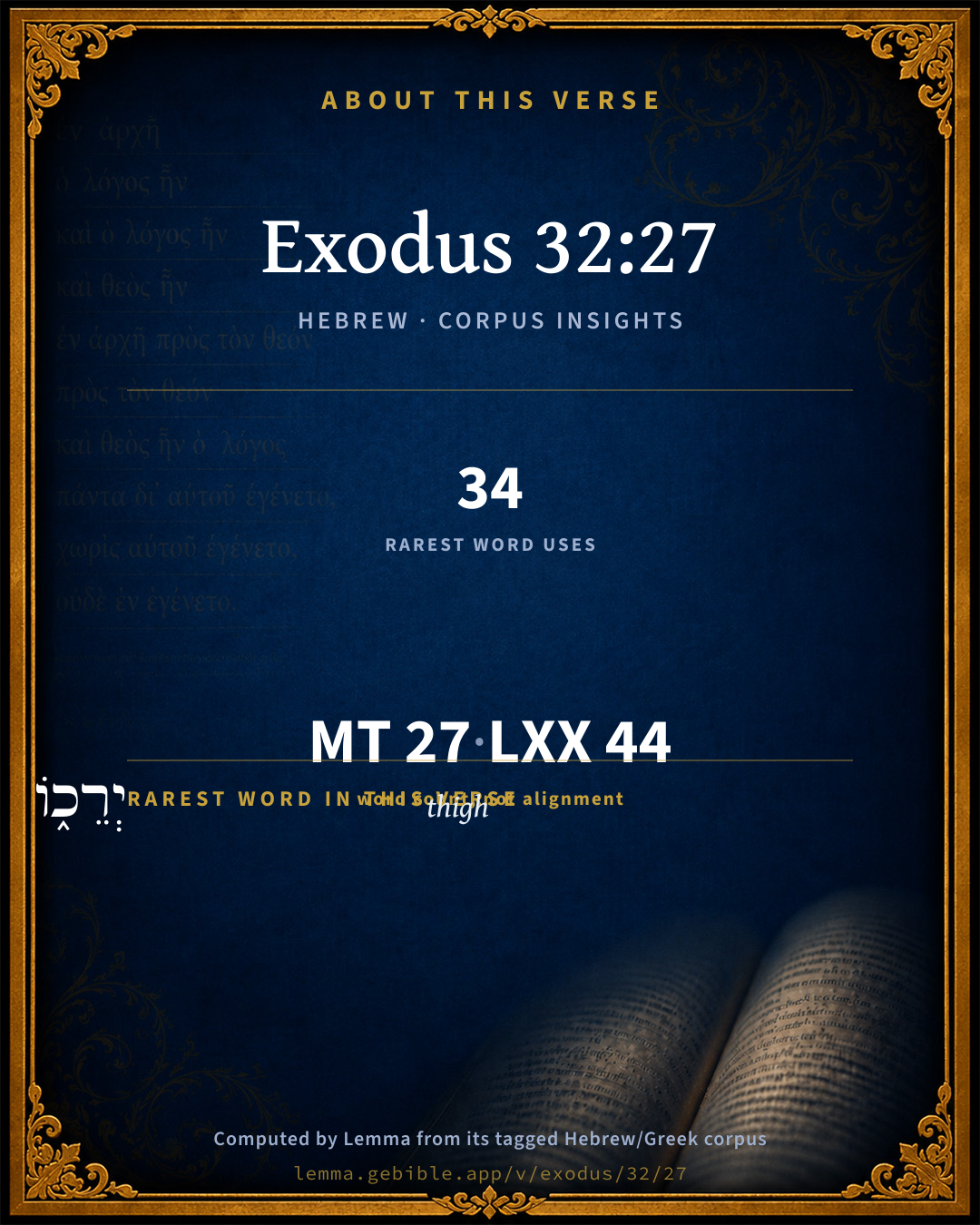
יְרֵכ֑וֹ
yârêk
H3409
“thigh · his”
Noun, Common, Feminine, Singular, Construct + Suffix, Personal, 3rd Person, Masculine, Singular
Part of Speech
Noun
Type
Common
Gender
Feminine
Number
Singular
State
Construct
Full BDB Definition

Origin: from an unused root meaning to be soft

TWOT: 916a

thigh, side, loin, base - thigh - outside of thigh (where sword was worn) - loins (as the seat of procreative power) - side (flank) (of object) - base
  1. וַיֹּ֣אמֶר ʼâmar H559 “and · to say” Conjunction + Verb, Qal, Sequential Imperfect, 3rd Person, Masculine, Singular
  2. כֹּֽה kôh H3541 “thus” Adverb
  3. אָמַ֤ר ʼâmar H559 “to say” Verb, Qal, Perfect, 3rd Person, Masculine, Singular
  4. יְהוָה֙ Yᵉhôvâh H3068 “LORD” Noun, Proper
  5. אֱלֹהֵ֣י ʼĕlôhîym H430 “God(s) of” Noun, Common, Masculine, Plural, Construct
  6. יִשְׂרָאֵ֔ל Yisrâʼêl H3478 “Israel” Noun, Proper
  7. שִׂ֥ימוּ sûwm H7760 “put” Verb, Qal, Imperative, 2nd Person, Masculine, Plural
  8. אִישׁ ʼîysh H376 “man” Noun, Common, Masculine, Singular, Absolute
  9. חַרְבּ֖וֹ chereb H2719 “sword · his” Noun, Common, Feminine, Singular, Construct + Suffix, Personal, 3rd Person, Masculine, Singular
  10. עַל ʻal H5921 “upon” Preposition
  11. עִבְר֨וּ ʻâbar H5674 “pass over” Verb, Qal, Imperative, 2nd Person, Masculine, Plural
  12. וָשׁ֜וּבוּ shûwb H7725 “and · return” Conjunction + Verb, Qal, Imperative, 2nd Person, Masculine, Plural
  13. מִשַּׁ֤עַר shaʻar H8179 “from · gate” Preposition + Noun, Common, Masculine, Singular, Absolute
  14. לָשַׁ֨עַר֙ shaʻar H8179 “to/for the · gate” Preposition, Determined + Noun, Common, Masculine, Singular, Absolute
  15. בַּֽמַּחֲנֶ֔ה machăneh H4264 “in/at the · camp” Preposition, Determined + Noun, Common, Both, Singular, Absolute
  16. וְהִרְג֧וּ hârag H2026 “and · kill” Conjunction + Verb, Qal, Imperative, 2nd Person, Masculine, Plural
  17. אִֽישׁ ʼîysh H376 “man” Noun, Common, Masculine, Singular, Absolute
  18. אֶת ʼêth H853 “-” Particle, Direct Object
  19. אָחִ֛יו ʼâch H251 “brother · his” Noun, Common, Masculine, Singular, Construct + Suffix, Personal, 3rd Person, Masculine, Singular
  20. וְאִ֥ישׁ ʼîysh H376 “and · man” Conjunction + Noun, Common, Masculine, Singular, Absolute
  21. אֶת ʼêth H853 “-” Particle, Direct Object
  22. רֵעֵ֖הוּ rêaʻ H7453 “friend · his” Noun, Common, Masculine, Singular, Construct + Suffix, Personal, 3rd Person, Masculine, Singular
  23. וְאִ֥ישׁ ʼîysh H376 “and · man” Conjunction + Noun, Common, Masculine, Singular, Absolute
  24. אֶת ʼêth H853 “-” Particle, Direct Object
  25. קְרֹבֽוֹ qârôwb H7138 “near · his” Adjective, Adjective, Masculine, Singular, Construct + Suffix, Personal, 3rd Person, Masculine, Singular

About this verse

These counts appear in no published source. They are computed here, from the morphology-tagged text and Lemma’s own curated glosses. What Lemma adds →

27
words
19
distinct lemmas
Pentateuch
section

Shared distinctive vocabulary

יְרֵכ֑וֹ thigh H3409 occurs in 32 verses of the Hebrew Bible. Also found in:

Grammatical profile

  • 6 verbs
  • 14 nouns
  • 1 adjective
  • 2 prepositions
  • 1 adverb
  • 3 particles

Verb forms

  • וַיֹּ֣אמֶר Qal · Sequential Imperfect
  • אָמַ֤ר Qal · Perfect
  • שִׂ֥ימוּ Qal · Imperative
  • עִבְר֨וּ Qal · Imperative
  • וָשׁ֜וּבוּ Qal · Imperative
  • וְהִרְג֧וּ Qal · Imperative

Repetition

Words recur within this verse — often emphatic in Hebrew:

  • אִישׁ man H376 ×4
  • וַיֹּ֣אמֶר to say H559 ×2
  • מִשַּׁ֤עַר gate H8179 ×2

Hebrew & Septuagint length

In English translation the verse runs 47 words from the Hebrew and 52 from the Septuagint (LXX English) — closely comparable.

A rough comparison of the two English renderings, which tokenize alike — not a word-level alignment.

Word counts can differ between the Hebrew and the Greek without any difference in meaning — e.g. the Hebrew direct-object marker אֵת has no separate Greek word, and Greek often adds the article ὁ.

In the original languages it is 27 Hebrew tokens and 44 Greek tokens — but the two are counted differently (Hebrew bundles its prefixes and suffixes into one token; the Greek is in lemma form), so that isn’t a like-for-like length.

Cross-references

7

Topical passages linked to Exodus 32:27 in the Treasury of Scripture Knowledge — connected by theme and wording, ordered by reader-vote popularity; previews shown in the World English Bible.

  • Numbers 25:5 Moses said to the judges of Israel, Kill you everyone his men who have joined themselves to Baal Peor.
  • Luke 14:26 "If anyone comes to me, and doesn't hate his own father, mother, wife, children, brothers, and sisters, yes, and his own life also, he can't be my disciple.
  • Deuteronomy 33:8–9 Of Levi he said, Your Thummim and your Urim are with your godly one, Whom you did prove at Massah, With whom you did strive at the waters of Meribah;
  • Exodus 32:26 then Moses stood in the gate of the camp, and said, "Whoever is on Yahweh's side, come to me!" All the sons of Levi gathered themselves together to him.
  • Exodus 32:29 Moses said, "Consecrate yourselves today to Yahweh, yes, every man against his son, and against his brother; that he may bestow on you a blessing this day."
  • Numbers 25:7–12 When Phinehas, the son of Eleazar, the son of Aaron the priest, saw it, he rose up from the midst of the congregation, and took a spear in his hand;
  • 2 Corinthians 5:16 Therefore we know no one after the flesh from now on. Even though we have known Christ after the flesh, yet now we know him so no more.

Cross-references courtesy of OpenBible.info (CC BY 4.0).

Hebrew and Greek witnesses Masoretic Hebrew ↔ Greek Septuagint

The same verse in the two great witnesses to the Old Testament, shown verse-for-verse.

These are two independent witnesses, not word-aligned to each other, and the Septuagint is shown in lemma (dictionary) form.

Hebrew Exodus 32:27 Masoretic · Westminster Leningrad Codex

וַיֹּ֣אמֶר לָהֶ֗ם כֹּֽה אָמַ֤ר יְהוָה֙ אֱלֹהֵ֣י יִשְׂרָאֵ֔ל שִׂ֥ימוּ אִישׁ חַרְבּ֖וֹ עַל יְרֵכ֑וֹ עִבְר֨וּ וָשׁ֜וּבוּ מִשַּׁ֤עַר לָשַׁ֨עַר֙ בַּֽמַּחֲנֶ֔ה וְהִרְג֧וּ אִֽישׁ אֶת אָחִ֛יו וְאִ֥ישׁ אֶת רֵעֵ֖הוּ וְאִ֥ישׁ אֶת קְרֹבֽוֹ

He said to them, "Thus says Yahweh, the God of Israel, 'Every man put his sword on his thigh, and go back and forth from gate to gate throughout the camp, and every man kill his brother, and every man his companion, and every man his neighbor."

World English Bible · Public Domain

Greek LXX Exodus 32:27 Septuagint · lemma form

καί λέγω αὐτός ὅδε λέγω κύριος ὁ θεός ἰσραήλ τίθημι ἕκαστος ὁ ἑαυτοῦ ῥομφαία ἐπί ὁ μηρός καί διαἔρχομαι καί ἀνακάμπτω ἀπό πύλη ἐπί πύλη διά ὁ παρεμβολή καί ἀποκτείνω ἕκαστος ὁ ἀδελφός αὐτός καί ἕκαστος ὁ πλησίον αὐτός καί ἕκαστος ὁ ἐγγύς αὐτός

And he says to them, Thus says the Lord God of Israel, Put every one his sword on his thigh, and go through and return from gate to gate through the camp, and kill every one his brother, and every one his neighbor, and every one him that is nearest to him.

LXX2012 (modern English Septuagint) · Public Domain

Hebrew: Westminster Leningrad Codex (CC BY 4.0). Greek: Septuagint (public domain); English from LXX2012 (modern English Septuagint) (Public Domain). How the Septuagint differs from the Hebrew →

Targum (Aramaic paraphrase)

2

The Targum is the ancient Jewish Aramaic paraphrase of the Hebrew Scriptures — an interpretive translation, not the Hebrew text itself. Onkelos (literal) and Pseudo-Jonathan (expansive) render the Torah, and Jonathan the Prophets. Coverage is partial: where no permissively-licensed English translation exists for a verse, only the Aramaic is shown. This is verse-level text, not a word-by-word alignment to the Hebrew.

  1. Targum Onkelos Torah (Genesis–Deuteronomy)
    וַאֲמַר לְהוֹן כִּדְנַן אֲמַר יְיָ אֱלָהָא דְיִשְׂרָאֵל שַׁווּ גְבַר חַרְבֵּהּ עַל יַרְכֵּהּ עִבַרוּ וְתוּבוּ מִתְּרַע לִתְרַע בְּמַשְׁרִיתָא וּקְטוּלוּ גְבַר יָת אָחוּהִי וּגְבַר יָת חַבְרֵהּ וֶאֱנַשׁ יָת קָרִיבֵהּ:

    (no public-domain English translation for this verse)

    Targum Onkelos — Aramaic: “Onkelos Genesis” (public domain); “Onkelos Exodus” (public domain); “Onkelos Leviticus” (public domain); “Onkelos Numbers” (public domain); “Onkelos Deuteronomy” (public domain). English: “Sefaria Community Translation” (CC0 1.0 (public-domain dedication)); “J.W. Etheridge. The Targums of Onkelos and Jonathan Ben Uzziel on the Pentateuch. London: Longmans, Green, 1862” (public domain). Text via Sefaria.

  2. Targum Pseudo-Jonathan Torah (Genesis–Deuteronomy)
    וַאֲמַר לְהוֹן כִּדְנַן אָמַר יְיָ אֱלָהָא דְיִשְרָאֵל כָּל מַאן דְּדָבַח לְטַעֲוַת עַמְמַיָא יִתְקְטֵל בְּסַיְיפָא וּכְדוּן עִיבְרוּ וְתוּבוּ מִתְּרַע סַנְהֶדְרִין לִתְרַע בֵּי דִינָא בְּמַשְׁרִיתָא וּבְעוֹי מִן קֳדָם יְיָ דְיִשְׁתְּבֵיק לְכוֹן חוֹבָא דָא וְאִתְפְּרָעוּ מִן רַשִׁיעַיָא פַּלְחֵי פּוּלְחָנָא נוּכְרָאָה וּקְטִילוּ אֲפִלּוּ גְבַר יַת אָחוֹי וּגְבַר יַת חַבְרֵיהּ וְאֵינַשׁ יַת קָרִיבֵיהּ

    And he said to them, Thus hath said the Lord, the God of Israel, Whosoever hath sacrificed to the idols of the Gentiles, let him be slain with the sword. And now, go, pass through from the gate of the sanhedrin to the gate of the house of judgment, in the camp, and with prayer before the Lord that He will forgive you this sin, take vengeance upon the wicked workers of strange worship and slay, even a man his brother, and a man his companion, and a man his neighbour.

    Targum Pseudo-Jonathan — Aramaic: “Targum Jonathan on Genesis” (public domain); “Targum Jonathan on Exodus” (public domain); “Targum Jonathan on Leviticus” (public domain); “Targum Jonathan on Numbers” (public domain); “Targum Jonathan on Deuteronomy” (public domain). English: “The Targum of Jonathan ben Uzziel, trans. J. W. Etheridge, London, 1862” (public domain). Text via Sefaria.

Commentary

Notes on Exodus 32:27 from classic Christian and Jewish commentators (each source and its license shown beneath its notes). The classic Christian expositions comment on the surrounding passage and are grouped to its opening verse, so a note may address several verses; the Jewish commentaries on the Tanakh (Rashi and others) are per-verse, so they appear only where the commentator wrote on this verse.

Lemma curates 59 commentaries, every one of them public domain or Creative Commons licensed, each selected and text-cleaned for this edition rather than reprinted as found. About our sources →

Trapp's Complete Commentary

John Trapp

Exo 32:27 And he said unto them, Thus saith the LORD God of Israel, Put every man his sword by his side, [and] go in and out from gate to gate throughout the camp, and slay every man his brother, and every man his companion, and every man his neighbour.

Ver. 27. Slay every man his brother.] Not all that they met with, for so they might have slain the innocent; but all that were chief in the transgression. In the war against the Waldenses in France, the Pope’s great army took one populous city and put to the sword sixty thousand, among whom were many of their own Catholics. For Arnoldus the Cistercian Abbot, being the Pope’s Legate in this great war, commanded the soldiers saying, Caedite eos: novit enim Dominus qui sunt eius: Kill them one with another: for the Lord knoweth who are his. {a} This was fine Popish justice.

{a} Caesar Heisterbuchensis, Hist., lib. v. cap. 21.

John Trapp, A Commentary or Exposition upon All the Books of the Old and New Testament (1647–1656) — public domain. Text from a community e-Sword module.

The Biblical Illustrator

Joseph S. Exell

Exo_32:27

Slay every man his brother.

Idolatry punished

I. the actors in this idolatrous scene.

1. Their historical character.

2. The recent experiences through which they had passed.

3. In view of these facts what a revelation of human nature we have here!

(1) Of its fickleness.

(2) Of the difficulty of making deep religious impressions.

(3) Of the imperiousness of the religious nature (Exo_32:1).

(4) Of the depraved tendency of mans natural religious instincts (Exo_32:6).

(5) Of the ingratitude of human nature.

(6) Of the weakness of their present leader, Aaron.

II. The punishment.

1. The opportunity to repent before the punishment was meted out (Exo_32:26).

2. The fidelity of the sons of Levi.

3. The terrible slaughter (Exo_32:27-28).

4. The condition of forgiveness (Exo_32:29-30).

5. The tender-hearted intercessor (Exo_32:31-32).

6. The result of the intercession (Exo_32:33-35).

Lessons:

1. The plausible grounds on which men justify themselves in following their inclinations.

(1) Doubtless the leaders in this idolatry were those who had been corrupted in Egypt, and were longing to have a taste of Egyptian religion.

(2) Their excuse was the delay of Moses in coming down from the mount.

2. The ease with which some leaders will fall in with a popular cry.

3. False leaders will lie to justify themselves.

4. What a power for good or evil is a great popular enthusiasm!

5. The contrast between the religion of man and the religion of God.

6. Sin is no less odious in Gods sight because it is committed in the name of religion. God is ever ready to forgive the truly penitent. (D. C. Hughes, M. A.)

Penalty a veiled blessing

When a thunderstorm is in progress, and torrents of rain are falling, one might wonder why God allowed such a seemingly evil thing to happen. But the farmer, who has been watching for weeks for some sign of rain, knows that this sudden storm and downpour is a blessing in disguise. So the penalties by which God preserved the Israelites from complete self-destruction were veiled blessings. Frowning fortresses, heavy artillery, and iron-clad ships are sometimes Gods best instruments in His sharp surgery of the nations. It is hard to see how the visitation of a penalty is often an act of mercy; but when Moses for his sin was denied an entrance into the Holy Land, was it, after all, a great hardship that he was taken into Gods Paradise instead? (S. S. Times.)

The Biblical Illustrator, edited by Joseph S. Exell (c. 1880s–1900s) — public domain. Text from a community e-Sword module.

Joseph Benson's Commentary

Exo 32:27. Thus saith the Lord God of Israel — What Moses now did was not done merely in the heat of a pious zeal, but by a divine influence and direction; and therefore can be no warrant to others to imitate his example, who cannot pretend to the same authority, and who are placed in circumstances entirely different from those in which he and the Israelites were placed. Slay every man his brother, and every man his companion — Moses being, under God, their chief ruler, at God’s command, passed this extraordinary sentence upon the offenders, without the common process in courts of judicature, requiring the sons of Levi to go armed into the camp, and cut off the most notorious and obstinate offenders, without regard to kindred, friendship, or any other distinction whatever. And there was no fear of their killing the innocent in this case, because Moses had called to himself all that were on God’s side. These, either by resorting to him, or by retiring to their tents, were separated from the guilty, who were impudently walking about in the camp, trusting to their numbers. It may be observed further here, that, besides the authority of the command of Moses to the Levites, a peculiar impulse from God must have actuated them in this business, otherwise it is very improbable that they should have obeyed so readily, or have dared to attack so many; and a peculiar consciousness of guilt and terror must have fallen on the people, to have caused such a multitude to submit to be slain without making any resistance.

Joseph Benson's Commentary on the Old and New Testaments (1811–1818) — public domain. Text from a community e-Sword module.

Geneva Bible (1599)

Geneva Bible translators

This fact did so please God, that he turned the curse of Jacob against Levi to a blessing, Deut. 33:9.

Geneva Bible (1599) marginal notes — public domain. Text via Bolls.life.

Adam Clarke's Commentary

Verse 27. From gate to gate] It is probable that there was an enclosed or intrenched camp, in which the chief rulers and heads of the people were, and that this camp had two gates or outlets; and the Levites were commanded to pass from one to the other, slaying as many of the transgressors as they could find.

Adam Clarke's Commentary on the Bible (1810–1826) — public domain. Text from a community e-Sword/MySword module.

Ellicott's Commentary for English Readers

(27) Thus saith the Lord God.—Moses felt that he was divinely commissioned to perform this act of severity. The lives of all who had committed the idolatry were justly forfeit. Trial was unnecessary where the offence was being openly committed before the eyes of all. Such dancing and such shouting could not possibly be Jehovah-worship. It was by its very character idolatrous.

Go in and out from gate to gate . . . —i.e., “pass through the whole camp from end to end, visit all parts of it, and wherever you see the rites continuing, smite with the sword—smite, and spare not.”

Slay every man his brother.—Comp. Exo_32:26. The Levites who had rallied to the call of Moses might find their own brothers or their own sons among the idolaters. If they did, they were still to smite, though the offender was their near relative.

A Bible Commentary for English Readers, edited by Charles John Ellicott (1878–1897) — public domain. Text from a community e-Sword module.

The Cambridge Bible for Schools and Colleges

gen. ed. J. J. S. Perowne

27. Thus saith, &c.] as Exo_5:1, Jos_7:13, 1Sa_10:18 al. Moses speaks as a prophet. Cf. on Exo_4:22.

The Cambridge Bible for Schools and Colleges (gen. ed. J. J. S. Perowne; Cambridge University Press, 1878–1918) — public domain. Text from a community e-Sword module.

John Gill's Exposition

And the children of Levi did according to the word of Moses,.... They girded their swords by their sides, went through the camp, and slew their brethren, companions and neighbours, who were keeping holy day in honour of the idol:

and there fell of the people that day about three thousand men; the Vulgate Latin version reads 23,000, very wrongly; now these being chiefly, if not altogether, of the tribe of Levi, the brethren, companions, and neighbours of the Levites, that were the slayers, together with the after plagues that came upon them, Exo 32:35 account for the deficiency of males in this tribe, some few months after, when it was numbered; and the number of them from one month old and upwards amounted but to 22,000, which was but a very small one in proportion to the other tribes, who generally, one with another, numbered 40,000 each, and none so few as 30,000 (r); of this tribe Aaron was, and therefore used with severity, because of his concern in this sin; and even though it was the tribe of Moses, it was not spared.

(r) See the Bishop of Clogber's Chronology of the Hebrew Bible, p. 360, 362.

John Gill's Exposition of the Whole Bible (1746–1763) — public domain (CC PDM 1.0). Text via the HelloAO Bible API.

Matthew Poole's English Annotations

The meaning is, slay every principal offender whom you meet with, without any indulgence or exception, though brother, or companion, or neighbour. There was no fear of killing the innocent in this case, because,

1. The people were generally guilty.

2. Moses had called to himself all that were on God’s side, who thereby where separated from the guilty.

3. The innocent might easily be discerned from the transgressors, either by the personal knowledge which the Levites or others had of the most forward idolaters, or by their abiding in their tents as ashamed and grieving for their sin, whilst the transgressors were impudently walking about in the camp, as trusting to their numbers; or by the direction of God’s providence, if not by some visible token.

Matthew Poole's English Annotations on the Holy Bible (1683–1685) — public domain. Text from a community e-Sword/MySword module.

Whedon's Commentary on the Bible

Daniel D. Whedon

27. Slay every man his brother — Those who were guilty of this breach of the covenant (comp. Exo_32:33) were liable to the penalty of a capital crime, and hence the order for this fearful slaughter. That this order was not intended or understood to warrant an indiscriminate and wholesale massacre is obvious from what follows. Only “about three thousand men” were slain, (Exo_32:28,) or one in two hundred of the adult Israelites, (compare Exo_12:37,) and had these Levitical swordsmen understood Moses’s words literally, they would have felt obliged to slay one another as well as all in the camp. It is not improbable that the three thousand who were slain resisted these Levites, or had refused to drink of the water, (Exo_32:20,) or in some way persisted in their sin. In going in and out from gate to gate throughout the camp the armed executioners of the order may have been safely left to determine who the most guilty parties were. Many facts, known to these Levites, who had seen the operations of the calf worship from its beginning, may be assumed to have guided them in their work of retribution.

Daniel D. Whedon (gen. ed.), Commentary on the Old and New Testaments (1874–1909) — public domain. Text from a community e-Sword module.

The Pulpit Commentary

Go in and out from gate to gate, etc., i.e. , "pass through the whole camp visit every part of it and, where you see the licentious rites continuing, use your swords do not spare, though the man be a brother, or a companion, or a neighbour strike nevertheless, and bring the revel to an end."

The Pulpit Commentary (1880–1919), ed. H.D.M. Spence-Jones & Joseph S. Exell — public domain. Text from a community e-Sword module.

John Wesley's Explanatory Notes

Slay every man his brother - That is, Slay all those that you know to have been active for the making and worshipping of the golden calf, though they were your nearest relations or dearest friends. Yet it should seem they were to slay those only whom they found abroad in the street of the camp; for it might be hoped that those who were retired into their tents were ashamed of what they had done.

John Wesley, Explanatory Notes Upon the Whole Bible (1754–1765) — public domain. Text via the GEBible commentary corpus.

Keil & Delitzsch

C. F. Keil & F. Delitzsch

The Levites had to allow their obedience to God to be subjected to a severe test. Moses issued this command to them in the name of Jehovah the God of Israel: "Let every one gird on his sword, and go to and fro through the camp from one gate (end) to the other, and put to death brothers, friends, and neighbours," i.e., all whom they met, without regard to relationship, friendship, or acquaintance. And they stood the test. About 3000 men fell by their sword on that day. There are several difficulties connected with this account, which have furnished occasion for doubts as to its historical credibility. The one of least importance is that which arises from the supposed severity and recklessness of Moses' proceedings. The severity of the punishment corresponded to the magnitude of the crime. The worship of an image, being a manifest transgression of one of the fundamental laws of the covenant, was a breach of the covenant, and as such a capital crime, bringing the punishment of death or extermination in its train. Now, although the whole nation had been guilty of this crime, yet in this, as in every other rebellion, the guilt of all would not be the same, but many would simply follow the example of others; so that, instead of punishing all alike, it was necessary that a separation should be made, if not between the innocent and guilty, yet between the penitent and the stiff-necked transgressors. To effect this separation, Moses called out into the camp: "Over to me, whoever is for the Lord!" All the Levites responded to his call, but not the other tribes; and it was necessary that the refractory should be punished. Even these, however, had not all sinned to the same extent, but might be divided into tempters and tempted; and as they were all mixed up together, nothing remained but to adopt that kind of punishment, which has been resorted to in all ages in such circumstances as these. "If at any time," as Calvin says, "mutiny has broken out in an army, and has led to violence, and even to bloodshed, by universal law a commander proceeds to decimate the guilty." He then adds, "How much milder, however, was the punishment here, when out of six hundred thousand only three thousand were put to death!" This decimation Moses committed to the Levites; and just as in every other decimation the selection must be determined by lot or accidental choice, so here Moses left it to be determined by chance, upon whom the sword of the Levites would fall, knowing very well that even the so-called chance would be under the direction of God.

There is apparently a greater difficulty in the fact, that not only did the Levites execute the command of Moses without reserve, but the people let them pass through the camp, and kill every one who came within reach of their sword, without offering the slightest resistance. To remove this difficulty, there is no necessity that we should either assume that the Levites knew who were the originators and ringleaders of the worship of the calf, and only used their swords against them, as Calvin does, or that we should follow Kurtz, and introduce into the text a "formal conflict between the two parties, in which some of Moses' party were also slain," since the history says nothing about "the men who sided with Moses gaining a complete victory," and merely states that in obedience to the word of Jehovah the God of Israel, as declared by Moses, they put 3000 men of the people to death with the sword. The obedience of the Levites was an act of faith, which knows neither the fear of man nor regard to person. The unresisting attitude of the people generally may be explained, partly from their reverence for Moses, whom God had so mightily and marvellously accredited as His servant in the sight of all the nation, and partly from the despondency and fear so natural to a guilty conscience, which took away all capacity for opposing the bold and determined course that was adopted by the divinely appointed rulers and their servants in obedience to the command of God. It must also be borne in mind, that in the present instance the sin of the people was not connected with any rebellion against Moses.

Very different explanations have been given of the words which were spoken by Moses to the Levites (Exo 32:29): "Fill your hand to-day for Jehovah; for every one against his son and against his brother, and to bring a blessing upon you to-day." "To fill the hand for Jehovah" does not mean to offer a sacrifice to the Lord, but to provide something to offer to God (Ch1 29:5; Ch2 29:31). Thus Jonathan's explanation, which Kurtz has revived in a modified form, viz., that Moses commanded the Levites to offer sacrifices as an expiation for the blood that they had shed, or for the rent made in the congregation by their reckless slaughter of their blood-relations, falls to the ground; though we cannot understand how the fulfilment of a divine command, or an act of obedience to the declared will of God, could be regarded as blood-guiltiness, or as a crime that needed expiation. As far as the clause which follows is concerned, so much is clear, viz., that the words can neither be rendered, "for every one is in his son," etc., nor "for every one was against his son," etc. To the former it is impossible to attach any sense; and the latter cannot be correct, because the preterite חיח could not be omitted after an imperative, if the explanatory clause referred to what was past. If כּי were a causal particle in this case, the meaning could only be, "for every one shall be against his son," etc. But it is much better to understand it as indicating the object, "that every one may be against his son and against his brother;" i.e., that in the cause of the Lord every one may not spare eve his nearest relative, but deny either son or brother for the Lord's sake (Deu 33:9). "And to give" (or bring), i.e., so that ye may bring, a blessing upon yourselves to-day." The following, then, is the thought contained in the verse: Provide yourselves to-day with a gift for the Lord, consecrate yourselves to-day for the service of the Lord, by preserving the obedience you have just shown towards Him, by not knowing either son or brother in His service, and thus gain for yourselves a blessing. In the fulfilment of the command of God, with the denial of their own flesh and blood, Moses discerns such a disposition and act as would fit them for the service of the Lord. He therefore points to the blessing which it would bring them, and exhorts them by their election as the peculiar possession of Jehovah (Num 3-4), which would be secured to them from this time forward, to persevere in this fidelity to the Lord. "The zeal of the tribe-father burned still in the Levites; but this time it was for the glory of God, and not for their own. Their ancestor had violated both truth and justice by his vengeance upon the Shechemites, from a false regard to blood-relationship, but now his descendants had saved truth, justice, and the covenant by avenging Jehovah upon their own relations" (Kurtz, and Oehler in Herzog's Cycl.), so that the curse which rested upon them (Gen 49:7) could now be turned into a blessing (cf. Deu 33:9).

Keil & Delitzsch — Biblical Commentary on the Old Testament (1861–1891) — public domain (CC PDM 1.0). Text via the HelloAO Bible API. (Old Testament only.)

Rashi

Rabbi Shlomo Yitzchaki (Rashi)

כה אמר הי וגו׳ THUS SAITH THE LORD etc. — Where did he say so? In the command, (Exodus 22:19) “He that sacrificeth unto any god shall utterly be destroyed”. Thus is it stated in the Mechilta.

אחיו HIS BROTHER from the same mother, but from a different father, and who was therefore an ordinary Israelite and not a Levite (Yoma 66b).

Rashi on the Tanakh — English translations: “The Judaica Press complete Tanach with Rashi, translated by A. J. Rosenberg” (CC BY 4.0); “Pentateuch with Rashi's commentary by M. Rosenbaum and A.M. Silbermann, 1929-1934” (public domain); “The Metsudah Tanach series, Lakewood, N.J” (CC BY 4.0); and “The Book of Joshua, Metsudah Publications, 1997” (CC BY 4.0). Text via Sefaria.

Ramban (Nachmanides)

Rabbi Moshe ben Nachman (Ramban / Nachmanides)

THUS SAITH THE ETERNAL, THE G-D OF ISRAEL. The reason for this expression — the Divine Name which denotes the attribute of justice. is that since the worshippers of the calf had intended to sacrifice to the G-d of Israel, therefore the attribute of justice extracted punishment from them, because they “mutilated the shoots” [of faith], and besides, for the judgment is G-d’s. It is for this reason that he [Moses], said of the Levites, for the G-d of Israel hath separated you from the congregation of Israel, for the Service is to the G-d of Israel, and to His Name they were separated by virtue of this meritorious deed.

PUT YE EVERY MAN HIS SWORD UPON HIS THIGH. Since there were many worshippers of the calf, and they could not have all been brought to the court, therefore Moses commanded all the sons of Levi to put on their swords, in a similar way to that which our Rabbis have said, that if you cannot administer to the guilty the specific kind of death mentioned for his case, you may execute him by any means that you can. Now this procedure was a decision only for an emergency, in order to sanctify G-d’s Name, since those who worshipped [the calf] had not been forewarned [of the death penalty], for who had warned them beforehand? The sons of Levi, however, recognized those whom they killed as the worshippers of the calf. And in the opinion of the Sage who says that if there were witnesses [to the act of idolatry] and forewarning of the penalty, the offender’s death was by hand of man, as Rashi wrote, then we shall interpret the meaning of the verse to be that Moses commanded the sons of Levi to put on their swords and take hold of the offenders by force and bring them to court before Moses or before the Sanhedrin. Those who were found to have worshipped the calf in the presence of witnesses and with forewarning, were then put to death by stoning, as is the punishment of those who worship idols, or perhaps their death was by the sword, as is the punishment of a whole city gone astray. Thus all the sons of Levi remained loyal to G-d, and it was they who had warned the people not to worship the calf or sacrifice to it, seeing that Aaron had only commanded to hold a feast to the Eternal alone, as I have explained. The correct interpretation is in accordance with the opinion of the Sage who says: “Those who slaughtered or burnt the sacrificial portions [to the calf] were punished by the sword; those who embraced and kissed it, were punished with death [by the hand of Heaven]; those who merely rejoiced in their heart, were afflicted with dropsy,” as is stated in Tractate Yoma. Thus it was all a decision under circumstances of emergency, because embracing or kissing an idol does not make one liable to death [by the hand of Heaven] in all future generations.

AND SLAY EVERY MAN HIS BROTHER. This means that they were not to spare nor conceal brother, friend, or relative. And the meaning of the expression, Thus saith the Eternal, the G-d of Israel: [Put ye every man his sword…] is not [as Rashi has it, a command] based upon the verse, He that sacrificeth unto the gods shall be utterly destroyed, since these worshippers of the calf were not strictly liable to death [as has been explained above], but it was a command said to Moses by the Almighty which was not written in the Torah; for when the Glorious Name repented of the evil, He commanded Moses, “Since you do not want Me to destroy them, you should slay its worshippers by the sword,” similar to that which is said, Take all of the chiefs of the people, and hang them up unto the Eternal in face of the sun, that the fierce anger of the Eternal may turn away from Israel. This commandment is thus similar to the one in connection with the manna, where it is said, This is the thing which the Eternal hath commanded: Let an omerful of it be kept etc. I have already mentioned, 10:2, and 11:1. similar instances.

Ramban (Nachmanides) on the Tanakh — English translation: “Commentary on the Torah by Ramban (Nachmanides). Translated and annotated by Charles B. Chavel. New York, Shilo Pub. House, 1971-1976” (CC BY 4.0). Text via Sefaria.

Lesson kit

Teaching starters — assembled from the data on this page, not authored interpretation. Every prompt links to the verse data it draws on. Edit before teaching.

Exodus, in the Pentateuch, opens this verse with 27 words (19 distinct Hebrew lemmas). Its most distinctive word is yârêk (“thigh”). A historical commentator’s framing appears above. Read the whole chapter for the surrounding context.

Discussion questions

  1. The word yârêk carries the sense “thigh.” How does it shape the verse?
  2. Genesis 24:2 shares the word «thigh» with this verse. How do the two illuminate each other?
  3. “man” occurs 4× in this one verse. What is the effect of the repetition?
  4. The translations on this page render this verse differently — a whole-verse word diff, not a word-by-word alignment. What might account for the different wordings?
  5. The verb «וַיֹּ֣אמֶר» is Qal Sequential Imperfect. How does its form color the action?
  6. Reading how Trapp's Complete Commentary and The Biblical Illustrator read this verse, where do the two commentators agree and where do they part?

Things to notice

Reading settings

Reading text

Shown beneath each verse's original-language words.

Old Testament
Old Testament edition

Read the OT as the Masoretic Hebrew (MT) or the Greek Septuagint (LXX).

English shown for the Greek Septuagint (in the Hebrew ↔ Greek comparison).

Comparing translations? Open the Compare panel on any verse page to stack up to four side by side.