1 Chronicles 21:30

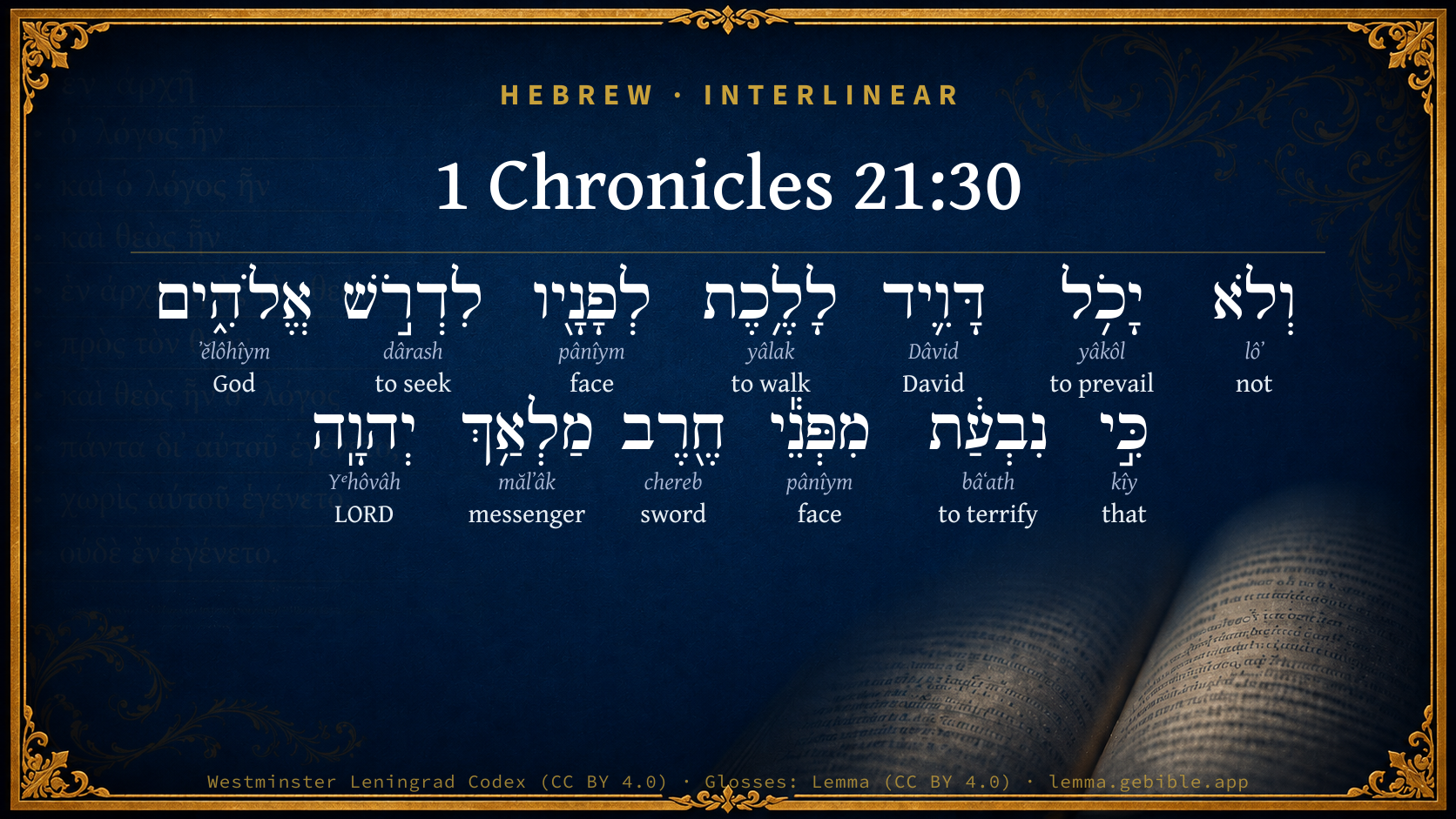
Hebrew (Westminster Leningrad Codex) 1 Chronicles 21:30 appears in the Hebrew Old Testament. The text above is from the Westminster Leningrad Codex. Each word links to its Strong’s number, a concise gloss, and parsing drawn from the Open Scriptures Hebrew Bible morphology. Click any word for its full Brown-Driver-Briggs (BDB) entry.
Download image
Cite this verse

1 Chronicles 21:30 (World English Bible). Public Domain. Lemma interlinear Bible study tool, https://lemma.gebible.app/v/1-chronicles/21/30.

Show BibTeX & RIS
BibTeX
RIS
English Translation
But David couldn't go before it to inquire of God; for he was afraid because of the sword of the angel of Yahweh.
World English Bible · Public Domain
Download a study sheet

One document with this verse’s original text, its word-by-word gloss line, the meaning frame, cross-references with their text, attributed commentary, and full source and license credits — printable, and it pastes into notes with its structure intact.

This verse Autodidact and up

Study sheet (.html) Plain text (.txt)

A passage Seminary Student

Up to 50 verses in one chapter. A passage sheet keeps up to 6 commentary sources and 12 cross-references per verse, in the order this page ranks them, and says so on the sheet whenever that leaves anything out. Ask for a single verse and you get the Autodidact verse sheet above.

Everything on this page stays free to read, with no account — the sheet is a download of what is already on screen, not access to it.

Want to remove ads? Support Godless Engineer
Compare translations 3

The same verse in 3 English versions, stacked beneath the original-language interlinear above. Click any original word for its lexicon entry.

Each is an independent rendering of the whole verse — the interlinear is not word-aligned to these translations.

Highlighted words mark where these versions differ — a whole-verse word diff, not a word-by-word alignment.

  • World English Bible Public Domain
    But David couldn't go before it to inquire of God; for he was afraid because of the sword of the angel of Yahweh.
  • King James Version Public Domain
    But David could not go before it to enquire of God: for he was afraid because of the sword of the angel of the LORD.
  • unfoldingWord Literal Text CC BY-SA 4.0
    And David was not able to go to its face to seek God, for he was terrified from the face of the sword of the angel of Yahweh.

unfoldingWord Literal Text — © unfoldingWord, licensed CC BY-SA 4.0. Word-aligned USFM3 via Door43 (git.door43.org/unfoldingWord/en_ult).

Versions to compare (up to 4)

3 of 4 selected

Show all 18 translations

Every available English version of this verse, each an independent rendering of the whole verse.

  • World English Bible Public Domain
    But David couldn't go before it to inquire of God; for he was afraid because of the sword of the angel of Yahweh.
  • Berean Standard Bible Public Domain
    but David could not go before it to inquire of God, because he was afraid of the sword of the angel of the LORD.
  • Majority Standard Bible Public Domain
    but David could not go before it to inquire of God, because he was afraid of the sword of the angel of the LORD.
  • King James Version Public Domain
    But David could not go before it to enquire of God: for he was afraid because of the sword of the angel of the LORD.
  • American Standard Version (1901) Public Domain
    But David could not go before it to inquire of God; for he was afraid because of the sword of the angel of Jehovah.
  • Revised Version (1885) Public Domain
    But David could not go before it to inquire of God: for he was afraid because of the sword of the angel of the LORD.
  • Geneva Bible (1599) Public Domain
    And Dauid could not go before it to aske counsel at God: for he was afraide of the sworde of the Angel of the Lord.)
  • Douay-Rheims (1899) Public Domain
    But the tabernacle of the Lord, which Moses made in the desert, and the altar of holocausts, was at that time in the high place of Gabaon.
  • Young's Literal Translation Public Domain
    and David is not able to go before it to seek God, for he hath been afraid because of the sword of the messenger of Jehovah.
  • Literal Standard Version CC BY-SA 4.0
    and David is not able to go before it to seek God, for he has been afraid because of the sword of the messenger of YHWH.
  • Unlocked Literal Bible CC BY-SA 4.0
    However, David could not go there to ask for God's direction, because he was afraid of the sword of the angel of Yahweh.
  • unfoldingWord Literal Text CC BY-SA 4.0
    And David was not able to go to its face to seek God, for he was terrified from the face of the sword of the angel of Yahweh.
  • Darby Bible Public Domain
    But David could not go before it to inquire of God; for he was afraid because of the sword of the angel of Jehovah.
  • World Messianic Bible Public Domain
    But David couldn’t go before it to inquire of God, for he was afraid because of the sword of the LORD’s angel.
  • Webster's Bible Public Domain
    But David could not go before it to inquire of God: for he was afraid because of the sword of the angel of the LORD.
  • Free Bible Version CC BY-SA 4.0
    But David did not want to go there to ask God's will, because he was afraid of the sword of the angel of the Lord.
  • Bible in Basic English Public Domain
    But David was not able to go before it to get directions from the Lord, so great was his fear of the sword of the angel of the Lord.
  • JPS Tanakh (1917) Public Domain
    But David could not go before it to inquire of God; for he was terrified because of the sword of the angel of the LORD.

Literal Standard Version (2020), Covenant Press — licensed CC BY-SA 4.0. Text via the HelloAO Bible API (eBible.org). Unlocked Literal Bible (unfoldingWord) — licensed CC BY-SA 4.0. Text via the HelloAO Bible API (eBible.org). unfoldingWord Literal Text — © unfoldingWord, licensed CC BY-SA 4.0. Word-aligned USFM3 via Door43 (git.door43.org/unfoldingWord/en_ult). Free Bible Version, Dr. Jonathan Gallagher — licensed CC BY-SA 4.0. Text via the HelloAO Bible API (eBible.org).

Word by word

More ways to search: Search by grammar → Find every occurrence → Compare this word →

Practice this passage: Drill this verse → Learn its vocabulary →

נִבְעַ֔ת
bâʻath
H1204
“to terrify”
Verb, Niphal, Perfect, 3rd Person, Masculine, Singular
Part of Speech
Verb
Stem
Niphal
Form
Perfect
Person
3rd Person
Gender
Masculine
Number
Singular
Full BDB Definition

Origin: a primitive root

TWOT: 265

to terrify, startle, fall upon, dismay, be overtaken by sudden terror - (Niphal) to be terrified - (Piel) - to fall upon, overwhelm - to terrify
  1. וְלֹא lôʼ H3808 “and · not” Conjunction + Particle, Negative
  2. יָכֹ֥ל yâkôl H3201 “to prevail” Verb, Qal, Perfect, 3rd Person, Masculine, Singular
  3. דָּוִ֛יד Dâvid H1732 “David” Noun, Proper
  4. לָלֶ֥כֶת yâlak H3212 “to walk” Preposition + Verb, Qal, Infinitive Construct
  5. לְפָנָ֖יו pânîym H6440 “to/for · face(s) · his” Preposition + Noun, Common, Both, Plural, Construct + Suffix, Personal, 3rd Person, Masculine, Singular
  6. לִדְרֹ֣שׁ dârash H1875 “to seek” Preposition + Verb, Qal, Infinitive Construct
  7. אֱלֹהִ֑ים ʼĕlôhîym H430 “God(s)” Noun, Common, Masculine, Plural, Absolute
  8. כִּ֣י kîy H3588 “that” Conjunction
  9. מִפְּנֵ֕י pânîym H6440 “from · face(s) of” Preposition + Noun, Common, Both, Plural, Construct
  10. חֶ֖רֶב chereb H2719 “sword of” Noun, Common, Feminine, Singular, Construct
  11. מַלְאַ֥ךְ mălʼâk H4397 “messenger of” Noun, Common, Masculine, Singular, Construct
  12. יְהוָֽה Yᵉhôvâh H3068 “LORD” Noun, Proper

About this verse

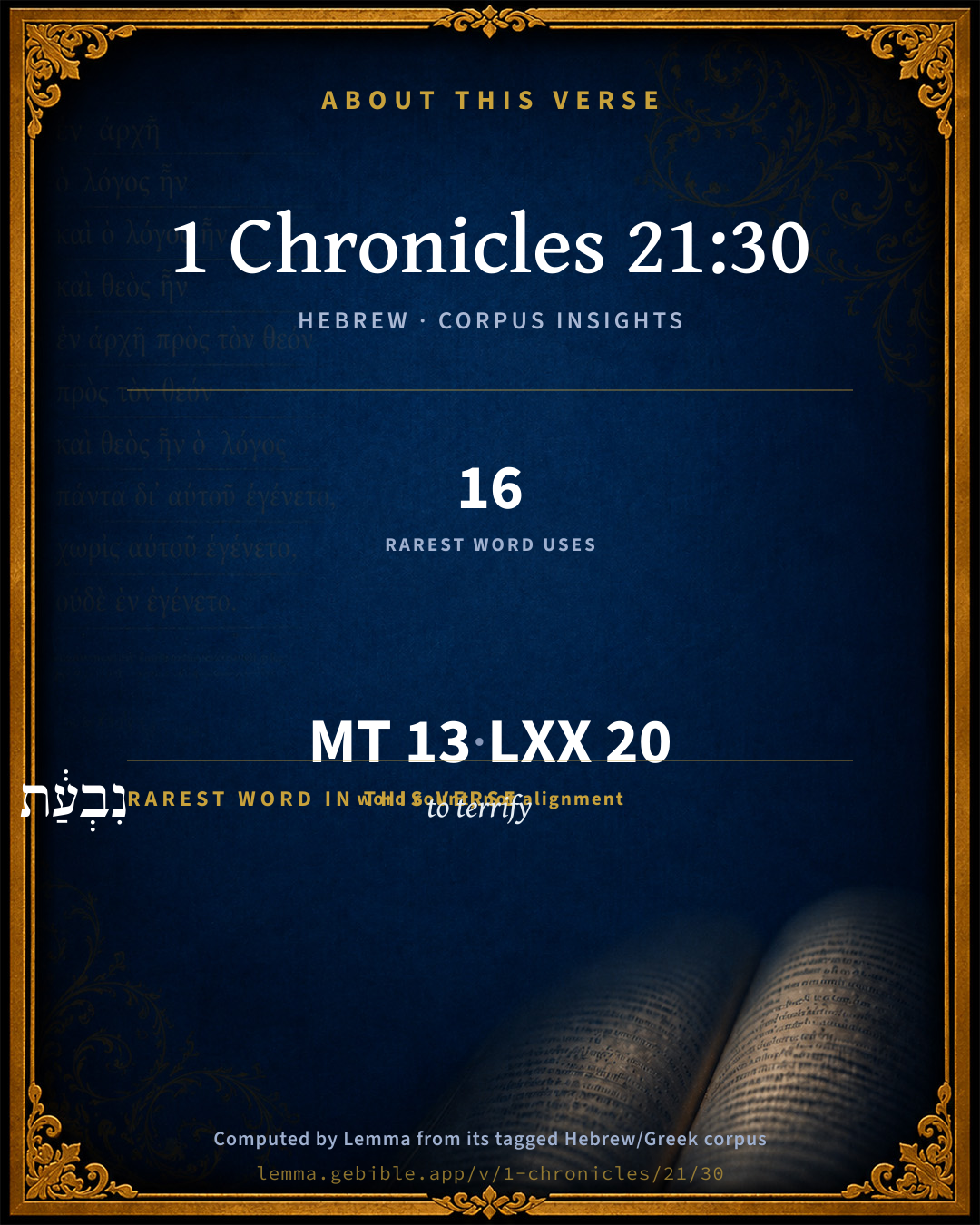
These counts appear in no published source. They are computed here, from the morphology-tagged text and Lemma’s own curated glosses. What Lemma adds →

13
words
12
distinct lemmas
Historical
section

Notable vocabulary

The rarest word here is נִבְעַ֔ת to terrify H1204 — appearing just 16 times in the whole Hebrew Bible.

Shared distinctive vocabulary

נִבְעַ֔ת to terrify H1204 occurs in 16 verses of the Hebrew Bible. Also found in:

Grammatical profile

  • 4 verbs
  • 7 nouns
  • 1 conjunction
  • 1 particle

Verb forms

  • יָכֹ֥ל Qal · Perfect
  • לָלֶ֥כֶת Qal · Infinitive Construct
  • לִדְרֹ֣שׁ Qal · Infinitive Construct
  • נִבְעַ֔ת Niphal · Perfect

Repetition

A word recurs within this verse — often emphatic in Hebrew:

  • לְפָנָ֖יו face H6440 ×2

Hebrew & Septuagint length

In English translation the verse runs 23 words from the Hebrew and 25 from the Septuagint (LXX English) — closely comparable.

A rough comparison of the two English renderings, which tokenize alike — not a word-level alignment.

Word counts can differ between the Hebrew and the Greek without any difference in meaning — e.g. the Hebrew direct-object marker אֵת has no separate Greek word, and Greek often adds the article ὁ.

In the original languages it is 13 Hebrew tokens and 20 Greek tokens — but the two are counted differently (Hebrew bundles its prefixes and suffixes into one token; the Greek is in lemma form), so that isn’t a like-for-like length.

Cross-references

14

Topical passages linked to 1 Chronicles 21:30 in the Treasury of Scripture Knowledge — connected by theme and wording, ordered by reader-vote popularity; previews shown in the World English Bible.

  • Hebrews 12:28–29 Therefore, receiving a Kingdom that can't be shaken, let us have grace, through which we serve God acceptably, with reverence and awe,
  • Revelation 1:17 When I saw him, I fell at his feet like a dead man. He laid his right hand on me, saying, "Don't be afraid. I am the first and the last,
  • Revelation 15:4 Who wouldn't fear you, Lord, And glorify your name? For you only are holy. For all the nations will come and worship before you. For your righteous acts have been revealed."
  • Deuteronomy 10:12 Now, Israel, what does Yahweh your God require of you, but to fear Yahweh your God, to walk in all his ways, and to love him, and to serve Yahweh your God with all your heart and with all your soul,
  • 2 Samuel 6:9 David was afraid of Yahweh that day; and he said, How shall the ark of Yahweh come to me?
  • 1 Chronicles 13:12 David was afraid of God that day, saying, How shall I bring the ark of God home to me?
  • 1 Chronicles 21:16 David lifted up his eyes, and saw the angel of Yahweh standing between earth and the sky, having a drawn sword in his hand stretched out over Jerusalem. Then David and the elders, clothed in sackcloth, fell on their faces.
  • Job 13:21 Withdraw your hand far from me; And don't let your terror make me afraid.
  • Job 21:6 When I remember, I am troubled. Horror takes hold of my flesh.
  • Job 23:15 Therefore I am terrified at his presence. When I consider, I am afraid of him.
  • Psalms 90:11 Who knows the power of your anger, Your wrath according to the fear that is due to you?
  • Psalms 119:120 My flesh trembles for fear of you. I am afraid of your judgments.
  • Jeremiah 5:22 Don't you fear me? says Yahweh: won't you tremble at my presence, who have placed the sand for the bound of the sea, by a perpetual decree, that it can't pass it? and though the waves of it toss themselves, yet they can't prevail; though they roar, yet they can't pass over it.
  • Jeremiah 10:7 Who should not fear you, King of the nations? for to you does it appertain; because among all the wise men of the nations, and in all their royal estate, there is none like you.

Cross-references courtesy of OpenBible.info (CC BY 4.0).

Hebrew and Greek witnesses Masoretic Hebrew ↔ Greek Septuagint

The same verse in the two great witnesses to the Old Testament, shown verse-for-verse.

These are two independent witnesses, not word-aligned to each other, and the Septuagint is shown in lemma (dictionary) form.

Hebrew 1 Chronicles 21:30 Masoretic · Westminster Leningrad Codex

וְלֹא יָכֹ֥ל דָּוִ֛יד לָלֶ֥כֶת לְפָנָ֖יו לִדְרֹ֣שׁ אֱלֹהִ֑ים כִּ֣י נִבְעַ֔ת מִפְּנֵ֕י חֶ֖רֶב מַלְאַ֥ךְ יְהוָֽה

But David couldn't go before it to inquire of God; for he was afraid because of the sword of the angel of Yahweh.

World English Bible · Public Domain

Greek LXX 1 Chronicles 21:30 Septuagint · lemma form

καί οὐ δύναμαι δαυίδ ὁ πορεύομαι ἔμπροσθεν αὐτός ὁ ζητέω ὁ θεός ὅτι κατασπεύδω ἀπό πρόσωπον ὁ ῥομφαία ἄγγελος κύριος

And David could not go before it to enquire of God; for he hasted not because of the sword of the angel of the Lord.

LXX2012 (modern English Septuagint) · Public Domain

Hebrew: Westminster Leningrad Codex (CC BY 4.0). Greek: Septuagint (public domain); English from LXX2012 (modern English Septuagint) (Public Domain). How the Septuagint differs from the Hebrew →

Commentary

Notes on 1 Chronicles 21:30 from classic Christian and Jewish commentators (each source and its license shown beneath its notes). The classic Christian expositions comment on the surrounding passage and are grouped to its opening verse, so a note may address several verses; the Jewish commentaries on the Tanakh (Rashi and others) are per-verse, so they appear only where the commentator wrote on this verse.

Lemma curates 59 commentaries, every one of them public domain or Creative Commons licensed, each selected and text-cleaned for this edition rather than reprinted as found. About our sources →

Joseph Benson's Commentary

1Ch 21:30. David could not go before it — Did not dare to go before the tabernacle, where the altar stood. To inquire of God — Hebrew, לדרשׁ, lidrosh, to seek God, or humbly to entreat his favour by prayer and sacrifice. For he was afraid because of the sword of the angel of the Lord — That is, when he saw the angel stand with his drawn sword over Jerusalem, he durst not go away to Gibeon, lest the angel in the mean time should destroy Jerusalem: for the prevention whereof he thought it proper to worship God in that place, which he had consecrated by his special presence and acceptance.

Joseph Benson's Commentary on the Old and New Testaments (1811–1818) — public domain. Text from a community e-Sword module.

Adam Clarke's Commentary

Verse 30. Because of the sword of the angel] This is given as a reason why David built an altar in the threshing-floor of Ornan: he was afraid to go to Gibeon, because of the sword of the destroying angel, or he was afraid of delaying the offerings so long as his going thither would require, lest the destroying angel should in the mean while exterminate the people; therefore he hastily built an altar in that place, and on it made the requisite offerings, and by the fire from heaven God showed that he had accepted his act and his devotion. Such interventions as these must necessarily maintain in the minds of the people a full persuasion of the truth and Divine origin of their religion.

For a more circumstantial account of these transactions, see the notes on 2Sa 24:1, Ac., in which several difficulties of the text are removed.

Adam Clarke's Commentary on the Bible (1810–1826) — public domain. Text from a community e-Sword/MySword module.

Ellicott's Commentary for English Readers

(30) But (and) David could not go before it—i.e., the Tabernacle at Gibeon and the altar of burnt offering (1Ch_16:4; 1Ch_16:37; 1Ch_16:39).

To enquire of God.—To seek Him, that is, to seek His favour by sacrifice and prayer. (But comp. 1Ch_13:3; 1Ch_15:13.)

For he was afraid because of the sword.—“David could not go to Gibeon,” says Keil, “because of the sword of the angel of Jehovah: i.e., on account of the pestilence which raged at Gibeon.” Others have thought that the awful vision of the angel had stricken him with some bodily weakness. A more natural explanation is that the menacing aspect of the apparition overawed the king, so that he durst not follow the usual course in the present instance. It made, as we should say, an indelible impression upon his mind as to the sanctity of the place where it appeared. (Comp. Gen_28:17; Exo_3:5; Jos_5:15; Jdg_6:21; Jdg_6:26.)

A Bible Commentary for English Readers, edited by Charles John Ellicott (1878–1897) — public domain. Text from a community e-Sword module.

The Cambridge Bible for Schools and Colleges

gen. ed. J. J. S. Perowne

30. he was afraid] Or, he was terrified. The Heb. word is unusual.

The Cambridge Bible for Schools and Colleges (gen. ed. J. J. S. Perowne; Cambridge University Press, 1878–1918) — public domain. Text from a community e-Sword module.

Albert Barnes' Notes on the Bible

David, knowing that by sacrifice on this altar he had caused the angel to stay his hand, was afraid to transfer his offerings elsewhere, lest the Angel should resume his task and pestilence again break out.

Albert Barnes' Notes on the Bible (1834–1885) — public domain. Text from a community e-Sword/MySword module.

Haydock's Catholic Bible Commentary

God. He performed what God had commanded. But he would have offered other voluntary victims at Gabaon, if he had been able. (Calmet) --- The distance shewed the propriety of building the temple at Jerusalem, (Du Hamel) which was nearly in the centre of the country. (Haydock)

George Leo Haydock (1774–1849), Haydock's Catholic Family Bible and Commentary, 1859 edition — public domain. Excludes Psalms (Douay-Rheims chapter numbering differs from Protestant) and Deuterocanonical books (Catholic canon only).

Matthew Poole's English Annotations

David could not, i.e. durst not. Before it, i.e. before the tabernacle, where the altar stood.

To inquire of God, Heb. to seek God, i.e. humbly to beg his favour by prayer and sacrifice.

Because of the sword of the angel of the Lord, i.e. when he saw the angel stand with his drawn sword over Jerusalem, as is related above, 1Ch 21:15,16, he durst not go away thence to Gibeon, lest the angel in the mean time should destroy Jerusalem; for the prevention whereof he thought it most proper to continue to worship God in that place, which he had consecrated by his special presence and gracious acceptance.

Matthew Poole's English Annotations on the Holy Bible (1683–1685) — public domain. Text from a community e-Sword/MySword module.

Whedon's Commentary on the Bible

Daniel D. Whedon

30. David could not go before it to inquire of God: for he was afraid because of the sword of the angel — It was a moral and spiritual, not a physical cause, that hindered David from going to Gibeon. Gibeon had probably not been spared by the pestilence, and the fear inspired by the sight of the angel, together with the command to build an altar and sacrifice on the spot where the angel appeared, convinced the king that thenceforth he must offer his sacrifices on the threshingfloor of Ornan. Hence he could not go elsewhere to sacrifice without violating his convictions of duty and obedience. He may also have feared that any disregard of the command to sacrifice on this new spot would cause the sword of the destroying angel to appear again. With this verse the first verse of the next chapter should be connected. Convinced by a Divine revelation that this spot was chosen by God as a place for sacrifice, he proclaimed, “This is the house of the Lord God, and this is the altar of the burnt offering for Israel.” Here at length he found the spot on which the temple should be built.

Daniel D. Whedon (gen. ed.), Commentary on the Old and New Testaments (1874–1909) — public domain. Text from a community e-Sword module.

John Wesley's Explanatory Notes

Afraid - When he saw the angel stand with his drawn sword over Jerusalem, he durst not go away to Gibeon, lest the angel in the mean time should destroy Jerusalem: for the prevention whereof he thought it proper to worship God in that place, which he had consecrated by his special presence and acceptance.

John Wesley, Explanatory Notes Upon the Whole Bible (1754–1765) — public domain. Text via the GEBible commentary corpus.

Rashi

Rabbi Shlomo Yitzchaki (Rashi)

But David could not Then, when that incident occurred that the Holy One, blessed be He, commanded him to offer up a sacrifice, David could not go before it to inquire of God, i.e., before the altar that was in Gibeon.

because he was frightened by the sword of the angel of the Lord and David went according to the words of the Lord and built an altar, and the Lord answered him.

Rashi on the Tanakh — English translations: “The Judaica Press complete Tanach with Rashi, translated by A. J. Rosenberg” (CC BY 4.0); “Pentateuch with Rashi's commentary by M. Rosenbaum and A.M. Silbermann, 1929-1934” (public domain); “The Metsudah Tanach series, Lakewood, N.J” (CC BY 4.0); and “The Book of Joshua, Metsudah Publications, 1997” (CC BY 4.0). Text via Sefaria.

Lesson kit

Teaching starters — assembled from the data on this page, not authored interpretation. Every prompt links to the verse data it draws on. Edit before teaching.

1 Chronicles, in the Historical, opens this verse with 13 words (12 distinct Hebrew lemmas). Its most distinctive word is bâʻath (“to terrify”). A historical commentator’s framing appears above. Read the whole chapter for the surrounding context.

Discussion questions

  1. The word bâʻath carries the sense “to terrify.” How does it shape the verse?
  2. How does 1 Samuel 16:14, which shares the word «to terrify», read alongside this verse?
  3. What does the repetition of “face” (2× in this one verse) do in this verse?
  4. These translations render this verse differently. What is at stake in choosing one wording over another?
  5. «יָכֹ֥ל» is a Qal Perfect verb. How does that grammatical form shape the action described?
  6. Compare how Joseph Benson's Commentary and Adam Clarke's Commentary read this verse. Where do they agree or differ?

Things to notice

Reading settings

Reading text

Shown beneath each verse's original-language words.

Old Testament
Old Testament edition

Read the OT as the Masoretic Hebrew (MT) or the Greek Septuagint (LXX).

English shown for the Greek Septuagint (in the Hebrew ↔ Greek comparison).

Comparing translations? Open the Compare panel on any verse page to stack up to four side by side.