
Joshua 10:39

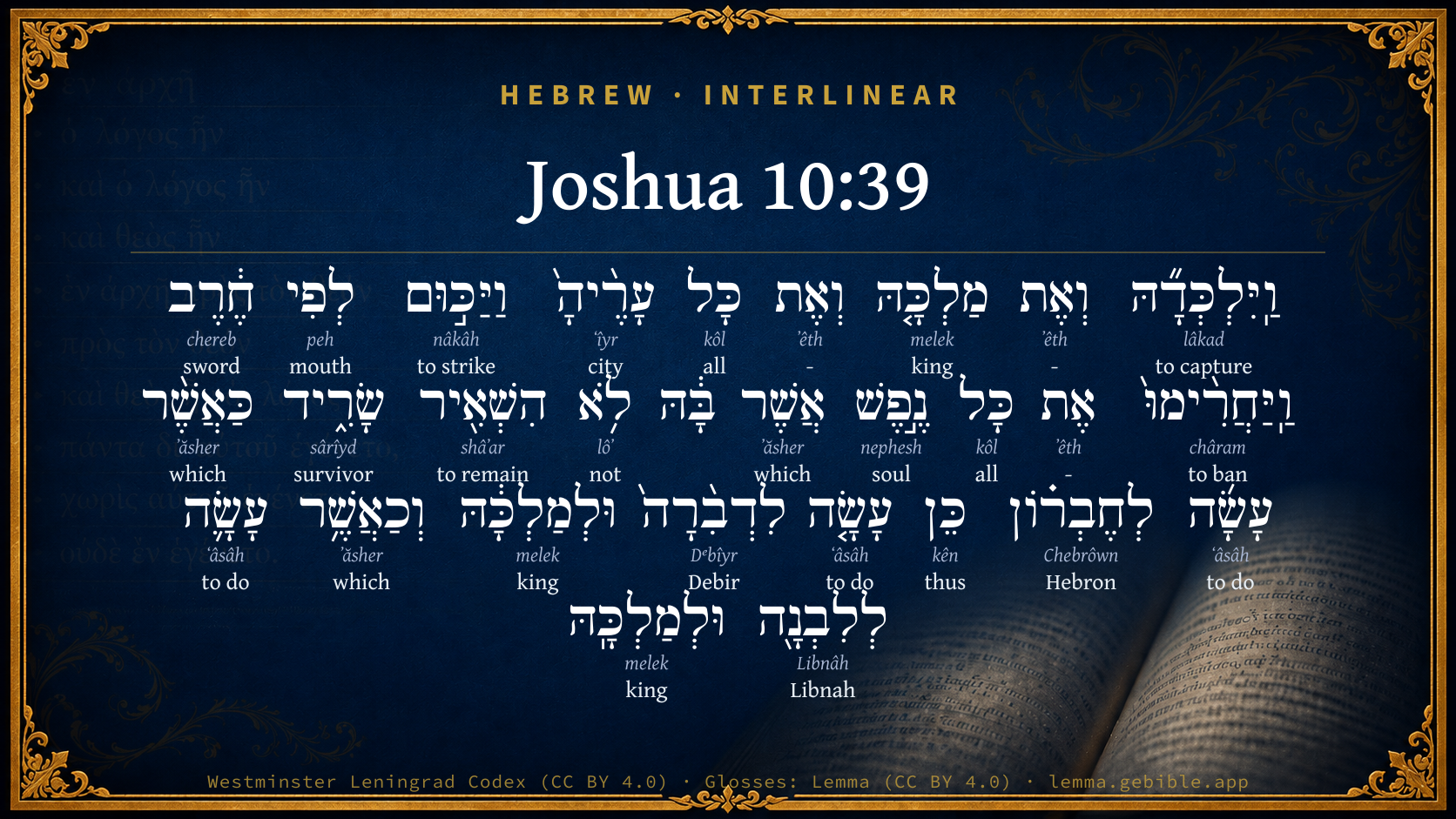
Hebrew (Westminster Leningrad Codex) Joshua 10:39 appears in the Hebrew Old Testament. The text above is from the Westminster Leningrad Codex. Each word links to its Strong’s number, a concise gloss, and parsing drawn from the Open Scriptures Hebrew Bible morphology. Click any word for its full Brown-Driver-Briggs (BDB) entry.
Download image
Cite this verse

Joshua 10:39 (World English Bible). Public Domain. Lemma interlinear Bible study tool, https://lemma.gebible.app/v/joshua/10/39.

Show BibTeX & RIS
BibTeX
RIS
English Translation
and he took it, and the king of it, and all the cities of it; and they struck them with the edge of the sword, and utterly destroyed all the souls who were therein; he left none remaining: as he had done to Hebron, so he did to Debir, and to the king of it; as he had done also to Libnah, and to the king of it.
World English Bible · Public Domain
Download a study sheet

One document with this verse’s original text, its word-by-word gloss line, the meaning frame, cross-references with their text, attributed commentary, and full source and license credits — printable, and it pastes into notes with its structure intact.

This verse Autodidact and up

Study sheet (.html) Plain text (.txt)

A passage Seminary Student

Up to 50 verses in one chapter. A passage sheet keeps up to 6 commentary sources and 12 cross-references per verse, in the order this page ranks them, and says so on the sheet whenever that leaves anything out. Ask for a single verse and you get the Autodidact verse sheet above.

Everything on this page stays free to read, with no account — the sheet is a download of what is already on screen, not access to it.

Want to remove ads? Support Godless Engineer
Compare translations 3

The same verse in 3 English versions, stacked beneath the original-language interlinear above. Click any original word for its lexicon entry.

Each is an independent rendering of the whole verse — the interlinear is not word-aligned to these translations.

Highlighted words mark where these versions differ — a whole-verse word diff, not a word-by-word alignment.

  • World English Bible Public Domain
    and he took it, and the king of it, and all the cities of it; and they struck them with the edge of the sword, and utterly destroyed all the souls who were therein; he left none remaining: as he had done to Hebron, so he did to Debir, and to the king of it; as he had done also to Libnah, and to the king of it.
  • King James Version Public Domain
    And he took it, and the king thereof, and all the cities thereof; and they smote them with the edge of the sword, and utterly destroyed all the souls that were therein; he left none remaining: as he had done to Hebron, so he did to Debir, and to the king thereof; as he had done also to Libnah, and to her king.
  • unfoldingWord Literal Text CC BY-SA 4.0
    And he captured it and its king and all of its cities, and they struck them to the mouth of the sword and devoted every soul that in it. He did not leave a survivor. Just as he had done to Hebron, thus he did to Debir and to its king, and just as he had done to Libnah and to its king.

unfoldingWord Literal Text — © unfoldingWord, licensed CC BY-SA 4.0. Word-aligned USFM3 via Door43 (git.door43.org/unfoldingWord/en_ult).

Versions to compare (up to 4)

3 of 4 selected

Show all 18 translations

Every available English version of this verse, each an independent rendering of the whole verse.

  • World English Bible Public Domain
    and he took it, and the king of it, and all the cities of it; and they struck them with the edge of the sword, and utterly destroyed all the souls who were therein; he left none remaining: as he had done to Hebron, so he did to Debir, and to the king of it; as he had done also to Libnah, and to the king of it.
  • Berean Standard Bible Public Domain
    And they captured Debir, its king, and all its villages. They put them to the sword and devoted to destruction everyone in the city, leaving no survivors. Joshua did to Debir and its king as he had done to Hebron and as he had done to Libnah and its king.
  • Majority Standard Bible Public Domain
    And they captured Debir, its king, and all its villages. They put them to the sword and devoted to destruction everyone in the city, leaving no survivors. Joshua did to Debir and its king as he had done to Hebron and as he had done to Libnah and its king.
  • King James Version Public Domain
    And he took it, and the king thereof, and all the cities thereof; and they smote them with the edge of the sword, and utterly destroyed all the souls that were therein; he left none remaining: as he had done to Hebron, so he did to Debir, and to the king thereof; as he had done also to Libnah, and to her king.
  • American Standard Version (1901) Public Domain
    and he took it, and the king thereof, and all the cities thereof; and they smote them with the edge of the sword, and utterly destroyed all the souls that were therein; he left none remaining: as he had done to Hebron, so he did to Debir, and to the king thereof; as he had done also to Libnah, and to the king thereof.
  • Revised Version (1885) Public Domain
    and he took it, and the king thereof, and all the cities thereof; and they smote them with the edge of the sword, and utterly destroyed all the souls that were therein; he left none remaining: as he had done to Hebron, so he did to Debir, and to the king thereof; as he had done also to Libnah, and to the king thereof.
  • Geneva Bible (1599) Public Domain
    And when he had taken it, and the King thereof, and all the citie thereof, they smote them with the edge of the sword, and vtterly destroyed all the soules that were therein, he let none remaine: as he did to Hebron, so he did to Debir, and to the King thereof, as he had also done to Libnah, and to the King thereof.
  • Douay-Rheims (1899) Public Domain
    He took it and destroyed it: the king also thereof and all the towns round about he destroyed with the edge of the sword: he left not in it any remains: as he had done to Hebron and Lebna and to their kings, so did he to Dabir and to the king thereof.
  • Young's Literal Translation Public Domain
    and captureth it, and its king, and all its cities, and they smite them by the mouth of the sword, and devote every person who `is' in it -- he hath not left a remnant; as he did to Hebron so he did to Debir, and to its king, and as he did to Libnah, and to its king.
  • Literal Standard Version CC BY-SA 4.0
    and captures it, and its king, and all its cities, and they strike them by the mouth of the sword, and devote every person who [is] in it—he has not left a remnant; as he did to Hebron so he did to Debir, and to its king, and as he did to Libnah, and to its king.
  • Unlocked Literal Bible CC BY-SA 4.0
    They captured it, its king and all its nearby villages. They struck them with the edge of the sword and completely destroyed every person in it. They left no survivor. They did to Debir and its king as they had done to Libnah and its king and to Hebron.
  • unfoldingWord Literal Text CC BY-SA 4.0
    And he captured it and its king and all of its cities, and they struck them to the mouth of the sword and devoted every soul that in it. He did not leave a survivor. Just as he had done to Hebron, thus he did to Debir and to its king, and just as he had done to Libnah and to its king.
  • Darby Bible Public Domain
    And he took it, and the king thereof, and all the cities thereof, and they smote them with the edge of the sword, and utterly destroyed all the souls that were therein; he let none remain: as he had done to Hebron, and as he had done to Libnah, and to the king thereof, so he did to Debir and to the king thereof.
  • World Messianic Bible Public Domain
    He took it, with its king and all its cities. They struck them with the edge of the sword, and utterly destroyed all the souls who were in it. He left no one remaining. As he had done to Hebron, so he did to Debir, and to its king; as he had done also to Libnah, and to its king.
  • Webster's Bible Public Domain
    And he took it, and its king, and all its cities, and they smote them with the edge of the sword, and utterly destroyed all the souls that were in them; he left none remaining: as he had done to Hebron, so he did to Debir, and to its king; as he had done also to Libnah, and to its king.
  • Free Bible Version CC BY-SA 4.0
    He captured it and its king and all the towns nearby. Joshua had all the inhabitants killed, leaving no survivors. Just as he had done in Hebron, he set it apart and completely destroyed it and everyone in it. He killed the king of Debir just as he had killed the king of Libnah.
  • Bible in Basic English Public Domain
    And he took it, with its king and all its towns: and he put them to the sword, giving every person in it to the curse; all were put to death: as he had done to Hebron, so he did to Debir and its king.
  • JPS Tanakh (1917) Public Domain
    And he took it, and the king thereof, and all the cities thereof; and they smote them with the edge of the sword, and utterly destroyed all the souls that were therein; he left none remaining; as he had done to Hebron, so he did to Debir, and to the king thereof; as he had done also to Libnah, and to the king thereof.

Literal Standard Version (2020), Covenant Press — licensed CC BY-SA 4.0. Text via the HelloAO Bible API (eBible.org). Unlocked Literal Bible (unfoldingWord) — licensed CC BY-SA 4.0. Text via the HelloAO Bible API (eBible.org). unfoldingWord Literal Text — © unfoldingWord, licensed CC BY-SA 4.0. Word-aligned USFM3 via Door43 (git.door43.org/unfoldingWord/en_ult). Free Bible Version, Dr. Jonathan Gallagher — licensed CC BY-SA 4.0. Text via the HelloAO Bible API (eBible.org).

Word by word

More ways to search: Search by grammar → Find every occurrence → Compare this word →

Practice this passage: Drill this verse → Learn its vocabulary →

לִדְבִ֨רָה֙
Dᵉbîyr
H1688
“to/for · Debir · toward”
Preposition + Noun, Proper + Suffix, Demonstrative
Part of Speech
Preposition + Noun
Type
Proper
Full BDB Definition

Origin: the same as H1687

TWOT: None

Debir = "sanctuary" - the king of Eglon, one of the five kings hanged by Joshua (noun proper masculine) - a town in the mountains of Judah west of Hebron and given to the priests and a city of refuge (noun proper locative) - a place on the northern boundary of Judah (noun proper locative) - a town in the territory of Gad (noun proper locative)
  1. וַֽיִּלְכְּדָ֞הּ lâkad H3920 “and · to capture · her” Conjunction + Verb, Qal, Sequential Imperfect, 3rd Person, Masculine, Singular + Suffix, Personal, 3rd Person, Feminine, Singular
  2. וְאֶת ʼêth H853 “and · -” Conjunction + Particle, Direct Object
  3. מַלְכָּ֤הּ melek H4428 “king · her” Noun, Common, Masculine, Singular, Construct + Suffix, Personal, 3rd Person, Feminine, Singular
  4. וְאֶת ʼêth H853 “and · -” Conjunction + Particle, Direct Object
  5. כָּל kôl H3605 “all of” Noun, Common, Masculine, Singular, Construct
  6. עָרֶ֨יהָ֙ ʻîyr H5892 “cities · her” Noun, Common, Feminine, Plural, Construct + Suffix, Personal, 3rd Person, Feminine, Singular
  7. וַיַּכּ֣וּם nâkâh H5221 “and · to strike · them” Conjunction + Verb, Hiphil, Sequential Imperfect, 3rd Person, Masculine, Plural + Suffix, Personal, 3rd Person, Masculine, Plural
  8. לְפִי peh H6310 “to/for · mouth of” Preposition + Noun, Common, Masculine, Singular, Construct
  9. חֶ֔רֶב chereb H2719 “sword” Noun, Common, Feminine, Singular, Absolute
  10. וַֽיַּחֲרִ֨ימוּ֙ châram H2763 “and · to ban” Conjunction + Verb, Hiphil, Sequential Imperfect, 3rd Person, Masculine, Plural
  11. אֶת ʼêth H853 “-” Particle, Direct Object
  12. כָּל kôl H3605 “all of” Noun, Common, Masculine, Singular, Construct
  13. נֶ֣פֶשׁ nephesh H5315 “soul” Noun, Common, Both, Singular, Absolute
  14. אֲשֶׁר ʼăsher H834 “which” Particle, Relative
  15. לֹ֥א lôʼ H3808 “not” Particle, Negative
  16. הִשְׁאִ֖יר shâʼar H7604 “to remain” Verb, Hiphil, Perfect, 3rd Person, Masculine, Singular
  17. שָׂרִ֑יד sârîyd H8300 “survivor” Noun, Common, Masculine, Singular, Absolute
  18. כַּאֲשֶׁ֨ר ʼăsher H834 “like/as · which” Preposition + Particle, Relative
  19. עָשָׂ֜ה ʻâsâh H6213 “to do” Verb, Qal, Perfect, 3rd Person, Masculine, Singular
  20. לְחֶבְר֗וֹן Chebrôwn H2275 “to/for · Hebron” Preposition + Noun, Proper
  21. כֵּן kên H3651 “thus” Particle, Demonstrative
  22. עָשָׂ֤ה ʻâsâh H6213 “to do” Verb, Qal, Perfect, 3rd Person, Masculine, Singular
  23. וּלְמַלְכָּ֔הּ melek H4428 “and · to/for · king · her” Conjunction + Preposition + Noun, Common, Masculine, Singular, Construct + Suffix, Personal, 3rd Person, Feminine, Singular
  24. וְכַאֲשֶׁ֥ר ʼăsher H834 “and · like/as · which” Conjunction + Preposition + Particle, Relative
  25. עָשָׂ֛ה ʻâsâh H6213 “to do” Verb, Qal, Perfect, 3rd Person, Masculine, Singular
  26. לְלִבְנָ֖ה Libnâh H3841 “to/for · Libnah” Preposition + Noun, Proper
  27. וּלְמַלְכָּֽהּ melek H4428 “and · to/for · king · her” Conjunction + Preposition + Noun, Common, Masculine, Singular, Construct + Suffix, Personal, 3rd Person, Feminine, Singular

About this verse

These counts appear in no published source. They are computed here, from the morphology-tagged text and Lemma’s own curated glosses. What Lemma adds →

29
words
19
distinct lemmas
Historical
section

Notable vocabulary

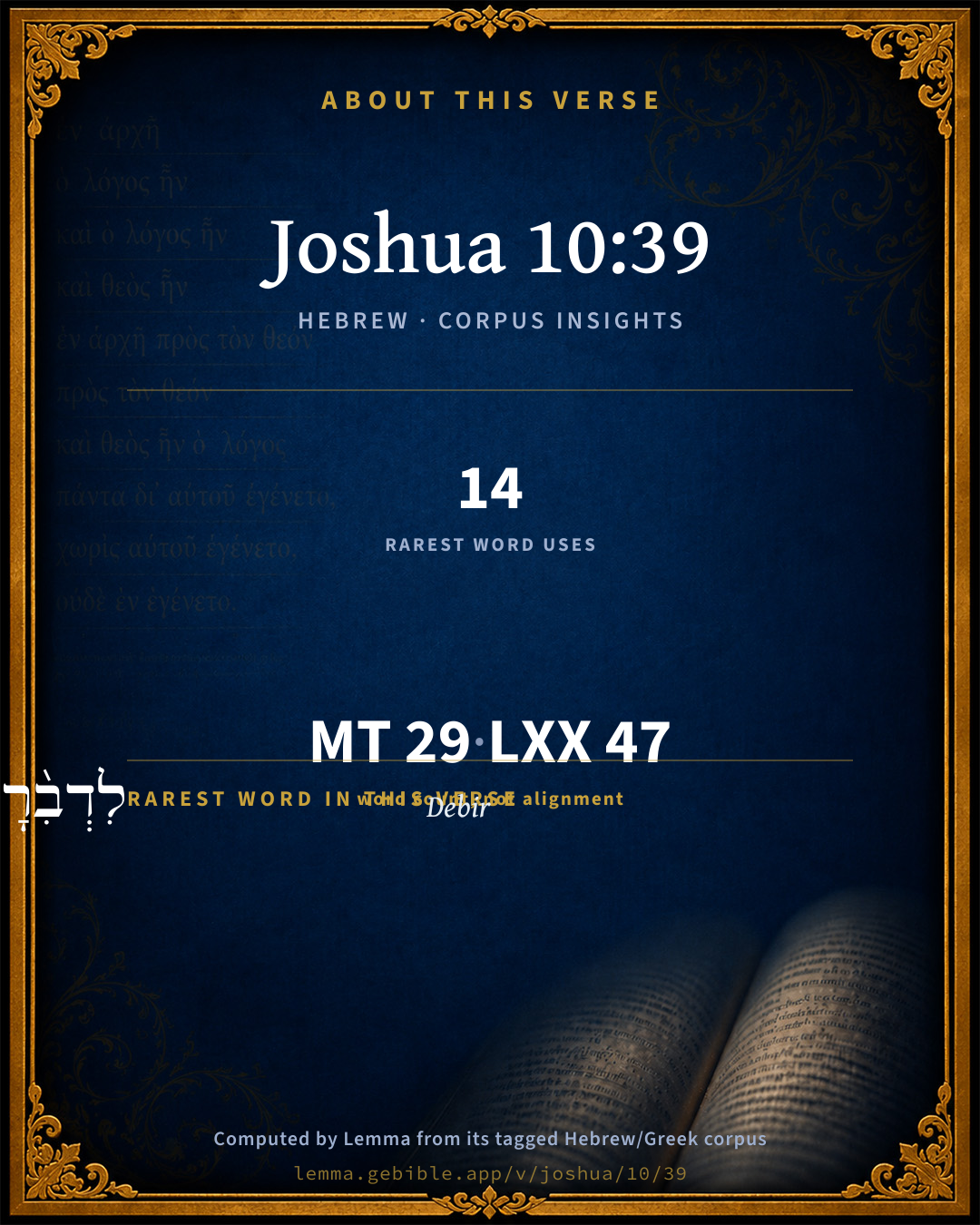
The rarest word here is לִדְבִ֨רָה֙ Debir H1688 — appearing just 14 times in the whole Hebrew Bible.

Shared distinctive vocabulary

לִדְבִ֨רָה֙ Debir H1688 occurs in 12 verses of the Hebrew Bible. Also found in:

Grammatical profile

  • 7 verbs
  • 13 nouns
  • 1 preposition
  • 8 particles

Verb forms

  • וַֽיִּלְכְּדָ֞הּ Qal · Sequential Imperfect
  • וַיַּכּ֣וּם Hiphil · Sequential Imperfect
  • וַֽיַּחֲרִ֨ימוּ֙ Hiphil · Sequential Imperfect
  • הִשְׁאִ֖יר Hiphil · Perfect
  • עָשָׂ֜ה Qal · Perfect
  • עָשָׂ֤ה Qal · Perfect
  • עָשָׂ֛ה Qal · Perfect

Repetition

Words recur within this verse — often emphatic in Hebrew:

  • מַלְכָּ֤הּ king H4428 ×3
  • עָשָׂ֜ה to do H6213 ×3
  • כָּל all H3605 ×2
  • אֲשֶׁר which H834 ×3

Hebrew & Septuagint length

In English translation the verse runs 68 words from the Hebrew and 58 from the Septuagint (LXX English) — closely comparable.

A rough comparison of the two English renderings, which tokenize alike — not a word-level alignment.

Word counts can differ between the Hebrew and the Greek without any difference in meaning — e.g. the Hebrew direct-object marker אֵת has no separate Greek word, and Greek often adds the article ὁ.

In the original languages it is 29 Hebrew tokens and 47 Greek tokens — but the two are counted differently (Hebrew bundles its prefixes and suffixes into one token; the Greek is in lemma form), so that isn’t a like-for-like length.

Cross-references

7

Topical passages linked to Joshua 10:39 in the Treasury of Scripture Knowledge — connected by theme and wording, ordered by reader-vote popularity; previews shown in the World English Bible.

  • Deuteronomy 3:3 So Yahweh our God delivered into our hand Og also, the king of Bashan, and all his people: and we struck him until none was left to him remaining.
  • Joshua 10:33 Then Horam king of Gezer came up to help Lachish; and Joshua struck him and his people, until he had left him none remaining.
  • Joshua 10:37 and they took it, and struck it with the edge of the sword, and the king of it, and all the cities of it, and all the souls who were therein; he left none remaining, according to all that he had done to Eglon; but he utterly destroyed it, and all the souls who were therein.
  • Joshua 11:8 Yahweh delivered them into the hand of Israel, and they struck them, and chased them to great Sidon, and to Misrephoth Maim, and to the valley of Mizpeh eastward; and they struck them, until they left them none remaining.
  • 2 Kings 10:11 So Jehu struck all that remained of the house of Ahab in Jezreel, and all his great men, and his familiar friends, and his priests, until he left him none remaining.
  • Obadiah 1:18 The house of Jacob will be a fire, the house of Joseph a flame, and the house of Esau for stubble. They will burn among them, and devour them. There will not be any remaining to the house of Esau." Indeed, Yahweh has spoken.
  • Joshua 10:40 So Joshua struck all the land, the hill-country, and the South, and the lowland, and the slopes, and all their kings: he left none remaining, but he utterly destroyed all that breathed, as Yahweh, the God of Israel, commanded.

Cross-references courtesy of OpenBible.info (CC BY 4.0).

Hebrew and Greek witnesses Masoretic Hebrew ↔ Greek Septuagint

The same verse in the two great witnesses to the Old Testament, shown verse-for-verse.

These are two independent witnesses, not word-aligned to each other, and the Septuagint is shown in lemma (dictionary) form.

Hebrew Joshua 10:39 Masoretic · Westminster Leningrad Codex

וַֽיִּלְכְּדָ֞הּ וְאֶת מַלְכָּ֤הּ וְאֶת כָּל עָרֶ֨יהָ֙ וַיַּכּ֣וּם לְפִי חֶ֔רֶב וַֽיַּחֲרִ֨ימוּ֙ אֶת כָּל נֶ֣פֶשׁ אֲשֶׁר בָּ֔הּ לֹ֥א הִשְׁאִ֖יר שָׂרִ֑יד כַּאֲשֶׁ֨ר עָשָׂ֜ה לְחֶבְר֗וֹן כֵּן עָשָׂ֤ה לִדְבִ֨רָה֙ וּלְמַלְכָּ֔הּ וְכַאֲשֶׁ֥ר עָשָׂ֛ה לְלִבְנָ֖ה וּלְמַלְכָּֽהּ

and he took it, and the king of it, and all the cities of it; and they struck them with the edge of the sword, and utterly destroyed all the souls who were therein; he left none remaining: as he had done to Hebron, so he did to Debir, and to the king of it; as he had done also to Libnah, and to the king of it.

World English Bible · Public Domain

Greek LXX Joshua 10:39 Septuagint · lemma form

λαμβάνω αὐτός καί ὁ βασιλεύς αὐτός καί ὁ κώμη αὐτός καί πατάσσω αὐτός ἐν στόμα ξίφος καί ἐκὀλεθρεύω αὐτός καί πᾶς ἐμπνέος ἐν αὐτός καί οὐ καταλείπω αὐτός οὐδείς διασώζω ὅς τρόπος ποιέω ὁ χεβρων καί ὁ βασιλεύς αὐτός οὕτως ποιέω ὁ δαβιρ καί ὁ βασιλεύς αὐτός

and they took it, and its king, and its villages: and he struck it with the edge of the sword, and they destroyed it, and every thing breathing in it; and they did not leave in it any one that was preserved: as they did to Chebron and her king, so they did to Dabir and her king.

LXX2012 (modern English Septuagint) · Public Domain

Hebrew: Westminster Leningrad Codex (CC BY 4.0). Greek: Septuagint (public domain); English from LXX2012 (modern English Septuagint) (Public Domain). How the Septuagint differs from the Hebrew →

Targum (Aramaic paraphrase)

1

The Targum is the ancient Jewish Aramaic paraphrase of the Hebrew Scriptures — an interpretive translation, not the Hebrew text itself. Onkelos (literal) and Pseudo-Jonathan (expansive) render the Torah, and Jonathan the Prophets. Coverage is partial: where no permissively-licensed English translation exists for a verse, only the Aramaic is shown. This is verse-level text, not a word-by-word alignment to the Hebrew.

  1. Targum Jonathan Prophets (Joshua–Malachi)
    וְכַבְשָׁהּ וְיַת מַלְכָּהּ וְיַת כָּל קִרְוָהָא וּמְחוֹנוּן לְפִּתְגַם דְחָרֶב וּגְמִירוּ יַת כָּל נַפְשָׁתָא דִי בָהּ לָא אַשְׁאַר מְשֵׁזִיב כְּמָא דַעֲבַד לְחֶבְרוֹן כֵּן עֲבַד לִדְבִיר וּלְמַלְכָּהּ וּכְמָא דַעֲבַד לְלִבְנָה וּלְמַלְכָּהּ:

    (no public-domain English translation for this verse)

    Targum Jonathan — Aramaic: “Mikraot Gedolot” (public domain). English: “Sefaria Community Translation” (CC0 1.0 (public-domain dedication)); “London "Chaldee Paraphrase," 1871” (public domain). Text via Sefaria.

Commentary

Notes on Joshua 10:39 from classic Christian and Jewish commentators (each source and its license shown beneath its notes). The classic Christian expositions comment on the surrounding passage and are grouped to its opening verse, so a note may address several verses; the Jewish commentaries on the Tanakh (Rashi and others) are per-verse, so they appear only where the commentator wrote on this verse.

Lemma curates 59 commentaries, every one of them public domain or Creative Commons licensed, each selected and text-cleaned for this edition rather than reprinted as found. About our sources →

Trapp's Complete Commentary

John Trapp

Jos 10:39 And he took it, and the king thereof, and all the cities thereof; and they smote them with the edge of the sword, and utterly destroyed all the souls that [were] therein; he left none remaining: as he had done to Hebron, so he did to Debir, and to the king thereof; as he had done also to Libnah, and to her king.

Ver. 39. All the souls,] i.e., All the people: the cattle they had for a prey.

John Trapp, A Commentary or Exposition upon All the Books of the Old and New Testament (1647–1656) — public domain. Text from a community e-Sword module.

Adam Clarke's Commentary

Verse 39. Destroyed all the souls] ויחרימו את כל נפש vaiyacharimu eth col nephesh, they brought every person under an anathema; they either slew them or reduced them to a state of slavery. Is it reasonable to say those were slain who were found in arms, of the others they made slaves?

Adam Clarke's Commentary on the Bible (1810–1826) — public domain. Text from a community e-Sword/MySword module.

John Gill's Exposition

So Joshua smote all the country of the hills and of the south, and of the vale, and of the springs, and all their kings,.... That part of the land of Canaan which lay southward, and consisted of hills and vales; which abounded with springs, and was a well watered country, and agrees with the description Moses gives of it, though he never saw it, Deu 8:7,

he left none remaining, but utterly destroyed all that breathed; that is, all human creatures; for as for the cattle, they were spared as a prey:

as the Lord God of Israel commanded; this law is extant, Deu 20:16; and which is here observed to clear the Israelites from the charge of cruelty and inhumanity; since what they did was not of themselves, nor from a private spirit of revenge, nor a greedy desire after the substance of the inhabitants; but in obedience to the command of God, and who ordered this as a righteous punishment of those people for their gross abominations of idolatry, incest, &c. see Lev 18:1.

John Gill's Exposition of the Whole Bible (1746–1763) — public domain (CC PDM 1.0). Text via the HelloAO Bible API.

Lesson kit

Teaching starters — assembled from the data on this page, not authored interpretation. Every prompt links to the verse data it draws on. Edit before teaching.

Joshua, in the Historical, opens this verse with 29 words (19 distinct Hebrew lemmas). Its most distinctive word is Dᵉbîyr (“Debir”). A historical commentator’s framing appears above. Read the whole chapter for the surrounding context.

Discussion questions

  1. How does “Debir” (Dᵉbîyr) shape what this verse is saying?
  2. How does Joshua 10:3, which shares the word «Debir», read alongside this verse?
  3. What does the repetition of “king” (3× in this one verse) do in this verse?
  4. The translations on this page render this verse differently — a whole-verse word diff, not a word-by-word alignment. What might account for the different wordings?
  5. «וַֽיִּלְכְּדָ֞הּ» is a Qal Sequential Imperfect verb. How does that grammatical form shape the action described?
  6. Compare how Trapp's Complete Commentary and Adam Clarke's Commentary read this verse. Where do they agree or differ?

Things to notice

Reading settings

Reading text

Shown beneath each verse's original-language words.

Old Testament
Old Testament edition

Read the OT as the Masoretic Hebrew (MT) or the Greek Septuagint (LXX).

English shown for the Greek Septuagint (in the Hebrew ↔ Greek comparison).

Comparing translations? Open the Compare panel on any verse page to stack up to four side by side.