
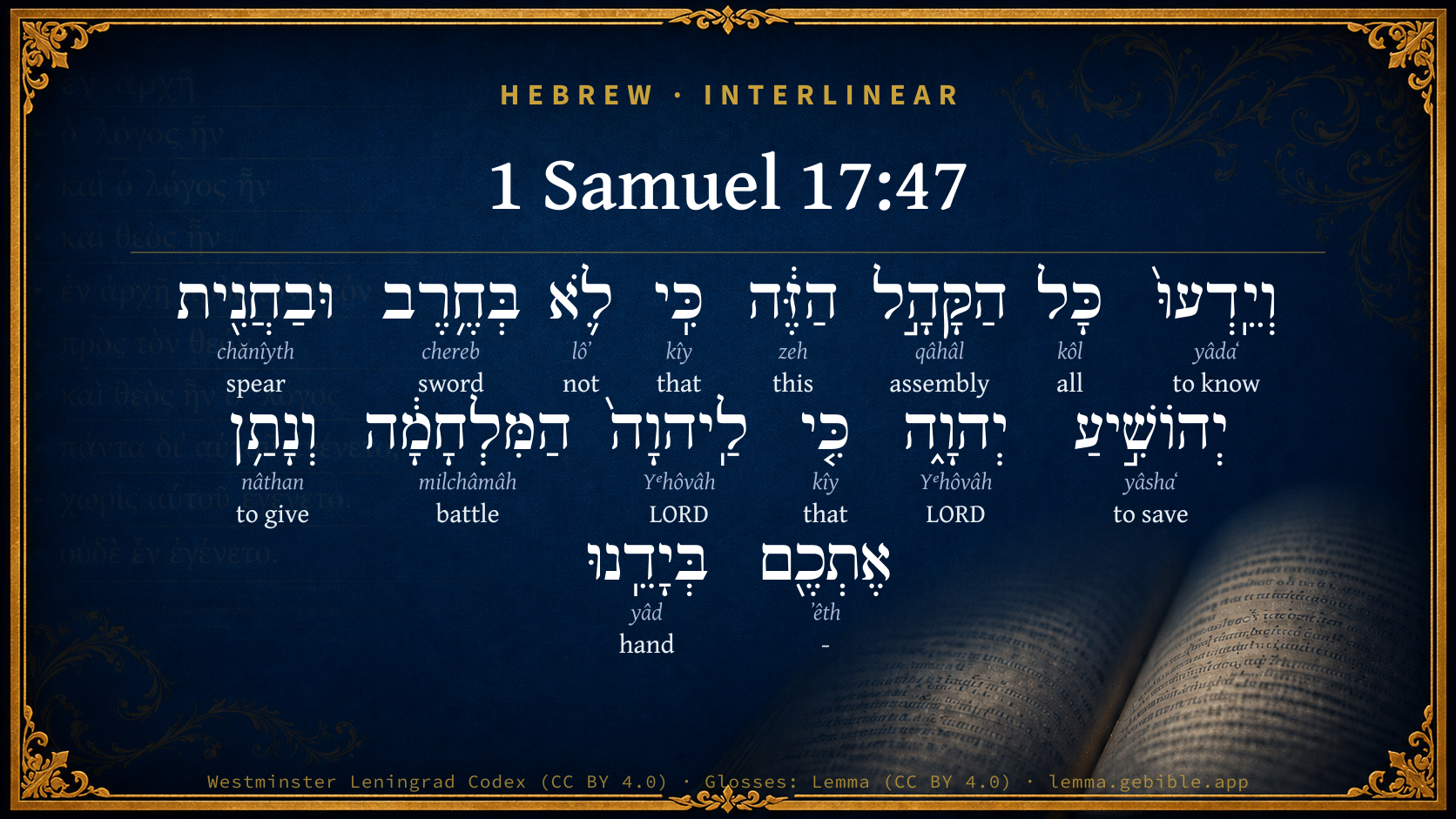
1 Samuel 17:47

Hebrew (Westminster Leningrad Codex) 1 Samuel 17:47 appears in the Hebrew Old Testament. The text above is from the Westminster Leningrad Codex. Each word links to its Strong’s number, a concise gloss, and parsing drawn from the Open Scriptures Hebrew Bible morphology. Click any word for its full Brown-Driver-Briggs (BDB) entry.
Download image
Cite this verse

1 Samuel 17:47 (World English Bible). Public Domain. Lemma interlinear Bible study tool, https://lemma.gebible.app/v/1-samuel/17/47.

Show BibTeX & RIS
BibTeX
RIS
English Translation
and that all this assembly may know that Yahweh doesn't save with sword and spear: for the battle is Yahweh's, and he will give you into our hand.
World English Bible · Public Domain
Download a study sheet

One document with this verse’s original text, its word-by-word gloss line, the meaning frame, cross-references with their text, attributed commentary, and full source and license credits — printable, and it pastes into notes with its structure intact.

This verse Autodidact and up

Study sheet (.html) Plain text (.txt)

A passage Seminary Student

Up to 50 verses in one chapter. A passage sheet keeps up to 6 commentary sources and 12 cross-references per verse, in the order this page ranks them, and says so on the sheet whenever that leaves anything out. Ask for a single verse and you get the Autodidact verse sheet above.

Everything on this page stays free to read, with no account — the sheet is a download of what is already on screen, not access to it.

Want to remove ads? Support Godless Engineer
Compare translations 3

The same verse in 3 English versions, stacked beneath the original-language interlinear above. Click any original word for its lexicon entry.

Each is an independent rendering of the whole verse — the interlinear is not word-aligned to these translations.

Highlighted words mark where these versions differ — a whole-verse word diff, not a word-by-word alignment.

  • World English Bible Public Domain
    and that all this assembly may know that Yahweh doesn't save with sword and spear: for the battle is Yahweh's, and he will give you into our hand.
  • King James Version Public Domain
    And all this assembly shall know that the LORD saveth not with sword and spear: for the battle is the LORD's, and he will give you into our hands.
  • unfoldingWord Literal Text CC BY-SA 4.0
    And all of this assembly will know that Yahweh does not save by sword or by spear. For the battle to Yahweh, and he will give you into our hand.”

unfoldingWord Literal Text — © unfoldingWord, licensed CC BY-SA 4.0. Word-aligned USFM3 via Door43 (git.door43.org/unfoldingWord/en_ult).

Versions to compare (up to 4)

3 of 4 selected

Show all 18 translations

Every available English version of this verse, each an independent rendering of the whole verse.

  • World English Bible Public Domain
    and that all this assembly may know that Yahweh doesn't save with sword and spear: for the battle is Yahweh's, and he will give you into our hand.
  • Berean Standard Bible Public Domain
    And all those assembled here will know that it is not by sword or spear that the LORD saves; for the battle is the LORD’s, and He will give all of you into our hands.”
  • Majority Standard Bible Public Domain
    And all those assembled here will know that it is not by sword or spear that the LORD saves; for the battle is the LORD’s, and He will give all of you into our hands.”
  • King James Version Public Domain
    And all this assembly shall know that the LORD saveth not with sword and spear: for the battle is the LORD's, and he will give you into our hands.
  • American Standard Version (1901) Public Domain
    and that all this assembly may know that Jehovah saveth not with sword and spear: for the battle is Jehovah's, and he will give you into our hand.
  • Revised Version (1885) Public Domain
    and that all this assembly may know that the LORD saveth not with sword and spear: for the battle is the LORD’S, and he will give you into our hand.
  • Geneva Bible (1599) Public Domain
    And that all this assembly may know, that the Lord saueth not with sworde nor with speare (for the battel is the Lords) and he will giue you into our handes.
  • Douay-Rheims (1899) Public Domain
    And all this assembly shall know, that the Lord saveth not with sword and spear: for it is his battle, and he will deliver you into our hands.
  • Young's Literal Translation Public Domain
    and all this assembly do know that not by sword and by spear doth Jehovah save, that the battle `is' Jehovah's, and He hath given you into our hand.'
  • Literal Standard Version CC BY-SA 4.0
    And all this assembly knows that YHWH does not save by sword and by spear, for the battle [is] YHWH’s, and He has given you into our hand.”
  • Unlocked Literal Bible CC BY-SA 4.0
    and that all this gathering may know that Yahweh does not give victory with sword or spear. For the battle is Yahweh's, and he will give you into our hand.”
  • unfoldingWord Literal Text CC BY-SA 4.0
    And all of this assembly will know that Yahweh does not save by sword or by spear. For the battle to Yahweh, and he will give you into our hand.”
  • Darby Bible Public Domain
    and all this congregation shall know that Jehovah saves not with sword and spear; for the battle is Jehovah's, and he will give you into our hands.
  • World Messianic Bible Public Domain
    and that all this assembly may know that the LORD doesn’t save with sword and spear; for the battle is the LORD’s, and he will give you into our hand.”
  • Webster's Bible Public Domain
    And all this assembly shall know that the LORD saveth not with sword and spear: for the battle is the LORD'S, and he will give you into our hands.
  • Free Bible Version CC BY-SA 4.0
    Everyone gathered here will realize that the Lord saves, but not with sword and spear. For the battle is the Lord's, and he will hand all of you over to us.”
  • Bible in Basic English Public Domain
    And all these people who are here today may see that the Lord does not give salvation by sword and spear: for the fight is the Lord's, and he will give you up into our hands.
  • JPS Tanakh (1917) Public Domain
    and that all this assembly may know that the LORD saveth not with sword and spear; for the battle is the LORD'S, and He will give you into our hand.'

Literal Standard Version (2020), Covenant Press — licensed CC BY-SA 4.0. Text via the HelloAO Bible API (eBible.org). Unlocked Literal Bible (unfoldingWord) — licensed CC BY-SA 4.0. Text via the HelloAO Bible API (eBible.org). unfoldingWord Literal Text — © unfoldingWord, licensed CC BY-SA 4.0. Word-aligned USFM3 via Door43 (git.door43.org/unfoldingWord/en_ult). Free Bible Version, Dr. Jonathan Gallagher — licensed CC BY-SA 4.0. Text via the HelloAO Bible API (eBible.org).

Word by word

More ways to search: Search by grammar → Find every occurrence → Compare this word →

Practice this passage: Drill this verse → Learn its vocabulary →

וּבַחֲנִ֖ית
chănîyth
H2595
“and · in/at · spear”
Conjunction + Preposition + Noun, Common, Feminine, Singular, Absolute
Part of Speech
Conjunction + Preposition + Noun
Type
Common
Gender
Feminine
Number
Singular
State
Absolute
Full BDB Definition

Origin: from H2583

TWOT: TWOT- 690b

spear - spear - shaft of a spear - spear-head
  1. וְיֵֽדְעוּ֙ yâdaʻ H3045 “and · to know” Conjunction + Verb, Qal, Imperfect, 3rd Person, Masculine, Plural
  2. כָּל kôl H3605 “all of” Noun, Common, Masculine, Singular, Construct
  3. הַקָּהָ֣ל qâhâl H6951 “the · assembly” Particle, Definite Article + Noun, Common, Masculine, Singular, Absolute
  4. הַזֶּ֔ה zeh H2088 “the · this” Particle, Definite Article + Pronoun, Demonstrative, Masculine, Singular
  5. כִּֽי kîy H3588 “that” Conjunction
  6. לֹ֛א lôʼ H3808 “not” Particle, Negative
  7. בְּחֶ֥רֶב chereb H2719 “in/at · sword” Preposition + Noun, Common, Feminine, Singular, Absolute
  8. יְהוֹשִׁ֣יעַ yâshaʻ H3467 “to save” Verb, Hiphil, Imperfect, 3rd Person, Masculine, Singular
  9. יְהוָ֑ה Yᵉhôvâh H3068 “LORD” Noun, Proper
  10. כִּ֤י kîy H3588 “that” Conjunction
  11. לַֽיהוָה֙ Yᵉhôvâh H3068 “to/for · LORD” Preposition + Noun, Proper
  12. הַמִּלְחָמָ֔ה milchâmâh H4421 “the · battle” Particle, Definite Article + Noun, Common, Feminine, Singular, Absolute
  13. וְנָתַ֥ן nâthan H5414 “and · to give” Conjunction + Verb, Qal, Perfect, 3rd Person, Masculine, Singular
  14. אֶתְכֶ֖ם ʼêth H853 “- · you” Particle, Direct Object + Suffix, Personal, 2nd Person, Masculine, Plural
  15. בְּיָדֵֽנוּ yâd H3027 “in/at · hand · our” Preposition + Noun, Common, Both, Singular, Construct + Suffix, Personal, 1st Person, Common, Plural

About this verse

These counts appear in no published source. They are computed here, from the morphology-tagged text and Lemma’s own curated glosses. What Lemma adds →

16
words
14
distinct lemmas
Historical
section

Shared distinctive vocabulary

וּבַחֲנִ֖ית spear H2595 occurs in 40 verses of the Hebrew Bible. Also found in:

Grammatical profile

  • 3 verbs
  • 8 nouns
  • 1 pronoun
  • 2 conjunctions
  • 2 particles

Verb forms

  • וְיֵֽדְעוּ֙ Qal · Imperfect
  • יְהוֹשִׁ֣יעַ Hiphil · Imperfect
  • וְנָתַ֥ן Qal · Perfect

Repetition

Words recur within this verse — often emphatic in Hebrew:

  • יְהוָ֑ה LORD H3068 ×2
  • כִּֽי that H3588 ×2

Hebrew & Septuagint length

In English translation the verse runs 28 words from the Hebrew and 30 from the Septuagint (LXX English) — closely comparable.

A rough comparison of the two English renderings, which tokenize alike — not a word-level alignment.

Word counts can differ between the Hebrew and the Greek without any difference in meaning — e.g. the Hebrew direct-object marker אֵת has no separate Greek word, and Greek often adds the article ὁ.

Cross-references

12

Topical passages linked to 1 Samuel 17:47 in the Treasury of Scripture Knowledge — connected by theme and wording, ordered by reader-vote popularity; previews shown in the World English Bible.

  • Psalms 44:6–7 For I will not trust in my bow, Neither shall my sword save me.
  • Zechariah 4:6 Then he answered and spoke to me, saying, "This is the word of Yahweh to Zerubbabel, saying, 'Not by might, nor by power, but by my Spirit,' says Yahweh of Hosts.
  • Hosea 1:7 But I will have mercy on the house of Judah, and will save them by Yahweh their God, and will not save them by bow, nor by sword, nor by battle, by horses, nor by horsemen."
  • Proverbs 21:30–31 There is no wisdom nor understanding Nor counsel against Yahweh.
  • 1 Samuel 14:6 Jonathan said to the young man who bore his armor, Come, and let us go over to the garrison of these uncircumcised: it may be that Yahweh will work for us; for there is no restraint to Yahweh to save by many or by few.
  • 2 Chronicles 14:11 Asa cried to Yahweh his God, and said, Yahweh, there is none besides you to help, between the mighty and him who has no strength: help us, Yahweh our God; for we rely on you, and in your name are we come against this multitude. Yahweh, you are our God; don't let man prevail against you.
  • 2 Chronicles 20:15–17 and he said, Listen you, all Judah, and you inhabitants of Jerusalem, and you king Jehoshaphat: Thus says Yahweh to you, Don't be afraid you, neither be dismayed by reason of this great multitude; for the battle is not yours, but God's.
  • Romans 8:31 What then shall we say about these things? If God is for us, who can be against us?
  • Romans 8:37 No, in all these things, we are more than conquerors through him who loved us.
  • Psalms 33:16–17 There is no king saved by the multitude of a host. A mighty man is not delivered by great strength.
  • Psalms 46:11 Yahweh of Hosts is with us. The God of Jacob is our refuge. Selah.
  • Isaiah 9:7 Of the increase of his government and of peace there shall be no end, on the throne of David, and on his kingdom, to establish it, and to uphold it with justice and with righteousness from henceforth even forever. The zeal of Yahweh of Hosts will perform this.

Cross-references courtesy of OpenBible.info (CC BY 4.0).

Hebrew and Greek witnesses Masoretic Hebrew ↔ Greek Septuagint

The same verse in the two great witnesses to the Old Testament, shown verse-for-verse.

These are two independent witnesses, not word-aligned to each other, and the Septuagint is shown in lemma (dictionary) form.

Hebrew 1 Samuel 17:47 Masoretic · Westminster Leningrad Codex

וְיֵֽדְעוּ֙ כָּל הַקָּהָ֣ל הַזֶּ֔ה כִּֽי לֹ֛א בְּחֶ֥רֶב וּבַחֲנִ֖ית יְהוֹשִׁ֣יעַ יְהוָ֑ה כִּ֤י לַֽיהוָה֙ הַמִּלְחָמָ֔ה וְנָתַ֥ן אֶתְכֶ֖ם בְּיָדֵֽנוּ

and that all this assembly may know that Yahweh doesn't save with sword and spear: for the battle is Yahweh's, and he will give you into our hand.

World English Bible · Public Domain

Greek LXX 1 Samuel 17:47 Septuagint · lemma form
And all this assembly shall know that the Lord delivers not by sword or spear, for the battle is the Lord's, and the Lord will deliver you into our hands.

LXX2012 (modern English Septuagint) · Public Domain

Hebrew: Westminster Leningrad Codex (CC BY 4.0). Greek: Septuagint (public domain); English from LXX2012 (modern English Septuagint) (Public Domain). How the Septuagint differs from the Hebrew →

Targum (Aramaic paraphrase)

1

The Targum is the ancient Jewish Aramaic paraphrase of the Hebrew Scriptures — an interpretive translation, not the Hebrew text itself. Onkelos (literal) and Pseudo-Jonathan (expansive) render the Torah, and Jonathan the Prophets. Coverage is partial: where no permissively-licensed English translation exists for a verse, only the Aramaic is shown. This is verse-level text, not a word-by-word alignment to the Hebrew.

  1. Targum Jonathan Prophets (Joshua–Malachi)
    וְיֵדְעוּן כָּל קְהָלָא הָדֵין אֲרֵי לָא בְּחַרְבָּא וּבְמוּרְנִיתָא פָּרִיק יְיָ אֲרֵי מִן קֳדָם יְיָ נִצְחָן קְרָבַיָא וְיִמְסַר יַתְכוֹן בִּידָנָא:

    (no public-domain English translation for this verse)

    Targum Jonathan — Aramaic: “Mikraot Gedolot” (public domain). English: “Sefaria Community Translation” (CC0 1.0 (public-domain dedication)); “London "Chaldee Paraphrase," 1871” (public domain). Text via Sefaria.

Commentary

Notes on 1 Samuel 17:47 from classic Christian and Jewish commentators (each source and its license shown beneath its notes). The classic Christian expositions comment on the surrounding passage and are grouped to its opening verse, so a note may address several verses; the Jewish commentaries on the Tanakh (Rashi and others) are per-verse, so they appear only where the commentator wrote on this verse.

Lemma curates 59 commentaries, every one of them public domain or Creative Commons licensed, each selected and text-cleaned for this edition rather than reprinted as found. About our sources →

Trapp's Complete Commentary

John Trapp

1Sa 17:47 And all this assembly shall know that the LORD saveth not with sword and spear: for the battle [is] the LORD’S, and he will give you into our hands.

Ver. 47. That the Lord sayeth not with sword and spear.] Is not tied to means, but crosseth oft the likeliest projects. See Zec 4:6. {See Trapp on "Zec 4:6"}

John Trapp, A Commentary or Exposition upon All the Books of the Old and New Testament (1647–1656) — public domain. Text from a community e-Sword module.

The Biblical Illustrator

Joseph S. Exell

1Sa_17:47

The battle is the Lords.

David and Goliath

This familiar dramatic story has much to teach us. One lesson only is our present consideration--Davids heroic and victorious faith. Time would fail me, said the writer of the Epistle to the Hebrews in his beautiful chronicle of the worthies of faith, to tell of Gedeon and of Barak, and of Sampson and of Jephthah; of David also. And when does his faith shine with such lustre as when, having single-handed slain Goliath, he turned to fight the armies of the aliens? In this narrative we see--

I. The surprises of faith. Forty days; and is he ever to be met in combat? Who will meet him? No Hebrew veteran. No well-panoplied soldier, but a young shepherd, and he with well-slung stone will be victor! Unlikely warrior! unlikely weapon! unlikely victory! A victory of faith. A surprise of faith. So has it ever been. The surprises of history are the surprises of faith. Who are the men who have entered the kingdom of influence wherein with abiding sceptre, they rule the human generations? Men of faith. The great men whose names are in the Old and New Testament chronicles were less likely, according to human judgment, to leave the impress they have upon the ages. And what surprises await us if we but emulate such faith? We can do all things through Christ who strengtheneth us!

II. The hindrances to faith. It is easy to go in company. It is easy among the faithful to deem our faith strong. But solitude tries the spirit. Celebrated is the poets Abdiel, because faithful found among the faithless, faithful only he. And where was another faithful beside David through all the camp of Israel.? It was no ordinary foe against whom his courage kindled. Much, too, had he to hinder him in the craven spirit of Israel. Nothing in this to help David. His eye, lit with indignant courage, met no answering light in any other. Israels only answer to Goliaths challenge was--flight! Enough in this to arrest David from offering himself for the combat. Who is he to stand forth as the pick of the nations valour? He is brought into the presence of the king. But David had to beat down hindrance sharp and strong before he reached Sauls tent. Sharper, I think, than from any other. To be thus rebuked and slandered by a brother! But his faith stood fast. He answered not bitter with bitter. Eliab was his brother, not his Lord. The battle was the Lords, the battle within him as well as against Goliath And the Lord gave him the inner victory before the outer. Had his faith failed him before Eliab he had never stood before Goliath. Hindrances to faith! How many hindrances we meet in the way of our hearts supreme surrender to, and reliance on, Christ! Hindrances from tyrannic evil habit whose power Christ only can break. Hindrances from our circumstances; our business methods; the worldly faithless atmosphere in which we long have lived. From those who nearest us can affect us the most, from kindred as close as--closer than--was Eliab to David. What then? All the more need for earnestness. But whether within or without, the battle is the Lords.

III. The argument of faith. Faith has varied arguments. Gods promises are one. Gods character is another But experience is the argument of David. This he urges with Saul. A valid argument is that of experience. Has God ever forsaken David even when life depended upon well-aimed blow against wild beast? As He had never forsaken him, so he never would. One victory carried with it the assurance of another. One enemy slain that all enemies should be destroyed. We too have personal memories of deliverance. These are to be cherished. They are silent promises. To the listening heart they speak of goodness to come as well as past. Jesus Christ is the same yesterday, today, and forever.

IV. the simplicity of faith. With what naturalness David enters and moves through this wondrous story! He runs into the camp and against Goliath with a boys eagerness, and yet stands among the soldiers, before the king, and face to face with the loud-tongued foe with the calm heroism of seasoned warrior. He will have no controversy with Eliab. He presumes not on his former service to the king; others open for him the way; the king sends for him. He is not boastful, but tells enough of his previous prowess to secure the kings assent to his championship. If faith be simple, not marred by any self-seeking, fixed only in the Lord, set only on His glory, difficulties drop asunder into a pathway for our feet. No matter of what kind they may be. Only trust in God and do the right; let that be the constant rule of life, and you can safely leave the result with Him. Be fearful of criticism; be swayed by the opinions of men, and then the path darkens, troubles gather, and even when the right thing is done it has no acceptance with God, being done to please men and not Him.

V. The victory of faith. Calmly forth went David, a spectacle to two armies. On he went alone, yet not alone, being, in the words of Josephus, accompanied with an invisible assistant, who was no other than God Himself. He teaches us to fight. He assures us of victory. Under His banner the weakest saint shall win the day. He helps to every prayer and effort of resistance. (G. T. Coster.)

The Biblical Illustrator, edited by Joseph S. Exell (c. 1880s–1900s) — public domain. Text from a community e-Sword module.

Joseph Benson's Commentary

1Sa 17:47. Saveth not with sword and spear — That is, that he can save without these arms, and with the most contemptible weapons, and that he needs not human force to effect his designs. For the battle is the Lord’s — The events of war are wholly in his power. And he will give you into our hands — David speaks thus confidently, because he was assured of success, by particular inspiration. How great is the difference between the speech of Goliath and that of David! The former consists of the vain- glorious boasting words of a man proudly confiding in his own strength, and thinking of nothing but his own glory. The words of the latter, although expressing an equal assurance of victory, are humble and modest, attributing nothing to himself, but all to the power and goodness of God; building his hopes upon, and rejoicing in, the honour that would accrue to God from his success, instead of puffing himself up with the glory that would arise to himself therefrom.

Joseph Benson's Commentary on the Old and New Testaments (1811–1818) — public domain. Text from a community e-Sword module.

Adam Clarke's Commentary

Verse 47. For the battle is the Lord's] It is the Lord's war: you are fighting against him and his religion, as the champion of your party; I am fighting for God, as the champion of his cause.

Adam Clarke's Commentary on the Bible (1810–1826) — public domain. Text from a community e-Sword/MySword module.

Ellicott's Commentary for English Readers

(47) For the battle is the Lord’s . . .—Although we possess no special ode or psalm composed by David on the occasion of this mortal combat, in which, owing to his sure trust in Jehovah, he won his never-to-be-forgotten victory, yet in many of the compositions attributed to him in the Psalter we find memories of this, his first great triumph. So in Psa_44:6-8 we read—

“I will not trust in my bow,

Neither shall my sword save me.

In God we boast all the day long,

And praise thy Name for ever.”

And in Psa_33:16-20,

“There is no king saved by the multitude of an host,

A mighty man is not delivered by much strength.”

* * * * *

“Our soul waiteth for the Lord,

He is our help and our shield.”

A Bible Commentary for English Readers, edited by Charles John Ellicott (1878–1897) — public domain. Text from a community e-Sword module.

The Cambridge Bible for Schools and Colleges

gen. ed. J. J. S. Perowne

47. the Lord saveth not with sword and spear, &c.] A lesson which is needed at all times, when men are tempted to fall down and worship brute force. It is a leading thought in Hannah’s song (1Sa_2:1-10); cp. also 1Sa_14:6; Psa_44:6-7; Hos_1:7; Zec_4:6; 1Co_1:27-28.

The Cambridge Bible for Schools and Colleges (gen. ed. J. J. S. Perowne; Cambridge University Press, 1878–1918) — public domain. Text from a community e-Sword module.

John Gill's Exposition

And all this assembly shall know,.... The congregation of Israel, and church of the living God, great part of which were now gathered together, and were spectators of this wonderful event:

that the Lord saveth not with sword and spear; that is, by outward means and instruments, by arms and armed men; he does not save by them only, or by them always; he can save as well without them as with them:

for the battle is the Lord's; it is under his direction; the issue and event of it depend on his will, and are owing to him; or, as the Targum,"from the Lord is the victory of wars,''it is he that gives it to whom he pleases:

and he will give you into our hands; not only this Philistine into the hands of David, but the army of them into the hands of the Israelites; David knew, and was assured of this by the Lord, and it was on this he relied, and was what animated him to engage with this champion in the manner he did.

John Gill's Exposition of the Whole Bible (1746–1763) — public domain (CC PDM 1.0). Text via the HelloAO Bible API.

Albert Barnes' Notes on the Bible

The Lord saveth not with sword ... - Observe the consistent teaching of such passages as 1Sa 14:6; Exo 14:13-18; Jdg 7:2, Jdg 7:4,Jdg 7:7; Psa 44:6, etc., and their practical use to the Church as lessons of trust in God, and distrust of ourselves.

Albert Barnes' Notes on the Bible (1834–1885) — public domain. Text from a community e-Sword/MySword module.

Haydock's Catholic Bible Commentary

Battle, whose armies thou hast defied, (ver. 45.; Haydock) or in general, He is the God of war, who grants victory to whom He pleases. (Calmet)

George Leo Haydock (1774–1849), Haydock's Catholic Family Bible and Commentary, 1859 edition — public domain. Excludes Psalms (Douay-Rheims chapter numbering differs from Protestant) and Deuterocanonical books (Catholic canon only).

Matthew Poole's English Annotations

That the Lord saveth not with sword and spear, i.e. that he can save without these arms, and with the most contemptible weapons, such as mine seem to thee.

The battle is the Lord’s, i.e. the events of war are wholly in his power, to give success to whom and by what means he pleaseth.

He will give you into our hands: David speaks thus confidently, because he was assured of it by a particular inspiration from God.

Matthew Poole's English Annotations on the Holy Bible (1683–1685) — public domain. Text from a community e-Sword/MySword module.

The Pulpit Commentary

The battle is the Lord"s.

Many of the battles which are waged on earth are not the Lord"s. They are unnecessary and unrighteous. The end they seek and the means they adopt to attain it are evil. Other conflicts are only the Lord"s in an inferior sense. Although not unnecessary, nor in themselves unrighteous, they are waged with secular aims and carnal weapons. But there is one which is the Lord"s in the highest sense. It is a holy war; a conflict of the kingdom of light with the kingdom of darkness. Observe that

1. The obligation is imposed by the Lord. "Fight the good fight of faith.

2. The adversaries are the adversaries of the Lord. "Principalities and powers," etc.

3. The soldiers are the people of the Lord. Those in whose hearts the principles of the kingdom of God are implanted peace, and joy in the Holy Ghost.

4. The Commander is the Anointed of the Lord. "The Captain of our salvation." "The Leader and Commander of the people.

5. The weapons are provided by the Lord. "Put on the whole armour of God armour of light.

6. The success is due to the Lord. He gives the strength which is needed: "teacheth our hands to war, and our fingers to fight," and "he will give you into our hands.

7. The end is the glory of the Lord. When it is over God will be "all in all." "Who is on the Lord"s side? D.

The Pulpit Commentary (1880–1919), ed. H.D.M. Spence-Jones & Joseph S. Exell — public domain. Text from a community e-Sword module.

John Wesley's Explanatory Notes

Saveth - That is, that he can save without these arms, and with the most contemptible weapons. The battle - That is, the events of war are wholly in his power. He will - David speaks thus confidently, because he was assured of it by a particular inspiration.

John Wesley, Explanatory Notes Upon the Whole Bible (1754–1765) — public domain. Text via the GEBible commentary corpus.

Lesson kit

Teaching starters — assembled from the data on this page, not authored interpretation. Every prompt links to the verse data it draws on. Edit before teaching.

1 Samuel, in the Historical, opens this verse with 16 words (14 distinct Hebrew lemmas). Its most distinctive word is chănîyth (“spear”). A historical commentator’s framing appears above. Read the whole chapter for the surrounding context.

Discussion questions

  1. The word chănîyth carries the sense “spear.” How does it shape the verse?
  2. How does 1 Samuel 13:19, which shares the word «spear», read alongside this verse?
  3. What does the repetition of “LORD” (2× in this one verse) do in this verse?
  4. These translations render this verse differently; the difference is in the English rendering, not the original. What questions does that raise?
  5. «וְיֵֽדְעוּ֙» is a Qal Imperfect verb. How does that grammatical form shape the action described?
  6. Compare how Trapp's Complete Commentary and The Biblical Illustrator read this verse. Where do they agree or differ?

Things to notice

Reading settings

Reading text

Shown beneath each verse's original-language words.

Old Testament
Old Testament edition

Read the OT as the Masoretic Hebrew (MT) or the Greek Septuagint (LXX).

English shown for the Greek Septuagint (in the Hebrew ↔ Greek comparison).

Comparing translations? Open the Compare panel on any verse page to stack up to four side by side.