Exodus 15:9

Hebrew (Westminster Leningrad Codex) Exodus 15:9 appears in the Hebrew Old Testament. The text above is from the Westminster Leningrad Codex. Each word links to its Strong’s number, a concise gloss, and parsing drawn from the Open Scriptures Hebrew Bible morphology. Click any word for its full Brown-Driver-Briggs (BDB) entry.
Download image
Cite this verse

Exodus 15:9 (World English Bible). Public Domain. Lemma interlinear Bible study tool, https://lemma.gebible.app/v/exodus/15/9.

Show BibTeX & RIS
BibTeX
RIS
English Translation
The enemy said, 'I will pursue, I will overtake, I will divide the spoil. My desire shall be satisfied on them. I will draw my sword, my hand shall destroy them.'
World English Bible · Public Domain
Download a study sheet

One document with this verse’s original text, its word-by-word gloss line, the meaning frame, cross-references with their text, attributed commentary, and full source and license credits — printable, and it pastes into notes with its structure intact.

This verse Autodidact and up

Study sheet (.html) Plain text (.txt)

A passage Seminary Student

Up to 50 verses in one chapter. A passage sheet keeps up to 6 commentary sources and 12 cross-references per verse, in the order this page ranks them, and says so on the sheet whenever that leaves anything out. Ask for a single verse and you get the Autodidact verse sheet above.

Everything on this page stays free to read, with no account — the sheet is a download of what is already on screen, not access to it.

Want to remove ads? Support Godless Engineer
Compare translations 3

The same verse in 3 English versions, stacked beneath the original-language interlinear above. Click any original word for its lexicon entry.

Each is an independent rendering of the whole verse — the interlinear is not word-aligned to these translations.

Highlighted words mark where these versions differ — a whole-verse word diff, not a word-by-word alignment.

  • World English Bible Public Domain
    The enemy said, 'I will pursue, I will overtake, I will divide the spoil. My desire shall be satisfied on them. I will draw my sword, my hand shall destroy them.'
  • King James Version Public Domain
    The enemy said, I will pursue, I will overtake, I will divide the spoil; my lust shall be satisfied upon them; I will draw my sword, my hand shall destroy them.
  • unfoldingWord Literal Text CC BY-SA 4.0
    The enemy said, ‘I will pursue, I will overtake; I will share out the plunder; my soul will be satisfied in them; I will empty my sword; my hand will dispossess them.’

unfoldingWord Literal Text — © unfoldingWord, licensed CC BY-SA 4.0. Word-aligned USFM3 via Door43 (git.door43.org/unfoldingWord/en_ult).

Versions to compare (up to 4)

3 of 4 selected

Show all 18 translations

Every available English version of this verse, each an independent rendering of the whole verse.

  • World English Bible Public Domain
    The enemy said, 'I will pursue, I will overtake, I will divide the spoil. My desire shall be satisfied on them. I will draw my sword, my hand shall destroy them.'
  • Berean Standard Bible Public Domain
    The enemy declared, ‘I will pursue, I will overtake. I will divide the spoils; I will gorge myself on them. I will draw my sword; my hand will destroy them.’
  • Majority Standard Bible Public Domain
    The enemy declared, ‘I will pursue, I will overtake. I will divide the spoils; I will gorge myself on them. I will draw my sword; my hand will destroy them.’
  • King James Version Public Domain
    The enemy said, I will pursue, I will overtake, I will divide the spoil; my lust shall be satisfied upon them; I will draw my sword, my hand shall destroy them.
  • American Standard Version (1901) Public Domain
    The enemy said, I will pursue, I will overtake, I will divide the spoil; My desire shall be satisfied upon them; I will draw my sword, my hand shall destroy them.
  • Revised Version (1885) Public Domain
    The enemy said, I will pursue, I will overtake, I will divide the spoil: My lust shall be satisfied upon them; I will draw my sword, my hand shall destroy them.
  • Geneva Bible (1599) Public Domain
    The enemie sayd, I wil pursue, I wil ouertake them, I will deuide the spoyle, my lust shall bee satisfied vpon them, I will drawe my sworde, mine hand shall destroy them.
  • Douay-Rheims (1899) Public Domain
    The enemy said: I will pursue and overtake, I will divide the spoils, my soul shall have its fill: I will draw my sword, my hand shall slay them.
  • Young's Literal Translation Public Domain
    The enemy said, I pursue, I overtake; I apportion spoil; Filled is my soul with them; I draw out my sword; My hand destroyeth them: --
  • Literal Standard Version CC BY-SA 4.0
    The enemy said, I pursue, I overtake; I apportion spoil; My soul is filled with them; I draw out my sword; My hand destroys them—
  • Unlocked Literal Bible CC BY-SA 4.0
    The enemy said, 'I will pursue, I will overtake, I will share out the plunder; my desire will be satisfied on them; I will draw my sword; my hand will destroy them.'
  • unfoldingWord Literal Text CC BY-SA 4.0
    The enemy said, ‘I will pursue, I will overtake; I will share out the plunder; my soul will be satisfied in them; I will empty my sword; my hand will dispossess them.’
  • Darby Bible Public Domain
    The enemy said, I will pursue, I will overtake, I will divide the spoil; my soul shall be sated upon them; I will unsheath my sword, my hand shall dispossess them.
  • World Messianic Bible Public Domain
    The enemy said, ‘I will pursue. I will overtake. I will divide the plunder. My desire will be satisfied on them. I will draw my sword. My hand will destroy them.’
  • Webster's Bible Public Domain
    The enemy said, I will pursue, I will overtake, I will divide the spoil; my lust shall be satisfied upon them; I will draw my sword, my hand shall destroy them.
  • Free Bible Version CC BY-SA 4.0
    The enemy bragged, “I will chase them and catch up with them. I will divide the plunder. I will eat them alive. I will swing my sword. By my hand I will destroy them.”
  • Bible in Basic English Public Domain
    Egypt said, I will go after them, I will overtake, I will make division of their goods: my desire will have its way with them; my sword will be uncovered, my hand will send destruction on them.
  • JPS Tanakh (1917) Public Domain
    The enemy said: 'I will pursue, I will overtake, I will divide the spoil; my lust shall be satisfied upon them; I will draw my sword, my hand shall destroy them.'

Literal Standard Version (2020), Covenant Press — licensed CC BY-SA 4.0. Text via the HelloAO Bible API (eBible.org). Unlocked Literal Bible (unfoldingWord) — licensed CC BY-SA 4.0. Text via the HelloAO Bible API (eBible.org). unfoldingWord Literal Text — © unfoldingWord, licensed CC BY-SA 4.0. Word-aligned USFM3 via Door43 (git.door43.org/unfoldingWord/en_ult). Free Bible Version, Dr. Jonathan Gallagher — licensed CC BY-SA 4.0. Text via the HelloAO Bible API (eBible.org).

Word by word

More ways to search: Search by grammar → Find every occurrence → Compare this word →

Practice this passage: Drill this verse → Learn its vocabulary →

אָרִ֣יק
rûwq
H7324
“to empty”
Verb, Hiphil, Imperfect, 1st Person, Common, Singular
Part of Speech
Verb
Stem
Hiphil
Form
Imperfect
Person
1st Person
Gender
Common
Number
Singular
Full BDB Definition

Origin: a primitive root

TWOT: 2161

to make empty, empty out - (Hiphil) - to empty, keep empty or hungry - to pour out or down - to empty out - (Hophal) to be emptied out
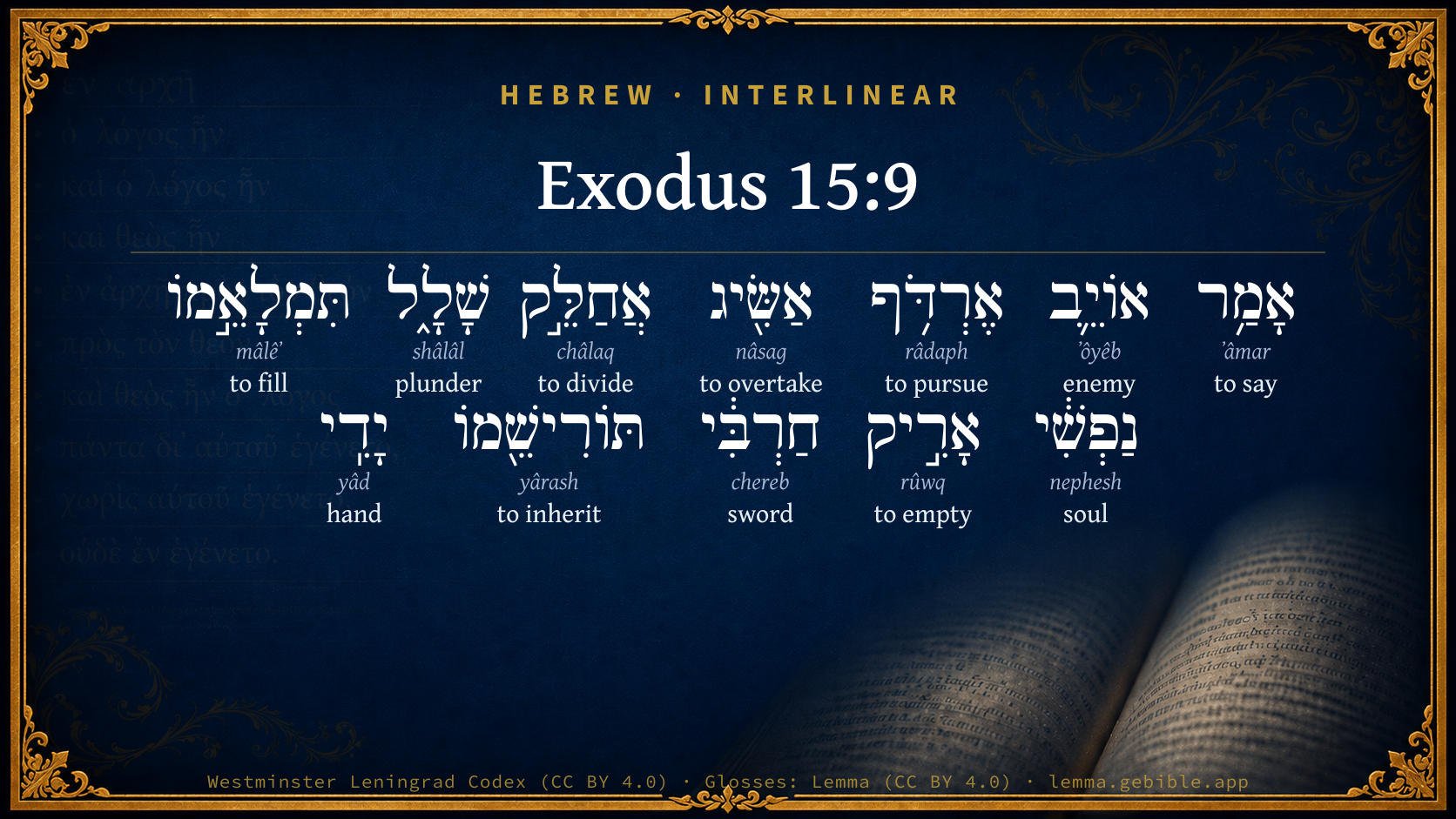
  1. אָמַ֥ר ʼâmar H559 “to say” Verb, Qal, Perfect, 3rd Person, Masculine, Singular
  2. אוֹיֵ֛ב ʼôyêb H341 “enemy” Verb, Qal, Participle Active, Masculine, Singular, Absolute
  3. אֶרְדֹּ֥ף râdaph H7291 “to pursue” Verb, Qal, Imperfect, 1st Person, Common, Singular
  4. אַשִּׂ֖יג nâsag H5381 “to overtake” Verb, Hiphil, Imperfect, 1st Person, Common, Singular
  5. אֲחַלֵּ֣ק châlaq H2505 “to divide” Verb, Piel, Imperfect, 1st Person, Common, Singular
  6. שָׁלָ֑ל shâlâl H7998 “plunder” Noun, Common, Masculine, Singular, Absolute
  7. תִּמְלָאֵ֣מוֹ mâlêʼ H4390 “to fill · them” Verb, Qal, Imperfect, 3rd Person, Feminine, Singular + Suffix, Personal, 3rd Person, Masculine, Plural
  8. נַפְשִׁ֔י nephesh H5315 “soul · my” Noun, Common, Both, Singular, Construct + Suffix, Personal, 1st Person, Common, Singular
  9. חַרְבִּ֔י chereb H2719 “sword · my” Noun, Common, Feminine, Singular, Construct + Suffix, Personal, 1st Person, Common, Singular
  10. תּוֹרִישֵׁ֖מוֹ yârash H3423 “to inherit · them” Verb, Hiphil, Imperfect, 3rd Person, Feminine, Singular + Suffix, Personal, 3rd Person, Masculine, Plural
  11. יָדִֽי yâd H3027 “hand · my” Noun, Common, Both, Singular, Construct + Suffix, Personal, 1st Person, Common, Singular

About this verse

These counts appear in no published source. They are computed here, from the morphology-tagged text and Lemma’s own curated glosses. What Lemma adds →

12
words
12
distinct lemmas
Pentateuch
section

Notable vocabulary

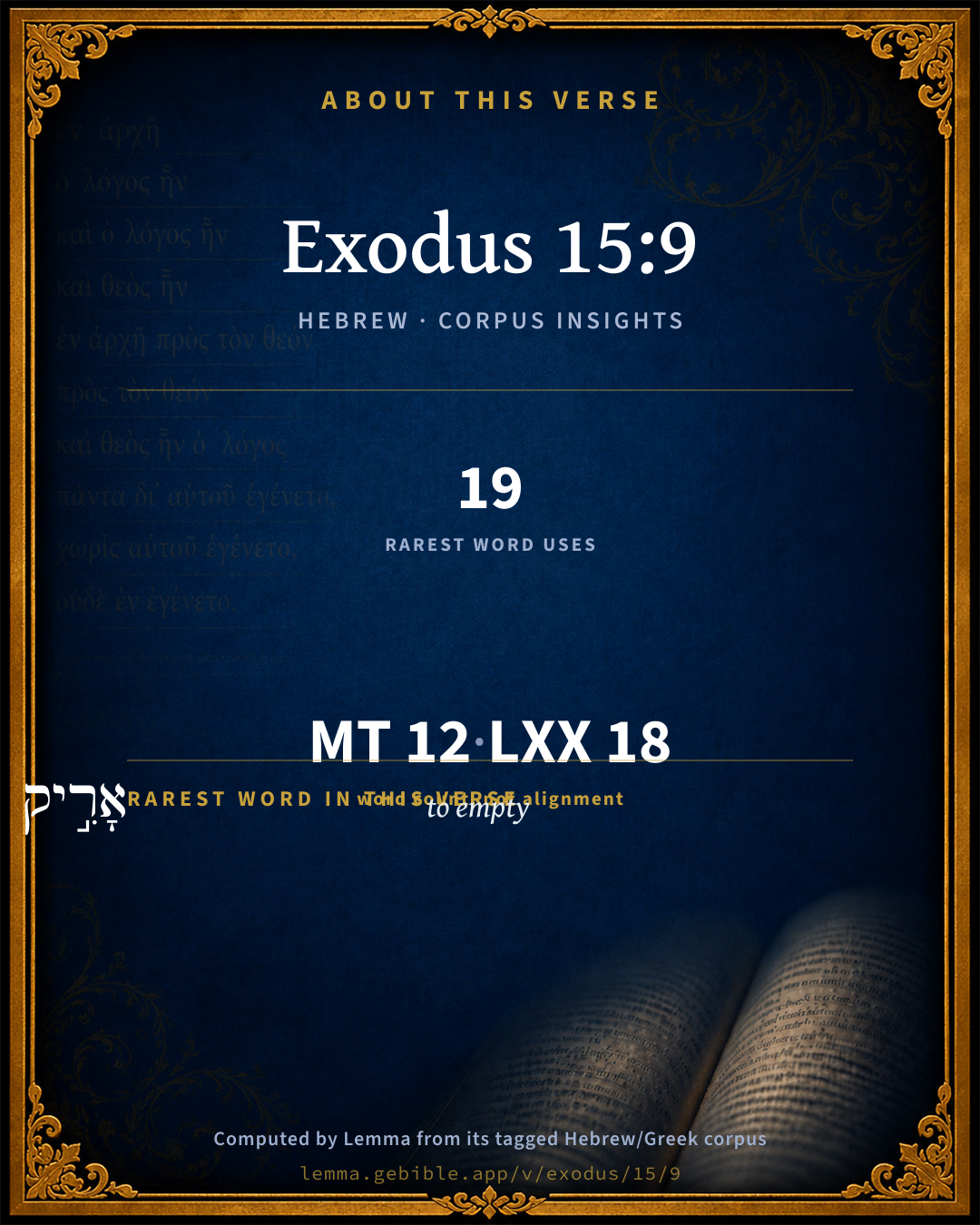
The rarest word here is אָרִ֣יק to empty H7324 — appearing just 19 times in the whole Hebrew Bible.

Shared distinctive vocabulary

אָרִ֣יק to empty H7324 occurs in 19 verses of the Hebrew Bible. Also found in:

Grammatical profile

  • 8 verbs
  • 4 nouns

Verb forms

  • אָמַ֥ר Qal · Perfect
  • אוֹיֵ֛ב Qal · Participle Active
  • אֶרְדֹּ֥ף Qal · Imperfect
  • אַשִּׂ֖יג Hiphil · Imperfect
  • אֲחַלֵּ֣ק Piel · Imperfect
  • תִּמְלָאֵ֣מוֹ Qal · Imperfect
  • אָרִ֣יק Hiphil · Imperfect
  • תּוֹרִישֵׁ֖מוֹ Hiphil · Imperfect

Hebrew & Septuagint length

In English translation the verse runs 31 words from the Hebrew and 30 from the Septuagint (LXX English) — closely comparable.

A rough comparison of the two English renderings, which tokenize alike — not a word-level alignment.

Word counts can differ between the Hebrew and the Greek without any difference in meaning — e.g. the Hebrew direct-object marker אֵת has no separate Greek word, and Greek often adds the article ὁ.

In the original languages it is 12 Hebrew tokens and 18 Greek tokens — but the two are counted differently (Hebrew bundles its prefixes and suffixes into one token; the Greek is in lemma form), so that isn’t a like-for-like length.

Cross-references

11

Topical passages linked to Exodus 15:9 in the Treasury of Scripture Knowledge — connected by theme and wording, ordered by reader-vote popularity; previews shown in the World English Bible.

  • Judges 5:30 Have they not found, have they not divided the spoil? A lady, two ladies to every man; To Sisera a spoil of dyed garments, A spoil of dyed garments embroidered, Of dyed garments embroidered on both sides, on the necks of the spoil?
  • Exodus 14:5 It was told the king of Egypt that the people had fled; and the heart of Pharaoh and of his servants was changed towards the people, and they said, "What is this we have done, that we have let Israel go from serving us?"
  • Isaiah 53:12 Therefore will I divide him a portion with the great, and he shall divide the spoil with the strong; because he poured out his soul to death, and was numbered with the transgressors: yet he bore the sin of many, and made intercession for the transgressors.
  • Luke 11:22 But when someone stronger attacks him and overcomes him, he takes from him his whole armor in which he trusted, and divides his spoils.
  • Genesis 49:27 "Benjamin is a ravenous wolf. In the morning he will devour the prey. At evening he will divide the spoil."
  • Isaiah 36:20 Who are they among all the gods of these countries, that have delivered their country out of my hand, that Yahweh should deliver Jerusalem out of my hand?
  • Habakkuk 3:14 You pierced the heads of his warriors with their own spears. They came as a whirlwind to scatter me, Gloating as if to devour the wretched in secret.
  • Exodus 14:8–9 Yahweh hardened the heart of Pharaoh king of Egypt, and he pursued after the children of Israel; for the children of Israel went out with a high hand.
  • 1 Kings 19:2 Then Jezebel send a messenger to Elijah, saying, So let the gods do to me, and more also, if I don't make your life as the life of one of them by tomorrow about this time.
  • 1 Kings 20:10 Ben Hadad sent to him, and said, The gods do so to me, and more also, if the dust of Samaria shall suffice for handfuls for all the people who follow me.
  • Isaiah 10:8–13 For he says, Aren't my princes all of them kings?

Cross-references courtesy of OpenBible.info (CC BY 4.0).

Hebrew and Greek witnesses Masoretic Hebrew ↔ Greek Septuagint

The same verse in the two great witnesses to the Old Testament, shown verse-for-verse.

These are two independent witnesses, not word-aligned to each other, and the Septuagint is shown in lemma (dictionary) form.

Hebrew Exodus 15:9 Masoretic · Westminster Leningrad Codex

אָמַ֥ר אוֹיֵ֛ב אֶרְדֹּ֥ף אַשִּׂ֖יג אֲחַלֵּ֣ק שָׁלָ֑ל תִּמְלָאֵ֣מוֹ נַפְשִׁ֔י אָרִ֣יק חַרְבִּ֔י תּוֹרִישֵׁ֖מוֹ יָדִֽי

The enemy said, 'I will pursue, I will overtake, I will divide the spoil. My desire shall be satisfied on them. I will draw my sword, my hand shall destroy them.'

World English Bible · Public Domain

Greek LXX Exodus 15:9 Septuagint · lemma form

εἶπον ὁ ἐχθρός διώκω καταλαμβάνω μερίζω σκῦλον ἐνπίμπλημι ψυχή ἐγώ ἀνααἱρέω ὁ μάχαιρα ἐγώ κυριεύω ὁ χείρ ἐγώ

The enemy said, I will pursue, I will overtake, I will divide the spoils; I will satisfy my soul, I will destroy with my sword, my hand shall have dominion.

LXX2012 (modern English Septuagint) · Public Domain

On this verse, Ellicott's Commentary for English Readers discusses the Septuagint’s reading. Read the note in Commentary ↓

Hebrew: Westminster Leningrad Codex (CC BY 4.0). Greek: Septuagint (public domain); English from LXX2012 (modern English Septuagint) (Public Domain). How the Septuagint differs from the Hebrew →

Targum (Aramaic paraphrase)

2

The Targum is the ancient Jewish Aramaic paraphrase of the Hebrew Scriptures — an interpretive translation, not the Hebrew text itself. Onkelos (literal) and Pseudo-Jonathan (expansive) render the Torah, and Jonathan the Prophets. Coverage is partial: where no permissively-licensed English translation exists for a verse, only the Aramaic is shown. This is verse-level text, not a word-by-word alignment to the Hebrew.

  1. Targum Onkelos Torah (Genesis–Deuteronomy)
    דַהֲוָה אֲמַר סָנְאָה אֶרְדוֹף אַדְבֵּק אֲפַלֵג בִּזְתָא תִּשְׂבַּע מִנְהוֹן נַפְשִׁי אֶשְׁלוֹף חַרְבִּי תְּשֵׁיצִינוּן יְדִי:

    (no public-domain English translation for this verse)

    Targum Onkelos — Aramaic: “Onkelos Genesis” (public domain); “Onkelos Exodus” (public domain); “Onkelos Leviticus” (public domain); “Onkelos Numbers” (public domain); “Onkelos Deuteronomy” (public domain). English: “Sefaria Community Translation” (CC0 1.0 (public-domain dedication)); “J.W. Etheridge. The Targums of Onkelos and Jonathan Ben Uzziel on the Pentateuch. London: Longmans, Green, 1862” (public domain). Text via Sefaria.

  2. Targum Pseudo-Jonathan Torah (Genesis–Deuteronomy)
    דַּהֲוָה אָמַר פַּרְעה רַשִׁיעָא סַנְאָה וּבַעַל דְּבָבָא אֶרְדוֹף בָּתַר עַמָא בְּנֵי יִשְרָאֵל וְנָרַע יַתְהוֹן שַׁרְיָין עַל גֵּיף יַמָא וּמְסַדְרָא לְקוּבְלֵיהוֹן סִדְרָא קְרָבָא וְנִקְטוֹל בְּהוֹן קְטוֹל רַב וְסַגִי וְנָבִיז מִנְהוֹן בִּיזָא רַבָּא וְנַשְׁבֵּי מִנְהוֹן שִׁבְיָא רַבָּא וְאַפְלוּג בִּיזֵיהוֹן לְעַמִּי עַבְדֵּי קְרָבָא וְכַד תִּתְמְלֵי נַפְשִׁי מִן דָּם קְטוֹלֵיהוֹן מִן בָּתַר כְּדֵין אֶשְׁלוֹף חַרְבִּי וְאֵישֵׁיצֵי יַתְהוֹן בְּיַד יְמִינִי

    Pharoh the wicked, the hater and adversary, did say, I will follow after the people of the sons of Israel, and will lay waste their camp on the bank of the sea: I will set war in array against them, and kill them, small and great, despoil them of much spoil, bring them back into great captivity, and divide their substance among my people who make war: and when my soul is satisfied with the blood of their slain, I will sheathe my sword, having, destroyed them with my right hand.

    Targum Pseudo-Jonathan — Aramaic: “Targum Jonathan on Genesis” (public domain); “Targum Jonathan on Exodus” (public domain); “Targum Jonathan on Leviticus” (public domain); “Targum Jonathan on Numbers” (public domain); “Targum Jonathan on Deuteronomy” (public domain). English: “The Targum of Jonathan ben Uzziel, trans. J. W. Etheridge, London, 1862” (public domain). Text via Sefaria.

Commentary

Notes on Exodus 15:9 from classic Christian and Jewish commentators (each source and its license shown beneath its notes). The classic Christian expositions comment on the surrounding passage and are grouped to its opening verse, so a note may address several verses; the Jewish commentaries on the Tanakh (Rashi and others) are per-verse, so they appear only where the commentator wrote on this verse.

Lemma curates 59 commentaries, every one of them public domain or Creative Commons licensed, each selected and text-cleaned for this edition rather than reprinted as found. About our sources →

Trapp's Complete Commentary

John Trapp

Exo 15:9 The enemy said, I will pursue, I will overtake, I will divide the spoil; my lust shall be satisfied upon them; I will draw my sword, my hand shall destroy them.

Ver. 9. The enemy said, I will.] They made account all was their own, but were soon confuted, as were likewise Sisera and Sennacherib. Where the beginning of a business is confidence, the end is confusion.

John Trapp, A Commentary or Exposition upon All the Books of the Old and New Testament (1647–1656) — public domain. Text from a community e-Sword module.

The Biblical Illustrator

Joseph S. Exell

Exo_15:9-10

The enemy said.

The enemys spirit

Observe the spirit of the enemy of Israel. It was characterized--

1. By great ambition. It was the love of power and dominion. To hold human beings as property is the vilest display of ambition.

2. Great arrogance and pride. I will pursue (rather repossess), overtake, divide, etc. What self-confidence! What boasting! What assumption! Pride goeth before destruction.

3. Insatiable avarice. Divide the spoil. Had not Pharaoh enough? An avaricious spirit unceasingly cries, Give! give! What a cursed spirit it is! Well has it been said that nature is content with little, grace with less, but the lust of avarice not even with all things.

4. Reckless malevolence and cruelty. My lust shall be satisfied, I will draw my sword, etc. What thirsting for blood! Ambition and avarice render the mind cold and the heart callous. Tears, wailings, groans, mangled bodies and the flowing blood of mankind allay not the fires of human malevolence and lust.

5. Presumptuous confidence and security. I will do, not endeavour, no peradventure. Contingency and doubt have no place. How foolish for the man who puts on the armour to boast. (A. Nevin, D. D.)

Gods Church and her enemies

Israel was a type of the Church, Pharaoh a type of the Churchs enemies in all ages of the world, both of the spiritual enemy Satan, and of the temporal, his instruments. The deliverance was a type of the deliverance that Christ wrought upon the cross by His blood; also of that Christ works upon His throne, the one from the reign of sin, the other from the empire of antichrist. The text is a part of Moses song; a song after victory, a panegyric; the praise of God, attended with dancing, at the sight of the Egyptian wrecks (Exo_15:20).

1. It was then real; the Israelites then sang it.

2. It is typical; the conquerors of antichrist shall again triumph in the same manner (Rev_15:3).

3. It was an earnest of future deliverance to the Israelites.

General observations.

1. The greatest idolaters are the fiercest enemies against the Church of God. It is the Egyptian is the enemy. No nation had more and more sordid idols.

2. The Churchs enemies are not for her correction, but her destruction: I will pursue; my hand shall destroy them.

3. How desperate are sometimes the straits of Gods Israel in the eye of man! How low their spirits before deliverance.

4. God orders the lusts of men for His own praise.

5. The nearer the deliverance of the Church is, the fiercer are Gods judgments on the enemies of it, and the higher the enemies rage.

6. All creatures are absolutely under the sovereignty of God, and are acted by His power in all their services.

7. By the same means God saves His people, whereby He destroys His enemies: the one sank, the other passed through. That which makes one balance sink makes the other rise the higher.

8. The strength and glory of a people is more wasted by opposing the interests of the Church than in conflicts with any other enemy.

9. We may take notice of the folly of the Churchs enemies. Former plagues might have warned them of the power of God, they had but burned their own fingers by pinching her, yet they would set their force against almighty power, that so often had worsted them; it is as if men would pull down a steeple with a string.

But the observations I shall treat of are--

1. When the enemies of the Church are in the highest fury and resolution, and the Church in the greatest extremity and dejection, then is the fittest time for God to work her deliverance fully and perfectly. When the enemy said, I will pursue, I will overtake, I will divide the spoil, etc., then God blowed with His wind, then they sank.

2. God is the author of all the deliverances of the Church, whosoever are the instruments. Thou didst blow with Thy wind; who is like unto the Lord among the gods. Uses: How dear is the Church to God!

2. Remember former deliverances in time of straits.

3. Thankfully remember former deliverances. (S. Charnock, B. D.)

Vanity of boasting

When Bonaparte was about to invade Russia, a person who had endeavoured to dissuade him from his purpose, finding he could not prevail, quoted to him the proverb, Man proposes, but God disposes; to which he indignantly replied, I dispose as well as propose. A Christian lady, on hearing the impious boast, remarked, I set that down as the turning-point of Bonapartes fortunes. God will not suffer a creature with impunity thus to usurp His prerogative. It happened to Bonaparte just as the lady predicted. His invasion of Russia was the commencement of his fall.

Triumphing before the battle

Nothing can be got, but much may be lost, by triumphing before a battle. When Charles V. invaded France, he lost his generals and a great part of his army by famine and disease; and returned baffled and thoroughly mortified from an enterprize which he began with such confidence of its happy issue, that he desired Paul Jovius, the historian, to make a large provision of paper sufficient to record the victories which he was going to acquire!

Providentially destroyed

During the last summer, at Coblentz, we saw a monument erected to commemorate the French campaign against the Russians in 1812. It was a gigantic failure; 400,000 men set forth for Moscow; 25,000, battered and worn and weary, tattered and half famished, returned. Do you ask how it was done? Not by the timid Alexanders guns and swords. We read in one place that the stars in their courses fought against Sisera; in another, how God has sent an army of locusts to overthrow an army of men; but here the very elements combine to drive the invader back in disgrace. Yes. He gave snow like wool, He scattered His hoar-frost like ashes, He cast forth His ice like morsels--who can stand before His cold? Who? Not Napoleon who, with self-sufficient heart, boasted in his own right hand, and sacrificed to his insatiable ambition the blood of myriads of murdered men. No! God blows upon him with His wind out of the north, and, shivering and half-starved, he slinks back in defeat. What a picture! But Alexander had not forgotten to prepare his ways before the Lord and seek the God of Jacobs aid. And in recognition of the Divine interposition and help, he struck a medal with a legend: Not to me, not to us, but unto Thy Name. Thus the lesson taught by ancient and modern history is, that the race is not to the swift, nor the battle to the strong, but to the man who prepares his ways before the Lord his God. (Enoch Hall.)

The Biblical Illustrator, edited by Joseph S. Exell (c. 1880s–1900s) — public domain. Text from a community e-Sword module.

Joseph Benson's Commentary

Exo 15:9. The enemy said, I will pursue — This verse is inexpressibly beautiful. Instead of barely saying, “The Egyptians, by pursuing the Israelites, went into the sea,” Moses himself, as it were, enters into the hearts of these barbarians, assumes their passions, and makes them speak the language which their thirst of vengeance and strong desire of overtaking the Israelites had put into their hearts. I will pursue, I will overtake, I will divide the spoil — We perceive a palpable vengeance in these words as we read them. The inspired penman has not suffered one conjunction to intervene between the distinct members of the sentence, that it might have the greater spirit, and might express more naturally and forcibly the disposition of a man whose soul is fired, who discourses with himself, and does not mind connecting his words together. Moses goes further, he represents them as rioting on spoils, and swimming in joy: My lust shall be satisfied upon them.

Joseph Benson's Commentary on the Old and New Testaments (1811–1818) — public domain. Text from a community e-Sword module.

Tyndale Open Study Notes

Tyndale Open Resources

15:9-10 Compared to the Creator’s plans, all the plans of even the most powerful humans are nothing (see Ps 2:2-5). They are like dust that can be blown away with one puff of his breath (see Isa 40:15-17).

Tyndale Open Study Notes — © Tyndale Open Resources, licensed CC BY-SA 4.0. Text via the HelloAO Bible API.

Geneva Bible (1599)

Geneva Bible translators

Hebrew, my soul shall be filled.

Geneva Bible (1599) marginal notes — public domain. Text via Bolls.life.

Adam Clarke's Commentary

Verse 9. The enemy said] As this song was composed by Divine inspiration, we may rest assured that these words were spoken by Pharaoh and his captains, and the passions they describe felt, in their utmost sway, in their hearts; but how soon was their boasting confounded? "Thou didst blow with thy wind, and the sea covered them: they sank as lead in the mighty waters!"

Adam Clarke's Commentary on the Bible (1810–1826) — public domain. Text from a community e-Sword/MySword module.

Ellicott's Commentary for English Readers

(9) The enemy said.—Pharaoh’s soldiers were as anxious as their master to come to blows. (See above, Exo_15:7.) They hoped to acquire the rich spoil which the Israelites had carried off from Egypt in the shape of gold and silver ornaments and goodly apparel (Exo_12:35-36), as well as their flocks and herds (Exo_12:38).

My lust.—Heb., my soul. The particular passion to be gratified was cupidity, or desire of riches.

Destroy them.—So the Vulg., Onkelos, Rosenmüller, Knobel, Kalisch, and others. The meaning “re-possess,” given in the margin, rests upon the rendering of the LXX., which is κυριεύσει, but is otherwise unsupported.

A Bible Commentary for English Readers, edited by Charles John Ellicott (1878–1897) — public domain. Text from a community e-Sword module.

The Cambridge Bible for Schools and Colleges

gen. ed. J. J. S. Perowne

9. The enemy’s confidence of victory, dramatically expressed in a series of quick, abrupt sentences, describing the rapid succession of one stage after another of the expected triumphant pursuit.

divide the spoil] A result of victory always looked forward to with satisfaction; cf. Jdg_5:30, Isa_9:3; Isa_33:23, Psa_68:12.

My soul shall be filled with them] i.e. sated, or glutted with them. The ‘soul,’ in the psychology of the Hebrews, is the seat of desire, and especially of appetite or greed; see Deu_12:15; Deu_14:26; Deu_23:24 (‘thou mayest eat grapes thy fill according to thy soul), Isa_29:8; Isa_32:6, Psa_17:9 (‘my greedy enemies,’ lit. ‘my enemies in soul’), Psa_27:12 (‘give me not over unto the soul of my enemies, so Psa_41:2), Psa_78:18 (‘by asking food for their soul’), Pro_23:2 (‘a man given to appetite,’ lit. ‘the possessor of a soul’), Ecc_6:7, Isa_56:11 (‘greedy dogs,’ lit. ‘dogs strong of soul’). See further the Glossary in the writer’s Parallel Psalter, p. 459 f.

shall dispossess them] Often used of the nations of Canaan (see on Exo_34:24). Fig. here for root out; cf. Num_14:12. ‘Destroy’ is a paraphrase, which obliterates the distinctive figure of the original.

The Cambridge Bible for Schools and Colleges (gen. ed. J. J. S. Perowne; Cambridge University Press, 1878–1918) — public domain. Text from a community e-Sword module.

John Gill's Exposition

The enemy said,.... That is, Pharaoh, who repented that he had let Israel go; an emblem of Satan, who when the people of God are taken out of his hands is uneasy at it, and seeks to recover them again into his possession; or of antichrist breathing out threatening and slaughter to the saints, the reformers departed from him, and delivered out of his captivity:

I will pursue, I will overtake, I will divide the spoil; which words being expressed without the copulative "and", show the passion he was in, the hastiness of his expressions, and the eagerness of his mind; and being delivered in such an absolute manner, "I will", "I will", &c. denote not only the fixed resolution and determination he had made to pursue, but the assurance he had of carrying his point; he thought as surely, as he pursued he should overtake, and overtaking should conquer, and get into his hands all the riches the people of Israel went out of Egypt with:

my lust shall be satified upon them; both his lust of covetousness to possess himself of the wealth the people had of their own, and which they had spoiled the Egyptians of, by borrowing of them; and also his lust of revenge and cruelty upon them; as appears from what follows:

I will draw my sword; out of its scabbard, and sheathe it in them:

my hand shall destroy them; which he made no doubt of, they being an unarmed people; and therefore, though numerous, were unable to engage with him, and defend themselves; see Rev 6:14 and with it compare Isa 10:11.

John Gill's Exposition of the Whole Bible (1746–1763) — public domain (CC PDM 1.0). Text via the HelloAO Bible API.

Haydock's Catholic Bible Commentary

Enemy. Miracles make but small impression upon the wicked. They pursue their schemes of destruction, which end in their own ruin! --- Slay. Hebrew, "despoil." Septuagint, "bring them into subjection." (Haydock)

George Leo Haydock (1774–1849), Haydock's Catholic Family Bible and Commentary, 1859 edition — public domain. Excludes Psalms (Douay-Rheims chapter numbering differs from Protestant) and Deuterocanonical books (Catholic canon only).

Matthew Poole's English Annotations

My lust; the lust of covetousness and revenge too. Shall destroy them; or, take possession of them and theirs: see of this word, Num 14:12,24.

Matthew Poole's English Annotations on the Holy Bible (1683–1685) — public domain. Text from a community e-Sword/MySword module.

Whedon's Commentary on the Bible

Daniel D. Whedon

9, 10. Third strain. Now the enemy is personified, and his boasts and threats are dramatically pictured in six terse, strong phrases, all compressed into ten nervous words, which our translation has broken up into twenty-five! In successive flashes it reveals the Egyptian host, proud, confident, fierce, eager for their prey, dashing on their chase through the darkness into the cloven sea; and then the closing couplet paints once more the waters returning at the blast of Jehovah’s breath.

Like lead — So Homer, Iliad, 24:80: “She, (Iris,) like the lead, plunged to the abyss.”

Daniel D. Whedon (gen. ed.), Commentary on the Old and New Testaments (1874–1909) — public domain. Text from a community e-Sword module.

The Pulpit Commentary

The enemy said. This verse is important as giving the animus of the pursuit, showing what was in the thoughts of the soldiers who flocked to Pharaoh"s standard at his call a point which had not been previously touched. It is remarkable as a departure from the general stately order of Hebrew poesy, and for what has been called its "abrupt, gasping" style. The broken speech imitates the utterance of one at once eager and out of breath. I will divide the spoil. The Israelites, it must be remembered, had gone out of Egypt laden with ornaments of silver and of gold, and accompanied by flocks and herds of great value. Pharaoh"s soldiers regarded this wealth as legitimate plunder, and intended to appropriate it. My lust. Literally, "my soul." Rage and hate were the passions to be satiated, rather than lust. My hand shall destroy them. So the Vulgate, Onkelos, Rosenmuller, Knobel, Kalisch, and others. The LXX have kurieusei, "acquire the lordship over them" (whence our marginal rendering) But the drawn sword points to death rather than recapture.

The Pulpit Commentary (1880–1919), ed. H.D.M. Spence-Jones & Joseph S. Exell — public domain. Text from a community e-Sword module.

John Wesley's Explanatory Notes

My lust - My desire both of revenge and gain.

John Wesley, Explanatory Notes Upon the Whole Bible (1754–1765) — public domain. Text via the GEBible commentary corpus.

Kretzmann's Popular Commentary

Paul E. Kretzmann

The Lord Sends Quails and Manna

v. 9. And Moses spake unto Aaron, Say unto all the congregation of the children of Israel, Come near before the Lord; for He hath heard your murmurings. Aaron, as the spokesman of Moses, was to make this announcement, giving the people the assurance that Jehovah had heard, and was ready to grant, the prayer included in their murmuring, in spite of the fact that it indicated a sinful weakness on their part.

v. 10. And it came to pass, as Aaron spake unto the whole congregation of the children of Israel, that they looked toward the wilderness, and, behold, the glory of the Lord appeared in the cloud. This appearance confirmed the reproof and the promise given by the mouth of the Lord’s ambassadors, and incidentally indicated to them that God was able to manifest Himself in their midst even in the desert wastes which now lay before them.

v. 11. And the Lord spake unto Moses, saying,

v. 12. I have heard the murmurings of the children of Israel. Speak unto them, saying, At even ye shall eat flesh, between the evenings, at twilight, before nightfall, and in the morning ye shall be filled with bread; and ye shall know that I am the Lord, your God. It would be another unmistakable proof of His almighty power.

v. 13. And it came to pass that at even the quails came up, and covered the camp; they arose on the horizon in great masses, like a heavy cloud, their usual number being much increased by a miracle of the Lord. And in the morning the dew lay round about the host, all around the camp.

v. 14. And when the dew that lay was gone up, that is, the heavy fog that accompanied the precipitation, behold, upon the face of the wilderness there lay a small round thing, as small as the hoarfrost on the ground, like flaky kernels, Num 11:7.

v. 15. And when the children of Israel saw it, they said one to another, What is this? For they wist (knew) not what it was. And Moses said unto them, This is the bread which the Lord hath given you to eat, the miraculous, heavenly bread, of which he had spoken the evening before.

v. 16. This is the thing which the Lord hath commanded, Gather of it every man according to his eating, an omer for every man, about two and one-half quarts per person, according to the number of your persons; take ye every man for them which are in his tents; that was the average amount per soul, whether children or adults.

v. 17. And the children of Israel did so, and gathered, some more, some less, as every man’s good fortune or his energy directed.

v. 18. And when they did mete it with an omer, the measure which the Lord had given as the standard, he that gathered much had nothing over, and he that gathered little had no lack; they gathered every man according to his eating. By God’s miraculous arrangement the amounts gathered were just sufficient for each family and for the entire people.

v. 19. And Moses said, Let no man leave of it till the morning, in an attempt to hoard the food.

v. 20. Notwithstanding they hearkened not unto Moses, they again became guilty of stubborn disobedience; but some of them left of it until the morning, and it bred worms and stank; the tiny maggots that developed caused a rapid decay. And Moses was wroth with them, on account of their stubbornness.

v. 21. And they gathered it every morning, every man according to his eating; and when the sun waxed hot, it melted. Thus the Lord provided for His people in their need, mercifully overlooking their weakness, even as He does to this day, as His children experience time and again.

Paul E. Kretzmann, Popular Commentary of the Bible (1921–1924) — public domain. Text from a community e-Sword module.

unfoldingWord translationNotes

Door43 World Missions Community

my desire will be satisfied on them

This can be expressed with an active form. AT: "I will satisfy my desire on them" or "I will take all I want from them" (See: Active or Passive)

my hand will destroy them

The enemies speak of destroying the Israelites by the power of their hands as if it were their hands that would destroy them. AT: "I will destroy them with my hand" (See: Metonymy)

But you blew with your wind

Moses spoke about God making the wind blow as if God blew the wind through his nose or mouth. AT: "But you made the wind blow" (See: Metaphor)

sank like lead in the mighty waters

Lead is a heavy metal that is commonly used to make things sink in water. The word "lead" here is used to show how fast God's enemies were destroyed. AT: "sank as fast as lead in the deep turbulent waters" (See: Simile)

Who is like you, Yahweh, among the gods?

Moses uses this question to show how great God is. AT: "O Yahweh, no one is like you among the gods!" or "Yahweh, none of the gods is like you!" (See: Rhetorical Question)

Who is like you, ... doing miracles?

Moses uses this question to show how great God is. AT: No one is like you. No one is majestic in holiness as you are, no one is honored in praises as you are, and no one does miracles as you do!" (See: Rhetorical Question)

translationWords

sword

hand

might

majesty

holy

praise

miracle

unfoldingWord translationNotes — © Distant Shores Media and the Door43 World Missions Community, licensed CC BY-SA 4.0. Source: git.door43.org/Door43/en_tn.

Rashi

Rabbi Shlomo Yitzchaki (Rashi)

אמר אויב THE ENEMY SAID to his people, when he was persuading them with words (cf. Rashi on 14:6), I WILL PURSUE and I WILL OVERTAKE them and I WILL DIVIDE THE SPOIL with my captains and my subjects.

תמלאמו means SHALL BE FILLED WITH THEM (not it shall fill them). נפשי MY SOUL — my spirit, my desire. Do not be puzzled at a word, that expresses an idea usually expressed by two, viz., תמלאמו for תִּמָּלֵא מֵהֶם, for there are many examples of this way of speaking; e. g., (Judges 1:15) “the south country נְתַתָּנִי”, which is the same as נָתַתָּ לִי, “thou hast given to me”; (Genesis 37:4) “And they were not able דַּבְּרוֹ peaceably”, which is the same as דַּבֵּר עִמּוֹ “to speak with him”; (Jeremiah 10:20) “My children יְצָאוּנִי which is the same as יָצְאוּ מִמֶּנִי “have gone away from me”; (Job. 31:37) “the number of my steps אַגִידֶנּוּ which is the same as אַגִּיד לוֹ “I would declare unto him”. Similarly here: תמלאמו means תִּמָּלֵא נַפְשִׁי מֵהֶם “my soul shall be filled with them”.

אריק חרבי Translate this as the Targum: I WILL DRAW [MY SWORD]. Because one empties the scabbard when one draws out the sword and it (the scabbard) then remains empty (ריק), the, expression “emptying” is appropriate to it (to the act of drawing the sword), as in (Genesis 42:35) “emptying (מריקים) their sacks”; (Jeremiah 48:12) “And they shall empty (יריקו) his vessels (of wine)”. Now do not say that the expression “emptiness” in these examples does not apply to the thing which comes out, but that it applies to the scabbard and the sack and the vessels from which these things come out and not to the sword and to the wine (it is the scabbard, the sack and the vessels which are empty not the sword, the corn and the wine), — and consequently give a forced explanation of אריק חרבי in the sense of the verb in (Genesis 14:14) “He armed (וירק) his trained servants”, saying that it means, “I will arm myself with my sword”, for we do, indeed, find the expression “empty” applied also to the thing which, comes out of a receptacle; e. g., (Song 1:3) “oil which is emptied (תורק)”; (Jeremiah 48:11) “it (the wine) hath not been emptied (הורק) from vessel to vessel”. It does not say here “the vessel hath not been emptied”, but “the wine has not been emptied (הורק) from vessel to vessel”; consequently this expression is applied to the wine. Exactly like the phrase in this verse, is (Ezekiel 28:7) “And they shall draw their swords (והריקו חרבותם) against the beauty of thy wisdom”, in the chapter about Hiram.

תורישמו This is an expression for poverty and need, (meaning “my hand shall make them poor”), just as, (I Samuel 2:27) “He maketh poor (מוריש) and maketh rich.”

Rashi on the Tanakh — English translations: “The Judaica Press complete Tanach with Rashi, translated by A. J. Rosenberg” (CC BY 4.0); “Pentateuch with Rashi's commentary by M. Rosenbaum and A.M. Silbermann, 1929-1934” (public domain); “The Metsudah Tanach series, Lakewood, N.J” (CC BY 4.0); and “The Book of Joshua, Metsudah Publications, 1997” (CC BY 4.0). Text via Sefaria.

Ramban (Nachmanides)

Rabbi Moshe ben Nachman (Ramban / Nachmanides)

THE ENEMY SAID. “I.e., to his people, when he [Pharaoh] was persuading them with words: ‘I will pursue them and I will overtake them, and I will divide the spoil with my captains and my servants.’” Thus the language of Rashi. Now I have seen in the Midrash Chazita:, Note 317), but in Koheleth Rabbah 1:31 and also in the Mechilta of Rabbi Shimon ben Yochai on the verse here. “Thus did Rabbi Yishmael teach: ‘The enemy said: I will pursue, I will overtake. This should fittingly have been at the beginning of the Song, and why was it not written there? It is because there is no strict chronological order in the narrative of the Torah.’” Now Onkelos is of that opinion, for he translated, “the enemy had said,” referring to the beginning of his plan to pursue after them.In my opinion, by way of the plain meaning of Scripture, this is to be understood in connection with the preceding verses, [all of them together explaining how the destruction of the enemy came about.] First, Scripture said that they sank in the sea and that they went down into the depths. This happened when the waters returned, and covered the chariots, and the horsemen. After that, Scripture reverts to tell how this came about. With the blast of Thy nostrils, which is a reference to the strong east wind, Verse 21. the waters were piled up, and the deeps were congealed from the beginning. It was because of this that the enemy thought that he would pursue and overtake them in the sea and divide their spoil, and that his lust would be satisfied upon them. But Thou didst blow upon them with Thy wind, and the sea covered them. Now Moses mentioned this for in this thought of Pharaoh too were discernible the wonderful causation of G-d, Who strengthened the hearts of the Egyptians and turned their counsel into foolishness to come after the Israelites into the sea, as I have explained above. It is for this reason that following that verse, Moses said, Who is like unto Thee, O Eternal, among the mighty, doing great and wondrous things in ways mutually opposed to each other, [such as was done here: with the same hand, He sank the Egyptians and delivered Israel, as mentioned above].

Ramban (Nachmanides) on the Tanakh — English translation: “Commentary on the Torah by Ramban (Nachmanides). Translated and annotated by Charles B. Chavel. New York, Shilo Pub. House, 1971-1976” (CC BY 4.0). Text via Sefaria.

Lesson kit

Teaching starters — assembled from the data on this page, not authored interpretation. Every prompt links to the verse data it draws on. Edit before teaching.

Exodus, in the Pentateuch, opens this verse with 12 words (12 distinct Hebrew lemmas). Its most distinctive word is rûwq (“to empty”). A historical commentator’s framing appears above. Read the whole chapter for the surrounding context.

Discussion questions

  1. How does “to empty” (rûwq) shape what this verse is saying?
  2. How does Genesis 14:14, which shares the word «to empty», read alongside this verse?
  3. These translations render this verse differently; the difference is in the English rendering, not the original. What questions does that raise?
  4. «אָמַ֥ר» is a Qal Perfect verb. How does that grammatical form shape the action described?
  5. Compare how Trapp's Complete Commentary and The Biblical Illustrator read this verse. Where do they agree or differ?

Things to notice

Reading settings

Reading text

Shown beneath each verse's original-language words.

Old Testament
Old Testament edition

Read the OT as the Masoretic Hebrew (MT) or the Greek Septuagint (LXX).

English shown for the Greek Septuagint (in the Hebrew ↔ Greek comparison).

Comparing translations? Open the Compare panel on any verse page to stack up to four side by side.