
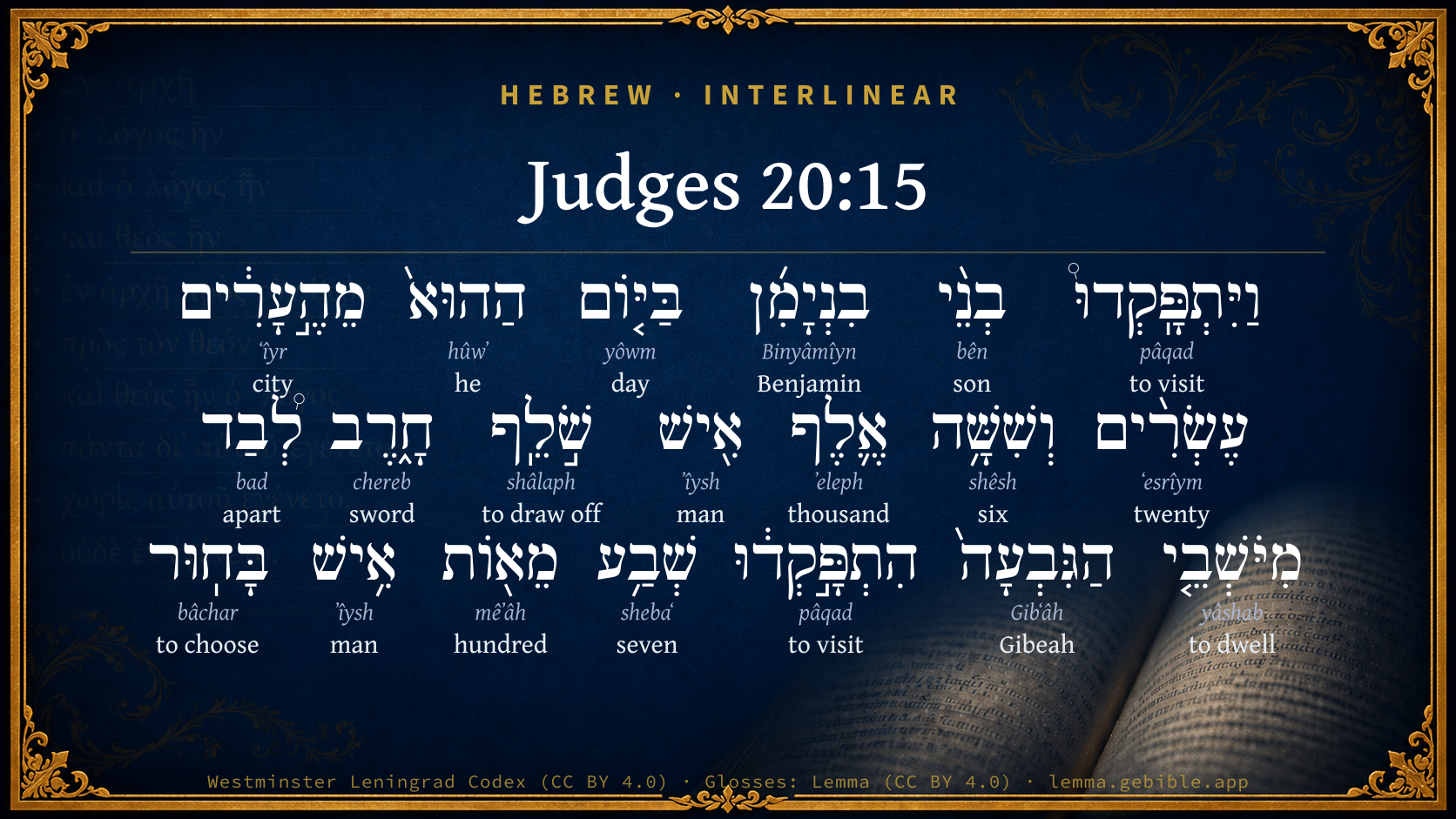
Judges 20:15

Hebrew (Westminster Leningrad Codex) Judges 20:15 appears in the Hebrew Old Testament. The text above is from the Westminster Leningrad Codex. Each word links to its Strong’s number, a concise gloss, and parsing drawn from the Open Scriptures Hebrew Bible morphology. Click any word for its full Brown-Driver-Briggs (BDB) entry.
Download image
Cite this verse

Judges 20:15 (World English Bible). Public Domain. Lemma interlinear Bible study tool, https://lemma.gebible.app/v/judges/20/15.

Show BibTeX & RIS
BibTeX
RIS
English Translation
The children of Benjamin were numbered on that day out of the cities twenty-six thousand men who drew the sword, besides the inhabitants of Gibeah, who were numbered seven hundred chosen men.
World English Bible · Public Domain
Download a study sheet

One document with this verse’s original text, its word-by-word gloss line, the meaning frame, cross-references with their text, attributed commentary, and full source and license credits — printable, and it pastes into notes with its structure intact.

This verse Autodidact and up

Study sheet (.html) Plain text (.txt)

A passage Seminary Student

Up to 50 verses in one chapter. A passage sheet keeps up to 6 commentary sources and 12 cross-references per verse, in the order this page ranks them, and says so on the sheet whenever that leaves anything out. Ask for a single verse and you get the Autodidact verse sheet above.

Everything on this page stays free to read, with no account — the sheet is a download of what is already on screen, not access to it.

Want to remove ads? Support Godless Engineer
Compare translations 3

The same verse in 3 English versions, stacked beneath the original-language interlinear above. Click any original word for its lexicon entry.

Each is an independent rendering of the whole verse — the interlinear is not word-aligned to these translations.

Highlighted words mark where these versions differ — a whole-verse word diff, not a word-by-word alignment.

  • World English Bible Public Domain
    The children of Benjamin were numbered on that day out of the cities twenty-six thousand men who drew the sword, besides the inhabitants of Gibeah, who were numbered seven hundred chosen men.
  • King James Version Public Domain
    And the children of Benjamin were numbered at that time out of the cities twenty and six thousand men that drew sword, beside the inhabitants of Gibeah, which were numbered seven hundred chosen men.
  • unfoldingWord Literal Text CC BY-SA 4.0
    And the sons of Benjamin mobilized themselves on that day from the cities, 26,000 men drawing the sword, besides 700 chosen men from the dwellers of Gibeah mobilized themselves.

unfoldingWord Literal Text — © unfoldingWord, licensed CC BY-SA 4.0. Word-aligned USFM3 via Door43 (git.door43.org/unfoldingWord/en_ult).

Versions to compare (up to 4)

3 of 4 selected

Show all 18 translations

Every available English version of this verse, each an independent rendering of the whole verse.

  • World English Bible Public Domain
    The children of Benjamin were numbered on that day out of the cities twenty-six thousand men who drew the sword, besides the inhabitants of Gibeah, who were numbered seven hundred chosen men.
  • Berean Standard Bible Public Domain
    On that day the Benjamites mobilized 26,000 swordsmen from their cities, in addition to the 700 select men of Gibeah.
  • Majority Standard Bible Public Domain
    On that day the Benjamites mobilized 26,000 swordsmen from their cities, in addition to the 700 select men of Gibeah.
  • King James Version Public Domain
    And the children of Benjamin were numbered at that time out of the cities twenty and six thousand men that drew sword, beside the inhabitants of Gibeah, which were numbered seven hundred chosen men.
  • American Standard Version (1901) Public Domain
    And the children of Benjamin were numbered on that day out of the cities twenty and six thousand men that drew sword, besides the inhabitants of Gibeah, who were numbered seven hundred chosen men.
  • Revised Version (1885) Public Domain
    And the children of Benjamin were numbered on that day out of the cities twenty and six thousand men that drew sword, besides the inhabitants of Gibeah, which were numbered seven hundred chosen men.
  • Geneva Bible (1599) Public Domain
    And ye children of Beniamin were nombred at that time out of the cities sixe and twenty thousand men that drewe sworde, beside the inhabitants of Gibeah, which were nombred seuen hundreth chosen men.
  • Douay-Rheims (1899) Public Domain
    And there were found of Benjamin five and twenty thousand men that drew the sword, besides the inhabitants of Gabaa,
  • Young's Literal Translation Public Domain
    And the sons of Benjamin number themselves on that day; out of the cities `are' twenty and six thousand men drawing sword, apart from the inhabitants of Gibeah, `who' numbered themselves, seven hundred chosen men;
  • Literal Standard Version CC BY-SA 4.0
    And the sons of Benjamin number themselves on that day; out of the cities [are] twenty-six thousand men drawing sword, apart from the inhabitants of Gibeah, [who] numbered themselves, seven hundred chosen men;
  • Unlocked Literal Bible CC BY-SA 4.0
    The people of Benjamin brought together from their cities to fight on that day twenty-six thousand soldiers who were trained to fight with the sword. In addition, there were seven hundred of their chosen men from the inhabitants of Gibeah.
  • unfoldingWord Literal Text CC BY-SA 4.0
    And the sons of Benjamin mobilized themselves on that day from the cities, 26,000 men drawing the sword, besides 700 chosen men from the dwellers of Gibeah mobilized themselves.
  • Darby Bible Public Domain
    And the Benjaminites mustered out of their cities on that day twenty-six thousand men that drew the sword, besides the inhabitants of Gib'e-ah, who mustered seven hundred picked men.
  • World Messianic Bible Public Domain
    The children of Benjamin were counted on that day out of the cities twenty-six thousand men who drew the sword, in addition to the inhabitants of Gibeah, who were counted seven hundred chosen men.
  • Webster's Bible Public Domain
    And the children of Benjamin were numbered at that time out of the cities twenty and six thousand men that drew sword, besides the inhabitants of Gibeah, who were numbered seven hundred chosen men.
  • Free Bible Version CC BY-SA 4.0
    That day a total of twenty-six thousand men armed with swords were called up from the towns of Benjamin, in addition to the seven hundred seasoned warriors from Gibeah.
  • Bible in Basic English Public Domain
    And the children of Benjamin who came that day from the towns were twenty-six thousand men armed with swords, in addition to the people of Gibeah, numbering seven hundred of the best fighting-men,
  • JPS Tanakh (1917) Public Domain
    And the children of Benjamin numbered on that day out of the cities twenty and six thousand men that drew sword, besides the inhabitants of Gibeah, who numbered seven hundred chosen men.

Literal Standard Version (2020), Covenant Press — licensed CC BY-SA 4.0. Text via the HelloAO Bible API (eBible.org). Unlocked Literal Bible (unfoldingWord) — licensed CC BY-SA 4.0. Text via the HelloAO Bible API (eBible.org). unfoldingWord Literal Text — © unfoldingWord, licensed CC BY-SA 4.0. Word-aligned USFM3 via Door43 (git.door43.org/unfoldingWord/en_ult). Free Bible Version, Dr. Jonathan Gallagher — licensed CC BY-SA 4.0. Text via the HelloAO Bible API (eBible.org).

Word by word

More ways to search: Search by grammar → Find every occurrence → Compare this word →

Practice this passage: Drill this verse → Learn its vocabulary →

שֹׁ֣לֵֽף
shâlaph
H8025
“drawing off”
Verb, Qal, Participle Active, Masculine, Singular, Absolute
Part of Speech
Verb
Stem
Qal
Form
Participle Active
Gender
Masculine
Number
Singular
State
Absolute
Full BDB Definition

Origin: a primitive root

TWOT: 2402

to draw out or off, take off - (Qal) - to draw out - to draw off - to shoot up, draw out (of blade of grass on roof)
  1. וַיִּתְפָּֽקְדוּ֩ pâqad H6485 “and · to visit” Conjunction + Verb, Hithpael, Sequential Imperfect, 3rd Person, Masculine, Plural
  2. בְנֵ֨י bên H1121 “sons of” Noun, Common, Masculine, Plural, Construct
  3. בִנְיָמִ֜ן Binyâmîyn H1144 “Benjamin” Noun, Proper
  4. בַּיּ֤וֹם yôwm H3117 “in/at the · day” Preposition, Determined + Noun, Common, Masculine, Singular, Absolute
  5. הַהוּא֙ hûwʼ H1931 “the · he” Particle, Definite Article + Pronoun, Personal, 3rd Person, Masculine, Singular
  6. מֵהֶ֣עָרִ֔ים ʻîyr H5892 “from · the · cities” Preposition + Particle, Definite Article + Noun, Common, Feminine, Plural, Absolute
  7. עֶשְׂרִ֨ים ʻesrîym H6242 “twenty” Adjective, Cardinal number, Both, Plural, Absolute
  8. וְשִׁשָּׁ֥ה shêsh H8337 “and · six” Conjunction + Adjective, Cardinal number, Masculine, Singular, Absolute
  9. אֶ֛לֶף ʼeleph H505 “thousand” Adjective, Cardinal number, Both, Singular, Absolute
  10. אִ֖ישׁ ʼîysh H376 “man” Noun, Common, Masculine, Singular, Absolute
  11. חָ֑רֶב chereb H2719 “sword” Noun, Common, Feminine, Singular, Absolute
  12. לְ֠בַד bad H905 “to/for · apart” Preposition + Noun, Common, Masculine, Singular, Absolute
  13. מִיֹּשְׁבֵ֤י yâshab H3427 “from · dwelling” Preposition + Verb, Qal, Participle Active, Masculine, Plural, Construct
  14. הַגִּבְעָה֙ Gibʻâh H1390 “the · Gibeah” Particle, Definite Article + Noun, Proper
  15. הִתְפָּ֣קְד֔וּ pâqad H6485 “to visit” Verb, Hithpael, Perfect, 3rd Person, Common, Plural
  16. שְׁבַ֥ע shebaʻ H7651 “seven” Adjective, Cardinal number, Feminine, Singular, Absolute
  17. מֵא֖וֹת mêʼâh H3967 “hundred” Adjective, Cardinal number, Both, Plural, Absolute
  18. אִ֥ישׁ ʼîysh H376 “man” Noun, Common, Masculine, Singular, Absolute
  19. בָּחֽוּר bâchar H977 “chosen” Verb, Qal, Participle Passive, Masculine, Singular, Absolute

About this verse

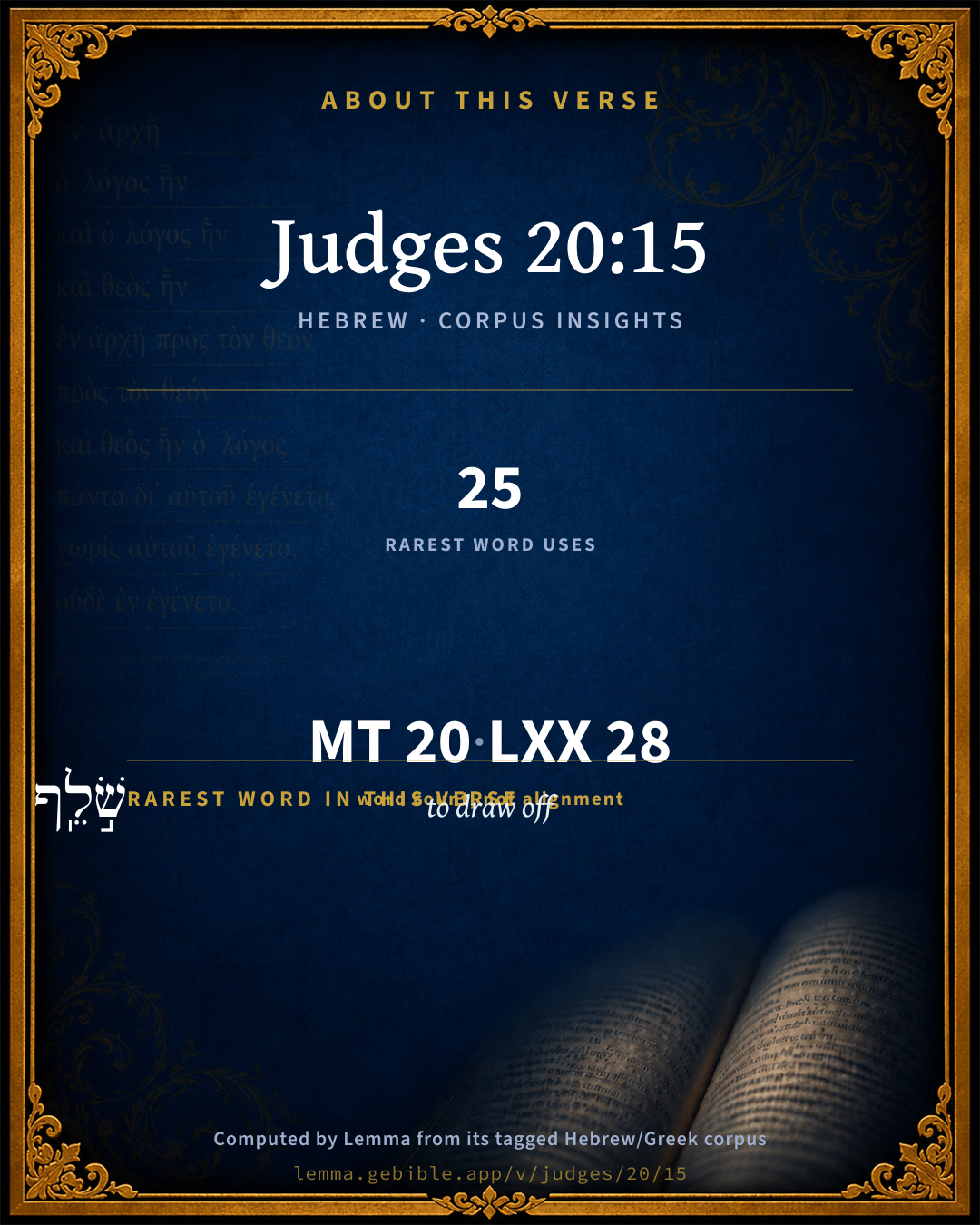
These counts appear in no published source. They are computed here, from the morphology-tagged text and Lemma’s own curated glosses. What Lemma adds →

20
words
18
distinct lemmas
Historical
section

Notable vocabulary

The rarest word here is שֹׁ֣לֵֽף to draw off H8025 — appearing just 25 times in the whole Hebrew Bible.

Shared distinctive vocabulary

שֹׁ֣לֵֽף to draw off H8025 occurs in 24 verses of the Hebrew Bible. Also found in:

Grammatical profile

  • 5 verbs
  • 9 nouns
  • 5 adjectives
  • 1 pronoun

Verb forms

  • וַיִּתְפָּֽקְדוּ֩ Hithpael · Sequential Imperfect
  • שֹׁ֣לֵֽף Qal · Participle Active
  • מִיֹּשְׁבֵ֤י Qal · Participle Active
  • הִתְפָּ֣קְד֔וּ Hithpael · Perfect
  • בָּחֽוּר Qal · Participle Passive

Repetition

Words recur within this verse — often emphatic in Hebrew:

  • וַיִּתְפָּֽקְדוּ֩ to visit H6485 ×2
  • אִ֖ישׁ man H376 ×2

Hebrew & Septuagint length

In English translation the verse runs 32 words from the Hebrew and 42 from the Septuagint (LXX English) — closely comparable.

A rough comparison of the two English renderings, which tokenize alike — not a word-level alignment.

Word counts can differ between the Hebrew and the Greek without any difference in meaning — e.g. the Hebrew direct-object marker אֵת has no separate Greek word, and Greek often adds the article ὁ.

In the original languages it is 20 Hebrew tokens and 28 Greek tokens — but the two are counted differently (Hebrew bundles its prefixes and suffixes into one token; the Greek is in lemma form), so that isn’t a like-for-like length.

Cross-references

5

Topical passages linked to Judges 20:15 in the Treasury of Scripture Knowledge — connected by theme and wording, ordered by reader-vote popularity; previews shown in the World English Bible.

  • Numbers 26:41 These are the sons of Benjamin after their families; and those who were numbered of them were forty-five thousand six hundred.
  • Numbers 1:37 those who were numbered of them, of the tribe of Benjamin, were thirty-five thousand four hundred.
  • Judges 20:25 Benjamin went forth against them out of Gibeah the second day, and destroyed down to the ground of the children of Israel again eighteen thousand men; all these drew the sword.
  • Judges 20:35 Yahweh struck Benjamin before Israel; and the children of Israel destroyed of Benjamin that day twenty-five thousand one hundred men: all these drew the sword.
  • Judges 20:46–47 So that all who fell that day of Benjamin were twenty-five thousand men who drew the sword; all these [were] men of valor.

Cross-references courtesy of OpenBible.info (CC BY 4.0).

Hebrew and Greek witnesses Masoretic Hebrew ↔ Greek Septuagint

The same verse in the two great witnesses to the Old Testament, shown verse-for-verse.

These are two independent witnesses, not word-aligned to each other, and the Septuagint is shown in lemma (dictionary) form.

Hebrew Judges 20:15 Masoretic · Westminster Leningrad Codex

וַיִּתְפָּֽקְדוּ֩ בְנֵ֨י בִנְיָמִ֜ן בַּיּ֤וֹם הַהוּא֙ מֵהֶ֣עָרִ֔ים עֶשְׂרִ֨ים וְשִׁשָּׁ֥ה אֶ֛לֶף אִ֖ישׁ שֹׁ֣לֵֽף חָ֑רֶב לְ֠בַד מִיֹּשְׁבֵ֤י הַגִּבְעָה֙ הִתְפָּ֣קְד֔וּ שְׁבַ֥ע מֵא֖וֹת אִ֥ישׁ בָּחֽוּר

The children of Benjamin were numbered on that day out of the cities twenty-six thousand men who drew the sword, besides the inhabitants of Gibeah, who were numbered seven hundred chosen men.

World English Bible · Public Domain

Greek LXX Judges 20:15 Septuagint · lemma form

καί ἐπισκέπτομαι ὁ υἱός βενιαμίν ἐν ὁ ἡμέρα ἐκεῖνος ἀπό ὁ πόλις εἴκοσι τρεῖς χιλιάς ἀνήρ ἕλκω ῥομφαία ἐκτός ὁ οἰκέω ὁ γαβαα ὅς ἐπισκέπτομαι ἑπτακόσιοι ἀνήρ ἐκλεκτός

And the children of Benjamin from their cities were numbered in that day, twenty-three thousand, every man drawing a sword, besides the inhabitants of Gabaa, who were numbered seven hundred chosen men of all the people, able to use both hands alike;

LXX2012 (modern English Septuagint) · Public Domain

On this verse, Adam Clarke's Commentary discusses the Septuagint’s reading. Read the note in Commentary ↓

Hebrew: Westminster Leningrad Codex (CC BY 4.0). Greek: Septuagint (public domain); English from LXX2012 (modern English Septuagint) (Public Domain). How the Septuagint differs from the Hebrew →

Targum (Aramaic paraphrase)

1

The Targum is the ancient Jewish Aramaic paraphrase of the Hebrew Scriptures — an interpretive translation, not the Hebrew text itself. Onkelos (literal) and Pseudo-Jonathan (expansive) render the Torah, and Jonathan the Prophets. Coverage is partial: where no permissively-licensed English translation exists for a verse, only the Aramaic is shown. This is verse-level text, not a word-by-word alignment to the Hebrew.

  1. Targum Jonathan Prophets (Joshua–Malachi)
    וְאִתְמְנִיאוּ בְנֵי בִנְיָמִין בְּיוֹמָא הַהוּא מִן קִרְוַיָא עַסְרִין וְשִׁיתָּא אַלְפִין גַבְרָא שַׁלְפֵי סַיְפָא בַּר מִיַתְבֵי גִבְעֲתָא אִתְמְנִיאוּ שְׁבַע מְאָה גְבַּר עוּלֵים:

    (no public-domain English translation for this verse)

    Targum Jonathan — Aramaic: “Mikraot Gedolot” (public domain). English: “Sefaria Community Translation” (CC0 1.0 (public-domain dedication)); “London "Chaldee Paraphrase," 1871” (public domain). Text via Sefaria.

Commentary

Notes on Judges 20:15 from classic Christian and Jewish commentators (each source and its license shown beneath its notes). The classic Christian expositions comment on the surrounding passage and are grouped to its opening verse, so a note may address several verses; the Jewish commentaries on the Tanakh (Rashi and others) are per-verse, so they appear only where the commentator wrote on this verse.

Lemma curates 59 commentaries, every one of them public domain or Creative Commons licensed, each selected and text-cleaned for this edition rather than reprinted as found. About our sources →

Trapp's Complete Commentary

John Trapp

Jdg 20:15 And the children of Benjamin were numbered at that time out of the cities twenty and six thousand men that drew sword, beside the inhabitants of Gibeah, which were numbered seven hundred chosen men.

Ver. 15. Twenty and six thousand men that drew sword.] But were all shortly after devoured by the sword, the whole land becoming like a general slaughter house, or a place of infernal torture. Had they not been so numerous, they had not, likely, been so venturous. "The pride of thy heart hath deceived thee." {Oba 1:3}

John Trapp, A Commentary or Exposition upon All the Books of the Old and New Testament (1647–1656) — public domain. Text from a community e-Sword module.

Joseph Benson's Commentary

Jdg 20:15. Twenty and six thousand men — “How does this agree with the following numbers; for all that were slain of Benjamin were twenty-five thousand and one hundred men, (Jdg 20:35,) and there were only six hundred that survived, (Jdg 20:47,) which make only twenty-five thousand and seven hundred?” We answer, The other thousand men were either left in some of their cities, where they were slain, (Jdg 20:48,) or were cut off in the first two battles, wherein it is unreasonable to think they had an unbloody victory: and as for these twenty-five thousand and one hundred men, they were all slain in the third battle.

Joseph Benson's Commentary on the Old and New Testaments (1811–1818) — public domain. Text from a community e-Sword module.

Adam Clarke's Commentary

Verse 15. Twenty and six thousand] Some copies of the Septuagint have twenty-three thousand, others twenty-five thousand. The Vulgate has this latter number; the Complutensian Polyglot and Josephus have the same.

Adam Clarke's Commentary on the Bible (1810–1826) — public domain. Text from a community e-Sword/MySword module.

Ellicott's Commentary for English Readers

(15) Out of the cities.—They could only live in cities, because the Jebusites still held Jerusalem, and the Canaanites around them were very incompletely subdued.

Twenty and six thousand.—This seems to be the correct number, and is found in the Chaldee, Syriac, and Arabic. Josephus, however (Antt. v. 2, § 10), has 25,000, as also has Codex A of theLXX., and Codex B has 23,000 (see Note on Jdg_20:46). We see generally that the Benjamites, like the rest of the Israelites, in spite of their exceptional increase in the wilderness, had been now diminished by about a third since the last census (Num_26:41). (See Note on Jdg_20:2.)

Seven hundred chosen men.—There seems to be some uncertainty or confusion in the text here. It is difficult to imagine that, as the text stands, the single city of Gibeah furnished to the Benjamites their one choice contingent of seven hundred slingers, and it would be a curious coincidence that the force of Gibeah and the slingers should each be exactly seven hundred.

A Bible Commentary for English Readers, edited by Charles John Ellicott (1878–1897) — public domain. Text from a community e-Sword module.

The Cambridge Bible for Schools and Colleges

gen. ed. J. J. S. Perowne

15. The figures in this account are inconsistent. The entire muster of Benjamites is reckoned here at 26,700; while Jdg_20:35; Jdg_20:47 give a total 25,700, and Jdg_20:44-47 a total 25,600. Some mss. of the LXX (cod. A, Luc. etc.), followed by Vulgate, read twenty and five thousand men here (see marg.); but this may be merely an attempt to harmonize with the numbers in Jdg_20:35; Jdg_20:47.

seven hundred chosen men] Repeated in Jdg_20:16 and applied to the left-handed slingers. The words can hardly be original in both places, and the Versions agree in giving them only once. Probably they should be omitted here, and the verse ended with the inhabitants of Gibeah; the insertion of were numbered would be required when the following words were added.

The Cambridge Bible for Schools and Colleges (gen. ed. J. J. S. Perowne; Cambridge University Press, 1878–1918) — public domain. Text from a community e-Sword module.

John Gill's Exposition

And the children of Benjamin were numbered at that time out of the cities,.... All that they could muster up, and gather together out of their several cities, were no more man than

twenty and six thousand men that drew the sword able bodied men fit for war, and expert in it:

beside the inhabitants of Gibeah, which were numbered seven hundred chosen men young, stout, and strong, and in all but 26,700; and what are these to an army of 400,000 men, or however 360,000 that came up against Gibeah, while 40,000 were employed in getting provisions for them? Josephus (g) makes the number of the Benjaminites still less, no more than 25,600, led thereunto by an later account, that 25,000 Benjaminites were slain in the third and last battle, and only six hundred escaped to a rock for safety, not considering that 1000 men may well be supposed to be lost in the two first battles; for it would be strange indeed that they should lose none in two engagement with so large an army; the same error is committed in the Vulgate Latin version, which makes them no more than 25,000; with which agrees the Alexandrian copy of the Septuagint version: though that, according to the Vatican exemplar, has but 23,000. The numbers in the Hebrew text are no doubt the right.

(g) Antiqu. l. 5. c. 2. sect. 10.

John Gill's Exposition of the Whole Bible (1746–1763) — public domain (CC PDM 1.0). Text via the HelloAO Bible API.

Albert Barnes' Notes on the Bible

Comparing the numbers here with those in Num. 1; 26, it is seen that in the case both of the Benjamites and the Israelites the numbers are diminished by about one-third, i. e., they appear as about two-thirds only of what they were at the last numbering in the plains of Moab. This diminution seems to indicate disturbed and harassing times. With this agrees the mention of the cities, as containing the whole Benjamite population. The inference is that the open country and unwalled villages were not safe, but that the Benjamites kept the Canaanites in subjection only by dwelling in fortified towns.

Jdg 20:16

See Jdg 3:15, and note. In the Septuagint and Vulgate the 700 chosen men of Gibeah are represented as the seven hundred left-handed slingers.

Albert Barnes' Notes on the Bible (1834–1885) — public domain. Text from a community e-Sword/MySword module.

Haydock's Catholic Bible Commentary

Men. This number is verified, ver. 35. The Benjamites had 25,700 in all, of whom they lost 25,100; so that 600 remained. Hebrew reads here 26,000; and some pretend (Calmet) that 1000 fell in the two victories which they obtained. (Grotius, &c.) --- But this is without proof, and the Vulgate is confirmed by Josephus, and by most of the copies of the Septuagint, though the Vatican copy has only 23,000. (Calmet) --- Gabaa. Hebrew and Septuagint add, "which were numbered 700 chosen men." Grabe repeats in the following verse with the Hebrew, "Among all this people, 700 chosen men," which seems to insinuate that these expert archers were selected out of all the army. (Haydock) --- But the other copies of the Septuagint agree with the Vulgate, that they were all of Gabaa, (Calmet) as if they were trained at this city with more particular care, to hit a mark how small soever.

George Leo Haydock (1774–1849), Haydock's Catholic Family Bible and Commentary, 1859 edition — public domain. Excludes Psalms (Douay-Rheims chapter numbering differs from Protestant) and Deuterocanonical books (Catholic canon only).

Matthew Poole's English Annotations

Object. This agrees not with the following numbers; for all that were slain of Benjamin were 25,100 men, Jdg 20:35, and there were only 600 that survived, Jdg 20:47, which make only 25,700.

Answ. The other thousand men were either left in some of their cities, where they were slain, Jdg 20:48, or were cut off in the two first battles, wherein it is reasonable to think they had an unbloody victory; and as for these 25,100 men, they were all slain in that day, i.e. the day of the third battle, as is affirmed, Jdg 20:35.

Matthew Poole's English Annotations on the Holy Bible (1683–1685) — public domain. Text from a community e-Sword/MySword module.

Whedon's Commentary on the Bible

Daniel D. Whedon

15. The inhabitants of Gibeah — These are specially mentioned because they were specially interested in the war. For their sake it was carried on, and so they furnished seven hundred men.

Daniel D. Whedon (gen. ed.), Commentary on the Old and New Testaments (1874–1909) — public domain. Text from a community e-Sword module.

The Pulpit Commentary

Twenty and six thousand. The numbers of Benjamin in the wilderness were at the first numbering 35, 400, and at the second 45, 600. (Num_1:36 Num_2:23 Num_26:41) It is impossible to account with certainty for the falling off in the numbers by so many as near 20, 000; but perhaps many were slain in the wars of Canaan, and the unsettled times were unfavourable to early marriages. For the whole of Israel there was, as appeared by ver. 2, note, a falling off of nearly 200, 000 men, or, to speak exactly (601, 730-400, 000 +26, 700), of 175, 030. Which were numbered. There is some obscurity in this latter clause; but, in spite of the accents being opposed to it, the A.V seems certainly right. The rendering according to the accents, "they (the Benjamites) were numbered, besides the inhabitants of Gibeah, seven hundred chosen men," makes no sense, and does not explain who the 700 were. The population of Gibeah would be about 5 700, i.e. 3500, according to this statement.

The Pulpit Commentary (1880–1919), ed. H.D.M. Spence-Jones & Joseph S. Exell — public domain. Text from a community e-Sword module.

John Wesley's Explanatory Notes

Were numbered - "How does this agree with the following numbers? For all that were slain of Benjamin were twenty-five thousand and one hundred men, ver. 35, and there were only six hundred that survived, ver. 47, which make only twenty-five thousand and seven hundred." The other thousand men were either left in some of their cities, where they were slain, ver. 48, or were cut off in the two first battles, wherein it is unreasonable to think they had an unbloody victory: and as for these twenty-five thousand and one hundred men, they were all slain in the third battle.

John Wesley, Explanatory Notes Upon the Whole Bible (1754–1765) — public domain. Text via the GEBible commentary corpus.

unfoldingWord translationNotes

Door43 World Missions Community

twenty-six thousand

"26,000" (See: Numbers)

seven hundred

"700" (See: Numbers)

left-handed

A left-handed person is someone who is more skilled with their left hand than with their right hand.

could sling a stone at a hair and not miss

This show how amazingly well they could aim and hit their target. It can be stated in positive form. AT: "could throw a stone at even a hair and hit it" or "could throw a stone at something as small as a hair and hit it"

translationWords

Benjamin

sword

Gibeah

unfoldingWord translationNotes — © Distant Shores Media and the Door43 World Missions Community, licensed CC BY-SA 4.0. Source: git.door43.org/Door43/en_tn.

Lesson kit

Teaching starters — assembled from the data on this page, not authored interpretation. Every prompt links to the verse data it draws on. Edit before teaching.

Judges, in the Historical, opens this verse with 20 words (18 distinct Hebrew lemmas). Its most distinctive word is shâlaph (“to draw off”). A historical commentator’s framing appears above. Read the whole chapter for the surrounding context.

Discussion questions

  1. How does “to draw off” (shâlaph) shape what this verse is saying?
  2. Numbers 22:23 shares the word «to draw off» with this verse. How do the two illuminate each other?
  3. “to visit” occurs 2× in this one verse. What is the effect of the repetition?
  4. The translations on this page render this verse differently — a whole-verse word diff, not a word-by-word alignment. What might account for the different wordings?
  5. The verb «וַיִּתְפָּֽקְדוּ֩» is Hithpael Sequential Imperfect. How does its form color the action?
  6. Reading how Trapp's Complete Commentary and Joseph Benson's Commentary read this verse, where do the two commentators agree and where do they part?

Things to notice

Reading settings

Reading text

Shown beneath each verse's original-language words.

Old Testament
Old Testament edition

Read the OT as the Masoretic Hebrew (MT) or the Greek Septuagint (LXX).

English shown for the Greek Septuagint (in the Hebrew ↔ Greek comparison).

Comparing translations? Open the Compare panel on any verse page to stack up to four side by side.