
Deuteronomy 28:22

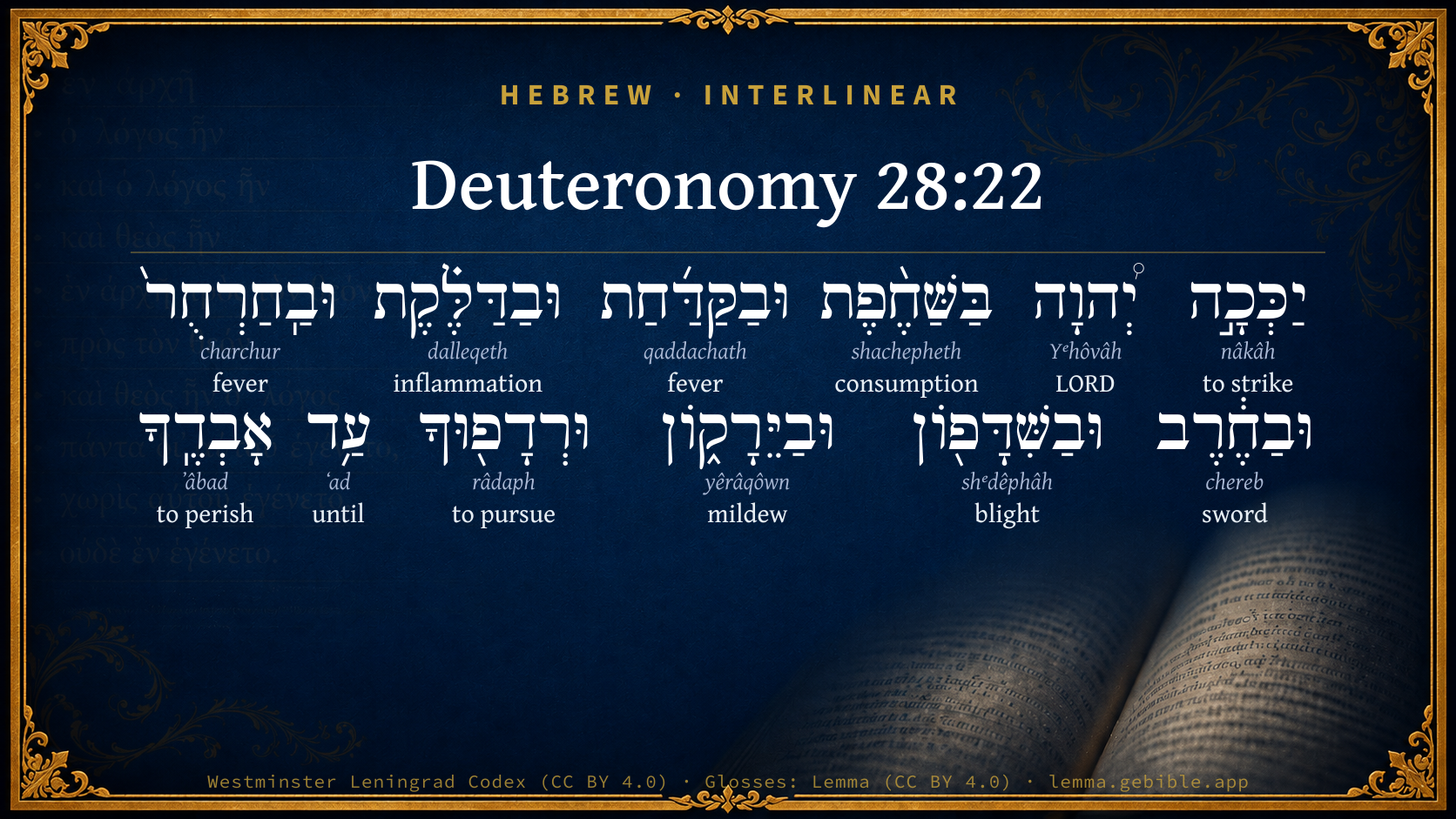
Hebrew (Westminster Leningrad Codex) Deuteronomy 28:22 appears in the Hebrew Old Testament. The text above is from the Westminster Leningrad Codex. Each word links to its Strong’s number, a concise gloss, and parsing drawn from the Open Scriptures Hebrew Bible morphology. Click any word for its full Brown-Driver-Briggs (BDB) entry.
Download image
Cite this verse

Deuteronomy 28:22 (World English Bible). Public Domain. Lemma interlinear Bible study tool, https://lemma.gebible.app/v/deuteronomy/28/22.

Show BibTeX & RIS
BibTeX
RIS
English Translation
Yahweh will strike you with consumption, and with fever, and with inflammation, and with fiery heat, and with the sword, and with blasting, and with mildew; and they shall pursue you until you perish.
World English Bible · Public Domain
Highlights
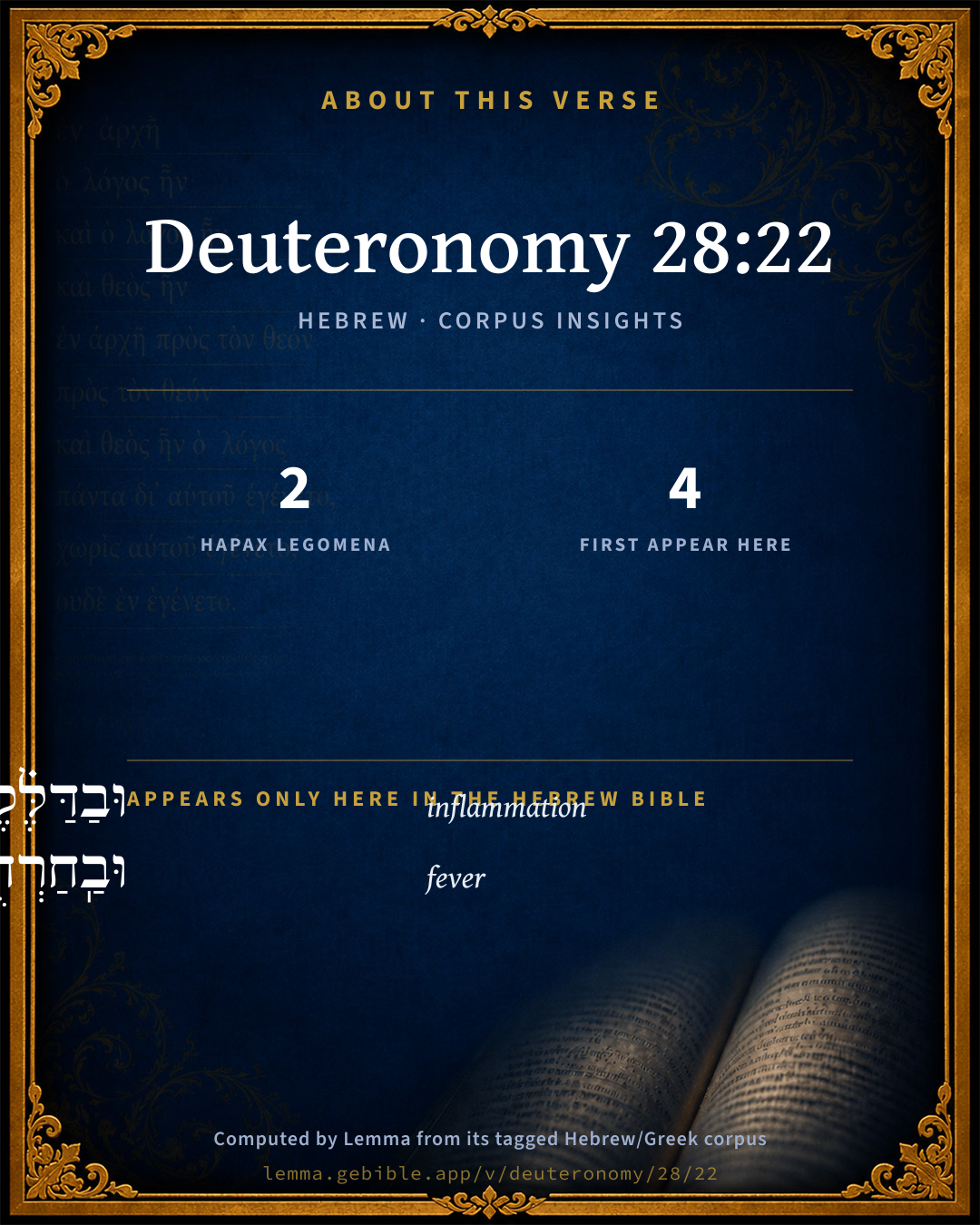
  • 2 hapax legomena — only here in the Hebrew Bible
  • 4 first appearances in the Hebrew Bible
Full analysis ↓
Download a study sheet

One document with this verse’s original text, its word-by-word gloss line, the meaning frame, cross-references with their text, attributed commentary, and full source and license credits — printable, and it pastes into notes with its structure intact.

This verse Autodidact and up

Study sheet (.html) Plain text (.txt)

A passage Seminary Student

Up to 50 verses in one chapter. A passage sheet keeps up to 6 commentary sources and 12 cross-references per verse, in the order this page ranks them, and says so on the sheet whenever that leaves anything out. Ask for a single verse and you get the Autodidact verse sheet above.

Everything on this page stays free to read, with no account — the sheet is a download of what is already on screen, not access to it.

Want to remove ads? Support Godless Engineer
Compare translations 3

The same verse in 3 English versions, stacked beneath the original-language interlinear above. Click any original word for its lexicon entry.

Each is an independent rendering of the whole verse — the interlinear is not word-aligned to these translations.

Highlighted words mark where these versions differ — a whole-verse word diff, not a word-by-word alignment.

  • World English Bible Public Domain
    Yahweh will strike you with consumption, and with fever, and with inflammation, and with fiery heat, and with the sword, and with blasting, and with mildew; and they shall pursue you until you perish.
  • King James Version Public Domain
    The LORD shall smite thee with a consumption, and with a fever, and with an inflammation, and with an extreme burning, and with the sword, and with blasting, and with mildew; and they shall pursue thee until thou perish.
  • unfoldingWord Literal Text CC BY-SA 4.0
    Yahweh will strike with emaciation and with fever and with inflammation and with fiery heat and with a sword and with scorching winds and with mildew. And they will pursue you until you perish.

unfoldingWord Literal Text — © unfoldingWord, licensed CC BY-SA 4.0. Word-aligned USFM3 via Door43 (git.door43.org/unfoldingWord/en_ult).

Versions to compare (up to 4)

3 of 4 selected

Show all 18 translations

Every available English version of this verse, each an independent rendering of the whole verse.

  • World English Bible Public Domain
    Yahweh will strike you with consumption, and with fever, and with inflammation, and with fiery heat, and with the sword, and with blasting, and with mildew; and they shall pursue you until you perish.
  • Berean Standard Bible Public Domain
    The LORD will strike you with wasting disease, with fever and inflammation, with scorching heat and drought, and with blight and mildew; these will pursue you until you perish.
  • Majority Standard Bible Public Domain
    The LORD will strike you with wasting disease, with fever and inflammation, with scorching heat and drought, and with blight and mildew; these will pursue you until you perish.
  • King James Version Public Domain
    The LORD shall smite thee with a consumption, and with a fever, and with an inflammation, and with an extreme burning, and with the sword, and with blasting, and with mildew; and they shall pursue thee until thou perish.
  • American Standard Version (1901) Public Domain
    Jehovah will smite thee with consumption, and with fever, and with inflammation, and with fiery heat, and with the sword, and with blasting, and with mildew; and they shall pursue thee until thou perish.
  • Revised Version (1885) Public Domain
    The LORD shall smite thee with consumption, and with fever, and with inflammation, and with fiery heat, and with the sword, and with blasting, and with mildew; and they shall pursue thee until thou perish.
  • Geneva Bible (1599) Public Domain
    The Lord shall smite thee with a consumption, and with the feuer, and with a burning ague, and with feruent heate, and with the sworde, and with blasting, and with the mildew, and they shall pursue thee vntill thou perish.
  • Douay-Rheims (1899) Public Domain
    May the Lord afflict thee with miser- able want, with the fever and with cold, with burning and with heat, and with corrupted air and with blasting, and pursue thee till thou perish.
  • Young's Literal Translation Public Domain
    `Jehovah doth smite thee with consumption, and with fever, and with inflammation, and with extreme burning, and with sword, and with blasting, and with mildew, and they have pursued thee till thou perish
  • Literal Standard Version CC BY-SA 4.0
    YHWH strikes you with consumption, and with fever, and with inflammation, and with extreme burning, and with sword, and with blasting, and with mildew, and they have pursued you until you perish
  • Unlocked Literal Bible CC BY-SA 4.0
    Yahweh will attack you with infectious diseases, with fever, with inflammation, and with drought and blistering heat, and with scorching winds and mildew. These will pursue you until you perish.
  • unfoldingWord Literal Text CC BY-SA 4.0
    Yahweh will strike with emaciation and with fever and with inflammation and with fiery heat and with a sword and with scorching winds and with mildew. And they will pursue you until you perish.
  • Darby Bible Public Domain
    Jehovah will smite thee with consumption, and with fever, and with inflammation, and with burning ague, and with drought, and with blight, and with mildew, and they shall pursue thee until thou perish.
  • World Messianic Bible Public Domain
    The LORD will strike you with consumption, with fever, with inflammation, with fiery heat, with the sword, with blight, and with mildew. They will pursue you until you perish.
  • Webster's Bible Public Domain
    The LORD shall smite thee with a consumption, and with a fever, and with an inflammation, and with an extreme burning, and with the sword, and with blasting, and with mildew: and they shall pursue thee until thou dost perish.
  • Free Bible Version CC BY-SA 4.0
    Then the Lord will hit you with sickness that makes you waste away, with a severe fever and swelling like you're burning up, while your crops are damaged by drought and blight and mildew. These will attack you until you die.
  • Bible in Basic English Public Domain
    The Lord will send wasting disease, and burning pain, and flaming heat against you, keeping back the rain till your land is waste and dead; so will it be till your destruction is complete.
  • JPS Tanakh (1917) Public Domain
    The LORD will smite thee with consumption, and with fever, and with inflammation, and with fiery heat, and with drought, and with blasting, and with mildew; and they shall pursue thee until thou perish.

Literal Standard Version (2020), Covenant Press — licensed CC BY-SA 4.0. Text via the HelloAO Bible API (eBible.org). Unlocked Literal Bible (unfoldingWord) — licensed CC BY-SA 4.0. Text via the HelloAO Bible API (eBible.org). unfoldingWord Literal Text — © unfoldingWord, licensed CC BY-SA 4.0. Word-aligned USFM3 via Door43 (git.door43.org/unfoldingWord/en_ult). Free Bible Version, Dr. Jonathan Gallagher — licensed CC BY-SA 4.0. Text via the HelloAO Bible API (eBible.org).

Word by word

More ways to search: Search by grammar → Find every occurrence → Compare this word →

Practice this passage: Drill this verse → Learn its vocabulary →

וּבַדַּלֶּ֗קֶת
dalleqeth
H1816
“and · in/at the · inflammation”
Conjunction + Preposition, Determined + Noun, Common, Feminine, Singular, Absolute
Part of Speech
Conjunction + Preposition + Noun
Type
Common
Gender
Feminine
Number
Singular
State
Absolute
Full BDB Definition

Origin: from H1814

TWOT: 435a

inflammation
  1. יַכְּכָ֣ה nâkâh H5221 “to strike · you” Verb, Hiphil, Imperfect, 3rd Person, Masculine, Singular + Suffix, Personal, 2nd Person, Masculine, Singular
  2. יְ֠הוָה Yᵉhôvâh H3068 “LORD” Noun, Proper
  3. בַּשַּׁחֶ֨פֶת shachepheth H7829 “in/at the · consumption” Preposition, Determined + Noun, Common, Feminine, Singular, Absolute
  4. וּבַקַּדַּ֜חַת qaddachath H6920 “and · in/at the · fever” Conjunction + Preposition, Determined + Noun, Common, Feminine, Singular, Absolute
  5. וּבַֽחַרְחֻר֙ charchur H2746 “and · in/at the · fever” Conjunction + Preposition, Determined + Noun, Common, Masculine, Singular, Absolute
  6. וּבַחֶ֔רֶב chereb H2719 “and · in/at the · sword” Conjunction + Preposition, Determined + Noun, Common, Feminine, Singular, Absolute
  7. וּבַשִּׁדָּפ֖וֹן shᵉdêphâh H7711 “and · in/at the · blight” Conjunction + Preposition, Determined + Noun, Common, Masculine, Singular, Absolute
  8. וּבַיֵּרָק֑וֹן yêrâqôwn H3420 “and · in/at the · mildew” Conjunction + Preposition, Determined + Noun, Common, Masculine, Singular, Absolute
  9. וּרְדָפ֖וּךָ râdaph H7291 “and · to pursue · you” Conjunction + Verb, Qal, Sequential Perfect, 3rd Person, Common, Plural + Suffix, Personal, 2nd Person, Masculine, Singular
  10. עַ֥ד ʻad H5704 “until” Preposition
  11. אָבְדֶֽךָ ʼâbad H6 “to perish · you” Verb, Qal, Infinitive Construct + Suffix, Personal, 2nd Person, Masculine, Singular

About this verse

These counts appear in no published source. They are computed here, from the morphology-tagged text and Lemma’s own curated glosses. What Lemma adds →

12
words
12
distinct lemmas
Pentateuch
section

Notable vocabulary

2 hapax legomena — words that appear only here in the entire Hebrew Bible:

  • וּבַדַּלֶּ֗קֶת inflammation H1816
  • וּבַֽחַרְחֻר֙ fever H2746

First appearance in Scripture

These words make their first canonical appearance in the Hebrew Bible here:

  • וּבַדַּלֶּ֗קֶת inflammation H1816
  • וּבַֽחַרְחֻר֙ fever H2746
  • וּבַשִּׁדָּפ֖וֹן blight H7711
  • וּבַיֵּרָק֑וֹן mildew H3420

Shared distinctive vocabulary

בַּשַּׁחֶ֨פֶת consumption H7829 occurs in 2 verses of the Hebrew Bible. Also found in:

Grammatical profile

  • 3 verbs
  • 8 nouns
  • 1 preposition

Verb forms

  • יַכְּכָ֣ה Hiphil · Imperfect
  • וּרְדָפ֖וּךָ Qal · Sequential Perfect
  • אָבְדֶֽךָ Qal · Infinitive Construct

Hebrew & Septuagint length

In English translation the verse runs 34 words from the Hebrew and 26 from the Septuagint (LXX English) — closely comparable.

A rough comparison of the two English renderings, which tokenize alike — not a word-level alignment.

Word counts can differ between the Hebrew and the Greek without any difference in meaning — e.g. the Hebrew direct-object marker אֵת has no separate Greek word, and Greek often adds the article ὁ.

Cross-references

6

Topical passages linked to Deuteronomy 28:22 in the Treasury of Scripture Knowledge — connected by theme and wording, ordered by reader-vote popularity; previews shown in the World English Bible.

  • Leviticus 26:16 I also will do this to you: I will appoint terror over you, even consumption and fever, that shall consume the eyes, and make the soul to pine away; and you will sow your seed in vain, for your enemies will eat it.
  • Amos 4:9 I struck you with blight and mildew many times in your gardens and your vineyards; And your fig trees and your olive trees have the swarming locust devoured: Yet you haven't returned to me," says Yahweh.
  • 1 Kings 8:37 If there be in the land famine, if there be pestilence, if there be blasting [or] mildew, locust [or] caterpillar; if their enemy besiege them in the land of their cities; whatever plague, whatever sickness there be;
  • Haggai 2:17 I struck you with blight, mildew, and hail in all the work of your hands; yet you didn't turn to me,' says Yahweh.
  • 2 Chronicles 6:28 If there be in the land famine, if there be pestilence, if there be blasting or mildew, locust or caterpillar; if their enemies besiege them in the land of their cities; whatever plague or whatever sickness there be;
  • Jeremiah 14:12 When they fast, I will not hear their cry; and when they offer burnt offering and meal-offering, I will not accept them; but I will consume them by the sword, and by the famine, and by the pestilence.

Cross-references courtesy of OpenBible.info (CC BY 4.0).

Hebrew and Greek witnesses Masoretic Hebrew ↔ Greek Septuagint

The same verse in the two great witnesses to the Old Testament, shown verse-for-verse.

These are two independent witnesses, not word-aligned to each other, and the Septuagint is shown in lemma (dictionary) form.

Hebrew Deuteronomy 28:22 Masoretic · Westminster Leningrad Codex

יַכְּכָ֣ה יְ֠הוָה בַּשַּׁחֶ֨פֶת וּבַקַּדַּ֜חַת וּבַדַּלֶּ֗קֶת וּבַֽחַרְחֻר֙ וּבַחֶ֔רֶב וּבַשִּׁדָּפ֖וֹן וּבַיֵּרָק֑וֹן וּרְדָפ֖וּךָ עַ֥ד אָבְדֶֽךָ

Yahweh will strike you with consumption, and with fever, and with inflammation, and with fiery heat, and with the sword, and with blasting, and with mildew; and they shall pursue you until you perish.

World English Bible · Public Domain

Greek LXX Deuteronomy 28:22 Septuagint · lemma form

πατάσσω σύ κύριος ἀπορία καί πυρετός καί ῥῖγος καί ἐρέθισμα καί φόνος καί ἀνεμοφθορία καί ὁ ὠχρός καί καταδιώκω σύ ἕως ἄν ἀποὀλλύω σύ

The Lord strike you with distress, and fever, and cold, and inflammation, and blighting, and paleness, and they shall pursue you until they have destroyed you.

LXX2012 (modern English Septuagint) · Public Domain

On this verse, The Cambridge Bible for Schools and Colleges discusses the Septuagint’s reading. Read the note in Commentary ↓

Hebrew: Westminster Leningrad Codex (CC BY 4.0). Greek: Septuagint (public domain); English from LXX2012 (modern English Septuagint) (Public Domain). How the Septuagint differs from the Hebrew →

Targum (Aramaic paraphrase)

2

The Targum is the ancient Jewish Aramaic paraphrase of the Hebrew Scriptures — an interpretive translation, not the Hebrew text itself. Onkelos (literal) and Pseudo-Jonathan (expansive) render the Torah, and Jonathan the Prophets. Coverage is partial: where no permissively-licensed English translation exists for a verse, only the Aramaic is shown. This is verse-level text, not a word-by-word alignment to the Hebrew.

  1. Targum Onkelos Torah (Genesis–Deuteronomy)
    יִמְחִנָךְ יְיָ בְּשַׁחֶפְתָּא וּבְקַדַחְתָּא וּבִדְלֶקְתָּא וּבְחַרְחוּרָא וּבְחַרְבָּא וּבְשִׁדְפוֹנָא וּבְיַרְקוֹנָא וְיִרְדְפֻנָךְ עַד דְתֵיבָד

    (no public-domain English translation for this verse)

    Targum Onkelos — Aramaic: “Onkelos Genesis” (public domain); “Onkelos Exodus” (public domain); “Onkelos Leviticus” (public domain); “Onkelos Numbers” (public domain); “Onkelos Deuteronomy” (public domain). English: “Sefaria Community Translation” (CC0 1.0 (public-domain dedication)); “J.W. Etheridge. The Targums of Onkelos and Jonathan Ben Uzziel on the Pentateuch. London: Longmans, Green, 1862” (public domain). Text via Sefaria.

  2. Targum Pseudo-Jonathan Torah (Genesis–Deuteronomy)
    יִמְחֵי יַתְכוֹן מֵימְרָא דַיְיָ בְּשַׁחְפוּתָא וּבְקַדְחוּתָא וּבְאֵישָׁא דְגַרְמַיָא דְדַלְקָא מוֹחַיָא וּבְחַרְחוּרֵי דְלוּחֵי צִירְתָא דְלִבָּא וּבִשְׁלוּפֵי חַרְבָּא וּבְשִׁדָפוֹנָא וּבְיַרְקוֹנָא דְמַקְדוֹנַיָא וְיִרְדְפוּנְכוֹן עַל שִׁוְויֵיכוֹן עַד דְתֵיבְדוּן

    The Word of the Lord will smite you with abscess and inflammation, and fire in the bones that will burn up the marrow, and with fearful imaginations in the thoughts of the heart; and with the naked sword, and with blasting, and the jaundice of Macedonia, which shall follow you to your beds, until you are destroyed.

    Targum Pseudo-Jonathan — Aramaic: “Targum Jonathan on Genesis” (public domain); “Targum Jonathan on Exodus” (public domain); “Targum Jonathan on Leviticus” (public domain); “Targum Jonathan on Numbers” (public domain); “Targum Jonathan on Deuteronomy” (public domain). English: “The Targum of Jonathan ben Uzziel, trans. J. W. Etheridge, London, 1862” (public domain). Text via Sefaria.

Commentary

Notes on Deuteronomy 28:22 from classic Christian and Jewish commentators (each source and its license shown beneath its notes). The classic Christian expositions comment on the surrounding passage and are grouped to its opening verse, so a note may address several verses; the Jewish commentaries on the Tanakh (Rashi and others) are per-verse, so they appear only where the commentator wrote on this verse.

Lemma curates 59 commentaries, every one of them public domain or Creative Commons licensed, each selected and text-cleaned for this edition rather than reprinted as found. About our sources →

Trapp's Complete Commentary

John Trapp

Deu 28:22 The LORD shall smite thee with a consumption, and with a fever, and with an inflammation, and with an extreme burning, and with the sword, and with blasting, and with mildew; and they shall pursue thee until thou perish.

Ver. 22. The Lord shall smite thee, &c.] {See Trapp on "Lev 26:16"}

John Trapp, A Commentary or Exposition upon All the Books of the Old and New Testament (1647–1656) — public domain. Text from a community e-Sword module.

Tyndale Open Study Notes

Tyndale Open Resources

28:22 Some scholars identify these symptoms with tuberculosis.

Tyndale Open Study Notes — © Tyndale Open Resources, licensed CC BY-SA 4.0. Text via the HelloAO Bible API.

Geneva Bible (1599)

Geneva Bible translators

Or, drought.

Geneva Bible (1599) marginal notes — public domain. Text via Bolls.life.

Jamieson, Fausset & Brown

Robert Jamieson, A. R. Fausset & David Brown

a consumption--a wasting disorder; but the modern tuberculosis is almost unknown in Asia.

fever . . . inflammation . . . extreme burning--Fever is rendered "burning ague" (Lev 26:16), and the others mentioned along with it evidently point to those febrile affections which are of malignant character and great frequency in the East.

the sword--rather, "dryness"--the effect on the human body of such violent disorders.

blasting, and with mildew--two atmospheric influences fatal to grain.

Jamieson, Fausset & Brown — Commentary Critical and Explanatory on the Whole Bible (1871) — public domain (CC PDM 1.0). Text via the HelloAO Bible API.

Adam Clarke's Commentary

Verse 22. Consumption] שחפת shachepheth, atrophy through lack of food; from שחף shacaph, to be in want.

Fever] קדחת kaddachath, from קדח kadach, to be kindled, burn, sparkle; a burning inflammatory fever.

Inflammation] דלקת dalleketh, from דלק dalak, to pursue eagerly, to burn after; probably a rapidly consuming cancer.

Extreme burning] חרחר charchur, burning upon burning, scald upon scald; from חר char, to be heated, enraged, &c. This probably refers, not only to excruciating inflammations on the body, but also to the irritation and agony of a mind utterly abandoned by God, and lost to hope. What an accumulation of misery! how formidable! and especially in a land where great heat was prevalent and dreadful.

Sword] War in general, enemies without, and civil broils within. This was remarkably the case in the last siege of Jerusalem.

Blasting] שדפון shiddaphon, probably either the blighting east wind that ruined vegetation, or those awful pestilential winds which suffocate both man and beast wherever they come. These often prevail in different parts of the East, and several examples have already been given. See Clarke on Ge 41:6.

Mildew] ירקון yerakon, an exudation of the vegetative juice from different parts of the stalk, by which the maturity and perfection of the plant are utterly prevented. It comes from ירק yarak, to throw out moisture.

Of these seven plagues, the five former were to fall on their bodies, the two latter upon their substance. What a fearful thing it is to fall into the hands of the living God!

Adam Clarke's Commentary on the Bible (1810–1826) — public domain. Text from a community e-Sword/MySword module.

Ellicott's Commentary for English Readers

(22) Consumption.—Only here and in Lev_26:16. “With which the flesh is consumed and puffed out” (Rashi).

Fever.—Only here and in Lev_26:16, where it is rendered “burning ague.” ( Comp. Deu_32:22 : “A fire is kindled in mine anger.”)

Inflammation.—Here only. The word is derived from a verb signifying to burn, or pursue hotly, like a fire that hastens on its way. “A heat greater than the fever” (Rashi).

Extreme burning.—Here only. “A disease which heats the body inwardly” (Rashi).

Blasting and mildew.—“I have smitten you with blasting and with mildew” (Amo_4:9, same words). (See also 1Ki_8:37, where “pestilence, blasting, and mildew” are contemplated as possibilities, very probably in view of this curse. Also Hag_2:17.)

A Bible Commentary for English Readers, edited by Charles John Ellicott (1878–1897) — public domain. Text from a community e-Sword module.

The Cambridge Bible for Schools and Colleges

gen. ed. J. J. S. Perowne

22. Seven Plagues, four on men, and three on their crops. On the former see Lev_26:16, and consult A. Macalister, art. ‘Medicine’ in Hastings’ D.B.

consumption] Heb. shaḥepheth; from the meaning of the corr. Ar. saḥaf, ‘to affect with consumption of the lungs,’ this is usually conceived as phthisis, but Macalister, from the connection here, thinks more likely a wasting fever of the Mediterranean or Malta type. LXX ἀπορία.

fever] Heb. ḳaddaḥath, lit. kindling, LXX πυρετὸς; cp. Luk_4:38, Joh_4:52. ‘May be malarial fever’ (Macalister).

inflammation] Heb. dalléḳeth, lit. burning, LXX ῥῖγος. ‘Possibly … some form of ague,’ but ‘perhaps indeed typhoid’ (Macalister).

fiery heat] Heb. ḥarḥur, lit. burning or parchedness, LXX ἐρεθισμός, ‘irritation’; ‘such as erysipelas, only this is not very common in Palestine. It might be one of the exanthemata’ (Macalister).

the sword] Heb. ḥereb, LXX A F, etc., φόνος, LXX B, etc., omit. But with Sam., Vulg. and R.V. marg. we may read ḥoreb, dryness; either (as in the similarly emended text of Zec_11:17, cp. Job_30:30) a withering of the body, or, in harmony with the following, drought of the earth.

blasting] Heb. shiddaphôn, mostly the effect of the Sirocco (see Jerusalem, i. pp. 12, 20 f.). Hence the LXX ἀνεμοφθορία.

mildew] Heb. yeraḳôn, wanness, lividness; LXX ὤχρα.

The Cambridge Bible for Schools and Colleges (gen. ed. J. J. S. Perowne; Cambridge University Press, 1878–1918) — public domain. Text from a community e-Sword module.

John Gill's Exposition

The Lord shall cause thee to be smitten fore thine enemies,.... And by them, as they sometimes were by the Philistines and others, before their utter destruction, when they sinned against the Lord; and by the Assyrians, Babylonians, and Romans:

thou shall go out one way against them, and flee seven ways before them; march out against them in a body, promising themselves victory, but be utterly routed; so that they shall flee every way they can for their safety; see Deu 28:7,

and shall be removed into all the kingdoms of the earth; this shows that Manasseh's case Kg2 21:1, observed Deu 28:15; will not strictly and entirely hold good, nor is there any necessity to adhere closely to it; it is enough that the things threatened and prophesied of were at one time or another fulfilled in these people; for neither the ten tribes, when taken captive by Shalmaneser, were carried into all the kingdoms of the earth, only to some particular places mentioned in Kg2 17:6; nor the two tribes by Nebuchadnezzar, who were carried by him to Babylon, and returned from thence again at the end of seventy years; but this was exactly fulfilled at their last destruction by the Romans, when they were sent by them into various countries, and have been ever since scattered about in each of the nations of the world. And yet it must be owned that Strabo (g), who wrote before the last destruction of them, affirms, that it was not easy to find any place in the world which had not received them, and was not occupied by them.

(g) Apud Joseph. Antiqu. l. 14. c. 7. sect. 2.

John Gill's Exposition of the Whole Bible (1746–1763) — public domain (CC PDM 1.0). Text via the HelloAO Bible API.

Haydock's Catholic Bible Commentary

Cold. The word occurs no where else. The Chaldean, Syriac, &c., have the reverse, "heat." --- Blasting. In the original, either the mildew destroying the corn, (Haydock) or the jaundice, which attacks the human body, may be meant. (Calmet)

George Leo Haydock (1774–1849), Haydock's Catholic Family Bible and Commentary, 1859 edition — public domain. Excludes Psalms (Douay-Rheims chapter numbering differs from Protestant) and Deuterocanonical books (Catholic canon only).

Matthew Poole's English Annotations

With blasting, and with mildew; two plagues or evil affections of corn. See 1Ki 8:37; 2Ch 6:28; Amo 4:9; Hag 2:17.

Matthew Poole's English Annotations on the Holy Bible (1683–1685) — public domain. Text from a community e-Sword/MySword module.

Whedon's Commentary on the Bible

Daniel D. Whedon

22. Smite thee… with the sword — The Hebrew word here translated sword, with different pointing, would be rendered heat, or drought; and so some of the versions have it.

Daniel D. Whedon (gen. ed.), Commentary on the Old and New Testaments (1874–1909) — public domain. Text from a community e-Sword module.

unfoldingWord translationNotes

Door43 World Missions Community

General Information:

Moses speaks to the Israelites as if they were one man, so the words "you" and "your" here are singular. (See: Forms of You)

infectious diseases, with fever, with inflammation

"diseases and burning fevers that will make you weak." These all refer to diseases that cause people to grow weak and die.

with drought

"with lack of rain"

mildew

mold that grows on crops and causes them to rot

These will pursue you

Moses speaks of the bad things that would happen to the Israelites as if they were people or animals who would chase after the Israelites. AT: "You will suffer from them" (See: Personification)

translationWords

perish

unfoldingWord translationNotes — © Distant Shores Media and the Door43 World Missions Community, licensed CC BY-SA 4.0. Source: git.door43.org/Door43/en_tn.

Rashi

Rabbi Shlomo Yitzchaki (Rashi)

בשחפת — This is a disease whereby one’s flesh becomes worn away and swollen.

ובקדחת AND WITH FEVER — The word is similar in meaning to the verb in (Deuteronomy 32:22) “For a fire burns (קדחה) in My nostrils”. It is the heat felt by sick people, mal du feu in old French, which is a very high temperature.

ובדלקת — This is a fever even hotter than קדחת. — All these terms denote different kinds of diseases, but of a similar character.

ובחרחר — a disease that makes one burning hot inside the body, so that one is continually thirsting for water; in old French astrandement. The word is of the same meaning as the verbs in (Job 30:30) “My bones are burnt (חרה) because of heat”, and in (Jeremiah 6:29) “The bellows are burnt (נחר) by the fire”.

ובחרב AND WITH THE SWORD — i.e. He will bring hostile troops against you.

ובשדפון ובירקון AND WITH BLASTING AND WITH MILDEW — these are diseases that afflict grain which is yet in the field (yet growing).

שדפון is the hot east-wind, hale in old French

ירקון is drought. The symptoms are that the surface of the grain becomes pale and ultimately turns yellow; chaume in old French

עד אבדך — The Targum renders this by עד דתיבד, meaning “until you perish”, i.e. until you will perish on your own.

Rashi on the Tanakh — English translations: “The Judaica Press complete Tanach with Rashi, translated by A. J. Rosenberg” (CC BY 4.0); “Pentateuch with Rashi's commentary by M. Rosenbaum and A.M. Silbermann, 1929-1934” (public domain); “The Metsudah Tanach series, Lakewood, N.J” (CC BY 4.0); and “The Book of Joshua, Metsudah Publications, 1997” (CC BY 4.0). Text via Sefaria.

Lesson kit

Teaching starters — assembled from the data on this page, not authored interpretation. Every prompt links to the verse data it draws on. Edit before teaching.

Deuteronomy, in the Pentateuch, opens this verse with 12 words (12 distinct Hebrew lemmas). Its most distinctive word is dalleqeth (“inflammation”). A historical commentator’s framing appears above. Read the whole chapter for the surrounding context.

Discussion questions

  1. What does “inflammation” (dalleqeth) contribute to the verse as a whole?
  2. 2 words here appear nowhere else in the Hebrew Bible. Why might the author reach for such rare wording?
  3. 4 words make their first appearance in Scripture here. What does this debut establish?
  4. How does Leviticus 26:16, which shares the word «consumption», read alongside this verse?
  5. The translations on this page render this verse differently — a whole-verse word diff, not a word-by-word alignment. What might account for the different wordings?
  6. «יַכְּכָ֣ה» is a Hiphil Imperfect verb. How does that grammatical form shape the action described?
  7. Compare how Trapp's Complete Commentary and Tyndale Open Study Notes read this verse. Where do they agree or differ?

Things to notice

  • 2 words in this verse appear nowhere else in the Hebrew Bible.
  • 4 words make their first canonical appearance in Scripture here.
  • These translations choose different wording for 16 words in this verse.
  • 12 distinct Hebrew lemmas span 12 words in this verse.

Reading settings

Reading text

Shown beneath each verse's original-language words.

Old Testament
Old Testament edition

Read the OT as the Masoretic Hebrew (MT) or the Greek Septuagint (LXX).

English shown for the Greek Septuagint (in the Hebrew ↔ Greek comparison).

Comparing translations? Open the Compare panel on any verse page to stack up to four side by side.