
Ezekiel 30:6

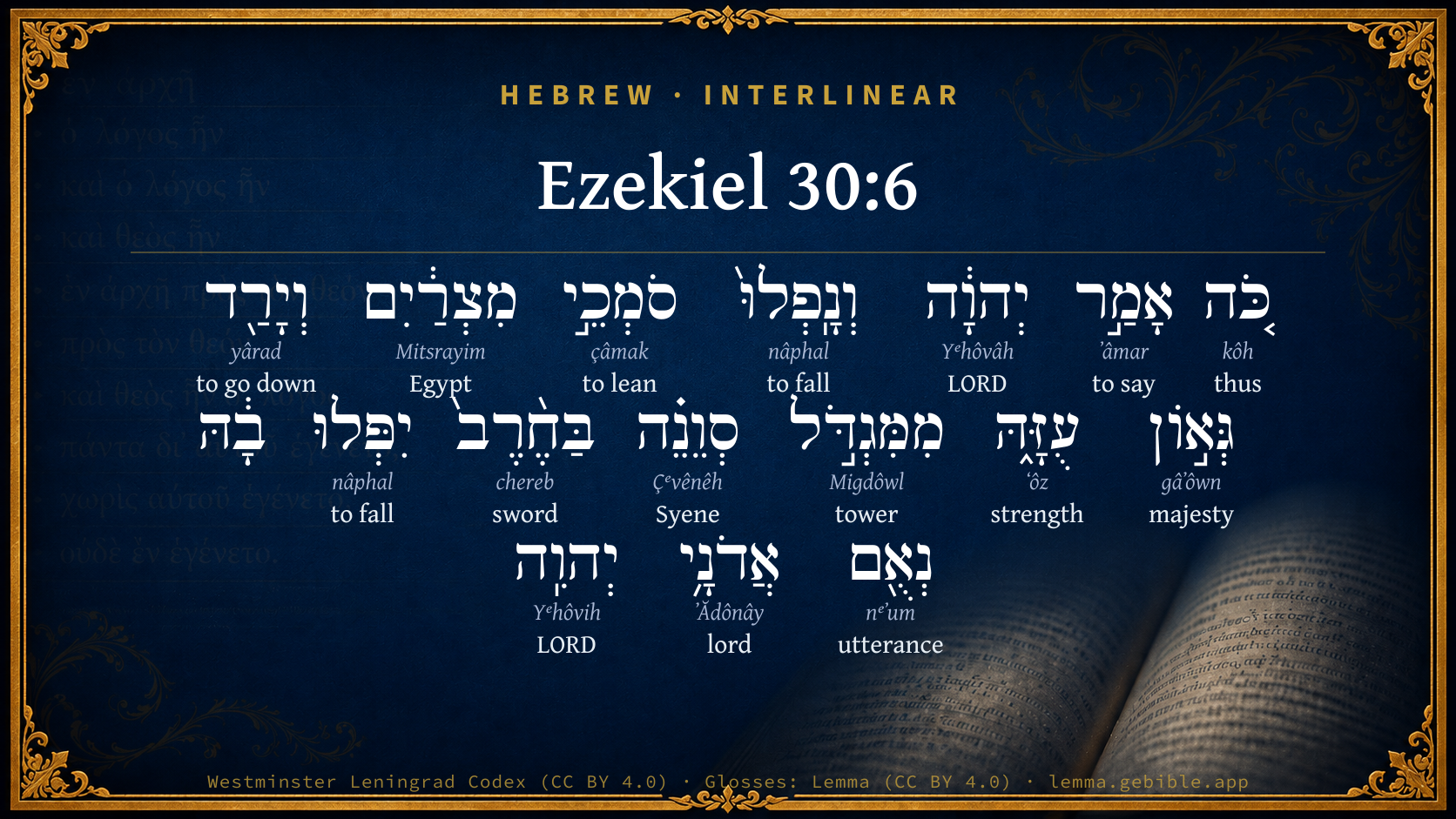
Hebrew (Westminster Leningrad Codex) Ezekiel 30:6 appears in the Hebrew Old Testament. The text above is from the Westminster Leningrad Codex. Each word links to its Strong’s number, a concise gloss, and parsing drawn from the Open Scriptures Hebrew Bible morphology. Click any word for its full Brown-Driver-Briggs (BDB) entry.
Download image
Cite this verse

Ezekiel 30:6 (World English Bible). Public Domain. Lemma interlinear Bible study tool, https://lemma.gebible.app/v/ezekiel/30/6.

Show BibTeX & RIS
BibTeX
RIS
English Translation
Thus says Yahweh: They also who uphold Egypt shall fall; and the pride of her power shall come down: from the tower of Seveneh shall they fall in it by the sword, says the Lord Yahweh.
World English Bible · Public Domain
Download a study sheet

One document with this verse’s original text, its word-by-word gloss line, the meaning frame, cross-references with their text, attributed commentary, and full source and license credits — printable, and it pastes into notes with its structure intact.

This verse Autodidact and up

Study sheet (.html) Plain text (.txt)

A passage Seminary Student

Up to 50 verses in one chapter. A passage sheet keeps up to 6 commentary sources and 12 cross-references per verse, in the order this page ranks them, and says so on the sheet whenever that leaves anything out. Ask for a single verse and you get the Autodidact verse sheet above.

Everything on this page stays free to read, with no account — the sheet is a download of what is already on screen, not access to it.

Want to remove ads? Support Godless Engineer
Compare translations 3

The same verse in 3 English versions, stacked beneath the original-language interlinear above. Click any original word for its lexicon entry.

Each is an independent rendering of the whole verse — the interlinear is not word-aligned to these translations.

Highlighted words mark where these versions differ — a whole-verse word diff, not a word-by-word alignment.

  • World English Bible Public Domain
    Thus says Yahweh: They also who uphold Egypt shall fall; and the pride of her power shall come down: from the tower of Seveneh shall they fall in it by the sword, says the Lord Yahweh.
  • King James Version Public Domain
    Thus saith the LORD; They also that uphold Egypt shall fall; and the pride of her power shall come down: from the tower of Syene shall they fall in it by the sword, saith the Lord GOD.
  • unfoldingWord Literal Text CC BY-SA 4.0
    Yahweh says this: So the ones who support Egypt will fall, and the pride of her strength will go down. From Migdol to Syene their soldiers will fall by the sword—this is the Lord Yahweh’s declaration.

unfoldingWord Literal Text — © unfoldingWord, licensed CC BY-SA 4.0. Word-aligned USFM3 via Door43 (git.door43.org/unfoldingWord/en_ult).

Versions to compare (up to 4)

3 of 4 selected

Show all 18 translations

Every available English version of this verse, each an independent rendering of the whole verse.

  • World English Bible Public Domain
    Thus says Yahweh: They also who uphold Egypt shall fall; and the pride of her power shall come down: from the tower of Seveneh shall they fall in it by the sword, says the Lord Yahweh.
  • Berean Standard Bible Public Domain
    For this is what the LORD says: The allies of Egypt will fall, and her proud strength will collapse. From Migdol to Syene they will fall by the sword within her, declares the Lord GOD.
  • Majority Standard Bible Public Domain
    For this is what the LORD says: The allies of Egypt will fall, and her proud strength will collapse. From Migdol to Syene they will fall by the sword within her, declares the Lord GOD.
  • King James Version Public Domain
    Thus saith the LORD; They also that uphold Egypt shall fall; and the pride of her power shall come down: from the tower of Syene shall they fall in it by the sword, saith the Lord GOD.
  • American Standard Version (1901) Public Domain
    Thus saith Jehovah: They also that uphold Egypt shall fall; and the pride of her power shall come down: from the tower of Seveneh shall they fall in it by the sword, saith the Lord Jehovah.
  • Revised Version (1885) Public Domain
    Thus saith the LORD: They also that uphold Egypt shall fall, and the pride of her power shall come down: from the tower of Seveneh shall they fall in it by the sword, saith the Lord GOD.
  • Geneva Bible (1599) Public Domain
    Thus sayth the Lord, They also that mainteine Egypt, shall fall, and the pride of her power shall come downe: from the towre of Seueneh shall they fall by the sword, sayth the Lord God.
  • Douay-Rheims (1899) Public Domain
    Thus saith the Lord God: They also that uphold Egypt shall fall, and the pride of her empire shall be brought down: from the tower of Syene shall they fall in it by the sword, saith the Lord the God of hosts.
  • Young's Literal Translation Public Domain
    Thus said Jehovah: And -- fallen have supporters of Egypt, And come down hath the arrogance of her strength, From Migdol to Syene, by sword they fall in her, An affirmation of the Lord Jehovah.
  • Literal Standard Version CC BY-SA 4.0
    Thus said YHWH: And those supporting Egypt have fallen, || And the arrogance of her strength has come down, || From Migdol to Syene, they fall by sword in her, || A declaration of Lord YHWH.
  • Unlocked Literal Bible CC BY-SA 4.0
    Yahweh says this: So the ones who support Egypt will fall, and the pride of her strength will go down. From Migdol to Syene their soldiers will fall by the sword—this is the Lord Yahweh's declaration.
  • unfoldingWord Literal Text CC BY-SA 4.0
    Yahweh says this: So the ones who support Egypt will fall, and the pride of her strength will go down. From Migdol to Syene their soldiers will fall by the sword—this is the Lord Yahweh’s declaration.
  • Darby Bible Public Domain
    Thus saith Jehovah: They also that uphold Egypt shall fall; and the pride of her strength shall come down: from Migdol to Syene shall they fall in her by the sword, saith the Lord Jehovah.
  • World Messianic Bible Public Domain
    “‘The LORD says: “They also who uphold Egypt will fall. The pride of her power will come down. They will fall by the sword in it from the tower of Seveneh,” says the Lord GOD.
  • Webster's Bible Public Domain
    Thus saith the LORD; They also that uphold Egypt shall fall; and the pride of her power shall come down: from the tower of Syene shall they fall in it by the sword, saith the Lord GOD.
  • Free Bible Version CC BY-SA 4.0
    This is what the Lord says: Egypt's allies will fall, and the country will lose its prestigious position. From Migdol in the north to Syene in the south, they will be killed by the sword, declares the Lord God.
  • Bible in Basic English Public Domain
    This is what the Lord has said: The supporters of Egypt will have a fall, and the pride of her power will come down: from Migdol to Syene they will be put to the sword in it, says the Lord.
  • JPS Tanakh (1917) Public Domain
    Thus saith the LORD: They also that uphold Egypt shall fall, and the pride of her power shall come down; from Migdol to Syene shall they fall in it by the sword, saith the Lord GOD.

Literal Standard Version (2020), Covenant Press — licensed CC BY-SA 4.0. Text via the HelloAO Bible API (eBible.org). Unlocked Literal Bible (unfoldingWord) — licensed CC BY-SA 4.0. Text via the HelloAO Bible API (eBible.org). unfoldingWord Literal Text — © unfoldingWord, licensed CC BY-SA 4.0. Word-aligned USFM3 via Door43 (git.door43.org/unfoldingWord/en_ult). Free Bible Version, Dr. Jonathan Gallagher — licensed CC BY-SA 4.0. Text via the HelloAO Bible API (eBible.org).

Word by word

More ways to search: Search by grammar → Find every occurrence → Compare this word →

Practice this passage: Drill this verse → Learn its vocabulary →

סְוֵנֵ֗ה
Çᵉvênêh
H5482
“Syene”
Noun, Proper
Part of Speech
Noun
Type
Proper
Full BDB Definition

Origin: of Egyptian derivation

TWOT: None

Syene = "her veiling (?)" - a town of Egypt on the frontier of Cush or Ethiopia
  1. כֹּ֚ה kôh H3541 “thus” Adverb
  2. אָמַ֣ר ʼâmar H559 “to say” Verb, Qal, Perfect, 3rd Person, Masculine, Singular
  3. יְהוָ֔ה Yᵉhôvâh H3068 “LORD” Noun, Proper
  4. וְנָֽפְלוּ֙ nâphal H5307 “and · to fall” Conjunction + Verb, Qal, Sequential Perfect, 3rd Person, Common, Plural
  5. סֹמְכֵ֣י çâmak H5564 “leaning” Verb, Qal, Participle Active, Masculine, Plural, Construct
  6. מִצְרַ֔יִם Mitsrayim H4714 “Egypt” Noun, Proper
  7. וְיָרַ֖ד yârad H3381 “and · to go down” Conjunction + Verb, Qal, Sequential Perfect, 3rd Person, Masculine, Singular
  8. גְּא֣וֹן gâʼôwn H1347 “majesty of” Noun, Common, Masculine, Singular, Construct
  9. עֻזָּ֑הּ ʻôz H5797 “strength · her” Noun, Common, Masculine, Singular, Construct + Suffix, Personal, 3rd Person, Feminine, Singular
  10. מִמִּגְדֹּ֣ל Migdôwl H4024 “from · tower” Preposition + Noun, Proper
  11. בַּחֶ֨רֶב֙ chereb H2719 “in/at the · sword” Preposition, Determined + Noun, Common, Feminine, Singular, Absolute
  12. יִפְּלוּ nâphal H5307 “to fall” Verb, Qal, Imperfect, 3rd Person, Masculine, Plural
  13. נְאֻ֖ם nᵉʼum H5002 “utterance of” Noun, Common, Masculine, Singular, Construct
  14. אֲדֹנָ֥י ʼĂdônây H136 “Lord · my” Noun, Common, Masculine, Plural, Construct + Suffix, Personal, 1st Person, Common, Singular
  15. יְהוִֽה Yᵉhôvih H3069 “LORD” Noun, Proper

About this verse

These counts appear in no published source. They are computed here, from the morphology-tagged text and Lemma’s own curated glosses. What Lemma adds →

17
words
15
distinct lemmas
Prophets
section

Notable vocabulary

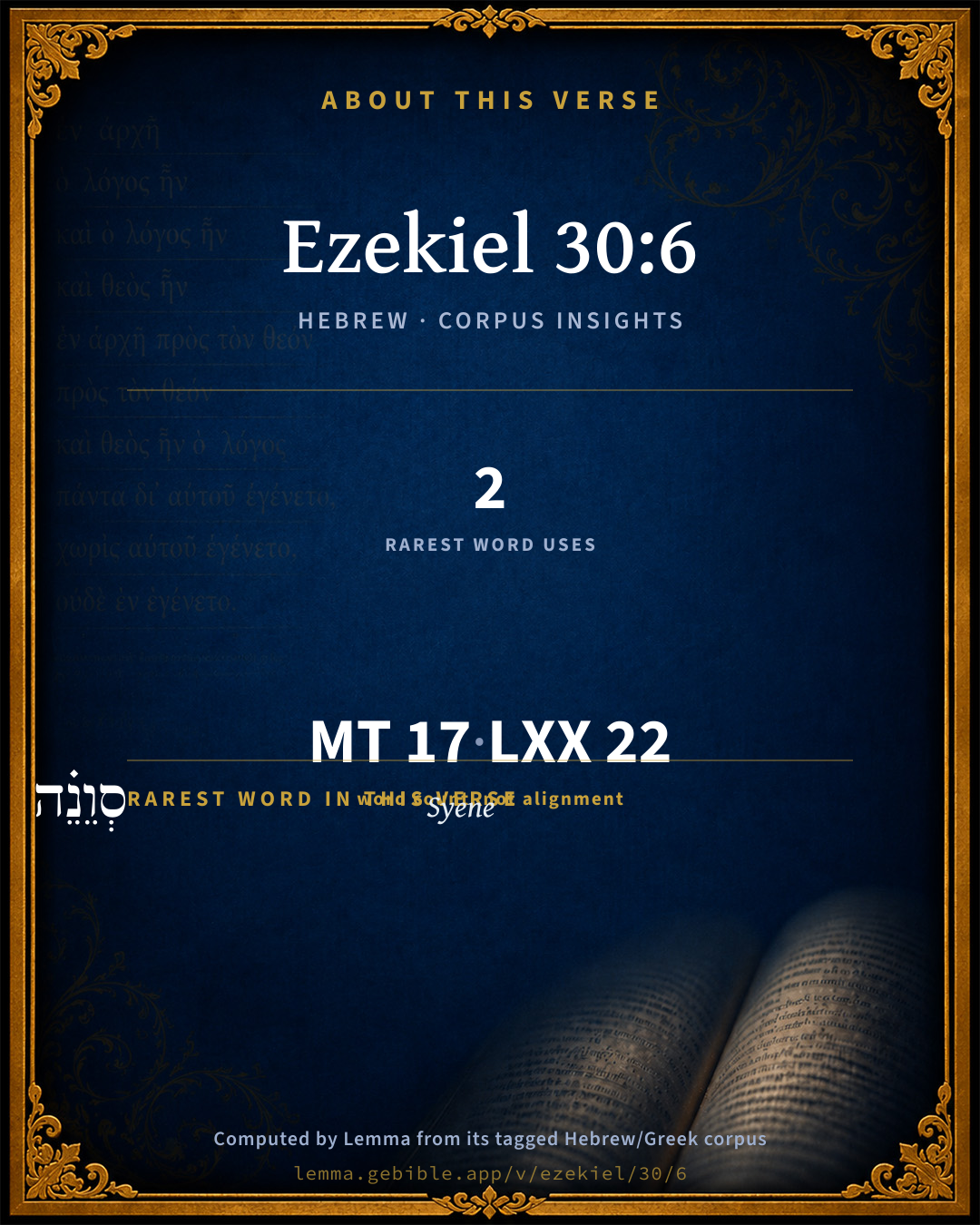
The rarest word here is סְוֵנֵ֗ה Syene H5482 — appearing just 2 times in the whole Hebrew Bible.

Shared distinctive vocabulary

סְוֵנֵ֗ה Syene H5482 occurs in 2 verses of the Hebrew Bible. Also found in:

Grammatical profile

  • 5 verbs
  • 10 nouns
  • 1 preposition
  • 1 adverb

Verb forms

  • אָמַ֣ר Qal · Perfect
  • וְנָֽפְלוּ֙ Qal · Sequential Perfect
  • סֹמְכֵ֣י Qal · Participle Active
  • וְיָרַ֖ד Qal · Sequential Perfect
  • יִפְּלוּ Qal · Imperfect

Repetition

A word recurs within this verse — often emphatic in Hebrew:

  • וְנָֽפְלוּ֙ to fall H5307 ×2

Hebrew & Septuagint length

In English translation the verse runs 36 words from the Hebrew and 31 from the Septuagint (LXX English) — closely comparable.

A rough comparison of the two English renderings, which tokenize alike — not a word-level alignment.

Word counts can differ between the Hebrew and the Greek without any difference in meaning — e.g. the Hebrew direct-object marker אֵת has no separate Greek word, and Greek often adds the article ὁ.

In the original languages it is 17 Hebrew tokens and 22 Greek tokens — but the two are counted differently (Hebrew bundles its prefixes and suffixes into one token; the Greek is in lemma form), so that isn’t a like-for-like length.

Cross-references

5

Topical passages linked to Ezekiel 30:6 in the Treasury of Scripture Knowledge — connected by theme and wording, ordered by reader-vote popularity; previews shown in the World English Bible.

  • Ezekiel 29:10 therefore, behold, I am against you, and against your rivers, and I will make the land of Egypt an utter waste and desolation, from the tower of Seveneh even to the border of Ethiopia.
  • Isaiah 20:3–6 Yahweh said, Like as my servant Isaiah has walked naked and barefoot three years for a sign and a wonder concerning Egypt and concerning Ethiopia;
  • Job 9:13 "God will not withdraw his anger; The helpers of Rahab stoop under him.
  • Isaiah 31:3 Now the Egyptians are men, and not God; and their horses flesh, and not spirit: and when Yahweh shall stretch out his hand, both he who helps shall stumble, and he who is helped shall fall, and they all shall be consumed together.
  • Nahum 3:9 Cush and Egypt were her boundless strength. Put and Libya were her helpers.

Cross-references courtesy of OpenBible.info (CC BY 4.0).

Hebrew and Greek witnesses Masoretic Hebrew ↔ Greek Septuagint

The same verse in the two great witnesses to the Old Testament, shown verse-for-verse.

These are two independent witnesses, not word-aligned to each other, and the Septuagint is shown in lemma (dictionary) form.

Hebrew Ezekiel 30:6 Masoretic · Westminster Leningrad Codex

כֹּ֚ה אָמַ֣ר יְהוָ֔ה וְנָֽפְלוּ֙ סֹמְכֵ֣י מִצְרַ֔יִם וְיָרַ֖ד גְּא֣וֹן עֻזָּ֑הּ מִמִּגְדֹּ֣ל סְוֵנֵ֗ה בַּחֶ֨רֶב֙ יִפְּלוּ בָ֔הּ נְאֻ֖ם אֲדֹנָ֥י יְהוִֽה

Thus says Yahweh: They also who uphold Egypt shall fall; and the pride of her power shall come down: from the tower of Seveneh shall they fall in it by the sword, says the Lord Yahweh.

World English Bible · Public Domain

Greek LXX Ezekiel 30:6 Septuagint · lemma form

καί πίπτω ὁ ἀντιστήριγμα αἴγυπτος καί καταβαίνω ὁ ὕβρις ὁ ἰσχύς αὐτός ἀπό μάγδωλος ἕως συήνη μάχαιρα πίπτω ἐν αὐτός λέγω κύριος

And the supports of Egypt shall fall; and the pride of her strength shall come down from Magdol to Syene: they shall fall by the sword in it, says the Lord.

LXX2012 (modern English Septuagint) · Public Domain

On this verse, Keil & Delitzsch discusses the Septuagint’s reading. Read the note in Commentary ↓

Hebrew: Westminster Leningrad Codex (CC BY 4.0). Greek: Septuagint (public domain); English from LXX2012 (modern English Septuagint) (Public Domain). How the Septuagint differs from the Hebrew →

Targum (Aramaic paraphrase)

1

The Targum is the ancient Jewish Aramaic paraphrase of the Hebrew Scriptures — an interpretive translation, not the Hebrew text itself. Onkelos (literal) and Pseudo-Jonathan (expansive) render the Torah, and Jonathan the Prophets. Coverage is partial: where no permissively-licensed English translation exists for a verse, only the Aramaic is shown. This is verse-level text, not a word-by-word alignment to the Hebrew.

  1. Targum Jonathan Prophets (Joshua–Malachi)
    כִּדְנַן אֲמַר יְיָ וְיִתְקַטְלוּן סַעֲדֵי מִצְרַיִם וְיִבַטֵל יְקַר תּוּקְפָהּ מִמִגְדוֹל סְוָנֵה בְּחַרְבָּא יִתְקַטְלוּן בָּהּ אֲמַר יְיָ אֱלֹהִים:

    (no public-domain English translation for this verse)

    Targum Jonathan — Aramaic: “Mikraot Gedolot” (public domain). English: “Sefaria Community Translation” (CC0 1.0 (public-domain dedication)); “London "Chaldee Paraphrase," 1871” (public domain). Text via Sefaria.

Commentary

Notes on Ezekiel 30:6 from classic Christian and Jewish commentators (each source and its license shown beneath its notes). The classic Christian expositions comment on the surrounding passage and are grouped to its opening verse, so a note may address several verses; the Jewish commentaries on the Tanakh (Rashi and others) are per-verse, so they appear only where the commentator wrote on this verse.

Lemma curates 59 commentaries, every one of them public domain or Creative Commons licensed, each selected and text-cleaned for this edition rather than reprinted as found. About our sources →

Trapp's Complete Commentary

John Trapp

Eze 30:6 Thus saith the LORD; They also that uphold Egypt shall fall; and the pride of her power shall come down: from the tower of Syene shall they fall in it by the sword, saith the Lord GOD.

Ver. 6. They that uphold Egypt shall fall,] i.e., Their confederates; or, as some, their tutelar gods. Herodotus writeth that Cambyses wasted with the sword Egypt and Ethiopia, killed their god Apis, and defaced all their idols. This he did, doubtless, rather in scorn of all religion than hatred of idolatry.

And the pride of her power shall come down.] Tumbling down as a great and weighty bullet from a very high and steep mountain.

From the tower of Syene.] See Eze 29:10.

John Trapp, A Commentary or Exposition upon All the Books of the Old and New Testament (1647–1656) — public domain. Text from a community e-Sword module.

Joseph Benson's Commentary

Eze 30:6-9. They also that uphold Egypt shall fall — By this seems to be meant the governors of the several provinces, those who are called the stay of the tribes thereof, Isa 19:13; that is, of the several Nomi, or districts of Egypt. From the tower of Syene shall they fall — This should rather be rendered, from Migdol to Syene. See note on Eze 29:10. When I have set a fire in Egypt — When I shall have kindled up the flame of war in Egypt. God’s judgments are often compared to fire: see the margin. And when all her helpers shall be destroyed — All her allies and auxiliaries. In that day shall messengers, &c. — Houbigant translates this verse, In that day shall swift messengers go forth from me, who shall terrify the secure Ethiopian; and he shall have great fears concerning the day of Egypt, because it shall be nigh. He observes, that as the messengers are said to be “sent to Cush, or Ethiopia, if the Arabians be meant, they were not to be gone by ships: if the Ethiopians, properly so called, to the south of Egypt, it was not proper for messengers to be sent to them in ships, because the navigation was against the stream, and could not be so quick as it ought upon an approaching calamity.” Bishop Newcome, however, adopts our translation of the first clause, observing, that to send messengers up the Nile in ships was, if not so swift, yet a more secure way of communicating intelligence in a time of general commotion, than to send them by land. The Egyptians and Ethiopians being confederates, the ill news of the conquest of Egypt could not but greatly affect the Ethiopians.

Joseph Benson's Commentary on the Old and New Testaments (1811–1818) — public domain. Text from a community e-Sword module.

Keil & Delitzsch

C. F. Keil & F. Delitzsch

All the supports and helpers of Egypt will fall, and the whole land with its cities will be laid waste. - Eze 30:6. Thus saith the Lord Jehovah, Those who support Egypt will fall, and its proud might will sink; from Migdol to Syene will they fall by the sword therein, is the saying of the Lord Jehovah. Eze 30:7. And they will lie waste in the midst of waste lands, and its cities be in the midst of desolate cities. Eze 30:8. They shall learn that I am Jehovah, when I bring fire into Egypt, and all its helpers are shattered. Eze 30:9. In that day will messengers go forth from me in ships to terrify the confident Ethiopia, and there will be writing among them as in the day of Egypt; for, behold, it cometh. - "Those who support Egypt" are not the auxiliary tribes and allies, for they are included in the term עזריה in Eze 30:8, but the idols and princes (Eze 30:13), the fortified cities (Eze 30:15), and the warriors (Eze 30:17), who formed the foundation of the might of the kingdom. גּאון , "the pride of its might," which is an expression applied in Eze 24:21 to the temple at Jerusalem, is to be taken here in a general sense, and understood not merely of the temples and idols of Egypt, but as the sum total of all the things on which the Egyptians rested the might of their kingdom, and on the ground of which they regarded it as indestructible. For 'ממּגדּל וגו, see the comm. on Eze 29:10. The subject to יפּלוּ בהּ is the 'סמכי מצר. Eze 30:7 is almost a literal repetition of Eze 29:12; and the subject to נשׁמּוּ is מצרים regarded as a country, though the number and gender of the verb have both been regulated by the form of the noun. The fire which God will bring into Egypt (Eze 30:8) is the fire of war. Eze 30:9. The tidings of this judgment of God will be carried by messengers to Ethiopia, and there awaken the most terrible dread of a similar fate. In the first hemistich, the prophet has Isa 18:2 floating before his mind. The messengers, who carry the tidings thither, are not the warlike forces of Chaldea, who are sent thither by God; for they would not be content with performing the service of messengers alone. We have rather to think of Egyptians, who flee by ship to Ethiopia. The messengers go, מלפני, from before Jehovah, who is regarded as being present in Egypt, while executing judgment there (cf. Isa 19:1). צים, as in Num 24:24 = ציּים (Dan 11:30), ships, trieres, according to the Rabbins, in Hieron. Symm. on Isa 33:21, and the Targum on Num. (cf. Ges. Thes. p. 1156). בּטח is attached to כּוּשׁ, Cush secure or confident, equivalent to the confident Cush (Ewald, 287c). 'והיתה חלח, repeated from Eze 30:4. בּהם, among the Ethiopians. 'כּיום מצר, as in the day of Egypt, i.e., not the present day of Egypt's punishment, for the Ethiopians have only just heard of this from the messengers; but the ancient, well-known day of judgment upon Egypt (Exo 15:12.). Ewald and Hitzig follow the lxx in taking כּיום for בּיום; but this is both incorrect and unsuitable, and reduces 'בּיום מצר into a tame repetition of בּיּום החוּא. The subject to הנּה באה is to be taken from the context, viz., that which is predicted in the preceding verses (Eze 30:6-8).

Keil & Delitzsch — Biblical Commentary on the Old Testament (1861–1891) — public domain (CC PDM 1.0). Text via the HelloAO Bible API. (Old Testament only.)

Tyndale Open Study Notes

Tyndale Open Resources

30:6-7 From Migdol to Aswan (Hebrew to Syene): This means “from north to south.” See study note on 29:8-13.

Tyndale Open Study Notes — © Tyndale Open Resources, licensed CC BY-SA 4.0. Text via the HelloAO Bible API.

Geneva Bible (1599)

Geneva Bible translators

Which was a strong city of Egypt, Ezek. 29:10.

Geneva Bible (1599) marginal notes — public domain. Text via Bolls.life.

Jamieson, Fausset & Brown

Robert Jamieson, A. R. Fausset & David Brown

from the tower of Syene--(see on Eze 29:10).

Jamieson, Fausset & Brown — Commentary Critical and Explanatory on the Whole Bible (1871) — public domain (CC PDM 1.0). Text via the HelloAO Bible API.

Ellicott's Commentary for English Readers

(6) From the tower of Syene.—From Migdol to Syene. (See Note on Eze_29:10.)

A Bible Commentary for English Readers, edited by Charles John Ellicott (1878–1897) — public domain. Text from a community e-Sword module.

The Cambridge Bible for Schools and Colleges

gen. ed. J. J. S. Perowne

6. the tower of Syene] from Migdol to Syene; cf. Eze_29:10.

The Cambridge Bible for Schools and Colleges (gen. ed. J. J. S. Perowne; Cambridge University Press, 1878–1918) — public domain. Text from a community e-Sword module.

John Gill's Exposition

Thus saith the Lord, they also that uphold Egypt shall fall,.... That is, by the sword; either their allies and auxiliaries without, that supported the Egyptians with men and money; or their principal people within, their nobles that supported their state with their estates, their counsellors with their wisdom, their soldiers with their valour and courage:

and the pride of her power shall come down; or the power they were proud of, the dominion and grandeur they boasted of; the greatness of their king, and the largeness of their empire, with the wealth and riches of it:

from the tower of Syene shall they fall in it by the sword, saith the Lord God; or rather, from "Migdol to Syene"; so the Septuagint and Arabic versions, from one end of Egypt to the other; the sword would ravage, and multitudes fall by it, in all cities and towns, between the one and the other; which denotes the general slaughter that should be made; See Gill on Eze 29:10.

John Gill's Exposition of the Whole Bible (1746–1763) — public domain (CC PDM 1.0). Text via the HelloAO Bible API.

Albert Barnes' Notes on the Bible

See the marginal reference note.

Albert Barnes' Notes on the Bible (1834–1885) — public domain. Text from a community e-Sword/MySword module.

Matthew Poole's English Annotations

They also that uphold Egypt; either the princes, counsellors, and martial men in Egypt, or those abroad, that favour her and help her.

The pride of her power; the glory of all her strength, of which she was proud.

Shall come down; be trodden under foot. From the tower; from Magdalum in the north-east part of Egypt, toward the Red Sea, to Syene in the most south-west part of Egypt. See Eze 29:10.

Matthew Poole's English Annotations on the Holy Bible (1683–1685) — public domain. Text from a community e-Sword/MySword module.

Whedon's Commentary on the Bible

Daniel D. Whedon

6. From the tower of Syene — Hebrews, from Migdol to Syene. (See note Eze_29:10.)

Daniel D. Whedon (gen. ed.), Commentary on the Old and New Testaments (1874–1909) — public domain. Text from a community e-Sword module.

The Pulpit Commentary

They that uphold Egypt. The words include the allies named in Ver. 5; but also embrace the rulers, generals, perhaps the idols, of Egypt itself. From the tower of Syene. As before, in Eze_29:10, "from Migdol to Syene."

The Pulpit Commentary (1880–1919), ed. H.D.M. Spence-Jones & Joseph S. Exell — public domain. Text from a community e-Sword module.

John Wesley's Explanatory Notes

Upheld - Those that favour and help her. The pride - The glory of all her strength.

John Wesley, Explanatory Notes Upon the Whole Bible (1754–1765) — public domain. Text via the GEBible commentary corpus.

unfoldingWord translationNotes

Door43 World Missions Community

Yahweh says this

"This is what Yahweh says." This sentence introduces what the Lord would say.

So the ones

"In this way, the peoples" or "In this manner, the nations"

who support Egypt

"who help Egypt"

will fall

"will die" or "come to ruin"

the pride of her strength will go down

This represents Egypt no longer being proud of their strength. The reason that they will not be proud is that they will no longer be strong. AT: "Egypt will no longer be proud about being strong" or "Egypt will no longer have the strength that they were so proud of" (See:Metaphor and Assumed Knowledge and Implicit Information)

From Migdol to Syene

Ezekiel names towns on the borders of Egypt in order to refer to all of Egypt. AT: "In all of Egypt" or "From the northern border of Egypt to the southern border of Egypt" (See: Merism)

their soldiers will fall by the sword

Here "fall" represents dying, and "the sword" represents battle. AT: "Egypt's soldiers will die in battle" or "an attacking army will kill Egypt's soldiers in battle" (See: Metonymy)

this is the Lord Yahweh's declaration

Yahweh speaks of himself by name to express the certainty of what he is declaring. See how you translated this in Ezekiel 5:11. AT: "this is what the Lord Yahweh has declared" or "this is what I, the Lord Yahweh, have declared" (See: First, Second, or Third Person)

They will be appalled in the midst of the abandoned lands

"The soldiers of the allies of Egypt will be appalled when they are left surrounded by nothing but abandoned lands"

in the midst of

"among" or "surrounded by"

their cities will be among all the ruined cities

Being "among" the ruined cities represents being ruined like the ruined cities of other countries. AT: "their cities will be ruined like the cities of other countries" (See: Metaphor)

translationWords

proud

Lord Yahweh

declare

unfoldingWord translationNotes — © Distant Shores Media and the Door43 World Missions Community, licensed CC BY-SA 4.0. Source: git.door43.org/Door43/en_tn.

Lesson kit

Teaching starters — assembled from the data on this page, not authored interpretation. Every prompt links to the verse data it draws on. Edit before teaching.

Ezekiel, in the Prophets, opens this verse with 17 words (15 distinct Hebrew lemmas). Its most distinctive word is Çᵉvênêh (“Syene”). A historical commentator’s framing appears above. Read the whole chapter for the surrounding context.

Discussion questions

  1. How does “Syene” (Çᵉvênêh) shape what this verse is saying?
  2. Ezekiel 29:10 shares the word «Syene» with this verse. How do the two illuminate each other?
  3. “to fall” occurs 2× in this one verse. What is the effect of the repetition?
  4. These translations render this verse differently; the difference is in the English rendering, not the original. What questions does that raise?
  5. The verb «אָמַ֣ר» is Qal Perfect. How does its form color the action?
  6. Reading how Trapp's Complete Commentary and Joseph Benson's Commentary read this verse, where do the two commentators agree and where do they part?

Things to notice

Reading settings

Reading text

Shown beneath each verse's original-language words.

Old Testament
Old Testament edition

Read the OT as the Masoretic Hebrew (MT) or the Greek Septuagint (LXX).

English shown for the Greek Septuagint (in the Hebrew ↔ Greek comparison).

Comparing translations? Open the Compare panel on any verse page to stack up to four side by side.