
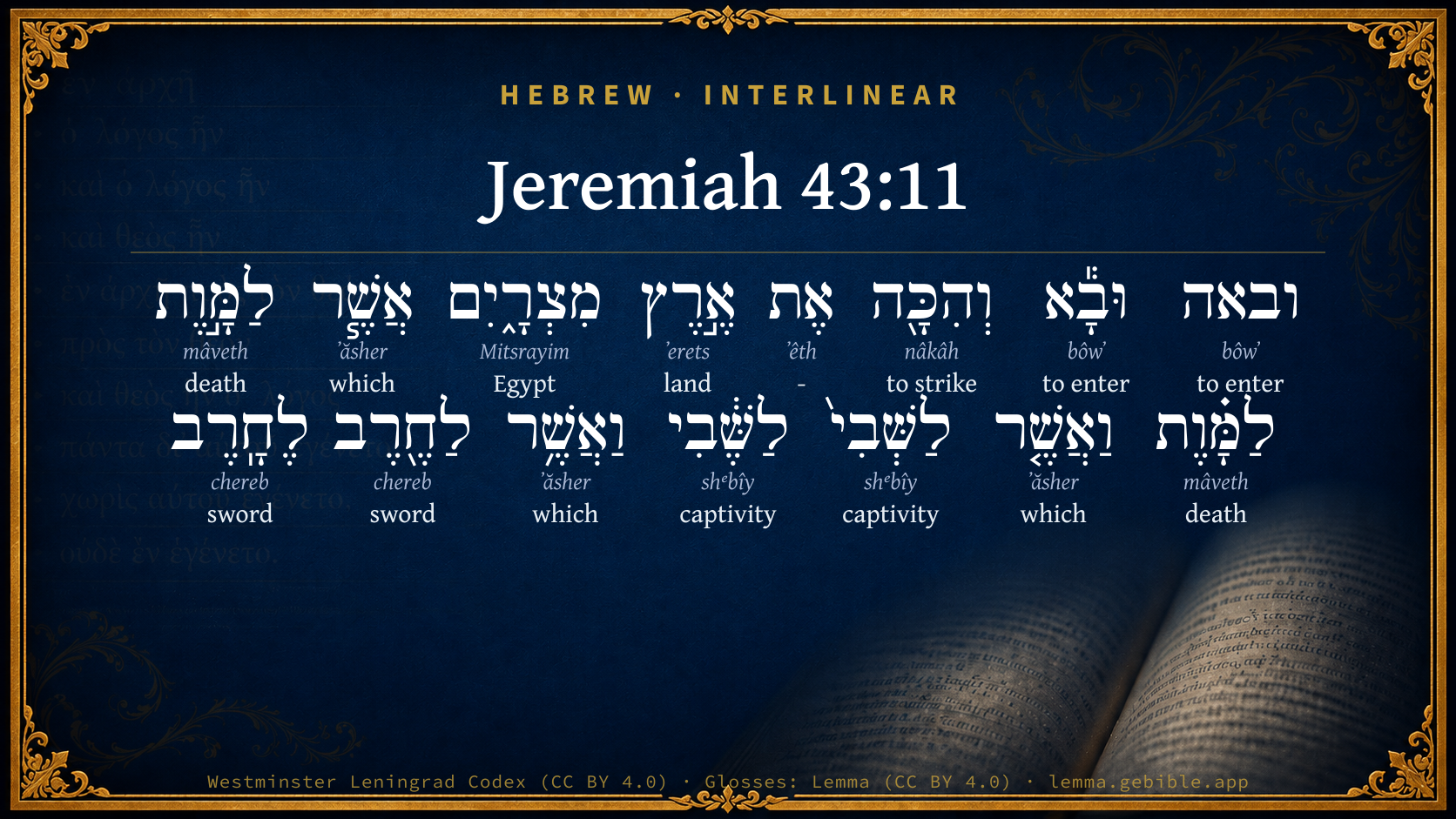
Jeremiah 43:11

Hebrew (Westminster Leningrad Codex) Jeremiah 43:11 appears in the Hebrew Old Testament. The text above is from the Westminster Leningrad Codex. Each word links to its Strong’s number, a concise gloss, and parsing drawn from the Open Scriptures Hebrew Bible morphology. Click any word for its full Brown-Driver-Briggs (BDB) entry.
Download image
Cite this verse

Jeremiah 43:11 (World English Bible). Public Domain. Lemma interlinear Bible study tool, https://lemma.gebible.app/v/jeremiah/43/11.

Show BibTeX & RIS
BibTeX
RIS
English Translation
He shall come, and shall strike the land of Egypt; such as are for death [shall be given] to death, and such as are for captivity to captivity, and such as are for the sword to the sword.
World English Bible · Public Domain
Download a study sheet

One document with this verse’s original text, its word-by-word gloss line, the meaning frame, cross-references with their text, attributed commentary, and full source and license credits — printable, and it pastes into notes with its structure intact.

This verse Autodidact and up

Study sheet (.html) Plain text (.txt)

A passage Seminary Student

Up to 50 verses in one chapter. A passage sheet keeps up to 6 commentary sources and 12 cross-references per verse, in the order this page ranks them, and says so on the sheet whenever that leaves anything out. Ask for a single verse and you get the Autodidact verse sheet above.

Everything on this page stays free to read, with no account — the sheet is a download of what is already on screen, not access to it.

Want to remove ads? Support Godless Engineer
Compare translations 3

The same verse in 3 English versions, stacked beneath the original-language interlinear above. Click any original word for its lexicon entry.

Each is an independent rendering of the whole verse — the interlinear is not word-aligned to these translations.

Highlighted words mark where these versions differ — a whole-verse word diff, not a word-by-word alignment.

  • World English Bible Public Domain
    He shall come, and shall strike the land of Egypt; such as are for death [shall be given] to death, and such as are for captivity to captivity, and such as are for the sword to the sword.
  • King James Version Public Domain
    And when he cometh, he shall smite the land of Egypt, and deliver such as are for death to death; and such as are for captivity to captivity; and such as are for the sword to the sword.
  • unfoldingWord Literal Text CC BY-SA 4.0
    For he will come and attack the land of Egypt. Anyone who is assigned to death will be given to death. Anyone who is assigned to captivity will be taken captive. Anyone who is assigned to the sword will be given to the sword.

unfoldingWord Literal Text — © unfoldingWord, licensed CC BY-SA 4.0. Word-aligned USFM3 via Door43 (git.door43.org/unfoldingWord/en_ult).

Versions to compare (up to 4)

3 of 4 selected

Show all 18 translations

Every available English version of this verse, each an independent rendering of the whole verse.

  • World English Bible Public Domain
    He shall come, and shall strike the land of Egypt; such as are for death [shall be given] to death, and such as are for captivity to captivity, and such as are for the sword to the sword.
  • Berean Standard Bible Public Domain
    He will come and strike down the land of Egypt, bringing death to those destined for death, captivity to those destined for captivity, and the sword to those destined for the sword.
  • Majority Standard Bible Public Domain
    He will come and strike down the land of Egypt, bringing death to those destined for death, captivity to those destined for captivity, and the sword to those destined for the sword.
  • King James Version Public Domain
    And when he cometh, he shall smite the land of Egypt, and deliver such as are for death to death; and such as are for captivity to captivity; and such as are for the sword to the sword.
  • American Standard Version (1901) Public Domain
    And he shall come, and shall smite the land of Egypt; such as are for death `shall be given' to death, and such as are for captivity to captivity, and such as are for the sword to the sword.
  • Revised Version (1885) Public Domain
    And he shall come, and shall smite the land of Egypt; such as are for death shall be given to death, and such as are for captivity to captivity, and such as are for the sword to the sword.
  • Geneva Bible (1599) Public Domain
    And when he shall come, he shall smite the land of Egypt: such as are appoynted for death, to death, and such as are for captiuitie, to captiuitie, and such as are for the sword to the sword.
  • Douay-Rheims (1899) Public Domain
    And he shall come and strike the land of Egypt: such as are for death, to death: and such as are for captivity, to captivity: and such as are for the sword, to the sword.
  • Young's Literal Translation Public Domain
    and he hath come, and smitten the land of Egypt -- those who `are' for death to death, and those who `are' for captivity to captivity, and those who `are' for the sword to the sword.
  • Literal Standard Version CC BY-SA 4.0
    and he has come, and struck the land of Egypt—those who [are] for death to death, and those who [are] for captivity to captivity, and those who [are] for the sword to the sword.
  • Unlocked Literal Bible CC BY-SA 4.0
    For he will come and attack the land of Egypt. Anyone who is assigned to death will be given to death. Anyone who is assigned to captivity will be taken captive. Anyone who is assigned to the sword will be given to the sword.
  • unfoldingWord Literal Text CC BY-SA 4.0
    For he will come and attack the land of Egypt. Anyone who is assigned to death will be given to death. Anyone who is assigned to captivity will be taken captive. Anyone who is assigned to the sword will be given to the sword.
  • Darby Bible Public Domain
    And he shall come and smite the land of Egypt: such as are for death to death, and such as are for captivity to captivity; and such as are for the sword to the sword.
  • World Messianic Bible Public Domain
    He will come, and will strike the land of Egypt; such as are for death will be put to death, and such as are for captivity to captivity, and such as are for the sword to the sword.
  • Webster's Bible Public Domain
    And when he cometh, he shall smite the land of Egypt, and deliver such as are for death to death; and such as are for captivity to captivity; and such as are for the sword to the sword.
  • Free Bible Version CC BY-SA 4.0
    He will come and attack Egypt, bringing death to those destined to die, imprisonment to those destined to be imprisoned, and the sword to those destined to be killed by the sword.
  • Bible in Basic English Public Domain
    And he will come and overcome the land of Egypt; those who are for death will be put to death, those who are to be prisoners will be made prisoners, and those who are for the sword will be given to the sword.
  • JPS Tanakh (1917) Public Domain
    And he shall come, and shall smite the land of Egypt; such as are for death to death, and such as are for captivity to captivity, and such as are for the sword to the sword.

Literal Standard Version (2020), Covenant Press — licensed CC BY-SA 4.0. Text via the HelloAO Bible API (eBible.org). Unlocked Literal Bible (unfoldingWord) — licensed CC BY-SA 4.0. Text via the HelloAO Bible API (eBible.org). unfoldingWord Literal Text — © unfoldingWord, licensed CC BY-SA 4.0. Word-aligned USFM3 via Door43 (git.door43.org/unfoldingWord/en_ult). Free Bible Version, Dr. Jonathan Gallagher — licensed CC BY-SA 4.0. Text via the HelloAO Bible API (eBible.org).

Word by word

More ways to search: Search by grammar → Find every occurrence → Compare this word →

Practice this passage: Drill this verse → Learn its vocabulary →

לַשְּׁבִי֙
shᵉbîy
H7628
“to/for the · captivity”
Preposition, Determined + Noun, Common, Both, Singular, Absolute
Part of Speech
Preposition + Noun
Type
Common
Gender
Both
Number
Singular
State
Absolute
Full BDB Definition

Origin: from H7618

TWOT: 2311a

captivity, captives (noun masculine) - (state of) captivity - (act of) capture - captives - captive (noun feminine)
  1. ובאה bôwʼ H935 “and · entering · toward” Conjunction + Verb, Qal, Participle Active, Masculine, Singular, Construct + Suffix, Demonstrative
  2. וּבָ֕א bôwʼ H935 “and · to enter” Conjunction + Verb, Qal, Sequential Perfect, 3rd Person, Masculine, Singular
  3. וְהִכָּ֖ה nâkâh H5221 “and · to strike” Conjunction + Verb, Hiphil, Sequential Perfect, 3rd Person, Masculine, Singular
  4. אֶת ʼêth H853 “-” Particle, Direct Object
  5. אֶ֣רֶץ ʼerets H776 “land of” Noun, Common, Both, Singular, Construct
  6. מִצְרָ֑יִם Mitsrayim H4714 “Egypt” Noun, Proper
  7. אֲשֶׁ֧ר ʼăsher H834 “which” Particle, Relative
  8. לַמָּ֣וֶת mâveth H4194 “to/for the · death” Preposition, Determined + Noun, Common, Masculine, Singular, Absolute
  9. לַמָּ֗וֶת mâveth H4194 “to/for the · death” Preposition, Determined + Noun, Common, Masculine, Singular, Absolute
  10. וַאֲשֶׁ֤ר ʼăsher H834 “and · which” Conjunction + Particle, Relative
  11. לַשֶּׁ֔בִי shᵉbîy H7628 “to/for the · captivity” Preposition, Determined + Noun, Common, Both, Singular, Absolute
  12. וַאֲשֶׁ֥ר ʼăsher H834 “and · which” Conjunction + Particle, Relative
  13. לַחֶ֖רֶב chereb H2719 “to/for the · sword” Preposition, Determined + Noun, Common, Feminine, Singular, Absolute
  14. לֶחָֽרֶב chereb H2719 “to/for the · sword” Preposition, Determined + Noun, Common, Feminine, Singular, Absolute

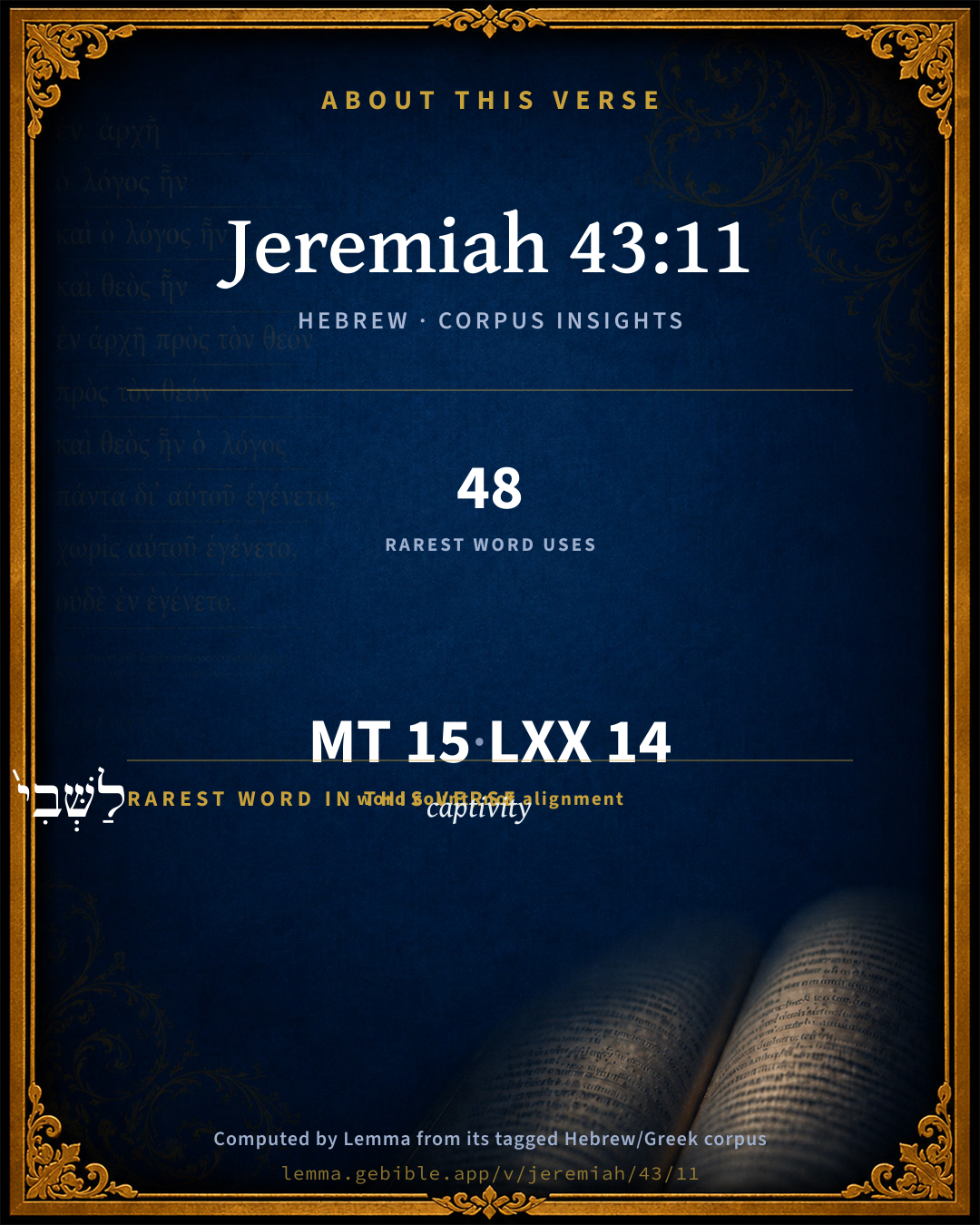
About this verse

These counts appear in no published source. They are computed here, from the morphology-tagged text and Lemma’s own curated glosses. What Lemma adds →

15
words
9
distinct lemmas
Prophets
section

Shared distinctive vocabulary

לַשְּׁבִי֙ captivity H7628 occurs in 46 verses of the Hebrew Bible. Also found in:

Grammatical profile

  • 3 verbs
  • 8 nouns
  • 4 particles

Verb forms

  • ובאה Qal · Participle Active
  • וּבָ֕א Qal · Sequential Perfect
  • וְהִכָּ֖ה Hiphil · Sequential Perfect

Repetition

Words recur within this verse — often emphatic in Hebrew:

  • ובאה to enter H935 ×2
  • לַמָּ֣וֶת death H4194 ×2
  • לַשְּׁבִי֙ captivity H7628 ×2
  • לַחֶ֖רֶב sword H2719 ×2
  • אֲשֶׁ֧ר which H834 ×3

Hebrew & Septuagint length

In the original languages it is 15 Hebrew tokens and 14 Greek tokens — but the two are counted differently (Hebrew bundles its prefixes and suffixes into one token; the Greek is in lemma form), so that isn’t a like-for-like length.

Cross-references

10

Topical passages linked to Jeremiah 43:11 in the Treasury of Scripture Knowledge — connected by theme and wording, ordered by reader-vote popularity; previews shown in the World English Bible.

  • Jeremiah 15:2 It shall happen, when they tell you, Where shall we go forth? then you shall tell them, Thus says Yahweh: Such as are for death, to death; and such as are for the sword, to the sword; and such as are for the famine, to the famine; and such as are for captivity, to captivity.
  • Jeremiah 44:13 For I will punish those who dwell in the land of Egypt, as I have punished Jerusalem, by the sword, by the famine, and by the pestilence;
  • Ezekiel 29:19–20 Therefore thus says the Lord Yahweh: Behold, I will give the land of Egypt to Nebuchadrezzar king of Babylon; and he shall carry off her multitude, and take her spoil, and take her prey; and it shall be the wages for his army.
  • Isaiah 19:1–25 The burden of Egypt. Behold, Yahweh rides on a swift cloud, and comes to Egypt: and the idols of Egypt shall tremble at his presence; and the heart of Egypt shall melt in the midst of it.
  • Jeremiah 25:19 Pharaoh king of Egypt, and his servants, and his princes, and all his people;
  • Zechariah 11:9 Then I said, "I will not feed you. That which dies, let it die; and that which is to be cut off, let it be cut off; and let those who are left eat each other's flesh."
  • Job 20:29 This is the portion of a wicked man from God, The heritage appointed to him by God."
  • Jeremiah 46:1–26 The word of Yahweh which came to Jeremiah the prophet concerning the nations.
  • Ezekiel 5:12 A third part of you shall die with the pestilence, and with famine shall they be consumed in the midst of you; and a third part shall fall by the sword round about you; and a third part I will scatter to all the winds, and will draw out a sword after them.
  • Ezekiel 30:1–26 The word of Yahweh came again to me, saying,

Cross-references courtesy of OpenBible.info (CC BY 4.0).

Hebrew and Greek witnesses Masoretic Hebrew ↔ Greek Septuagint

The same verse in the two great witnesses to the Old Testament, shown verse-for-verse.

These are two independent witnesses, not word-aligned to each other, and the Septuagint is shown in lemma (dictionary) form.

Hebrew Jeremiah 43:11 Masoretic · Westminster Leningrad Codex

ובאה וּבָ֕א וְהִכָּ֖ה אֶת אֶ֣רֶץ מִצְרָ֑יִם אֲשֶׁ֧ר לַמָּ֣וֶת לַמָּ֗וֶת וַאֲשֶׁ֤ר לַשְּׁבִי֙ לַשֶּׁ֔בִי וַאֲשֶׁ֥ר לַחֶ֖רֶב לֶחָֽרֶב

He shall come, and shall strike the land of Egypt; such as are for death [shall be given] to death, and such as are for captivity to captivity, and such as are for the sword to the sword.

World English Bible · Public Domain

Greek LXX Structure differs

In the Septuagint, Jeremiah is about an eighth shorter than the Hebrew and arranges its material differently — the Oracles Against the Nations (Hebrew chapters 46–51) appear in the middle of the Greek book, after 25:13. Because the chapter and verse boundaries do not line up, a verse-for-verse comparison with the Hebrew is not shown.

A verse-for-verse comparison isn’t shown here because the chapters and verses don’t line up. Switch to the LXX edition with the MT / LXX toggle above to read the Greek directly.

Hebrew: Westminster Leningrad Codex (CC BY 4.0). Greek: Septuagint (public domain); English from a public-domain English Septuagint. How the Septuagint differs from the Hebrew →

Targum (Aramaic paraphrase)

1

The Targum is the ancient Jewish Aramaic paraphrase of the Hebrew Scriptures — an interpretive translation, not the Hebrew text itself. Onkelos (literal) and Pseudo-Jonathan (expansive) render the Torah, and Jonathan the Prophets. Coverage is partial: where no permissively-licensed English translation exists for a verse, only the Aramaic is shown. This is verse-level text, not a word-by-word alignment to the Hebrew.

  1. Targum Jonathan Prophets (Joshua–Malachi)
    וְיֵיתֵי וְיִקְטַל יַת אַרְעָא דְמִצְרַיִם דִי לְמוֹתָא לְמוֹתָא וְדִי לְשִׁבְיָא לְשִׁבְיָא וְדִי לְחַרְבָּא לְחַרְבָּא:

    (no public-domain English translation for this verse)

    Targum Jonathan — Aramaic: “Mikraot Gedolot” (public domain). English: “Sefaria Community Translation” (CC0 1.0 (public-domain dedication)); “London "Chaldee Paraphrase," 1871” (public domain). Text via Sefaria.

Commentary

Notes on Jeremiah 43:11 from classic Christian and Jewish commentators (each source and its license shown beneath its notes). The classic Christian expositions comment on the surrounding passage and are grouped to its opening verse, so a note may address several verses; the Jewish commentaries on the Tanakh (Rashi and others) are per-verse, so they appear only where the commentator wrote on this verse.

Lemma curates 59 commentaries, every one of them public domain or Creative Commons licensed, each selected and text-cleaned for this edition rather than reprinted as found. About our sources →

Trapp's Complete Commentary

John Trapp

Jer 43:11 And when he cometh, he shall smite the land of Egypt, [and deliver] such [as are] for death to death; and such [as are] for captivity to captivity; and such [as are] for the sword to the sword.

Ver. 11. And when he cometh.] Being sent and set on by God.

He shall smite the land of Egypt.] As for their idolatry, &c., so especially for harbouring these perfidious Jews, whom divine vengeance still pursues hot foot, and will not allow them to live anywhere, since they would not be persuaded to live in God’s good land, and by his good laws.

John Trapp, A Commentary or Exposition upon All the Books of the Old and New Testament (1647–1656) — public domain. Text from a community e-Sword module.

Geneva Bible (1599)

Geneva Bible translators

Everyone shall be slain by that means that God hath appointed, Jer. 15:2.

Geneva Bible (1599) marginal notes — public domain. Text via Bolls.life.

Jamieson, Fausset & Brown

Robert Jamieson, A. R. Fausset & David Brown

such as are for death to death--that is, the deadly plague. Some he shall cause to die by the plague arising from insufficient or bad food; others, by the sword; others he shall lead captive, according as God shall order it (see on Jer 15:2).

Jamieson, Fausset & Brown — Commentary Critical and Explanatory on the Whole Bible (1871) — public domain (CC PDM 1.0). Text via the HelloAO Bible API.

Adam Clarke's Commentary

Verse 11. Such as are for death to death] See Clarke on Jer 15:2.

Adam Clarke's Commentary on the Bible (1810–1826) — public domain. Text from a community e-Sword/MySword module.

John Calvin's Commentaries

He confirms the former verse by what he says here and in the two following verses to the end of the chapter. As Egypt had cities well fortified and deemed impregnable, the Jews never thought that the Chaldeans could so easily penetrate into them. For, first, that country is situated in a plain; and, secondly, in the midst of lakes: and it is in part surrounded by the Nile and the Red Sea. As, then, Egypt was on every side so well fortified, they thought that there would be there a quiet nest for them. But God declares that King Nebuchadnezzar would become the conqueror of the whole land; and he removes all objections when he says, —

Those for death, to death; those for captivity, to captivity; those for the sword, to the sword; as though he had said, “Were Egypt ever so populous, yet the immense multitude of men will avail nothing, for they shall be conquered by their enemy; for some shall perish by the sword, and some by various kinds of death, and some shall be driven into exile; and Egypt shall be destroyed, as though no one stood up in its defense.” We hence see that this was added, that the Prophet might shake off the false confidence of the Jews. To the same purpose are the two following verses.

John Calvin's Commentaries (1540-1563) — public domain. Text from the Calvin Translation Society English edition (1840s-50s) via the Christian Classics Ethereal Library (ccel.org). Calvin's coverage is partial (roughly two-thirds of the Bible); uncommented books and verses are honest gaps, never fabricated. The 19th-century editor's footnotes and remarks are omitted so the notes are faithfully Calvin's own voice.

Ellicott's Commentary for English Readers

(11) Such as are for death to death.—Again we note the re-appearance of a characteristic formula (Jer_11:2).

A Bible Commentary for English Readers, edited by Charles John Ellicott (1878–1897) — public domain. Text from a community e-Sword module.

The Cambridge Bible for Schools and Colleges

gen. ed. J. J. S. Perowne

11. to death] See on Jer_15:2.

The Cambridge Bible for Schools and Colleges (gen. ed. J. J. S. Perowne; Cambridge University Press, 1878–1918) — public domain. Text from a community e-Sword module.

John Gill's Exposition

And when he cometh, he shall smite the land of Egypt,.... Here is a various reading: the "Cetib", or textual writing, is, "when it cometh, it shall smite"; which Kimchi rightly interprets of the camp or army of Nebuchadnezzar; and the "Keri", or marginal reading, which we follow, is, "when he cometh, he shall smite"; that is, the king of Babylon; both are to be received: when Nebuchadnezzar should come with his army to Tahpanhes, he would not only take that, but go through the land of Egypt, and subdue and destroy the inhabitants of it, all that dwelt in it, sojourners as well as natives; and so the Jews that were come hither to dwell, against the express command of God, to whom this prophecy was delivered, and to whom it has a particular respect:

and deliver such as are for death to death; who are appointed to death, either by pestilence or famine; that is, he shall oblige them to flee to, or block them up in, places where they shall perish by one or other of these:

and such as are for captivity to captivity: such as are designed to be carried captive, these shall be taken by him, and carried captive into Babylon, and the provinces of it:

and such as are for the sword to the sword; who are destined to fall by the sword, these should be slain by the sword of Nebuchadnezzar, and his soldiers; so that, what by one way or another, a general destruction should be made.

John Gill's Exposition of the Whole Bible (1746–1763) — public domain (CC PDM 1.0). Text via the HelloAO Bible API.

Albert Barnes' Notes on the Bible

According to each man’s destiny, he will either die of famine, pestilence, or in battle; or he will be led captive; or be put to death by the executioner.

Albert Barnes' Notes on the Bible (1834–1885) — public domain. Text from a community e-Sword/MySword module.

Matthew Poole's English Annotations

He prophesieth the certain ruin of the Egyptians by the king of Babylon, some of whom the king of Babylon should slay, others of them he should lead away into captivity as prisoners of war. See the like phrases Jer 15:2.

Matthew Poole's English Annotations on the Holy Bible (1683–1685) — public domain. Text from a community e-Sword/MySword module.

Whedon's Commentary on the Bible

Daniel D. Whedon

11. Such as are for death to death — No theological importance can be found in this peculiar phraseology. It is neither fatalistic nor predestinarian.

Daniel D. Whedon (gen. ed.), Commentary on the Old and New Testaments (1874–1909) — public domain. Text from a community e-Sword module.

The Pulpit Commentary

He shall smite the land of Egypt. On the invasion of Egypt by Nebuchadnezzar, wrongly controverted by some, see note on Jer_46:13. Such as are for death. Such as are destined for death. (i.e. pestilence, as Jer_15:2 Jer_18:21) The words, "and deliver," prefixed in the Authorized Version, are unnecessary; "land" is equivalent to "population."

The Pulpit Commentary (1880–1919), ed. H.D.M. Spence-Jones & Joseph S. Exell — public domain. Text from a community e-Sword module.

unfoldingWord translationNotes

Door43 World Missions Community

General Information:

Yahweh continues telling his message.

he will come

Here "he" refers to Nebuchadnezzar who represents his whole army. AT: "Nebuchadnezzar's army will come" (See: Metonymy)

Anyone who is assigned to death will be given to death

The abstract noun "death" can be stated as "die." This can be stated in active form. AT: "Everyone will die whom I have decided must die" (See: Active or Passive)

Anyone who is assigned to captivity will be taken captive

This can be stated in active form. AT: "The Babylonians will take everyone captive whom I have decided must go into captivity" (See: Active or Passive)

Anyone who is assigned to the sword will be given to the sword

Here "sword" represents battle. This can be stated in active form. AT: "Everyone will die in battle whom I have decided will die in battle" (See: Metonymy and Active or Passive)

Then I will light a fire

Here "I" refers to Yahweh. This represents Yahweh sending the Babylonian army to light a fire. AT: "Then I will cause the Babylonian army to light a fire" (See: Metonymy)

Nebuchadnezzar will ... He will

Here Nebuchadnezzar represents his army. AT: "Nebuchadnezzar's army will ... They will" (See: Metonymy)

burn them or capture them

"burn the Egyptian idols or take them"

He will clean out the land of Egypt just as shepherds clean vermin off their clothes

Taking or destroying everything in Egypt is compared to how a shepherd carefully cleans off his clothes. AT: "He will take or destroy everything valuable in Egypt just as a shepherd is careful to get every insect off of his clothes" (See: Simile)

Heliopolis

This is the name of a city. The name means "city of the sun." In this city was a temple where they worshiped a sun god. (See: How to Translate Names and Assumed Knowledge and Implicit Information)

translationWords

assign

die

captive

sword

fire

temple

false god

clean

shepherd

column

unfoldingWord translationNotes — © Distant Shores Media and the Door43 World Missions Community, licensed CC BY-SA 4.0. Source: git.door43.org/Door43/en_tn.

Lesson kit

Teaching starters — assembled from the data on this page, not authored interpretation. Every prompt links to the verse data it draws on. Edit before teaching.

Jeremiah, in the Prophets, opens this verse with 15 words (9 distinct Hebrew lemmas). Its most distinctive word is shᵉbîy (“captivity”). A historical commentator’s framing appears above. Read the whole chapter for the surrounding context.

Discussion questions

  1. How does “captivity” (shᵉbîy) shape what this verse is saying?
  2. Exodus 12:29 shares the word «captivity» with this verse. How do the two illuminate each other?
  3. “to enter” occurs 2× in this one verse. What is the effect of the repetition?
  4. The translations on this page render this verse differently — a whole-verse word diff, not a word-by-word alignment. What might account for the different wordings?
  5. The verb «ובאה» is Qal Participle Active. How does its form color the action?
  6. Reading how Trapp's Complete Commentary and Geneva Bible (1599) read this verse, where do the two commentators agree and where do they part?

Things to notice

Reading settings

Reading text

Shown beneath each verse's original-language words.

Old Testament
Old Testament edition

Read the OT as the Masoretic Hebrew (MT) or the Greek Septuagint (LXX).

English shown for the Greek Septuagint (in the Hebrew ↔ Greek comparison).

Comparing translations? Open the Compare panel on any verse page to stack up to four side by side.