Judges 3:21

Hebrew (Westminster Leningrad Codex) Judges 3:21 appears in the Hebrew Old Testament. The text above is from the Westminster Leningrad Codex. Each word links to its Strong’s number, a concise gloss, and parsing drawn from the Open Scriptures Hebrew Bible morphology. Click any word for its full Brown-Driver-Briggs (BDB) entry.
Download image
Cite this verse

Judges 3:21 (World English Bible). Public Domain. Lemma interlinear Bible study tool, https://lemma.gebible.app/v/judges/3/21.

Show BibTeX & RIS
BibTeX
RIS
English Translation
Ehud put forth his left hand, and took the sword from his right thigh, and thrust it into his body:
World English Bible · Public Domain
Download a study sheet

One document with this verse’s original text, its word-by-word gloss line, the meaning frame, cross-references with their text, attributed commentary, and full source and license credits — printable, and it pastes into notes with its structure intact.

This verse Autodidact and up

Study sheet (.html) Plain text (.txt)

A passage Seminary Student

Up to 50 verses in one chapter. A passage sheet keeps up to 6 commentary sources and 12 cross-references per verse, in the order this page ranks them, and says so on the sheet whenever that leaves anything out. Ask for a single verse and you get the Autodidact verse sheet above.

Everything on this page stays free to read, with no account — the sheet is a download of what is already on screen, not access to it.

Want to remove ads? Support Godless Engineer
Compare translations 3

The same verse in 3 English versions, stacked beneath the original-language interlinear above. Click any original word for its lexicon entry.

Each is an independent rendering of the whole verse — the interlinear is not word-aligned to these translations.

Highlighted words mark where these versions differ — a whole-verse word diff, not a word-by-word alignment.

  • World English Bible Public Domain
    Ehud put forth his left hand, and took the sword from his right thigh, and thrust it into his body:
  • King James Version Public Domain
    And Ehud put forth his left hand, and took the dagger from his right thigh, and thrust it into his belly:
  • unfoldingWord Literal Text CC BY-SA 4.0
    Then Ehud stretched out his left hand and took the sword from upon his right thigh, and he thrust it into his belly.

unfoldingWord Literal Text — © unfoldingWord, licensed CC BY-SA 4.0. Word-aligned USFM3 via Door43 (git.door43.org/unfoldingWord/en_ult).

Versions to compare (up to 4)

3 of 4 selected

Show all 18 translations

Every available English version of this verse, each an independent rendering of the whole verse.

  • World English Bible Public Domain
    Ehud put forth his left hand, and took the sword from his right thigh, and thrust it into his body:
  • Berean Standard Bible Public Domain
    And Ehud reached with his left hand, pulled the sword from his right thigh, and plunged it into Eglon’s belly.
  • Majority Standard Bible Public Domain
    And Ehud reached with his left hand, pulled the sword from his right thigh, and plunged it into Eglon’s belly.
  • King James Version Public Domain
    And Ehud put forth his left hand, and took the dagger from his right thigh, and thrust it into his belly:
  • American Standard Version (1901) Public Domain
    And Ehud put forth his left hand, and took the sword from his right thigh, and thrust it into his body:
  • Revised Version (1885) Public Domain
    And Ehud put forth his left hand, and took the sword from his right thigh, and thrust it into his belly:
  • Geneva Bible (1599) Public Domain
    And Ehud put forth his left hand, and tooke the dagger from his right thigh, and thrust it into his bellie,
  • Douay-Rheims (1899) Public Domain
    And Aod put forth his left hand, and took the dagger from his right thigh, and thrust it into his belly,
  • Young's Literal Translation Public Domain
    and Ehud putteth forth his left hand, and taketh the sword from off his right thigh, and striketh it into his belly;
  • Literal Standard Version CC BY-SA 4.0
    and Ehud puts forth his left hand, and takes the sword from off his right thigh, and thrusts it into his belly;
  • Unlocked Literal Bible CC BY-SA 4.0
    Ehud reached with his left hand and took the sword from his right thigh, and he stabbed it into the king's body.
  • unfoldingWord Literal Text CC BY-SA 4.0
    Then Ehud stretched out his left hand and took the sword from upon his right thigh, and he thrust it into his belly.
  • Darby Bible Public Domain
    And Ehud reached with his left hand, took the sword from his right thigh, and thrust it into his belly;
  • World Messianic Bible Public Domain
    Ehud put out his left hand, and took the sword from his right thigh, and thrust it into his body.
  • Webster's Bible Public Domain
    And Ehud put forth his left hand, and took the dagger from his right thigh, and thrust it into his belly:
  • Free Bible Version CC BY-SA 4.0
    Ehud grabbed his sword with his left hand from his right thigh and drove it into Eglon's belly.
  • Bible in Basic English Public Domain
    And Ehud put out his left hand, and took the sword from his right side, and sent it into his stomach;
  • JPS Tanakh (1917) Public Domain
    And Ehud put forth his left hand, and took the sword from his right thigh, and thrust it into his belly.

Literal Standard Version (2020), Covenant Press — licensed CC BY-SA 4.0. Text via the HelloAO Bible API (eBible.org). Unlocked Literal Bible (unfoldingWord) — licensed CC BY-SA 4.0. Text via the HelloAO Bible API (eBible.org). unfoldingWord Literal Text — © unfoldingWord, licensed CC BY-SA 4.0. Word-aligned USFM3 via Door43 (git.door43.org/unfoldingWord/en_ult). Free Bible Version, Dr. Jonathan Gallagher — licensed CC BY-SA 4.0. Text via the HelloAO Bible API (eBible.org).

Word by word

More ways to search: Search by grammar → Find every occurrence → Compare this word →

Practice this passage: Drill this verse → Learn its vocabulary →

אֵהוּד֙
ʼÊhûwd
H164
“Ehud”
Noun, Proper
Part of Speech
Noun
Type
Proper
Full BDB Definition

Origin: from the same as H161

TWOT: None

Ehud = "I will give thanks: I will be praised" or " undivided, union" in ( 1Ch 8:6 ) only - Benjamite judge of Israel, deliverer of Israel from Moab - another Benjamite, son of Bilhan ( 1Ch 8:6 )
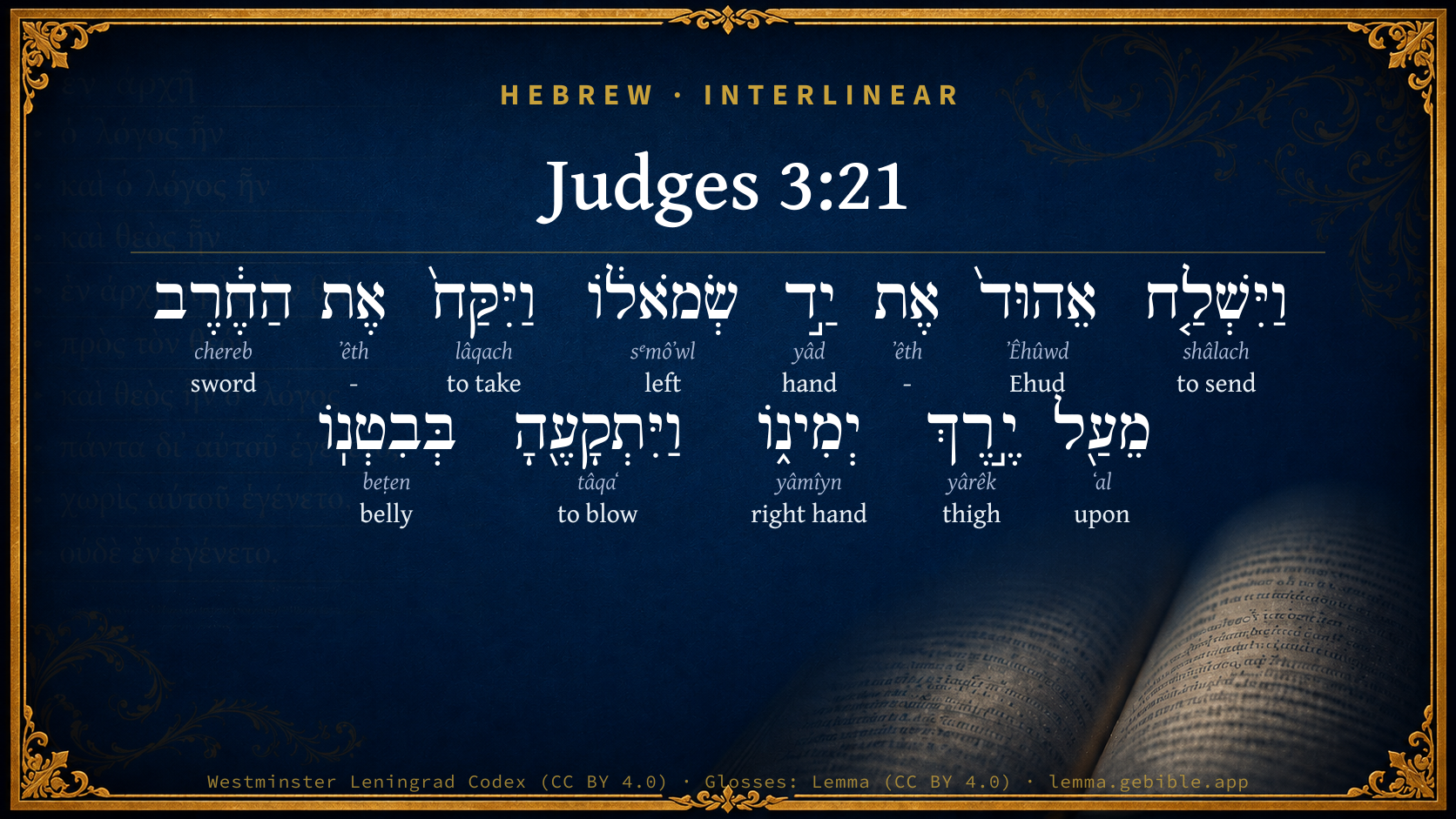
  1. וַיִּשְׁלַ֤ח shâlach H7971 “and · to send” Conjunction + Verb, Qal, Sequential Imperfect, 3rd Person, Masculine, Singular
  2. אֶת ʼêth H853 “-” Particle, Direct Object
  3. יַ֣ד yâd H3027 “hand of” Noun, Common, Both, Singular, Construct
  4. שְׂמֹאל֔וֹ sᵉmôʼwl H8040 “left · his” Noun, Common, Masculine, Singular, Construct + Suffix, Personal, 3rd Person, Masculine, Singular
  5. וַיִּקַּח֙ lâqach H3947 “and · to take” Conjunction + Verb, Qal, Sequential Imperfect, 3rd Person, Masculine, Singular
  6. אֶת ʼêth H853 “-” Particle, Direct Object
  7. הַחֶ֔רֶב chereb H2719 “the · sword” Particle, Definite Article + Noun, Common, Feminine, Singular, Absolute
  8. מֵעַ֖ל ʻal H5921 “from · upon” Preposition + Preposition
  9. יֶ֣רֶךְ yârêk H3409 “thigh of” Noun, Common, Feminine, Singular, Construct
  10. יְמִינ֑וֹ yâmîyn H3225 “right hand · his” Noun, Common, Feminine, Singular, Construct + Suffix, Personal, 3rd Person, Masculine, Singular
  11. וַיִּתְקָעֶ֖הָ tâqaʻ H8628 “and · to blow · her” Conjunction + Verb, Qal, Sequential Imperfect, 3rd Person, Masculine, Singular + Suffix, Personal, 3rd Person, Feminine, Singular
  12. בְּבִטְנֽוֹ beṭen H990 “in/at · belly · his” Preposition + Noun, Common, Feminine, Singular, Construct + Suffix, Personal, 3rd Person, Masculine, Singular

About this verse

These counts appear in no published source. They are computed here, from the morphology-tagged text and Lemma’s own curated glosses. What Lemma adds →

13
words
12
distinct lemmas
Historical
section

Notable vocabulary

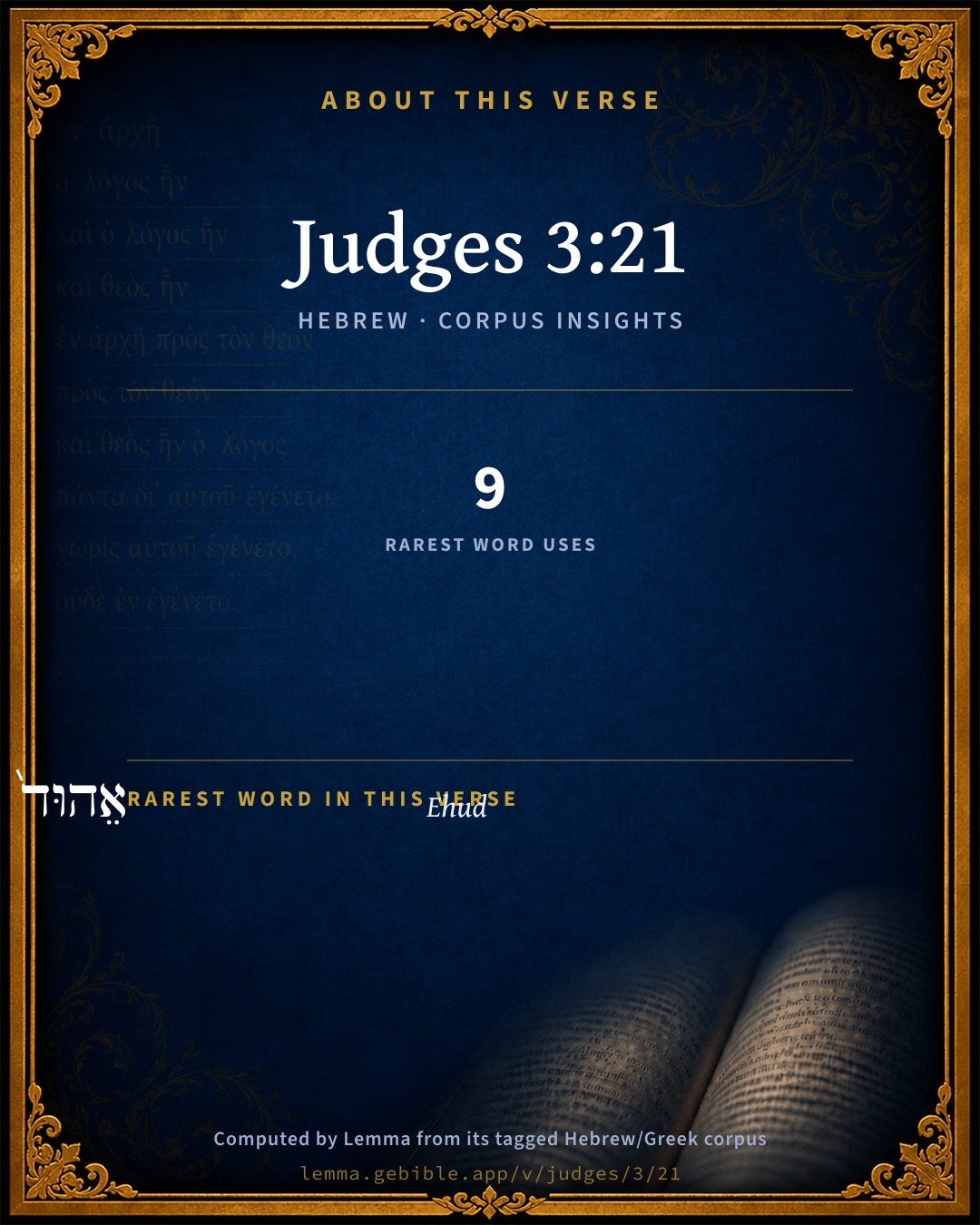
The rarest word here is אֵהוּד֙ Ehud H164 — appearing just 9 times in the whole Hebrew Bible.

Shared distinctive vocabulary

אֵהוּד֙ Ehud H164 occurs in 8 verses of the Hebrew Bible. Also found in:

Grammatical profile

  • 3 verbs
  • 7 nouns
  • 1 preposition
  • 2 particles

Verb forms

  • וַיִּשְׁלַ֤ח Qal · Sequential Imperfect
  • וַיִּקַּח֙ Qal · Sequential Imperfect
  • וַיִּתְקָעֶ֖הָ Qal · Sequential Imperfect

Hebrew & Septuagint length

In English translation the verse runs 20 words from the Hebrew and 29 from the Septuagint (LXX English) — the Septuagint runs noticeably longer here. See the side-by-side →

A rough comparison of the two English renderings, which tokenize alike — not a word-level alignment.

Word counts can differ between the Hebrew and the Greek without any difference in meaning — e.g. the Hebrew direct-object marker אֵת has no separate Greek word, and Greek often adds the article ὁ.

Cross-references

5

Topical passages linked to Judges 3:21 in the Treasury of Scripture Knowledge — connected by theme and wording, ordered by reader-vote popularity; previews shown in the World English Bible.

  • 1 Samuel 15:33 Samuel said, As your sword has made women childless, so shall your mother be childless among women. Samuel hewed Agag in pieces before Yahweh in Gilgal.
  • Numbers 25:7–8 When Phinehas, the son of Eleazar, the son of Aaron the priest, saw it, he rose up from the midst of the congregation, and took a spear in his hand;
  • Job 20:25 He draws it forth, and it comes out of his body. Yes, the glittering point comes out of his liver. Terrors are on him.
  • Zechariah 13:3 It will happen that, when anyone still prophesies, then his father and his mother who bore him will tell him, 'You must die, because you speak lies in the name of Yahweh;' and his father and his mother who bore him will stab him when he prophesies.
  • 2 Corinthians 5:16 Therefore we know no one after the flesh from now on. Even though we have known Christ after the flesh, yet now we know him so no more.

Cross-references courtesy of OpenBible.info (CC BY 4.0).

Hebrew and Greek witnesses Masoretic Hebrew ↔ Greek Septuagint

The same verse in the two great witnesses to the Old Testament, shown verse-for-verse.

Here the Septuagint runs noticeably longer than the Hebrew — LXX2012 (modern English Septuagint) 29 words vs World English Bible 20. A rough length comparison of the two English translations, not a word-level alignment — read both below.

These are two independent witnesses, not word-aligned to each other, and the Septuagint is shown in lemma (dictionary) form.

Hebrew Judges 3:21 Masoretic · Westminster Leningrad Codex

וַיִּשְׁלַ֤ח אֵהוּד֙ אֶת יַ֣ד שְׂמֹאל֔וֹ וַיִּקַּח֙ אֶת הַחֶ֔רֶב מֵעַ֖ל יֶ֣רֶךְ יְמִינ֑וֹ וַיִּתְקָעֶ֖הָ בְּבִטְנֽוֹ

Ehud put forth his left hand, and took the sword from his right thigh, and thrust it into his body:

World English Bible · Public Domain

Greek LXX Judges 3:21 Septuagint · lemma form

καί γίγνομαι ἅμα ὁ ἀναἵστημι αὐτός καί ἐκτείνω αωδ ὁ χείρ ὁ ἀριστερός αὐτός καί λαμβάνω ὁ μάχαιρα ἐπάνωθεν ὁ μηρός αὐτός ὁ δεξιός καί ἐνπήγνυμι αὐτός ἐν ὁ κοιλία αὐτός

And it came to pass as he arose, that Aod stretched forth his left hand, and took the dagger off his right thigh, and plunged it into his belly;

LXX2012 (modern English Septuagint) · Public Domain

Hebrew: Westminster Leningrad Codex (CC BY 4.0). Greek: Septuagint (public domain); English from LXX2012 (modern English Septuagint) (Public Domain). How the Septuagint differs from the Hebrew →

Targum (Aramaic paraphrase)

1

The Targum is the ancient Jewish Aramaic paraphrase of the Hebrew Scriptures — an interpretive translation, not the Hebrew text itself. Onkelos (literal) and Pseudo-Jonathan (expansive) render the Torah, and Jonathan the Prophets. Coverage is partial: where no permissively-licensed English translation exists for a verse, only the Aramaic is shown. This is verse-level text, not a word-by-word alignment to the Hebrew.

  1. Targum Jonathan Prophets (Joshua–Malachi)
    וְאוֹשִׁיט אֵהוּד יַת יַד שְׂמָאלֵיהּ וּנְסִיב יַת חַרְבָּא מֵעַל יַרְכָא דְיַמִינֵיהּ וּקְבָעָה בִּמְעוֹהִי:

    (no public-domain English translation for this verse)

    Targum Jonathan — Aramaic: “Mikraot Gedolot” (public domain). English: “Sefaria Community Translation” (CC0 1.0 (public-domain dedication)); “London "Chaldee Paraphrase," 1871” (public domain). Text via Sefaria.

Commentary

Notes on Judges 3:21 from classic Christian and Jewish commentators (each source and its license shown beneath its notes). The classic Christian expositions comment on the surrounding passage and are grouped to its opening verse, so a note may address several verses; the Jewish commentaries on the Tanakh (Rashi and others) are per-verse, so they appear only where the commentator wrote on this verse.

Lemma curates 59 commentaries, every one of them public domain or Creative Commons licensed, each selected and text-cleaned for this edition rather than reprinted as found. About our sources →

Trapp's Complete Commentary

John Trapp

Jdg 3:21 And Ehud put forth his left hand, and took the dagger from his right thigh, and thrust it into his belly:

Ver. 21. And thrust it into his belly.] This he did by an extraordinary call from God; {Jdg 3:15} and therefore this example was traitorously misapplied to Ravillas, that desperate assassin, who murdered the French king by the instigation of the Jesuits, and defended it when he had done. Our own chronicles {a} tell us of one Birchet in Queen Elizabeth’s reign, who by the example of Ehud, thought he might lawfully have killed a great personage in this kingdom, whom he took to be God’s enemy. Upon the same account he wounded Hawkins, and slew his keeper. The Janizaries have learned of the Jesuits the art of king killing: but to preserve him from harm by strangers, they allow none to come into the presence of the grand signior, but first they search him that he have no weapon; and so clasping him by the arms under colour of doing him honour, dissemblingly bereave him of the use of his hands, lest he should offer him any violence. {b}

And thrust it into his belly.] Eglon stabbed into the guts, finds his bane the same way with his sin. It was good counsel that one gave Henry IV of France, after that he had been first stabbed in the mouth and lost a tooth only, to take heed he denied not God with his heart, as he had already done with his mouth where now he was wounded, lest the next stab were to the heart, as indeed it proved.

{a} Camden’s Elisab, 174.

{b} Turk. Hist.

John Trapp, A Commentary or Exposition upon All the Books of the Old and New Testament (1647–1656) — public domain. Text from a community e-Sword module.

Joseph Benson's Commentary

Jdg 3:21. Ehud put forth his hand and took the dagger — It is justly observed by Dr. Dodd, that this action of Ehud “is certainly among the number of those which are not to be imitated without that which gave it all its sanction; namely, a divine commission. The text expressly says, The Lord raised up Ehud; and it is well known that all the deliverances which the Jews had under the judges, were directed and conducted by the immediate hand of God, according as the people, by their repentance, became fit to receive them. A divine warrant, in such a case, is a clear ground to go upon, but it can be no precedent for others to go upon, who have no divine warrant at all, but quite the contrary. What are reason and understanding given us for, but to distinguish upon cases and circumstances?” As reasons why God excited Ehud to this action, it may be observed, that Eglon had been the aggressor, and that he was the oppressor of God’s people, and held them under a cruel subjection and bondage; that he was undoubtedly guilty of great injustice and violence toward them, and, in all probability, continued to make many thousands of them miserable daily, by means of their servitude, which he had no right to do. Therefore God, who had called Ehud to the office of delivering and governing Israel, stirred him up on this occasion, to take this method of cutting off their enemy and oppressor.

Joseph Benson's Commentary on the Old and New Testaments (1811–1818) — public domain. Text from a community e-Sword module.

Jamieson, Fausset & Brown

Robert Jamieson, A. R. Fausset & David Brown

Ehud put forth his left hand--The whole circumstance of this daring act--the death of Eglon without a shriek, or noise--the locking of the doors--the carrying off the key--the calm, unhurried deportment of Ehud--show the strength of his confidence that he was doing God service.

Jamieson, Fausset & Brown — Commentary Critical and Explanatory on the Whole Bible (1871) — public domain (CC PDM 1.0). Text via the HelloAO Bible API.

Ellicott's Commentary for English Readers

(21) Thrust it into his belly.—This would involve certain, though not necessarily instant death. Josephus says, inaccurately, that he stabbed him to the heart (Antt. v. 4, § 2). The assassination is exactly similar to that of Henry III. of France, by the Dominican monk, Jacques Clement, who had provided himself with a commission from a friend of the king: “On Tuesday, Aug. 1, at 8 a.m.,” says L’Estoile, “he was told that a monk desired to speak with him. The king ordered him to be admitted. The monk entered, having in his sleeve a knife, unsheathed. He made a profound reverence to the king, who had just got up, and had nothing but a dressing-gown on, and presented him despatches from the Comte de Brienne, saying that he had further orders to tell the king privately something of importance. Then the king ordered those who were present to retire, and began reading the letter. The monk, seeing his attention engaged, drew his knife from his sleeve, and drove it right into the king’s small gut, below the navel, so home that he left the knife in the hole.”—Guizot, “Hist. of France,” iii. 479.

A Bible Commentary for English Readers, edited by Charles John Ellicott (1878–1897) — public domain. Text from a community e-Sword module.

John Gill's Exposition

And the haft went in, after the blade,.... The handle of the dagger, as well as the blade; so strong and violent was the thrust, he determining to do his business effectually:

and the fat closed upon the blade; being an excessive fat man, the wound made by the dagger closed up at once upon it, through the fat:

so that he could not draw the dagger out of his belly; being not able to take hold of the haft or handle, that having slipped in through the fat after the blade, so that he was obliged to leave it in him:

and the dirt came out; the margin of our Bibles is, "it came out at the fundament"; that is, the dagger did, the thrust being so strong and vehement; but that is not so likely, the dagger being so short, and Eglon a very fat man. The Targum is,"his food went out;''which was in his bowels; but as the wound was closed up through fat, and the dagger stuck fast in it, it could not come out that way: rather therefore this is to he understood of his excrements, and of their coming out at the usual place, it being common for persons that die a violent death, and indeed others, to purge upon it; some, as Kimchi observes, interpret it of the place where the guards were, the guard room, through which Ehud went out, but that is expressed in another word in Jdg 3:23; the Syriac and Arabic versions read, "he went out in haste", that is, Ehud.

John Gill's Exposition of the Whole Bible (1746–1763) — public domain (CC PDM 1.0). Text via the HelloAO Bible API.

Keil & Delitzsch

C. F. Keil & F. Delitzsch

But when the king stood up, Ehud drew his sword from under his garment, and plunged it so deeply into his abdomen that even the hilt followed the blade, and the fat closed upon the blade (so that there was nothing to be seen of it in front, because he did not draw the sword again out of his body), and the blade came out between the legs. The last words have been rendered in various ways. Luther follows the Chaldee and Vulgate, and renders it "so that the dirt passed from him," taking the ἁπ. λεγ. פּרשׁדנה as a composite noun from פּרשׁ, stercus, and שׁדה, jecit. But this is hardly correct, as the form of the word פּרשׁדנה, and its connection with יצא, rather points to a noun, פּרשׁדן, with ה local. The explanation given by Gesenius in his Thes. and Heb. lex. has much more in its favour, viz., interstitium pedum, the place between the legs, from an Arabic word signifying pedes dissitos habuit, used as a euphemism for anus, podex. The subject to the verb is the blade.

(Note: At any rate the rendering suggested by Ewald, "Ehud went into the open air, or into the enclosure, the space in front of the Alija," is untenable, for the simple reason that it is perfectly irreconcilable with the next clause, "Ehud went forth," etc. (consequently Fr. Bttcher proposes to erase this clause from the text, without any critical authority whatever). For if Ehud were the subject to the verb, the subject would necessarily have been mentioned, as it really is in the next clause, Jdg 3:23.)

Keil & Delitzsch — Biblical Commentary on the Old Testament (1861–1891) — public domain (CC PDM 1.0). Text via the HelloAO Bible API. (Old Testament only.)

unfoldingWord translationNotes

Door43 World Missions Community

The tip of the sword came out of his back

"The sharp end of the sword came out of his back"

porch

an outside room with low walls and a roof covering

translationWords

sword

unfoldingWord translationNotes — © Distant Shores Media and the Door43 World Missions Community, licensed CC BY-SA 4.0. Source: git.door43.org/Door43/en_tn.

Lesson kit

Teaching starters — assembled from the data on this page, not authored interpretation. Every prompt links to the verse data it draws on. Edit before teaching.

Judges, in the Historical, opens this verse with 13 words (12 distinct Hebrew lemmas). Its most distinctive word is ʼÊhûwd (“Ehud”). The Greek Septuagint runs longer here. A historical commentator’s framing appears above. Read the whole chapter for the surrounding context.

Discussion questions

  1. What does “Ehud” (ʼÊhûwd) contribute to the verse as a whole?
  2. Judges 3:15 shares the word «Ehud» with this verse. How do the two illuminate each other?
  3. Compared with the Hebrew, the Septuagint runs longer here. What questions does that raise?
  4. These translations render this verse differently. What is at stake in choosing one wording over another?
  5. The verb «וַיִּשְׁלַ֤ח» is Qal Sequential Imperfect. How does its form color the action?
  6. Reading how Trapp's Complete Commentary and Joseph Benson's Commentary read this verse, where do the two commentators agree and where do they part?

Things to notice

Reading settings

Reading text

Shown beneath each verse's original-language words.

Old Testament
Old Testament edition

Read the OT as the Masoretic Hebrew (MT) or the Greek Septuagint (LXX).

English shown for the Greek Septuagint (in the Hebrew ↔ Greek comparison).

Comparing translations? Open the Compare panel on any verse page to stack up to four side by side.