
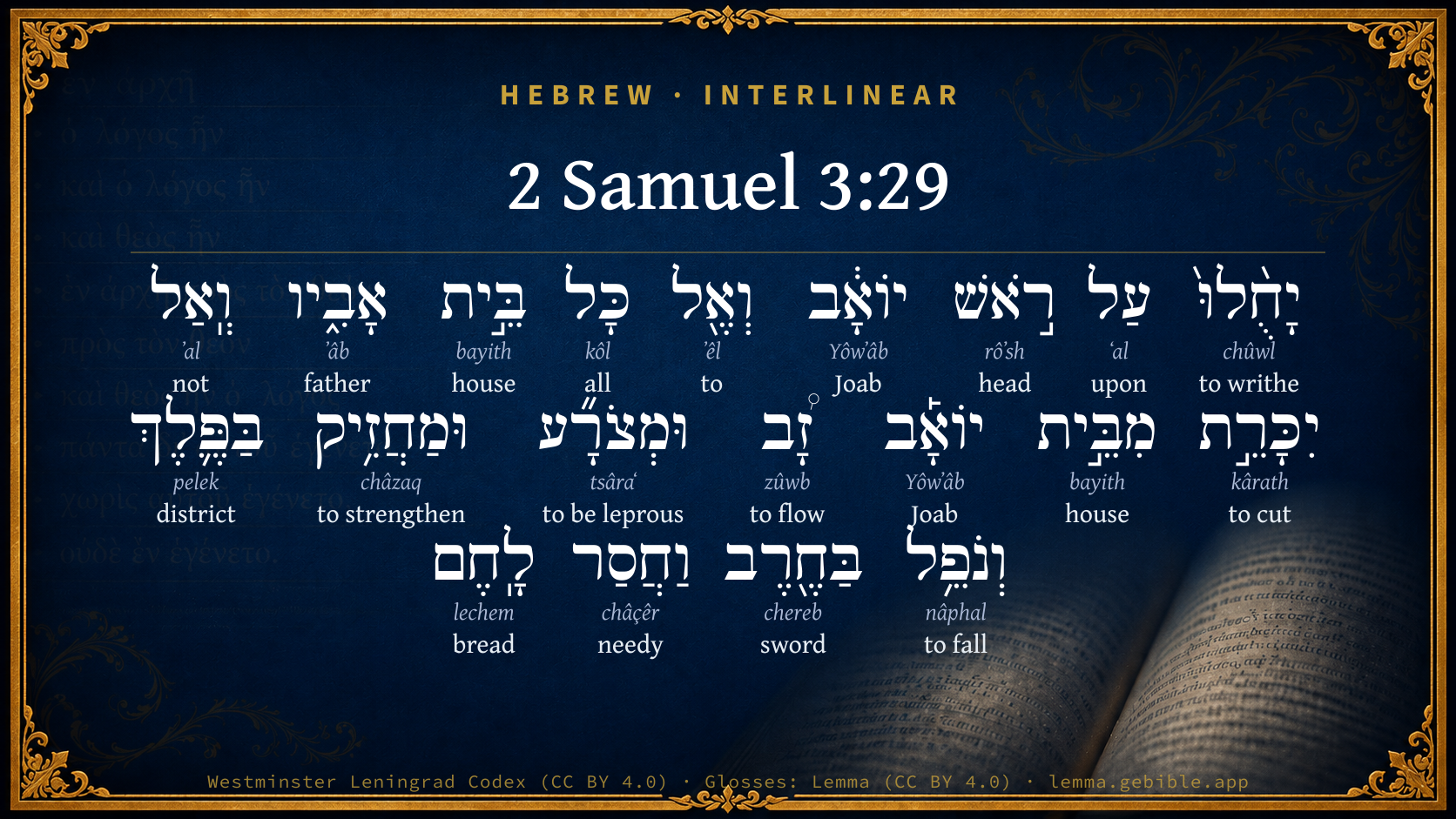
2 Samuel 3:29

Hebrew (Westminster Leningrad Codex) 2 Samuel 3:29 appears in the Hebrew Old Testament. The text above is from the Westminster Leningrad Codex. Each word links to its Strong’s number, a concise gloss, and parsing drawn from the Open Scriptures Hebrew Bible morphology. Click any word for its full Brown-Driver-Briggs (BDB) entry.
Download image
Cite this verse

2 Samuel 3:29 (World English Bible). Public Domain. Lemma interlinear Bible study tool, https://lemma.gebible.app/v/2-samuel/3/29.

Show BibTeX & RIS
BibTeX
RIS
English Translation
let it fall on the head of Joab, and on all his father's house; and let there not fail from the house of Joab one who has an issue, or who is a leper, or who leans on a staff, or who falls by the sword, or who lacks bread.
World English Bible · Public Domain
Highlights
  • 1 first appearance in the Hebrew Bible
Full analysis ↓
Download a study sheet

One document with this verse’s original text, its word-by-word gloss line, the meaning frame, cross-references with their text, attributed commentary, and full source and license credits — printable, and it pastes into notes with its structure intact.

This verse Autodidact and up

Study sheet (.html) Plain text (.txt)

A passage Seminary Student

Up to 50 verses in one chapter. A passage sheet keeps up to 6 commentary sources and 12 cross-references per verse, in the order this page ranks them, and says so on the sheet whenever that leaves anything out. Ask for a single verse and you get the Autodidact verse sheet above.

Everything on this page stays free to read, with no account — the sheet is a download of what is already on screen, not access to it.

Want to remove ads? Support Godless Engineer
Compare translations 3

The same verse in 3 English versions, stacked beneath the original-language interlinear above. Click any original word for its lexicon entry.

Each is an independent rendering of the whole verse — the interlinear is not word-aligned to these translations.

Highlighted words mark where these versions differ — a whole-verse word diff, not a word-by-word alignment.

  • World English Bible Public Domain
    let it fall on the head of Joab, and on all his father's house; and let there not fail from the house of Joab one who has an issue, or who is a leper, or who leans on a staff, or who falls by the sword, or who lacks bread.
  • King James Version Public Domain
    Let it rest on the head of Joab, and on all his father's house; and let there not fail from the house of Joab one that hath an issue, or that is a leper, or that leaneth on a staff, or that falleth on the sword, or that lacketh bread.
  • unfoldingWord Literal Text CC BY-SA 4.0
    May it writhe on the head of Joab and to all of the house of his father, and may not be cut off from the house of Joab one discharging or one stricken with leprosy or one holding onto a staff or one falling by the sword or a destitute of bread.”

unfoldingWord Literal Text — © unfoldingWord, licensed CC BY-SA 4.0. Word-aligned USFM3 via Door43 (git.door43.org/unfoldingWord/en_ult).

Versions to compare (up to 4)

3 of 4 selected

Show all 18 translations

Every available English version of this verse, each an independent rendering of the whole verse.

  • World English Bible Public Domain
    let it fall on the head of Joab, and on all his father's house; and let there not fail from the house of Joab one who has an issue, or who is a leper, or who leans on a staff, or who falls by the sword, or who lacks bread.
  • Berean Standard Bible Public Domain
    May it whirl over the heads of Joab and the entire house of his father, and may the house of Joab never be without one having a discharge or skin disease, or one who leans on a staff or falls by the sword or lacks food.”
  • Majority Standard Bible Public Domain
    May it whirl over the head of Joab and over the entire house of his father, and may the house of Joab never be without one having a discharge or skin disease, or one who leans on a staff or falls by the sword or lacks food.”
  • King James Version Public Domain
    Let it rest on the head of Joab, and on all his father's house; and let there not fail from the house of Joab one that hath an issue, or that is a leper, or that leaneth on a staff, or that falleth on the sword, or that lacketh bread.
  • American Standard Version (1901) Public Domain
    let it fall upon the head of Joab, and upon all his father's house; and let there not fail from the house of Joab one that hath an issue, or that is a leper, or that leaneth on a staff, or that falleth by the sword, or that lacketh bread.
  • Revised Version (1885) Public Domain
    let it fall upon the head of Joab, and upon all his father’s house; and let there not fail from the house of Joab one that hath an issue, or that is a leper, or that leaneth on a staff, or that falleth by the sword, or that lacketh bread.
  • Geneva Bible (1599) Public Domain
    Let the blood fall on the head of Ioab, and on all his fathers house, that the house of Ioab be neuer without some that haue running issues, or leper, or that leaneth on a staffe, or that doeth fall on the sworde, or that lacketh bread.
  • Douay-Rheims (1899) Public Domain
    And may it come upon the head of Joab, and upon all his father's house: and let there not fail from the house of Joab one that hath an issue of seed, or that is a leper, or that holdeth the distaff, or that falleth by the sword, or that wanteth bread.
  • Young's Literal Translation Public Domain
    it doth stay on the head of Joab, and on all the house of his father, and there is not cut off from the house of Joab one having an issue, and leprous, and laying hold on a staff, and falling by a sword, and lacking bread.'
  • Literal Standard Version CC BY-SA 4.0
    it stays on the head of Joab, and on all the house of his father, and there is not cut off from the house of Joab one who has discharging, and leprous, and laying hold on a staff, and falling by a sword, and lacking bread.”
  • Unlocked Literal Bible CC BY-SA 4.0
    Let the guilt of Abner's death fall on the head of Joab and on all his father's house. May there never fail to be in the family of Joab someone who has a flowing sore or skin disease or who is lame and must walk with a staff or who is killed by the sword or who goes without food.”
  • unfoldingWord Literal Text CC BY-SA 4.0
    May it writhe on the head of Joab and to all of the house of his father, and may not be cut off from the house of Joab one discharging or one stricken with leprosy or one holding onto a staff or one falling by the sword or a destitute of bread.”
  • Darby Bible Public Domain
    let it fall on the head of Joab, and on all his father's house; and let there not fail from the house of Joab one that has an issue, or that is a leper, or that leans on a staff, or that falls by the sword, or that lacks bread!
  • World Messianic Bible Public Domain
    Let it fall on the head of Joab and on all his father’s house. Let there not fail from the house of Joab one who has a discharge, or who is a leper, or who leans on a staff, or who falls by the sword, or who lacks bread.”
  • Webster's Bible Public Domain
    Let it rest on the head of Joab, and on all his father's house; and let there not fail from the house of Joab one that hath an issue, or that is a leper, or that leaneth on a staff, or that falleth on the sword, or that lacketh bread.
  • Free Bible Version CC BY-SA 4.0
    May the guilt for his death fall on Joab and his family! May Joab's descendants always have someone who has running sores or leprosy or is crippled or who is killed by the sword or who is starving.”
  • Bible in Basic English Public Domain
    May it come on the head of Joab and all his father's family: among the men of Joab's family may there ever be some who are diseased or lepers, or who do the work of women, or are put to the sword, or are wasted from need of food!
  • JPS Tanakh (1917) Public Domain
    let it fall upon the head of Joab, and upon all his father's house; and let there not fail from the house of Joab one that hath an issue, or that is a leper, or that leaneth on a staff, or that falleth by the sword, or that lacketh bread.'

Literal Standard Version (2020), Covenant Press — licensed CC BY-SA 4.0. Text via the HelloAO Bible API (eBible.org). Unlocked Literal Bible (unfoldingWord) — licensed CC BY-SA 4.0. Text via the HelloAO Bible API (eBible.org). unfoldingWord Literal Text — © unfoldingWord, licensed CC BY-SA 4.0. Word-aligned USFM3 via Door43 (git.door43.org/unfoldingWord/en_ult). Free Bible Version, Dr. Jonathan Gallagher — licensed CC BY-SA 4.0. Text via the HelloAO Bible API (eBible.org).

Word by word

More ways to search: Search by grammar → Find every occurrence → Compare this word →

Practice this passage: Drill this verse → Learn its vocabulary →

בַּפֶּ֛לֶךְ
pelek
H6418
“in/at the · district”
Preposition, Determined + Noun, Common, Masculine, Singular, Absolute
Part of Speech
Preposition + Noun
Type
Common
Gender
Masculine
Number
Singular
State
Absolute
Full BDB Definition

Origin: from an unused root meaning to be round

TWOT: 1775a

whirl of spindle, stick, district - whirl of spindle, stick - district, circuit
  1. יָחֻ֨לוּ֙ chûwl H2342 “to writhe” Verb, Qal, Imperfect, 3rd Person, Masculine, Plural
  2. עַל ʻal H5921 “upon” Preposition
  3. רֹ֣אשׁ rôʼsh H7218 “head of” Noun, Common, Masculine, Singular, Construct
  4. יוֹאָ֔ב Yôwʼâb H3097 “Joab” Noun, Proper
  5. וְאֶ֖ל ʼêl H413 “and · to” Conjunction + Preposition
  6. כָּל kôl H3605 “all of” Noun, Common, Masculine, Singular, Construct
  7. בֵּ֣ית bayith H1004 “house of” Noun, Common, Masculine, Singular, Construct
  8. אָבִ֑יו ʼâb H1 “father · his” Noun, Common, Masculine, Singular, Construct + Suffix, Personal, 3rd Person, Masculine, Singular
  9. וְֽאַל ʼal H408 “and · not” Conjunction + Particle, Negative
  10. יִכָּרֵ֣ת kârath H3772 “to cut” Verb, Niphal, Jussive, 3rd Person, Masculine, Singular
  11. מִבֵּ֣ית bayith H1004 “from · house of” Preposition + Noun, Common, Masculine, Singular, Construct
  12. יוֹאָ֡ב Yôwʼâb H3097 “Joab” Noun, Proper
  13. זָ֠ב zûwb H2100 “flowing” Verb, Qal, Participle Active, Masculine, Singular, Absolute
  14. וּמְצֹרָ֞ע tsâraʻ H6879 “and · leprous” Conjunction + Verb, Pual, Participle Passive, Masculine, Singular, Absolute
  15. וּמַחֲזִ֥יק châzaq H2388 “and · strengthening” Conjunction + Verb, Hiphil, Participle Active, Masculine, Singular, Absolute
  16. וְנֹפֵ֥ל nâphal H5307 “and · falling” Conjunction + Verb, Qal, Participle Active, Masculine, Singular, Absolute
  17. בַּחֶ֖רֶב chereb H2719 “in/at the · sword” Preposition, Determined + Noun, Common, Feminine, Singular, Absolute
  18. וַחֲסַר châçêr H2638 “and · needy of” Conjunction + Adjective, Adjective, Masculine, Singular, Construct
  19. לָֽחֶם lechem H3899 “bread” Noun, Common, Both, Singular, Absolute

About this verse

These counts appear in no published source. They are computed here, from the morphology-tagged text and Lemma’s own curated glosses. What Lemma adds →

20
words
18
distinct lemmas
Historical
section

Notable vocabulary

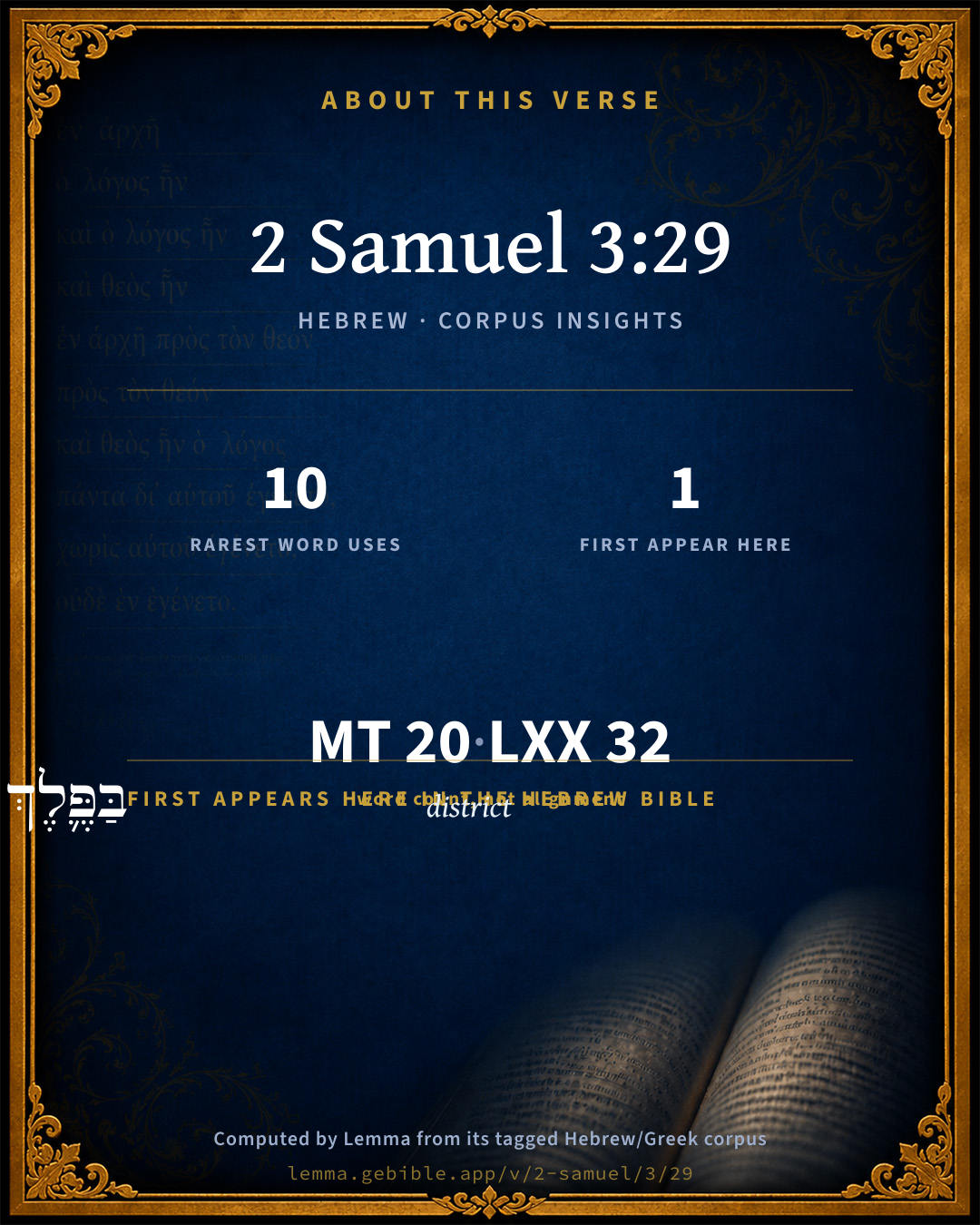
The rarest word here is בַּפֶּ֛לֶךְ district H6418 — appearing just 10 times in the whole Hebrew Bible.

First appearance in Scripture

This word makes its first canonical appearance in the Hebrew Bible here:

  • בַּפֶּ֛לֶךְ district H6418

Shared distinctive vocabulary

בַּפֶּ֛לֶךְ district H6418 occurs in 9 verses of the Hebrew Bible. Also found in:

Grammatical profile

  • 6 verbs
  • 10 nouns
  • 1 adjective
  • 2 prepositions
  • 1 particle

Verb forms

  • יָחֻ֨לוּ֙ Qal · Imperfect
  • יִכָּרֵ֣ת Niphal · Jussive
  • זָ֠ב Qal · Participle Active
  • וּמְצֹרָ֞ע Pual · Participle Passive
  • וּמַחֲזִ֥יק Hiphil · Participle Active
  • וְנֹפֵ֥ל Qal · Participle Active

Repetition

Words recur within this verse — often emphatic in Hebrew:

  • יוֹאָ֔ב Joab H3097 ×2
  • בֵּ֣ית house H1004 ×2

Hebrew & Septuagint length

In English translation the verse runs 50 words from the Hebrew and 51 from the Septuagint (LXX English) — closely comparable.

A rough comparison of the two English renderings, which tokenize alike — not a word-level alignment.

Word counts can differ between the Hebrew and the Greek without any difference in meaning — e.g. the Hebrew direct-object marker אֵת has no separate Greek word, and Greek often adds the article ὁ.

In the original languages it is 20 Hebrew tokens and 32 Greek tokens — but the two are counted differently (Hebrew bundles its prefixes and suffixes into one token; the Greek is in lemma form), so that isn’t a like-for-like length.

Cross-references

12

Topical passages linked to 2 Samuel 3:29 in the Treasury of Scripture Knowledge — connected by theme and wording, ordered by reader-vote popularity; previews shown in the World English Bible.

  • 2 Samuel 1:16 David said to him, Your blood be on your head; for your mouth has testified against you, saying, I have slain Yahweh's anointed.
  • Psalms 109:8–19 Let his days be few. Let another take his office.
  • Leviticus 13:44–46 he is a leprous man. He is unclean. The priest shall surely pronounce him unclean. His plague is on his head.
  • Leviticus 15:2 "Speak to the children of Israel, and tell them, 'When any man has a discharge from his body, because of his discharge he is unclean.
  • Judges 9:24 that the violence done to the seventy sons of Jerubbaal might come, and that their blood might be laid on Abimelech their brother, who killed them, and on the men of Shechem, who strengthened his hands to kill his brothers.
  • Judges 9:56–57 Thus God requited the wickedness of Abimelech, which he did to his father, in killing his seventy brothers;
  • 1 Samuel 2:32–36 You shall see the affliction of [my] habitation, in all the wealth which [God] shall give Israel; and there shall not be an old man in your house forever.
  • 1 Kings 2:31–34 The king said to him, Do as he has said, and fall on him, and bury him; that you may take away the blood, which Joab shed without cause, from me and from my father's house.
  • 2 Kings 5:1 Now Naaman, captain of the host of the king of Syria, was a great man with his master, and honorable, because by him Yahweh had given victory to Syria: he was also a mighty man of valor, [but he was] a leper.
  • 2 Kings 5:27 The leprosy therefore of Naaman shall cleave to you, and to your seed forever. He went out from his presence a leper [as white] as snow.
  • Acts 28:4 When the natives saw the creature hanging from his hand, they said one to another, "No doubt this man is a murderer, whom, though he has escaped from the sea, yet Justice has not allowed to live."
  • Revelation 16:6 For they poured out the blood of the saints and the prophets, and you have given them blood to drink. They deserve this."

Cross-references courtesy of OpenBible.info (CC BY 4.0).

Hebrew and Greek witnesses Masoretic Hebrew ↔ Greek Septuagint

The same verse in the two great witnesses to the Old Testament, shown verse-for-verse.

These are two independent witnesses, not word-aligned to each other, and the Septuagint is shown in lemma (dictionary) form.

Hebrew 2 Samuel 3:29 Masoretic · Westminster Leningrad Codex

יָחֻ֨לוּ֙ עַל רֹ֣אשׁ יוֹאָ֔ב וְאֶ֖ל כָּל בֵּ֣ית אָבִ֑יו וְֽאַל יִכָּרֵ֣ת מִבֵּ֣ית יוֹאָ֡ב זָ֠ב וּמְצֹרָ֞ע וּמַחֲזִ֥יק בַּפֶּ֛לֶךְ וְנֹפֵ֥ל בַּחֶ֖רֶב וַחֲסַר לָֽחֶם

let it fall on the head of Joab, and on all his father's house; and let there not fail from the house of Joab one who has an issue, or who is a leper, or who leans on a staff, or who falls by the sword, or who lacks bread.

World English Bible · Public Domain

Greek LXX 2 Samuel 3:29 Septuagint · lemma form

καταἀντάω ἐπί κεφαλή ιωαβ καί ἐπί πᾶς ὁ οἶκος ὁ πατήρ αὐτός καί μή ἐκλείπω ἐκ ὁ οἶκος ιωαβ γονορρυής καί λεπρός καί κρατέω σκυτάλη καί πίπτω ἐν ῥομφαία καί ἐλαττόω ἄρτος

Let it fall upon the head of Joab, and upon all the house of his father; and let there not be lacking of the house of Joab one that has an issue, or a leper, or that leans on a staff, or that falls by the sword, or that wants bread.

LXX2012 (modern English Septuagint) · Public Domain

On this verse, Trapp's Complete Commentary discusses the Septuagint’s reading. Read the note in Commentary ↓

Hebrew: Westminster Leningrad Codex (CC BY 4.0). Greek: Septuagint (public domain); English from LXX2012 (modern English Septuagint) (Public Domain). How the Septuagint differs from the Hebrew →

Targum (Aramaic paraphrase)

1

The Targum is the ancient Jewish Aramaic paraphrase of the Hebrew Scriptures — an interpretive translation, not the Hebrew text itself. Onkelos (literal) and Pseudo-Jonathan (expansive) render the Torah, and Jonathan the Prophets. Coverage is partial: where no permissively-licensed English translation exists for a verse, only the Aramaic is shown. This is verse-level text, not a word-by-word alignment to the Hebrew.

  1. Targum Jonathan Prophets (Joshua–Malachi)
    יְחוּלוּן עַל רֵישׁ דְיוֹאָב וְאֶל כָּל בֵּית אֲבוּהִי וְלָא יִפְסוֹק מִבֵּית יוֹאָב דְאֵיב וּסְגִיר וּמַתְקִיף בַּאֲגַד וּמִתְקְטֵיל בְּחַרְבָּא וַחֲסִיר מָזוֹן:

    (no public-domain English translation for this verse)

    Targum Jonathan — Aramaic: “Mikraot Gedolot” (public domain). English: “Sefaria Community Translation” (CC0 1.0 (public-domain dedication)); “London "Chaldee Paraphrase," 1871” (public domain). Text via Sefaria.

Commentary

Notes on 2 Samuel 3:29 from classic Christian and Jewish commentators (each source and its license shown beneath its notes). The classic Christian expositions comment on the surrounding passage and are grouped to its opening verse, so a note may address several verses; the Jewish commentaries on the Tanakh (Rashi and others) are per-verse, so they appear only where the commentator wrote on this verse.

Lemma curates 59 commentaries, every one of them public domain or Creative Commons licensed, each selected and text-cleaned for this edition rather than reprinted as found. About our sources →

Trapp's Complete Commentary

John Trapp

2Sa 3:29 Let it rest on the head of Joab, and on all his father’s house; and let there not fail from the house of Joab one that hath an issue, or that is a leper, or that leaneth on a staff, or that falleth on the sword, or that lacketh bread.

Ver. 29. Let there not fail from the house of Joab.] This lamentable legacy Joab left his children. So do all these peremptores potius quam parentes, that bequeath their sins and punishments to their wretched posterity.

One that hath an issue.] The gonorrhea, or running of the reins, as the Septuagint hath it.

Or that leaneth on a staff.] Weak, gouty, or consumptive. Aquila rendereth it, That is blind.

John Trapp, A Commentary or Exposition upon All the Books of the Old and New Testament (1647–1656) — public domain. Text from a community e-Sword module.

Tyndale Open Study Notes

Tyndale Open Resources

3:29 leprosy: While leprosy is a possible translation, the Hebrew here probably refers to a broader range of skin inflammations, not only Hansen’s disease. • who walks on crutches: This curse effectively alienated Joab from David, and from this point on they had only a professional relationship. David’s deathbed order to Solomon to get rid of Joab (1 Kgs 2:5-6) and Solomon’s exoneration of David in Abner’s death (1 Kgs 2:31-33) indicate that David’s mourning over Abner was genuine.

Tyndale Open Study Notes — © Tyndale Open Resources, licensed CC BY-SA 4.0. Text via the HelloAO Bible API.

Adam Clarke's Commentary

Verse 29. Let it rest on the head] All these verbs may be rendered in the future tense: it will rest on the head of Joab, &c. This was a prophetic declaration, which sufficiently showed the displeasure of God against this execrable man.

Adam Clarke's Commentary on the Bible (1810–1826) — public domain. Text from a community e-Sword/MySword module.

Ellicott's Commentary for English Readers

(29) Let it rest on the head of Joab.—The strong curse here pronounced by David shows that Joab’s act could not be justified as that of the “Goel,” or lawful avenger of his brother’s blood, for Abner had slain Asahel in battle, unwillingly and in self-defence. It is also to be remembered that Hebron was a city of refuge (Jos_21:13), and that here not even the “Goel” might slay the murderer without a trial (Num_35:22-25). The curse falls “on his father’s house,” since Abishai also (2Sa_3:30) had been concerned with him in the murder.

The phrase, “that leaneth on a staff,” has been understood by many as “holding a distaff,” i.e., a person unfit for war. The word has the sense of “distaff” in Pro_31:19, and is so rendered here by the Vulgate; but the sense given by the English—which is also that of the LXX. and Targum—is better, and more in accordance with the other particulars.

For “on the sword” read “by the sword,” there being no reference to the idea of suicide. On the violent end of Joab see 1Ki_2:31-34.

A Bible Commentary for English Readers, edited by Charles John Ellicott (1878–1897) — public domain. Text from a community e-Sword module.

The Cambridge Bible for Schools and Colleges

gen. ed. J. J. S. Perowne

29. let it rest] Let it fall. The Heb. word is a forcible one, expressing the energy of David’s indignation. It is used in Jer_23:19; Jer_30:23, of the whirlwind of God’s wrath falling upon the head of the wicked.

one that hath an issue, or that is a leper] Pining away miserably with incurable diseases, which not only made life a burden, but rendered their victim ceremonially unclean, and excluded him from the congregation of the Lord (Lev_13:46).

that leaneth on a staff] A cripple, lame, or blind. The word translated staff means elsewhere distaff (Pro_31:19), and the phrase may also be rendered as it is in the Vulgate “distaff holder” (tenens fusum). This would signify ‘a weak, effeminate man, unfit for war,’ as “Hercules with the distaff” was the type of unmanly feebleness among the Greeks. But this explanation seems forced, and the E. V. is supported by the Sept. and Targum.

that falleth on the sword] Render, “by the sword.” The E. V. suggests the idea of suicide, but untimely death in battle or by the hand of an assassin is meant.

The Cambridge Bible for Schools and Colleges (gen. ed. J. J. S. Perowne; Cambridge University Press, 1878–1918) — public domain. Text from a community e-Sword module.

John Gill's Exposition

Let it rest on the head of Joab,.... That is, the blood of Abner, who was the shedder of it; let the guilt of it be charged to him, and let punishment for it be inflicted on him:

and on all his father's house; on Abishai his brother, and other relations that might be privy to the death of Abner, and advising to it, and ready to assist in it if necessary:

and let there not fail from the house of Joab; let there be always in his family, and of his seed, one or other of the persons described as follows:

one that hath an issue; a gonorrhoea, which was reckoned infamous, and very impure, according to the Jewish law, and rendered persons unfit for society; see Lev 15:1,

or that is a leper; whose disease was very loathsome and infectious, and shut him out of the company of men; see Lev 13:1,

or that leaneth on a staff; being blind, as Aquila renders the word; or through weakness of body, not being able to walk without one; or through some disease of the feet, as the Jewish writers generally understand it; and R. Isaiah interprets it of the gout particularly: the word for "staff" is rendered "spindle", Pro 31:19; and to this sense it is rendered here in, the Vulgate Latin, Syriac, and Arabic versions; and then the meaning is, let his posterity, or some of them, be so poor, that they shall be obliged to get their livelihood in so mean a way as by spinning; or let them be of such an effeminate disposition, as be more fit to handle the spindle, and do the, work of women, than to use the sword:

or that falleth on the sword; not by it honourably in the field of battle, but cowardly destroying themselves with it:

or that lacketh bread; and is obliged to beg it: all which David might say, not by a spirit of prophecy, but in a passion; and to show with what horror he resented the action, and how detestable it was to him, and how far it was for him to have any concern in it: but though it was a very wicked action in Joab to murder Abner in this manner, and for the reasons he did; yet it was a just vengeance from the Lord on Abner for fighting against God, and acting against the dictates of his own conscience; for his rebellion against David, and perfidy to Ishbosheth, and for having been the cause of much bloodshed in Israel.

John Gill's Exposition of the Whole Bible (1746–1763) — public domain (CC PDM 1.0). Text via the HelloAO Bible API.

Albert Barnes' Notes on the Bible

The curse of David proves that Joab was not justified as blood-revenger or Goel 2Sa 3:27 in taking away Abner’s life.

That leaneth on a staff - Rather, a crutch. The phrase denotes one lame or infirm. For similar instances of hereditary disease and poverty as a punishment of great sin, see 1Sa 2:31-33, 1Sa 2:36; 2Ki 5:27; Joh 9:2.

Albert Barnes' Notes on the Bible (1834–1885) — public domain. Text from a community e-Sword/MySword module.

Haydock's Catholic Bible Commentary

Issue. Such were looked upon as unclean, (Leviticus xv. 3,) and incapable of having children. Aquila translates zab, "blind." Septuagint, "afflicted with the gonorrhœa." --- Distaff, like eunuchs. (Delrio, adag. 190.) (Claud in Eutrop.) Tu telas non tela pati, &c. Some translate a stick, with which the blind, lame and aged endeavour to walk. (Calmet) --- Any of these conditions would be very mortifying to great warriors. (Haydock) --- Bread. Hunger and famine were considered as a scourge of God, Psalm lviii. 7, 15., and cviii. 10. David is not moved with hatred, but foretells what will befall the posterity of these men, whose crime he abhors. (Calmet)

George Leo Haydock (1774–1849), Haydock's Catholic Family Bible and Commentary, 1859 edition — public domain. Excludes Psalms (Douay-Rheims chapter numbering differs from Protestant) and Deuterocanonical books (Catholic canon only).

Matthew Poole's English Annotations

Let it rest, i.e. this blood, the guilt and punishment of it.

And on all his father’s house. But children were not to suffer for their parent’s sin, Deu 24:16; and therefore either this was only a prediction; or, if it were an imprecation, David may seem to have transgressed his bounds, and mingled his passion with his zeal, that so he might express his utter detestation of this horrid murder, and how far he was from having any hand in it.

An issue was not only a troublesome and shameful disease, but also infectious, both to him that had it, and to all that touched him; so that whilst it was upon a man, he was cut off in a great part from converse either with God or men.

That leaneth on a staff, through craziness, or feebleness, or lameness, whereby he is rendered unfit for action and public service.

Matthew Poole's English Annotations on the Holy Bible (1683–1685) — public domain. Text from a community e-Sword/MySword module.

Whedon's Commentary on the Bible

Daniel D. Whedon

29. Let there not fail from the house of Joab — Let that house always be afflicted by having constantly among its members those distressed with an issue, that is, gonorrhea, (Lev_15:2.) or leprosy, or lameness, or poverty, or those that suffer assassination or some similarly violent death.

Daniel D. Whedon (gen. ed.), Commentary on the Old and New Testaments (1874–1909) — public domain. Text from a community e-Sword module.

The Pulpit Commentary

Let it rest on the head of Joab. The Hebrew word is very strong, "Let it roll itself," or throw itself upon Joab"s head. The force of the expression thus indicates the great excitement under which David was labouring; yet even so it was no slight matter to utter so bitter a curse upon a man so powerful, and whose military skill was so essential to the maintenance of his throne. To a man of David"s strong sense of justice, it was a small matter that by Abner"s murder the kingdom of the ten tribes was lost perhaps forever; what he hated was the wickedness of this mean act of personal revenge. And thus his imprecations are all such as would be humiliating to a family so distinguished for great physical as well as mental gifts, as the house of Zeruiah. Nor was David content with this; for we gather from 1Ch_11:6 that during the intervening years Joab was deprived of his office, and that he regained it only by an act of daring bravery. (For the miserable condition of one suffering with an issue, see Lev_15:2, etc.; and for that of a leper, Leviticus, 13, 14.) Instead of one that leaneth on a staff, some translate "a distaff holder," that is, a poor effeminate creature, fit only for woman"s work. The true sense is probably a cripple one who needs a crutch. That falleth on the sword; more correctly the Revised Version, that falleth by the sword. The two last imprecations mean that if any of the race of Joab and Abishai escape these personal blemishes, yet that his fate shall be, in war an inglorious death, and in peace a life of poverty. This curse of David is regarded in the Talmud ("Sanhedr.," 48.2) as very sinful. Undeniably it was uttered in violent anger, and while Joab"s act was utterly base and perfidious, yet he had the excuse for it of Asahel"s death and David"s double-dealing. The latter made him conclude that the man who had killed his brother was also to usurp his place. Possibly this suspicion was not without reason. As David was strong enough to deprive Joab of his command, it is plain that he had nothing to fear from telling him his plans. Joab would have assented, the blood feud have been appeased by a money payment, and all gone well. But David, it seems, wished to hold Joab in check by giving at least a share in the command to the veteran Abner.

The Pulpit Commentary (1880–1919), ed. H.D.M. Spence-Jones & Joseph S. Exell — public domain. Text from a community e-Sword module.

John Wesley's Explanatory Notes

Let it, &c. - But would not a resolute punishment of the murderer himself have become David better, than this passionate imprecation on his posterity?

John Wesley, Explanatory Notes Upon the Whole Bible (1754–1765) — public domain. Text via the GEBible commentary corpus.

Rashi

Rabbi Shlomo Yitzchaki (Rashi)

[The guilt] should fall. The [guilt of the] blood of Avner should rest, should fall. [This verse is] referring back to the preceding verse that stated, I and my kingdom are innocent from [the guilt of] the blood of Avner [The guilt of] his blood should fall on the head of Yoav. The blood [of Avner] that was mentioned in the previous verse.

[A lame person] who leans on a cane. Who leans on his cane because of diseased feet.

Rashi on the Tanakh — English translations: “The Judaica Press complete Tanach with Rashi, translated by A. J. Rosenberg” (CC BY 4.0); “Pentateuch with Rashi's commentary by M. Rosenbaum and A.M. Silbermann, 1929-1934” (public domain); “The Metsudah Tanach series, Lakewood, N.J” (CC BY 4.0); and “The Book of Joshua, Metsudah Publications, 1997” (CC BY 4.0). Text via Sefaria.

Lesson kit

Teaching starters — assembled from the data on this page, not authored interpretation. Every prompt links to the verse data it draws on. Edit before teaching.

2 Samuel, in the Historical, opens this verse with 20 words (18 distinct Hebrew lemmas). Its most distinctive word is pelek (“district”). A historical commentator’s framing appears above. Read the whole chapter for the surrounding context.

Discussion questions

  1. How does “district” (pelek) shape what this verse is saying?
  2. This is the first place “district” appears in Scripture (first appears here). What does its debut here establish?
  3. How does Nehemiah 3:9, which shares the word «district», read alongside this verse?
  4. What does the repetition of “Joab” (2× in this one verse) do in this verse?
  5. These translations render this verse differently. What is at stake in choosing one wording over another?
  6. «יָחֻ֨לוּ֙» is a Qal Imperfect verb. How does that grammatical form shape the action described?
  7. Compare how Trapp's Complete Commentary and Tyndale Open Study Notes read this verse. Where do they agree or differ?

Things to notice

Reading settings

Reading text

Shown beneath each verse's original-language words.

Old Testament
Old Testament edition

Read the OT as the Masoretic Hebrew (MT) or the Greek Septuagint (LXX).

English shown for the Greek Septuagint (in the Hebrew ↔ Greek comparison).

Comparing translations? Open the Compare panel on any verse page to stack up to four side by side.