
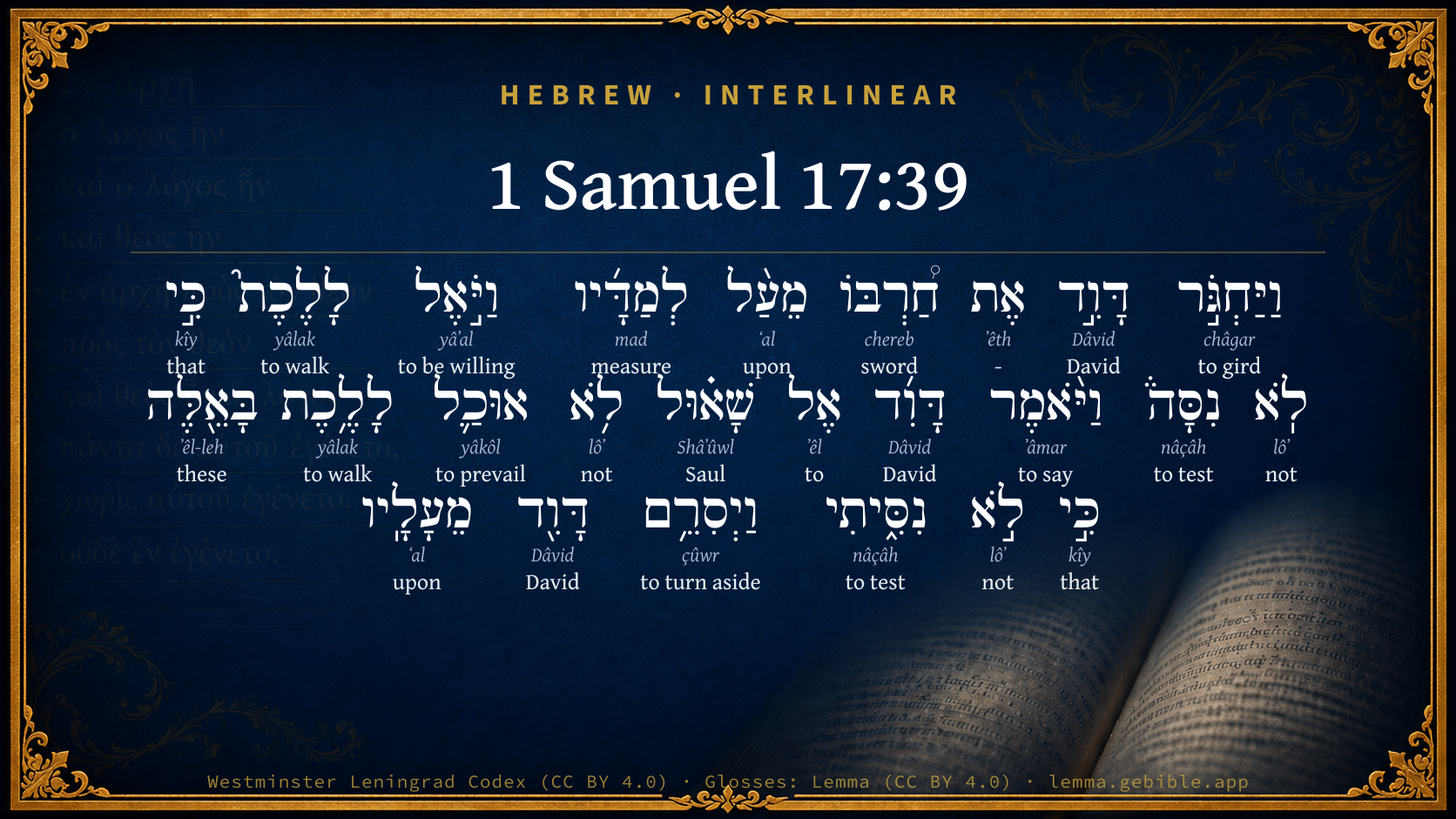
1 Samuel 17:39

Hebrew (Westminster Leningrad Codex) 1 Samuel 17:39 appears in the Hebrew Old Testament. The text above is from the Westminster Leningrad Codex. Each word links to its Strong’s number, a concise gloss, and parsing drawn from the Open Scriptures Hebrew Bible morphology. Click any word for its full Brown-Driver-Briggs (BDB) entry.
Download image
Cite this verse

1 Samuel 17:39 (World English Bible). Public Domain. Lemma interlinear Bible study tool, https://lemma.gebible.app/v/1-samuel/17/39.

Show BibTeX & RIS
BibTeX
RIS
English Translation
David girded his sword on his clothing, and he tried to go; for he had not proved it. David said to Saul, I can't go with these; for I have not proved them. David put them off him.
World English Bible · Public Domain
Download a study sheet

One document with this verse’s original text, its word-by-word gloss line, the meaning frame, cross-references with their text, attributed commentary, and full source and license credits — printable, and it pastes into notes with its structure intact.

This verse Autodidact and up

Study sheet (.html) Plain text (.txt)

A passage Seminary Student

Up to 50 verses in one chapter. A passage sheet keeps up to 6 commentary sources and 12 cross-references per verse, in the order this page ranks them, and says so on the sheet whenever that leaves anything out. Ask for a single verse and you get the Autodidact verse sheet above.

Everything on this page stays free to read, with no account — the sheet is a download of what is already on screen, not access to it.

Want to remove ads? Support Godless Engineer
Compare translations 3

The same verse in 3 English versions, stacked beneath the original-language interlinear above. Click any original word for its lexicon entry.

Each is an independent rendering of the whole verse — the interlinear is not word-aligned to these translations.

Highlighted words mark where these versions differ — a whole-verse word diff, not a word-by-word alignment.

  • World English Bible Public Domain
    David girded his sword on his clothing, and he tried to go; for he had not proved it. David said to Saul, I can't go with these; for I have not proved them. David put them off him.
  • King James Version Public Domain
    And David girded his sword upon his armor, and he assayed to go; for he had not proved it. And David said unto Saul, I cannot go with these; for I have not proved them. And David put them off him.
  • unfoldingWord Literal Text CC BY-SA 4.0
    And David strapped on his sword over his garments, and he tried to walk, for he had not tested. And David said to Saul, “I am not able to walk with these, for I have not tested.” And David removed them from on him.

unfoldingWord Literal Text — © unfoldingWord, licensed CC BY-SA 4.0. Word-aligned USFM3 via Door43 (git.door43.org/unfoldingWord/en_ult).

Versions to compare (up to 4)

3 of 4 selected

Show all 18 translations

Every available English version of this verse, each an independent rendering of the whole verse.

  • World English Bible Public Domain
    David girded his sword on his clothing, and he tried to go; for he had not proved it. David said to Saul, I can't go with these; for I have not proved them. David put them off him.
  • Berean Standard Bible Public Domain
    David strapped his sword over the tunic and tried to walk, but he was not accustomed to them. “I cannot walk in these,” David said to Saul. “I am not accustomed to them.” So David took them off.
  • Majority Standard Bible Public Domain
    David strapped his sword over the tunic and tried to walk, but he was not accustomed to them. “I cannot walk in these,” David said to Saul. “I am not accustomed to them.” So David took them off.
  • King James Version Public Domain
    And David girded his sword upon his armor, and he assayed to go; for he had not proved it. And David said unto Saul, I cannot go with these; for I have not proved them. And David put them off him.
  • American Standard Version (1901) Public Domain
    And David girded his sword upon his apparel, and he assayed to go; for he had not proved it. And David said unto Saul, I cannot go with these; for I have not proved them. And David put them off him.
  • Revised Version (1885) Public Domain
    And David girded his sword upon his apparel, and he assayed to go; for he had not proved it. And David said unto Saul, I cannot go with these; for I have not proved them. And David put them off him.
  • Geneva Bible (1599) Public Domain
    Then girded Dauid his sword vpon his rayment, and began to go: for he neuer proued it: and Dauid sayde vnto Saul, I can not goe with these: for I am not accustomed. wherefore Dauid put them off him.
  • Douay-Rheims (1899) Public Domain
    And David having girded his sword upon his armour, began to try if he could walk in armour: for he was not accustomed to it. And David said to Saul: I cannot go thus, for I am not used to it. And he laid them off,
  • Young's Literal Translation Public Domain
    And David girded his sword above his long robe, and beginneth to go, for he hath not tried `it'; and David saith unto Saul, `I am not able to go with these, for I had not tried;' and David turneth them aside from off him.
  • Literal Standard Version CC BY-SA 4.0
    And David girded his sword above his long robe, and begins to go, for he has not tried [it]; and David says to Saul, “I am not able to go with these, for I had not tried”; and David turns them aside from off him.
  • Unlocked Literal Bible CC BY-SA 4.0
    David strapped his sword on his armor. But he was not able to walk, because he had not trained with them. Then David said to Saul, “I cannot go out to fight with these, for I have not trained with them.” So David put them off.
  • unfoldingWord Literal Text CC BY-SA 4.0
    And David strapped on his sword over his garments, and he tried to walk, for he had not tested. And David said to Saul, “I am not able to walk with these, for I have not tested.” And David removed them from on him.
  • Darby Bible Public Domain
    And David girded his sword upon his dress, and endeavoured to go; for he had not yet tried [it]. And David said to Saul, I cannot go in these; for I have never tried [them]. And David put them off him.
  • World Messianic Bible Public Domain
    David strapped his sword on his clothing and he tried to move, for he had not tested it. David said to Saul, “I can’t go with these, for I have not tested them.” Then David took them off.
  • Webster's Bible Public Domain
    And David girded his sword upon his armor, and he essayed to go; for he had not proved it. And David said to Saul, I cannot go with these, for I have not proved them. And David put them off from him.
  • Free Bible Version CC BY-SA 4.0
    David strapped his sword on over the armor but he couldn't walk because he wasn't used to it. “I can't walk in all this,” David told Saul. “I'm not used to it.” So David took all the armor off.
  • Bible in Basic English Public Domain
    And David took Saul's sword and put the band round him over the metal coat, and was unable to go forward; for he was not used to them. Then David said to Saul, It is not possible for me to go out with these, for I am not used to them. So David took them off.
  • JPS Tanakh (1917) Public Domain
    And David girded his sword upon his apparel, and he essayed to go, but could not; for he had not tried it. And David said unto Saul: 'I cannot go with these; for I have not tried them.' And David put them off him.

Literal Standard Version (2020), Covenant Press — licensed CC BY-SA 4.0. Text via the HelloAO Bible API (eBible.org). Unlocked Literal Bible (unfoldingWord) — licensed CC BY-SA 4.0. Text via the HelloAO Bible API (eBible.org). unfoldingWord Literal Text — © unfoldingWord, licensed CC BY-SA 4.0. Word-aligned USFM3 via Door43 (git.door43.org/unfoldingWord/en_ult). Free Bible Version, Dr. Jonathan Gallagher — licensed CC BY-SA 4.0. Text via the HelloAO Bible API (eBible.org).

Word by word

More ways to search: Search by grammar → Find every occurrence → Compare this word →

Practice this passage: Drill this verse → Learn its vocabulary →

לְמַדָּ֜יו
mad
H4055
“to/for · measures · his”
Preposition + Noun, Common, Masculine, Plural, Construct + Suffix, Personal, 3rd Person, Masculine, Singular
Part of Speech
Preposition + Noun
Type
Common
Gender
Masculine
Number
Plural
State
Construct
Full BDB Definition

Origin: from H4058

TWOT: 1146a

measure, cloth garment - measure - cloth, carpet - garment (outer)
  1. וַיַּחְגֹּ֣ר châgar H2296 “and · to gird” Conjunction + Verb, Qal, Sequential Imperfect, 3rd Person, Masculine, Singular
  2. דָּוִ֣ד Dâvid H1732 “David” Noun, Proper
  3. אֶת ʼêth H853 “-” Particle, Direct Object
  4. חַ֠רְבּוֹ chereb H2719 “sword · his” Noun, Common, Feminine, Singular, Construct + Suffix, Personal, 3rd Person, Masculine, Singular
  5. מֵעַ֨ל ʻal H5921 “from · upon” Preposition + Preposition
  6. וַיֹּ֣אֶל yâʼal H2974 “and · to be willing” Conjunction + Verb, Hiphil, Sequential Imperfect, 3rd Person, Masculine, Singular
  7. לָלֶכֶת֮ yâlak H3212 “to walk” Preposition + Verb, Qal, Infinitive Construct
  8. כִּ֣י kîy H3588 “that” Conjunction
  9. לֹֽא lôʼ H3808 “not” Particle, Negative
  10. נִסָּה֒ nâçâh H5254 “to test” Verb, Piel, Perfect, 3rd Person, Masculine, Singular
  11. וַיֹּ֨אמֶר ʼâmar H559 “and · to say” Conjunction + Verb, Qal, Sequential Imperfect, 3rd Person, Masculine, Singular
  12. דָּוִ֜ד Dâvid H1732 “David” Noun, Proper
  13. אֶל ʼêl H413 “to” Preposition
  14. שָׁא֗וּל Shâʼûwl H7586 “Saul” Noun, Proper
  15. לֹ֥א lôʼ H3808 “not” Particle, Negative
  16. אוּכַ֛ל yâkôl H3201 “to prevail” Verb, Qal, Imperfect, 1st Person, Common, Singular
  17. לָלֶ֥כֶת yâlak H3212 “to walk” Preposition + Verb, Qal, Infinitive Construct
  18. בָּאֵ֖לֶּה ʼêl-leh H428 “in/at · these” Preposition + Pronoun, Demonstrative, Common, Plural
  19. כִּ֣י kîy H3588 “that” Conjunction
  20. לֹ֣א lôʼ H3808 “not” Particle, Negative
  21. נִסִּ֑יתִי nâçâh H5254 “to test” Verb, Piel, Perfect, 1st Person, Common, Singular
  22. וַיְסִרֵ֥ם çûwr H5493 “and · to turn aside · them” Conjunction + Verb, Hiphil, Sequential Imperfect, 3rd Person, Masculine, Singular + Suffix, Personal, 3rd Person, Masculine, Plural
  23. דָּוִ֖ד Dâvid H1732 “David” Noun, Proper
  24. מֵעָלָֽיו ʻal H5921 “from · upon · him” Preposition + Preposition + Suffix, Personal, 3rd Person, Masculine, Singular

About this verse

These counts appear in no published source. They are computed here, from the morphology-tagged text and Lemma’s own curated glosses. What Lemma adds →

25
words
17
distinct lemmas
Historical
section

Notable vocabulary

The rarest word here is לְמַדָּ֜יו measure H4055 — appearing just 11 times in the whole Hebrew Bible.

Shared distinctive vocabulary

לְמַדָּ֜יו measure H4055 occurs in 11 verses of the Hebrew Bible. Also found in:

Grammatical profile

  • 9 verbs
  • 6 nouns
  • 1 pronoun
  • 3 prepositions
  • 2 conjunctions
  • 4 particles

Verb forms

  • וַיַּחְגֹּ֣ר Qal · Sequential Imperfect
  • וַיֹּ֣אֶל Hiphil · Sequential Imperfect
  • לָלֶכֶת֮ Qal · Infinitive Construct
  • נִסָּה֒ Piel · Perfect
  • וַיֹּ֨אמֶר Qal · Sequential Imperfect
  • אוּכַ֛ל Qal · Imperfect
  • לָלֶ֥כֶת Qal · Infinitive Construct
  • נִסִּ֑יתִי Piel · Perfect
  • וַיְסִרֵ֥ם Hiphil · Sequential Imperfect

Repetition

Words recur within this verse — often emphatic in Hebrew:

  • דָּוִ֣ד David H1732 ×3
  • מֵעַ֨ל upon H5921 ×2
  • לָלֶכֶת֮ to walk H3212 ×2
  • נִסָּה֒ to test H5254 ×2
  • לֹֽא not H3808 ×3
  • כִּ֣י that H3588 ×2

Hebrew & Septuagint length

In English translation the verse runs 38 words from the Hebrew and 46 from the Septuagint (LXX English) — closely comparable.

A rough comparison of the two English renderings, which tokenize alike — not a word-level alignment.

Word counts can differ between the Hebrew and the Greek without any difference in meaning — e.g. the Hebrew direct-object marker אֵת has no separate Greek word, and Greek often adds the article ὁ.

Cross-references

3

Topical passages linked to 1 Samuel 17:39 in the Treasury of Scripture Knowledge — connected by theme and wording, ordered by reader-vote popularity; previews shown in the World English Bible.

  • 2 Corinthians 10:4–5 for the weapons of our warfare are not of the flesh, but mighty before God to the throwing down of strongholds,
  • Hosea 1:7 But I will have mercy on the house of Judah, and will save them by Yahweh their God, and will not save them by bow, nor by sword, nor by battle, by horses, nor by horsemen."
  • Zechariah 4:6 Then he answered and spoke to me, saying, "This is the word of Yahweh to Zerubbabel, saying, 'Not by might, nor by power, but by my Spirit,' says Yahweh of Hosts.

Cross-references courtesy of OpenBible.info (CC BY 4.0).

Hebrew and Greek witnesses Masoretic Hebrew ↔ Greek Septuagint

The same verse in the two great witnesses to the Old Testament, shown verse-for-verse.

These are two independent witnesses, not word-aligned to each other, and the Septuagint is shown in lemma (dictionary) form.

Hebrew 1 Samuel 17:39 Masoretic · Westminster Leningrad Codex

וַיַּחְגֹּ֣ר דָּוִ֣ד אֶת חַ֠רְבּוֹ מֵעַ֨ל לְמַדָּ֜יו וַיֹּ֣אֶל לָלֶכֶת֮ כִּ֣י לֹֽא נִסָּה֒ וַיֹּ֨אמֶר דָּוִ֜ד אֶל שָׁא֗וּל לֹ֥א אוּכַ֛ל לָלֶ֥כֶת בָּאֵ֖לֶּה כִּ֣י לֹ֣א נִסִּ֑יתִי וַיְסִרֵ֥ם דָּוִ֖ד מֵעָלָֽיו

David girded his sword on his clothing, and he tried to go; for he had not proved it. David said to Saul, I can't go with these; for I have not proved them. David put them off him.

World English Bible · Public Domain

Greek LXX 1 Samuel 17:39 Septuagint · lemma form
And he girded David with his sword over his coat: and he made trial walking with them once and again: and David said to Saul, I shall not be able to go with these, for I have not proved them: so they remove them from him.

LXX2012 (modern English Septuagint) · Public Domain

On this verse, Haydock's Catholic Bible Commentary discusses the Septuagint’s reading. Read the note in Commentary ↓

Hebrew: Westminster Leningrad Codex (CC BY 4.0). Greek: Septuagint (public domain); English from LXX2012 (modern English Septuagint) (Public Domain). How the Septuagint differs from the Hebrew →

Targum (Aramaic paraphrase)

1

The Targum is the ancient Jewish Aramaic paraphrase of the Hebrew Scriptures — an interpretive translation, not the Hebrew text itself. Onkelos (literal) and Pseudo-Jonathan (expansive) render the Torah, and Jonathan the Prophets. Coverage is partial: where no permissively-licensed English translation exists for a verse, only the Aramaic is shown. This is verse-level text, not a word-by-word alignment to the Hebrew.

  1. Targum Jonathan Prophets (Joshua–Malachi)
    וְזָרֵיז דָוִד יַת חַרְבֵּיהּ מֵעַל לִלְבוּשׁוֹהִי וְלָא אָבָא לְמֵיזַל אֲרֵי לָא אַלִיף וַאֲמַר דָוִד לְשָׁאוּל לֵית אֲנָא יָכִיל לְמֵיזַל בְּאִלֵין אֲרֵי לֵית בְּהוֹן נִסָא וְאַעְדִינוּן דָוִד מֵעִלַווֹהִי:

    (no public-domain English translation for this verse)

    Targum Jonathan — Aramaic: “Mikraot Gedolot” (public domain). English: “Sefaria Community Translation” (CC0 1.0 (public-domain dedication)); “London "Chaldee Paraphrase," 1871” (public domain). Text via Sefaria.

Commentary

Notes on 1 Samuel 17:39 from classic Christian and Jewish commentators (each source and its license shown beneath its notes). The classic Christian expositions comment on the surrounding passage and are grouped to its opening verse, so a note may address several verses; the Jewish commentaries on the Tanakh (Rashi and others) are per-verse, so they appear only where the commentator wrote on this verse.

Lemma curates 59 commentaries, every one of them public domain or Creative Commons licensed, each selected and text-cleaned for this edition rather than reprinted as found. About our sources →

Trapp's Complete Commentary

John Trapp

1Sa 17:39 And David girded his sword upon his armour, and he assayed to go; for he had not proved [it]. And David said unto Saul, I cannot go with these; for I have not proved [them]. And David put them off him.

Ver. 39. I cannot go with these.] If Saul’s coat be never so rich, and his armour never so strong, what is David the better if they fit him not? It is not to be inquired how excellent anything is, but how proper. If we could wish another man’s honour, when we feel the weight of his cares, we should be glad to be in our own coat. {a}

For I have not proved them.] Or, Been accustomed to them. He had been Saul’s armourbearer for a short while, but never in any battle with him; he had led a rural and pastoral life; and for arms he could not well wield them, and was therefore soon weary of them. Press some people to the exercise of prayer, or any other piece of the armour of God, and they must say, if they say truly, as here, I cannot do in addition, for I have not been accustomed to it. Or if they have taken up such a custom, it may well be said of them as Sidonius saith {b} of King Theodoricus, that he so served God as that any man might see, quod servet illam pro consuetudine potius quam pro religione reverentiam, that he did it more of course, and of custom, than of conscience, or any good affection to God’s work.

{a} Dr Hall.

{b} Epist. i., lib. i.

John Trapp, A Commentary or Exposition upon All the Books of the Old and New Testament (1647–1656) — public domain. Text from a community e-Sword module.

The Biblical Illustrator

Joseph S. Exell

1Sa_17:39

I cannot go with these.

I have not proved them.

Suitable equipment

The words recall to you at once the whole vivid story of the combat between the stripling David and the Philistine giant Goliath. It is a simple tale from the memories of border warfare in an early and somewhat rude time. There are two ways in which David might have forfeited his victory.

I. First he might have forfeited it by a careless neglect of the simple opportunities of a boy. He had only to keep the sheep. It would have been boy-like to have gone after play or after comrades and leave the flock. It would have been the different but equally fatal mistake of a gifted nature to dream away the hours with his back on the turf and his face to the sky, building air castles of future exploits, the while the beasts preyed on the straying sheep. David avoided the one mistake and the other. He had his play, indeed; that skill which sends the stone like bullet to the Philistines brow will not have come to such perfection without many a shot at passing quarry or jutting rock; but it was play which made him fitter for work, training him in the free use of the favourite weapon of his tribe; making his arm suppler and stronger, and his eye more keen. And he had his battle, too, in his own way; he was watchful to detect and bold to face the prowling and preying beast. And though these may seem simple things, yet to the doer of them there was a strong sense and clear knowledge that there was a power with him in them, and if his conflict with the lion and the bear prepared him to face Goliath by steadying his nerve and strengthening his self-reliance it did so much more by giving him proof of the supporting and protecting presence of his God. Is it not the fact that one of the most frequent, causes of waste and loss here is to be found in what I may call the adjournment of responsibility? I am not thinking of the man who wants to taste the pleasures of sin for a time; nor of the man who shirks all his work and fails in his examinations. I am thinking of men who take things as they come and do not look beyond; who interpret the phrase sufficient unto the day is the evil thereof as a charter for postponing troublesome thoughts of future responsibility; who think that it will be time enough to attend to those things when they come.

II. But David had a second danger to avoid: it was the danger of unproven armour. We can feel that a twofold instinct guided him right; the royal armour was grand, but he knew that he would be uneasy in it; and meanwhile his fingers twitched on the sling strings with the half-conscious sense of how they could hurl against that blustering front. What is the danger of unproven armour for any of us? It is not difficult to see; and it may seem to be the very opposite of that which we have considered. It is the danger of those who look forward, not too little, but too confidently, and who do so because they believe themselves amply ready to face life. They feet full armed with well-appointed mail and weapons; it may be with all the adaptable resources of high academical and social culture; it may be with the keen thoughts, and bright ideals, social and philanthropic, which they deem to characterise their generation. Or, most probably of all, it may be with confidence in the strength of Divine truth and a Divine system, which they have themselves embraced, and in the strength of which it would be faithless to doubt that they will succeed with others. Far be it to speak disparagingly of such as these, they have much in them of the mettle of the future warrior: the day was to come when David too would do valiantly with sword and spear. But they have much to learn. The shield and sword, the spear and armour of God and of His Church are not for the first comer to wield with mastery. Doctrine the most true, arguments the most convincing, ideas the most lovely, will somehow be found not to strike home; and it will be well for the user if hampered and perhaps wounded he is not tempted in reaction of disheartenment or cynicism to cast them all aside and turn his back upon the battle. We have, then, here another danger, and opposite though it seems, it may really be combined, and often is combined with the other. The man who adjourns responsibility will think that he can put on the whole armour at pleasure in the future, and that in the strength and completeness of a professional outfit he could be a match for any enemy. There are giants in these days, and surely to defy Israel are they come up: evils which are monstrous in their proportions and which have the peculiar note of scornful and cruel defiance towards God and man. There is the giant of sensuality in all its forms. There is the giant of worldliness: the domineering power of prevailing fashion, or of so-called public opinion, or of stolid indifference to every higher call. And third brother to these there is the giant of unbelief. These are giants, and now as then we want men to meet them. And not seldom it is to the stripling that the task should fall. He is not dazed and weary with the daily bellowing of the giants challenges. He comes with a fresh eye, with an unbroken nerve, with a quick fire of zeal. Place for the young man against the giant! But at that moment all will depend upon what he is and what he brings. They must be well proved, he must be master of them, and they may have in them an unsuspected force of swift and piercing strength. What, to drop the figures, will this mean? It will mean first that a man who is to do good service against public evils must have first fought his own fights. He will have known, perhaps, in very plain reality, what it is to have the beasts come up against him. To meet the lion and the bear is specially the young mans task. It is from the wilderness of temptation that David and Davids Lord go forth to the help of the Lord and His people against the mighty. And then next, the men who are to be champions must bring with them genuine, first-hand, realised truth. We want men who have put things to the proof and can speak of that they do know: who can not only repeat, but testify, who can wield the great appeal experto crede. It is not much truth of which to a young man at the outset of experience this can be true: it may be only as the few smooth stones out of the brook: but, believe me, these may be enough. But what I mean is this: that while a man may fairly start by taking on trust many parts of that which he believes, there must be some part in it, some aspect of it, which he has proved for himself. It has been truly said that it is unchristian to assert that to rightly understand the faith one must have passed through doubt. But it is Christian in modesty and truthfulness to say that in a real and adequate sense a man can hardly be a champion who has not felt the stress and strain upon his faith of the mysteries and difficulties round about us, whose imagination they have never awed, whose reason they have never puzzled, whose sympathies they have never wrung. But there is one thing which must yet be said, for it underlies the whole. The victory of David was won not only by the sling and stone, but by the proved and trusted presence of God. Theirs is the strength which speaks in words which we have not yet learnt to separate from David. The Lord is my strength in whom I will trust. By Thee I have run through a troop and by my God I have leaped over a wall. It is God that girdeth me with strength. (E. S. Talbot, D. D.)

Impossible armour

The armour was good armour. Sword, and helmet, and coat of mail, each was faultless--true metal, excellent temper, perfect workmanship. And it was a great honour to wear it: it was the kings own, the king lent it, and the king put it on. What was wanting? At first there is compliance. To refuse such honour seems ungracious or seems impossible. Saul armed David with his armour--put a helmet of brass upon his head--armed him with a coat of mail: David girded the sword upon the armour, and assayed to go--assayed, but went not. Why? He had not proved it. David said to Saul, I cannot go with these, for I have not proved them--and he put them off him. Anything better than the unproved. Better no armour than the awkward encumbrance of the unwonted and the untried. There is a warfare between all and each of us. It has two chief departments--but we need not stay to separate them very carefully--the faith, and the life. For each of these there is an equipment--call it preparation, call it education, or what you will: only remember that it is not all preliminary--it is lifelong, it is daily, it is new every morning. Most young men have someone who offers them his armour. In these days the schoolmaster is abroad even for the poorest. In all days the parent, for better or worse, is present in the homo. The Church is, or ought to be, at hand everywhere, with its instructing and educating influences. All these may be described as offering to arm the young mind and the young soul for the battle of that life which has death in front of it. It is scarcely a reflexion upon this offer to say that it largely resembles Sauls offer to David. We hardly see how it could be otherwise. Parents and teachers must educate out of their own stores of experience. They cannot and they ought not to ask the child or the pupil what he has, and advise him to make the best of it. To a large extent he must be clothed upon with faiths and principles to be taken at first on trust. Any attempt to lay down rules of conduct in circumstances necessarily future, or to warn against evils not yet developed, whether because the age for them is not yet, or because the opportunity is not yet, must more or less partake of the character of arming David with Sauls coat of mall: the person addressed cannot yet have proved it, and yet the instructor durst not take the responsibility of deferring into an indefinite future the counsel or the warning which may at any moment become vital to the hearer when the voice which now speaks will be silent. Yet all the time he knows that he is uttering that which can scarcely be impressive, because it necessarily lacks the personal proving. What pains ought to be taken to enable the receiver to prove everything--so to bring down and bring home the instruction as that it may be, at least in its germ, fruitful at once, operative, on the smallest scale, in the young life! But what shall we say when we pass from matters of conduct into matters of faith? Must there not here at least, be an offer of helmet and sword which cannot by the nature of the case have been yet proved by the receiver? Great indeed is the responsibility of arming others, young or old, in our armour. Well were it if those who have the charge of minds would think more of it. Have they proved their own armour? Can they give a reason, to themselves and to God, for the faith with which they thus preoccupy another? Am I my brothers keeper?--always a solemn question--has no graver or more momentous application than to this matter of the transmission of religion. Yet not to transmit it is to be worse than an infidel. There must be an arming of one by another with the Christian panoply if Christianity itself is not to die out of the earth which it has re-made. We must prove, but we must assert when we have proved, the mighty verity, without which good were it not to have been born, that God hath given to us eternal life, and this life is in His Son. We pass to a later thought, and one more practical still. The helmet and the sword and the coat of mail of the Christian faith were first put upon us by others. We thank and we bless God for it. Never could we have forged them, never could we have found them, never could we have put them on, for ourselves. The armour put on must be proved afterwards. The faith of the childhood must be proved by the man. Risk not the battle of life--risk not the discharge from it--in unproved armour. Prove all things, St. Paul said. Prove the spirits, St. John wrote--meaning the professed inspirations of men who came saying, I have a message unto thee, O man, from God. Prove your own selves, St. Paul said again--always the same word, though with seven various renderings in the English Bible. If I were on a platform, arguing with atheists, I should adopt one course. There I should be speaking to men not yet pledged, or pledged the other way. And upon them I should urge one argument, not always pressed as it ought to be--All questions must be argued in their appropriate region. I do not take the telescope to a leaf, nor the microscope to a star: I do not listen to a face, nor look at a voice: I do not taste a colour, nor smell a book. In the same way, if I am asked to believe that Christ died for me, or that God forgives me, or that prayer is heard, or that death is the gate of life, I do not consult Euclid or algebra about it; I know quite well that, true or false, that could not help the decision: no, I remind myself that I am a whole made up of many parts--conscience, feeling, affection, quite as really constituents of my whole being as memory, or intellect, or the critical faculty, cold and bald and naked; and that, if God has spoken, He is sure to have spoken not to one element but to the whole of me; and that therefore I must bring myself, the whole of me, to listen whether He has spoken; and if heart and soul find themselves powerfully affected by a professed revelation--if it seem to exercise an elevating and softening and sweetening influence upon the temper, and the conduct, and the intercourse with others, of those who believe and live it--if, in proportion as a man tries to live the Gospel, the life, the spirit, the man, is evidently ennobled and beautified--if he really finds the day, the separate day, made this or that, happy and bright and useful, or else heavy and slovenly and miserable, according as it is begun, continued and ended in communion with God through Christ, or the contrary--I see there a proof, real, if not by itself conclusive, that that revelation is from Him who made me. But now, speaking from a pulpit, and in a congregation of persons worshipping on the faith of Christ, the application of the call to prove all things takes a slightly different form. It bids us to bring to the proof the armour of Christian profession--which has been put upon us by education or tradition, by common consent or social propriety, or whatever else--by seeing whether it will or will not do for us what we have just now supposed it to do for those whose experience we have spoken of as evidence; whether it can make our lives pure and humble and noble; whether it will bear the strain put upon it by the particular trials which beset us in the course of daily life. O, if one half of the trouble were taken in proving ourselves that is bestowed upon challenging the legality of a dress or a posture, or making some preacher or writer an offender for a word, we should grow apace in that real Christianity which is first humility, and then patience, and then charity. The only, only question then is, Has the armour been proved? has it borne the brunt of trial? has it been kept buckled and kept burnished by a living heart-deep communion with the Author and the Finisher, with the Lord and Giver of Life? (C. J. Vaughan, D. D.)

Gods fighters not to take the weapons of the world

Gods fighters have often been its germ, fruitful at once, operative, on the smallest scale, in the young life! But what shall we say when we pass from matters of conduct into matters of faith? Must there not here at least, be an offer of helmet and sword which cannot by the nature of the case have been yet proved by the receiver? Great indeed is the responsibility of arming others, young or old, in our armour. Well were it if those who have the charge of minds would think more of it. Have they proved their own armour? Can they give a reason, to themselves and to God, for the faith with which they thus preoccupy another? Am I my brothers keeper?--always a solemn question--has no graver or more momentous application than to this matter of the transmission of religion. Yet not to transmit it is to be worse than an infidel. There must be an arming of one by another with the Christian panoply if Christianity itself is not to die out of the earth which it has re-made. We must prove, but we must assert when we have proved, the mighty verity, without which good were it not to have been born, that God hath given to us eternal life, and this life is in His Son. We pass to a later thought, and one more practical still. The helmet and the sword and the coat of mail of the Christian faith were first put upon us by others. We thank and we bless God for it. Never could we have forged them, never could we have found them, never could we have put them on, for ourselves. The armour put on must be proved afterwards. The faith of the childhood must be proved by the man. Risk not the battle of life--risk not the discharge from it--in unproved armour. Prove all things, St. Paul said. Prove the spirits, St. John wrote--meaning the professed inspirations of men who came saying, I have a message unto thee, O man, from God. Prove your own selves, St. Paul said again--always the same word, though with seven various renderings in the English Bible. If I were on a platform, arguing with atheists, I should adopt one course. There I should be speaking to men not yet pledged, or pledged the other way. And upon them I should urge one argument, not always pressed as it ought to be--All questions must be argued in their appropriate region. I do not take the telescope to a leaf, nor the microscope to a star: I do not listen to a face, nor look at a voice: I do not taste a colour, nor smell a book. In the same way, if I am asked to believe that Christ died for me, or that God forgives me, or that prayer is heard, or that death is the gate of life, I do not consult Euclid or algebra about it; I know quite well that, true or false, that could not help the decision: no, I remind myself that I am a whole made up of many parts--conscience, feeling, affection, quite as really constituents of my whole being as memory, or intellect, or the critical faculty, cold and bald and naked; and that, if God has spoken, He is sure to have spoken not to one element but to the whole of me; and that therefore I must bring myself, the whole of me, to listen whether He has spoken; and if heart and soul find themselves powerfully affected by a professed revelation--if it seem to exercise an elevating and softening and sweetening influence upon the temper, and the conduct, and the intercourse with others, of those who believe and live it--if, in proportion as a man tries to live the Gospel, the life, the spirit, the man, is evidently ennobled and beautified--if he really finds the day, the separate day, made this or that, happy and bright and useful, or else heavy and slovenly and miserable, according as it is begun, continued and ended in communion with God through Christ, or the contrary--I see there a proof, real, if not by itself conclusive, that that revelation is from Him who made me. But now, speaking from a pulpit, and in a congregation of persons worshipping on the faith of Christ, the application of the call to prove all things takes a slightly different form. It bids us to bring to the proof the armour of Christian profession--which has been put upon us by education or tradition, by common consent or social propriety, or whatever else--by seeing whether it will or will not do for us what we have just now supposed it to do for those whose experience we have spoken of as evidence; whether it can make our lives pure and humble and noble; whether it will bear the strain put upon it by the particular trials which beset us in the course of daily life. O, if one half of the trouble were taken in proving ourselves that is bestowed upon challenging the legality of a dress or a posture, or making some preacher or writer an offender for a word, we should grow apace in that real Christianity which is first humility, and then patience, and then charity. The only, only question then is, Has the armour been proved? has it borne the brunt of trial? has it been kept buckled and kept burnished by a living heart-deep communion with the Author and the Finisher, with the Lord and Giver of Life? (C. J. Vaughan, D. D.)

Gods fighters not to take the weapons of the world

Gods fighters have often been tempted to don Sauls armour, and it has always hampered them. It may have shielded them from some assaults, but it has robbed them of elasticity, and half stifled them. They are stronger far without than with it. As surely as the Church yields to the falsehood that it must be clothed with worldly power and wealth in order to fight worldly power, it surrenders its freedom and capacity to attack, though it may obtain a sort of defence. And it is not only in churches which are called established that the temptation of fighting the world with worldly weapons has been yielded to. Wherever Christian individuals or communities rely upon anything but the power of the indwelling Christ to make their work successful, and seek to eke out the one weapon which God gives into their hand, the sword of the Spirit, which is the word of God, with others borrowed from the armoury of the world, they trammel themselves and invite defeat The world laughs, just as Goliath no doubt chuckled to see the stripling walking ungainly and stiff, in Sauls armour. It likes nothing better than to reduce Christians to impotence by getting them to arm themselves out of its stores, and to fight with weapons of the pattern of its own. Goliath had long practice in using sword and javelin; David had none. It is folly to fling aside the weapons that we are used to, and to take up with new ones, on the eve of a fight. Jesus taught us how His soldiers are to be attired if they are to conquer, when He said, Tarry ye . . . till ye be clothed with power from on high. (A. Maclaren, D. D)

The Biblical Illustrator, edited by Joseph S. Exell (c. 1880s–1900s) — public domain. Text from a community e-Sword module.

Joseph Benson's Commentary

1Sa 17:39. David girded his sword upon his armour — Literally, above, upon his vestments. He assayed to go — יאל ללכת, joel lalecheth. The learned translate these words different ways, but nearly to the same sense, Voluit ire, tentavit ire, conatus est incedere; he willed, wished, tried, or endeavoured to go; that is, to walk or march. As he had never worn such things before, not being used to go armed, he wished to try how he could walk in them; and finding that they were likely rather to encumber him than facilitate his enterprise, he begged leave to lay them aside. “David marched with difficulty, as not accustomed to these; therefore he said to Saul, I cannot go with these arms, for I am not accustomed to them; and David put them off.” — Houb.

Joseph Benson's Commentary on the Old and New Testaments (1811–1818) — public domain. Text from a community e-Sword module.

Geneva Bible (1599)

Geneva Bible translators

Or, assayed.

Geneva Bible (1599) marginal notes — public domain. Text via Bolls.life.

Adam Clarke's Commentary

Verse 39. I cannot go with these] In ancient times it required considerable exercise and training to make a man expert in the use of such heavy armour; armour which in the present day scarcely a man is to be found who is able to carry; and so it must have been then, until that practice which arises from frequent use had made the proprietor perfect. I have not proved them says David: I am wholly unaccustomed to such armour and it would be an encumbrance to me.

Adam Clarke's Commentary on the Bible (1810–1826) — public domain. Text from a community e-Sword/MySword module.

The Cambridge Bible for Schools and Colleges

gen. ed. J. J. S. Perowne

39. assayed] i.e. endeavoured. The word is derived from Old Fr. asaier, “to try, put to the proof,” and this from Lat. exigere, “to weigh.”

for he had not proved it] He made the effort in ignorance, because he had never tried a suit of armour, and did not know what an encumbrance it would be to one unaccustomed to the use of it.

David put them off him] “Expeditissimus ille ad prœlium procedere cupiebat; fortis non in se sed in Domino; armatus non tam ferro quam fide.” “He desired to go forth to the battle in the lightest possible armour: strong in the Lord not in himself: armed not with steel but with faith.” Augustine, Serm. XXXII. God would show, as in the case of Gideon (Jdg_7:2), that the victory was His alone. Compare Maurice, Prophets and Kings, p. 46.

The Cambridge Bible for Schools and Colleges (gen. ed. J. J. S. Perowne; Cambridge University Press, 1878–1918) — public domain. Text from a community e-Sword module.

John Gill's Exposition

And David girded his, sword upon his armour,.... Which Saul also perhaps furnished him with:

and he assayed to go; made an attempt, and had a mind to go thus accoutred; he at first showed an inclination to go in such an habit, but afterwards would not:

for he had not proved it; as warriors were wont to do; so Achilles did (i); he never made trial of such armour before, he had not been used to it, and knew not how to behave in it, or walk with it on him; it was an encumbrance to him: Abarbinel renders it, "but he had not proved it"; he would have gone with it but for that reason; the Targum is,"because there was no miracle in them;''because if he had made use of this, there would have been no appearance of a miracle in getting the victory over the Philistine, as was by using only a sling and stones:

and David said unto Saul, I cannot go with these, for I have not proved them; he thought fit to acquaint Saul with it that he could not go thus accoutred, and his reason for it, lest he should be offended with him:

and David put them off him; took off the helmet from his head, ungirt the sword upon his armour, and stripped himself of his coat of mail, and went forth entirely unarmed.

(i) Homer. Iliad. 19. ver. 384, 385. so Theocrit. Idyll. 10. ver. 61.

John Gill's Exposition of the Whole Bible (1746–1763) — public domain (CC PDM 1.0). Text via the HelloAO Bible API.

Haydock's Catholic Bible Commentary

Armour. Hebrew, "he tried to go." Symmachus, "he went lame." Septuagint, "he laboured in walking once and twice." (Calmet) --- Salien supposes that the armour was not made for Saul, as he was much more bulky than young David. Yet we find that the latter could use the sword of the giant without difficulty. (St. Chrysostom, &c.) (Haydock)

George Leo Haydock (1774–1849), Haydock's Catholic Family Bible and Commentary, 1859 edition — public domain. Excludes Psalms (Douay-Rheims chapter numbering differs from Protestant) and Deuterocanonical books (Catholic canon only).

Matthew Poole's English Annotations

I have not proved them; I have no skill nor experience in the management of this kind of arms.

Matthew Poole's English Annotations on the Holy Bible (1683–1685) — public domain. Text from a community e-Sword/MySword module.

John Wesley's Explanatory Notes

Proved them - I have no skill or experience in the managements of this kind of arms.

John Wesley, Explanatory Notes Upon the Whole Bible (1754–1765) — public domain. Text via the GEBible commentary corpus.

unfoldingWord translationNotes

Door43 World Missions Community

his sword on his armor

"Saul's sword on the armor"

his staff in his hand

Here "his" refers to David.

His sling was in his hand

A sling is a weapon for throwing stones.

translationWords

David

sword

armor

Saul (OT)

staff

shepherd

Philistines

unfoldingWord translationNotes — © Distant Shores Media and the Door43 World Missions Community, licensed CC BY-SA 4.0. Source: git.door43.org/Door43/en_tn.

Rashi

Rabbi Shlomo Yitzchaki (Rashi)

But he did not want to go out. Targum Yonoson renders "and he did not want to go." There are words which have two opposite definitions, as in "will cut off [מְסָעֵף] a branch," [derived from סָעִיף, a branch]. [Also,] "and he will uproot you [וְשֵׁרֶשְׁךְ] from the land of the living," [derived from שׁוֹרֶש, a root].

For he was not accustomed. I.e., because he was not accustomed.

For I am not accustomed. [Targum renders] 'for their is no miracle [נֵס] in them,' [meaning] there will be no praise for the miracle in this manner. Another explanation of,וַיאֶׁל לָלֶכֶת is, 'he wanted to go, and to try [wearing Shaul's battle garments],' but when he saw that they were too heavy for him, he took them off.

Rashi on the Tanakh — English translations: “The Judaica Press complete Tanach with Rashi, translated by A. J. Rosenberg” (CC BY 4.0); “Pentateuch with Rashi's commentary by M. Rosenbaum and A.M. Silbermann, 1929-1934” (public domain); “The Metsudah Tanach series, Lakewood, N.J” (CC BY 4.0); and “The Book of Joshua, Metsudah Publications, 1997” (CC BY 4.0). Text via Sefaria.

Lesson kit

Teaching starters — assembled from the data on this page, not authored interpretation. Every prompt links to the verse data it draws on. Edit before teaching.

1 Samuel, in the Historical, opens this verse with 25 words (17 distinct Hebrew lemmas). Its most distinctive word is mad (“measure”). A historical commentator’s framing appears above. Read the whole chapter for the surrounding context.

Discussion questions

  1. What does “measure” (mad) contribute to the verse as a whole?
  2. Leviticus 6:10 shares the word «measure» with this verse. How do the two illuminate each other?
  3. “David” occurs 3× in this one verse. What is the effect of the repetition?
  4. These translations render this verse differently. What is at stake in choosing one wording over another?
  5. The verb «וַיַּחְגֹּ֣ר» is Qal Sequential Imperfect. How does its form color the action?
  6. Reading how Trapp's Complete Commentary and The Biblical Illustrator read this verse, where do the two commentators agree and where do they part?

Things to notice

Reading settings

Reading text

Shown beneath each verse's original-language words.

Old Testament
Old Testament edition

Read the OT as the Masoretic Hebrew (MT) or the Greek Septuagint (LXX).

English shown for the Greek Septuagint (in the Hebrew ↔ Greek comparison).

Comparing translations? Open the Compare panel on any verse page to stack up to four side by side.