Deuteronomy 32:25

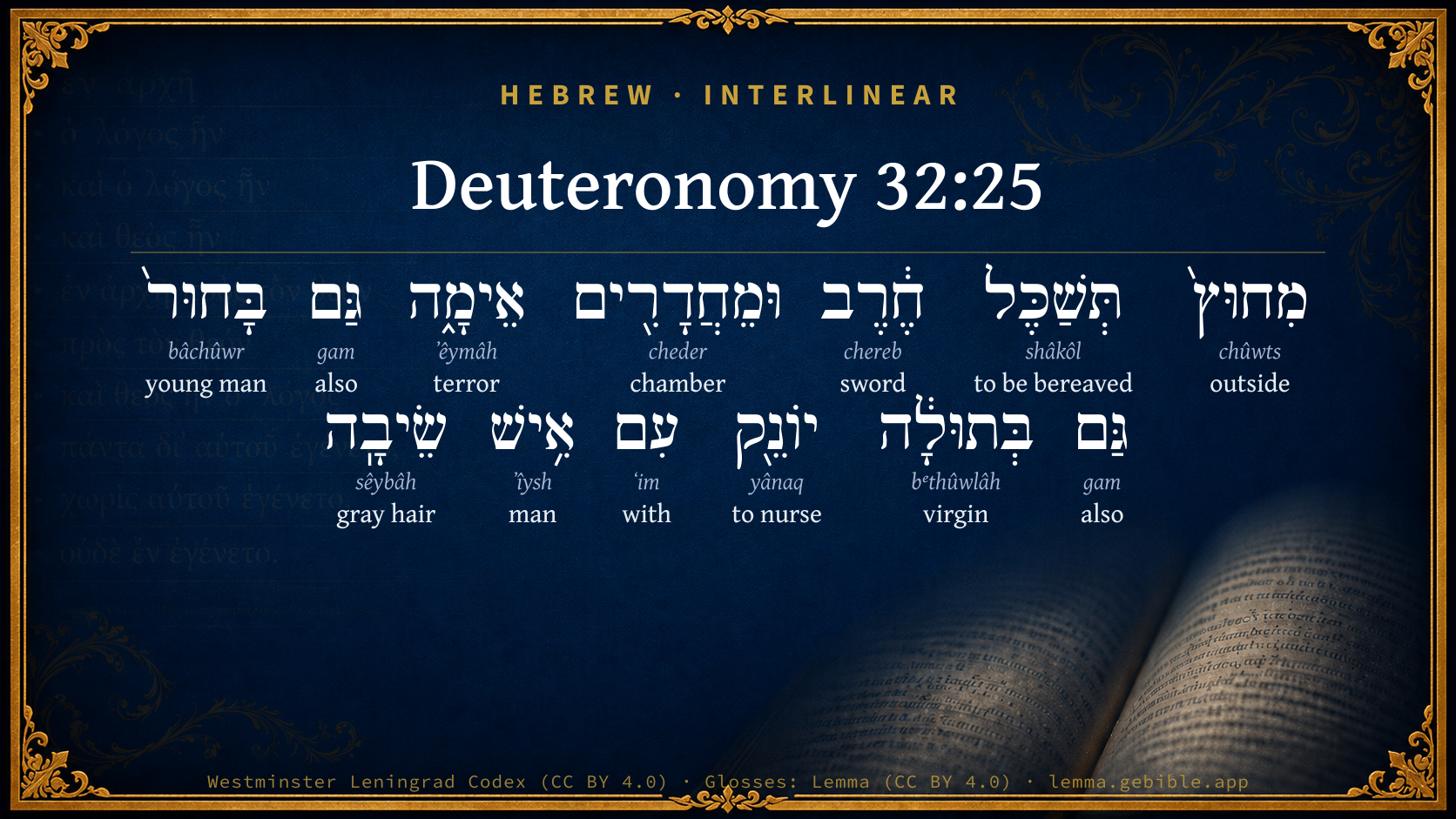
Hebrew (Westminster Leningrad Codex) Deuteronomy 32:25 appears in the Hebrew Old Testament. The text above is from the Westminster Leningrad Codex. Each word links to its Strong’s number, a concise gloss, and parsing drawn from the Open Scriptures Hebrew Bible morphology. Click any word for its full Brown-Driver-Briggs (BDB) entry.
Download image
Cite this verse

Deuteronomy 32:25 (World English Bible). Public Domain. Lemma interlinear Bible study tool, https://lemma.gebible.app/v/deuteronomy/32/25.

Show BibTeX & RIS
BibTeX
RIS
English Translation
Outside shall the sword bereave, In the chambers terror; [It shall destroy] both young man and virgin, The suckling with the man of gray hairs.
World English Bible · Public Domain
Highlights
  • 1 first appearance in the Hebrew Bible
Full analysis ↓
Download a study sheet

One document with this verse’s original text, its word-by-word gloss line, the meaning frame, cross-references with their text, attributed commentary, and full source and license credits — printable, and it pastes into notes with its structure intact.

This verse Autodidact and up

Study sheet (.html) Plain text (.txt)

A passage Seminary Student

Up to 50 verses in one chapter. A passage sheet keeps up to 6 commentary sources and 12 cross-references per verse, in the order this page ranks them, and says so on the sheet whenever that leaves anything out. Ask for a single verse and you get the Autodidact verse sheet above.

Everything on this page stays free to read, with no account — the sheet is a download of what is already on screen, not access to it.

Want to remove ads? Support Godless Engineer
Compare translations 3

The same verse in 3 English versions, stacked beneath the original-language interlinear above. Click any original word for its lexicon entry.

Each is an independent rendering of the whole verse — the interlinear is not word-aligned to these translations.

Highlighted words mark where these versions differ — a whole-verse word diff, not a word-by-word alignment.

  • World English Bible Public Domain
    Outside shall the sword bereave, In the chambers terror; [It shall destroy] both young man and virgin, The suckling with the man of gray hairs.
  • King James Version Public Domain
    The sword without, and terror within, shall destroy both the young man and the virgin, the suckling also with the man of gray hairs.
  • unfoldingWord Literal Text CC BY-SA 4.0
    Outside the sword will bereave, and in the bedrooms, terror, both young man and virgin, the suckling, with the gray-haired man.

unfoldingWord Literal Text — © unfoldingWord, licensed CC BY-SA 4.0. Word-aligned USFM3 via Door43 (git.door43.org/unfoldingWord/en_ult).

Versions to compare (up to 4)

3 of 4 selected

Show all 18 translations

Every available English version of this verse, each an independent rendering of the whole verse.

  • World English Bible Public Domain
    Outside shall the sword bereave, In the chambers terror; [It shall destroy] both young man and virgin, The suckling with the man of gray hairs.
  • Berean Standard Bible Public Domain
    Outside, the sword will take their children, and inside, terror will strike the young man and the young woman, the infant and the gray-haired man.
  • Majority Standard Bible Public Domain
    Outside, the sword will take their children, and inside, terror will strike the young man and the young woman, the infant and the gray-haired man.
  • King James Version Public Domain
    The sword without, and terror within, shall destroy both the young man and the virgin, the suckling also with the man of gray hairs.
  • American Standard Version (1901) Public Domain
    Without shall the sword bereave, And in the chambers terror; `It shall destroy' both young man and virgin, The suckling with the man of gray hairs.
  • Revised Version (1885) Public Domain
    Without shall the sword bereave, And in the chambers terror; It shall destroy both young man and virgin, The suckling with the man of gray hairs.
  • Geneva Bible (1599) Public Domain
    The sworde shall kill them without, and in the chambers feare: both the yong man and the yong woman, the suckeling with the man of gray heare.
  • Douay-Rheims (1899) Public Domain
    Without, the sword shall lay them waste, and terror within, both the young man and the virgin, the sucking child with the man in years.
  • Young's Literal Translation Public Domain
    Without bereave doth the sword, And at the inner-chambers -- fear, Both youth and virgin, Suckling with man of grey hair.
  • Literal Standard Version CC BY-SA 4.0
    The sword destroys from outside, || And out of the inner-chambers—terror, || Both youth and virgin, || Suckling with man of grey hair.
  • Unlocked Literal Bible CC BY-SA 4.0
    Outside the sword will bereave, and in the bedrooms terror will do so. It will destroy both young man and virgin, the nursing baby, and the man of gray hairs.
  • unfoldingWord Literal Text CC BY-SA 4.0
    Outside the sword will bereave, and in the bedrooms, terror, both young man and virgin, the suckling, with the gray-haired man.
  • Darby Bible Public Domain
    From without shall the sword bereave them, and in the chambers, terror -- Both the young man and the virgin, The suckling with the man of gray hairs.
  • World Messianic Bible Public Domain
    Outside the sword will bereave, and in the rooms, terror on both young man and virgin, the nursing infant with the gray-haired man.
  • Webster's Bible Public Domain
    The sword without, and terror within, shall destroy both the young man and the virgin, the suckling also with the man of gray hairs.
  • Free Bible Version CC BY-SA 4.0
    Outside in the streets the sword kills their children, inside their homes, they die from fright; young men and young women, children and old people.
  • Bible in Basic English Public Domain
    Outside they will be cut off by the sword, and in the inner rooms by fear; death will take the young man and the virgin, the baby at the breast and the grey-haired man.
  • JPS Tanakh (1917) Public Domain
    Without shall the sword bereave, and in the chambers terror; slaying both young man and virgin, the suckling with the man of gray hairs.

Literal Standard Version (2020), Covenant Press — licensed CC BY-SA 4.0. Text via the HelloAO Bible API (eBible.org). Unlocked Literal Bible (unfoldingWord) — licensed CC BY-SA 4.0. Text via the HelloAO Bible API (eBible.org). unfoldingWord Literal Text — © unfoldingWord, licensed CC BY-SA 4.0. Word-aligned USFM3 via Door43 (git.door43.org/unfoldingWord/en_ult). Free Bible Version, Dr. Jonathan Gallagher — licensed CC BY-SA 4.0. Text via the HelloAO Bible API (eBible.org).

Word by word

More ways to search: Search by grammar → Find every occurrence → Compare this word →

Practice this passage: Drill this verse → Learn its vocabulary →

אֵימָ֑ה
ʼêymâh
H367
“terror”
Noun, Common, Feminine, Singular, Absolute
Part of Speech
Noun
Type
Common
Gender
Feminine
Number
Singular
State
Absolute
Full BDB Definition

Origin: from the same as H366

TWOT: 80b

terror, dread
  1. מִחוּץ֙ chûwts H2351 “from · outside” Preposition + Noun, Common, Masculine, Singular, Absolute
  2. תְּשַׁכֶּל shâkôl H7921 “to be bereaved” Verb, Piel, Imperfect, 3rd Person, Feminine, Singular
  3. חֶ֔רֶב chereb H2719 “sword” Noun, Common, Feminine, Singular, Absolute
  4. וּמֵחֲדָרִ֖ים cheder H2315 “and · from · chambers” Conjunction + Preposition + Noun, Common, Masculine, Plural, Absolute
  5. גַּם gam H1571 “also” Particle, Accusative
  6. בָּחוּר֙ bâchûwr H970 “young man” Noun, Common, Masculine, Singular, Absolute
  7. גַּם gam H1571 “also” Particle, Accusative
  8. בְּתוּלָ֔ה bᵉthûwlâh H1330 “virgin” Noun, Common, Feminine, Singular, Absolute
  9. יוֹנֵ֖ק yânaq H3243 “nursing” Verb, Qal, Participle Active, Masculine, Singular, Absolute
  10. עִם ʻim H5973 “with” Preposition
  11. אִ֥ישׁ ʼîysh H376 “man of” Noun, Common, Masculine, Singular, Construct
  12. שֵׂיבָֽה sêybâh H7872 “gray hair” Noun, Common, Feminine, Singular, Absolute

About this verse

These counts appear in no published source. They are computed here, from the morphology-tagged text and Lemma’s own curated glosses. What Lemma adds →

13
words
12
distinct lemmas
Pentateuch
section

Notable vocabulary

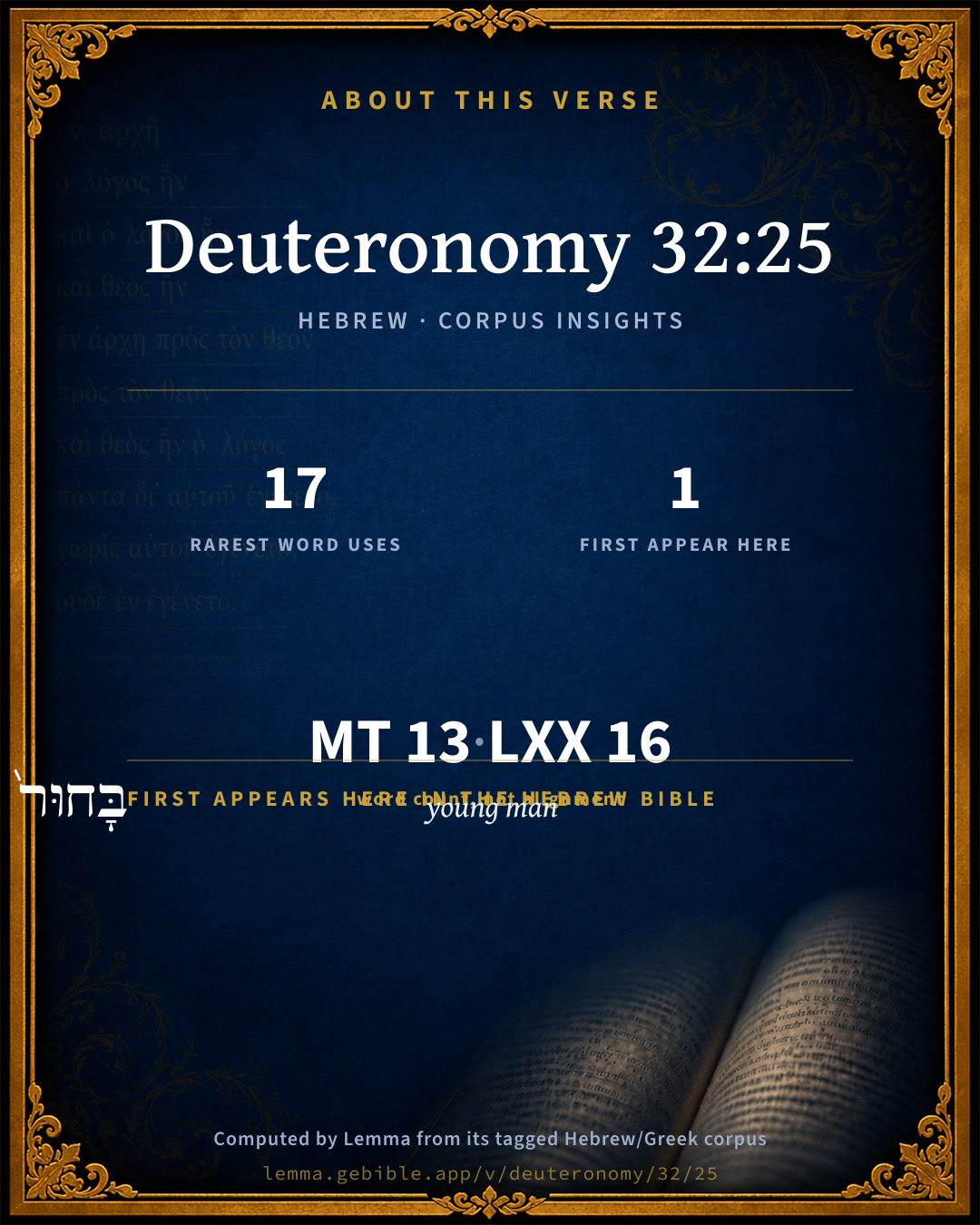
The rarest word here is אֵימָ֑ה terror H367 — appearing just 17 times in the whole Hebrew Bible.

First appearance in Scripture

This word makes its first canonical appearance in the Hebrew Bible here:

  • בָּחוּר֙ young man H970

Shared distinctive vocabulary

אֵימָ֑ה terror H367 occurs in 17 verses of the Hebrew Bible. Also found in:

Grammatical profile

  • 2 verbs
  • 8 nouns
  • 1 preposition
  • 2 particles

Verb forms

  • תְּשַׁכֶּל Piel · Imperfect
  • יוֹנֵ֖ק Qal · Participle Active

Repetition

A word recurs within this verse — often emphatic in Hebrew:

  • גַּם also H1571 ×2

Hebrew & Septuagint length

In English translation the verse runs 25 words from the Hebrew and 33 from the Septuagint (LXX English) — closely comparable.

A rough comparison of the two English renderings, which tokenize alike — not a word-level alignment.

Word counts can differ between the Hebrew and the Greek without any difference in meaning — e.g. the Hebrew direct-object marker אֵת has no separate Greek word, and Greek often adds the article ὁ.

In the original languages it is 13 Hebrew tokens and 16 Greek tokens — but the two are counted differently (Hebrew bundles its prefixes and suffixes into one token; the Greek is in lemma form), so that isn’t a like-for-like length.

Cross-references

9

Topical passages linked to Deuteronomy 32:25 in the Treasury of Scripture Knowledge — connected by theme and wording, ordered by reader-vote popularity; previews shown in the World English Bible.

  • Ezekiel 7:15 The sword is outside, and the pestilence and the famine within: he who is in the field shall die with the sword: and he who is in the city, famine and pestilence shall devour him.
  • Lamentations 1:20 See, Yahweh; for I am in distress; my heart is troubled; My heart is turned within me; for I have grievously rebelled: Abroad the sword bereaves, at home there is as death.
  • Leviticus 26:36–37 "'As for those of you who are left, I will send a faintness into their hearts in the lands of their enemies: and the sound of a driven leaf will put them to flight; and they shall flee, as one flees from the sword; and they will fall when no one pursues.
  • 2 Chronicles 36:17 Therefore he brought on them the king of the Chaldeans, who killed their young men with the sword in the house of their sanctuary, and had no compassion on young man or virgin, old man or gray-headed: he gave them all into his hand.
  • Isaiah 30:16 but you said, No, for we will flee on horses; therefore shall you flee: and, We will ride on the swift; therefore shall those who pursue you be swift.
  • Jeremiah 9:21 For death is come up into our windows, it is entered into our palaces; to cut off the children from outside, [and] the young men from the streets.
  • Lamentations 4:4 The tongue of the sucking child cleaves to the roof of his mouth for thirst: The young children ask bread, and no man breaks it to them.
  • 2 Corinthians 7:5 For even when we had come into Macedonia, our flesh had no relief, but we were afflicted on every side. Fightings were outside. Fear was inside.
  • Lamentations 2:19–22 Arise, cry out in the night, at the beginning of the watches; Pour out your heart like water before the face of the Lord: Lift up your hands toward him for the life of your young children, that faint for hunger at the head of every street.

Cross-references courtesy of OpenBible.info (CC BY 4.0).

Hebrew and Greek witnesses Masoretic Hebrew ↔ Greek Septuagint

The same verse in the two great witnesses to the Old Testament, shown verse-for-verse.

These are two independent witnesses, not word-aligned to each other, and the Septuagint is shown in lemma (dictionary) form.

Hebrew Deuteronomy 32:25 Masoretic · Westminster Leningrad Codex

מִחוּץ֙ תְּשַׁכֶּל חֶ֔רֶב וּמֵחֲדָרִ֖ים אֵימָ֑ה גַּם בָּחוּר֙ גַּם בְּתוּלָ֔ה יוֹנֵ֖ק עִם אִ֥ישׁ שֵׂיבָֽה

Outside shall the sword bereave, In the chambers terror; [It shall destroy] both young man and virgin, The suckling with the man of gray hairs.

World English Bible · Public Domain

Greek LXX Deuteronomy 32:25 Septuagint · lemma form

ἔξωθεν ἀτεκνόω αὐτός μάχαιρα καί ἐκ ὁ ταμιεῖον φόβος νεανίσκος σύν παρθένος θηλάζω μετά καταἵστημι πρεσβύτης

Without, the sword shall bereave them of children, and terror shall issue out of the secret chambers; the young man shall perish with the virgin, the suckling with him who has grown old.

LXX2012 (modern English Septuagint) · Public Domain

Hebrew: Westminster Leningrad Codex (CC BY 4.0). Greek: Septuagint (public domain); English from LXX2012 (modern English Septuagint) (Public Domain). How the Septuagint differs from the Hebrew →

Targum (Aramaic paraphrase)

2

The Targum is the ancient Jewish Aramaic paraphrase of the Hebrew Scriptures — an interpretive translation, not the Hebrew text itself. Onkelos (literal) and Pseudo-Jonathan (expansive) render the Torah, and Jonathan the Prophets. Coverage is partial: where no permissively-licensed English translation exists for a verse, only the Aramaic is shown. This is verse-level text, not a word-by-word alignment to the Hebrew.

  1. Targum Onkelos Torah (Genesis–Deuteronomy)
    מִבָּרָא תְּתַכֵּל חַרְבָּא וּמִתְּוָנַיָא חַרְגַת מוֹתָא אַף עוּלֵמֵיהוֹן אַף עוּלֵמָתְהוֹן יָנְקֵיהוֹן עִם אֱנַשׁ סָבֵיהוֹן

    (no public-domain English translation for this verse)

    Targum Onkelos — Aramaic: “Onkelos Genesis” (public domain); “Onkelos Exodus” (public domain); “Onkelos Leviticus” (public domain); “Onkelos Numbers” (public domain); “Onkelos Deuteronomy” (public domain). English: “Sefaria Community Translation” (CC0 1.0 (public-domain dedication)); “J.W. Etheridge. The Targums of Onkelos and Jonathan Ben Uzziel on the Pentateuch. London: Longmans, Green, 1862” (public domain). Text via Sefaria.

  2. Targum Pseudo-Jonathan Torah (Genesis–Deuteronomy)
    עַמָא דְגָלוּ מִבָּרָא לְאַרְעָא דְיִשְרָאֵל תַּתְכֵּיל יַתְהוֹן מָחַת חַרְבָּא וּדְמִשְׁתַּיְירִין בְּאַרְעָא דְיִשְרָאֵל בְּגוֹ קִיטוֹנֵי מִדַמִיכֵיהוֹן אִיגְרֵי בְּהוֹן חַרְגַת מוֹתָא אֵילֵךְ וְאֵילֵךְ יִשְׁתֵּיצוּן לְחוֹד עוֹלֵימֵיהוֹן וּלְחוֹד בְּתוּלַתְהוֹן יְנִיקַתְהוֹן עִם גוּבְרֵיהוֹן וְסָבֵיהוֹן

    A people who will come from beyond the land of Israel shall consume them with the stroke of the sword, and those who are left in the land of Israel will I throw into the terror of death, in the chambers here and there where they sleep; their young men shall perish, their maidens, their sucklings, with their men and their elders.

    Targum Pseudo-Jonathan — Aramaic: “Targum Jonathan on Genesis” (public domain); “Targum Jonathan on Exodus” (public domain); “Targum Jonathan on Leviticus” (public domain); “Targum Jonathan on Numbers” (public domain); “Targum Jonathan on Deuteronomy” (public domain). English: “The Targum of Jonathan ben Uzziel, trans. J. W. Etheridge, London, 1862” (public domain). Text via Sefaria.

Commentary

Notes on Deuteronomy 32:25 from classic Christian and Jewish commentators (each source and its license shown beneath its notes). The classic Christian expositions comment on the surrounding passage and are grouped to its opening verse, so a note may address several verses; the Jewish commentaries on the Tanakh (Rashi and others) are per-verse, so they appear only where the commentator wrote on this verse.

Lemma curates 59 commentaries, every one of them public domain or Creative Commons licensed, each selected and text-cleaned for this edition rather than reprinted as found. About our sources →

Trapp's Complete Commentary

John Trapp

Deu 32:25 The sword without, and terror within, shall destroy both the young man and the virgin, the suckling [also] with the man of gray hairs.

Ver. 25. And terror within.] Warring times are terrible times. By the civil dissensions here in King John’s time, all the kingdom became like a general shambles, or place of infernal terrors and tortures. War, saith one, is a misery which all words, how wide soever, want compass to express. It is, saith another, the slaughter house of mankind, and the hell of this present world. {See Trapp on "Gen 14:2"}

John Trapp, A Commentary or Exposition upon All the Books of the Old and New Testament (1647–1656) — public domain. Text from a community e-Sword module.

Geneva Bible (1599)

Geneva Bible translators

They shall be slain both in the field and at home.

Geneva Bible (1599) marginal notes — public domain. Text via Bolls.life.

The Cambridge Bible for Schools and Colleges

gen. ed. J. J. S. Perowne

25. War the climax to these natural plagues, just as in Amos 7.

The Cambridge Bible for Schools and Colleges (gen. ed. J. J. S. Perowne; Cambridge University Press, 1878–1918) — public domain. Text from a community e-Sword module.

John Gill's Exposition

I said,.... Or could have said, or might have said; that is, determined and resolved, as it was in his power, and in right and justice might have done what follows:

I would scatter them into corners; which does not fitly express the sense of the word used, and besides this was what was done; it is notorious that the Jews were and are scattered into the several corners of the world, and there is no corner where they are not; whereas the phrase is expressive of something that could and might have been done, but was not: moreover, to disperse them into the several parts of the world does not agree with what follows; for that, instead of making their remembrance to cease, would make them the more known, and the more to be remembered. But the word literally taken may be rendered, "I will corner them" (f); drive them up into a corner, and cut them off together, or search for them in, and ferret them out of, every corner in which they should get, and destroy them all: agreeably to which is the Targum of Onkelos,"mine anger shall rest upon them, and I will destroy them;''and so Aben Ezra interprets it of the destruction of them, and observes, that otherwise it would not agree with what follows. There may be an allusion in it to the corner of the field, which was ordered to be left to the poor, and not reaped, Lev 19:9; and so the sense is, I could and might have determined when the harvest of this land and people was come, or the time of wrath upon them, to cut down every corner, and leave none, no, not one standing stalk of corn, but make clean riddance of them:

I would make the remembrance of them cease from among men; as of the Amalekites, Moabites, Midianites, Edomites, Chaldeans, and others, whose names as well as nations are no more. This is what the enemies of the Jews plotted and conspired to do, Psa 83:4; and what God could and might have done, but has not; the Jews continue to this day a distinct people, though it is now near 1900 years since the destruction of their city and temple, and their dispersion in the various parts of the world; which is what was never known of any other people in the like circumstances, and which is a most amazing and surprising event; the reasons of it follow.

(f) "angulabo illos", Oleaster, Vitringa; "ad angulos usque quaeram ipsos, seu ad verbum, angulabo ipsos", Van Till; "ab angulo succidam ipsos", Cocceius. Vid. Gusset. Ebr. Comment. p. 661.

John Gill's Exposition of the Whole Bible (1746–1763) — public domain (CC PDM 1.0). Text via the HelloAO Bible API.

unfoldingWord translationNotes

Door43 World Missions Community

General Information:

Moses speaks a poetic song to the people of Israel. He continues to quote Yahweh's words. (See: Parallelism)

Outside the sword will bereave

Here "sword" represents the army of the enemy. AT: "When the Israelites are outside, the enemy army will kill them" (See: Metonymy)

terror will do so

Yahweh speaks of being afraid as if it were a person who comes into a house and kills those who live in it. AT: "you will die because you are afraid" (See: Personification)

young man and virgin, the nursing baby, and the man of gray hairs

These terms describing people of different ages are combined to mean that all kinds of people will die. (See: Merism)

I said that I would ... away, that I would ... mankind.

This can be translated as a direct quote. AT: "I said, 'I will ... away, and I will ... mankind.'" (See: Direct and Indirect Quotations)

I would make the memory of them to cease from among mankind

"I would make all people forget about them"

translationWords

sword

terror

virgin

unfoldingWord translationNotes — © Distant Shores Media and the Door43 World Missions Community, licensed CC BY-SA 4.0. Source: git.door43.org/Door43/en_tn.

Rashi

Rabbi Shlomo Yitzchaki (Rashi)

מחוץ תשכל חרב WITHOUT, THE SWORD SHALL BEREAVE — This means, outside the city will the sword of the hostile troops bereave them,

ומחדרים אימה AND WITHIN, DREAD — when one flees and escapes, the recesses (חדרים) of his heart will vehemently beat out of dread, and he will gradually die through this (Sifrei Devarim 321:11). — Another explanation of ומחדרים אימה: In the house there will be the fear of pestilence, as it says, (Jeremiah 9:20) “For the death is come up into our windows" (cf. Bava Kamma 60b). So, too, did Onkelos translate it. — Another explanation of this verse: מחוץ תשכל חרב — the sword shall destroy them on account of what they have done in the streets (חוצה; the prefix מ denotes the cause: on account of the streets), as it is said, (Jeremiah 11:13) “According to the number of the streets of Jerusalem have you set up altars to the shameful thing” (Sifrei Devarim 321:12); ומחדרים אימה — on account of what they have done in the innermost chambers of their houses, as it is said, (Ezekiel 8:12) “[Have you seen] what the elders of the house of Israel do in the dark, every man in his marbled chambers?” (Sifrei Devarim 321:12)

Rashi on the Tanakh — English translations: “The Judaica Press complete Tanach with Rashi, translated by A. J. Rosenberg” (CC BY 4.0); “Pentateuch with Rashi's commentary by M. Rosenbaum and A.M. Silbermann, 1929-1934” (public domain); “The Metsudah Tanach series, Lakewood, N.J” (CC BY 4.0); and “The Book of Joshua, Metsudah Publications, 1997” (CC BY 4.0). Text via Sefaria.

Lesson kit

Teaching starters — assembled from the data on this page, not authored interpretation. Every prompt links to the verse data it draws on. Edit before teaching.

Deuteronomy, in the Pentateuch, opens this verse with 13 words (12 distinct Hebrew lemmas). Its most distinctive word is ʼêymâh (“terror”). A historical commentator’s framing appears above. Read the whole chapter for the surrounding context.

Discussion questions

  1. What does “terror” (ʼêymâh) contribute to the verse as a whole?
  2. This is the first place “young man” appears in Scripture (first appears here). What does its debut here establish?
  3. How does Genesis 15:12, which shares the word «terror», read alongside this verse?
  4. What does the repetition of “also” (2× in this one verse) do in this verse?
  5. These translations render this verse differently; the difference is in the English rendering, not the original. What questions does that raise?
  6. «תְּשַׁכֶּל» is a Piel Imperfect verb. How does that grammatical form shape the action described?
  7. Compare how Trapp's Complete Commentary and Geneva Bible (1599) read this verse. Where do they agree or differ?

Things to notice

Reading settings

Reading text

Shown beneath each verse's original-language words.

Old Testament
Old Testament edition

Read the OT as the Masoretic Hebrew (MT) or the Greek Septuagint (LXX).

English shown for the Greek Septuagint (in the Hebrew ↔ Greek comparison).

Comparing translations? Open the Compare panel on any verse page to stack up to four side by side.