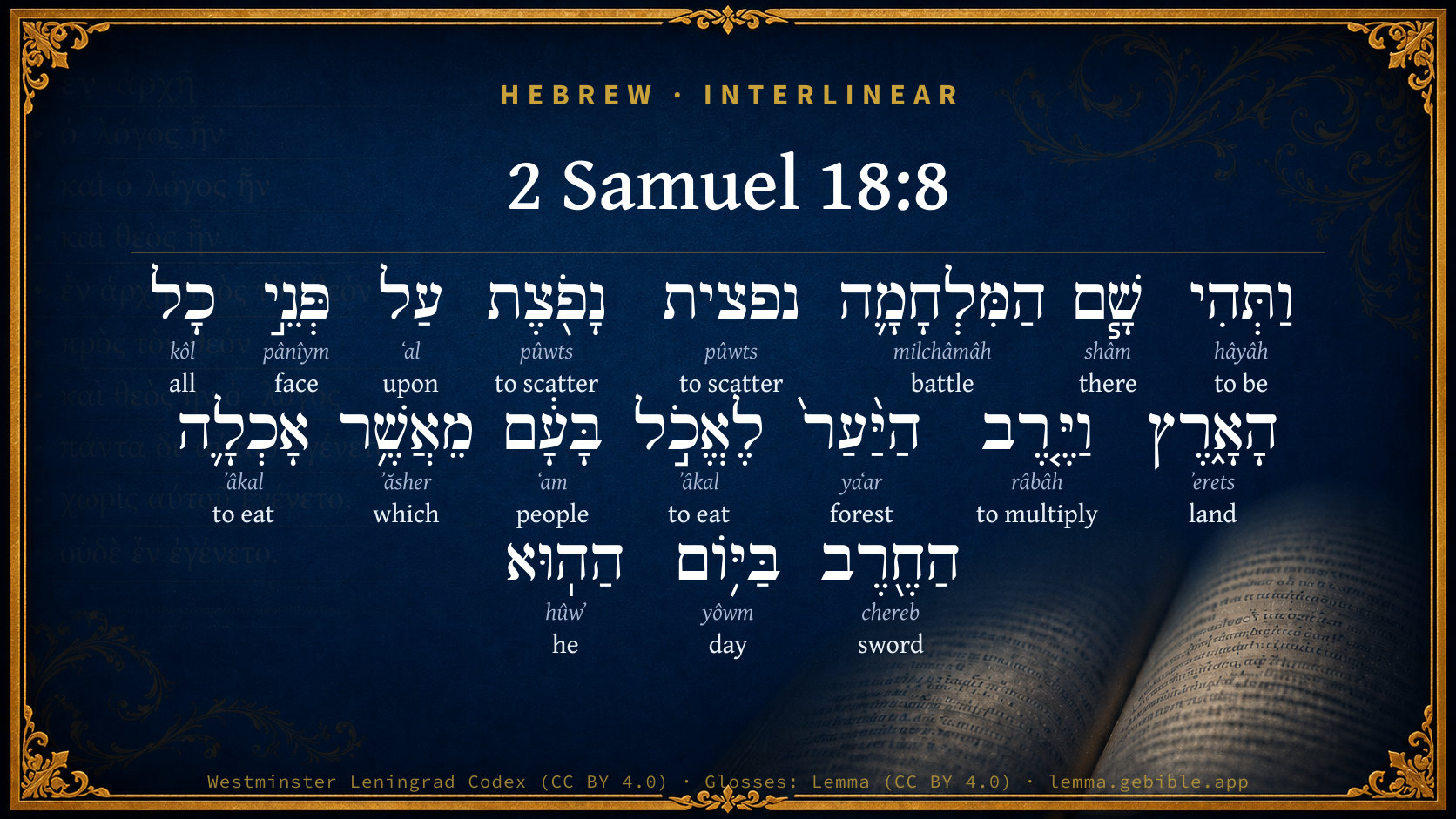
2 Samuel 18:8

Hebrew (Westminster Leningrad Codex) 2 Samuel 18:8 appears in the Hebrew Old Testament. The text above is from the Westminster Leningrad Codex. Each word links to its Strong’s number, a concise gloss, and parsing drawn from the Open Scriptures Hebrew Bible morphology. Click any word for its full Brown-Driver-Briggs (BDB) entry.
Download image
Cite this verse

2 Samuel 18:8 (World English Bible). Public Domain. Lemma interlinear Bible study tool, https://lemma.gebible.app/v/2-samuel/18/8.

Show BibTeX & RIS
BibTeX
RIS
English Translation
For the battle was there spread over the surface of all the country; and the forest devoured more people that day than the sword devoured.
World English Bible · Public Domain
Download a study sheet

One document with this verse’s original text, its word-by-word gloss line, the meaning frame, cross-references with their text, attributed commentary, and full source and license credits — printable, and it pastes into notes with its structure intact.

This verse Autodidact and up

Study sheet (.html) Plain text (.txt)

A passage Seminary Student

Up to 50 verses in one chapter. A passage sheet keeps up to 6 commentary sources and 12 cross-references per verse, in the order this page ranks them, and says so on the sheet whenever that leaves anything out. Ask for a single verse and you get the Autodidact verse sheet above.

Everything on this page stays free to read, with no account — the sheet is a download of what is already on screen, not access to it.

Want to remove ads? Support Godless Engineer
Compare translations 3

The same verse in 3 English versions, stacked beneath the original-language interlinear above. Click any original word for its lexicon entry.

Each is an independent rendering of the whole verse — the interlinear is not word-aligned to these translations.

Highlighted words mark where these versions differ — a whole-verse word diff, not a word-by-word alignment.

  • World English Bible Public Domain
    For the battle was there spread over the surface of all the country; and the forest devoured more people that day than the sword devoured.
  • King James Version Public Domain
    For the battle was there scattered over the face of all the country: and the wood devoured more people that day than the sword devoured.
  • unfoldingWord Literal Text CC BY-SA 4.0
    And the battle was scattered there over the face of all of the land. And the forest made more to consume among the people than what the sword consumed on that day.

unfoldingWord Literal Text — © unfoldingWord, licensed CC BY-SA 4.0. Word-aligned USFM3 via Door43 (git.door43.org/unfoldingWord/en_ult).

Versions to compare (up to 4)

3 of 4 selected

Show all 18 translations

Every available English version of this verse, each an independent rendering of the whole verse.

  • World English Bible Public Domain
    For the battle was there spread over the surface of all the country; and the forest devoured more people that day than the sword devoured.
  • Berean Standard Bible Public Domain
    The battle spread over the whole countryside, and that day the forest devoured more people than the sword.
  • Majority Standard Bible Public Domain
    The battle spread over the whole countryside, and that day the forest devoured more people than the sword.
  • King James Version Public Domain
    For the battle was there scattered over the face of all the country: and the wood devoured more people that day than the sword devoured.
  • American Standard Version (1901) Public Domain
    For the battle was there spread over the face of all the country; and the forest devoured more people that day than the sword devoured.
  • Revised Version (1885) Public Domain
    For the battle was there spread over the face of all the country: and the forest devoured more people that day than the sword devoured.
  • Geneva Bible (1599) Public Domain
    For the battel was skattered ouer all the countrey: and the wood deuoured much more people that day, then did the sworde.
  • Douay-Rheims (1899) Public Domain
    And the battle there was scattered over the face of all the country, and there were many more of the people whom the forest consumed, than whom the sword devoured that day.
  • Young's Literal Translation Public Domain
    and the battle is there scattered over the face of all the land, and the forest multiplieth to devour among the people more than those whom the sword hath devoured in that day.
  • Literal Standard Version CC BY-SA 4.0
    and the battle there is scattered over the face of all the land, and the forest multiplies to devour among the people more than those whom the sword has devoured in that day.
  • Unlocked Literal Bible CC BY-SA 4.0
    The battle spread throughout the whole countryside, and more men were consumed by the forest than by the sword.
  • unfoldingWord Literal Text CC BY-SA 4.0
    And the battle was scattered there over the face of all of the land. And the forest made more to consume among the people than what the sword consumed on that day.
  • Darby Bible Public Domain
    And the battle was there scattered over the face of all the country; and the forest devoured more people that day than the sword devoured.
  • World Messianic Bible Public Domain
    For the battle was there spread over the surface of all the country, and the forest devoured more people that day than the sword devoured.
  • Webster's Bible Public Domain
    For the battle was there scattered over the face of all the country: and the wood devoured more people that day than the sword devoured.
  • Free Bible Version CC BY-SA 4.0
    The battle covered the whole countryside, and that day more died because of the forest than were killed by the sword.
  • Bible in Basic English Public Domain
    And the fighting went on over all the face of the country: and the woods were responsible for more deaths than the sword.
  • JPS Tanakh (1917) Public Domain
    For the battle was there spread over the face of all the country; and the forest devoured more people that day than the sword devoured.

Literal Standard Version (2020), Covenant Press — licensed CC BY-SA 4.0. Text via the HelloAO Bible API (eBible.org). Unlocked Literal Bible (unfoldingWord) — licensed CC BY-SA 4.0. Text via the HelloAO Bible API (eBible.org). unfoldingWord Literal Text — © unfoldingWord, licensed CC BY-SA 4.0. Word-aligned USFM3 via Door43 (git.door43.org/unfoldingWord/en_ult). Free Bible Version, Dr. Jonathan Gallagher — licensed CC BY-SA 4.0. Text via the HelloAO Bible API (eBible.org).

Word by word

More ways to search: Search by grammar → Find every occurrence → Compare this word →

Practice this passage: Drill this verse → Learn its vocabulary →

הַיַּ֨עַר֙
yaʻar
H3293
“the · forest”
Particle, Definite Article + Noun, Common, Masculine, Singular, Absolute
Part of Speech
Particle + Noun
Type
Common
Gender
Masculine
Number
Singular
State
Absolute
Full BDB Definition

Origin: from an unused root probably meaning to thicken with verdure

TWOT: 888 , 889

forest, wood, thicket, wooded height
  1. וַתְּהִי hâyâh H1961 “and · to be” Conjunction + Verb, Qal, Sequential Imperfect, 3rd Person, Feminine, Singular
  2. שָׁ֧ם shâm H8033 “there” Adverb
  3. הַמִּלְחָמָ֛ה milchâmâh H4421 “the · battle” Particle, Definite Article + Noun, Common, Feminine, Singular, Absolute
  4. נפצית pûwts H6327 “scattered” Verb, Niphal, Participle Passive, Feminine, Plural, Absolute
  5. נָפֹ֖צֶת pûwts H6327 “scattered” Verb, Niphal, Participle Passive, Feminine, Singular, Absolute
  6. עַל ʻal H5921 “upon” Preposition
  7. פְּנֵ֣י pânîym H6440 “face(s) of” Noun, Common, Both, Plural, Construct
  8. כָל kôl H3605 “all of” Noun, Common, Masculine, Singular, Construct
  9. הָאָ֑רֶץ ʼerets H776 “the · land” Particle, Definite Article + Noun, Common, Both, Singular, Absolute
  10. וַיֶּ֤רֶב râbâh H7235 “and · to multiply” Conjunction + Verb, Hiphil, Sequential Imperfect, 3rd Person, Masculine, Singular
  11. לֶאֱכֹ֣ל ʼâkal H398 “to eat” Preposition + Verb, Qal, Infinitive Construct
  12. בָּעָ֔ם ʻam H5971 “in/at the · people” Preposition, Determined + Noun, Common, Masculine, Singular, Absolute
  13. מֵאֲשֶׁ֥ר ʼăsher H834 “from · which” Preposition + Particle, Relative
  14. אָכְלָ֛ה ʼâkal H398 “to eat” Verb, Qal, Perfect, 3rd Person, Feminine, Singular
  15. הַחֶ֖רֶב chereb H2719 “the · sword” Particle, Definite Article + Noun, Common, Feminine, Singular, Absolute
  16. בַּיּ֥וֹם yôwm H3117 “in/at the · day” Preposition, Determined + Noun, Common, Masculine, Singular, Absolute
  17. הַהֽוּא hûwʼ H1931 “the · he” Particle, Definite Article + Pronoun, Personal, 3rd Person, Masculine, Singular

About this verse

These counts appear in no published source. They are computed here, from the morphology-tagged text and Lemma’s own curated glosses. What Lemma adds →

18
words
16
distinct lemmas
Historical
section

Shared distinctive vocabulary

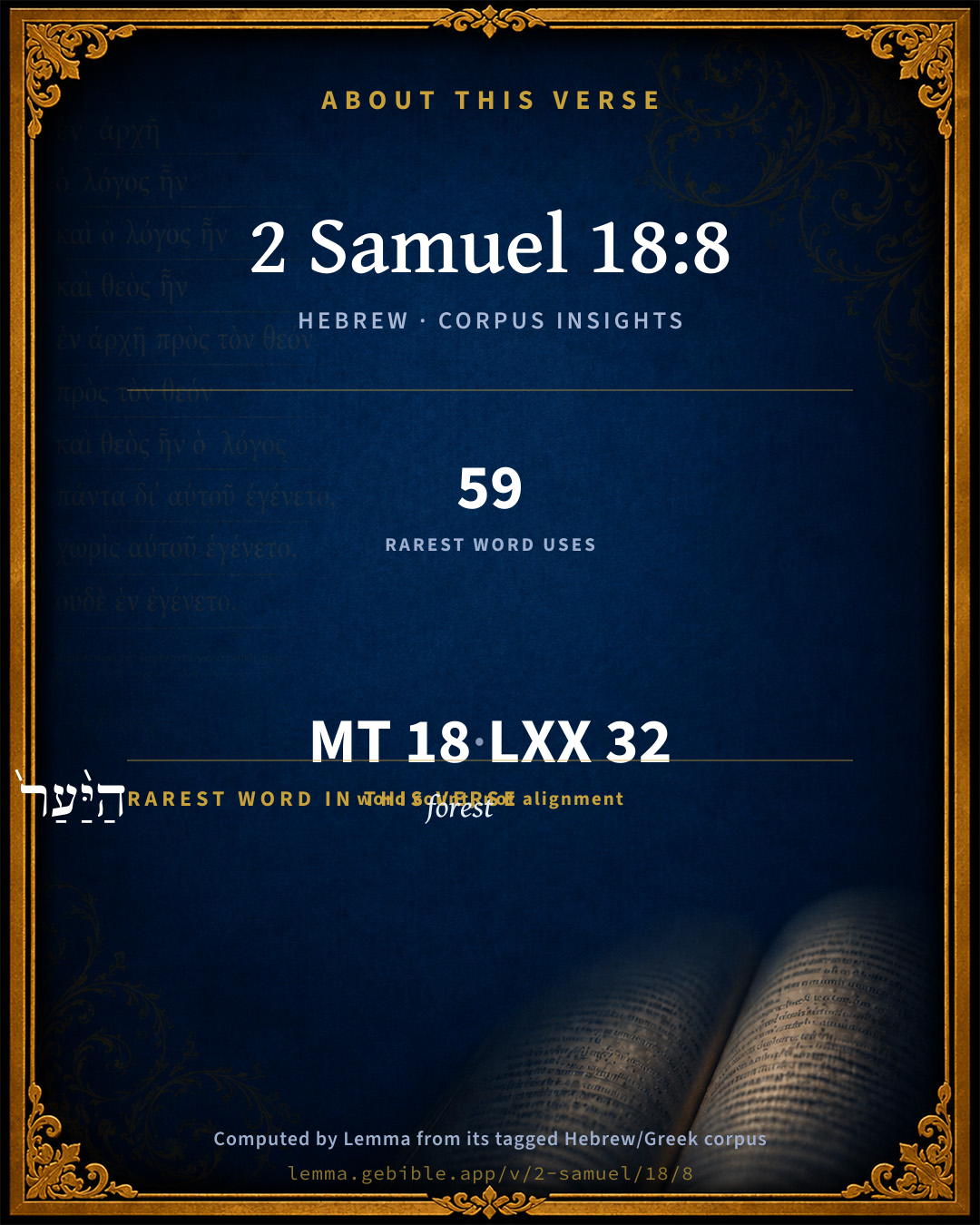
הַיַּ֨עַר֙ forest H3293 occurs in 59 verses of the Hebrew Bible. Also found in:

Grammatical profile

  • 6 verbs
  • 8 nouns
  • 1 pronoun
  • 1 preposition
  • 1 adverb
  • 1 particle

Verb forms

  • וַתְּהִי Qal · Sequential Imperfect
  • נפצית Niphal · Participle Passive
  • נָפֹ֖צֶת Niphal · Participle Passive
  • וַיֶּ֤רֶב Hiphil · Sequential Imperfect
  • לֶאֱכֹ֣ל Qal · Infinitive Construct
  • אָכְלָ֛ה Qal · Perfect

Repetition

Words recur within this verse — often emphatic in Hebrew:

  • נפצית to scatter H6327 ×2
  • לֶאֱכֹ֣ל to eat H398 ×2

Hebrew & Septuagint length

In English translation the verse runs 25 words from the Hebrew and 31 from the Septuagint (LXX English) — closely comparable.

A rough comparison of the two English renderings, which tokenize alike — not a word-level alignment.

Word counts can differ between the Hebrew and the Greek without any difference in meaning — e.g. the Hebrew direct-object marker אֵת has no separate Greek word, and Greek often adds the article ὁ.

In the original languages it is 18 Hebrew tokens and 32 Greek tokens — but the two are counted differently (Hebrew bundles its prefixes and suffixes into one token; the Greek is in lemma form), so that isn’t a like-for-like length.

Cross-references

6

Topical passages linked to 2 Samuel 18:8 in the Treasury of Scripture Knowledge — connected by theme and wording, ordered by reader-vote popularity; previews shown in the World English Bible.

  • Exodus 15:10 You blew with your wind. The sea covered them. They sank like lead in the mighty waters.
  • Joshua 10:11 It happened, as they fled from before Israel, while they were at the descent of Beth Horon, that Yahweh cast down great stones from the sky on them to Azekah, and they died: they were more who died with the hailstones than they whom the children of Israel killed with the sword.
  • Judges 5:20–21 From the sky the stars fought, From their courses they fought against Sisera.
  • 1 Kings 20:30 But the rest fled to Aphek, into the city; and the wall fell on twenty-seven thousand men who were left. Ben Hadad fled, and came into the city, into an inner chamber.
  • Psalms 3:7 Arise, Yahweh! Save me, my God! For you have struck all of my enemies on the cheek bone. You have broken the teeth of the wicked.
  • Psalms 43:1 Vindicate me, God, and plead my cause against an ungodly nation. Oh, deliver me from deceitful and wicked men.

Cross-references courtesy of OpenBible.info (CC BY 4.0).

Hebrew and Greek witnesses Masoretic Hebrew ↔ Greek Septuagint

The same verse in the two great witnesses to the Old Testament, shown verse-for-verse.

These are two independent witnesses, not word-aligned to each other, and the Septuagint is shown in lemma (dictionary) form.

Hebrew 2 Samuel 18:8 Masoretic · Westminster Leningrad Codex

וַתְּהִי שָׁ֧ם הַמִּלְחָמָ֛ה נפצית נָפֹ֖צֶת עַל פְּנֵ֣י כָל הָאָ֑רֶץ וַיֶּ֤רֶב הַיַּ֨עַר֙ לֶאֱכֹ֣ל בָּעָ֔ם מֵאֲשֶׁ֥ר אָכְלָ֛ה הַחֶ֖רֶב בַּיּ֥וֹם הַהֽוּא

For the battle was there spread over the surface of all the country; and the forest devoured more people that day than the sword devoured.

World English Bible · Public Domain

Greek LXX 2 Samuel 18:8 Septuagint · lemma form

καί γίγνομαι ἐκεῖ ὁ πόλεμος διασπείρω ἐπί πρόσωπον πᾶς ὁ γῆ καί πλεονάζω ὁ δρυμός ὁ καταἐσθίω ἐκ ὁ λαός ὑπέρ ὅς καταἐσθίω ἐν ὁ λαός ὁ μάχαιρα ἐν ὁ ἡμέρα ἐκεῖνος

And the battle there was scattered over the face of all the land: and the wood consumed more of the people than the sword consumed among the people in that day.

LXX2012 (modern English Septuagint) · Public Domain

Hebrew: Westminster Leningrad Codex (CC BY 4.0). Greek: Septuagint (public domain); English from LXX2012 (modern English Septuagint) (Public Domain). How the Septuagint differs from the Hebrew →

Targum (Aramaic paraphrase)

1

The Targum is the ancient Jewish Aramaic paraphrase of the Hebrew Scriptures — an interpretive translation, not the Hebrew text itself. Onkelos (literal) and Pseudo-Jonathan (expansive) render the Torah, and Jonathan the Prophets. Coverage is partial: where no permissively-licensed English translation exists for a verse, only the Aramaic is shown. This is verse-level text, not a word-by-word alignment to the Hebrew.

  1. Targum Jonathan Prophets (Joshua–Malachi)
    וַהֲווֹ תַמָן עַבְדֵי קְרָבָא מִתְבַּדְרִין עַל אַפֵי כָל אַרְעָא וְאַסְגִיאַת חַיַת חוּרְשָׁא לְקַטָלָא בְעַמָא מִדְקָטִילַת חַרְבָּא בְּיוֹמָא הַהוּא:

    (no public-domain English translation for this verse)

    Targum Jonathan — Aramaic: “Mikraot Gedolot” (public domain). English: “Sefaria Community Translation” (CC0 1.0 (public-domain dedication)); “London "Chaldee Paraphrase," 1871” (public domain). Text via Sefaria.

Commentary

Notes on 2 Samuel 18:8 from classic Christian and Jewish commentators (each source and its license shown beneath its notes). The classic Christian expositions comment on the surrounding passage and are grouped to its opening verse, so a note may address several verses; the Jewish commentaries on the Tanakh (Rashi and others) are per-verse, so they appear only where the commentator wrote on this verse.

Lemma curates 59 commentaries, every one of them public domain or Creative Commons licensed, each selected and text-cleaned for this edition rather than reprinted as found. About our sources →

Trapp's Complete Commentary

John Trapp

2Sa 18:8 For the battle was there scattered over the face of all the country: and the wood devoured more people that day than the sword devoured.

Ver. 8. And the wood devoured more people that day.] While in running from death, they ran to it; sive in stipites impegerint, sive in arbores illisetint, sive in scrobes, praecipitia aut etiam feras inciderint; whether they fell upon the stubs, or fell into the ditches, or were hanged in the trees, or devoured by wild beasts, or were slain there in the pursuit, or knocked on the head by the country people; quod arguit hanc divinam esse vindictam, saith Jerome.

John Trapp, A Commentary or Exposition upon All the Books of the Old and New Testament (1647–1656) — public domain. Text from a community e-Sword module.

Joseph Benson's Commentary

2Sa 18:8. The battle was scattered over all the country — In that neighbourhood; both in the field and in the wood. The wood devoured more people than the sword — Some think the wood is said to devour them because they fell into pits, or stumbled upon stumps of trees, or pressed one another to death, as they came into strait places, or were killed by wild beasts. But the most natural meaning of the words is, that there were more slain in the wood, into which Absalom’s men fled, than in the open field; that is, more in their flight, which was stopped by the wood, than in the battle.

Joseph Benson's Commentary on the Old and New Testaments (1811–1818) — public domain. Text from a community e-Sword module.

Tyndale Open Study Notes

Tyndale Open Resources

18:8 more men died because of the forest: The topographical conditions of the forest apparently took away the numerical advantage of Absalom’s forces.

Tyndale Open Study Notes — © Tyndale Open Resources, licensed CC BY-SA 4.0. Text via the HelloAO Bible API.

Jamieson, Fausset & Brown

Robert Jamieson, A. R. Fausset & David Brown

the wood devoured more people than the sword--The thick forest of oaks and terebinths, by obstructing the flight, greatly aided the victors in the pursuit.

Jamieson, Fausset & Brown — Commentary Critical and Explanatory on the Whole Bible (1871) — public domain (CC PDM 1.0). Text via the HelloAO Bible API.

Adam Clarke's Commentary

Verse 8. The wood devoured more people] It is generally supposed that, when the army was broken, they betook themselves to the wood, fell into pits, swamps, c., and, being entangled, were hewn down by David's men but the Chaldee, Syriac, and Arabic, state that they were devoured by wild beasts in the wood.

Adam Clarke's Commentary on the Bible (1810–1826) — public domain. Text from a community e-Sword/MySword module.

Ellicott's Commentary for English Readers

(8) The wood devoured more.—The battle and the pursuit covered a wide range of country; more were slain in the pursuit through the wood, both by accident and by the sword, than in the actual battle itself.

A Bible Commentary for English Readers, edited by Charles John Ellicott (1878–1897) — public domain. Text from a community e-Sword module.

The Cambridge Bible for Schools and Colleges

gen. ed. J. J. S. Perowne

8. the wood devoured more, &c.] The explanation generally given is that they perished in the pits and precipices and morasses of the forest: but this seems unlikely. More probably it means that owing to the nature of the ground more were slain in the pursuit through the forest, than in the actual battle.

The Cambridge Bible for Schools and Colleges (gen. ed. J. J. S. Perowne; Cambridge University Press, 1878–1918) — public domain. Text from a community e-Sword module.

John Gill's Exposition

For the battle was there scattered over the face of all the country,.... Or the warriors were scattered, as the Targum; Absalom's soldiers, their ranks were broken, and they were thrown into the utmost confusion, and ran about here and there all over the field or plain in which the battle was fought, and into the neighbouring wood:

and the wood devoured more people that day than the sword devoured; there were more slain in it the in the field of battle, what by one thing or another; as by falling into pits and on stumps of trees, and being entangled in the bushes, and could make but little haste, and so were overtaken by David's men, and slain; insomuch that, as Josephus (h) observes, there were more slain fleeing than fighting, and perhaps some might perish by wild beasts; so the Targum,"and the beasts of the wood slew more of the people than were slain by the sword;''and so the Syriac and Arabic versions render the words to the same purpose.

(h) Ut supra. (Antiqu. l. 7. c. 10. sect. 2.)

John Gill's Exposition of the Whole Bible (1746–1763) — public domain (CC PDM 1.0). Text via the HelloAO Bible API.

Albert Barnes' Notes on the Bible

The battle was scattered - Probably Absalom’s forces were far more numerous than David’s; but, most likely by Joab’s skillful generalship, the field of battle was such that numbers did not tell, and David’s veteran troops were able to destroy Absalom’s rabble in detail. The wood entangled them, and was perhaps full of pits, precipices, and morasses 2Sa 18:17.

Albert Barnes' Notes on the Bible (1834–1885) — public domain. Text from a community e-Sword/MySword module.

Haydock's Catholic Bible Commentary

Country; people fighting in great numbers. But the army of Absalom was soon dispersed. (Haydock) --- Consumed, viz., by pits and precipices: (Challoner) "wild beasts." (Syriac, &c.) Many also died of their wounds, and were slain in the wood; (Calmet) so that not less, probably, than 50,000 perished on this fatal day. (Haydock)

George Leo Haydock (1774–1849), Haydock's Catholic Family Bible and Commentary, 1859 edition — public domain. Excludes Psalms (Douay-Rheims chapter numbering differs from Protestant) and Deuterocanonical books (Catholic canon only).

Matthew Poole's English Annotations

The battle was there scattered, i. e. the warriors being beaten in the fight, fled, and were dispersed; the abstract being put for the concrete, as poverty is put for poor men, 2Ki 24:14, and deceit for the deceiver, and dreams for dreamers, Pro 12:24; 13:6.

The wood devoured more people, i.e. more people died in the wood, either through hunger, and thirst, and weariness; or by the wild beasts, whereof great numbers were there, which, though they were driven away by noise and clamour from the place of the main battle, yet might easily meet with them when they fled several ways, which also might be directed and sent to them by God’s providence and just judgment to punish them for their rebellion; or by falling into ditches and pits, which were in that place, 2Sa 18:17, and probably were covered with grass or wood, so as they could not see them till they fell into them; or by being hanged in trees, as Absalom was, 2Sa 18:9; and especially by David’s men, who pursued them, and killed them in the wood: and the wood is rightly said to have devoured them, because it gave the occasion to their destruction, inasmuch as the trees, and ditches, and pits, entangled them, and stopped their flight, and made them an easy prey to David’s men, who followed them, and slew them in the pursuit, being therein directed and assisted by the people of that country, who, after the manner, fell in with the victorious side.

Than the sword devoured, to wit, in the main battle; the sword being put for the battle, by a common metonymy.

Matthew Poole's English Annotations on the Holy Bible (1683–1685) — public domain. Text from a community e-Sword/MySword module.

Whedon's Commentary on the Bible

Daniel D. Whedon

8. A bear — See on 1Sa_17:34.

8. Scattered — For they could not march en masse through the tangled forests.

The wood devoured more people… than the sword — This forest was probably full of deep gorges and pits, into which, in their haste, multitudes were thrown and perished; others were lost; and some, perhaps, as the Chaldee, Syriac, and Arabic versions suggest, destroyed by wild beasts. Tristram, who passed through this region in 1864, writes: “We rose to the higher ground, and cantered through a noble forest of oaks. Perhaps we were in the woods of Mahanaim. Somewhere a little to the east of us was fought the battle with the rebellious Absalom, and by such an oak as these was he caught. In picturing the broken lines, and a rout through such an open forest, how we realized the statement: ‘The battle was there scattered over the face of all the country, and the wood devoured more people that day than the sword devoured.’ As I rode under a grand old oak tree, I, too, lost my hat and turban, which were caught by a bough.”

Daniel D. Whedon (gen. ed.), Commentary on the Old and New Testaments (1874–1909) — public domain. Text from a community e-Sword module.

The Pulpit Commentary

The battle was there scattered. The word in the Hebrew is a noun, which the Massorites have changed into a participle. But the noun is right: "The battle became a scattering," that is, it was a series of disconnected encounters, in which David"s three divisions attacked and routed Absalom"s men, while still on the march, without giving them an opportunity of collecting and forming in order of battle. And the wood devoured more people that day thin the sword devoured. The woodland was difficult, full of gorges and begs and steep defiles leading down to the Jordan, and the fugitives easily lest their way in it, and wandered about till they were hopelessly entangled in thicket and morass.

The Pulpit Commentary (1880–1919), ed. H.D.M. Spence-Jones & Joseph S. Exell — public domain. Text from a community e-Sword module.

John Wesley's Explanatory Notes

The wood - More people died in the wood, either through hunger, and thirst, and weariness: or, by the wild beasts, whereof great numbers were there, which, though they were driven away from the place of the main battle, yet might easily meet with them when they fled several ways: or, by falling into ditches and pits, which were in that place, ver. 17, and probably were covered with grass or wood, so that they could not see them till they fell into them: and especially by David's men, who pursued them, and killed them in the wood: and the wood is rightly said to have devoured them, because it gave the occasion to their destruction, inasmuch as the trees, and ditches, and pits, entangled them, and stopped their flight, and made them an easy prey to David's men, who followed them, and slew them in the pursuit. The sword - In the main battle: the sword being put for the battle, by a common figure.

John Wesley, Explanatory Notes Upon the Whole Bible (1754–1765) — public domain. Text via the GEBible commentary corpus.

Keil & Delitzsch

C. F. Keil & F. Delitzsch

The conflict extended over the surface of the whole land, i.e., the whole of that region (the Chethib נפצות is not the plural נפצות, which would be quite unsuitable, but is most probably a noun, נפצוּת ,nuon a, signifying bursting asunder, or wild flight; the Keri נפצת is a Niphal participle, fem. gen.); "and the wood devoured more of the people than the sword ate on the same day." The woody region was most likely full of ravines, precipices, and marches, into which the flying foe was pursued, and where so many perished.

Keil & Delitzsch — Biblical Commentary on the Old Testament (1861–1891) — public domain (CC PDM 1.0). Text via the HelloAO Bible API. (Old Testament only.)

Rashi

Rabbi Shlomo Yitzchaki (Rashi)

The [wild beasts of the] forest killed more people. The wild beasts of the forest, so Yonason translated.

Rashi on the Tanakh — English translations: “The Judaica Press complete Tanach with Rashi, translated by A. J. Rosenberg” (CC BY 4.0); “Pentateuch with Rashi's commentary by M. Rosenbaum and A.M. Silbermann, 1929-1934” (public domain); “The Metsudah Tanach series, Lakewood, N.J” (CC BY 4.0); and “The Book of Joshua, Metsudah Publications, 1997” (CC BY 4.0). Text via Sefaria.

Lesson kit

Teaching starters — assembled from the data on this page, not authored interpretation. Every prompt links to the verse data it draws on. Edit before teaching.

2 Samuel, in the Historical, opens this verse with 18 words (16 distinct Hebrew lemmas). Its most distinctive word is yaʻar (“forest”). A historical commentator’s framing appears above. Read the whole chapter for the surrounding context.

Discussion questions

  1. How does “forest” (yaʻar) shape what this verse is saying?
  2. Deuteronomy 19:5 shares the word «forest» with this verse. How do the two illuminate each other?
  3. “to scatter” occurs 2× in this one verse. What is the effect of the repetition?
  4. These translations render this verse differently; the difference is in the English rendering, not the original. What questions does that raise?
  5. The verb «וַתְּהִי» is Qal Sequential Imperfect. How does its form color the action?
  6. Reading how Trapp's Complete Commentary and Joseph Benson's Commentary read this verse, where do the two commentators agree and where do they part?

Things to notice

Reading settings

Reading text

Shown beneath each verse's original-language words.

Old Testament
Old Testament edition

Read the OT as the Masoretic Hebrew (MT) or the Greek Septuagint (LXX).

English shown for the Greek Septuagint (in the Hebrew ↔ Greek comparison).

Comparing translations? Open the Compare panel on any verse page to stack up to four side by side.