
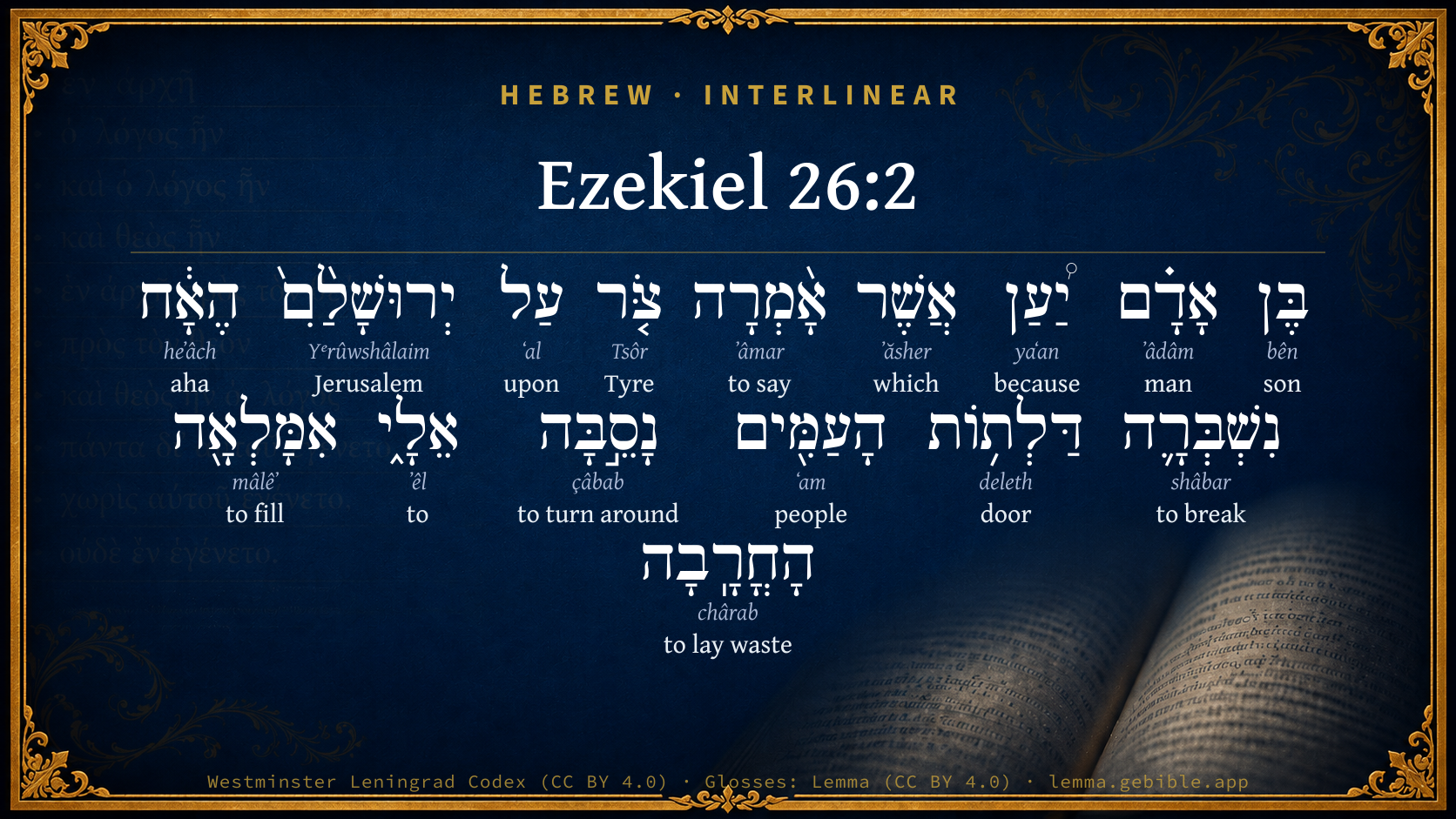
Ezekiel 26:2

Hebrew (Westminster Leningrad Codex) Ezekiel 26:2 appears in the Hebrew Old Testament. The text above is from the Westminster Leningrad Codex. Each word links to its Strong’s number, a concise gloss, and parsing drawn from the Open Scriptures Hebrew Bible morphology. Click any word for its full Brown-Driver-Briggs (BDB) entry.
Download image
Cite this verse

Ezekiel 26:2 (World English Bible). Public Domain. Lemma interlinear Bible study tool, https://lemma.gebible.app/v/ezekiel/26/2.

Show BibTeX & RIS
BibTeX
RIS
English Translation
Son of man, because Tyre has said against Jerusalem, Aha, she is broken: the gate of the peoples; she is turned to me; I shall be replenished, now that she is laid waste:
World English Bible · Public Domain
Download a study sheet

One document with this verse’s original text, its word-by-word gloss line, the meaning frame, cross-references with their text, attributed commentary, and full source and license credits — printable, and it pastes into notes with its structure intact.

This verse Autodidact and up

Study sheet (.html) Plain text (.txt)

A passage Seminary Student

Up to 50 verses in one chapter. A passage sheet keeps up to 6 commentary sources and 12 cross-references per verse, in the order this page ranks them, and says so on the sheet whenever that leaves anything out. Ask for a single verse and you get the Autodidact verse sheet above.

Everything on this page stays free to read, with no account — the sheet is a download of what is already on screen, not access to it.

Want to remove ads? Support Godless Engineer
Compare translations 3

The same verse in 3 English versions, stacked beneath the original-language interlinear above. Click any original word for its lexicon entry.

Each is an independent rendering of the whole verse — the interlinear is not word-aligned to these translations.

Highlighted words mark where these versions differ — a whole-verse word diff, not a word-by-word alignment.

  • World English Bible Public Domain
    Son of man, because Tyre has said against Jerusalem, Aha, she is broken: the gate of the peoples; she is turned to me; I shall be replenished, now that she is laid waste:
  • King James Version Public Domain
    Son of man, because that Tyrus hath said against Jerusalem, Aha, she is broken that was the gates of the people: she is turned unto me: I shall be replenished, now she is laid waste:
  • unfoldingWord Literal Text CC BY-SA 4.0
    “Son of man, because Tyre has said against Jerusalem, ‘Aha! The gates of the people are broken! She has turned to me; I will be filled up because she is ruined.’

unfoldingWord Literal Text — © unfoldingWord, licensed CC BY-SA 4.0. Word-aligned USFM3 via Door43 (git.door43.org/unfoldingWord/en_ult).

Versions to compare (up to 4)

3 of 4 selected

Show all 18 translations

Every available English version of this verse, each an independent rendering of the whole verse.

  • World English Bible Public Domain
    Son of man, because Tyre has said against Jerusalem, Aha, she is broken: the gate of the peoples; she is turned to me; I shall be replenished, now that she is laid waste:
  • Berean Standard Bible Public Domain
    “Son of man, because Tyre has said of Jerusalem, ‘Aha! The gate to the nations is broken; it has swung open to me; now that she lies in ruins I will be filled,’
  • Majority Standard Bible Public Domain
    “Son of man, because Tyre has said of Jerusalem, ‘Aha! The gate to the nations is broken; it has swung open to me; now that she lies in ruins I will be filled,’
  • King James Version Public Domain
    Son of man, because that Tyrus hath said against Jerusalem, Aha, she is broken that was the gates of the people: she is turned unto me: I shall be replenished, now she is laid waste:
  • American Standard Version (1901) Public Domain
    Son of man, because that Tyre hath said against Jerusalem, Aha, she is broken `that was' the gate of the peoples; she is turned unto me; I shall be replenished, now that she is laid waste:
  • Revised Version (1885) Public Domain
    Son of man, because that Tyre hath said against Jerusalem, Aha, she is broken that was the gate of the peoples; she is turned unto me: I shall be replenished, now that she is laid waste:
  • Geneva Bible (1599) Public Domain
    Sonne of man, because that Tyrus hath said against Ierusalem, Aha, the gate of the people is broken: it is turned vnto me: for seeing she is desolate, I shall be replenished,
  • Douay-Rheims (1899) Public Domain
    Son of man, because Tyre hath said of Jerusalem: Aha, the gates of the people are broken, she is turned to me: I shall be filled, now she is laid waste.
  • Young's Literal Translation Public Domain
    Because that Tyre hath said of Jerusalem: Aha, she hath been broken, the doors of the peoples, She hath turned round unto me, I am filled -- she hath been laid waste,
  • Literal Standard Version CC BY-SA 4.0
    Because that Tyre has said of Jerusalem: Aha, she has been broken, || The doors of the peoples, || She has turned around to me, || I am filled—she has been laid waste,
  • Unlocked Literal Bible CC BY-SA 4.0
    “Son of man, because Tyre has said against Jerusalem, 'Aha! The gates of the people are broken! She has turned to me; I will be filled up because she is ruined.'
  • unfoldingWord Literal Text CC BY-SA 4.0
    “Son of man, because Tyre has said against Jerusalem, ‘Aha! The gates of the people are broken! She has turned to me; I will be filled up because she is ruined.’
  • Darby Bible Public Domain
    Son of man, because Tyre hath said against Jerusalem, Aha, she is broken, the gate of the peoples! she is turned unto me: I shall be replenished [now] she is laid waste;
  • World Messianic Bible Public Domain
    “Son of man, because Tyre has said against Jerusalem, ‘Aha! She is broken! She who was the gateway of the peoples has been returned to me. I will be replenished, now that she is laid waste;’
  • Webster's Bible Public Domain
    Son of man, because that Tyre hath said against Jerusalem, Aha, she is broken that was the gates of the people: she is turned to me: I shall be replenished, now she is laid waste:
  • Free Bible Version CC BY-SA 4.0
    “Son of man, because Tyre said about Jerusalem, ‘Oh good! The trade gateway to the nations has been broken—it's swung wide open for me. Now that Jerusalem has been destroyed, I will be rich!’
  • Bible in Basic English Public Domain
    Son of man, because Tyre has said against Jerusalem, Aha, she who was the doorway of the peoples is broken; she is turned over to them; she who was full is made waste;
  • JPS Tanakh (1917) Public Domain
    'Son of man, because that Tyre hath said against Jerusalem: Aha, she is broken that was the gate of the peoples; she is turned unto me; I shall be filled with her that is laid waste;

Literal Standard Version (2020), Covenant Press — licensed CC BY-SA 4.0. Text via the HelloAO Bible API (eBible.org). Unlocked Literal Bible (unfoldingWord) — licensed CC BY-SA 4.0. Text via the HelloAO Bible API (eBible.org). unfoldingWord Literal Text — © unfoldingWord, licensed CC BY-SA 4.0. Word-aligned USFM3 via Door43 (git.door43.org/unfoldingWord/en_ult). Free Bible Version, Dr. Jonathan Gallagher — licensed CC BY-SA 4.0. Text via the HelloAO Bible API (eBible.org).

Word by word

More ways to search: Search by grammar → Find every occurrence → Compare this word →

Practice this passage: Drill this verse → Learn its vocabulary →

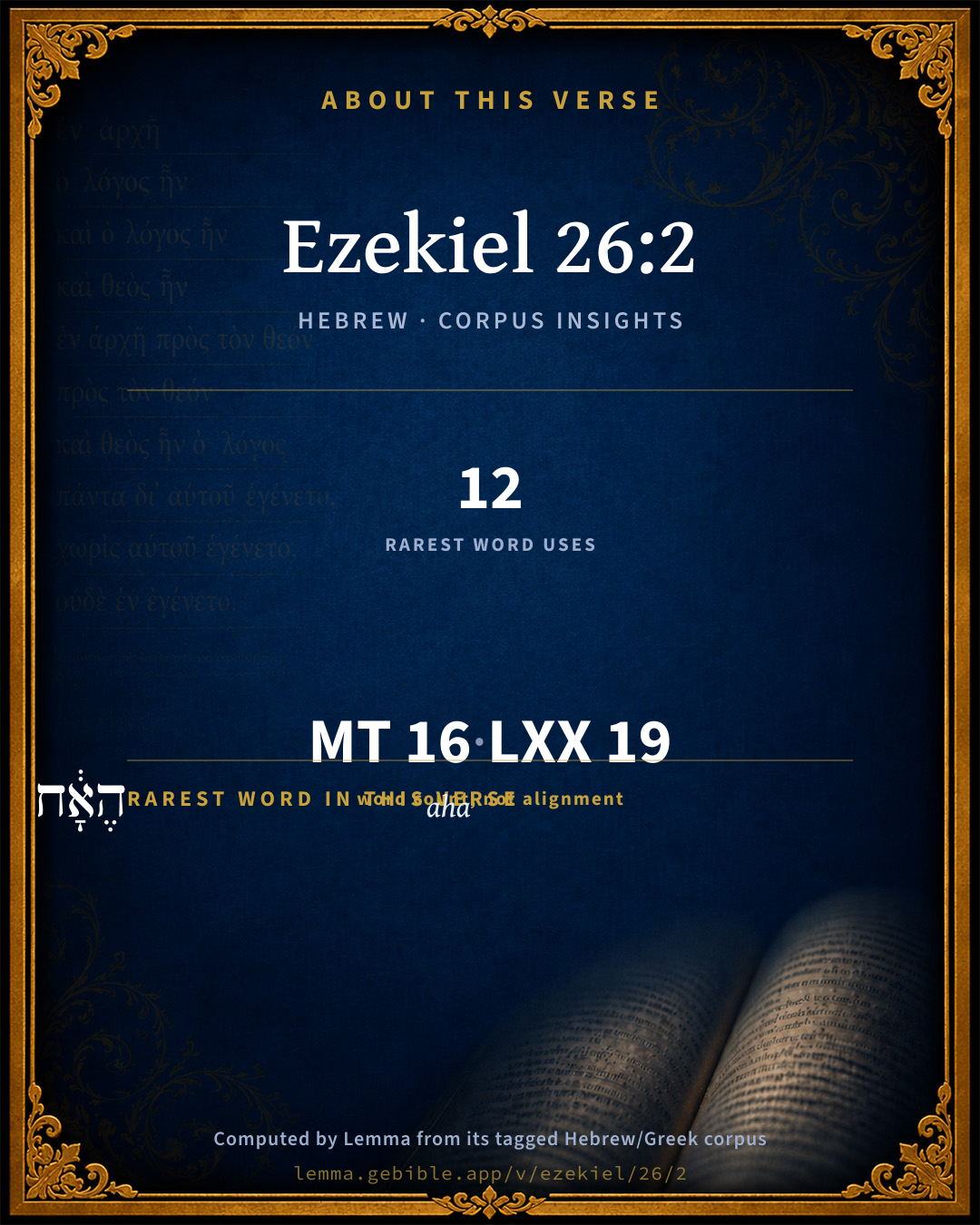
הֶאָ֔ח
heʼâch
H1889
“aha”
Particle, Interjection
Part of Speech
Particle
Type
Interjection
Full BDB Definition

Origin: from H1887 and H253

TWOT: 462

aha!
  1. בֶּן bên H1121 “son of” Noun, Common, Masculine, Singular, Construct
  2. אָדָ֗ם ʼâdâm H120 “man” Noun, Common, Masculine, Singular, Absolute
  3. יַ֠עַן yaʻan H3282 “because” Conjunction
  4. אֲשֶׁר ʼăsher H834 “which” Particle, Relative
  5. אָ֨מְרָה ʼâmar H559 “to say” Verb, Qal, Perfect, 3rd Person, Feminine, Singular
  6. צֹּ֤ר Tsôr H6865 “Tyre” Noun, Proper
  7. עַל ʻal H5921 “upon” Preposition
  8. יְרוּשָׁלִַ֨ם֙ Yᵉrûwshâlaim H3389 “Jerusalem” Noun, Proper
  9. נִשְׁבְּרָ֛ה shâbar H7665 “to break” Verb, Niphal, Perfect, 3rd Person, Feminine, Singular
  10. דַּלְת֥וֹת deleth H1817 “doors of” Noun, Common, Feminine, Plural, Construct
  11. הָעַמִּ֖ים ʻam H5971 “the · peoples” Particle, Definite Article + Noun, Common, Masculine, Plural, Absolute
  12. נָסֵ֣בָּה çâbab H5437 “to turn around” Verb, Niphal, Perfect, 3rd Person, Feminine, Singular
  13. אֵלָ֑י ʼêl H413 “to · me” Preposition + Suffix, Personal, 1st Person, Common, Singular
  14. אִמָּלְאָ֖ה mâlêʼ H4390 “to fill” Verb, Niphal, Cohortative, 1st Person, Common, Singular
  15. הָחֳרָֽבָה chârab H2717 “to lay waste” Verb, Hophal, Perfect, 3rd Person, Feminine, Singular

About this verse

These counts appear in no published source. They are computed here, from the morphology-tagged text and Lemma’s own curated glosses. What Lemma adds →

16
words
16
distinct lemmas
Prophets
section

Notable vocabulary

The rarest word here is הֶאָ֔ח aha H1889 — appearing just 12 times in the whole Hebrew Bible.

Shared distinctive vocabulary

הֶאָ֔ח aha H1889 occurs in 9 verses of the Hebrew Bible. Also found in:

Grammatical profile

  • 5 verbs
  • 6 nouns
  • 2 prepositions
  • 1 conjunction
  • 2 particles

Verb forms

  • אָ֨מְרָה Qal · Perfect
  • נִשְׁבְּרָ֛ה Niphal · Perfect
  • נָסֵ֣בָּה Niphal · Perfect
  • אִמָּלְאָ֖ה Niphal · Cohortative
  • הָחֳרָֽבָה Hophal · Perfect

Hebrew & Septuagint length

In English translation the verse runs 33 words from the Hebrew and 29 from the Septuagint (LXX English) — closely comparable.

A rough comparison of the two English renderings, which tokenize alike — not a word-level alignment.

Word counts can differ between the Hebrew and the Greek without any difference in meaning — e.g. the Hebrew direct-object marker אֵת has no separate Greek word, and Greek often adds the article ὁ.

In the original languages it is 16 Hebrew tokens and 19 Greek tokens — but the two are counted differently (Hebrew bundles its prefixes and suffixes into one token; the Greek is in lemma form), so that isn’t a like-for-like length.

Cross-references

22

Topical passages linked to Ezekiel 26:2 in the Treasury of Scripture Knowledge — connected by theme and wording, ordered by reader-vote popularity; previews shown in the World English Bible.

  • Isaiah 23:1–18 The burden of Tyre. Howl, you ships of Tarshish; for it is laid waste, so that there is no house, no entering in: from the land of Kittim it is revealed to them.
  • Jeremiah 25:22 and all the kings of Tyre, and all the kings of Sidon, and the kings of the isle which is beyond the sea;
  • Ezekiel 36:2 Thus says the Lord Yahweh: Because the enemy has said against you, Aha! and, The ancient high places are ours in possession;
  • Joel 3:4 "Yes, and what are you to me, Tyre, and Sidon, And all the regions of Philistia? Will you repay me? And if you repay me, I will swiftly and speedily return your repayment on your own head.
  • Joshua 19:29 and the border turned to Ramah, and to the fortified city of Tyre; and the border turned to Hosah; and the goings out of it were at the sea by the region of Achzib;
  • 2 Samuel 5:11 Hiram king of Tyre sent messengers to David, and cedar trees, and carpenters, and masons; and they built David a house.
  • Psalms 35:21 Yes, they opened their mouth wide against me. They said, "Aha! Aha! Our eye has seen it!"
  • Psalms 40:15 Let them be desolate by reason of their shame that tell me, "Aha! Aha!"
  • Psalms 70:3 Let them be turned because of their shame Who say, "Aha! Aha!"
  • Psalms 83:2–4 For, behold, your enemies are stirred up. Those who hate you have lifted up their heads.
  • Psalms 83:7 Gebal, Ammon, and Amalek; Philistia with the inhabitants of Tyre;
  • Jeremiah 27:3 and send them to the king of Edom, and to the king of Moab, and to the king of the children of Ammon, and to the king of Tyre, and to the king of Sidon, by the hand of the messengers who come to Jerusalem to Zedekiah king of Judah;
  • Jeremiah 47:4 because of the day that comes to destroy all the Philistines, to cut off from Tyre and Sidon every helper who remains: for Yahweh will destroy the Philistines, the remnant of the isle of Caphtor.
  • Jeremiah 49:1 Of the children of Ammon. Thus says Yahweh: Has Israel no sons? has he no heir? why then does Malcam possess Gad, and his people well in the cities of it?
  • Lamentations 1:1 How does the city sit solitary, that was full of people! She has become as a widow, who was great among the nations! She who was a princess among the provinces is become tributary!
  • Ezekiel 25:2–3 Son of man, set your face toward the children of Ammon, and prophesy against them:
  • Ezekiel 25:6 For thus says the Lord Yahweh: Because you have clapped your hands, and stamped with the feet, and rejoiced with all the despite of your soul against the land of Israel;
  • Ezekiel 25:10 to the children of the east, [to go] against the children of Ammon; and I will give them for a possession, that the children of Ammon may not be remembered among the nations.
  • Ezekiel 27:1–28 The word of Yahweh came again to me, saying,
  • Amos 1:9–10 Thus says Yahweh: "For three transgressions of Tyre, yes, for four, I will not turn away its punishment; Because they delivered up the whole community to Edom, And didn't remember the brotherly covenant;
  • Zechariah 9:2–4 And Hamath, also, which borders on it; Tyre and Sidon, because they are very wise.
  • Acts 2:5–10 Now there were dwelling in Jerusalem Jews, devout men, from every nation under the sky.

Cross-references courtesy of OpenBible.info (CC BY 4.0).

Hebrew and Greek witnesses Masoretic Hebrew ↔ Greek Septuagint

The same verse in the two great witnesses to the Old Testament, shown verse-for-verse.

These are two independent witnesses, not word-aligned to each other, and the Septuagint is shown in lemma (dictionary) form.

Hebrew Ezekiel 26:2 Masoretic · Westminster Leningrad Codex

בֶּן אָדָ֗ם יַ֠עַן אֲשֶׁר אָ֨מְרָה צֹּ֤ר עַל יְרוּשָׁלִַ֨ם֙ הֶאָ֔ח נִשְׁבְּרָ֛ה דַּלְת֥וֹת הָעַמִּ֖ים נָסֵ֣בָּה אֵלָ֑י אִמָּלְאָ֖ה הָחֳרָֽבָה

Son of man, because Tyre has said against Jerusalem, Aha, she is broken: the gate of the peoples; she is turned to me; I shall be replenished, now that she is laid waste:

World English Bible · Public Domain

Greek LXX Ezekiel 26:2 Septuagint · lemma form

υἱός ἄνθρωπος ἀντί ὅς εἶπον σορ ἐπί ἰερουσαλήμ εὖγε συντρίβω ἀποὀλλύω ὁ ἔθνος ἐπιστρέφω πρός ἐγώ ὁ πλήρης ἐρημόω

Son of man, because Sor has said against Jerusalem, Aha, she is crushed: the nations are destroyed: she is turned to me: she that was full is made desolate:

LXX2012 (modern English Septuagint) · Public Domain

Hebrew: Westminster Leningrad Codex (CC BY 4.0). Greek: Septuagint (public domain); English from LXX2012 (modern English Septuagint) (Public Domain). How the Septuagint differs from the Hebrew →

Targum (Aramaic paraphrase)

1

The Targum is the ancient Jewish Aramaic paraphrase of the Hebrew Scriptures — an interpretive translation, not the Hebrew text itself. Onkelos (literal) and Pseudo-Jonathan (expansive) render the Torah, and Jonathan the Prophets. Coverage is partial: where no permissively-licensed English translation exists for a verse, only the Aramaic is shown. This is verse-level text, not a word-by-word alignment to the Hebrew.

  1. Targum Jonathan Prophets (Joshua–Malachi)
    בַּר אָדָם חֲלַף דַאֲמָרֵית צוֹר עַל יְרוּשְׁלֵם חֶדְוָא אִתְבְּרַת דַהֲוָה מְסַפְּקָא סְחוֹרָה לְכָל עַמְמַיָא אִסְתְּחָרַת לְמֵיתֵי לְוָתִי דַהֲוַת מַלְיָא חֲרוּבָת:

    (no public-domain English translation for this verse)

    Targum Jonathan — Aramaic: “Mikraot Gedolot” (public domain). English: “Sefaria Community Translation” (CC0 1.0 (public-domain dedication)); “London "Chaldee Paraphrase," 1871” (public domain). Text via Sefaria.

Commentary

Notes on Ezekiel 26:2 from classic Christian and Jewish commentators (each source and its license shown beneath its notes). The classic Christian expositions comment on the surrounding passage and are grouped to its opening verse, so a note may address several verses; the Jewish commentaries on the Tanakh (Rashi and others) are per-verse, so they appear only where the commentator wrote on this verse.

Lemma curates 59 commentaries, every one of them public domain or Creative Commons licensed, each selected and text-cleaned for this edition rather than reprinted as found. About our sources →

Trapp's Complete Commentary

John Trapp

Eze 26:2 Son of man, because that Tyrus hath said against Jerusalem, Aha, she is broken [that was] the gates of the people: she is turned unto me: I shall be replenished, [now] she is laid waste:

Ver. 2. Because that Tyrus hath said.] Wicked men shall give account for their "hard speeches also," {Jdg 1:15} if not sooner, yet certainly at the last day, with the whole world all on a light fire about their ears. Tyre was the chief city of Phoenicia, built before Solomon’s temple, saith Josephus; {a} and anciently called Sarra, {b} saith Servius, of the Hebrew tsor, which signifieth a rock, because it was built upon a rock. It became the most famous and wealthy market town of the whole East; and having so great a resort to it from all parts, it was a very sinful place; and framing comedies out of the Church’s tragedies, hath this prophecy to champ upon, for a rebater of its pride and petulance.

Aha.] See Eze 25:3.

That was the gates of the people.] Whereinto they entered by troops and caravans, for religion and traffic.

She is turned unto me.] Vide hic ingenia mercatorum. Her ruin shall be my rise. Lo, this is the world; envy and avarice rejoice at, and are fed with other men’s tears and losses; sed gaudent pyraustae gaudium. Contrariwise, God is rich to all that call upon him; {Rom 10:12} and in spiritual things there is no envy, because they may be divided in solidum, in the whole, one may have as much as another, and all alike.

I shall be replenished.] Mercibus et opibus; with wars and wealth. But how long will it hold?

{a} Antiq., lib. viii. cap. 2.

{b} Sarrano dormiat ostro. - Virg. Gorg., lib. ii.

John Trapp, A Commentary or Exposition upon All the Books of the Old and New Testament (1647–1656) — public domain. Text from a community e-Sword module.

Joseph Benson's Commentary

Eze 26:2-3. Because that Tyrus hath said, Aha, she is broken, &c. — The meaning seems to be, the city is broken, at whose gates the people entered in; that is, the place is demolished where there used to be a confluence of people from all parts, especially at the solemn festivals. She is turned unto me, I shall be replenished — Tyre rejoiced at the fall of Jerusalem, because she expected her trade would be increased by it in becoming the mart for the commodities which, while Jerusalem stood, were bought and sold there. To which may be added, that when Jerusalem was taken, the spoil of the city was carried thither for sale, and several of the inhabitants who were made captives, were there sold as slaves. Therefore, behold, I am, against thee, O Tyrus — The providence of God had greatly favoured Tyre: it was a pleasant and wealthy city, and might have continued so if its inhabitants had sympathized with Jerusalem in her calamities; but when, instead of that, they took pleasure in those calamities, and rejoiced at the fall of that neighbouring city, because of the gain which they thought would thereby accrue to them, they provoked the wrath of God against themselves, for he cannot but abhor the conduct of all such as take pleasure in the calamities of others. I will cause many nations to come up against thee, &c. — The Chaldeans with their confederates might be very properly called many nations, as, without doubt, the army of Nebuchadnezzar, whose dominions were very extensive, was made up of the people of various nations. As the sea causeth his waves to come up — “They shall be as loud, as numerous, as irresistible, as the waves of the sea. This is one of the beautiful and expressive images which occur in the magnificent prophecy here recorded.” — Bishop Newcome. Great and victorious armies are described in other places of Scripture under the figure of an inundation carrying all before it.

Joseph Benson's Commentary on the Old and New Testaments (1811–1818) — public domain. Text from a community e-Sword module.

Keil & Delitzsch

C. F. Keil & F. Delitzsch

Tyre shall be broken and utterly destroyed

Eze 26:2. Son of man, because Tyre saith concerning Jerusalem, "Aha, the door of the nations is broken; it turneth to me; I shall become full; she is laid waste;" Eze 26:3. Therefore thus saith the Lord Jehovah, Behold, I will come upon thee, O Tyre, and will bring up against thee many nations, as the sea bringing up its waves. Eze 26:4. They will destroy the walls of Tyre, and throw down her towers; and I will sweep away her dust from her, and make her a bare rock. Eze 26:5. She shall become a place for the spreading of nets in the midst of the sea, for I have spoken it, is the saying of the Lord Jehovah; and she shall become booty for the nations. Eze 26:6. And her daughters which are in the land shall be slain with the sword; and they shall learn that I am Jehovah. - Tyre, as in the prophecy of Isaiah (Ezekiel 23), is not the city of that name upon the mainland, ἡ πάλαι Τύρος or Παλαίτυρος, Old Tyre, which was taken by Shalmaneser and destroyed by Alexander (as Perizon., Marsh, Vitringa, J. D. Michaelis, and Eichhorn supposed), but Insular Tyre, which was three-quarters of a mile farther north, and only 1200 paces from the land, being built upon a small island, and separated from the mainland by a strait of no great depth (vid., Movers, Phoenizier, II p. 288ff.). This Insular Tyre had successfully resisted the Assyrians (Josephus, Antt. ix. 14. 2), and was at that time the market of the nations; and in Ezekiel's day it had reached the summit of its greatness as mistress of the sea and the centre of the commerce of the world. That it is against this Tyre that our prophecy is chiefly directed, is evident from Eze 26:5 and Eze 26:14, according to which Tyre is to become a bare rock in the midst of the sea, and from the allusion to the daughter cities, בּשּׂדה, in the field, i.e., on the mainland (in Eze 26:6), as contrasted with the position occupied by Tyre upon a rocky island in the sea; and, lastly, from the description given in Ezekiel 27 of the maritime trade of Tyre with all nations, to which Old Tyre never attained, inasmuch as it possessed no harbour (vid., Movers, l.c. p. 176). This may easily be reconciled with such passages as Eze 26:6, Eze 26:8, and Ezekiel 27, 28, in which reference is also made to the continental Tyre, and the conquest of Tyre is depicted as the conquest of a land-city (see the exposition of these verses). - The threat against Tyre commences, as in the case of the nations threatened in Ezekiel 25, with a brief description of its sin. Tyre gave expression to its joy at the fall of Jerusalem, because it hoped to derive profit therefrom through the extension of its commerce and increase of its wealth. Different explanations have been given of the meaning of the words put into the mouth of Tyre. "The door of the nations is broken in pieces." The plural דּלתות indicates the folding doors which formed the gate, and are mentioned in its stead. Jerusalem is the door of the nations, and is so called according to the current opinion of expositors, because it was the centre of the commerce of the nations, i.e., as a place of trade. But nothing is known to warrant the idea that Jerusalem was ever able to enter into rivalry with Tyre as a commercial city. The importance of Jerusalem with regard to other nations was to be found, not in its commerce, nor in the favourable situation which it occupied for trade, in support of which Hvernick refers to Herodotus, iii. 5, and Hitzig to Eze 23:40-41, but in its sanctuary, or the sacred calling which it had received for the whole world of nations. Kliefoth has therefore decided in favour of the following view: That Jerusalem is called a gate of the nations, not because it had hitherto been open to the nations for free and manifold intercourse, but for the very opposite reason, namely, because the gate of Jerusalem had hitherto been closed and barred against the nations, but was now broken in pieces through the destruction of the city, and thereby opened to the nations. Consequently the nations, and notably Tyre, would be able to enter now; and from this fact the Tyrians hoped to derive advantage, so far as their commercial interests were concerned. But this view is not in harmony with the text. Although a gate is opened by being broken in pieces, and one may force an entrance into a house by breaking the door (Gen 19:9), yet the expression "door of the nations" cannot signify a door which bars all entrance on the part of the nations, inasmuch as doors and gates are not made to secure houses and cities against the forcible entrance of men and nations, but to render it possible for them to go out and in. Moreover, the supposition that "door of the nations" is equivalent to shutting against the nations, is not in harmony with the words נסבּא אלי which follow. The expression "it has turned to me," or it is turned to me, has no meaning unless it signifies that through the breaking of the door the stream of the nations would turn away from Jerusalem to Tyre, and therefore that hitherto the nations had turned to Jerusalem. נסבּה is the 3rd pers. perf. Niphal of סבב, for נסבּה , formed after the analogy of נמס, etc. The missing subject to נסבּה is to be found ad sensum in דּלתות העמּים. It is not the door itself, but the entrance and streaming in of the nations, which had previously been directed towards Jerusalem, and would now turn to Tyre. There is no necessity, therefore, for Hitzig's conjecture, that אמּלאה should be altered into מלאהּ, and the latter taken as the subject.

Consequently we must understand the words of the Tyrians as signifying that they had regarded the drawing of the nations to Jerusalem, i.e., the force of attraction which Jerusalem had hitherto exerted upon the nations, as the seat of the divine revelation of mercy, or of the law and judgment of the Lord, as interfering with their endeavour to draw all nations to themselves and gain them over to their purposes, and that they rejoiced at the destruction of Jerusalem, because they hoped that henceforth they would be able to attract the nations to themselves and enrich themselves with their possessions. This does not require that we should accredit the Tyrians with any such insight into the spiritual calling of Jerusalem as would lie beyond their heathen point of view. The simple circumstance, that the position occupied by Jerusalem in relation to the world apparently interfered with the mercantile interests of the Tyrians, would be quite sufficient to excite a malignant pleasure at the fall of the city of God, as the worship of God and the worship of Mammon are irreconcilably opposed. The source from which the envy and the enmity manifesting itself in this malicious pleasure took their rise, is indicated in the last words: "I shall fill myself, she (Jerusalem) is laid waste," which Jerome has correctly linked together thus: quia illa deserta est, idcirco ego implebor. המּלא, to be filled with merchandise and wealth, as in Eze 27:25. On account of this disposition toward the kingdom of God, which led Tyre to expect an increase of power and wealth from its destruction, the Lord God would smite it with ruin and annihilation. הנני עליך, behold, I will come upon thee, as in Eze 13:8; Jer 50:31; Nah 3:5. God will lead a powerful army against Tyre, which shall destroy its walls and towers. Instead of the army, "many nations" are mentioned, because Tyre is hoping to attract more nations to itself in consequence of the destruction of Jerusalem. This hope is to be fulfilled, though in a different sense from that which Tyre intended. The comparison of the advancing army to the advancing waves of the sea is very significant when the situation of Tyre is considered. היּם is the subject to כּהעלות, and the Hiphil is construed with ל instead of the accusative (compare Ewald, 292c with 277e). According to Arrian, ii. 18. 3, and Curtius, iv. 2. 9, 12, and 3. 13, Insular Tyre was fortified all round with lofty walls and towers, which were certainly in existence as early as Nebuchadnezzar's time. Even the dust of the demolished buildings (עפרהּ) God would sweep away (סחיתי, ἁπ. λεγ., with a play upon שׁחתוּ), so that the city, i.e., the site on which it had stood, would become a bare and barren rock (צחיח סלע, as in Eze 24:7), a place where fishermen would spread out their nets to dry. "Her daughters" also, that is to say, the towns dependent upon Tyre, "on the field," i.e., the open country - in other words, their inhabitants - would be slain with the sword.

In Eze 26:7-14 the threat is carried still further. - Eze 26:7. For thus saith the Lord Jehovah, Behold, I will bring against Tyre Nebuchadnezzar, the king of Babylon, from the north, the king of kings, with horses, and chariots, and horsemen, and a multitude of much people. Eze 26:8. Thy daughters in the field he will slay with the sword, and he will erect siege-towers against thee, and throw up a rampart against thee, and set up shields against thee, Eze 26:9. And direct his battering-rams against thy walls, and throw down thy towers with his swords. Eze 26:10. From the multitude of his horses their dust will cover thee; from the noise of the horsemen, wheels, and chariots, thy walls will shake when he shall enter into thy gates, as they enter a city broken open. Eze 26:11. With the hoofs of his horses he will tread down all thy streets; thy people he will slay with the sword, and thy glorious pillars will fall to the ground. Eze 26:12. They will make booty of thy possessions, and plunder thy merchandise, destroy thy walls, and throw down thy splendid mansions, and sink thy stones, thy wood, and thy dust in the water. Eze 26:13. I will put an end to the sound of thy songs, and the music of thy harps shall be heard no more. Eze 26:14. I will make thee a bare rock; thou shalt be a place for the spreading of nets, and be built no more; for I Jehovah have spoken it, is the saying of the Lord Jehovah. - Nebuchadnezzar, the great king of Babylon, - this is the meaning of the rhetorical description in these verses, - will come with a powerful army (Eze 26:7), smite with the sword the inland cities dependent upon Tyre. (Eze 26:8, compare Eze 26:6), then commence the siege of Tyre, destroy its walls and towers (Eze 26:8 and Eze 26:9), enter with his army the city in which breaches have been made, put the inhabitants to death (Eze 26:10 and Eze 26:11), plunder the treasures, destroy walls and buildings, and cast the ruins into the sea (Eze 26:12). Nebuchadrezzar, or Nebuchadnezzar (for the name see the comm. on Kg2 24:10, is called king of kings, as the supreme ruler of the Babylonian empire, because the kings of conquered provinces and lands were subject to him as vassals (see the comm. on Isa 10:8).

His army consists of war-chariots, and cavalry, and a great multitude of infantry. קהל are co-ordinate, so far as the rhetorical style is concerned; but in reality עם־רב is subordinate to קהל , as in Eze 23:24, inasmuch as the קהל consisted of עם־רב. On the siege-works mentioned in Eze 26:8, see the comm. on Eze 4:2. הקים צנּה signifies the construction of a roof with shields, by which the besiegers were accustomed to defend themselves from the missiles of the defenders of the city wall while pursing their labours. Herodotus repeatedly mentions such shield-roofs as used by the Persians (ix. 61. 99, 102), though, according to Layard, they are not to be found upon the Assyrian monuments (see the comm. on Nah 2:6). There is no doubt that מחי קב signifies the battering-ram, called כּר in Eze 21:27, though the meaning of the words is disputed. מחי , literally, thrusting or smiting. קבלו, from קבל, to be pointed either קבלּו or קבלּו (the form קבלּו adopted by v. d. Hooght and J. H. Michaelis is opposed to the grammatical rules), has been explained by Gesenius and others as signifying res opposita, that which is opposite; hence מחי קבלו, the thrusting or demolishing of that which stands opposite. In the opinion of others, קבל is an instrument employed in besieging; but there is nothing in the usage of the language to sustain either this explanation or that adopted by Hvernick, "destruction of his defence." הרבותיו, his swords, used figuratively for his weapons or instruments of war, "his irons," as Ewald has very aptly rendered it. The description in Eze 26:10 is hyperbolical. The number of horses is so great, that on their entering the city they cover it with dust, and the walls shake with the noise of the horsemen and chariots. 'כּמבואי עיר מב, literally, as the marchings into a broken city, i.e., a city taken by storm, generally are. The simile may be explained from the peculiar situation of Insular Tyre. It means that the enemy will enter it as they march into a land-fortress into which a breach has been made by force. The words presuppose that the besieger has made a road to the city by throwing up an embankment or dam. מצּבות עזּך, the memorial pillars of thy might, and the pillars dedicated to Baal, two of which are mentioned by Herodotus (ii. 44) as standing in the temple of Hercules at Tyre, one of gold, the other of emerald; not images of gods, but pillars, as symbols of Baal. These sink or fall to the ground before the overwhelming might of the foe (compare Isa 46:1; Isa 21:9, and Sa1 5:3). After the slaughter of the inhabitants and the fall of the gods, the plundering of the treasures begins, and then follows the destruction of the city. בּתּי המדּה are not pleasure-houses ("pleasure-towers, or garden-houses of the wealthy merchants," as Ewald supposes), for there was not space enough upon the island for gardens (Strabo, xvi. 2. 23), but the lofty, magnificent houses of the city, the palaces mentioned in Isa 23:13. Yea, the whole city shall be destroyed, and that so completely that they will sweep stones, wood, and rubbish into the sea. - Thus will the Lord put an end to the exultation and rejoicing in Tyre (Eze 26:13; compare Isa 14:11 and Amo 5:23). - The picture of the destruction of this powerful city closes with the repetition of the thought from Eze 26:5, that Tyre shall be turned into a bare rock, and shall never be built again.

Keil & Delitzsch — Biblical Commentary on the Old Testament (1861–1891) — public domain (CC PDM 1.0). Text via the HelloAO Bible API. (Old Testament only.)

Tyndale Open Study Notes

Tyndale Open Resources

26:2 Like its neighbors, Tyre rejoiced over the fall of Jerusalem, which eliminated a rival trading center and potentially opened up new trade routes and markets for Tyre.

Tyndale Open Study Notes — © Tyndale Open Resources, licensed CC BY-SA 4.0. Text via the HelloAO Bible API.

Geneva Bible (1599)

Geneva Bible translators

That is, the famous city Jerusalem, whereunto all people resorted.

My riches and fame shall increase: thus the wicked rejoice at their fall by whom they may have any profit or advantage.

Geneva Bible (1599) marginal notes — public domain. Text via Bolls.life.

Jamieson, Fausset & Brown

Robert Jamieson, A. R. Fausset & David Brown

Tyre-- (Jos 19:29; Sa2 24:7), literally, meaning "the rock-city," Zor; a name applying to the island Tyre, called New Tyre, rather than Old Tyre on the mainland. They were half a mile apart. "New Tyre," a century and a half before the fall of Jerusalem, had successfully resisted Shalmaneser of Assyria, for five years besieging it (MENANDER, from the Tyrian archives, quoted by JOSEPHUS, Antiquities, 9.14. 2). It was the stronger and more important of the two cities, and is the one chiefly, though not exclusively, here meant. Tyre was originally a colony of Zidon. Nebuchadnezzar's siege of it lasted thirteen years (Eze 29:18; Isa. 23:1-18). Though no profane author mentions his having succeeded in the siege, JEROME states he read the fact in Assyrian histories.

Aha!--exultation over a fallen rival (Psa 35:21, Psa 35:25).

she . . . that was the gates--that is, the single gate composed of two folding doors. Hence the verb is singular. "Gates" were the place of resort for traffic and public business: so here it expresses a mart of commerce frequented by merchants. Tyre regards Jerusalem not as an open enemy, for her territory being the narrow, long strip of land north of Philistia, between Mount Lebanon and the sea, her interest was to cultivate friendly relations with the Jews, on whom she was dependent for corn (Eze 27:17; Kg1 5:9; Act 12:20). But Jerusalem had intercepted some of the inland traffic which she wished to monopolize to herself; so, in her intensely selfish worldly-mindedness, she exulted heartlessly over the fall of Jerusalem as her own gain. Hence she incurred the wrath of God as pre-eminently the world's representative in its ambition, selfishness, and pride, in defiance of the will of God (Isa 23:9).

she is turned unto me--that is, the mart of corn, wine, oil, balsam, &c., which she once was, is transferred to me. The caravans from Palmyra, Petra, and the East will no longer be intercepted by the market ("the gates") of Jerusalem, but will come to me.

Jamieson, Fausset & Brown — Commentary Critical and Explanatory on the Whole Bible (1871) — public domain (CC PDM 1.0). Text via the HelloAO Bible API.

Adam Clarke's Commentary

Verse 2. Tyrus hath said] From this it would appear that Jerusalem had been taken, which was on the fourth month of this year; but it is possible that the prophet speaks of the event beforehand.

She is broken that was the gates of the people] Jerusalem, a general emporium.

I shall be replenished] The merchandise that went to Jerusalem will come to me, (to Tyre.)

Adam Clarke's Commentary on the Bible (1810–1826) — public domain. Text from a community e-Sword/MySword module.

Ellicott's Commentary for English Readers

(2) She is broken that was the gates of the people.—“Gates” is in the plural simply because the word originally means a leaf of a door or gate, and hence the two leaves mean the gate; accordingly the sense would be better conveyed by using the singular in English. On the other hand, “people, both here and in Eze_27:3, is intentionally in the plural =the nations. By omitting all the words in italics in this verse a better idea is obtained of the exultation of Tyre over the fall of Jerusalem.

This exultation is described as of a purely selfish and commercial character, and shows nothing of the spitefulness and religious animosity of the nations mentioned in the previous chapter. Jerusalem had been made in the days of Solomon the great commercial emporium of the inland trade from Arabia, and even from India, as well as the negotiator of products between Egypt and the Hittites and other northern nations. Doubtless something of this commercial importance still remained to Jerusalem in her decay, of which we have already seen evidence in Ezekiel 16; but however this may have been, a considerable city, situated as Jerusalem was, must of necessity have been the centre of many of those transactions between the surrounding nations which Tyre would gladly have monopolised for herself. Hence her exultation: “Jerusalem being destroyed, all that gave her importance among the nations must come to increase my prosperity.”

A Bible Commentary for English Readers, edited by Charles John Ellicott (1878–1897) — public domain. Text from a community e-Sword module.

The Cambridge Bible for Schools and Colleges

gen. ed. J. J. S. Perowne

2. The sin of Tyre: her rejoicing over the calamity of Judah, in the hopes that it will further her interests.

Aha, she is broken] Rather: aha! the gate (door) of the peoples is broken, it is turned unto me. (“Door” is plur. having leaves, or by attraction of peoples.) The idea appears to be that Jerusalem or Judah was a door barring the entrance to Tyre, which being broken and turned or opened towards Tyre the nations would stream with their commerce towards her. The kingdom of Judah lay across the great commercial routes from the south, and no doubt intercepted much of the merchandise that otherwise would have reached Tyre, and probably exacted custom on that which was allowed to pass. The natural sense of “door of the nations” would be door into the nations (Nah_3:13; Zec_11:1), and the idea would be that the door was now opened for Tyre to enter. The sense remains the same: that which stood between Tyre and the nations is removed.

2. Prophecy is always ideal in its delineations. Its threats and promises are alike hyperbolical whether they concern Israel or the nations. And in regard to fulfilment the same general principles must be applied to all prophecies, those of redemption and those of calamity alike. The former are not fulfilled at once, nor at all literally, neither need we expect immediate or literal fulfilment of the latter. At the same time in regard to both it must be maintained that the prophets imagined the fulfilment as they describe it. This, however, is part of their idealism; the moral element is always the main thing in their prophecies. What they predict is the exhibition of Jehovah’s moral rule of the world; the form in which they clothe this exhibition may not be quite that given in history.

The Cambridge Bible for Schools and Colleges (gen. ed. J. J. S. Perowne; Cambridge University Press, 1878–1918) — public domain. Text from a community e-Sword module.

John Gill's Exposition

Son of man, because that Tyrus hath said against Jerusalem, aha,.... As rejoicing at her destruction, and insulting over her in it; which was barbarous and inhuman, and resented by the Lord:

she is broken that was the gates of the people; through whose gates the people went in and out in great numbers; a city to which there was very popular, not only for religion, from all parts, at their solemn feasts, but for merchandise from several parts of the world; and was now full of people before its destruction, the inhabitants of Judea having fled thither for safety, upon the invasion made by the king of Babylon; but now the city was broken up, as it is said it was, by the Chaldean army, Jer 52:7, its gates and walls were broken down, and lay in a ruinous condition. The Targum is,

"she is broken down that afforded merchandise to all people.''

She is turned unto me; either the inhabitants of Jerusalem, which escaped and fled to Tyre for refuge; or the spoil taken out of it, which was carried there to be sold; and even the captives themselves to be sold for slaves, which was one part of the merchandise of Tyre; see Eze 27:3, or the business, trade, and merchandise carried on in Jerusalem, were brought to Tyre upon its destruction; so Jarchi and Kimchi. The Targum is,

"she is turned to come unto me;''

which favours the first sense; all may be intended.

I shall be replenished, now she is laid waste; or, "I shall be filled" (b); with inhabitants, riches, and wealth, with merchants and merchandise, Jerusalem her rival being destroyed; this was what gave her joy; and is a common thing for persons to rejoice at the fall or death of those of the same trade with them; hoping for an increase of theirs by means of it, which yet is sinful.

(b) "implebor", Cocceius, Starckius.

John Gill's Exposition of the Whole Bible (1746–1763) — public domain (CC PDM 1.0). Text via the HelloAO Bible API.

Albert Barnes' Notes on the Bible

Gates - i. e., one gate of two leaves.

The people - Or, the peoples (and in Eze 27:3), the plural expressing the fact that many peoples passed through Jerusalem, as the central place on the highway of commerce, e. g., in the reign of Solomon. This was viewed with jealousy by Tyre, who owed her greatness to the same cause, and in the true spirit of mercantile competition exulted in the thought that the trade of Jerusalem would be diverted into her markets. Render it: Aha! She is broken - the gate of the peoples! She is turned unto me. I shall be filled. She is laid waste.

Albert Barnes' Notes on the Bible (1834–1885) — public domain. Text from a community e-Sword/MySword module.

Haydock's Catholic Bible Commentary

Gates: places of resort and commerce. The Jews came to Jerusalem frequently from all parts, which increased her beauty and trade. New Tyre expects that more will come to her.

George Leo Haydock (1774–1849), Haydock's Catholic Family Bible and Commentary, 1859 edition — public domain. Excludes Psalms (Douay-Rheims chapter numbering differs from Protestant) and Deuterocanonical books (Catholic canon only).

Matthew Poole's English Annotations

Tyrus; the city for the people; it is probable it was a universal joy, therefore ascribed to the whole city, built on a rock and island of the same name, not far distant from the continent, a very great traded port and city.

Hath said; either God revealed this to the prophet so soon as these insulting Tyrians spoke it, or else Ezekiel speaks of it prophetically, and as if it were done.

Said against Jerusalem, Aha; showed great joy at the fall of Jerusalem, and triumphed over her.

She is broken by Nebuchadnezzar’s army.

The gates of the people; near to the gates of the cities were usually, the great merchants, and so here Jerusalem is called the great mart of nations and people from all parts resorting to her for trade or religion.

She is turned unto me; trading interest will turn to me, they that did carry merchandise to Jerusalem will now bring it to me.

I shall be replenished; have full trade, my haven full of ships, streets full of buyers and sellers, ships full of wares, houses full of lodgers, and purses full of money.

She is laid waste; she reflected on wasted Jerusalem with joy, which was impious, injurious, and inhuman, to rejoice in the ruin of her neighbour.

Matthew Poole's English Annotations on the Holy Bible (1683–1685) — public domain. Text from a community e-Sword/MySword module.

Whedon's Commentary on the Bible

Daniel D. Whedon

2. Tyrus — Tyre was the chief city of Phoenicia, which was the leading naval power — the Great Britain — of the ancient world. It was but a small country, smaller even than Palestine, but its fame filled the whole earth. Phoenician credit and currency extended “from the coasts of Britain to those of Northwest India and probably to Madagascar… This trade tapped river basins as far apart as those of the Indus, the Euphrates, probably the Zambesi, the Nile, the Rhone, the Guadalquivir” (Smith, Isaiah, i, p. 390). In the eleventh century B.C. an Egyptian official was sent to Phoenicia for cedar wood (Pap. Golenischeff), as were Solomon’s agents one hundred years later. Tradition ascribes the invention of navigation to the Tyrians. Sennacherib (700 B.C.) boasts that he had builded at Nineveh, by Phoenician carpenters, “artful, great ships, according to their home manner,” and ordered as their sailors, prisoners of war, Tyrians, Sidonians, etc. It was during Ezekiel’s lifetime (600 B.C.) that a Phoenician sea captain circumnavigated Africa (Herodotus, 4:42). For fifteen hundred years Phoenicia was the merchant of all nations. Her vast wealth made the mightiest kings of Egypt and Babylon look toward her as a possible prize, but because of her strategic position, unequaled navy, and shrewd diplomacy, she was enabled to maintain for many centuries her practical independence. In the fourteenth century B.C. Abimelki prostrates himself before the Pharaoh and calls Tyre the “handmaid of Egypt;” but the allegiance of Tyre to Egypt was entirely selfish and Egyptian power in Phoenicia was not great. Again and again in the ninth and eighth centuries B.C. the Assyrian king boasts: “I marched up to the great sea of the West. I cleansed my weapons in the great sea. I put tribute upon Damascus, Tyre, Sidon,” etc. But the frequency of these campaigns indicates how superficial were the conquests. On a tablet from Sinjerli, Baal, king of Tyre, is represented as kneeling before Esarhaddon with a ring through his lips attached to a cord in the hands of the great king; but the inscriptions do not even name Tyre as a vassal state, and certainly the picture does not represent the ordinary relations of the king of Tyre with the king of Assyria (McCurdy, ii, p. 345). Phoenicia did not depend for victory upon her soldiers, but upon her gold, and rather than have her commerce interrupted she could well afford to give tribute. She made, of course, political alliances with the states lying between her and her enemies. During the prosperous reigns of David and Solomon, Phoenicia was a warm friend to Israel; but after the division of the kingdom she lost interest in her weak neighbor and “sold” her to the Greeks or the Edomites as her own advantages dictated (Amo_1:9; Joe_3:6). Previous to Assurbanipal (668-626 B.C.) the Assyrians seem to have been content with gifts from the chief cities of Phoenicia, but his successors urged campaign after campaign in the vain attempt to completely subjugate their small but doughty adversary. Nebuchadnezzar was determined to do this, but failed to get from Tyre the treasure that he had anticipated (see Eze_29:18).

She is broken that was the gates of the people — Literally, gate of the peoples. Jerusalem was the gateway opening from Egypt to Babylon and Phoenicia, and she had evidently been getting some of the trade of which Tyro wished the monopoly.

She is turned — Rather, it. The gate of traffic now opens more freely toward Phoenicia since her rival is disposed of.

Daniel D. Whedon (gen. ed.), Commentary on the Old and New Testaments (1874–1909) — public domain. Text from a community e-Sword module.

The Pulpit Commentary

Because that Tyrus, etc. As the nearest great commercial city, the Venice of the ancient world, Tyre, from the days of David. (2Sa_5:11) and Solomon (1Ki_5:1) onward, had been prominent in the eyes of the statesmen and prophets of Judah; and Ezekiel follows in the footsteps of Joe_3:4 Amo_1:9, 10 Isa 23, in dealing with it. The description in Vers. 5 and 14 points, not to the city on the mainland, the old Tyre of Jos_19:29, which had been taken by Shalmaneser and was afterwards destroyed by Alexander the Great, but to the island-city, the new Tyre, which was, at this time, the emporium of the ancient world. The extent of her commerce will meet us in Eze 27. Here, too, as in the case of the nations in Eze 25, Ezekiel"s indignation is roused by the exulting selfishness with which Tyre had looked on the downfall (actual or imminent, as before) of Jerusalem. "Now," her rulers seem to have said, "we shall be the only power in the land of Canaan." Jerusalem, that had been the gate of the peoples, was now broken. The name thus given may imply either

(1) that Jerusalem was regarded as to a considerable extent a commercial city, carrying on much intercourse with the nations with which she was in alliance, (Eze_23:40, Eze_23:41; 1Ki_9:26-28 1Ki_22:48; Isa_2:7 Herod:, 3:5, of Cadytis, i.e. probably Jerusalem) or

(2) that its temple had, under Hezekiah and Josiah, drawn many proselytes from the neighboring nations, as in Psa_87:4-6, and was looking forward to a yet fuller confluence of men of all races, as in the prophecies Mic_4:1, 2 and Isa_2:2, 3 expectations which may well have become known to a city like Tyro, in frequent intercourse with Judah. "Now," the Tyrians might say, "that hope is shattered." I shall be replenished. The interpolated "now" indicates what is, of course, implied, that Tyre expects her prosperity to increase in proportion to the decline and fall of Jerusalem.

Ver. 2 (last clause, "I shall be replenished, now she is laid waste"). An unworthy anticipation.

The destruction of Jerusalem afforded delights to Tyro, because the mercenary Tyrians imagined that they would gain by the loss of the Jewish capital. This was an unworthy anticipation, and the event proved that it was founded on a delusion. Tyro did not ultimately profit by the ruin of Jerusalem.

I IT IS WICKED TO HOPE FOR GAIN THROUGH THE DISTRESS OF OTHERS. Tyre should have sympathized with her old ally in the time of adversity. But her commercial greed bears down all thoughts of friendship and all feelings of commiseration. She only looks at the direful event as an opportunity for enlarging her trade. Nations are guilty of this wickedness when they exult in the downfall and misery of their neighbors, expecting to reap a harvest of gain for themselves. Thus while two peoples are in the agonies of war, a third may be delighted at the opportunity of coining wealth by seizing the ground for commerce which the belligerents have been forced to relinquish. It may come more nearly home to us to see the same greedy spirit in the shopkeeper who inwardly rejoices over the bankruptcy of his rival, believing that now the custom will be all in his own hands. The same miserable, mercantile selfishness is even witnessed in ecclesiastical regions, when one Church takes pleasure in the misfortunes of a neighboring Church, expecting thus to have grist brought to its mill. In this case there is far less excuse, for Christians profess brotherhood, and a true Church exists for the glory of God, not for the pomp and aggrandizement of its members. God is not glorified when one Church fattens on the wreck of another Church.

II THIS UNWORTHY ANTICIPATION IS DOOMED TO ULTIMATE FAILURE. Tyre did not gain by the overthrow of Jerusalem; on the contrary, she was swept away by the same besom of destruction that she had greedily rejoiced to see turned against her ancient ally, We are members one of another. What is hurtful to one part of the body injures the whole body. War brings nothing but loss in the long run. Selfish commerce does not ultimately pay. Greedy competition overreaches itself and reaps a Nemesis of general commercial depression. It is often found that the ruin of one house of business is followed by that of others. A market is injured, and all concerned with it suffer. Selfishness, envy, jealousy, and greed destroy mutual confidence. They introduce a condition in which every man"s hand is against his fellow. This must be one of general disaster, because it is one of general distrust. We do not suffer in the end by being magnanimous. Assuredly these considerations apply with double force to religious communities. The Church that exults in the downfall of its rival cannot truly prosper. Here, indeed, what hurts a member of the body hurts the whole body. Far wiser as well as higher was the spirit of St. Paul, who rejoiced in the preaching of the gospel by all means, even though, in some cases, it involved enmity to himself. (Php_1:18)

HOMILIES BY J.R. THOMSON

The jealousy of Tyre.

It is a singular fact that, in his reproaches and censures directed against the states and tribes by which Israel was surrounded, Ezekiel does not confine himself to a condemnation of their idolatries and their vices and crimes generally, but refers especially to the attitude these peoples had taken towards his own countrymen, their land, and their metropolis. No doubt there was patriotism in this way of looking at matters. But the frequency and evident deliberateness of such references show that it was not mere personal and patriotic feeling which animated Ezekiel. He spoke as a religious teacher and as the prophet of the Lord; and he recognized, as underlying hostility to Israel, hostility to Israel"s God. It is observable that in the powerful and eloquent denunciation of Tyre"s offences, in the awful prediction of Type"s impending fate, which forms so interesting and instructive a portion of this book, Ezekiel puts in the very forefront of his indictment Type"s attitude towards Jerusalem, the Hebrew metropolis. Type"s jealousy of Jerusalem"s historic power, prosperity, and wealth, Tyre"s malicious delight in Jerusalem"s humiliation and fall, are adduced as reasons for the Divine displeasure, and for the execution of the sentence of Divine condemnation. The proud queen of the seas was to be smitten and deposed, not only because of her luxury, pride, and idolatry, but especially because of her jealousy and malevolence towards the beloved and chosen city of Jehovah.

I THE FACT UPON WHICH THIS JEALOUSY WAS BASED, i.e. THE FORMER PROSPERITY OF JERUSALEM. According to the poetical language of the prophet, Jerusalem had been "the gate of the peoples." In the reign of Solomon especially, and to some extent subsequently, the metropolis of the Jewish people had been an emporium of commerce. Its situation in some degree fitted it to be the center of communication between the great Eastern countries, and Egypt on the south, and the Mediterranean and its traffic Westwards. We are not accustomed to think of Jerusalem in this light; but this verse in Ezekiel"s prophecies brings before our minds the unquestionable fact that there was a time when this city was a mart in which the surrounding nations were wont to exchange their produce and their commodities.

II THE REJOICING TO WHICH THIS JEALOUSY LED, i.e. IN THE DOWNFALL OF JERUSALEM. "She is broken," was the exulting exclamation of Type upon beholding the distress of her rival. That Jerusalem deserved her fate there is no room for doubting; yet it was not generous in Type thus to triumph over the misfortunes and calamities of her neighbor. The wealth and prosperity of the Jewish capital was about to end; the days of her glory were over; her streets were to be forsaken; the caravans of the merchants were no more to thread their way through the proud gates of the city. And in this change, in these disasters, Type rejoiced.

III THE HOPE WITH WHICH THIS JEALOUSY WAS ASSOCIATED, i.e. THE EXTENSION OF THE PROSPERITY OF TYRE. The Phoenician city anticipated that she would gain what Jerusalem was about to lose: "I shall be replenished, now that she is laid waste." The greatness, opulence, and renown of Tyre were such that it seems scarcely credible that her prosperity could be affected by anything which could happen to a small and inland capital such as Jerusalem. Yet it is evident that the Tyrian spirit was a spirit of selfishness, exclusiveness, and grasping. Nothing was too great for Tyre"s ambition, nothing too small to be beneath her notice and cupidity.

IV THE MEANNESS WHICH THIS JEALOUSY REVEALED. In what follows Ezekiel displays the pomp, splendor, and magnificence of the great seaport of Phoenicia; it is strange that he should put in the forefront of his address to Tyre this imputation of littleness. There is a reason for this; it may be that the prophet spoke, not only as a patriot who resented Type"s jealousy, but as a religious teacher for whom moral distinctions were all-important, and for whom a moral fault was of more consequence than all material splendor.

V THE DISPLEASURE WHICH THIS JEALOUSY EXCITED IN THE MIND OF THE DIVINE KING AND JUDGE. "I," says God am against thee, O Tyre!" The city which had envied and hated his own Jerusalem, the seat of his worship, and the metropolis of his chosen; the city which was pained by Jerusalem"s prosperity, and which rejoiced in Jerusalem"s fall, incurred the indignation as well as the disapproval of the Most High. For dispositions were revealed discreditable to human hate, ire, and repugnant to Divine purity. Because Tyre was against Jerusalem, the Lord God was against Tyre. T.

Vers. 2-4. The exultation of the world over the Church.

of man, because that Tyrus hath said against Jerusalem, Aha! she is broken that was the gate of the peoples," etc. Type is viewed by the prophet, not merely in its literal aspect, but also in a typical one. "Tyre, in the prophets," says Schroder, "comes into consideration, not in a political respect, but as the representative, the might, of the world"s commerce. Jehovah and mammon are the counterpart to Jerusalem and Tyre." And says Hengstenberg, "Along with Babylon and Egypt, Tyre was then the most glorious concentration of the worldly power. In the queen of the sea, the thought of the vanity of all worldly power was strikingly exemplified. Hand-in-hand with this thought goes, in Ezekiel, that of the indestructibleness of the kingdom of God." If, then, we take Tyre as representing the world with its riches and pomp and power, and Jerusalem the Church, the text gives us as a subject the exultation of the world over the Church. But it behooves us to be clear as to what we are to understand by the world the world that is antagonistic to the Church. It is neither the material world, nor the human world the world of men, nor our worldly or secular occupation. Very admirably has F. W. Robertson, on 1Jn_2:15-17, brought out the meaning of the world which is forbidden to Christians. "Now to define what worldliness is. Remark, first, that it is determined by the spirit of a life, not the objects with which the life is conversant. It is not the " flesh," nor the "eye," nor "life," which are forbidden, but it is the lust of the flesh, and the lust of the eye, and the pride of life.... Look into this a little closer. The lust of the flesh. Here is affection for the outward: pleasure, that which affects the senses only: the flesh, that enjoyment which comes from the emotions of an hour, be it coarse or be it refined. The pleasure of wine or the pleasure of music, so far as it is only a movement of the flesh. Again, the lust of the eye. Here is affection for the transient, for the eye can only gaze on form and color; and these are things that do not last. Once more, the pride of life. Here is affection for the unreal men"s opinion, the estimate which depends upon wealth, rank, circumstances. Worldliness, then, consists in these three things attachment to the outward, attachment to the transitory, attachment to the unreal, in opposition to love for the inward, the eternal, the true; and the one of these affections is necessarily expelled by the other." In this view of worldliness, Type was representative of the world. She gloried in her secure situation, her commercial prosperity, her great riches, etc. We remark that the exultation of the world over the Church

I IS BITTER AND BOASTFUL. "Tyre hath said against Jerusalem, Aha! she is broken that was the gate of the peoples" etc. (Ver. 2). As we have already shown (in our homily on the chapter as a whole), this unseemly triumphing arose from the selfishness which anticipated that the fall of Jerusalem would promote the commercial prosperity of Type. But probably this was not the only reason for the rejoicing of the Tyriana in the ruin of the sacred city. The antagonism between their religion and the religion of the Jews would increase their joy at the downfall of Jerusalem and the destruction of the temple. "Only thirty-four years before the destruction of Jerusalem," says Mr. Twisleton, "commenced the celebrated reformation of Josiah (B.C. 622). This momentous religious revolution (2Ki 22 2Ki 23) fully explains the exultation and malevolence of the Tyrians. In that reformation Josiah had heaped insults on the gods who were the objects of Tyrian veneration and love; he had consumed with fire the sacred vessels used in their worship; he had burnt their images and defiled their high places not excepting even the high place near Jerusalem, which Solomon the friend of Hiram had built to Ashtoreth the queen of heaven, and which for more than three hundred and fifty years had been a striking memorial of the reciprocal good will which once united the two monarchs and the two nations. Indeed, he seemed to have endeavored to exterminate their religion, for in Samaria (2Ki_23:20) he had slain upon the altars of the high places all their priests. These acts, although in their ultimate results they may have contributed powerfully to the diffusion of the Jewish religion, must have been regarded by the Tyriaus as a series of sacrilegious and abominable outrages; and we can scarcely doubt that the death in battle of Josiah at Megiddo, and the subsequent destruction of the city and temple of Jerusalem, were hailed by them with triumphant joy as instances of Divine retribution in human affairs." Moreover, it is very probable that some of the predictions of the Hebrew prophets concerning Tyro in its relation to Jerusalem were known to the people of the island-city, and increased the bitterness of their joy over the calamities of the Jews. "In the Messianic announcements, the homage of Tyre to Jerusalem, and its incorporation into the kingdom of God, were expressly celebrated". (see, as examples, Psa_45:12 Psa_87:4; Isa_23:18) "Without doubt," says Hengstenberg, "these bold hopes of Zion were known in Tyre, and caused much bad blood in the proud queen of the sea." And still there are those who, worldly in spirit, are bitter against the Church of God. They deride its noblest enterprises; they ridicule its vital beliefs; they mock its most cherished hopes. If Christians are rigid and scrupulous in their religious duties and observances, the world reproaches them for their narrowness and Pharisaism. If Christians stumble and fall, the world rejoices in their overthrow and scoffs at their religion. But the exultation of the world over the Church

II IS VAIN. The things from which the world draws its satisfaction, and upon which it rests its hopes, are uncertain and delusive. Tyre rejoiced in her security, her riches, her commercial prosperity; but these things failed her in her time of need. That these things are unstable, impermanent, transient, is a truth which no one attempts to deny. How vain, then, to exult in the ascendancy which such things give! The world"s triumph, even at the best, is more in appearance than reality. "The world passeth away, and the lust thereof." But the essential elements of the Church"s life are real and abiding verities. The Church may be brought down very low, but it shall rise again. Its course leads on to splendid triumph. But the ungodly world shall sink. Its rank and fiches, its pomp and power and pleasures shall pass away as the dreams of night fade before the light and the activities of day.

III IS OBSERVED BY THE LORD GOD. He knew and took notice of the cruel triumph of proud Tyro over prostrate Jerusalem. He made known the fact of that triumph to his servant Ezekiel on the banks of the Chebar. He still observes the attitude of the world towards his Church. No persons or powers can exalt themselves against his people without attracting the notice of his ever-watchful eye (cf. 2Ch_16:9; Psa_34:15; 1Pe_3:12, 1Pe_3:13)

IV WILL BE PUNISHED BY THE LORD GOD. "Thus saith the Lord God; Behold, I am against thee, O Tyre," etc. (Vers. 3, 4). The Lord here proclaims himself against Tyre, and threatens to strip the proud city of her boasted pomp, prosperity, and power. He would break down her defenses, level her to the ground, make an utter end of her, leaving nothing but the bare rock on which she had stood. The defenses of the irreligious world are subtle policies, material riches, social power, etc. These are all impermanent things. And should they endure, the time comes when they will fail to meet the needs of those who putAs the sea causeth, etc. We note the special appropriateness of the comparison to the position of the island city.

Divine antagonism.

I IT IS POSSIBLE FOR GOD TO BE IN ANTAGONISM TO MEN. We have come to regard the quarrel between man and God as one-sided. Now, it is one-sided in its origin, its evil, and its malice. God never wishes to be at war with men, and never originates any breach of the peace. His conduct throughout is just, considerate, marvelously long-suffering. Even when the conflict is forced on to an extremity, God never ceases to love his foolish, fallen children. He is ever waiting to be gracious, longing for signs of contrition and a door of reconciliation. The origin of the quarrel, its evil, and its malice are all on our side. But this does not mean that God takes no part in it, that he only stands before us as an impassive and immobile granite wall that we may dash our heads against, but that never moves an inch against us; much less that he gives way before our rebellious onslaught, and weakly yields to willful opposition on our part. We can provoke the Lord to anger. (Psa_78:58) "God is angry with the wicked every day". (Psa_7:11) As Lord and Judge, he executes sentence. By necessity of righteousness, he sets himself in array against his sinful creatures.

II SIN PROVOKES THE ANTAGONISM OF GOD. God was angry with Tyre for its wickedness, and his anger was not mitigated by the fact that the greedy were rejoicing over the calamities of their neighbors. All sin rouses the anger and active opposition of God. He is not opposed to any one from prejudice, as men are too often opposed to their neighbors. But sin, which is opposition to the will of God, must needs be opposed by him if that will is to be done on earth as it is in heaven. This, then, is not a question for a few rare souls in the awful condition of victims of Divine displeasure. Every sinner has God for his opponent. The fatal punishment of others ought to be a warning. It was not so taken by Tyre. Instead of seeing a dreadful lesson in the ruin of Jerusalem, the Tyrians rejoiced over it. Such wickedness the more stirred up the antagonism of God. Now, these Tyrians were heathen people, judged only according to their light. Yet they were condemned, for the ground of judgment was moral evil, not defective theology. But much more must God be in antagonism to those who have fuller light and yet rebel against him. "Therefore thou art inexcusable," etc.. (Rom_2:1)

III CHRIST HAS COME TO PUT AN END TO THE DIVINE ANTAGONISM. This does not mean that God is reluctant to sheathe his sword, till Christ succeeds in persuading him to do so; for our Lord was sent by his Father for the express purpose of making peace. But the cause of the antagonism had to be removed, and Christ came to effect that end by making his great atonement for sin. Through this also he brought men into a new state of repentance, and reconciled them to God. Now, we are under the doom of Divine antagonism, so long as we live in unrepented sin. But the offer of the gospel shows the way of escape from it in free forgiveness and perfect restoration to the favor of God.

Vers. 3-6. The fate of Type.

From such obscure peoples as the Ammonites, Moabites, and Edomites, who except for their occasional association with Israel are quite aside from the world"s history, the prophet passes to deal with Tyre, one of the greatest and most commanding cities whose deeds and fame adorn the annals of mankind. The Ruler of men does not, indeed, allow the meanest to defy his authority with impunity; his sway extends to the most insignificant of peoples, of tribes. But on the other hand, the proudest and the mightiest are subject to his control, and, when rebellious and defiant, must feel the weight of his irresistible hand.

I THE GREATNESS OF TYRE. The elements of this greatness, the causes which conspired to produce it, were many and various. There may be noticed:

1. Its commanding maritime situation. Partly upon a rock, partly upon the mainland, Tyre sat a queen. To the east, the north, the south, were countries which poured their produce into the Phoenician port; before her, to the west, were the waters of the great sea, upon whose shores lay the great states and cities of the ancient world. Tyre was thus the highway of the nations.

2. Its commerce. This was carried on with all the known countries accessible to the Tyrian fleets. Her supremacy upon the sea gave Tyre a foremost position among the nations; her adventurous mariners not only visited every port of the Mediterranean, they passed the Pillars of Hercules, and traded with "the islands of the West.

3. Its wealth. Every nation paid tribute to Tyre. The exchange, the mart, of the world, it acquired and retained riches scarcely equaled.

4. Its splendor such as is described by Ezekiel was the natural result of the opulence of its enterprising merchants and sea-captains.

5. Its political power was out of all proportion to its territory, its population; its alliance was sought, and its hostility was dreaded.

II THE ENEMIES OF TYRE. These were many and formidable. It is a sad symptom of human depravity that unusual prosperity should excite general dislike, jealousy, envy, and ill will. "Many nations came up against Tyre, as the sea causeth his waves to come up." But some of these adversaries Tyre could treat with derision or contempt. This was not so, however, with Babylon. A different type of civilization and national life was no doubt exhibited in the great kingdom of the East; but the population and armies of Babylonia were enormous, and the resources of the kingdom all but inexhaustible. When the King of Babylon turned his arms against Tyre, brave and powerful as was the regal city by the sea, there was no disguising the fact that the time of trial and of danger had come.

III THE SIEGE AND CONQUEST OF TYRE. It is matter of history that the prophet"s predictions were fulfilled. Nebuchadnezzar King of Babylon came up against Tyre, and, notwithstanding its boasted impregnability, laid siege to it, and directed against it all the vast military resources of his kingdom. For long years the siege was maintained. The besieged, having open communication by sea, were able to withstand the assaults of the enemy; and it was only the patience and indomitable perseverance of the Babylonians that gave them the final victory.

IV THE DESTRUCTION AND DESOLATION OF TYRE. A more striking and detailed prediction than this was never uttered; and never was prediction more strikingly and literally fulfilled. The downfall of Tyre was complete. The walls and towers of the city were broken down. The rock upon which she stood a stronghold of defiance was left bare and desolate. The nets of the solitary fisher were spread where magnificence and revelry had reigned. Tyre became a spoil to the nations. Her dependencies were vanquished and destroyed with her; in her they had trusted, in her favor they had basked, and in her ruin they were overwhelmed. The destruction and desolation were in awful contrast to the light and glory, the splendor and power, of bygone days.

APPLICATION. The time of national greatness and prosperity is to any people a time of trial. Then especially does it behoove a nation to beware of pride and self-confidence. For the rebellious, contumacious, and ungodly there is assuredly retribution prepared. The King of all is God of hosts, and he never wants means and agencies to carry out his own righteous and judicial purposes. Resistance to God is vain; it can last but for a short time. And every nation must learn that the Lord is God alone. T. their trust in them. If no other punishment awaited the votaries of this world, surely this would be a heart-crushing, a heart-breaking one, to awake to the sad realization of the stern truth that the objects for which they had striven in life, which they had looked upon as their chief good, and in which they had trusted, were vain, having no power or fitness to answer the deep cravings of their souls, or to help them in the awful needs of their being. "Whose confidence shall break in sunder, and whose trust is a spider"s web;" "And their hope shall be the giving up of the ghost. W.J.

The Pulpit Commentary (1880–1919), ed. H.D.M. Spence-Jones & Joseph S. Exell — public domain. Text from a community e-Sword module.

John Wesley's Explanatory Notes

Because - Probably God revealed this to the prophet as soon as these insulting Tyrians spoke it. The gates - The great mart of nations, people from all parts. She is turned - The trading interest will turn to me.

John Wesley, Explanatory Notes Upon the Whole Bible (1754–1765) — public domain. Text via the GEBible commentary corpus.

Rashi

Rabbi Shlomo Yitzchaki (Rashi)

Jerusalem which was under siege.

Aha! [Heb. הֶאָח,] an expression of a shout of joy.

The doors of the peoples have been broken A city through which all the nations enter for commerce will now be broken, for the siege will not leave it until it is taken.

it has turned to me From now on, the merchandise of the nations has turned on me.

I shall become full from the destroyed [city] I shall become full from the destroyed city of Jerusalem.

Rashi on the Tanakh — English translations: “The Judaica Press complete Tanach with Rashi, translated by A. J. Rosenberg” (CC BY 4.0); “Pentateuch with Rashi's commentary by M. Rosenbaum and A.M. Silbermann, 1929-1934” (public domain); “The Metsudah Tanach series, Lakewood, N.J” (CC BY 4.0); and “The Book of Joshua, Metsudah Publications, 1997” (CC BY 4.0). Text via Sefaria.

Lesson kit

Teaching starters — assembled from the data on this page, not authored interpretation. Every prompt links to the verse data it draws on. Edit before teaching.

Ezekiel, in the Prophets, opens this verse with 16 words (16 distinct Hebrew lemmas). Its most distinctive word is heʼâch (“aha”). A historical commentator’s framing appears above. Read the whole chapter for the surrounding context.

Discussion questions

  1. How does “aha” (heʼâch) shape what this verse is saying?
  2. How does Job 39:25, which shares the word «aha», read alongside this verse?
  3. These translations render this verse differently. What is at stake in choosing one wording over another?
  4. «אָ֨מְרָה» is a Qal Perfect verb. How does that grammatical form shape the action described?
  5. Compare how Trapp's Complete Commentary and Joseph Benson's Commentary read this verse. Where do they agree or differ?

Things to notice

Reading settings

Reading text

Shown beneath each verse's original-language words.

Old Testament
Old Testament edition

Read the OT as the Masoretic Hebrew (MT) or the Greek Septuagint (LXX).

English shown for the Greek Septuagint (in the Hebrew ↔ Greek comparison).

Comparing translations? Open the Compare panel on any verse page to stack up to four side by side.