
2 Samuel 11:25

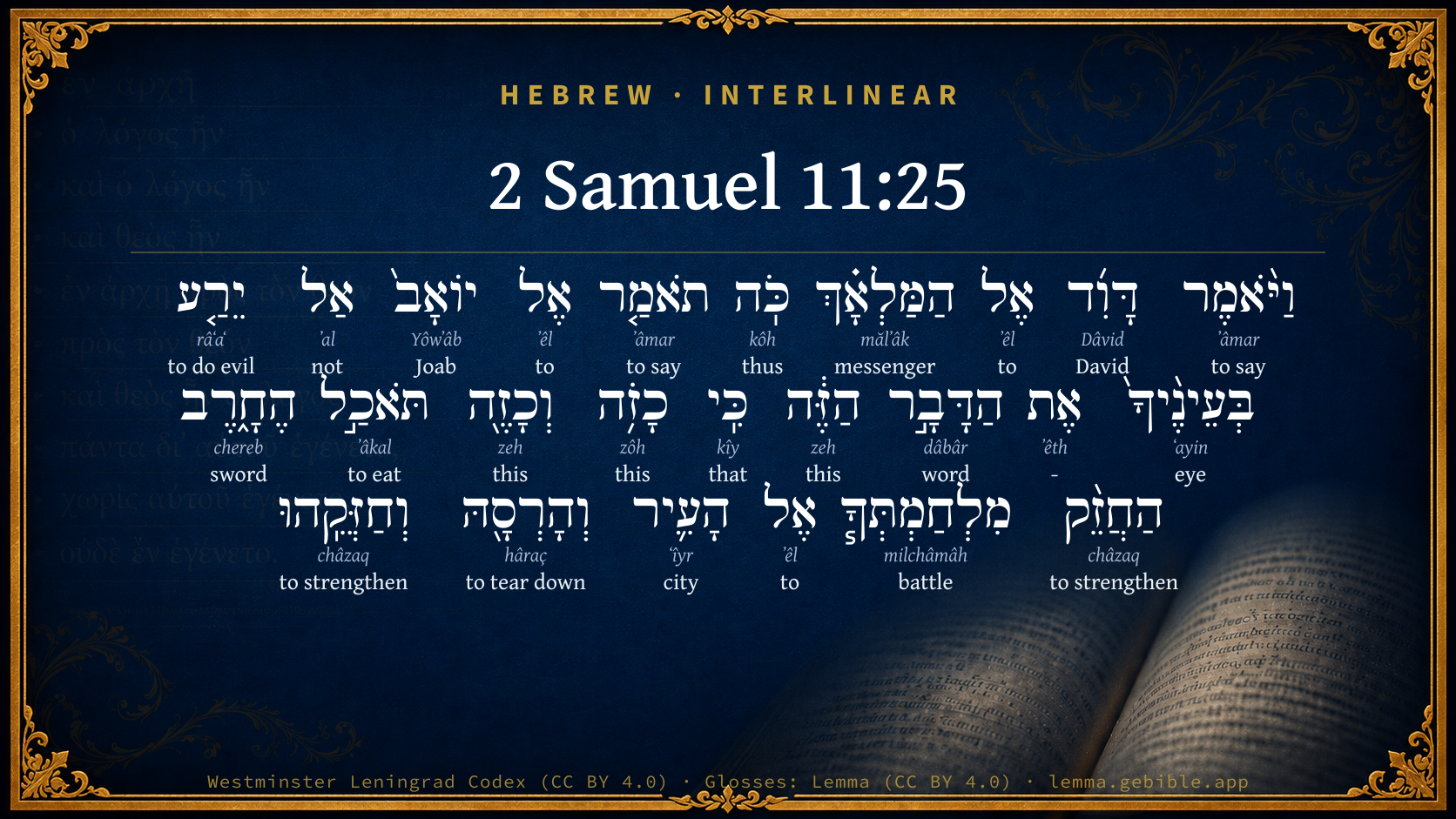
Hebrew (Westminster Leningrad Codex) 2 Samuel 11:25 appears in the Hebrew Old Testament. The text above is from the Westminster Leningrad Codex. Each word links to its Strong’s number, a concise gloss, and parsing drawn from the Open Scriptures Hebrew Bible morphology. Click any word for its full Brown-Driver-Briggs (BDB) entry.
Download image
Cite this verse

2 Samuel 11:25 (World English Bible). Public Domain. Lemma interlinear Bible study tool, https://lemma.gebible.app/v/2-samuel/11/25.

Show BibTeX & RIS
BibTeX
RIS
English Translation
Then David said to the messenger, Thus shall you tell Joab, Don't let this thing displease you, for the sword devours one as well as another; make your battle more strong against the city, and overthrow it: and encourage you him.
World English Bible · Public Domain
Download a study sheet

One document with this verse’s original text, its word-by-word gloss line, the meaning frame, cross-references with their text, attributed commentary, and full source and license credits — printable, and it pastes into notes with its structure intact.

This verse Autodidact and up

Study sheet (.html) Plain text (.txt)

A passage Seminary Student

Up to 50 verses in one chapter. A passage sheet keeps up to 6 commentary sources and 12 cross-references per verse, in the order this page ranks them, and says so on the sheet whenever that leaves anything out. Ask for a single verse and you get the Autodidact verse sheet above.

Everything on this page stays free to read, with no account — the sheet is a download of what is already on screen, not access to it.

Want to remove ads? Support Godless Engineer
Compare translations 3

The same verse in 3 English versions, stacked beneath the original-language interlinear above. Click any original word for its lexicon entry.

Each is an independent rendering of the whole verse — the interlinear is not word-aligned to these translations.

Highlighted words mark where these versions differ — a whole-verse word diff, not a word-by-word alignment.

  • World English Bible Public Domain
    Then David said to the messenger, Thus shall you tell Joab, Don't let this thing displease you, for the sword devours one as well as another; make your battle more strong against the city, and overthrow it: and encourage you him.
  • King James Version Public Domain
    Then David said unto the messenger, Thus shalt thou say unto Joab, Let not this thing displease thee, for the sword devoureth one as well as another: make thy battle more strong against the city, and overthrow it: and encourage thou him.
  • unfoldingWord Literal Text CC BY-SA 4.0
    And David said to the messenger, “Thus you shall say to Joab, ‘May this matter not be bad in your eyes, for like this and like this the sword devours. Strengthen your battle against the city and destroy it.’ So strengthen him.”

unfoldingWord Literal Text — © unfoldingWord, licensed CC BY-SA 4.0. Word-aligned USFM3 via Door43 (git.door43.org/unfoldingWord/en_ult).

Versions to compare (up to 4)

3 of 4 selected

Show all 18 translations

Every available English version of this verse, each an independent rendering of the whole verse.

  • World English Bible Public Domain
    Then David said to the messenger, Thus shall you tell Joab, Don't let this thing displease you, for the sword devours one as well as another; make your battle more strong against the city, and overthrow it: and encourage you him.
  • Berean Standard Bible Public Domain
    Then David told the messenger, “Say this to Joab: ‘Do not let this matter upset you, for the sword devours one as well as another. Strengthen your attack against the city and demolish it.’ Encourage him with these words.”
  • Majority Standard Bible Public Domain
    Then David told the messenger, “Say this to Joab: ‘Do not let this matter upset you, for the sword devours one as well as another. Strengthen your attack against the city and demolish it.’ Encourage him with these words.”
  • King James Version Public Domain
    Then David said unto the messenger, Thus shalt thou say unto Joab, Let not this thing displease thee, for the sword devoureth one as well as another: make thy battle more strong against the city, and overthrow it: and encourage thou him.
  • American Standard Version (1901) Public Domain
    Then David said unto the messenger, Thus shalt thou say unto Joab, Let not this thing displease thee, for the sword devoureth one as well as another; make thy battle more strong against the city, and overthrow it: and encourage thou him.
  • Revised Version (1885) Public Domain
    Then David said unto the messenger, Thus shalt thou say unto Joab, Let not this thing displease thee, for the sword devoureth one as well as another: make thy battle more strong against the city, and overthrow it: and encourage thou him.
  • Geneva Bible (1599) Public Domain
    Then Dauid said vnto the messenger, Thus shalt thou say vnto Ioab, Let not this thing trouble thee: for the sworde deuoureth one as well as another: make thy battell more strong against the citie and destroy it, and encourage thou him.
  • Douay-Rheims (1899) Public Domain
    And David said to the messenger: Thus shalt thou say to Joab: Let not this thing discourage thee: for various is the event of war: and sometimes one, sometimes another is consumed by the sword: encourage thy warriors against The city, and exhort them that thou mayest overthrow it.
  • Young's Literal Translation Public Domain
    And David saith unto the messenger, `Thus dost thou say unto Joab, Let not this thing be evil in thine eyes; for thus and thus doth the sword devour; strengthen thy warfare against the city, and throw it down -- and strengthen thou him.'
  • Literal Standard Version CC BY-SA 4.0
    And David says to the messenger, “Thus you say to Joab, Do not let this thing be evil in your eyes; for thus and thus the sword devours; strengthen your warfare against the city, and throw it down; so you strengthen him.”
  • Unlocked Literal Bible CC BY-SA 4.0
    Then David said to the messenger, “Say this to Joab, 'Do not let this displease you, for the sword devours one as well as another. Make your battle even stronger against the city, and overthrow it,' and encourage him.”
  • unfoldingWord Literal Text CC BY-SA 4.0
    And David said to the messenger, “Thus you shall say to Joab, ‘May this matter not be bad in your eyes, for like this and like this the sword devours. Strengthen your battle against the city and destroy it.’ So strengthen him.”
  • Darby Bible Public Domain
    Then David said to the messenger, Thus shalt thou say to Joab: Let not this thing displease thee, for the sword devours one as well as another: make thy battle strong against the city, and overthrow it; -- and encourage him.
  • World Messianic Bible Public Domain
    Then David said to the messenger, “Tell Joab, ‘Don’t let this thing displease you, for the sword devours one as well as another. Make your battle stronger against the city, and overthrow it.’ Encourage him.”
  • Webster's Bible Public Domain
    Then David said to the messenger, Thus shalt thou say to Joab, Let not this thing displease thee, for the sword devoureth one as well as another: make thy battle more strong against the city, and overthrow it: and encourage thou him.
  • Free Bible Version CC BY-SA 4.0
    Then David said to the messenger, “Tell Joab this: ‘Don't be upset about this, for the sword destroys people at random. Press on with your attack against the town and conquer it.’ Encourage him by telling him this.”
  • Bible in Basic English Public Domain
    Then David said to the man, Go and say to Joab, Do not let this be a grief to you; for one man may come to his death by the sword like another: put up an even stronger fight against the town, and take it: and do you put heart into him.
  • JPS Tanakh (1917) Public Domain
    Then David said unto the messenger: 'Thus shalt thou say unto Joab: Let not this thing displease thee, for the sword devoureth in one manner or another; make thy battle more strong against the city, and overthrow it; and encourage thou him.'

Literal Standard Version (2020), Covenant Press — licensed CC BY-SA 4.0. Text via the HelloAO Bible API (eBible.org). Unlocked Literal Bible (unfoldingWord) — licensed CC BY-SA 4.0. Text via the HelloAO Bible API (eBible.org). unfoldingWord Literal Text — © unfoldingWord, licensed CC BY-SA 4.0. Word-aligned USFM3 via Door43 (git.door43.org/unfoldingWord/en_ult). Free Bible Version, Dr. Jonathan Gallagher — licensed CC BY-SA 4.0. Text via the HelloAO Bible API (eBible.org).

Word by word

More ways to search: Search by grammar → Find every occurrence → Compare this word →

Practice this passage: Drill this verse → Learn its vocabulary →

כָזֹ֥ה
zôh
H2090
“like/as · this”
Preposition + Pronoun, Demonstrative, Feminine, Singular
Part of Speech
Preposition + Pronoun
Type
Demonstrative
Gender
Feminine
Number
Singular
Full BDB Definition

Origin: for H2088

TWOT: None

this
  1. וַיֹּ֨אמֶר ʼâmar H559 “and · to say” Conjunction + Verb, Qal, Sequential Imperfect, 3rd Person, Masculine, Singular
  2. דָּוִ֜ד Dâvid H1732 “David” Noun, Proper
  3. אֶל ʼêl H413 “to” Preposition
  4. הַמַּלְאָ֗ךְ mălʼâk H4397 “the · messenger” Particle, Definite Article + Noun, Common, Masculine, Singular, Absolute
  5. כֹּֽה kôh H3541 “thus” Adverb
  6. תֹאמַ֤ר ʼâmar H559 “to say” Verb, Qal, Imperfect, 2nd Person, Masculine, Singular
  7. אֶל ʼêl H413 “to” Preposition
  8. יוֹאָב֙ Yôwʼâb H3097 “Joab” Noun, Proper
  9. אַל ʼal H408 “not” Particle, Negative
  10. יֵרַ֤ע râʻaʻ H7489 “to do evil” Verb, Qal, Jussive, 3rd Person, Masculine, Singular
  11. בְּעֵינֶ֨יךָ֙ ʻayin H5869 “in/at · eyes · your” Preposition + Noun, Common, Both, Dual, Construct + Suffix, Personal, 2nd Person, Masculine, Singular
  12. אֶת ʼêth H853 “-” Particle, Direct Object
  13. הַדָּבָ֣ר dâbâr H1697 “the · word” Particle, Definite Article + Noun, Common, Masculine, Singular, Absolute
  14. הַזֶּ֔ה zeh H2088 “the · this” Particle, Definite Article + Pronoun, Demonstrative, Masculine, Singular
  15. כִּֽי kîy H3588 “that” Conjunction
  16. וְכָזֶ֖ה zeh H2088 “and · like/as · this” Conjunction + Preposition + Pronoun, Demonstrative, Masculine, Singular
  17. תֹּאכַ֣ל ʼâkal H398 “to eat” Verb, Qal, Imperfect, 3rd Person, Feminine, Singular
  18. הֶחָ֑רֶב chereb H2719 “the · sword” Particle, Definite Article + Noun, Common, Feminine, Singular, Absolute
  19. הַחֲזֵ֨ק châzaq H2388 “strengthen” Verb, Hiphil, Imperative, 2nd Person, Masculine, Singular
  20. מִלְחַמְתְּךָ֧ milchâmâh H4421 “battle · your” Noun, Common, Feminine, Singular, Construct + Suffix, Personal, 2nd Person, Masculine, Singular
  21. אֶל ʼêl H413 “to” Preposition
  22. הָעִ֛יר ʻîyr H5892 “the · city” Particle, Definite Article + Noun, Common, Feminine, Singular, Absolute
  23. וְהָרְסָ֖הּ hâraç H2040 “and · tear down · her” Conjunction + Verb, Qal, Imperative, 2nd Person, Masculine, Singular + Suffix, Personal, 3rd Person, Feminine, Singular
  24. וְחַזְּקֵֽהוּ châzaq H2388 “and · strengthen · him” Conjunction + Verb, Piel, Imperative, 2nd Person, Masculine, Singular + Suffix, Personal, 3rd Person, Masculine, Singular

About this verse

These counts appear in no published source. They are computed here, from the morphology-tagged text and Lemma’s own curated glosses. What Lemma adds →

25
words
20
distinct lemmas
Historical
section

Notable vocabulary

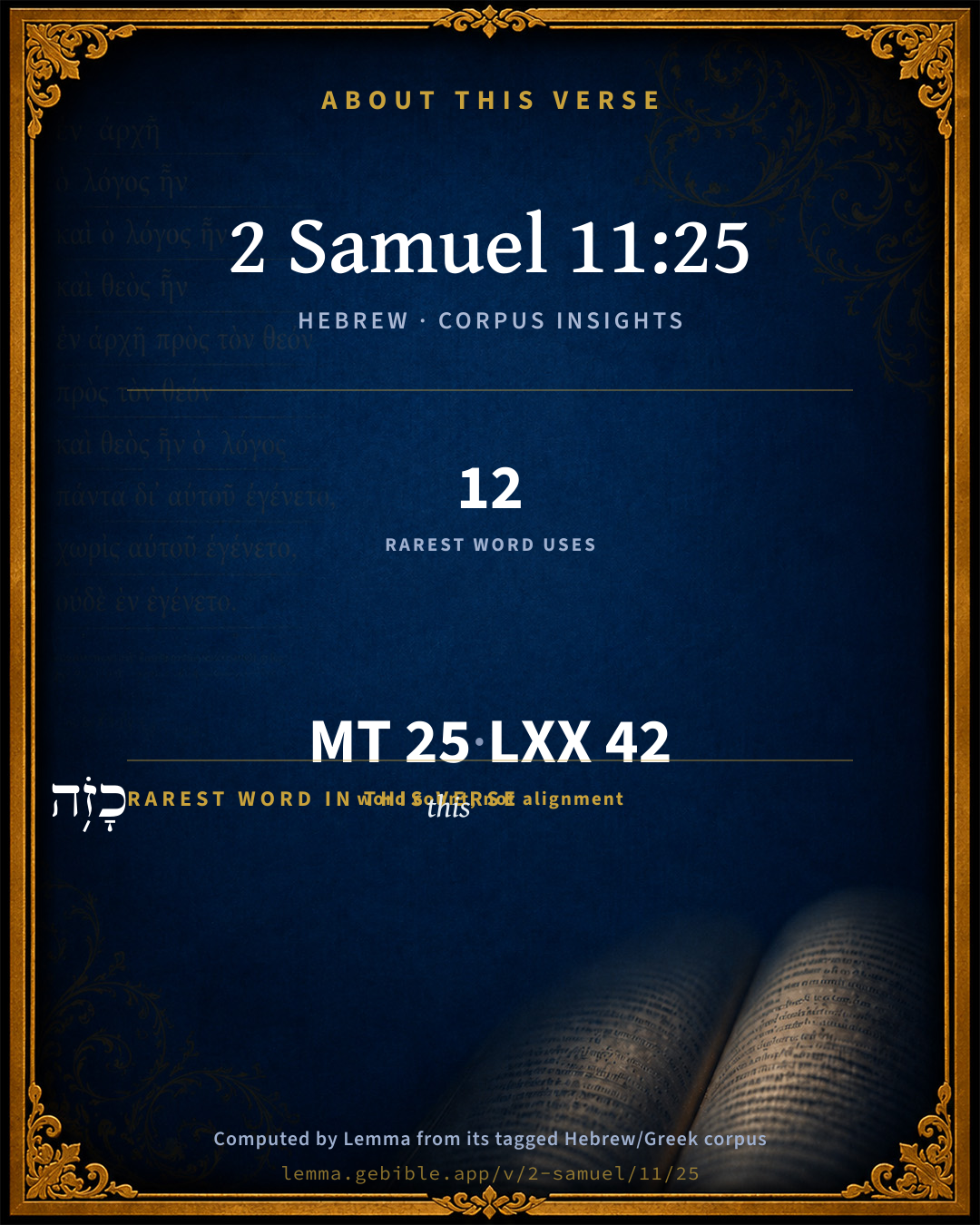
The rarest word here is כָזֹ֥ה this H2090 — appearing just 12 times in the whole Hebrew Bible.

Shared distinctive vocabulary

כָזֹ֥ה this H2090 occurs in 12 verses of the Hebrew Bible. Also found in:

Grammatical profile

  • 7 verbs
  • 8 nouns
  • 3 pronouns
  • 3 prepositions
  • 1 conjunction
  • 1 adverb
  • 2 particles

Verb forms

  • וַיֹּ֨אמֶר Qal · Sequential Imperfect
  • תֹאמַ֤ר Qal · Imperfect
  • יֵרַ֤ע Qal · Jussive
  • תֹּאכַ֣ל Qal · Imperfect
  • הַחֲזֵ֨ק Hiphil · Imperative
  • וְהָרְסָ֖הּ Qal · Imperative
  • וְחַזְּקֵֽהוּ Piel · Imperative

Repetition

Words recur within this verse — often emphatic in Hebrew:

  • וַיֹּ֨אמֶר to say H559 ×2
  • הַחֲזֵ֨ק to strengthen H2388 ×2
  • אֶל to H413 ×3
  • הַזֶּ֔ה this H2088 ×2

Hebrew & Septuagint length

In English translation the verse runs 41 words from the Hebrew and 47 from the Septuagint (LXX English) — closely comparable.

A rough comparison of the two English renderings, which tokenize alike — not a word-level alignment.

Word counts can differ between the Hebrew and the Greek without any difference in meaning — e.g. the Hebrew direct-object marker אֵת has no separate Greek word, and Greek often adds the article ὁ.

In the original languages it is 25 Hebrew tokens and 42 Greek tokens — but the two are counted differently (Hebrew bundles its prefixes and suffixes into one token; the Greek is in lemma form), so that isn’t a like-for-like length.

Cross-references

5

Topical passages linked to 2 Samuel 11:25 in the Treasury of Scripture Knowledge — connected by theme and wording, ordered by reader-vote popularity; previews shown in the World English Bible.

  • Joshua 7:8–9 Oh, Lord, what shall I say, after that Israel has turned their backs before their enemies!
  • 1 Samuel 6:9 Behold; if it goes up by the way of its own border to Beth-shemesh, then he has done us this great evil: but if not, then we shall know that it is not his hand that struck us; it was a chance that happened to us."
  • 2 Samuel 12:26 Now Joab fought against Rabbah of the children of Ammon, and took the royal city.
  • Ecclesiastes 9:1–3 For all this I laid to my heart, even to explore all this: that the righteous, and the wise, and their works, are in the hand of God; whether it is love or hatred, man doesn't know it; all is before them.
  • Ecclesiastes 9:11–12 I returned, and saw under the sun, that the race is not to the swift, nor the battle to the strong, neither yet bread to the wise, nor yet riches to men of understanding, nor yet favor to men of skill; but time and chance happen to them all.

Cross-references courtesy of OpenBible.info (CC BY 4.0).

Hebrew and Greek witnesses Masoretic Hebrew ↔ Greek Septuagint

The same verse in the two great witnesses to the Old Testament, shown verse-for-verse.

These are two independent witnesses, not word-aligned to each other, and the Septuagint is shown in lemma (dictionary) form.

Hebrew 2 Samuel 11:25 Masoretic · Westminster Leningrad Codex

וַיֹּ֨אמֶר דָּוִ֜ד אֶל הַמַּלְאָ֗ךְ כֹּֽה תֹאמַ֤ר אֶל יוֹאָב֙ אַל יֵרַ֤ע בְּעֵינֶ֨יךָ֙ אֶת הַדָּבָ֣ר הַזֶּ֔ה כִּֽי כָזֹ֥ה וְכָזֶ֖ה תֹּאכַ֣ל הֶחָ֑רֶב הַחֲזֵ֨ק מִלְחַמְתְּךָ֧ אֶל הָעִ֛יר וְהָרְסָ֖הּ וְחַזְּקֵֽהוּ

Then David said to the messenger, Thus shall you tell Joab, Don't let this thing displease you, for the sword devours one as well as another; make your battle more strong against the city, and overthrow it: and encourage you him.

World English Bible · Public Domain

Greek LXX 2 Samuel 11:25 Septuagint · lemma form

καί εἶπον δαυίδ πρός ὁ ἄγγελος ὅδε εἶπον πρός ιωαβ μή πονηρός εἰμί ἐν ὀφθαλμός σύ ὁ ῥῆμα οὗτος ὅτι ποτέ μέν οὕτως καί ποτέ οὕτως ἐσθίω ὁ μάχαιρα κραταιόω ὁ πόλεμος σύ πρός ὁ πόλις καί κατασπάω αὐτός καί κραταιόω αὐτός

And David said to the messenger, Thus shall you say to Joab, Let not the matter be grievous in your eyes, for the sword devours one way at one time and another way at another: strengthen your array against the city, and destroy it, and strengthen him.

LXX2012 (modern English Septuagint) · Public Domain

On this verse, The Cambridge Bible for Schools and Colleges discusses the Septuagint’s reading. Read the note in Commentary ↓

Hebrew: Westminster Leningrad Codex (CC BY 4.0). Greek: Septuagint (public domain); English from LXX2012 (modern English Septuagint) (Public Domain). How the Septuagint differs from the Hebrew →

Targum (Aramaic paraphrase)

1

The Targum is the ancient Jewish Aramaic paraphrase of the Hebrew Scriptures — an interpretive translation, not the Hebrew text itself. Onkelos (literal) and Pseudo-Jonathan (expansive) render the Torah, and Jonathan the Prophets. Coverage is partial: where no permissively-licensed English translation exists for a verse, only the Aramaic is shown. This is verse-level text, not a word-by-word alignment to the Hebrew.

  1. Targum Jonathan Prophets (Joshua–Malachi)
    וַאֲמַר דָוִד לְאִזְגַדָא כְּדֵין תֵּימַר לְיוֹאָב לָא יַבְאֵשׁ בְּעֵינָךְ יַת פִּתְגָמָא הָדֵין אֲרֵי כְדֵין וּכְדֵין תִּקְטוֹל חַרְבָּא אַתְקֵיף קְרָבָא עַל קַרְתָּא וּפַגְרָהּ וְתַקְפֵהוּ:

    (no public-domain English translation for this verse)

    Targum Jonathan — Aramaic: “Mikraot Gedolot” (public domain). English: “Sefaria Community Translation” (CC0 1.0 (public-domain dedication)); “London "Chaldee Paraphrase," 1871” (public domain). Text via Sefaria.

Commentary

Notes on 2 Samuel 11:25 from classic Christian and Jewish commentators (each source and its license shown beneath its notes). The classic Christian expositions comment on the surrounding passage and are grouped to its opening verse, so a note may address several verses; the Jewish commentaries on the Tanakh (Rashi and others) are per-verse, so they appear only where the commentator wrote on this verse.

Lemma curates 59 commentaries, every one of them public domain or Creative Commons licensed, each selected and text-cleaned for this edition rather than reprinted as found. About our sources →

Trapp's Complete Commentary

John Trapp

2Sa 11:25 Then David said unto the messenger, Thus shalt thou say unto Joab, Let not this thing displease thee, for the sword devoureth one as well as another: make thy battle more strong against the city, and overthrow it: and encourage thou him.

Ver. 25. Let not this thing displease thee.] Thus he smootheth up Joab, slights the slaughter of so many gallant men, and deeply dissembleth with the messenger, to the intent that neither his cruel command, nor Joab’s fawning obedience, may be discovered. But was this David? O quantum mutatus!

For the sword devoureth one as well as another.] Heb., So and such; lords and losels {lowlies} together. Mars est αλλοπροσαλλος: down they go pell-mell, without difference.

John Trapp, A Commentary or Exposition upon All the Books of the Old and New Testament (1647–1656) — public domain. Text from a community e-Sword module.

Joseph Benson's Commentary

2Sa 11:25. Let not this thing displease thee — Be not disheartened by this loss. David showed no sign of grief or displeasure at these tidings, as he heard the news, which he desired, of Uriah’s death. The sword devoureth one as well as another — Makes no distinction between good and bad. Make thy battle more strong, &c. — Assault the city with greater force, till thou art made master of it. And encourage thou him — Joab and his soldiery.

Joseph Benson's Commentary on the Old and New Testaments (1811–1818) — public domain. Text from a community e-Sword module.

Tyndale Open Study Notes

Tyndale Open Resources

11:25 The sword devours this one today and that one tomorrow! David’s callous attitude toward the unnecessary deaths he caused is chilling.

Tyndale Open Study Notes — © Tyndale Open Resources, licensed CC BY-SA 4.0. Text via the HelloAO Bible API.

Geneva Bible (1599)

Geneva Bible translators

He dissembleth with the messenger, to the intent that neither his cruel commandment, nor Joab’s wicked obedience might be espied.

Hebrew, so and so.

Geneva Bible (1599) marginal notes — public domain. Text via Bolls.life.

Adam Clarke's Commentary

Verse 25. The sword devoureth one as well as another] What abominable hypocrisy was here! He well knew that Uriah's death was no chance-medley; he was by his own order thrust on the edge of the sword.

Adam Clarke's Commentary on the Bible (1810–1826) — public domain. Text from a community e-Sword/MySword module.

Ellicott's Commentary for English Readers

(25) One as well as another.—While David’s reply to Joab is ostensibly to encourage him, on the ground that the mishap was a mere accident of war, it is yet couched in such language as to imply a special regret for the loss of Uriah. “One as well as another,” i.e., “though Uriah was a brave hero whom we could ill spare, yet in the fortune of war we cannot choose who shall fall. Notwithstanding this loss, let Joab go on with a good heart.”

A Bible Commentary for English Readers, edited by Charles John Ellicott (1878–1897) — public domain. Text from a community e-Sword module.

The Cambridge Bible for Schools and Colleges

gen. ed. J. J. S. Perowne

25. the sword devoureth] Cp. the phrase “the mouth (E. V. edge) of the sword” (1Sa_15:8).

encourage thou him] This is certainly the right rendering. That of the LXX., and take it, which follows a slightly different text, is contrary to the usage of the verb.

The Cambridge Bible for Schools and Colleges (gen. ed. J. J. S. Perowne; Cambridge University Press, 1878–1918) — public domain. Text from a community e-Sword module.

John Gill's Exposition

Then David said to the messenger,.... Whom he dispatched again to Joab upon the delivery of his message:

thus shall thou say to Joab; in the name of David:

let not this thing displease thee; be not grieved, and cast down, and intimidated at the repulse he had met with, and the loss of so many brave men, and especially Uriah:

for the sword devours one as well as another; officers as well as soldiers the strong as well as the weak, the valiant and courageous as well as the more timorous; the events of war are various and uncertain, and to be submitted to, and not repined at, and laid to heart. David's heart being hardened by sin, made light of the death of his brave soldiers, to which he himself was accessory; his conscience was very different now from what it was when he cut off the skirt of Saul's robe, and his heart in a different frame from that in which he composed the lamentation over Saul and Jonathan:

make thy battle more strong against the city, and overthrow it; more closely besiege it, more vigorously attack it; assault it, endeavour to take it by storm, and utterly destroy it, razing the very foundations of it: and encourage thou him; which words are either said to the messenger to encourage and animate Joab in David's name, which is not so likely that a messenger should be employed to encourage the general; or rather the words of David to Joab continued, that he would "encourage it", the army under him, who might be disheartened with the rebuff and loss they had met with; and therefore Joab is bid to spirit them up, to carry on the siege with vigour.

John Gill's Exposition of the Whole Bible (1746–1763) — public domain (CC PDM 1.0). Text via the HelloAO Bible API.

Matthew Poole's English Annotations

Let not this thing displease thee; be not dejected or discouraged by this sad occasion.

Encourage thou him, i.e. Joab, to proceed in the siege.

Matthew Poole's English Annotations on the Holy Bible (1683–1685) — public domain. Text from a community e-Sword/MySword module.

Whedon's Commentary on the Bible

Daniel D. Whedon

25. Thus shalt thou say unto Joab — This message was dictated by an abominable hypocrisy. He would thus affect sorrow for the fall of the noble Uriah, and seek to cover his own guilt in the matter.

Daniel D. Whedon (gen. ed.), Commentary on the Old and New Testaments (1874–1909) — public domain. Text from a community e-Sword module.

The Pulpit Commentary

Let not this thing displease thee. David professes to be satisfied with Joab"s apology, and bids him, if the war is in the main going on prosperously, not to be too much distressed at a temporary reverse. As for Uriah"s death, of course it is to be regretted, but such is the fortune of war, and the sword devours now one and now another. The last words, encourage thou him, have provoked comment, as though the messenger was to aid and abet Joab. They simply mean "Give him a message of encouragement from me," the exact form of which is left to the messenger, but of which his report would be that the king wished Joab to take courage.

The Pulpit Commentary (1880–1919), ed. H.D.M. Spence-Jones & Joseph S. Exell — public domain. Text from a community e-Sword module.

Rashi

Rabbi Shlomo Yitzchaki (Rashi)

Intensify your war [against] the city and destroy it. The words of the message [end] at this point.

You should encourage him [Yoav]. Dovid [then] said to the messenger, "Encourage Yoav with consoling words so that his heart should not weaken.

Rashi on the Tanakh — English translations: “The Judaica Press complete Tanach with Rashi, translated by A. J. Rosenberg” (CC BY 4.0); “Pentateuch with Rashi's commentary by M. Rosenbaum and A.M. Silbermann, 1929-1934” (public domain); “The Metsudah Tanach series, Lakewood, N.J” (CC BY 4.0); and “The Book of Joshua, Metsudah Publications, 1997” (CC BY 4.0). Text via Sefaria.

Lesson kit

Teaching starters — assembled from the data on this page, not authored interpretation. Every prompt links to the verse data it draws on. Edit before teaching.

2 Samuel, in the Historical, opens this verse with 25 words (20 distinct Hebrew lemmas). Its most distinctive word is zôh (“this”). A historical commentator’s framing appears above. Read the whole chapter for the surrounding context.

Discussion questions

  1. What does “this” (zôh) contribute to the verse as a whole?
  2. Judges 18:4 shares the word «this» with this verse. How do the two illuminate each other?
  3. “to say” occurs 2× in this one verse. What is the effect of the repetition?
  4. These translations render this verse differently; the difference is in the English rendering, not the original. What questions does that raise?
  5. The verb «וַיֹּ֨אמֶר» is Qal Sequential Imperfect. How does its form color the action?
  6. Reading how Trapp's Complete Commentary and Joseph Benson's Commentary read this verse, where do the two commentators agree and where do they part?

Things to notice

Reading settings

Reading text

Shown beneath each verse's original-language words.

Old Testament
Old Testament edition

Read the OT as the Masoretic Hebrew (MT) or the Greek Septuagint (LXX).

English shown for the Greek Septuagint (in the Hebrew ↔ Greek comparison).

Comparing translations? Open the Compare panel on any verse page to stack up to four side by side.