
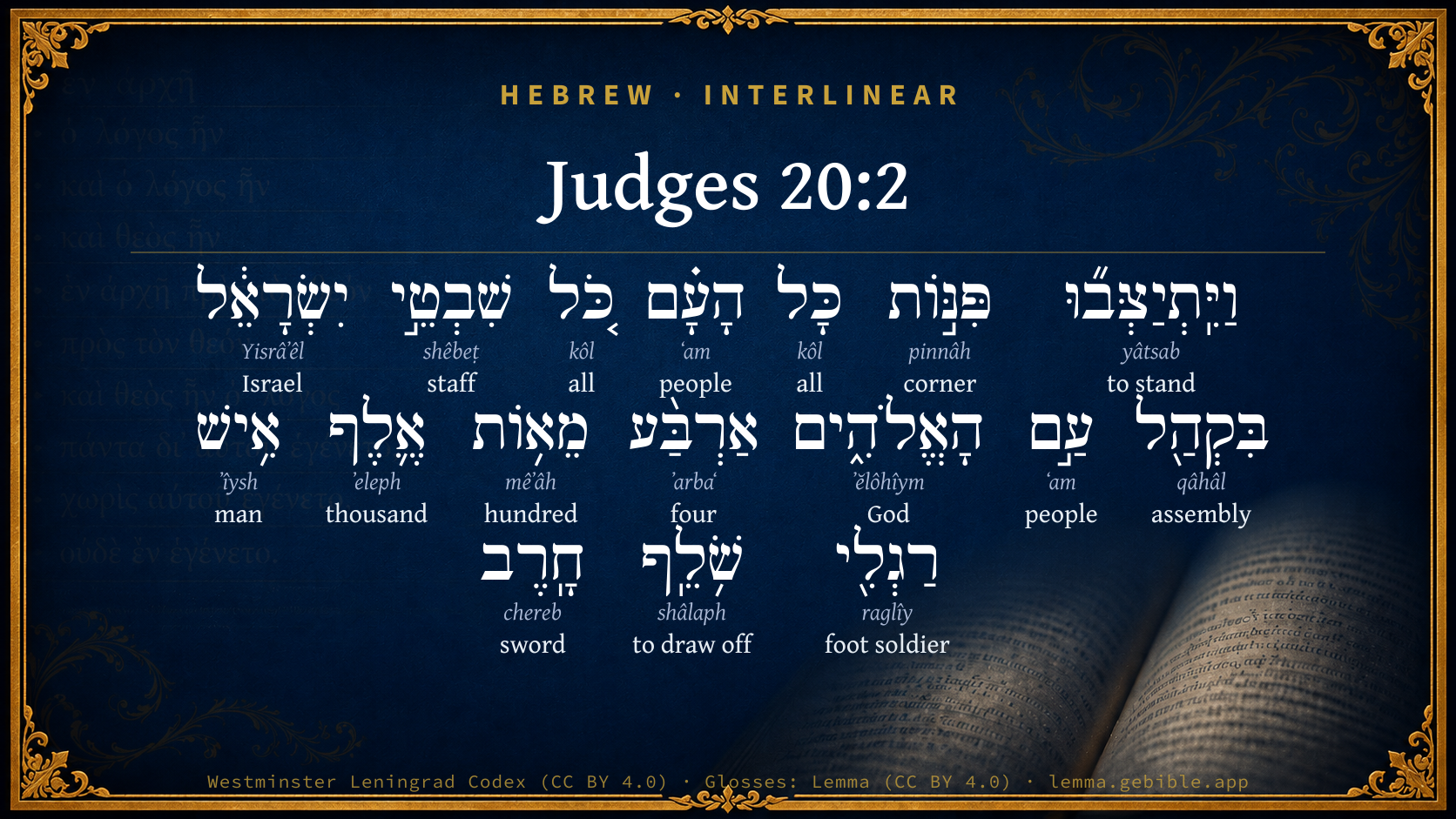
Judges 20:2

Hebrew (Westminster Leningrad Codex) Judges 20:2 appears in the Hebrew Old Testament. The text above is from the Westminster Leningrad Codex. Each word links to its Strong’s number, a concise gloss, and parsing drawn from the Open Scriptures Hebrew Bible morphology. Click any word for its full Brown-Driver-Briggs (BDB) entry.
Download image
Cite this verse

Judges 20:2 (World English Bible). Public Domain. Lemma interlinear Bible study tool, https://lemma.gebible.app/v/judges/20/2.

Show BibTeX & RIS
BibTeX
RIS
English Translation
The chiefs of all the people, even of all the tribes of Israel, presented themselves in the assembly of the people of God, four hundred thousand footmen who drew sword.
World English Bible · Public Domain
Download a study sheet

One document with this verse’s original text, its word-by-word gloss line, the meaning frame, cross-references with their text, attributed commentary, and full source and license credits — printable, and it pastes into notes with its structure intact.

This verse Autodidact and up

Study sheet (.html) Plain text (.txt)

A passage Seminary Student

Up to 50 verses in one chapter. A passage sheet keeps up to 6 commentary sources and 12 cross-references per verse, in the order this page ranks them, and says so on the sheet whenever that leaves anything out. Ask for a single verse and you get the Autodidact verse sheet above.

Everything on this page stays free to read, with no account — the sheet is a download of what is already on screen, not access to it.

Want to remove ads? Support Godless Engineer
Compare translations 3

The same verse in 3 English versions, stacked beneath the original-language interlinear above. Click any original word for its lexicon entry.

Each is an independent rendering of the whole verse — the interlinear is not word-aligned to these translations.

Highlighted words mark where these versions differ — a whole-verse word diff, not a word-by-word alignment.

  • World English Bible Public Domain
    The chiefs of all the people, even of all the tribes of Israel, presented themselves in the assembly of the people of God, four hundred thousand footmen who drew sword.
  • King James Version Public Domain
    And the chief of all the people, even of all the tribes of Israel, presented themselves in the assembly of the people of God, four hundred thousand footmen that drew sword.
  • unfoldingWord Literal Text CC BY-SA 4.0
    And the cornerstones of all of the people, all of the tribes of Israel, stationed themselves within the assembly of the people of God, 400, 000, a man, a footsoldier drawing the sword.

unfoldingWord Literal Text — © unfoldingWord, licensed CC BY-SA 4.0. Word-aligned USFM3 via Door43 (git.door43.org/unfoldingWord/en_ult).

Versions to compare (up to 4)

3 of 4 selected

Show all 18 translations

Every available English version of this verse, each an independent rendering of the whole verse.

  • World English Bible Public Domain
    The chiefs of all the people, even of all the tribes of Israel, presented themselves in the assembly of the people of God, four hundred thousand footmen who drew sword.
  • Berean Standard Bible Public Domain
    The leaders of all the people and all the tribes of Israel presented themselves in the assembly of God’s people: 400,000 men on foot, armed with swords.
  • Majority Standard Bible Public Domain
    The leaders of all the people and all the tribes of Israel presented themselves in the assembly of God’s people: 400,000 men on foot, armed with swords.
  • King James Version Public Domain
    And the chief of all the people, even of all the tribes of Israel, presented themselves in the assembly of the people of God, four hundred thousand footmen that drew sword.
  • American Standard Version (1901) Public Domain
    And the chiefs of all the people, even of all the tribes of Israel, presented themselves in the assembly of the people of God, four hundred thousand footmen that drew sword.
  • Revised Version (1885) Public Domain
    And the chiefs of all the people, even of all the tribes of Israel, presented themselves in the assembly of the people of God, four hundred thousand footmen that drew sword.
  • Geneva Bible (1599) Public Domain
    And the chiefe of all the people, and all the tribes of Israel assembled in the Congregation of the people of God foure hundreth thousand footemen that drewe sword.
  • Douay-Rheims (1899) Public Domain
    And all the chiefs of the people, and all the tribes of Israel met together in the assembly of the people of God, four hundred thousand footmen fit for war.
  • Young's Literal Translation Public Domain
    And the chiefs of all the people, of all the tribes of Israel, station themselves in the assembly of the people of God, four hundred thousand footmen drawing sword.
  • Literal Standard Version CC BY-SA 4.0
    And the chiefs of all the people, of all the tribes of Israel, station themselves in the assembly of the people of God, four hundred thousand footmen drawing sword.
  • Unlocked Literal Bible CC BY-SA 4.0
    The leaders of all the people, of all the tribes of Israel, took their places in the assembly of the people of God—400,000 men on foot, who were ready to fight with the sword.
  • unfoldingWord Literal Text CC BY-SA 4.0
    And the cornerstones of all of the people, all of the tribes of Israel, stationed themselves within the assembly of the people of God, 400, 000, a man, a footsoldier drawing the sword.
  • Darby Bible Public Domain
    And the chiefs of all the people, of all the tribes of Israel, presented themselves in the assembly of the people of God, four hundred thousand men on foot that drew the sword.
  • World Messianic Bible Public Domain
    The chiefs of all the people, even of all the tribes of Israel, presented themselves in the assembly of the people of God, four hundred thousand footmen who drew sword.
  • Webster's Bible Public Domain
    And the chief of all the people, even of all the tribes of Israel, presented themselves in the assembly of the people of God, four hundred thousand footmen that drew sword.
  • Free Bible Version CC BY-SA 4.0
    The leaders of all the people of every Israelite tribe took their assigned positions in the assembled army of God's people, four hundred thousand soldiers armed with swords.
  • Bible in Basic English Public Domain
    And the chiefs of the people, out of all the tribes of Israel, took their places in the meeting of the people of God, four hundred thousand footmen armed with swords.
  • JPS Tanakh (1917) Public Domain
    And the chiefs of all the people, even of all the tribes of Israel, presented themselves in the assembly of the people of God, four hundred thousand footmen that drew sword. —

Literal Standard Version (2020), Covenant Press — licensed CC BY-SA 4.0. Text via the HelloAO Bible API (eBible.org). Unlocked Literal Bible (unfoldingWord) — licensed CC BY-SA 4.0. Text via the HelloAO Bible API (eBible.org). unfoldingWord Literal Text — © unfoldingWord, licensed CC BY-SA 4.0. Word-aligned USFM3 via Door43 (git.door43.org/unfoldingWord/en_ult). Free Bible Version, Dr. Jonathan Gallagher — licensed CC BY-SA 4.0. Text via the HelloAO Bible API (eBible.org).

Word by word

More ways to search: Search by grammar → Find every occurrence → Compare this word →

Practice this passage: Drill this verse → Learn its vocabulary →

רַגְלִ֖י
raglîy
H7273
“foot soldier”
Adjective, Adjective, Masculine, Singular, Absolute
Part of Speech
Adjective
Type
Adjective
Gender
Masculine
Number
Singular
State
Absolute
Full BDB Definition

Origin: from H7272

TWOT: 2113b

on foot - man on foot, footman, foot soldier
  1. וַיִּֽתְיַצְּב֞וּ yâtsab H3320 “and · to stand” Conjunction + Verb, Hithpael, Sequential Imperfect, 3rd Person, Masculine, Plural
  2. פִּנּ֣וֹת pinnâh H6438 “corners of” Noun, Common, Feminine, Plural, Construct
  3. כָּל kôl H3605 “all of” Noun, Common, Masculine, Singular, Construct
  4. הָעָ֗ם ʻam H5971 “the · people” Particle, Definite Article + Noun, Common, Masculine, Singular, Absolute
  5. כֹּ֚ל kôl H3605 “all of” Noun, Common, Masculine, Singular, Construct
  6. שִׁבְטֵ֣י shêbeṭ H7626 “staffs of” Noun, Common, Masculine, Plural, Construct
  7. יִשְׂרָאֵ֔ל Yisrâʼêl H3478 “Israel” Noun, Proper
  8. בִּקְהַ֖ל qâhâl H6951 “in/at · assembly of” Preposition + Noun, Common, Masculine, Singular, Construct
  9. עַ֣ם ʻam H5971 “people of” Noun, Common, Masculine, Singular, Construct
  10. הָאֱלֹהִ֑ים ʼĕlôhîym H430 “the · God(s)” Particle, Definite Article + Noun, Common, Masculine, Plural, Absolute
  11. אַרְבַּ֨ע ʼarbaʻ H702 “four” Adjective, Cardinal number, Feminine, Singular, Absolute
  12. מֵא֥וֹת mêʼâh H3967 “hundred” Adjective, Cardinal number, Both, Plural, Absolute
  13. אֶ֛לֶף ʼeleph H505 “thousand” Adjective, Cardinal number, Both, Singular, Absolute
  14. אִ֥ישׁ ʼîysh H376 “man” Noun, Common, Masculine, Singular, Absolute
  15. שֹׁ֥לֵֽף shâlaph H8025 “drawing off” Verb, Qal, Participle Active, Masculine, Singular, Absolute
  16. חָֽרֶב chereb H2719 “sword” Noun, Common, Feminine, Singular, Absolute

About this verse

These counts appear in no published source. They are computed here, from the morphology-tagged text and Lemma’s own curated glosses. What Lemma adds →

17
words
15
distinct lemmas
Historical
section

Notable vocabulary

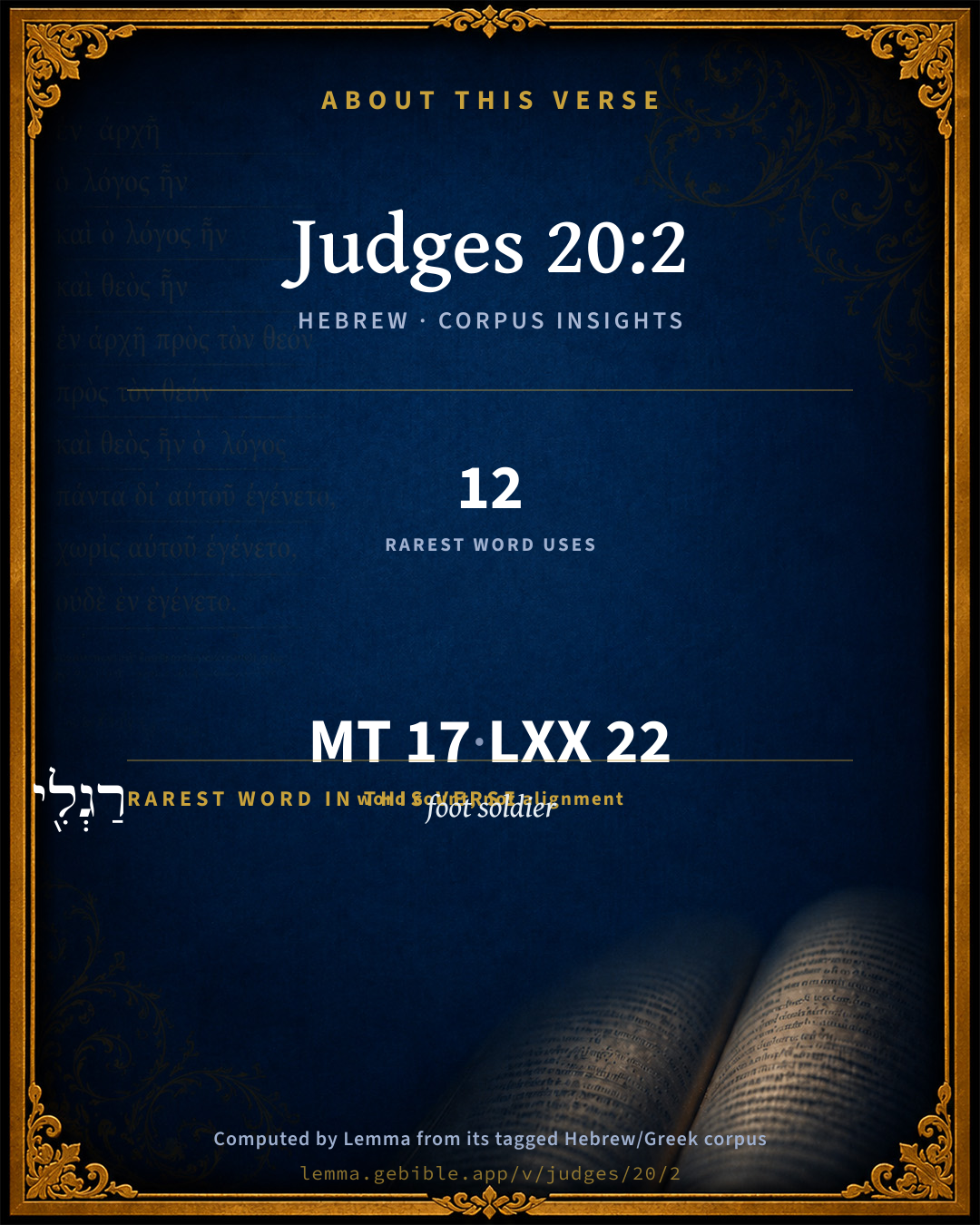
The rarest word here is רַגְלִ֖י foot soldier H7273 — appearing just 12 times in the whole Hebrew Bible.

Shared distinctive vocabulary

רַגְלִ֖י foot soldier H7273 occurs in 12 verses of the Hebrew Bible. Also found in:

Grammatical profile

  • 2 verbs
  • 11 nouns
  • 4 adjectives

Verb forms

  • וַיִּֽתְיַצְּב֞וּ Hithpael · Sequential Imperfect
  • שֹׁ֥לֵֽף Qal · Participle Active

Repetition

Words recur within this verse — often emphatic in Hebrew:

  • כָּל all H3605 ×2
  • הָעָ֗ם people H5971 ×2

Hebrew & Septuagint length

In English translation the verse runs 30 words from the Hebrew and 25 from the Septuagint (LXX English) — closely comparable.

A rough comparison of the two English renderings, which tokenize alike — not a word-level alignment.

Word counts can differ between the Hebrew and the Greek without any difference in meaning — e.g. the Hebrew direct-object marker אֵת has no separate Greek word, and Greek often adds the article ὁ.

In the original languages it is 17 Hebrew tokens and 22 Greek tokens — but the two are counted differently (Hebrew bundles its prefixes and suffixes into one token; the Greek is in lemma form), so that isn’t a like-for-like length.

Cross-references

5

Topical passages linked to Judges 20:2 in the Treasury of Scripture Knowledge — connected by theme and wording, ordered by reader-vote popularity; previews shown in the World English Bible.

  • Judges 8:10 Now Zebah and Zalmunna were in Karkor, and their hosts with them, about fifteen thousand men, all who were left of all the host of the children of the east; for there fell one hundred twenty thousand men who drew sword.
  • Judges 20:15 The children of Benjamin were numbered on that day out of the cities twenty-six thousand men who drew the sword, besides the inhabitants of Gibeah, who were numbered seven hundred chosen men.
  • Judges 20:17 The men of Israel, besides Benjamin, were numbered four hundred thousand men who drew sword: all these were men of war.
  • 2 Kings 3:26 When the king of Moab saw that the battle was too severe for him, he took with him seven hundred men who drew sword, to break through to the king of Edom; but they could not.
  • 2 Samuel 24:9 Joab gave up the sum of the numbering of the people to the king: and there were in Israel eight hundred thousand valiant men who drew the sword; and the men of Judah were five hundred thousand men.

Cross-references courtesy of OpenBible.info (CC BY 4.0).

Hebrew and Greek witnesses Masoretic Hebrew ↔ Greek Septuagint

The same verse in the two great witnesses to the Old Testament, shown verse-for-verse.

These are two independent witnesses, not word-aligned to each other, and the Septuagint is shown in lemma (dictionary) form.

Hebrew Judges 20:2 Masoretic · Westminster Leningrad Codex

וַיִּֽתְיַצְּב֞וּ פִּנּ֣וֹת כָּל הָעָ֗ם כֹּ֚ל שִׁבְטֵ֣י יִשְׂרָאֵ֔ל בִּקְהַ֖ל עַ֣ם הָאֱלֹהִ֑ים אַרְבַּ֨ע מֵא֥וֹת אֶ֛לֶף אִ֥ישׁ רַגְלִ֖י שֹׁ֥לֵֽף חָֽרֶב

The chiefs of all the people, even of all the tribes of Israel, presented themselves in the assembly of the people of God, four hundred thousand footmen who drew sword.

World English Bible · Public Domain

Greek LXX Judges 20:2 Septuagint · lemma form

καί ἵστημι κατά πρόσωπον κύριος πᾶς ὁ φυλή ὁ ἰσραήλ ἐν ἐκκλησία ὁ λαός ὁ θεός τετρακόσιοι χιλιάς ἀνήρ πεζός ἕλκω ῥομφαία

And all the tribes of Israel stood before the Lord in the assembly of the people of God, four hundred thousand footmen that drew sword.

LXX2012 (modern English Septuagint) · Public Domain

On this verse, Adam Clarke's Commentary discusses the Septuagint’s reading. Read the note in Commentary ↓

Hebrew: Westminster Leningrad Codex (CC BY 4.0). Greek: Septuagint (public domain); English from LXX2012 (modern English Septuagint) (Public Domain). How the Septuagint differs from the Hebrew →

Targum (Aramaic paraphrase)

1

The Targum is the ancient Jewish Aramaic paraphrase of the Hebrew Scriptures — an interpretive translation, not the Hebrew text itself. Onkelos (literal) and Pseudo-Jonathan (expansive) render the Torah, and Jonathan the Prophets. Coverage is partial: where no permissively-licensed English translation exists for a verse, only the Aramaic is shown. This is verse-level text, not a word-by-word alignment to the Hebrew.

  1. Targum Jonathan Prophets (Joshua–Malachi)
    וְאִתְעַתָּדוּ רֵישֵׁי כָל עַמָא כָּל שִׁבְטַיָא דְיִשְׂרָאֵל בִּקְהַל עַמָא דַייָ אַרְבַּע מְאָה אַלְפִין גְבַר רִגְלֵי שַׁלְפֵי סַיְפָא:

    (no public-domain English translation for this verse)

    Targum Jonathan — Aramaic: “Mikraot Gedolot” (public domain). English: “Sefaria Community Translation” (CC0 1.0 (public-domain dedication)); “London "Chaldee Paraphrase," 1871” (public domain). Text via Sefaria.

Commentary

Notes on Judges 20:2 from classic Christian and Jewish commentators (each source and its license shown beneath its notes). The classic Christian expositions comment on the surrounding passage and are grouped to its opening verse, so a note may address several verses; the Jewish commentaries on the Tanakh (Rashi and others) are per-verse, so they appear only where the commentator wrote on this verse.

Lemma curates 59 commentaries, every one of them public domain or Creative Commons licensed, each selected and text-cleaned for this edition rather than reprinted as found. About our sources →

Trapp's Complete Commentary

John Trapp

Jdg 20:2 And the chief of all the people, [even] of all the tribes of Israel, presented themselves in the assembly of the people of God, four hundred thousand footmen that drew sword.

Ver. 2. And the chief of all the people.] Heb., The corners of all the people: for the chieftains and rulers bear up the people, and hold them together, as the corner stones do the whole building, which else would soon shatter and fall to ruin. {a} See the like in Zep 3:6. Diodat rendereth it, the cantons.

{a} Ut anguli in domo, sunt primates in populo. - Vat.

John Trapp, A Commentary or Exposition upon All the Books of the Old and New Testament (1647–1656) — public domain. Text from a community e-Sword module.

Joseph Benson's Commentary

Jdg 20:2. Four hundred thousand — The number is here set down, to show their zeal and forwardness in punishing such a villany; the strange blindness of the Benjamites, that durst oppose so great and united a body; and that the success of battles depends not upon great numbers, seeing this great host was twice defeated by the Benjamites.

Joseph Benson's Commentary on the Old and New Testaments (1811–1818) — public domain. Text from a community e-Sword module.

Geneva Bible (1599)

Geneva Bible translators

Hebrew, corners.

Meaning, men able to handle their weapons.

Geneva Bible (1599) marginal notes — public domain. Text via Bolls.life.

Adam Clarke's Commentary

Verse 2. The chief of all the people] The corners פנות pinnoth; for as the corner-stones are the strength of the walls, so are the chiefs the strength of the people. Hence Christ is called the chief corner-stone.

In the assembly of the people of God] The Septuagint translate, And all the tribes of Israel stood up before the face of the Lord, εν εκκλησιᾳ του λαου του Θεου, in the Church of the people of God. Here was a Church, though there was no priest; for, as Tertullian says, Ubi tres, ecclesia est, licet laici; "Wheresoever three are gathered together in the name of the Lord, there is a Church, although there be none but the laity."

Adam Clarke's Commentary on the Bible (1810–1826) — public domain. Text from a community e-Sword/MySword module.

Ellicott's Commentary for English Readers

(2) The chief.—The Hebrew word is pinnoth, “corner-stones,” as in 1Sa_14:38; Isa_19:13.

Four hundred thousand.—Hence we learn the interesting fact that in their struggles against the Canaanites the number of the people had been diminished one-third—i.e., to a far greater extent than they had been diminished by the wanderings in the wilderness. For at the census in the first year of the wanderings their numbers were (including 35,400 of Benjamin) 603,550 (Num_1:46); and in the census in the last year they were 601,730, excluding the Benjamites, who, unlike the other tribes, had increased in numbers, for they were then 45,600 in number.

Footmen.—The Israelites were forbidden to use either chariots or cavalry. (See Notes on Jdg_1:19; Jdg_4:3.)

That drew sword.—Jdg_8:10.

A Bible Commentary for English Readers, edited by Charles John Ellicott (1878–1897) — public domain. Text from a community e-Sword module.

The Cambridge Bible for Schools and Colleges

gen. ed. J. J. S. Perowne

2. chiefs] Lit. the word = corner, of a house Job_1:19, or of a city Neh_3:24; Neh_3:31 f.; also a corner-stone Isa_28:16, cf. Jer_51:26. As suggestive of support or prominence, the corner could be used in a metaphorical sense; cf. 1Sa_14:38, Isa_19:13.

even of all the tribes] even of is not in the Hebr.; read and all the tribes with LXX. cod. A.

presented themselves] took their stand, ready for what might happen; cf. Exo_19:17, Deu_31:14, 1Sa_17:16.

the assembly of the people of God] Only here; usually the assembly of Jehovah or of God, Deu_23:1-3, Neh_13:1. The number 400,000 is obviously exaggerated; contrast the Song of Deborah, which reckons the warriors of all Israel at 40,000, Jdg_5:8. The treatment of history in the narrative of B reflects the ideas of the church-nation of a later day; cf. the impossible figures of P, Exo_12:37. Moore notes that the Roman army which destroyed Jerusalem in a.d. 70 numbered about 60,000; and the German army which captured Paris in 1870, about 240,000.

that drew sword] Cf. Jdg_20:15; Jdg_20:17; Jdg_20:25; Jdg_20:35; Jdg_20:46, Jdg_8:10, 2Sa_24:9.

The Cambridge Bible for Schools and Colleges (gen. ed. J. J. S. Perowne; Cambridge University Press, 1878–1918) — public domain. Text from a community e-Sword module.

John Gill's Exposition

And the chief of all the people,.... The princes of the tribes and heads of families, rulers of thousands, and hundreds, and fifties, and tens; or the "corners" (c), who were like the corner stones in a building, which are not only the most valuable and ornamental, but the strength of the building, which cement it, and support it, and hold it together; though Abarbinel thinks this intends the division and separation of each tribe, which encamped in a separate corner and side by itself: but the former sense seems best, and the meaning is, that the principal men of them:

even of all the tribes of Israel; excepting the tribe of Benjamin:

presented themselves in the assembly of the people of God; now gathered together: which assembly consisted, besides the heads of them, of

four hundred thousand footmen that drew sword; or were armed men; there were 600,000 or more in Israel able to bear arms; but as now the wars in Canaan were pretty much at an end, the militia of the nation was not so regularly kept up, and many were employed in tilling the ground, and dressing the vines, and the like; and besides, as there were none of the tribe of Benjamin present, it need not be wondered at there should be no more, but rather that so many should be gathered together on such an occasion.

(c) "anguli", V. L. Pagninus, Montanus, Munster, Vatablus, Drusius, Tigurine version.

John Gill's Exposition of the Whole Bible (1746–1763) — public domain (CC PDM 1.0). Text via the HelloAO Bible API.

Albert Barnes' Notes on the Bible

The chief - literally, “the corner stones.” (Compare 1Sa 14:38.)

Albert Barnes' Notes on the Bible (1834–1885) — public domain. Text from a community e-Sword/MySword module.

Haydock's Catholic Bible Commentary

Chiefs. Literally, "angles and corner-stones," whose business it was to keep the people in order; or, all the different ranks of men might be designated. (Calmet) --- Septuagint, "the climate," or country. (Haydock) --- Syriac and Arabic, "the families of all the people." (1 Kings xiv. 38.) (Calmet)

George Leo Haydock (1774–1849), Haydock's Catholic Family Bible and Commentary, 1859 edition — public domain. Excludes Psalms (Douay-Rheims chapter numbering differs from Protestant) and Deuterocanonical books (Catholic canon only).

Matthew Poole's English Annotations

The chief, Heb. the corners, i.e. the nobles and rulers, which are oft so called, because, like corner-stones, they both unite, and support, and adorn the whole building.

Four hundred thousand, or, and four hundred thousand. It is an ellipsis of the particle and, of which examples have been given before: for the chief of the people were not so many; but the common soldiers, and these were all footmen; whereas many of the rulers rode upon horses, or asses, Jdg 5:10; 10:4; 12:14. The number is here set down, to show both their zeal and forwardness in punishing such a villany; and the strange blindness of the Benjamites that durst oppose so great and united body; and that the success of battles depends not upon great numbers, seeing this great host was twice defeated by the Benjamites, but wholly upon God’s blessing.

Footmen; for horsemen they had few or none in their armies.

Matthew Poole's English Annotations on the Holy Bible (1683–1685) — public domain. Text from a community e-Sword/MySword module.

Whedon's Commentary on the Bible

Daniel D. Whedon

2. Four hundred thousand — On the possibility of collecting so vast a number in a short time, see note on 1Sa_11:9.

Daniel D. Whedon (gen. ed.), Commentary on the Old and New Testaments (1874–1909) — public domain. Text from a community e-Sword module.

The Pulpit Commentary

The chief. The word here used means the corner-stones of a building. Hence it is applied to the chief men, who, as it were, bind and keep together the whole people. Their presence at this great meeting is mentioned to show that it was a regularly constituted assembly of all Israel. The same phrase occurs 1Sa_14:38, and Isa_19:13 (the stay of the tribes, A.V). The numbers (400, 000) are of course those of the whole congregation. The assembly of the people of God. So, Num_16:3 Num_20:4, Israel is called the congregation of the Lord; and Neh_13:1, the congregation of God. Not dissimilar was the first great council of the Church, consisting of the Church (h ekelhsia ) i.e. the assembly of disciples) and the apostles and elders (who were the cornerstones, the lapides angulares, thereof). See Act_15:4, Act_15:6, Act_15:12. Four hundred thousand. See ver. 17. The enumeration in the wilderness gave 603, 550, (Num_2:32 Num_11:21) and at the second numbering 601, 730. (Num_26:51) In 1Sa_11:8 a general assembly of the whole people, summoned by sending a piece of the flesh of a yoke of oxen "throughout all the coasts of Israel," amounted to 330, 000. David"s numbering gave of Israel 800, 000, and of Judah 500, 000, in all 1, 300, 000; but these were not assembled together, but numbered at their own homes. Jehoshaphat"s men of war amounted to 1, 160, 000 according to 2Ch_17:14-18. In the time of Amaziah there were of Judah alone 300, 000 men able to go forth to war. (2Ch_24:6)

The Pulpit Commentary (1880–1919), ed. H.D.M. Spence-Jones & Joseph S. Exell — public domain. Text from a community e-Sword module.

John Wesley's Explanatory Notes

Four hundred thousand - The number is here set down, to shew their zeal and forwardness in punishing such a villainy; the strange blindness of the Benjamites that durst oppose so great and united a Body; and that the success of battles depends not upon great numbers, seeing this great host was twice defeated by the Benjamites.

John Wesley, Explanatory Notes Upon the Whole Bible (1754–1765) — public domain. Text via the GEBible commentary corpus.

Rashi

Rabbi Shlomo Yitzchaki (Rashi)

The leaders of the entire people. The heads of the entire people.

Rashi on the Tanakh — English translations: “The Judaica Press complete Tanach with Rashi, translated by A. J. Rosenberg” (CC BY 4.0); “Pentateuch with Rashi's commentary by M. Rosenbaum and A.M. Silbermann, 1929-1934” (public domain); “The Metsudah Tanach series, Lakewood, N.J” (CC BY 4.0); and “The Book of Joshua, Metsudah Publications, 1997” (CC BY 4.0). Text via Sefaria.

Lesson kit

Teaching starters — assembled from the data on this page, not authored interpretation. Every prompt links to the verse data it draws on. Edit before teaching.

Judges, in the Historical, opens this verse with 17 words (15 distinct Hebrew lemmas). Its most distinctive word is raglîy (“foot soldier”). A historical commentator’s framing appears above. Read the whole chapter for the surrounding context.

Discussion questions

  1. What does “foot soldier” (raglîy) contribute to the verse as a whole?
  2. Exodus 12:37 shares the word «foot soldier» with this verse. How do the two illuminate each other?
  3. “all” occurs 2× in this one verse. What is the effect of the repetition?
  4. The translations on this page render this verse differently — a whole-verse word diff, not a word-by-word alignment. What might account for the different wordings?
  5. The verb «וַיִּֽתְיַצְּב֞וּ» is Hithpael Sequential Imperfect. How does its form color the action?
  6. Reading how Trapp's Complete Commentary and Joseph Benson's Commentary read this verse, where do the two commentators agree and where do they part?

Things to notice

Reading settings

Reading text

Shown beneath each verse's original-language words.

Old Testament
Old Testament edition

Read the OT as the Masoretic Hebrew (MT) or the Greek Septuagint (LXX).

English shown for the Greek Septuagint (in the Hebrew ↔ Greek comparison).

Comparing translations? Open the Compare panel on any verse page to stack up to four side by side.