
2 Chronicles 23:21

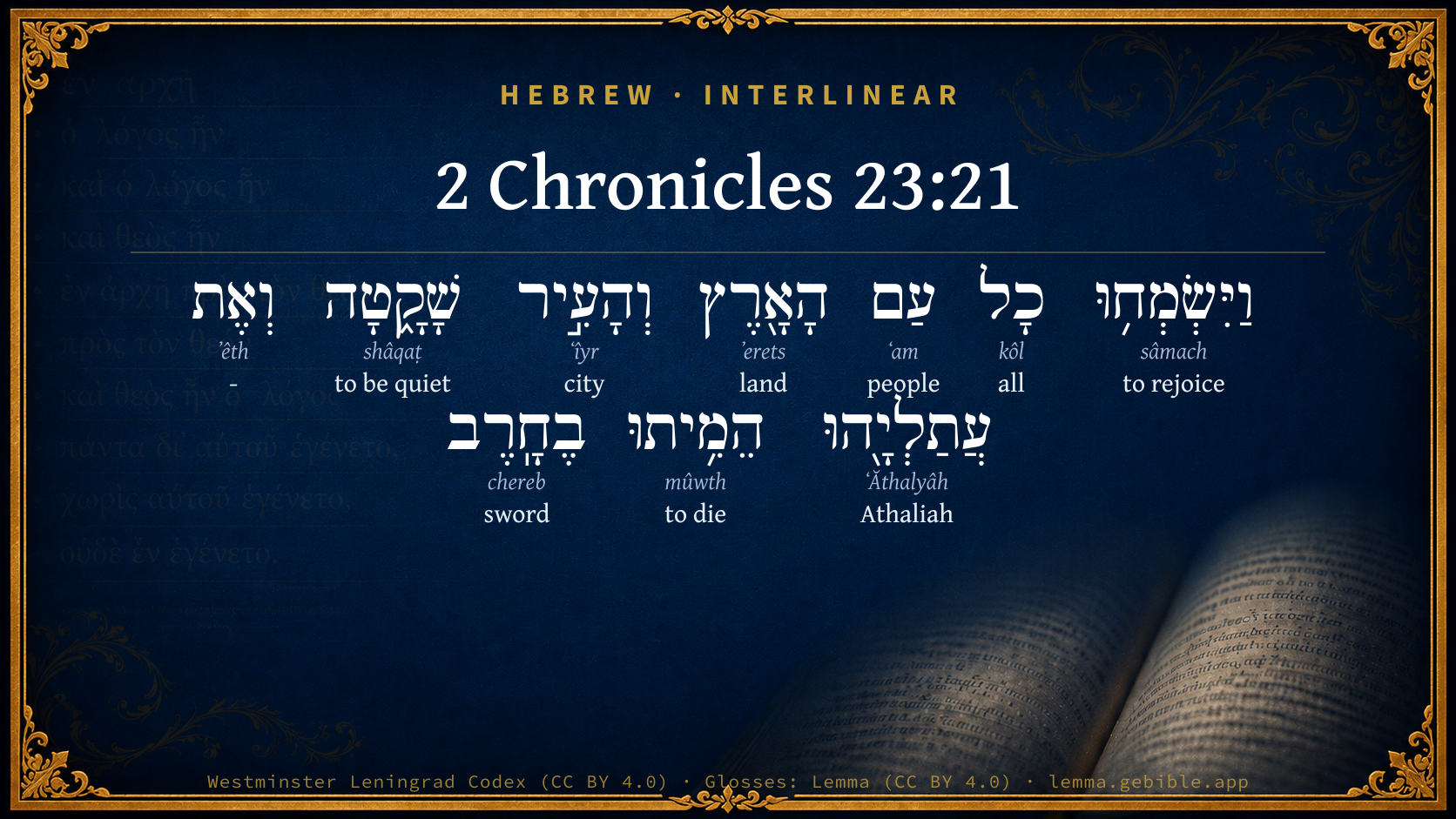
Hebrew (Westminster Leningrad Codex) 2 Chronicles 23:21 appears in the Hebrew Old Testament. The text above is from the Westminster Leningrad Codex. Each word links to its Strong’s number, a concise gloss, and parsing drawn from the Open Scriptures Hebrew Bible morphology. Click any word for its full Brown-Driver-Briggs (BDB) entry.
Download image
Cite this verse

2 Chronicles 23:21 (World English Bible). Public Domain. Lemma interlinear Bible study tool, https://lemma.gebible.app/v/2-chronicles/23/21.

Show BibTeX & RIS
BibTeX
RIS
English Translation
So all the people of the land rejoiced, and the city was quiet. Athaliah they had slain with the sword.
World English Bible · Public Domain
Download a study sheet

One document with this verse’s original text, its word-by-word gloss line, the meaning frame, cross-references with their text, attributed commentary, and full source and license credits — printable, and it pastes into notes with its structure intact.

This verse Autodidact and up

Study sheet (.html) Plain text (.txt)

A passage Seminary Student

Up to 50 verses in one chapter. A passage sheet keeps up to 6 commentary sources and 12 cross-references per verse, in the order this page ranks them, and says so on the sheet whenever that leaves anything out. Ask for a single verse and you get the Autodidact verse sheet above.

Everything on this page stays free to read, with no account — the sheet is a download of what is already on screen, not access to it.

Want to remove ads? Support Godless Engineer
Compare translations 3

The same verse in 3 English versions, stacked beneath the original-language interlinear above. Click any original word for its lexicon entry.

Each is an independent rendering of the whole verse — the interlinear is not word-aligned to these translations.

Highlighted words mark where these versions differ — a whole-verse word diff, not a word-by-word alignment.

  • World English Bible Public Domain
    So all the people of the land rejoiced, and the city was quiet. Athaliah they had slain with the sword.
  • King James Version Public Domain
    And all the people of the land rejoiced: and the city was quiet, after that they had slain Athaliah with the sword.
  • unfoldingWord Literal Text CC BY-SA 4.0
    And all the people of the land rejoiced, and the city was quiet. And Athaliah they put to death with the sword.

unfoldingWord Literal Text — © unfoldingWord, licensed CC BY-SA 4.0. Word-aligned USFM3 via Door43 (git.door43.org/unfoldingWord/en_ult).

Versions to compare (up to 4)

3 of 4 selected

Show all 18 translations

Every available English version of this verse, each an independent rendering of the whole verse.

  • World English Bible Public Domain
    So all the people of the land rejoiced, and the city was quiet. Athaliah they had slain with the sword.
  • Berean Standard Bible Public Domain
    and all the people of the land rejoiced. And the city was quiet, because Athaliah had been put to the sword.
  • Majority Standard Bible Public Domain
    and all the people of the land rejoiced. And the city was quiet, because Athaliah had been put to the sword.
  • King James Version Public Domain
    And all the people of the land rejoiced: and the city was quiet, after that they had slain Athaliah with the sword.
  • American Standard Version (1901) Public Domain
    So all the people of the land rejoiced, and the city was quiet. And Athaliah they had slain with the sword.
  • Revised Version (1885) Public Domain
    So all the people of the land rejoiced, and the city was quiet: and they slew Athaliah with the sword.
  • Geneva Bible (1599) Public Domain
    Then all the people of the land reioyced, and the citie was quiet, after that they had slaine Athaliah with the sword.
  • Douay-Rheims (1899) Public Domain
    ,21And all the people of the land rejoiced, and the city was quiet: but Athalia was slain with the sword.
  • Young's Literal Translation Public Domain
    And all the people of the land rejoice, and the city hath been quiet, and Athaliah they have put to death by the sword.
  • Literal Standard Version CC BY-SA 4.0
    And all the people of the land rejoice, and the city has been quiet, and they have put Athaliah to death by the sword.
  • Unlocked Literal Bible CC BY-SA 4.0
    So all the people of the land rejoiced, and the city was quiet. As for Athaliah, they had killed her with the sword.
  • unfoldingWord Literal Text CC BY-SA 4.0
    And all the people of the land rejoiced, and the city was quiet. And Athaliah they put to death with the sword.
  • Darby Bible Public Domain
    And all the people of the land rejoiced, and the city was quiet; and they had slain Athaliah with the sword.
  • World Messianic Bible Public Domain
    So all the people of the land rejoiced, and the city was quiet. They had slain Athaliah with the sword.
  • Webster's Bible Public Domain
    And all the people of the land rejoiced: and the city was quiet, after they had slain Athaliah with the sword.
  • Free Bible Version CC BY-SA 4.0
    All throughout the land people celebrated, and Jerusalem was at peace, because Athaliah had been killed by the sword.
  • Bible in Basic English Public Domain
    So all the people of the land were glad and the town was quiet, for they had put Athaliah to death with the sword.
  • JPS Tanakh (1917) Public Domain
    So all the people of the land rejoiced, and the city was quiet; and they slew Athaliah with the sword.

Literal Standard Version (2020), Covenant Press — licensed CC BY-SA 4.0. Text via the HelloAO Bible API (eBible.org). Unlocked Literal Bible (unfoldingWord) — licensed CC BY-SA 4.0. Text via the HelloAO Bible API (eBible.org). unfoldingWord Literal Text — © unfoldingWord, licensed CC BY-SA 4.0. Word-aligned USFM3 via Door43 (git.door43.org/unfoldingWord/en_ult). Free Bible Version, Dr. Jonathan Gallagher — licensed CC BY-SA 4.0. Text via the HelloAO Bible API (eBible.org).

Word by word

More ways to search: Search by grammar → Find every occurrence → Compare this word →

Practice this passage: Drill this verse → Learn its vocabulary →

עֲתַלְיָ֖הוּ
ʻĂthalyâh
H6271
“Athaliah”
Noun, Proper
Part of Speech
Noun
Type
Proper
Full BDB Definition

Origin: from the same as H6270 and H3050

TWOT: None

Athaliah = "afflicted of the Lord" - son of Jeroham of the tribe of Benjamin (noun proper masculine) - father of Jeshaiah of the sons of Elam who was one of the heads of a family who returned with Ezra from exile (noun proper masculine) - the daughter of Ahab and Jezebel and the wife of king Jehoram of Judah; killer of all the members of the royal family of Judah with the exception of one baby named Joash who was hidden by the high priest Jehoiada until 6 years had passed and Jehoiada led the revolution to put him on the throne, overthrowing Athaliah and putting her to death (noun proper feminine)
  1. וַיִּשְׂמְח֥וּ sâmach H8055 “and · to rejoice” Conjunction + Verb, Qal, Sequential Imperfect, 3rd Person, Masculine, Plural
  2. כָל kôl H3605 “all of” Noun, Common, Masculine, Singular, Construct
  3. עַם ʻam H5971 “people of” Noun, Common, Masculine, Singular, Construct
  4. הָאָ֖רֶץ ʼerets H776 “the · land” Particle, Definite Article + Noun, Common, Both, Singular, Absolute
  5. וְהָעִ֣יר ʻîyr H5892 “and · the · city” Conjunction + Particle, Definite Article + Noun, Common, Feminine, Singular, Absolute
  6. שָׁקָ֑טָה shâqaṭ H8252 “to be quiet” Verb, Qal, Perfect, 3rd Person, Feminine, Singular
  7. וְאֶת ʼêth H853 “and · -” Conjunction + Particle, Direct Object
  8. הֵמִ֥יתוּ mûwth H4191 “to die” Verb, Hiphil, Perfect, 3rd Person, Common, Plural
  9. בֶחָֽרֶב chereb H2719 “in/at the · sword” Preposition, Determined + Noun, Common, Feminine, Singular, Absolute

About this verse

These counts appear in no published source. They are computed here, from the morphology-tagged text and Lemma’s own curated glosses. What Lemma adds →

10
words
10
distinct lemmas
Historical
section

Notable vocabulary

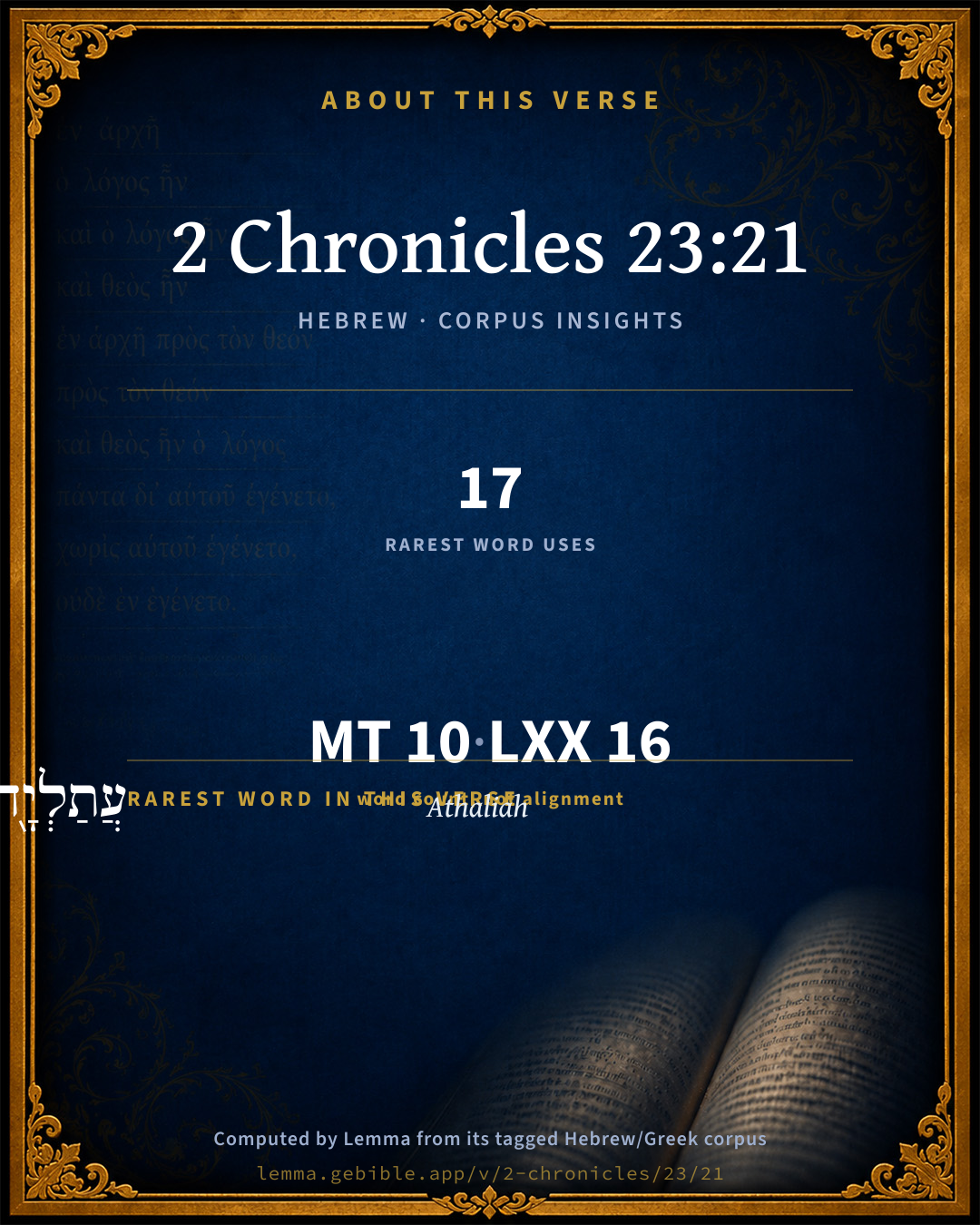
The rarest word here is עֲתַלְיָ֖הוּ Athaliah H6271 — appearing just 17 times in the whole Hebrew Bible.

Shared distinctive vocabulary

עֲתַלְיָ֖הוּ Athaliah H6271 occurs in 17 verses of the Hebrew Bible. Also found in:

Grammatical profile

  • 3 verbs
  • 6 nouns
  • 1 particle

Verb forms

  • וַיִּשְׂמְח֥וּ Qal · Sequential Imperfect
  • שָׁקָ֑טָה Qal · Perfect
  • הֵמִ֥יתוּ Hiphil · Perfect

Hebrew & Septuagint length

In English translation the verse runs 20 words from the Hebrew and 17 from the Septuagint (LXX English) — closely comparable.

A rough comparison of the two English renderings, which tokenize alike — not a word-level alignment.

Word counts can differ between the Hebrew and the Greek without any difference in meaning — e.g. the Hebrew direct-object marker אֵת has no separate Greek word, and Greek often adds the article ὁ.

In the original languages it is 10 Hebrew tokens and 16 Greek tokens — but the two are counted differently (Hebrew bundles its prefixes and suffixes into one token; the Greek is in lemma form), so that isn’t a like-for-like length.

Cross-references

5

Topical passages linked to 2 Chronicles 23:21 in the Treasury of Scripture Knowledge — connected by theme and wording, ordered by reader-vote popularity; previews shown in the World English Bible.

  • 2 Kings 11:20 So all the people of the land rejoiced, and the city was quiet. Athaliah they had slain with the sword at the king's house.
  • Psalms 58:10–11 The righteous shall rejoice when he sees the vengeance. He shall wash his feet in the blood of the wicked;
  • Proverbs 11:10 When it goes well with the righteous, the city rejoices. When the wicked perish, there is shouting.
  • Revelation 18:20 Rejoice over her, O heaven, you saints, apostles, and prophets; for God has judged your judgment on her."
  • Revelation 19:1–4 After these things I heard something like a loud voice of a great multitude in heaven, saying, "Hallelujah! Salvation, power, and glory belong to our God:

Cross-references courtesy of OpenBible.info (CC BY 4.0).

Hebrew and Greek witnesses Masoretic Hebrew ↔ Greek Septuagint

The same verse in the two great witnesses to the Old Testament, shown verse-for-verse.

These are two independent witnesses, not word-aligned to each other, and the Septuagint is shown in lemma (dictionary) form.

Hebrew 2 Chronicles 23:21 Masoretic · Westminster Leningrad Codex

וַיִּשְׂמְח֥וּ כָל עַם הָאָ֖רֶץ וְהָעִ֣יר שָׁקָ֑טָה וְאֶת עֲתַלְיָ֖הוּ הֵמִ֥יתוּ בֶחָֽרֶב

So all the people of the land rejoiced, and the city was quiet. Athaliah they had slain with the sword.

World English Bible · Public Domain

Greek LXX 2 Chronicles 23:21 Septuagint · lemma form

καί εὐφραίνω πᾶς ὁ λαός ὁ γῆ καί ὁ πόλις ἡσυχάζω καί ὁ γοθολια θανατόω μάχαιρα

And all the people of the land rejoiced; and the city was quiet: and they killed Gotholia.

LXX2012 (modern English Septuagint) · Public Domain

Hebrew: Westminster Leningrad Codex (CC BY 4.0). Greek: Septuagint (public domain); English from LXX2012 (modern English Septuagint) (Public Domain). How the Septuagint differs from the Hebrew →

Commentary

Notes on 2 Chronicles 23:21 from classic Christian and Jewish commentators (each source and its license shown beneath its notes). The classic Christian expositions comment on the surrounding passage and are grouped to its opening verse, so a note may address several verses; the Jewish commentaries on the Tanakh (Rashi and others) are per-verse, so they appear only where the commentator wrote on this verse.

Lemma curates 59 commentaries, every one of them public domain or Creative Commons licensed, each selected and text-cleaned for this edition rather than reprinted as found. About our sources →

Trapp's Complete Commentary

John Trapp

2Ch 23:21 And all the people of the land rejoiced: and the city was quiet, after that they had slain Athaliah with the sword.

Ver. 21. And all the people of the land rejoiced.] So, and much more shall the whole community of God’s people do, when the whore of Rome is executed by Christ, the true Jehoiada, who shall throw her out of the temple, and burn her with fire, because she hath slain the seed royal, put down kings at her pleasure, usurped the government of the Church, set up altars and images to Baalim, called such traitors as seek to set the crown upon Christ’s head, &c. But how impudent and ungrateful was Rhiston the Jesuit, who being condemned to die, and yet pardoned by Queen Elizabeth, ran beyond sea, and railed on her in print, saying that she was worse than Athaliah, Maachah, Jezebel, Herodias, &c.

John Trapp, A Commentary or Exposition upon All the Books of the Old and New Testament (1647–1656) — public domain. Text from a community e-Sword module.

The Biblical Illustrator

Joseph S. Exell

2Ch_23:21

And the city was quiet, after that they had slain Athaliah with the sword.

A wicked woman

Is it possible that a time may come when people will rejoice that we are dead? Will some pulpits be more honoured by emptiness man by occupancy? Will some businesses have a chance to recover their character when the principals are dead, but not so long as those principals initiate and conduct the policy of the house? Is it possible that a throne may be a fountain of mischief? Questions such as these, penetrating, unsparing, we should thrust into ourselves, that they may work first painfully and then curatively. Is there no explanation given of all this rejoicing over the death of Athaliah? The explanation is given in 2Ch_24:7 --that wicked woman. This is an alliteration which the grammarian might detest, the rhetorician avoid as a vice in eloquence, but which the moralist must look at with a sense of ineffable shame. Wicked woman--it is impossible! It ought to be an affront to the very genius of creation; say dark sun, say waterless sea, say flowerless summer, and the irony might be tolerated, for it might be only a discord in words; but wicked woman indicates a possibility that makes all hell easy of belief. This is the moral explanation of the physical disaster. Athaliah was slain with the sword--cry, Murder then! Arrest the homicide, the regicide! But wait; you know not all; the explanatory word found in the context--that wicked woman. (J. Parker, D.D.)

.

The Biblical Illustrator, edited by Joseph S. Exell (c. 1880s–1900s) — public domain. Text from a community e-Sword module.

Joseph Benson's Commentary

2Ch 23:21. All the people rejoiced: and the city was quiet — The generality of the people rejoiced, the rest were quiet, and made no opposition. When the son of David is enthroned in the soul, all therein is quiet, and springs of joy are opened.

Joseph Benson's Commentary on the Old and New Testaments (1811–1818) — public domain. Text from a community e-Sword module.

Geneva Bible (1599)

Geneva Bible translators

For where a tyrant and an idolater reigneth, there can be no quietness for the plagues of God are ever among such people.

Geneva Bible (1599) marginal notes — public domain. Text via Bolls.life.

Adam Clarke's Commentary

Verse 21. The city was quiet] There was no attempt at a counter-revolution. Concerning the coronation of Joash, there is a curious circumstance mentioned by the Targumist on 2Ch 23:11, it is as follows: -

"And they brought forth the son of the king, and put on him the royal crown which David took from the head of the king of the children of Ammon. In it was inserted the precious attracting stone, in which was engraven and expressed the great and honourable NAME [יהוה] which David had placed there by the Holy Spirit: and it was of the weight of a talent of gold; it was therefore a testimony to the house of David that no king who was not of the seed of David should be able to put it on his head, nor be able to bear its weight. When, therefore, the people saw it placed on the head of Joash, and that he was able to bear this crown, they believed him to be of the seed of David, and immediately constituted him king. Therefore Jehoiada and his sons anointed him, and said, May the king be prosperous in his kingdom!"

The Jews say that this was the crown of the king of the Ammonites; and that it was always worn afterwards by the kings of the house of Judah. See Jarchi on this place.

Adam Clarke's Commentary on the Bible (1810–1826) — public domain. Text from a community e-Sword/MySword module.

The Cambridge Bible for Schools and Colleges

gen. ed. J. J. S. Perowne

21. after that they had slain] R.V. and they slew.

The Cambridge Bible for Schools and Colleges (gen. ed. J. J. S. Perowne; Cambridge University Press, 1878–1918) — public domain. Text from a community e-Sword module.

The Pulpit Commentary

First purity, then peace.

the city was quiet, after that they had slain Athaliah with the sword." We can conceive of many occasions when the "slaying of a woman with the sword" should not and would not lead to quietude, but to unrest, to turbulence, and to strife. But this "wicked woman," Athaliah, was the impersonation of usurpation and of idolatry. To slay her was to "put away the evil thing" from above and from the midst of the people of God. It was an act of purgation, of cleansing of the nation"s conscience. It was a spiritual upheaval, throwing off a heavy weight that rested on the spirit of obedience. It was an act of excision, cutting off the guilty "right hand" that the "whole body" might be saved. If there be in the way of our conscientious adhesion to the cause, and engagement in the service, of Christ any such obstacle as was this Athaliah to the people of Judah, then no half-measures will suffice. The evil, whatever it be, must be slain with the sword, must be "done to death," must be relentlessly rooted out; then, and net till then, will there be quiet through all the region of the soul. We may find this Athaliah of ours in

I AN INSINCERE PROFESSION OF FAITH we no longer hold, and consequently a disloyal practice in which we do not believe.

II AN IMMORAL OR INJURIOUS HABIT, which may be secretly cherished, but which we know to be guilty.

III AN UNLAWFUL GAIN, which our conscience condemns.

IV A COMPANIONSHIP (or companionships), which cannot be retained while Jesus Christ is honoured and obeyed. C.

The Pulpit Commentary (1880–1919), ed. H.D.M. Spence-Jones & Joseph S. Exell — public domain. Text from a community e-Sword module.

John Wesley's Explanatory Notes

Rejoiced, &c. - The generality of the people rejoiced, the rest were quiet and made no opposition. When the Son of David is enthroned in the soul, all therein is quiet, and springs of joy are opened.

John Wesley, Explanatory Notes Upon the Whole Bible (1754–1765) — public domain. Text via the GEBible commentary corpus.

Lesson kit

Teaching starters — assembled from the data on this page, not authored interpretation. Every prompt links to the verse data it draws on. Edit before teaching.

2 Chronicles, in the Historical, opens this verse with 10 words (10 distinct Hebrew lemmas). Its most distinctive word is ʻĂthalyâh (“Athaliah”). A historical commentator’s framing appears above. Read the whole chapter for the surrounding context.

Discussion questions

  1. The word ʻĂthalyâh carries the sense “Athaliah.” How does it shape the verse?
  2. 2 Kings 8:26 shares the word «Athaliah» with this verse. How do the two illuminate each other?
  3. These translations render this verse differently; the difference is in the English rendering, not the original. What questions does that raise?
  4. The verb «וַיִּשְׂמְח֥וּ» is Qal Sequential Imperfect. How does its form color the action?
  5. Reading how Trapp's Complete Commentary and The Biblical Illustrator read this verse, where do the two commentators agree and where do they part?

Things to notice

Reading settings

Reading text

Shown beneath each verse's original-language words.

Old Testament
Old Testament edition

Read the OT as the Masoretic Hebrew (MT) or the Greek Septuagint (LXX).

English shown for the Greek Septuagint (in the Hebrew ↔ Greek comparison).

Comparing translations? Open the Compare panel on any verse page to stack up to four side by side.