
2 Samuel 15:14

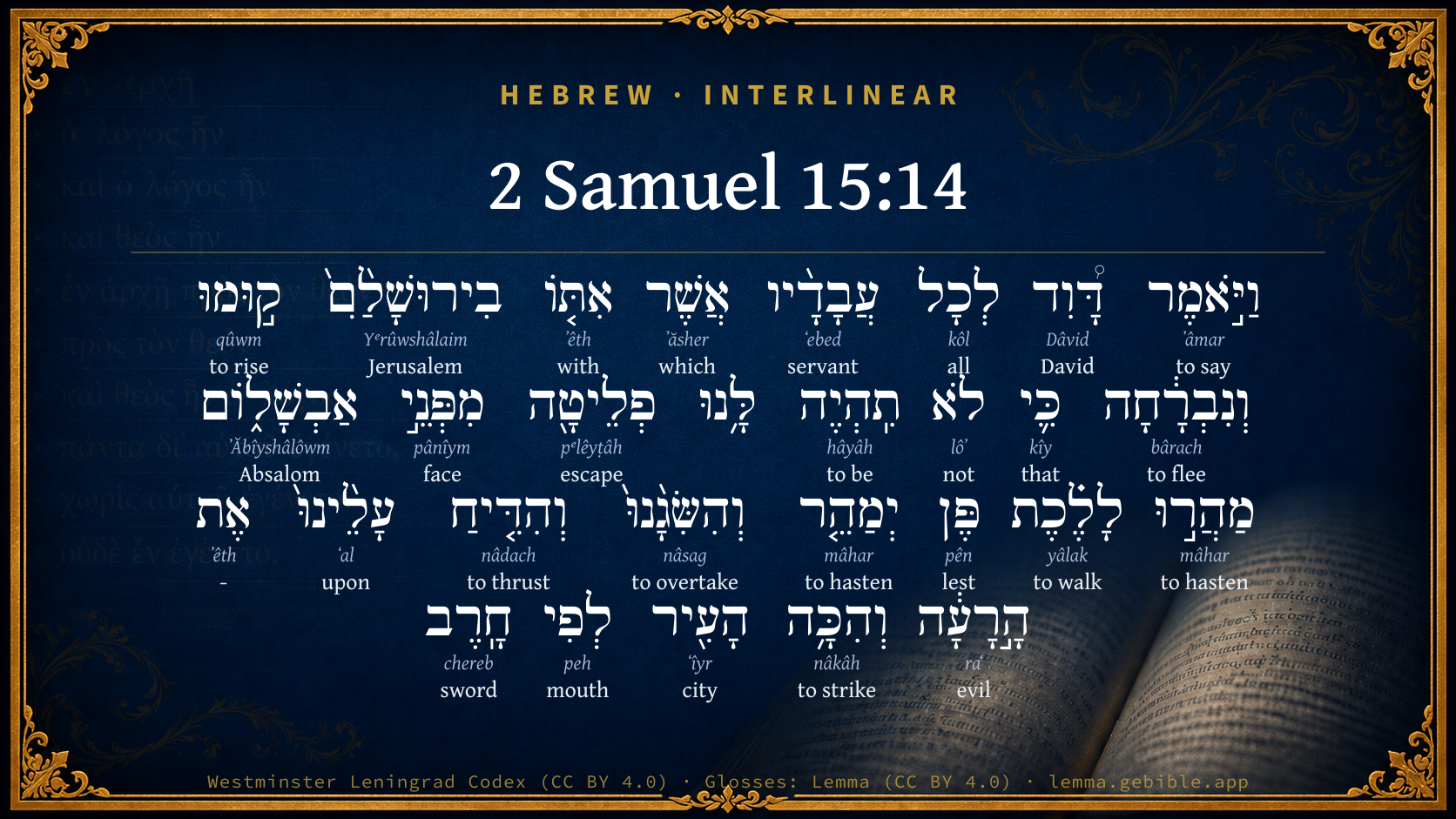
Hebrew (Westminster Leningrad Codex) 2 Samuel 15:14 appears in the Hebrew Old Testament. The text above is from the Westminster Leningrad Codex. Each word links to its Strong’s number, a concise gloss, and parsing drawn from the Open Scriptures Hebrew Bible morphology. Click any word for its full Brown-Driver-Briggs (BDB) entry.
Download image
Cite this verse

2 Samuel 15:14 (World English Bible). Public Domain. Lemma interlinear Bible study tool, https://lemma.gebible.app/v/2-samuel/15/14.

Show BibTeX & RIS
BibTeX
RIS
English Translation
David said to all his servants who were with him at Jerusalem, Arise, and let us flee; for else none of us shall escape from Absalom: make speed to depart, lest he overtake us quickly, and bring down evil on us, and strike the city with the edge of the sword.
World English Bible · Public Domain
Download a study sheet

One document with this verse’s original text, its word-by-word gloss line, the meaning frame, cross-references with their text, attributed commentary, and full source and license credits — printable, and it pastes into notes with its structure intact.

This verse Autodidact and up

Study sheet (.html) Plain text (.txt)

A passage Seminary Student

Up to 50 verses in one chapter. A passage sheet keeps up to 6 commentary sources and 12 cross-references per verse, in the order this page ranks them, and says so on the sheet whenever that leaves anything out. Ask for a single verse and you get the Autodidact verse sheet above.

Everything on this page stays free to read, with no account — the sheet is a download of what is already on screen, not access to it.

Want to remove ads? Support Godless Engineer
Compare translations 3

The same verse in 3 English versions, stacked beneath the original-language interlinear above. Click any original word for its lexicon entry.

Each is an independent rendering of the whole verse — the interlinear is not word-aligned to these translations.

Highlighted words mark where these versions differ — a whole-verse word diff, not a word-by-word alignment.

  • World English Bible Public Domain
    David said to all his servants who were with him at Jerusalem, Arise, and let us flee; for else none of us shall escape from Absalom: make speed to depart, lest he overtake us quickly, and bring down evil on us, and strike the city with the edge of the sword.
  • King James Version Public Domain
    And David said unto all his servants that were with him at Jerusalem, Arise, and let us flee; for we shall not else escape from Absalom: make speed to depart, lest he overtake us suddenly, and bring evil upon us, and smite the city with the edge of the sword.
  • unfoldingWord Literal Text CC BY-SA 4.0
    And David said to all of his servants who with him in Jerusalem, “Arise, and let us flee, for there will not be for us an escape from the face of Absalom. Hurry to go, lest he hurry and overtake us and bring harm upon us and strike the city to the mouth of the sword.”

unfoldingWord Literal Text — © unfoldingWord, licensed CC BY-SA 4.0. Word-aligned USFM3 via Door43 (git.door43.org/unfoldingWord/en_ult).

Versions to compare (up to 4)

3 of 4 selected

Show all 18 translations

Every available English version of this verse, each an independent rendering of the whole verse.

  • World English Bible Public Domain
    David said to all his servants who were with him at Jerusalem, Arise, and let us flee; for else none of us shall escape from Absalom: make speed to depart, lest he overtake us quickly, and bring down evil on us, and strike the city with the edge of the sword.
  • Berean Standard Bible Public Domain
    And David said to all the servants with him in Jerusalem, “Arise and let us flee, or we will not escape from Absalom! We must leave quickly, or he will soon overtake us, heap disaster on us, and put the city to the sword.”
  • Majority Standard Bible Public Domain
    And David said to all the servants with him in Jerusalem, “Arise and let us flee, or we will not escape from Absalom! We must leave quickly, or he will soon overtake us, heap disaster on us, and put the city to the sword.”
  • King James Version Public Domain
    And David said unto all his servants that were with him at Jerusalem, Arise, and let us flee; for we shall not else escape from Absalom: make speed to depart, lest he overtake us suddenly, and bring evil upon us, and smite the city with the edge of the sword.
  • American Standard Version (1901) Public Domain
    And David said unto all his servants that were with him at Jerusalem, Arise, and let us flee; for else none of us shall escape from Absalom: make speed to depart, lest he overtake us quickly, and bring down evil upon us, and smite the city with the edge of the sword.
  • Revised Version (1885) Public Domain
    And David said unto all his servants that were with him at Jerusalem, Arise, and let us flee; for else none of us shall escape from Absalom: make speed to depart, lest he overtake us quickly, and bring down evil upon us, and smite the city with the edge of the sword.
  • Geneva Bible (1599) Public Domain
    Then Dauid sayd vnto all his seruants that were with him at Ierusalem, Vp, and let vs flee: for we shall not escape from Absalom: make speede to depart, lest he come suddenly and take vs, and bring euill vpon vs, and smite the citie with the edge of the sworde.
  • Douay-Rheims (1899) Public Domain
    And David said to his servants, that were with him in Jerusalem: Arise and let us flee: for we shall not escape else from the face of Absalom: make haste to go out, lest he come and overtake us, and bring ruin upon us, and smite the city with the edge of the sword.
  • Young's Literal Translation Public Domain
    And David saith to all his servants who `are' with him in Jerusalem, `Rise, and we flee, for we have no escape from the face of Absalom; haste to go, lest he hasten, and have overtaken us, and forced on us evil, and smitten the city by the mouth of the sword.'
  • Literal Standard Version CC BY-SA 4.0
    And David says to all his servants who [are] with him in Jerusalem, “Rise, and we flee, for we have no escape from the face of Absalom; hurry to go, lest he hurries, and has overtaken us, and forced evil on us, and struck the city by the mouth of the sword.”
  • Unlocked Literal Bible CC BY-SA 4.0
    So David said to all his servants who were with him at Jerusalem, “Arise and let us flee, or none of us will escape from Absalom. Prepare to leave immediately, or he will quickly overtake us, and he will bring down disaster on us and attack the city with the edge of the sword.”
  • unfoldingWord Literal Text CC BY-SA 4.0
    And David said to all of his servants who with him in Jerusalem, “Arise, and let us flee, for there will not be for us an escape from the face of Absalom. Hurry to go, lest he hurry and overtake us and bring harm upon us and strike the city to the mouth of the sword.”
  • Darby Bible Public Domain
    And David said to all his servants that were with him at Jerusalem, Rise up and let us flee; for we shall not [else] escape from Absalom. Be quick to depart, lest he overtake us quickly, and bring evil upon us, and smite the city with the edge of the sword.
  • World Messianic Bible Public Domain
    David said to all his servants who were with him at Jerusalem, “Arise! Let’s flee, or else none of us will escape from Absalom. Hurry to depart, lest he overtake us quickly and bring down evil on us, and strike the city with the edge of the sword.”
  • Webster's Bible Public Domain
    And David said to all his servants that were with him at Jerusalem, Arise, and let us flee; for we shall not else escape from Absalom: make speed to depart, lest he should overtake us suddenly, and bring evil upon us, and smite the city with the edge of the sword.
  • Free Bible Version CC BY-SA 4.0
    David said to all the officials with him in Jerusalem, “Quick! Let's go! Otherwise we won't be able to get away from Absalom! We must leave immediately, or he will soon catch up with us, attack us, and kill the people here in the city.”
  • Bible in Basic English Public Domain
    And David said to all his servants who were with him at Jerusalem, Come, let us go in flight, or not one of us will be safe from Absalom: let us go without loss of time, or he will overtake us quickly and send evil on us, and put the town to the sword.
  • JPS Tanakh (1917) Public Domain
    And David said unto all his servants that were with him at Jerusalem: 'Arise, and let us flee; or else none of us shall escape from Absalom; make speed to depart, lest he overtake us quickly, and bring down evil upon us, and smite the city with the edge of the sword.'

Literal Standard Version (2020), Covenant Press — licensed CC BY-SA 4.0. Text via the HelloAO Bible API (eBible.org). Unlocked Literal Bible (unfoldingWord) — licensed CC BY-SA 4.0. Text via the HelloAO Bible API (eBible.org). unfoldingWord Literal Text — © unfoldingWord, licensed CC BY-SA 4.0. Word-aligned USFM3 via Door43 (git.door43.org/unfoldingWord/en_ult). Free Bible Version, Dr. Jonathan Gallagher — licensed CC BY-SA 4.0. Text via the HelloAO Bible API (eBible.org).

Word by word

More ways to search: Search by grammar → Find every occurrence → Compare this word →

Practice this passage: Drill this verse → Learn its vocabulary →

פְלֵיטָ֖ה
pᵉlêyṭâh
H6413
“escape”
Noun, Common, Feminine, Singular, Absolute
Part of Speech
Noun
Type
Common
Gender
Feminine
Number
Singular
State
Absolute
Full BDB Definition

Origin: from H6412

TWOT: 1774d

escape, deliverance - escape, deliverance - escaped remnant
  1. וַיֹּ֣אמֶר ʼâmar H559 “and · to say” Conjunction + Verb, Qal, Sequential Imperfect, 3rd Person, Masculine, Singular
  2. דָּ֠וִד Dâvid H1732 “David” Noun, Proper
  3. לְכָל kôl H3605 “to/for · all of” Preposition + Noun, Common, Masculine, Singular, Construct
  4. עֲבָדָ֨יו ʻebed H5650 “servants · his” Noun, Common, Masculine, Plural, Construct + Suffix, Personal, 3rd Person, Masculine, Singular
  5. אֲשֶׁר ʼăsher H834 “which” Particle, Relative
  6. אִתּ֤וֹ ʼêth H854 “with · him” Preposition + Suffix, Personal, 3rd Person, Masculine, Singular
  7. בִירוּשָׁלִַ֨ם֙ Yᵉrûwshâlaim H3389 “in/at · Jerusalem” Preposition + Noun, Proper
  8. ק֣וּמוּ qûwm H6965 “rise” Verb, Qal, Imperative, 2nd Person, Masculine, Plural
  9. וְנִבְרָ֔חָה bârach H1272 “and · to flee” Conjunction + Verb, Qal, Cohortative, 1st Person, Common, Plural
  10. כִּ֛י kîy H3588 “that” Conjunction
  11. לֹא lôʼ H3808 “not” Particle, Negative
  12. תִֽהְיֶה hâyâh H1961 “to be” Verb, Qal, Imperfect, 3rd Person, Feminine, Singular
  13. מִפְּנֵ֣י pânîym H6440 “from · face(s) of” Preposition + Noun, Common, Both, Plural, Construct
  14. אַבְשָׁל֑וֹם ʼĂbîyshâlôwm H53 “Absalom” Noun, Proper
  15. מַהֲר֣וּ mâhar H4116 “hasten” Verb, Piel, Imperative, 2nd Person, Masculine, Plural
  16. לָלֶ֗כֶת yâlak H3212 “to walk” Preposition + Verb, Qal, Infinitive Construct
  17. פֶּן pên H6435 “lest” Conjunction
  18. יְמַהֵ֤ר mâhar H4116 “to hasten” Verb, Piel, Imperfect, 3rd Person, Masculine, Singular
  19. וְהִשִּׂגָ֨נוּ֙ nâsag H5381 “and · to overtake · us” Conjunction + Verb, Hiphil, Sequential Perfect, 3rd Person, Masculine, Singular + Suffix, Personal, 1st Person, Common, Plural
  20. וְהִדִּ֤יחַ nâdach H5080 “and · to thrust” Conjunction + Verb, Hiphil, Sequential Perfect, 3rd Person, Masculine, Singular
  21. עָלֵ֨ינוּ֙ ʻal H5921 “upon · us” Preposition + Suffix, Personal, 1st Person, Common, Plural
  22. אֶת ʼêth H853 “-” Particle, Direct Object
  23. הָ֣רָעָ֔ה raʻ H7451 “the · evil” Particle, Definite Article + Noun, Common, Feminine, Singular, Absolute
  24. וְהִכָּ֥ה nâkâh H5221 “and · to strike” Conjunction + Verb, Hiphil, Sequential Perfect, 3rd Person, Masculine, Singular
  25. הָעִ֖יר ʻîyr H5892 “the · city” Particle, Definite Article + Noun, Common, Feminine, Singular, Absolute
  26. לְפִי peh H6310 “to/for · mouth of” Preposition + Noun, Common, Masculine, Singular, Construct
  27. חָֽרֶב chereb H2719 “sword” Noun, Common, Feminine, Singular, Absolute

About this verse

These counts appear in no published source. They are computed here, from the morphology-tagged text and Lemma’s own curated glosses. What Lemma adds →

29
words
27
distinct lemmas
Historical
section

Shared distinctive vocabulary

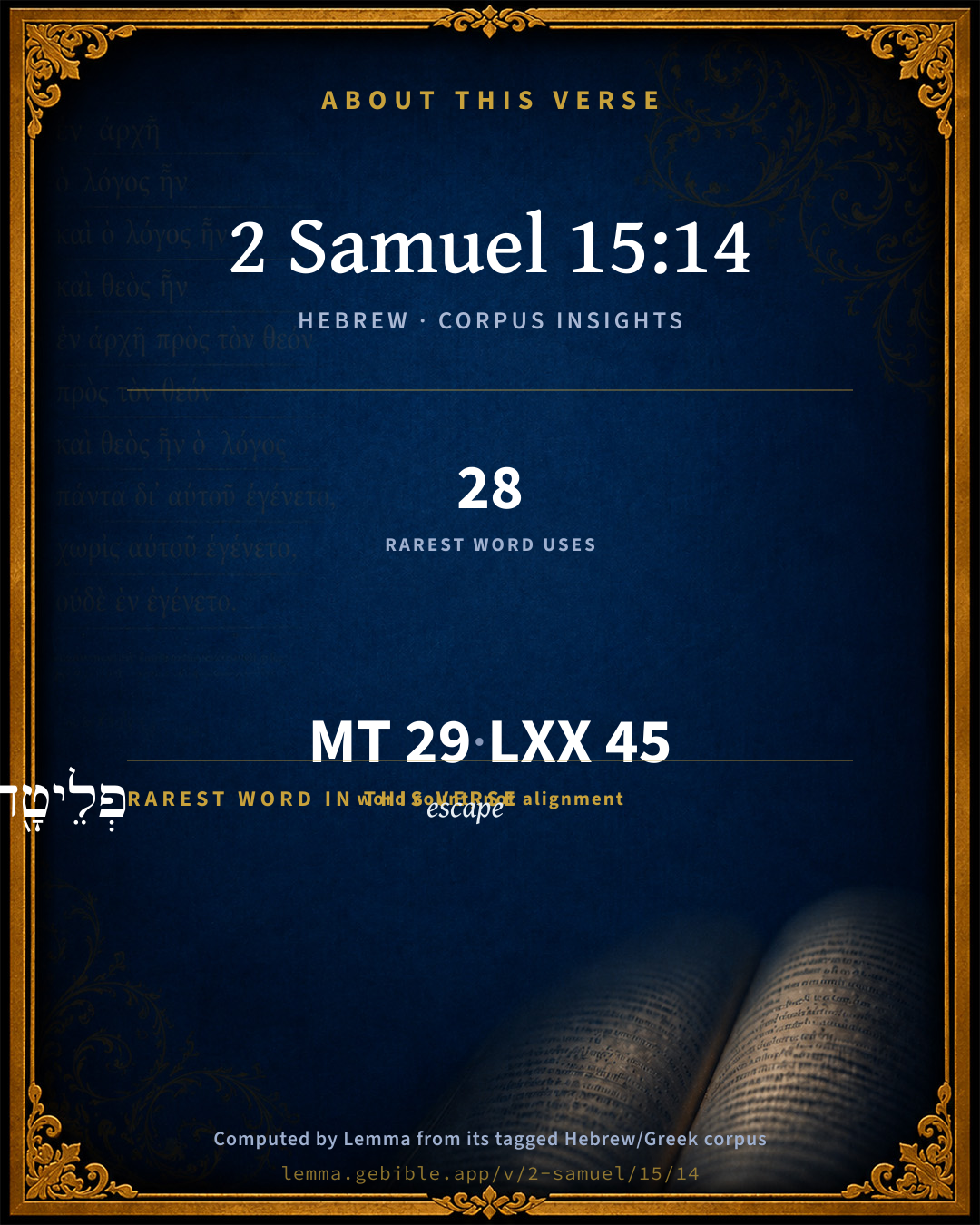
פְלֵיטָ֖ה escape H6413 occurs in 28 verses of the Hebrew Bible. Also found in:

Grammatical profile

  • 10 verbs
  • 11 nouns
  • 3 prepositions
  • 2 conjunctions
  • 3 particles

Verb forms

  • וַיֹּ֣אמֶר Qal · Sequential Imperfect
  • ק֣וּמוּ Qal · Imperative
  • וְנִבְרָ֔חָה Qal · Cohortative
  • תִֽהְיֶה Qal · Imperfect
  • מַהֲר֣וּ Piel · Imperative
  • לָלֶ֗כֶת Qal · Infinitive Construct
  • יְמַהֵ֤ר Piel · Imperfect
  • וְהִשִּׂגָ֨נוּ֙ Hiphil · Sequential Perfect
  • וְהִדִּ֤יחַ Hiphil · Sequential Perfect
  • וְהִכָּ֥ה Hiphil · Sequential Perfect

Repetition

A word recurs within this verse — often emphatic in Hebrew:

  • מַהֲר֣וּ to hasten H4116 ×2

Hebrew & Septuagint length

In English translation the verse runs 51 words from the Hebrew and 49 from the Septuagint (LXX English) — closely comparable.

A rough comparison of the two English renderings, which tokenize alike — not a word-level alignment.

Word counts can differ between the Hebrew and the Greek without any difference in meaning — e.g. the Hebrew direct-object marker אֵת has no separate Greek word, and Greek often adds the article ὁ.

In the original languages it is 29 Hebrew tokens and 45 Greek tokens — but the two are counted differently (Hebrew bundles its prefixes and suffixes into one token; the Greek is in lemma form), so that isn’t a like-for-like length.

Cross-references

10

Topical passages linked to 2 Samuel 15:14 in the Treasury of Scripture Knowledge — connected by theme and wording, ordered by reader-vote popularity; previews shown in the World English Bible.

  • 2 Samuel 19:9 All the people were at strife throughout all the tribes of Israel, saying, The king delivered us out of the hand of our enemies, and he saved us out of the hand of the Philistines; and now he is fled out of the land from Absalom.
  • 2 Samuel 12:11 This is what Yahweh says: 'Behold, I will raise up evil against you out of your own house; and I will take your wives before your eyes, and give them to your neighbor, and he will lie with your wives in the sight of this sun.
  • 2 Samuel 23:16–17 The three mighty men broke through the host of the Philistines, and drew water out of the well of Bethlehem, that was by the gate, and took it, and brought it to David: but he would not drink of it, but poured it out to Yahweh.
  • Psalms 3:1–8 Yahweh, how my adversaries have increased! Many are those who rise up against me.
  • Psalms 51:18 Do well in your good pleasure to Zion. Build the walls of Jerusalem.
  • Psalms 55:3–11 Because of the voice of the enemy, Because of the oppression of the wicked. For they bring suffering on me. In anger they hold a grudge against me.
  • Psalms 137:5–6 If I forget you, Jerusalem, Let my right hand forget its skill.
  • Ezekiel 46:18 Moreover the prince shall not take of the people's inheritance, to thrust them out of their possession; he shall give inheritance to his sons out of his own possession, that my people not be scattered every man from his possession.
  • Matthew 11:12 From the days of John the Baptizer until now, the Kingdom of Heaven suffers violence, and the violent take it by force.
  • Luke 10:15 You, Capernaum, who are exalted to heaven, will be brought down to Hades.

Cross-references courtesy of OpenBible.info (CC BY 4.0).

Hebrew and Greek witnesses Masoretic Hebrew ↔ Greek Septuagint

The same verse in the two great witnesses to the Old Testament, shown verse-for-verse.

These are two independent witnesses, not word-aligned to each other, and the Septuagint is shown in lemma (dictionary) form.

Hebrew 2 Samuel 15:14 Masoretic · Westminster Leningrad Codex

וַיֹּ֣אמֶר דָּ֠וִד לְכָל עֲבָדָ֨יו אֲשֶׁר אִתּ֤וֹ בִירוּשָׁלִַ֨ם֙ ק֣וּמוּ וְנִבְרָ֔חָה כִּ֛י לֹא תִֽהְיֶה לָּ֥נוּ פְלֵיטָ֖ה מִפְּנֵ֣י אַבְשָׁל֑וֹם מַהֲר֣וּ לָלֶ֗כֶת פֶּן יְמַהֵ֤ר וְהִשִּׂגָ֨נוּ֙ וְהִדִּ֤יחַ עָלֵ֨ינוּ֙ אֶת הָ֣רָעָ֔ה וְהִכָּ֥ה הָעִ֖יר לְפִי חָֽרֶב

David said to all his servants who were with him at Jerusalem, Arise, and let us flee; for else none of us shall escape from Absalom: make speed to depart, lest he overtake us quickly, and bring down evil on us, and strike the city with the edge of the sword.

World English Bible · Public Domain

Greek LXX 2 Samuel 15:14 Septuagint · lemma form

καί εἶπον δαυίδ πᾶς ὁ παῖς αὐτός ὁ μετά αὐτός ὁ ἐν ἰερουσαλήμ ἀναἵστημι καί φεύγω ὅτι οὐ εἰμί ἐγώ σωτηρία ἀπό πρόσωπον αβεσσαλωμ ταχύνω ὁ πορεύομαι ἵνα μή ταχύνω καί καταλαμβάνω ἐγώ καί ἐκὠθέω ἐπί ἐγώ ὁ κακία καί πατάσσω ὁ πόλις στόμα μάχαιρα

And David said to all his servants who were with him in Jerusalem, Rise, and let us flee, for we have no refuge from Abessalom: make haste and go, lest he overtake us speedily, and bring evil upon us, and strike the city with the edge of the sword.

LXX2012 (modern English Septuagint) · Public Domain

Hebrew: Westminster Leningrad Codex (CC BY 4.0). Greek: Septuagint (public domain); English from LXX2012 (modern English Septuagint) (Public Domain). How the Septuagint differs from the Hebrew →

Targum (Aramaic paraphrase)

1

The Targum is the ancient Jewish Aramaic paraphrase of the Hebrew Scriptures — an interpretive translation, not the Hebrew text itself. Onkelos (literal) and Pseudo-Jonathan (expansive) render the Torah, and Jonathan the Prophets. Coverage is partial: where no permissively-licensed English translation exists for a verse, only the Aramaic is shown. This is verse-level text, not a word-by-word alignment to the Hebrew.

  1. Targum Jonathan Prophets (Joshua–Malachi)
    וַאֲמַר דָוִד לְכָל עַבְדוֹהִי דִי עִמֵיהּ בִּירוּשְׁלֵם קוּמוּ וְנַעֲרוֹק אֲרֵי לָא תְהֵי לָנָא שֵׁיזְבָא מִן קֳדָם אַבְשָׁלוֹם אוֹחוּ לְמֵיזַל דִילְמָא יוֹחִי וְיִדְבְּקִינָנָא וְיִכְמוֹן יַת בִּישְׁתָא עֲלָנָא וְיִמְחֵי יַת קַרְתָּא לְפִתְגַם דְחָרֶב:

    (no public-domain English translation for this verse)

    Targum Jonathan — Aramaic: “Mikraot Gedolot” (public domain). English: “Sefaria Community Translation” (CC0 1.0 (public-domain dedication)); “London "Chaldee Paraphrase," 1871” (public domain). Text via Sefaria.

Commentary

Notes on 2 Samuel 15:14 from classic Christian and Jewish commentators (each source and its license shown beneath its notes). The classic Christian expositions comment on the surrounding passage and are grouped to its opening verse, so a note may address several verses; the Jewish commentaries on the Tanakh (Rashi and others) are per-verse, so they appear only where the commentator wrote on this verse.

Lemma curates 59 commentaries, every one of them public domain or Creative Commons licensed, each selected and text-cleaned for this edition rather than reprinted as found. About our sources →

Trapp's Complete Commentary

John Trapp

2Sa 15:14 And David said unto all his servants that [were] with him at Jerusalem, Arise, and let us flee; for we shall not [else] escape from Absalom: make speed to depart, lest he overtake us suddenly, and bring evil upon us, and smite the city with the edge of the sword.

Ver. 14. Arise, and let us flee.] And so prevent, what in us lieth, the misery of a civil war, and the sacking of the city.

And bring evil upon us.] Impellatque super nos malum, push evil upon us by a sudden surprise. This he spake, not for want of courage, {witness Psa 3:1-8} or of good company about him, but out of prudence, and willingness to serve God’s providence.

John Trapp, A Commentary or Exposition upon All the Books of the Old and New Testament (1647–1656) — public domain. Text from a community e-Sword module.

The Biblical Illustrator

Joseph S. Exell

2Sa_15:14-24

Arise and let us flee.

Davids flight

The motive for the flight was probably a patriotic one. David would not, let the city be destroyed by civil war. Like Louis Philippe, he could: not hear to shed his peoples blood. This tenderness of disposition, so unlike the spirit of the times, is characteristic of him. (1Ch_21:17.)

1. Notice the different classes of people who went out with the king, displaying different aspects of loyalty.

(1) The servants of the household (2Sa_15:15). Unqualified obedience, whatsoever (Joh_2:5; Joh_15:14).

(2) The sympathising people.

(3) The bodyguard. Cherethites and Pelethites (1Ki_1:38-44). (Foreigners, Eze_25:16; 1Sa_30:14; Eph_2:19.)

(4) Ittai and his Gittites--mercenaries become volunteers. Story of Ittai. From Gath, a Philistine city, probably (2Sa_15:19), an exile from his own country, who had taken refuge with David.

The special lessons he teaches. True service must be voluntary. (Psa_40:8; Deu_28:47.) Whose service is perfect freedom. It becomes so in proportion as we know and love the one served. (2Co_5:14; Son_1:4.) Duty a lower motive-power than love. (Duty would have constrained Ittai to fight well, but not to endure exile.) All soul-satisfying religion centres round a person, not a system, or a doctrine. Believe on the Lord Jesus Christ, not only in His work for you. A man the real object of love and trust. The God-man--Emmanuel. (R. E. Faulkner.)

David retires from the capital to the east of the Jordan

David is evidently taken completely by surprise. The reasons for his hasty resolution to leave his fortified capital are not clear from the narrative before us. Had he grounds for suspecting the loyalty of the population, perhaps still predominantly Jebusite? Of no single day in the whole course of the recorded history of the Hebrews have we so detailed a record as we have of the day on which David fled before his undutiful son. From the time when, in the morning hours: he passed in haste through the eastern gate until, before the next day dawned (2Sa_17:22),. he and all his following had safely crossed the Jordan, every hour is crowded with life and incident, and every line of the narrative is instinct with the emotions and impulses, good and bad, that mould the lives of men. (Century Bible.)

A kings flight from his capital

James II. was fleeing from his English subjects. At three in the morning of Tuesday, the 11th of December, James rose, took the great seal in his hand, laid his commands on Northumberland not to open the door of the bed-chamber till the usual hour, and disappeared through a secret passage . . . Sir Edward Hales was in attendance with a hackney coach. James was conveyed to Milbank, where he crossed the Thames in a small wherry. As he passed Lambeth he flung the great seal into the midst of the stream, whence, after many months, it was accidentally caught by a fishing-net and dragged up. (Macaulays England.)

The Biblical Illustrator, edited by Joseph S. Exell (c. 1880s–1900s) — public domain. Text from a community e-Sword module.

Joseph Benson's Commentary

2Sa 15:14. David said, Arise, and let us flee — As soon as he had received information of what had passed, he saw the danger was instant, and took his measures accordingly. He knew Absalom would lose no time to accomplish his design, and that the nature of it required him to strike home at once. David therefore orders his servants, soldiery, and friends, to depart from Jerusalem immediately. For, though the fort of Zion was strong, and he might have defended himself there for some time, yet he had not laid in provisions for a long siege; and, if he had been once besieged there, Absalom would have got speedy possession of his whole kingdom, whereas, if he marched abroad, he might raise a considerable army for his defence. Besides, the greatest part of Jerusalem could not be well defended against an enemy. And if it could, “he did not care to expose a favourite city, built by himself, and the residence of the tabernacle of God, to all the evils incident to sieges, and almost inseparable from them. Nor, perhaps, did he incline to trust the inhabitants of a place so long exposed to the taint of Absalom’s temptations.” This, some think, appears from the 55th Psalm, which, they suppose, was meditated and poured out in prayer to God upon the discovery of Absalom’s conspiracy. And from thence it is evident that he had discerned the seeds and workings of a conspiracy in the city, and that Ahithophel was at the bottom of it: and not only so, but that David foresaw his sudden and sad end. — Delaney. For we shall not else escape from Absalom — He was well acquainted with the young man’s impetuosity, and the madness of the people, and therefore judged that the only method to be pursued, in order to safety, was to give way to the fury of the flood, and not attempt to stem it in the fulness of its overflowing.

Joseph Benson's Commentary on the Old and New Testaments (1811–1818) — public domain. Text from a community e-Sword module.

Geneva Bible (1599)

Geneva Bible translators

Whose heart he saw that Satan had so possessed, that he would leave no mischief unattempted.

Geneva Bible (1599) marginal notes — public domain. Text via Bolls.life.

Jamieson, Fausset & Brown

Robert Jamieson, A. R. Fausset & David Brown

DAVID FLEES FROM JERUSALEM. (2Sa. 15:13-37)

David said . . . Arise, and let us flee--David, anxious for the preservation of the city which he had beautified, and hopeful of a greater support throughout the country, wisely resolved on leaving Jerusalem.

Jamieson, Fausset & Brown — Commentary Critical and Explanatory on the Whole Bible (1871) — public domain (CC PDM 1.0). Text via the HelloAO Bible API.

Adam Clarke's Commentary

Verse 14. David said - Arise - let us flee] This, I believe, was the first time that David turned his back to his enemies. And why did he now flee? Jerusalem, far from not being in a state to sustain a siege, was so strong that even the blind and the lame were supposed to be a sufficient defence for the walls, see 2Sa 5:6. And he had still with him his faithful Cherethites and Pelethites; besides six hundred faithful Gittites, who were perfectly willing to follow his fortunes. There does not appear any reason why such a person, in such circumstances, should not act on the defensive; at least till he should be fully satisfied of the real complexion of affairs. But he appears to take all as coming from the hand of God; therefore he humbles himself, weeps, goes barefoot, and covers his head! He does not even hasten his departure, for the habit of mourners is not the habit of those who are flying before the face of their enemies. He sees the storm, and he yields to what he conceives to be the tempest of the Almighty.

Adam Clarke's Commentary on the Bible (1810–1826) — public domain. Text from a community e-Sword/MySword module.

Ellicott's Commentary for English Readers

(14) Let us flee.—The sequel abundantly proved the wisdom of David’s course. Ahithophel also (2Sa_17:1-2) and Hushai (2Sa_17:7-13) recognised that delay would be fatal to Absalom’s cause. His rebellion was thoroughly unreasonable, and must lose ground with time given for reflection. By this course also much of the horror of civil war was averted, and Jerusalem saved from “the edge of the sword.”

A Bible Commentary for English Readers, edited by Charles John Ellicott (1878–1897) — public domain. Text from a community e-Sword module.

The Cambridge Bible for Schools and Colleges

gen. ed. J. J. S. Perowne

14. let us flee] For the moment David’s courage seems to have failed him. The calamities predicted by Nathan (ch. 2Sa_12:11), stared him in the face: a sack of Jerusalem with all the horrors of civil war seemed imminent: he could not face them, and retreat proved in the end to be the wisest course. Time was gained; the first violence of rebellion spent itself; his loyal subjects recovered from their alarm and rallied to defend him. Ahithophel was perfectly right in discerning that delay would be fatal to the enterprise (ch. 2Sa_17:1-2).

The Cambridge Bible for Schools and Colleges (gen. ed. J. J. S. Perowne; Cambridge University Press, 1878–1918) — public domain. Text from a community e-Sword module.

John Gill's Exposition

And David said unto all his servants that were with him at Jerusalem,.... His courtiers and ministers of state, the officers of his household, as many of them as were with him in the city; for some of them very probably were in the country, as Ahithophel was, and some might be along with Absalom, whom he had invited to his peace offerings:

arise, and let us flee; it is much that a man of such courage and valour as David should be so intimidated at once as to make a flight as soon as he heard of a conspiracy forming against him:

for we shall not else escape from Absalom; his fears ran so high, that he fancied he would be upon them presently:

make speed to depart, lest he overtake us suddenly; which still more clearly shows the panic he was in:

and bring evil upon us; kill them, or make them prisoners:

and smite the city with the edge of the sword; the inhabitants of it, should they make resistance.

John Gill's Exposition of the Whole Bible (1746–1763) — public domain (CC PDM 1.0). Text via the HelloAO Bible API.

Albert Barnes' Notes on the Bible

And smite the city - David’s kind nature induced him to spare Jerusalem the horrors of a siege, and the risk of being taken by assault. He had no standing army with which to resist this sudden attack from so unexpected a quarter. Possibly too he remembered Nathan’s prophecy 2Sa 12:10-12.

Albert Barnes' Notes on the Bible (1834–1885) — public domain. Text from a community e-Sword/MySword module.

Haydock's Catholic Bible Commentary

Ruin, of a house falling. Hebrew, "evil." David gives way to the fury of the rebels, hoping that they will enter into themselves, without bloodshed. He departs on foot, like a penitent, acknowledging the justice of God. Fear does not prompt him to leave Jerusalem, which was a place of such strength, (chap. v. 6.) nor are his attendants abandoned on a sudden by that courage, which made some of them a match for a whole army. David disposes of all things with great coolness and prudence. (Calmet) --- He wishes to appease God. (Menochius)

George Leo Haydock (1774–1849), Haydock's Catholic Family Bible and Commentary, 1859 edition — public domain. Excludes Psalms (Douay-Rheims chapter numbering differs from Protestant) and Deuterocanonical books (Catholic canon only).

Matthew Poole's English Annotations

Arise, and let us flee; for though the fort of Zion was strong and impregnable, and he might have defended himself there; yet he had not laid in provisions for a long siege; and, if he had been once besieged there, Absalom would have got speedy and quiet possession of his whole kingdom; whereas if he marched abroad, he might raise a considerable army for his defence, and the suppression of the rebels. Besides, the greatest part of Jerusalem could not be well defended against him. And he suspected that a great number of the citizens might take part with Absalom, and possibly deliver him up into Absalom’s hands. Besides, if he had made that the seat of the war, he feared the destruction of that city, which he vehemently desired to preserve, because it was the chief and royal city, and the place in which God had appointed to put his name and worship. Moreover, when David considered that God’s hand was now against him, and that he was now bringing evil upon him out of his own house, as he had threatened, 2Sa 12:11, it is no wonder if he was intimidated and disposed to flee.

Matthew Poole's English Annotations on the Holy Bible (1683–1685) — public domain. Text from a community e-Sword/MySword module.

Whedon's Commentary on the Bible

Daniel D. Whedon

DAVID’S FLIGHT FROM JERUSALEM, 2Sa_15:13-30.

14. Arise, and let us flee — His deep consciousness of that guilt which brought all this evil upon him unmanned him in the hour of danger, and that mighty warrior, whose sword had subdued all the nations around him, now for the first time turns his back to the foe. But, as Nathan had forewarned him, the evil was in his own house, (2Sa_12:11,) and he felt there was no safety for him at his home.

Daniel D. Whedon (gen. ed.), Commentary on the Old and New Testaments (1874–1909) — public domain. Text from a community e-Sword module.

The Pulpit Commentary

Arise, and let us flee. The rebellion of Absalom, and David"s humiliating flight, bring out all the better parts of the king"s character, and set him once again before us as a man after God"s own heart. For this period is richly illustrated by the psalms which were written under the pressure of this great affliction, and which are marked by firm confidence in God, and an assured sense of the Divine nearness and protection. Ps 41 shows how poignant was his anguish at Ahithophel"s treachery, but it inspired no fear: "As for me, thou up. holdest me in mine integrity, and settest me before thy face forever". (Psa_41:12) It was a firm faith which prompted such words. In Psalm 63., written "in the wilderness of Judah," before David had reached the Jordan, he gives utterance to his grief at the loss of his religious privileges at Jerusalem; but Jehovah is still his strong Tower, and his dwelling will be in God"s tabernacle forever.

Psalm 3. and 4. are his morning and evening hymns written "when he fled from Absalom his son." Ps 55 is one more sad even than Psalm 41. He describes in it his panic stricken feelings when the news reached him, his longing to escape from the turmoil of life, and flee into the wilderness and be at rest; and his grief at his desertion by men in whose company he had worshipped in the house of God. Upon this follows an outburst of vehement indignation, made the more bitter by the sense of the treachery whereby he had been duped into connivance with Absalom"s plans (ver. 21); but amidst it all his confidence was unshaken that if he cast his burden upon God, "he would sustain him, and never suffer the righteous to be moved." Finally, in Ps 27, we have the contrast between Jehovah"s abiding goodness and the inconstancy of men; while Ps 61 and Ps 62. were probably written at Mahanaim, when David s anguish of mind was being assuaged, and a calm confidence was taking its place. Everywhere in all of them David speaks as one who had now given all his heart to God. As regards his terror and flight, (Psa_55:5-8) it may seem strange that David should have withdrawn so hurriedly from a city so strong as Jerusalem. But we must not suppose that he had a standing army, and his few Cherethites and Pelethites could have made no head against the nation. Probably, too, the fortifications of the city were incomplete; (Psa_51:18) and even if in good order, yet, cooped up in Jerusalem, David would have left the whole country in Absalom"s power, and finally, after a long blockade, he must have been driven by famine to surrender. Away from Jerusalem he was the centre whither all who disliked Absalom"s attempt would gather, and every day as it passed would make men reflect more and more upon what David had done for them, and the more steady and thoughtful of them would finally decide in his favour. There would be, moreover, the secret conviction that David, with such men round him as Joab and Abishai, if free to take his own course, would be more than a match for Absalom and his larger numbers. This was what Ahithophel foresaw, and was so convinced that, if David were not crushed at once, he would gain the day, that he did not even wait to see, but destroyed himself. Abarbanel thinks that the wish of the people had never been for more than the association of Absalom with David on the throne, according to what he had himself suggested (ver. 4); and that there was a great revulsion of feeling when they saw that they must choose absolutely between father and son, and that whoever lost the crown must lose his life as well. Some commentators consider that Psalm 31. also belongs to this period, though others ascribe it to Jeremiah. Parts of it are singularly applicable to the circumstances of David"s flight, as where the psalmist speaks of Jehovah as being his Fortress in contrast with Jerusalem, and adds, "Thou hast not shut me up into the hands of the enemy, but hast set my feet in a large space," as though "the net which the conspirators had privily laid for him" had been the design to coop him up within the walls of the city, There are touching words, too, of distress at the slander and reproach breaking forth on every side, and at the completeness of his fall, so that whereas but a few days before he had been a king, now "he was clean forgotten, as a dead man out of mind; and east aside as though he were now of no more account than the shards of a broken vessel." But, with the calm strength of faith he adds, "My times are in thy hand;" "Thou shalt hide all who trust in thee in the secret of thy presence;" "Oh, then, love Jehovah, and be of good courage! for he shall strengthen the heart of all whose hope is fixed on him."

The Pulpit Commentary (1880–1919), ed. H.D.M. Spence-Jones & Joseph S. Exell — public domain. Text from a community e-Sword module.

John Wesley's Explanatory Notes

Let us flee - For though the fort of Zion was strong, and he might have defended himself there; yet he had not laid in provisions for a long siege; and, if he had been once besieged there, Absalom would have got speedy possession of his whole kingdom; whereas if he marched abroad, he might raise a considerable army for his defense. Besides, the greatest part of Jerusalem could not be well defended against him.

John Wesley, Explanatory Notes Upon the Whole Bible (1754–1765) — public domain. Text via the GEBible commentary corpus.

Lesson kit

Teaching starters — assembled from the data on this page, not authored interpretation. Every prompt links to the verse data it draws on. Edit before teaching.

2 Samuel, in the Historical, opens this verse with 29 words (27 distinct Hebrew lemmas). Its most distinctive word is pᵉlêyṭâh (“escape”). A historical commentator’s framing appears above. Read the whole chapter for the surrounding context.

Discussion questions

  1. How does “escape” (pᵉlêyṭâh) shape what this verse is saying?
  2. Genesis 32:8 shares the word «escape» with this verse. How do the two illuminate each other?
  3. “to hasten” occurs 2× in this one verse. What is the effect of the repetition?
  4. These translations render this verse differently; the difference is in the English rendering, not the original. What questions does that raise?
  5. The verb «וַיֹּ֣אמֶר» is Qal Sequential Imperfect. How does its form color the action?
  6. Reading how Trapp's Complete Commentary and The Biblical Illustrator read this verse, where do the two commentators agree and where do they part?

Things to notice

Reading settings

Reading text

Shown beneath each verse's original-language words.

Old Testament
Old Testament edition

Read the OT as the Masoretic Hebrew (MT) or the Greek Septuagint (LXX).

English shown for the Greek Septuagint (in the Hebrew ↔ Greek comparison).

Comparing translations? Open the Compare panel on any verse page to stack up to four side by side.