
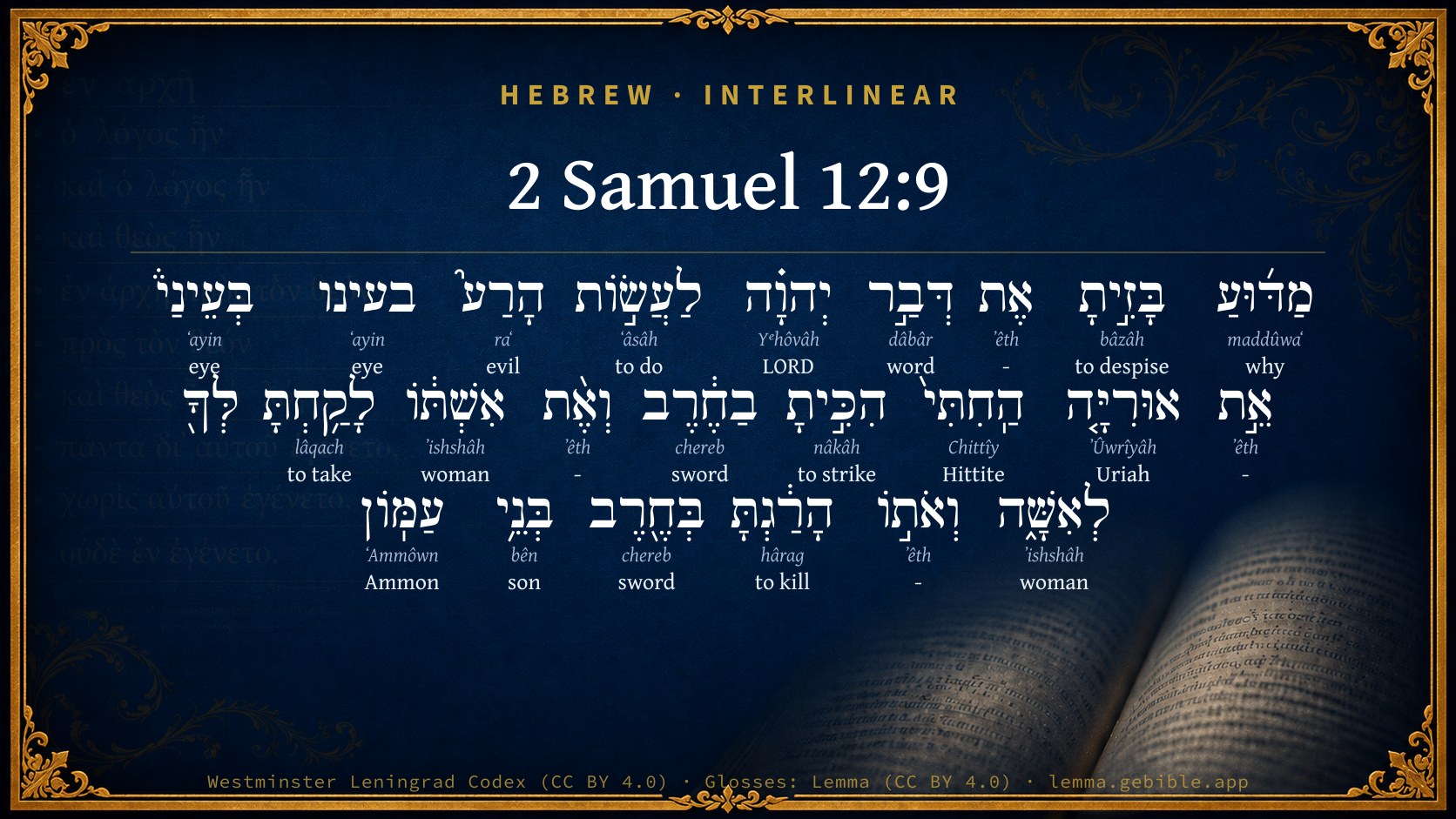
2 Samuel 12:9

Hebrew (Westminster Leningrad Codex) 2 Samuel 12:9 appears in the Hebrew Old Testament. The text above is from the Westminster Leningrad Codex. Each word links to its Strong’s number, a concise gloss, and parsing drawn from the Open Scriptures Hebrew Bible morphology. Click any word for its full Brown-Driver-Briggs (BDB) entry.
Download image
Cite this verse

2 Samuel 12:9 (World English Bible). Public Domain. Lemma interlinear Bible study tool, https://lemma.gebible.app/v/2-samuel/12/9.

Show BibTeX & RIS
BibTeX
RIS
English Translation
Why have you despised the word of Yahweh, to do that which is evil in his sight? You have struck Uriah the Hittite with the sword, and have taken his wife to be your wife, and have slain him with the sword of the children of Ammon.
World English Bible · Public Domain
Download a study sheet

One document with this verse’s original text, its word-by-word gloss line, the meaning frame, cross-references with their text, attributed commentary, and full source and license credits — printable, and it pastes into notes with its structure intact.

This verse Autodidact and up

Study sheet (.html) Plain text (.txt)

A passage Seminary Student

Up to 50 verses in one chapter. A passage sheet keeps up to 6 commentary sources and 12 cross-references per verse, in the order this page ranks them, and says so on the sheet whenever that leaves anything out. Ask for a single verse and you get the Autodidact verse sheet above.

Everything on this page stays free to read, with no account — the sheet is a download of what is already on screen, not access to it.

Want to remove ads? Support Godless Engineer
Compare translations 3

The same verse in 3 English versions, stacked beneath the original-language interlinear above. Click any original word for its lexicon entry.

Each is an independent rendering of the whole verse — the interlinear is not word-aligned to these translations.

Highlighted words mark where these versions differ — a whole-verse word diff, not a word-by-word alignment.

  • World English Bible Public Domain
    Why have you despised the word of Yahweh, to do that which is evil in his sight? You have struck Uriah the Hittite with the sword, and have taken his wife to be your wife, and have slain him with the sword of the children of Ammon.
  • King James Version Public Domain
    Wherefore hast thou despised the commandment of the LORD, to do evil in his sight? thou hast killed Uriah the Hittite with the sword, and hast taken his wife to be thy wife, and hast slain him with the sword of the children of Ammon.
  • unfoldingWord Literal Text CC BY-SA 4.0
    Why have you despised the word of Yahweh to do evil in my eyes? You struck Uriah the Hittite with the sword, and you took his wife for yourself as a wife, and you murdered him with the sword of the sons of Ammon.

unfoldingWord Literal Text — © unfoldingWord, licensed CC BY-SA 4.0. Word-aligned USFM3 via Door43 (git.door43.org/unfoldingWord/en_ult).

Versions to compare (up to 4)

3 of 4 selected

Show all 18 translations

Every available English version of this verse, each an independent rendering of the whole verse.

  • World English Bible Public Domain
    Why have you despised the word of Yahweh, to do that which is evil in his sight? You have struck Uriah the Hittite with the sword, and have taken his wife to be your wife, and have slain him with the sword of the children of Ammon.
  • Berean Standard Bible Public Domain
    Why then have you despised the command of the LORD by doing evil in His sight? You put Uriah the Hittite to the sword and took his wife as your own, for you have slain him with the sword of the Ammonites.
  • Majority Standard Bible Public Domain
    Why then have you despised the command of the LORD by doing evil in His sight? You put Uriah the Hittite to the sword and took his wife as your own. You have slain him with the sword of the Ammonites.
  • King James Version Public Domain
    Wherefore hast thou despised the commandment of the LORD, to do evil in his sight? thou hast killed Uriah the Hittite with the sword, and hast taken his wife to be thy wife, and hast slain him with the sword of the children of Ammon.
  • American Standard Version (1901) Public Domain
    Wherefore hast thou despised the word of Jehovah, to do that which is evil in his sight? thou hast smitten Uriah the Hittite with the sword, and hast taken his wife to be thy wife, and hast slain him with the sword of the children of Ammon.
  • Revised Version (1885) Public Domain
    Wherefore hast thou despised the word of the LORD, to do that which is evil in his sight? thou hast smitten Uriah the Hittite with the sword, and hast taken his wife to be thy wife, and hast slain him with the sword of the children of Ammon.
  • Geneva Bible (1599) Public Domain
    Wherefore hast thou despised the commandement of the Lord, to doe euill in his sight? thou hast killed Vriah the Hittite with ye sworde, and hast taken his wife to be thy wife, and hast slaine him with the sworde of the children of Ammon.
  • Douay-Rheims (1899) Public Domain
    Why therefore hast thou despised the word of the Lord, to do evil in my sight? Thou hast killed Urias the Hethite with the sword, and hast taken his wife to be thy wife, and hast slain him with the sword of the children of Ammon.
  • Young's Literal Translation Public Domain
    `Wherefore hast thou despised the word of Jehovah, to do the evil thing in His eyes? Uriah the Hittite thou hast smitten by the sword, and his wife thou hast taken to thee for a wife, and him thou hast slain by the sword of the Bene-Ammon.
  • Literal Standard Version CC BY-SA 4.0
    Why have you despised the word of YHWH, to do evil in His eyes? You have struck Uriah the Hittite by the sword, and you have taken his wife for a wife for yourself, and you have slain him by the sword of the sons of Ammon.
  • Unlocked Literal Bible CC BY-SA 4.0
    So why have you despised the commands of Yahweh, so as to do what is evil in his sight? You have struck down Uriah the Hittite with the sword and have taken his wife to be your own wife. You killed him with the sword of the army of Ammon.
  • unfoldingWord Literal Text CC BY-SA 4.0
    Why have you despised the word of Yahweh to do evil in my eyes? You struck Uriah the Hittite with the sword, and you took his wife for yourself as a wife, and you murdered him with the sword of the sons of Ammon.
  • Darby Bible Public Domain
    Wherefore hast thou despised the word of Jehovah to do evil in his sight? thou hast smitten Urijah the Hittite with the sword, and hast taken his wife to be thy wife, and hast slain him with the sword of the children of Ammon.
  • World Messianic Bible Public Domain
    Why have you despised the LORD’s word, to do that which is evil in his sight? You have struck Uriah the Hittite with the sword, have taken his wife to be your wife, and have slain him with the sword of the children of Ammon.
  • Webster's Bible Public Domain
    Why hast thou despised the commandment of the LORD, to do evil in his sight? thou hast killed Uriah the Hittite with the sword, and hast taken his wife to be thy wife, and hast slain him with the sword of the children of Ammon.
  • Free Bible Version CC BY-SA 4.0
    So why have you treated what the Lord said with contempt by doing evil in his sight? You killed Uriah the Hittite with the sword and stole his wife—you killed him using the sword of the Ammonites.
  • Bible in Basic English Public Domain
    Why then have you had no respect for the word of the Lord, doing what is evil in his eyes? You have put Uriah the Hittite to death with the sword, and have taken his wife to be your wife; you have put him to death with the sword of the children of Ammon.
  • JPS Tanakh (1917) Public Domain
    Wherefore hast thou despised the word of the LORD, to do that which is evil in My sight? Uriah the Hittite thou hast smitten with the sword, and his wife thou hast taken to be thy wife, and him thou hast slain with the sword of the children of Ammon.

Literal Standard Version (2020), Covenant Press — licensed CC BY-SA 4.0. Text via the HelloAO Bible API (eBible.org). Unlocked Literal Bible (unfoldingWord) — licensed CC BY-SA 4.0. Text via the HelloAO Bible API (eBible.org). unfoldingWord Literal Text — © unfoldingWord, licensed CC BY-SA 4.0. Word-aligned USFM3 via Door43 (git.door43.org/unfoldingWord/en_ult). Free Bible Version, Dr. Jonathan Gallagher — licensed CC BY-SA 4.0. Text via the HelloAO Bible API (eBible.org).

Word by word

More ways to search: Search by grammar → Find every occurrence → Compare this word →

Practice this passage: Drill this verse → Learn its vocabulary →

אוּרִיָּ֤ה
ʼÛwrîyâh
H223
“Uriah”
Noun, Proper
Part of Speech
Noun
Type
Proper
Full BDB Definition

Origin: from H217 and H3050

TWOT: None

Uriah or Urijah = "Jehovah (Yahweh) is my light (flame)" - Hittite husband of Bathsheba - a priest who built king Ahaz' heathen altar - a priest who rebuilt Jerusalem's wall - a prophet slain by Jehoiakim
  1. מַדּ֜וּעַ maddûwaʻ H4069 “why” Particle, Interrogative
  2. בָּזִ֣יתָ bâzâh H959 “to despise” Verb, Qal, Perfect, 2nd Person, Masculine, Singular
  3. אֶת ʼêth H853 “-” Particle, Direct Object
  4. דְּבַ֣ר dâbâr H1697 “word of” Noun, Common, Masculine, Singular, Construct
  5. יְהוָ֗ה Yᵉhôvâh H3068 “LORD” Noun, Proper
  6. לַעֲשׂ֣וֹת ʻâsâh H6213 “to do” Preposition + Verb, Qal, Infinitive Construct
  7. הָרַע֮ raʻ H7451 “the · evil” Particle, Definite Article + Adjective, Adjective, Masculine, Singular, Absolute
  8. בעינו ʻayin H5869 “in/at · eyes · his” Preposition + Noun, Common, Both, Dual, Construct + Suffix, Personal, 3rd Person, Masculine, Singular
  9. בְּעֵינַי֒ ʻayin H5869 “in/at · eyes · my” Preposition + Noun, Common, Both, Dual, Construct + Suffix, Personal, 1st Person, Common, Singular
  10. אֵ֣ת ʼêth H853 “-” Particle, Direct Object
  11. הַֽחִתִּי֙ Chittîy H2850 “the · Hittite” Particle, Definite Article + Noun, Gentilic, Masculine, Singular, Absolute
  12. הִכִּ֣יתָ nâkâh H5221 “to strike” Verb, Hiphil, Perfect, 2nd Person, Masculine, Singular
  13. בַחֶ֔רֶב chereb H2719 “in/at the · sword” Preposition, Determined + Noun, Common, Feminine, Singular, Absolute
  14. וְאֶ֨ת ʼêth H853 “and · -” Conjunction + Particle, Direct Object
  15. אִשְׁתּ֔וֹ ʼishshâh H802 “woman · his” Noun, Common, Feminine, Singular, Construct + Suffix, Personal, 3rd Person, Masculine, Singular
  16. לָקַ֥חְתָּ lâqach H3947 “to take” Verb, Qal, Perfect, 2nd Person, Masculine, Singular
  17. לְאִשָּׁ֑ה ʼishshâh H802 “to/for · woman” Preposition + Noun, Common, Feminine, Singular, Absolute
  18. וְאֹת֣וֹ ʼêth H853 “and · - · him” Conjunction + Particle, Direct Object + Suffix, Personal, 3rd Person, Masculine, Singular
  19. הָרַ֔גְתָּ hârag H2026 “to kill” Verb, Qal, Perfect, 2nd Person, Masculine, Singular
  20. בְּחֶ֖רֶב chereb H2719 “in/at · sword of” Preposition + Noun, Common, Feminine, Singular, Construct
  21. בְּנֵ֥י bên H1121 “sons of” Noun, Common, Masculine, Plural, Construct
  22. עַמּֽוֹן ʻAmmôwn H5983 “Ammon” Noun, Proper

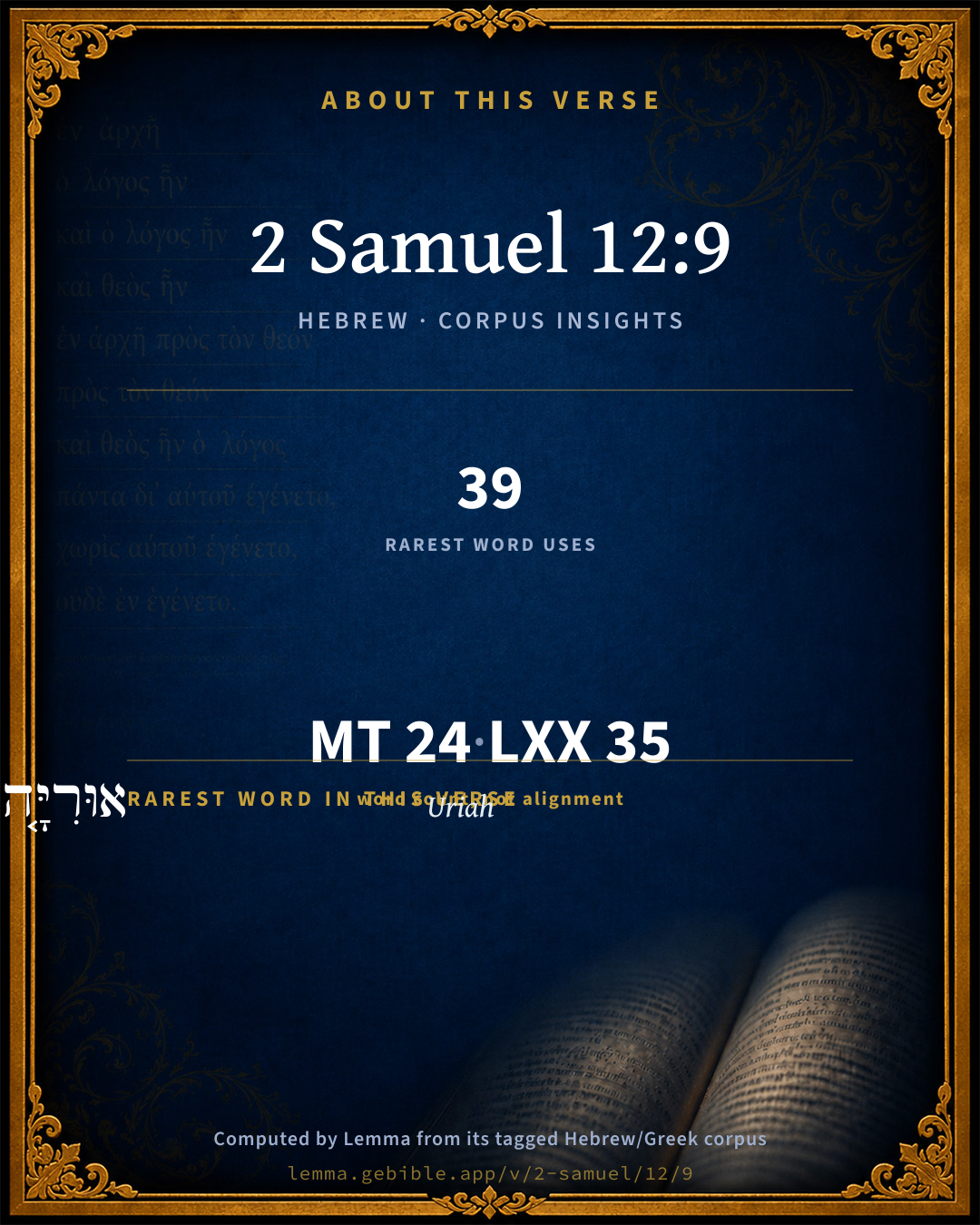
About this verse

These counts appear in no published source. They are computed here, from the morphology-tagged text and Lemma’s own curated glosses. What Lemma adds →

24
words
17
distinct lemmas
Historical
section

Shared distinctive vocabulary

אוּרִיָּ֤ה Uriah H223 occurs in 33 verses of the Hebrew Bible. Also found in:

Grammatical profile

  • 5 verbs
  • 12 nouns
  • 1 adjective
  • 1 preposition
  • 5 particles

Verb forms

  • בָּזִ֣יתָ Qal · Perfect
  • לַעֲשׂ֣וֹת Qal · Infinitive Construct
  • הִכִּ֣יתָ Hiphil · Perfect
  • לָקַ֥חְתָּ Qal · Perfect
  • הָרַ֔גְתָּ Qal · Perfect

Repetition

Words recur within this verse — often emphatic in Hebrew:

  • בעינו eye H5869 ×2
  • בַחֶ֔רֶב sword H2719 ×2
  • אִשְׁתּ֔וֹ woman H802 ×2

Hebrew & Septuagint length

In English translation the verse runs 47 words from the Hebrew and 52 from the Septuagint (LXX English) — closely comparable.

A rough comparison of the two English renderings, which tokenize alike — not a word-level alignment.

Word counts can differ between the Hebrew and the Greek without any difference in meaning — e.g. the Hebrew direct-object marker אֵת has no separate Greek word, and Greek often adds the article ὁ.

In the original languages it is 24 Hebrew tokens and 35 Greek tokens — but the two are counted differently (Hebrew bundles its prefixes and suffixes into one token; the Greek is in lemma form), so that isn’t a like-for-like length.

Cross-references

16

Topical passages linked to 2 Samuel 12:9 in the Treasury of Scripture Knowledge — connected by theme and wording, ordered by reader-vote popularity; previews shown in the World English Bible.

  • 1 Samuel 15:19 Why then didn't you obey the voice of Yahweh, but flew on the spoil, and did that which was evil in the sight of Yahweh?"
  • 1 Samuel 15:23 For rebellion is as the sin of witchcraft, and stubbornness is as idolatry and teraphim. Because you have rejected the word of Yahweh, he has also rejected you from being king.
  • Psalms 90:8 You have set our iniquities before you, Our secret sins in the light of your presence.
  • Psalms 139:1–2 Yahweh, you have searched me, And you know me.
  • Jeremiah 18:10 if they do that which is evil in my sight, that they not obey my voice, then I will repent of the good, with which I said I would benefit them.
  • Amos 2:4 Thus says Yahweh: "For three transgressions of Judah, yes, for four, I will not turn away its punishment; Because they have rejected Yahweh's law, And have not kept his statutes, And their lies have led them astray, After which their fathers walked;
  • Genesis 9:5–6 I will surely require your blood of your lives. At the hand of every animal I will require it. At the hand of man, even at the hand of every man's brother, I will require the life of man.
  • Exodus 20:13–14 "You shall not murder.
  • Numbers 15:30–31 But the soul who does anything with a high hand, whether he is home-born or a foreigner, the same blasphemes Yahweh; and that soul shall be cut off from among his people.
  • 2 Samuel 11:4 David sent messengers, and took her; and she came in to him, and he lay with her (for she was purified from her uncleanness); and she returned to her house.
  • Isaiah 5:24 Therefore as the tongue of fire devours the stubble, And as the dry grass sinks down in the flame, So their root shall be as rottenness, And their blossom shall go up as dust; Because they have rejected the law of Yahweh of Hosts, And despised the word of the Holy One of Israel.
  • Hebrews 10:28–29 A man who disregards Moses' law dies without compassion on the word of two or three witnesses.
  • 2 Samuel 11:14–27 It happened in the morning, that David wrote a letter to Joab, and sent it by the hand of Uriah.
  • 2 Samuel 12:10 Now therefore the sword will never depart from your house, because you have despised me, and have taken the wife of Uriah the Hittite to be your wife.'
  • 2 Chronicles 33:6 He also made his children to pass through the fire in the valley of the son of Hinnom; and he practiced sorcery, and used enchantments, and practiced sorcery, and dealt with those who had familiar spirits, and with wizards: he worked much evil in the sight of Yahweh, to provoke him to anger.
  • Psalms 51:4 Against you, and you only, have I sinned, And done that which is evil in your sight; That you may be proved right when you speak, And justified when you judge.

Cross-references courtesy of OpenBible.info (CC BY 4.0).

Hebrew and Greek witnesses Masoretic Hebrew ↔ Greek Septuagint

The same verse in the two great witnesses to the Old Testament, shown verse-for-verse.

These are two independent witnesses, not word-aligned to each other, and the Septuagint is shown in lemma (dictionary) form.

Hebrew 2 Samuel 12:9 Masoretic · Westminster Leningrad Codex

מַדּ֜וּעַ בָּזִ֣יתָ אֶת דְּבַ֣ר יְהוָ֗ה לַעֲשׂ֣וֹת הָרַע֮ בעינו בְּעֵינַי֒ אֵ֣ת אוּרִיָּ֤ה הַֽחִתִּי֙ הִכִּ֣יתָ בַחֶ֔רֶב וְאֶ֨ת אִשְׁתּ֔וֹ לָקַ֥חְתָּ לְּךָ֖ לְאִשָּׁ֑ה וְאֹת֣וֹ הָרַ֔גְתָּ בְּחֶ֖רֶב בְּנֵ֥י עַמּֽוֹן

Why have you despised the word of Yahweh, to do that which is evil in his sight? You have struck Uriah the Hittite with the sword, and have taken his wife to be your wife, and have slain him with the sword of the children of Ammon.

World English Bible · Public Domain

Greek LXX 2 Samuel 12:9 Septuagint · lemma form

τίς ὅτι φαυλίζω ὁ λόγος κύριος ὁ ποιέω ὁ πονηρός ἐν ὀφθαλμός αὐτός ὁ ουριας ὁ χετταῖος πατάσσω ἐν ῥομφαία καί ὁ γυνή αὐτός λαμβάνω σεαυτοῦ εἰς γυνή καί αὐτός ἀποκτείνω ἐν ῥομφαία υἱός αμμων

Why have you set at nothing the word of the Lord, to do that which is evil in his eyes? you have slain Urias the Chettite with the sword, and you have taken his wife to be your wife, and you have slain him with the sword of the children of Ammon.

LXX2012 (modern English Septuagint) · Public Domain

Hebrew: Westminster Leningrad Codex (CC BY 4.0). Greek: Septuagint (public domain); English from LXX2012 (modern English Septuagint) (Public Domain). How the Septuagint differs from the Hebrew →

Targum (Aramaic paraphrase)

1

The Targum is the ancient Jewish Aramaic paraphrase of the Hebrew Scriptures — an interpretive translation, not the Hebrew text itself. Onkelos (literal) and Pseudo-Jonathan (expansive) render the Torah, and Jonathan the Prophets. Coverage is partial: where no permissively-licensed English translation exists for a verse, only the Aramaic is shown. This is verse-level text, not a word-by-word alignment to the Hebrew.

  1. Targum Jonathan Prophets (Joshua–Malachi)
    מָא דֵין בָּסַרְתָּא עַל פִּתְגָמָא דַייָ לְמֶעְבַּד דְבִישׁ קֳדָמוֹהִי יַת אוּרִיָה חִתָּאָה קְטַלְתָּא בְּחַרְבָּא וְיַת אִתְּתֵיהּ נְסִיבְתָּא לָךְ לְאִתּוּ וְיָתֵיהּ קְטַלְתָּא בְחַרְבָּא דִבְנֵי עַמוֹן:

    (no public-domain English translation for this verse)

    Targum Jonathan — Aramaic: “Mikraot Gedolot” (public domain). English: “Sefaria Community Translation” (CC0 1.0 (public-domain dedication)); “London "Chaldee Paraphrase," 1871” (public domain). Text via Sefaria.

Commentary

Notes on 2 Samuel 12:9 from classic Christian and Jewish commentators (each source and its license shown beneath its notes). The classic Christian expositions comment on the surrounding passage and are grouped to its opening verse, so a note may address several verses; the Jewish commentaries on the Tanakh (Rashi and others) are per-verse, so they appear only where the commentator wrote on this verse.

Lemma curates 59 commentaries, every one of them public domain or Creative Commons licensed, each selected and text-cleaned for this edition rather than reprinted as found. About our sources →

Trapp's Complete Commentary

John Trapp

2Sa 12:9 Wherefore hast thou despised the commandment of the LORD, to do evil in his sight? thou hast killed Uriah the Hittite with the sword, and hast taken his wife [to be] thy wife, and hast slain him with the sword of the children of Ammon.

Ver. 9. Wherefore hast thou despised the commandment?] Yea, not one, but many: especially the sixth and seventh commandment: although the truth is, the whole law is but one copulative, as the schools speak, {Exo 16:18 Eze 18:10-13} and he that breaketh one commandment is guilty of all, {Jas 2:10} since God will not be served with an exception, neither brooketh he a dispensatory conscience.

Thou hast killed Uriah.] A wretched reward for all his good service: a valiant man that ventured his life for thy sake, and would have laid it down for thy safeguard. Like as we read in our chronicles of one Hubert de St Clare, that at the siege of Bridgenorth, A.D. 1155, he cast himself between death and King Henry II, taking the arrow into his own bosom to preserve his sovereign’s life. {a} Uriah likely would have done as much for David.

{a} Speed.

John Trapp, A Commentary or Exposition upon All the Books of the Old and New Testament (1647–1656) — public domain. Text from a community e-Sword module.

The Biblical Illustrator

Joseph S. Exell

2Sa_12:9

Wherefore hast thou despised the commandment of the Lord.

The sinners treatment of Gods law

Some men treat the law and testimony of the Lord as if it were like plaster of Paris, to be poured over their features to take the cast of their own boasted loveliness. Religion is to them a matter of opinion and not of fact; they talk about their views, and their ideas, as if Christians were no longer believers but inventors, and no more disciples but masters. This cometh of evil, and leadeth on to worse consequences. Our sentiments are like a tree, which must be trained to the wall of Scripture; but too many go about to bow the wall to their tree, and cut and trim texts to shape them to their mind. Let us never be guilty of this. Reverence for the perfect word should prevent our altering even a syllable of it. The law of the Lord is perfect, converting the soul; let it convert us, but never let us try to pervert it. Our ideas must take the mould of Scripture--this is wisdom: to endeavour to mould Scripture to our ideas would be presumption. (C. H. Spurgeon.)

The Biblical Illustrator, edited by Joseph S. Exell (c. 1880s–1900s) — public domain. Text from a community e-Sword module.

Joseph Benson's Commentary

2Sa 12:9. Thou hast killed Uriah — David’s contriving his death was as bad as if he had killed him with his own hand. With the sword of the children of Ammon — This was an aggravation of his crime, that he caused him to be slain by the professed enemies of God, who doubtless triumphed in the slaughter of so great a man. Hast taken his wife, &c. — To marry her whom he had defiled, and whose husband he had slain, was an affront upon the ordinance of marriage, making that not only to palliate, but in a manner to consecrate such villanies. In all this he despised the word of the Lord; (so it is in the Hebrew;) not only his commandment in general, but the particular word of promise, which God had before sent him by Nathan, that he would build him a house: which sacred promise if he had had a due value for, he would not have polluted his house with lust and blood.

Joseph Benson's Commentary on the Old and New Testaments (1811–1818) — public domain. Text from a community e-Sword module.

Geneva Bible (1599)

Geneva Bible translators

Thou hast most cruelly given him into the hands of God’s enemies.

Geneva Bible (1599) marginal notes — public domain. Text via Bolls.life.

Adam Clarke's Commentary

Verse 9. Thou hast killed Uriah] THOU art the MURDERER, as having planned his death; the sword of the Ammonites was THY instrument only.

Adam Clarke's Commentary on the Bible (1810–1826) — public domain. Text from a community e-Sword/MySword module.

Ellicott's Commentary for English Readers

(9) Hast slain him.—This is a different and stronger word than “killed” in the first part of the verse, and might well be translated murdered. It was murder in the eyes of the Lord, although accomplished indirectly by the sword of the Ammonites.

A Bible Commentary for English Readers, edited by Charles John Ellicott (1878–1897) — public domain. Text from a community e-Sword module.

The Cambridge Bible for Schools and Colleges

gen. ed. J. J. S. Perowne

9. Wherefore hast thou despised the commandment of the Lord] Cp. Num_15:31; 1Sa_15:23; 1Sa_15:26. Great as was David’s sin against Uriah and Bath-sheba, his sin against God was greater in thus breaking two express commandments of the decalogue. Cp. Psa_51:4.

and hast slain him with the sword of the children of Ammon] This is not a mere repetition of the clause “thou hast killed Uriah the Hittite with the sword.” The verb is stronger, “thou hast murdered;” and the offence is shewn to have been aggravated by the employment of the Ammonites, the enemies of God’s people, as the instruments for its commission.

The Cambridge Bible for Schools and Colleges (gen. ed. J. J. S. Perowne; Cambridge University Press, 1878–1918) — public domain. Text from a community e-Sword module.

John Gill's Exposition

Now therefore the sword shall never depart from thine house,.... During his life, and as appeared in the slaughter of his sons Ammon and Absalom before his death, and of Adonijah quickly after, and in his posterity through their wars with the children of Israel, and other nations:

because thou hast despised me; his commandments, and that in effect was despising him the lawgiver:

and hast taken the wife of Uriah the Hittite to be thy wife; which being repeated shows that it was very displeasing to God, and a very heinous crime in his sight.

John Gill's Exposition of the Whole Bible (1746–1763) — public domain (CC PDM 1.0). Text via the HelloAO Bible API.

Matthew Poole's English Annotations

The commandment of the Lord, i. e. those laws of God which forbade thee to do this thing, by not giving them that respect and observance which they deserved.

Uriah the Hittite; that valiant, and generous, and noble person.

Hast taken his wife to be thy wife: this he mentions amongst his other sins; partly because he had rewarded her, who by God’s law should have been severely punished; partly because he compassed this marriage by wicked practices, even by Uriah’s murder, and for sinful ends, even for the gratification of his inordinate and sensual lusts, and for the concealment of that sin which he was obliged to confess and lament.

Hast slain him with the sword of the children of Ammon; those cursed enemies of God, and of his people, whom thou hast encouraged and hardened in their idolatry, by giving up him and others of God’s people into their hands. And note here, that although David did not kill Uriah himself, nor command any to do it; but only that he should be put upon dangerous service (which a general of an army oft doth to soldiers under him, on justifiable accounts, without being therefore legally chargeable with murder, though the person so employed die in the service); yet in God’s account, who judged of David’s design therein, it is justly so reputed. And therefore, though the Ammonites slew Uriah, yet David is said to have killed him with their sword.

Matthew Poole's English Annotations on the Holy Bible (1683–1685) — public domain. Text from a community e-Sword/MySword module.

Whedon's Commentary on the Bible

Daniel D. Whedon

9. Despised the commandment of the Lord — Which says, “Thou shalt not kill.” David was guilty of murder.

Thou hast killed Uriah… with the sword… hast slain him with the sword of the children of Ammon — This is not tautology, for to slay with the sword of the heathen Ammonites was even more aggravating than to kill one outright; and the last term, hast slain — from הרג, to murder — is stronger than the former, hast killed — from נכה, to smite.

Daniel D. Whedon (gen. ed.), Commentary on the Old and New Testaments (1874–1909) — public domain. Text from a community e-Sword module.

The Pulpit Commentary

Despising the commandments of God.

David, by his grievous sins, had virtually shown contempt for the well-known commandments of God against coveting the wife of another, and against adultery and murder. Hence the force of this remonstrance. It may be properly addressed to all who in any way show contempt for any of the Divine commandments; to all men, therefore, since all are in some respects and in some degree guilty of this sin.

I WHO MAY BE SAID TO DESPISE THE COMMANDMENTS OF GOD?

1. Those who take no pains to know and understand them. Who do not think it worth while to inquire, in reference to their course of life, their duty to others, or any particular action, or even their religious faith and observances, what the will of God is; but are content to follow without question the customs of the world around them, or their own inclinations and habits.

2. Those who refuse to give heed when their attention is called to them.

Which may be by their own consciences, or by other men.

3. Those who disobey them. And the degree of contempt shown by disobedience will be in proportion to

(1) their knowledge;

(2) their remembrance, at the time, of the commandment, its Author, and its sanctions;

(3) the difficulties of disobedience which have to be overcome; and

(4) the remonstrances of conscience, and of the Spirit of God, which are resisted and conquered.

II THEIR SIN AND FOLLY. They may be addressed as the prophet addressed David, "Wherefore," etc.

1. What rational ground have you for doing it? Seeing the commandment

(1) is "of the Lord," who has the highest right to the obedience of his creatures;

(2) proceeds from the perfect reason and the infinite love; and therefore

(3) is adapted to promote the good of each and all. "The Law is holy, and the commandment holy, and just, and good. (Rom_7:12) Consider any particular commandment you have disregarded, and you will see that all this is true of it; and that, therefore, your conduct is foolish and wicked.

1. How can "you" do it? Who have been laid under obligations so weighty by the kindness of God; who know so well his character, claims, and laws; who have so often and in such various ways professed love and loyalty to him; who are bound by so many considerations to set a good example; or (as in David"s case) are appointed to be an upholder of law, a guardian of innocence, a protector of the public morals.

2. How "dare" you do it? In view of the shame and moral injury you bring on yourself; the evil you do to others; the terrible threatenings of the Word of God against sinners; his knowledge of all you do; his awful holiness and justice; and his almighty power to execute his threatenings. In view also of death, and of the day of judgment, when your most secret sins will be brought to light and punished. G.W.

The Pulpit Commentary (1880–1919), ed. H.D.M. Spence-Jones & Joseph S. Exell — public domain. Text from a community e-Sword module.

John Wesley's Explanatory Notes

To be thy wife - To marry her whom he had defiled, and whose husband he had slain, was an affront upon the ordinance of marriage, making that not only to palliate, but in a manner to consecrate such villainies. In all this he despised the word of the Lord; (so it is in the Hebrew.) Not only his commandment in general, but the particular word of promise, which God had before sent him by Nathan, that he would build him an house: which sacred promise if he had had a due value for, he would not have polluted his house with lust and blood.

John Wesley, Explanatory Notes Upon the Whole Bible (1754–1765) — public domain. Text via the GEBible commentary corpus.

unfoldingWord translationNotes

Door43 World Missions Community

So why have you despised ... Yahweh, so as to do what is evil in his sight?

This rhetorical question is used to rebuke David. This can be written as a statement. AT: "You should not have despised ... Yahweh and should not have done what is evil in his sight!" (See: Rhetorical Question)

what is evil in his sight

Here "sight" refers to Yahweh's thoughts or opinion. AT: "what he considers to be evil" or "what is evil in Yahweh's judgement" (See: Metaphor)

You have struck down Uriah the Hittite with the sword

David did not kill Uriah himself, rather he arranged for him to be killed in battle. The phrase "with the sword" represents how Uriah died in battle. AT: "You have arranged for Uriah the Hittite to die in battle" (See: Metonymy)

You killed him with the sword of the army of Ammon

David did not kill Uriah himself, rather he arranged for him to be killed in battle when Israel was fighting against Ammon. The phrase "with the sword" refers to how he died in battle. AT: "You arranged for him to die in battle against the army of Ammon" (See: Metonymy)

the sword will never leave your house

Here the word "sword" refers to people dying in war. Also, David's "house" refers to his descendants. AT: "some of your descendants will always die in battle" (See: Metonymy)

translationWords

command

evil

Uriah

Hittite

sword

Ammon

house

unfoldingWord translationNotes — © Distant Shores Media and the Door43 World Missions Community, licensed CC BY-SA 4.0. Source: git.door43.org/Door43/en_tn.

Lesson kit

Teaching starters — assembled from the data on this page, not authored interpretation. Every prompt links to the verse data it draws on. Edit before teaching.

2 Samuel, in the Historical, opens this verse with 24 words (17 distinct Hebrew lemmas). Its most distinctive word is ʼÛwrîyâh (“Uriah”). A historical commentator’s framing appears above. Read the whole chapter for the surrounding context.

Discussion questions

  1. How does “Uriah” (ʼÛwrîyâh) shape what this verse is saying?
  2. How does 2 Samuel 11:3, which shares the word «Uriah», read alongside this verse?
  3. What does the repetition of “eye” (2× in this one verse) do in this verse?
  4. The translations on this page render this verse differently — a whole-verse word diff, not a word-by-word alignment. What might account for the different wordings?
  5. «בָּזִ֣יתָ» is a Qal Perfect verb. How does that grammatical form shape the action described?
  6. Compare how Trapp's Complete Commentary and The Biblical Illustrator read this verse. Where do they agree or differ?

Things to notice

Reading settings

Reading text

Shown beneath each verse's original-language words.

Old Testament
Old Testament edition

Read the OT as the Masoretic Hebrew (MT) or the Greek Septuagint (LXX).

English shown for the Greek Septuagint (in the Hebrew ↔ Greek comparison).

Comparing translations? Open the Compare panel on any verse page to stack up to four side by side.