Exodus 22:24

Hebrew (Westminster Leningrad Codex) Exodus 22:24 appears in the Hebrew Old Testament. The text above is from the Westminster Leningrad Codex. Each word links to its Strong’s number, a concise gloss, and parsing drawn from the Open Scriptures Hebrew Bible morphology. Click any word for its full Brown-Driver-Briggs (BDB) entry.
Download image
Cite this verse

Exodus 22:24 (World English Bible). Public Domain. Lemma interlinear Bible study tool, https://lemma.gebible.app/v/exodus/22/24.

Show BibTeX & RIS
BibTeX
RIS
English Translation
and my wrath will grow hot, and I will kill you with the sword; and your wives shall be widows, and your children fatherless.
World English Bible · Public Domain
Download a study sheet

One document with this verse’s original text, its word-by-word gloss line, the meaning frame, cross-references with their text, attributed commentary, and full source and license credits — printable, and it pastes into notes with its structure intact.

This verse Autodidact and up

Study sheet (.html) Plain text (.txt)

A passage Seminary Student

Up to 50 verses in one chapter. A passage sheet keeps up to 6 commentary sources and 12 cross-references per verse, in the order this page ranks them, and says so on the sheet whenever that leaves anything out. Ask for a single verse and you get the Autodidact verse sheet above.

Everything on this page stays free to read, with no account — the sheet is a download of what is already on screen, not access to it.

Want to remove ads? Support Godless Engineer
Compare translations 3

The same verse in 3 English versions, stacked beneath the original-language interlinear above. Click any original word for its lexicon entry.

Each is an independent rendering of the whole verse — the interlinear is not word-aligned to these translations.

Highlighted words mark where these versions differ — a whole-verse word diff, not a word-by-word alignment.

  • World English Bible Public Domain
    and my wrath will grow hot, and I will kill you with the sword; and your wives shall be widows, and your children fatherless.
  • King James Version Public Domain
    And my wrath shall wax hot, and I will kill you with the sword; and your wives shall be widows, and your children fatherless.
  • unfoldingWord Literal Text CC BY-SA 4.0
    and my nose will burn, and I will kill you with the sword; your wives will become widows, and your sons will become fatherless.

unfoldingWord Literal Text — © unfoldingWord, licensed CC BY-SA 4.0. Word-aligned USFM3 via Door43 (git.door43.org/unfoldingWord/en_ult).

Versions to compare (up to 4)

3 of 4 selected

Show all 18 translations

Every available English version of this verse, each an independent rendering of the whole verse.

  • World English Bible Public Domain
    and my wrath will grow hot, and I will kill you with the sword; and your wives shall be widows, and your children fatherless.
  • Berean Standard Bible Public Domain
    My anger will be kindled, and I will kill you with the sword; then your wives will become widows and your children will be fatherless.
  • Majority Standard Bible Public Domain
    My anger will be kindled, and I will kill you with the sword; then your wives will become widows and your children will be fatherless.
  • King James Version Public Domain
    And my wrath shall wax hot, and I will kill you with the sword; and your wives shall be widows, and your children fatherless.
  • American Standard Version (1901) Public Domain
    and my wrath shall wax hot, and I will kill you with the sword; and your wives shall be widows, and your children fatherless.
  • Revised Version (1885) Public Domain
    and my wrath shall wax hot, and I will kill you with the sword; and your wives shall be widows, and your children fatherless.
  • Geneva Bible (1599) Public Domain
    Then shall my wrath be kindled, and I will kill you with the sword, and your wiues shall be widowes, and your children fatherlesse.
  • Douay-Rheims (1899) Public Domain
    And my rage shall be enkindled, and I will strike you with the sword, and your wives shall be widows, and your children fatherless.
  • Young's Literal Translation Public Domain
    and Mine anger hath burned, and I have slain you by the sword, and your wives have been widows, and your sons orphans.
  • Literal Standard Version CC BY-SA 4.0
    and My anger has burned, and I have slain you by the sword, and your wives have been widows, and your sons orphans.
  • Unlocked Literal Bible CC BY-SA 4.0
    My anger will burn, and I will kill you with the sword; your wives will become widows, and your children will become fatherless.
  • unfoldingWord Literal Text CC BY-SA 4.0
    and my nose will burn, and I will kill you with the sword; your wives will become widows, and your sons will become fatherless.
  • Darby Bible Public Domain
    and my anger shall burn, and I will slay you with the sword; and your wives shall be widows, and your children fatherless.
  • World Messianic Bible Public Domain
    and my wrath will grow hot, and I will kill you with the sword; and your wives shall be widows, and your children fatherless.
  • Webster's Bible Public Domain
    And my wrath shall wax hot, and I will kill you with the sword; and your wives shall be widows, and your children fatherless.
  • Free Bible Version CC BY-SA 4.0
    I will become angry, and I will kill you with the sword. Your wives will become widows and your children will be fatherless.
  • Bible in Basic English Public Domain
    And in the heat of my wrath I will put you to death with the sword, so that your wives will be widows and your children without fathers.
  • JPS Tanakh (1917) Public Domain
    (22-23) My wrath shall wax hot, and I will kill you with the sword; and your wives shall be widows, and your children fatherless.

Literal Standard Version (2020), Covenant Press — licensed CC BY-SA 4.0. Text via the HelloAO Bible API (eBible.org). Unlocked Literal Bible (unfoldingWord) — licensed CC BY-SA 4.0. Text via the HelloAO Bible API (eBible.org). unfoldingWord Literal Text — © unfoldingWord, licensed CC BY-SA 4.0. Word-aligned USFM3 via Door43 (git.door43.org/unfoldingWord/en_ult). Free Bible Version, Dr. Jonathan Gallagher — licensed CC BY-SA 4.0. Text via the HelloAO Bible API (eBible.org).

Word by word

More ways to search: Search by grammar → Find every occurrence → Compare this word →

Practice this passage: Drill this verse → Learn its vocabulary →

יְתֹמִֽים
yâthôwm
H3490
“orphans”
Noun, Common, Masculine, Plural, Absolute
Part of Speech
Noun
Type
Common
Gender
Masculine
Number
Plural
State
Absolute
Full BDB Definition

Origin: from an unused root meaning to be lonely

TWOT: 934a

an orphan, fatherless
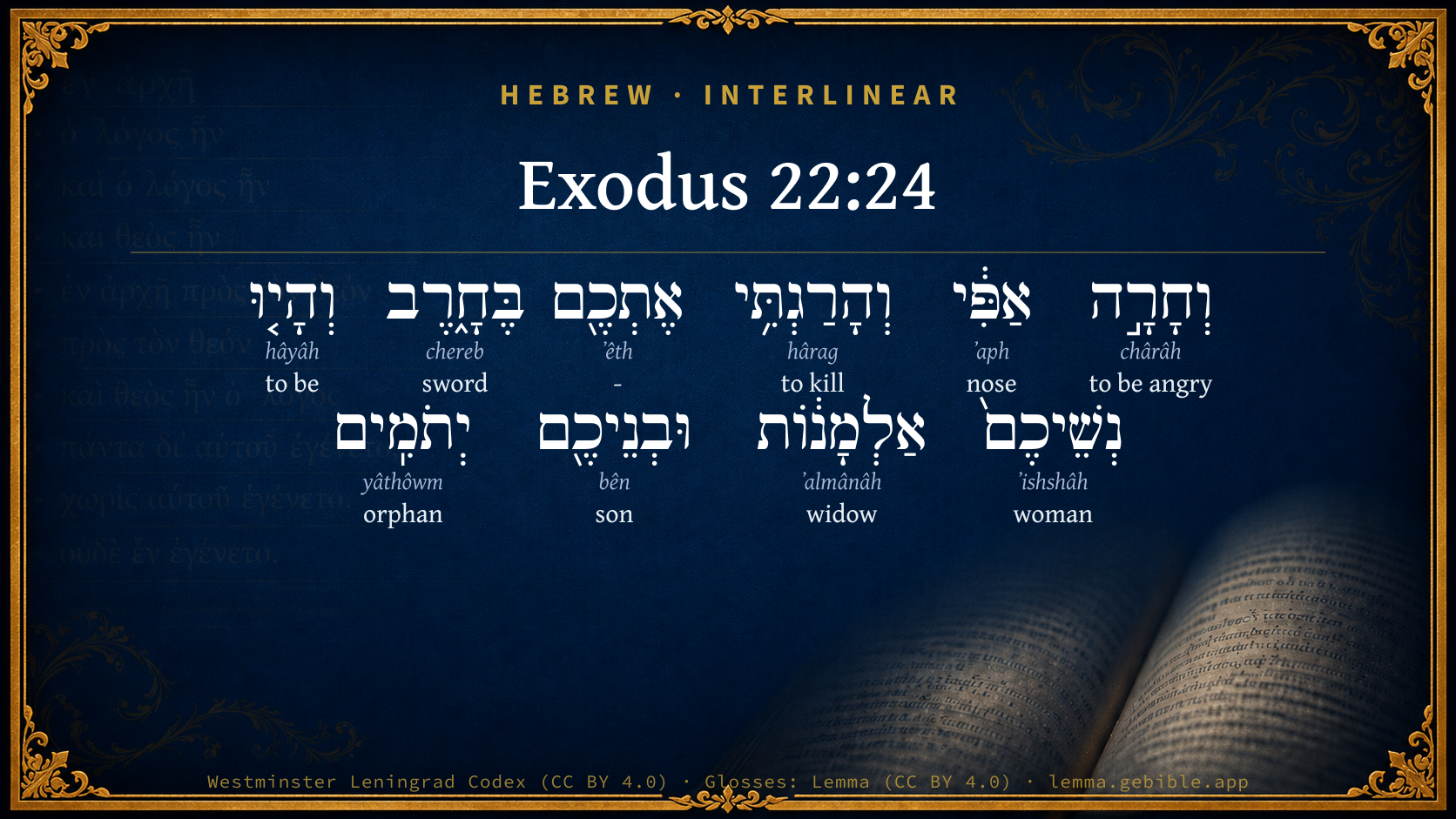
  1. וְחָרָ֣ה chârâh H2734 “and · to be angry” Conjunction + Verb, Qal, Perfect, 3rd Person, Masculine, Singular
  2. אַפִּ֔י ʼaph H639 “nose · my” Noun, Common, Masculine, Singular, Construct + Suffix, Personal, 1st Person, Common, Singular
  3. וְהָרַגְתִּ֥י hârag H2026 “and · to kill” Conjunction + Verb, Qal, Sequential Perfect, 1st Person, Common, Singular
  4. אֶתְכֶ֖ם ʼêth H853 “- · you” Particle, Direct Object + Suffix, Personal, 2nd Person, Masculine, Plural
  5. בֶּחָ֑רֶב chereb H2719 “in/at the · sword” Preposition, Determined + Noun, Common, Feminine, Singular, Absolute
  6. וְהָי֤וּ hâyâh H1961 “and · to be” Conjunction + Verb, Qal, Sequential Perfect, 3rd Person, Common, Plural
  7. נְשֵׁיכֶם֙ ʼishshâh H802 “women · your” Noun, Common, Feminine, Plural, Construct + Suffix, Personal, 2nd Person, Masculine, Plural
  8. אַלְמָנ֔וֹת ʼalmânâh H490 “widows” Noun, Common, Feminine, Plural, Absolute
  9. וּבְנֵיכֶ֖ם bên H1121 “and · sons · your” Conjunction + Noun, Common, Masculine, Plural, Construct + Suffix, Personal, 2nd Person, Masculine, Plural

About this verse

These counts appear in no published source. They are computed here, from the morphology-tagged text and Lemma’s own curated glosses. What Lemma adds →

10
words
10
distinct lemmas
Pentateuch
section

Shared distinctive vocabulary

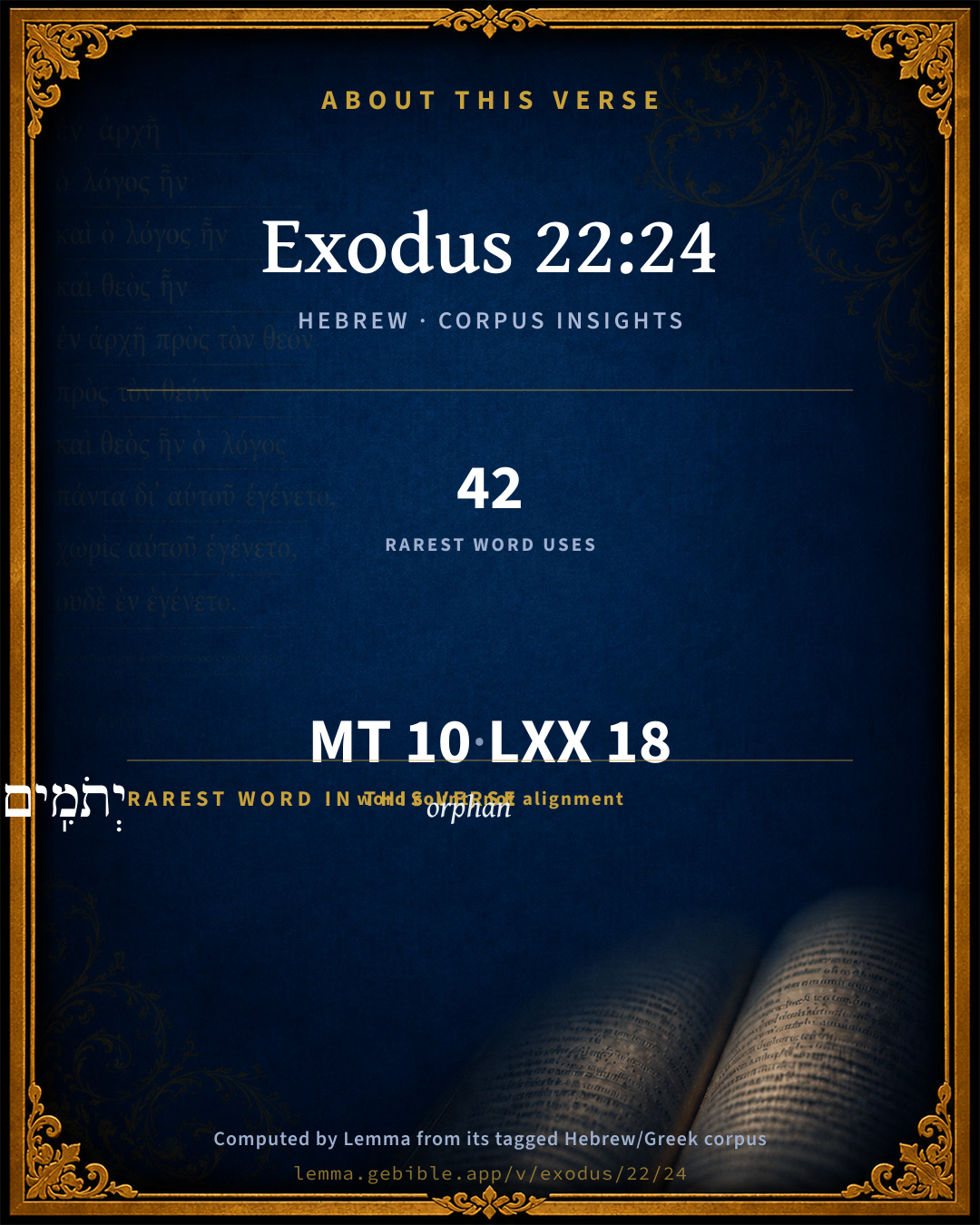
יְתֹמִֽים orphan H3490 occurs in 42 verses of the Hebrew Bible. Also found in:

Grammatical profile

  • 3 verbs
  • 6 nouns
  • 1 particle

Verb forms

  • וְחָרָ֣ה Qal · Perfect
  • וְהָרַגְתִּ֥י Qal · Sequential Perfect
  • וְהָי֤וּ Qal · Sequential Perfect

Hebrew & Septuagint length

In English translation the verse runs 24 words from the Hebrew and 23 from the Septuagint (LXX English) — closely comparable.

A rough comparison of the two English renderings, which tokenize alike — not a word-level alignment.

Word counts can differ between the Hebrew and the Greek without any difference in meaning — e.g. the Hebrew direct-object marker אֵת has no separate Greek word, and Greek often adds the article ὁ.

In the original languages it is 10 Hebrew tokens and 18 Greek tokens — but the two are counted differently (Hebrew bundles its prefixes and suffixes into one token; the Greek is in lemma form), so that isn’t a like-for-like length.

Cross-references

14

Topical passages linked to Exodus 22:24 in the Treasury of Scripture Knowledge — connected by theme and wording, ordered by reader-vote popularity; previews shown in the World English Bible.

  • Psalms 109:9 Let his children be fatherless, And his wife a widow.
  • Jeremiah 15:8 Their widows are increased to me above the sand of the seas; I have brought on them against the mother of the young men a destroyer at noonday: I have caused anguish and terrors to fall on her suddenly.
  • Psalms 69:24 Pour out your indignation on them. Let the fierceness of your anger overtake them.
  • Psalms 76:7 You, even you, are to be feared. Who can stand in your sight when you are angry?
  • Psalms 78:63–64 Fire devoured their young men; Their virgins had no wedding song.
  • Psalms 90:11 Who knows the power of your anger, Your wrath according to the fear that is due to you?
  • Lamentations 5:3 We are orphans and fatherless; Our mothers are as widows.
  • Job 27:13–15 "This is the portion of a wicked man with God, The heritage of oppressors, which they receive from the Almighty.
  • Job 31:23 For calamity from God is a terror to me, By reason of his majesty I can do nothing.
  • Jeremiah 18:21 Therefore deliver up their children to the famine, and give them over to the power of the sword; and let their wives become childless, and widows; and let their men be slain of death, [and] their young men struck of the sword in battle.
  • Nahum 1:6 Who can stand before his indignation? Who can endure the fierceness of his anger? His wrath is poured out like fire, and the rocks are broken apart by him.
  • Luke 6:38 "Give, and it will be given to you: good measure, pressed down, shaken together, and running over, will be given to you. For with the same measure you measure it will be measured back to you."
  • Romans 2:5–9 But according to your hardness and unrepentant heart you are treasuring up for yourself wrath in the day of wrath, revelation, and of the righteous judgment of God;
  • Hebrews 10:31 It is a fearful thing to fall into the hands of the living God.

Cross-references courtesy of OpenBible.info (CC BY 4.0).

Hebrew and Greek witnesses Masoretic Hebrew ↔ Greek Septuagint

The same verse in the two great witnesses to the Old Testament, shown verse-for-verse.

These are two independent witnesses, not word-aligned to each other, and the Septuagint is shown in lemma (dictionary) form.

Hebrew Exodus 22:24 Masoretic · Westminster Leningrad Codex

וְחָרָ֣ה אַפִּ֔י וְהָרַגְתִּ֥י אֶתְכֶ֖ם בֶּחָ֑רֶב וְהָי֤וּ נְשֵׁיכֶם֙ אַלְמָנ֔וֹת וּבְנֵיכֶ֖ם יְתֹמִֽים

and my wrath will grow hot, and I will kill you with the sword; and your wives shall be widows, and your children fatherless.

World English Bible · Public Domain

Greek LXX Exodus 22:24 Septuagint · lemma form

ἐάν δέ ἀργύριον ἐκδανείζω ὁ ἀδελφός ὁ πενιχρός παρά σύ οὐ εἰμί αὐτός καταἐπείγω οὐ ἐπιτίθημι αὐτός τόκος

And I will be very angry, and will kill you with the sword, and your wives shall be widows and your children orphans.

LXX2012 (modern English Septuagint) · Public Domain

Hebrew: Westminster Leningrad Codex (CC BY 4.0). Greek: Septuagint (public domain); English from LXX2012 (modern English Septuagint) (Public Domain). How the Septuagint differs from the Hebrew →

Targum (Aramaic paraphrase)

2

The Targum is the ancient Jewish Aramaic paraphrase of the Hebrew Scriptures — an interpretive translation, not the Hebrew text itself. Onkelos (literal) and Pseudo-Jonathan (expansive) render the Torah, and Jonathan the Prophets. Coverage is partial: where no permissively-licensed English translation exists for a verse, only the Aramaic is shown. This is verse-level text, not a word-by-word alignment to the Hebrew.

  1. Targum Onkelos Torah (Genesis–Deuteronomy)
    אִם כַּסְפָּא תּוֹזֵף בְּעַמִי לְּעַנְיָא דִי עִמָךְ לָא תְהֵי לֵהּ כְּרַשְׁיָא לָא תְשַׁוּוֹן עֲלוֹהִי חִבּוּלְיָא:

    (no public-domain English translation for this verse)

    Targum Onkelos — Aramaic: “Onkelos Genesis” (public domain); “Onkelos Exodus” (public domain); “Onkelos Leviticus” (public domain); “Onkelos Numbers” (public domain); “Onkelos Deuteronomy” (public domain). English: “Sefaria Community Translation” (CC0 1.0 (public-domain dedication)); “J.W. Etheridge. The Targums of Onkelos and Jonathan Ben Uzziel on the Pentateuch. London: Longmans, Green, 1862” (public domain). Text via Sefaria.

  2. Targum Pseudo-Jonathan Torah (Genesis–Deuteronomy)
    אִין כַּסְפָּא תּוֹזִיף לְעַמִּי יַת עַנְיָיא דְעִמָּךְ לָא תְהֵי לֵיהּ הֵי כְּרַשְׁיָא לָא תְשַׁוּוּן דְּלֶהֱוֵי עֲלוֹי סַהֲדִין וּמִידִי עַרְבְנוּתָא לָא עַל שְׁעָרִין וְלָא רִיבְיָין

    If thou lend money to (one of) My people, to (one of) the humble of My people, thou shalt not be to him as an usurer, neither lay it upon him that there shall be witnesses against him, or that he give pledges, or equivalents, or usury.

    Targum Pseudo-Jonathan — Aramaic: “Targum Jonathan on Genesis” (public domain); “Targum Jonathan on Exodus” (public domain); “Targum Jonathan on Leviticus” (public domain); “Targum Jonathan on Numbers” (public domain); “Targum Jonathan on Deuteronomy” (public domain). English: “The Targum of Jonathan ben Uzziel, trans. J. W. Etheridge, London, 1862” (public domain). Text via Sefaria.

Commentary

Notes on Exodus 22:24 from classic Christian and Jewish commentators (each source and its license shown beneath its notes). The classic Christian expositions comment on the surrounding passage and are grouped to its opening verse, so a note may address several verses; the Jewish commentaries on the Tanakh (Rashi and others) are per-verse, so they appear only where the commentator wrote on this verse.

Lemma curates 59 commentaries, every one of them public domain or Creative Commons licensed, each selected and text-cleaned for this edition rather than reprinted as found. About our sources →

Trapp's Complete Commentary

John Trapp

Exo 22:24 And my wrath shall wax hot, and I will kill you with the sword; and your wives shall be widows, and your children fatherless.

Ver. 24. Your wives shall be widows.] God delights to punish cruelty in kind, as he did in Agag. {1Sa 15:33}

John Trapp, A Commentary or Exposition upon All the Books of the Old and New Testament (1647–1656) — public domain. Text from a community e-Sword module.

Geneva Bible (1599)

Geneva Bible translators

The just plague of God upon the oppressors.

Geneva Bible (1599) marginal notes — public domain. Text via Bolls.life.

The Cambridge Bible for Schools and Colleges

gen. ed. J. J. S. Perowne

24. Those who had shewn heartlessness towards widows and orphans will perish in battle (cf. Isa_9:17), and their wives and children will become widows and orphans themselves.

The Cambridge Bible for Schools and Colleges (gen. ed. J. J. S. Perowne; Cambridge University Press, 1878–1918) — public domain. Text from a community e-Sword module.

John Gill's Exposition

If thou at all take thy neighbour's raiment to pledge,.... So that it seems that the lender, though he might not impose usury on the borrower, or oblige him to pay interest for what he lent him, yet for the security of his money he might take his clothes, either his bed clothes or wearing apparel, or any instruments or goods of his; but when he did, he was bound to what follows:

thou shalt deliver it to him by that the sun goeth down; the reason of which appears in the next verse, with respect to his bed clothes, should that be the pledge: but Jarchi interprets it, not of his nocturnal clothes, but of his apparel in the daytime, and paraphrases it thus,"all the day thou shalt restore it to him until the setting of the sun; and when the sun is set, thou shalt return and take it until the morning of the morrow comes; the Scripture speaks of the covering of the day, of which there is no need at night;''but rather night clothes are meant by what follows.

John Gill's Exposition of the Whole Bible (1746–1763) — public domain (CC PDM 1.0). Text via the HelloAO Bible API.

Haydock's Catholic Bible Commentary

Fatherless. Thus God will retaliate upon the oppressors of the poor. (Haydock)

George Leo Haydock (1774–1849), Haydock's Catholic Family Bible and Commentary, 1859 edition — public domain. Excludes Psalms (Douay-Rheims chapter numbering differs from Protestant) and Deuterocanonical books (Catholic canon only).

Whedon's Commentary on the Bible

Daniel D. Whedon

24. I will kill you with the sword — Observe here that Jehovah is the governor and judge over all, and will, sooner or later, punish all evildoers and them that forget mercy. The magistrate bears not the sword in vain if he maintain justice and defend the weak; but if he fail in these high responsibilities, God’s own hand will interpose and bring deserved retribution.

Daniel D. Whedon (gen. ed.), Commentary on the Old and New Testaments (1874–1909) — public domain. Text from a community e-Sword module.

The Pulpit Commentary

I will kill you with the sword. It was, in large measure, on account of the neglect of this precept, that the capture of Jerusalem by Nebuchadnezzar, and destruction of its inhabitants, was allowed to take. (Jer_22:3-5) Your wives shall be widows, etc. A quasi-retaliation. They shall be exposed to the same sort of ill-usage as you have dealt out to other widows.

The Pulpit Commentary (1880–1919), ed. H.D.M. Spence-Jones & Joseph S. Exell — public domain. Text from a community e-Sword module.

Rashi

Rabbi Shlomo Yitzchaki (Rashi)

אם כסף תלוה את עמי IF THOU LEND MONEY TO ANY OF MY PEOPLE — R. Yishmael said: wherever אם occurs in Scripture it is used of an act the performance of which is optional, except in three instances, of which this is one (Mekhilta; cf. Rashi on Exodus 20:22 - the translation therefore is: “When thou lendeth etc.”).

את עמי TO ANY OF MY PEOPLE — If thou hast to choose between lending money to My people and a heathen, My people come first; if between a poor man and one who is better off, the poor man comes first; if between thine own poor (poor relatives) and other poor of thy city, thine own poor come first; if between the poor of thine own city and the poor of another city, the poor of thine own city come first (Mekhilta; Bava Metzia 71a). And this is how the above explanation is implied in the text: “If thou lend money” — את עמי “lend it to My people”, and not to a heathen; and to which one of My people? את העני, to the poor; and to which poor? עמך to him that is with thee (i. e. who is with thee in relationship and is with thee in thy city). [Another explanation of את עמי is: Thou shalt not treat him disrespectfully when lending him money, for he is עמי — though in need he is still “My people”!

את העני עמך Look at thyself as though thou art the poor man (Midrash Tanchuma 6:15)].

לא תהיה לו כנשה THOU SHALT NOT BE UNTO HIM AS AN EXACTOR — you shall not demand the debt of him forcibly. The comparative כ of כנשה suggests thou shalt not be like a נשה: if you know that he has no money do not appear in your attitude towards him as though you had lent him, but as though you had not lent him — it means as much as, do not humble him.

נשך is what is called in Rabbinical Hebrew רבית (from רבה to increase). It is called נשך “biting”, because it resembles the bite of a snake: it bites, inflicting a small wound in a person’s foot which he does not feel at first, but all at once it swells and distends the whole body up to the top of his head. So it is with interest: at first one does not feel the drain it makes on him and it remains unnoticed until the interest mounts up and suddenly makes the person lose a big fortune (Exodus Rabbah 31:6).

Rashi on the Tanakh — English translations: “The Judaica Press complete Tanach with Rashi, translated by A. J. Rosenberg” (CC BY 4.0); “Pentateuch with Rashi's commentary by M. Rosenbaum and A.M. Silbermann, 1929-1934” (public domain); “The Metsudah Tanach series, Lakewood, N.J” (CC BY 4.0); and “The Book of Joshua, Metsudah Publications, 1997” (CC BY 4.0). Text via Sefaria.

Ramban (Nachmanides)

Rabbi Moshe ben Nachman (Ramban / Nachmanides)

THOU SHALT NOT BE TO HIM AS AN EXACTOR — that is, a creditor. He is saying that the lender should not behave to the borrower like a creditor who is a sort of lord over the borrower, as it is written, and the borrower is a servant to the lender, but instead you should behave to him exactly as if he had never borrowed from you; neither shall you lay upon him interest, whether interest of money, interest of victuals. Rather, the loan to him should be an act of goodness; you should not take from him any mark of honor because of it, nor are you to derive any monetary benefit from it.

Ramban (Nachmanides) on the Tanakh — English translation: “Commentary on the Torah by Ramban (Nachmanides). Translated and annotated by Charles B. Chavel. New York, Shilo Pub. House, 1971-1976” (CC BY 4.0). Text via Sefaria.

Lesson kit

Teaching starters — assembled from the data on this page, not authored interpretation. Every prompt links to the verse data it draws on. Edit before teaching.

Exodus, in the Pentateuch, opens this verse with 10 words (10 distinct Hebrew lemmas). Its most distinctive word is yâthôwm (“orphan”). A historical commentator’s framing appears above. Read the whole chapter for the surrounding context.

Discussion questions

  1. How does “orphan” (yâthôwm) shape what this verse is saying?
  2. Exodus 22:22 shares the word «orphan» with this verse. How do the two illuminate each other?
  3. These translations render this verse differently; the difference is in the English rendering, not the original. What questions does that raise?
  4. The verb «וְחָרָ֣ה» is Qal Perfect. How does its form color the action?
  5. Reading how Trapp's Complete Commentary and Geneva Bible (1599) read this verse, where do the two commentators agree and where do they part?

Things to notice

Reading settings

Reading text

Shown beneath each verse's original-language words.

Old Testament
Old Testament edition

Read the OT as the Masoretic Hebrew (MT) or the Greek Septuagint (LXX).

English shown for the Greek Septuagint (in the Hebrew ↔ Greek comparison).

Comparing translations? Open the Compare panel on any verse page to stack up to four side by side.