
1 Samuel 13:22

Hebrew (Westminster Leningrad Codex) 1 Samuel 13:22 appears in the Hebrew Old Testament. The text above is from the Westminster Leningrad Codex. Each word links to its Strong’s number, a concise gloss, and parsing drawn from the Open Scriptures Hebrew Bible morphology. Click any word for its full Brown-Driver-Briggs (BDB) entry.
Download image
Cite this verse

1 Samuel 13:22 (World English Bible). Public Domain. Lemma interlinear Bible study tool, https://lemma.gebible.app/v/1-samuel/13/22.

Show BibTeX & RIS
BibTeX
RIS
English Translation
So it came to pass in the day of battle, that there was neither sword nor spear found in the hand of any of the people who were with Saul and Jonathan: but with Saul and with Jonathan his son was there found.
World English Bible · Public Domain
Download a study sheet

One document with this verse’s original text, its word-by-word gloss line, the meaning frame, cross-references with their text, attributed commentary, and full source and license credits — printable, and it pastes into notes with its structure intact.

This verse Autodidact and up

Study sheet (.html) Plain text (.txt)

A passage Seminary Student

Up to 50 verses in one chapter. A passage sheet keeps up to 6 commentary sources and 12 cross-references per verse, in the order this page ranks them, and says so on the sheet whenever that leaves anything out. Ask for a single verse and you get the Autodidact verse sheet above.

Everything on this page stays free to read, with no account — the sheet is a download of what is already on screen, not access to it.

Want to remove ads? Support Godless Engineer
Compare translations 3

The same verse in 3 English versions, stacked beneath the original-language interlinear above. Click any original word for its lexicon entry.

Each is an independent rendering of the whole verse — the interlinear is not word-aligned to these translations.

Highlighted words mark where these versions differ — a whole-verse word diff, not a word-by-word alignment.

  • World English Bible Public Domain
    So it came to pass in the day of battle, that there was neither sword nor spear found in the hand of any of the people who were with Saul and Jonathan: but with Saul and with Jonathan his son was there found.
  • King James Version Public Domain
    So it came to pass in the day of battle, that there was neither sword nor spear found in the hand of any of the people that were with Saul and Jonathan: but with Saul and with Jonathan his son was there found.
  • unfoldingWord Literal Text CC BY-SA 4.0
    So it was on the day of battle that a sword or spear not found in the hand of any of the people who with Saul and with Jonathan, but one was found for Saul and for his son Jonathan.

unfoldingWord Literal Text — © unfoldingWord, licensed CC BY-SA 4.0. Word-aligned USFM3 via Door43 (git.door43.org/unfoldingWord/en_ult).

Versions to compare (up to 4)

3 of 4 selected

Show all 18 translations

Every available English version of this verse, each an independent rendering of the whole verse.

  • World English Bible Public Domain
    So it came to pass in the day of battle, that there was neither sword nor spear found in the hand of any of the people who were with Saul and Jonathan: but with Saul and with Jonathan his son was there found.
  • Berean Standard Bible Public Domain
    So on the day of battle not a sword or spear could be found in the hands of the troops with Saul and Jonathan; only Saul and his son Jonathan had weapons.
  • Majority Standard Bible Public Domain
    So on the day of battle not a sword or spear could be found in the hands of the troops with Saul and Jonathan; only Saul and his son Jonathan had weapons.
  • King James Version Public Domain
    So it came to pass in the day of battle, that there was neither sword nor spear found in the hand of any of the people that were with Saul and Jonathan: but with Saul and with Jonathan his son was there found.
  • American Standard Version (1901) Public Domain
    So it came to pass in the day of battle, that there was neither sword nor spear found in the hand of any of the people that were with Saul and Jonathan: but with Saul and with Jonathan his son was there found.
  • Revised Version (1885) Public Domain
    So it came to pass in the day of battle, that there was neither sword nor spear found in the hand of any of the people that were with Saul and Jonathan: but with Saul and with Jonathan his son was there found.
  • Geneva Bible (1599) Public Domain
    So whe the day of battell was come, there was neither sworde nor speare founde in the handes of any of the people that were with Saul and with Ionathan: but onely with Saul and Ionathan his sonne was there founde.
  • Douay-Rheims (1899) Public Domain
    And when the day of battle was come, there was neither sword nor spear found in the hand of any of the people that were with Saul and Jonathan, except Saul and Jonathan his son.
  • Young's Literal Translation Public Domain
    And it hath been, in the day of battle, that there hath not been found sword and spear in the hand of any of the people who `are' with Saul and with Jonathan -- and there is found to Saul and to Jonathan his son.
  • Literal Standard Version CC BY-SA 4.0
    And it has been, in the day of battle, that there has not been found a sword and spear in the hand of any of the people who [are] with Saul and with Jonathan—but it is found with Saul and with his son Jonathan.
  • Unlocked Literal Bible CC BY-SA 4.0
    So on the day of battle, there were no swords or spears found in the hands of any of the soldiers who were with Saul and Jonathan; only Saul and his son Jonathan had them.
  • unfoldingWord Literal Text CC BY-SA 4.0
    So it was on the day of battle that a sword or spear not found in the hand of any of the people who with Saul and with Jonathan, but one was found for Saul and for his son Jonathan.
  • Darby Bible Public Domain
    And it came to pass in the day of battle, that there was neither sword nor spear found in the hand of any of the people that were with Saul and Jonathan; but with Saul and with Jonathan his son there was found.
  • World Messianic Bible Public Domain
    So it came to pass in the day of battle that neither sword nor spear was found in the hand of any of the people who were with Saul and Jonathan; but Saul and Jonathan his son had them.
  • Webster's Bible Public Domain
    So it came to pass in the day of battle, that there was neither sword nor spear found in the hand of any of the people that were with Saul and Jonathan: but with Saul and with Jonathan his son was there found.
  • Free Bible Version CC BY-SA 4.0
    So when it came to the day of battle none of the soldiers with Saul and Jonathan had swords or spears—only Saul and his son Jonathan had such weapons.
  • Bible in Basic English Public Domain
    So on the day of the fight at Michmash, not a sword or a spear was to be seen in the hands of any of the people with Saul and Jonathan: only Saul and his son Jonathan had them.
  • JPS Tanakh (1917) Public Domain
    So it came to pass in the day of battle, that there was neither sword nor spear found in the hand of any of the people that were with Saul and Jonathan; but with Saul and with Jonathan his son was there found.

Literal Standard Version (2020), Covenant Press — licensed CC BY-SA 4.0. Text via the HelloAO Bible API (eBible.org). Unlocked Literal Bible (unfoldingWord) — licensed CC BY-SA 4.0. Text via the HelloAO Bible API (eBible.org). unfoldingWord Literal Text — © unfoldingWord, licensed CC BY-SA 4.0. Word-aligned USFM3 via Door43 (git.door43.org/unfoldingWord/en_ult). Free Bible Version, Dr. Jonathan Gallagher — licensed CC BY-SA 4.0. Text via the HelloAO Bible API (eBible.org).

Word by word

More ways to search: Search by grammar → Find every occurrence → Compare this word →

Practice this passage: Drill this verse → Learn its vocabulary →

יוֹנָתָ֑ן
Yôwnâthân
H3129
“Jonathan”
Noun, Proper
Part of Speech
Noun
Type
Proper
Full BDB Definition

Origin: a form of H3083

TWOT: None

Jonathan or Jehonathan = "Jehovah has given" - a son of king Saul and a friend of David - a son of the high priest Abiathar and the last descendant of Eli of whom we hear - one of David's mighty warriors - a Levite and father of Zechariah, a priest who blew the trumpet at the dedication of the wall - a son of Kareah and a brother of Johanan; a Judaite captain after the fall of Jerusalem - another Judaite - father of Ebed in the time of Ezra - son of Asahel in the time of Ezra - a priest of the family of Melicu in the time of Nehemiah - son of Joiada and his successor to the high priesthood in the time of Nehemiah
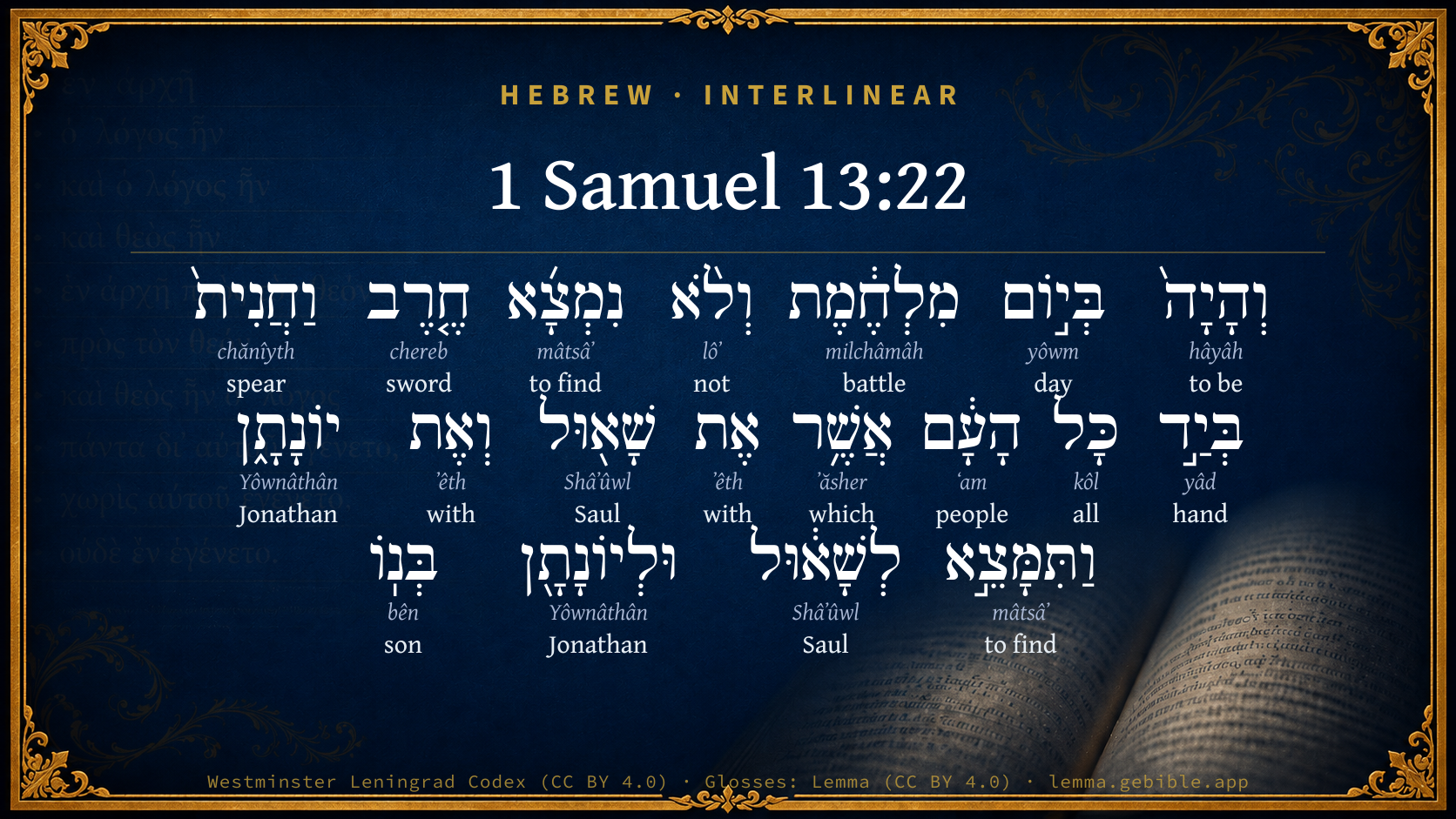
  1. וְהָיָה֙ hâyâh H1961 “and · to be” Conjunction + Verb, Qal, Perfect, 3rd Person, Masculine, Singular
  2. בְּי֣וֹם yôwm H3117 “in/at · day of” Preposition + Noun, Common, Masculine, Singular, Construct
  3. מִלְחֶ֔מֶת milchâmâh H4421 “battle” Noun, Common, Feminine, Singular, Absolute
  4. וְלֹ֨א lôʼ H3808 “and · not” Conjunction + Particle, Negative
  5. נִמְצָ֜א mâtsâʼ H4672 “to find” Verb, Niphal, Perfect, 3rd Person, Masculine, Singular
  6. חֶ֤רֶב chereb H2719 “sword” Noun, Common, Feminine, Singular, Absolute
  7. וַחֲנִית֙ chănîyth H2595 “and · spear” Conjunction + Noun, Common, Feminine, Singular, Absolute
  8. בְּיַ֣ד yâd H3027 “in/at · hand of” Preposition + Noun, Common, Both, Singular, Construct
  9. כָּל kôl H3605 “all of” Noun, Common, Masculine, Singular, Construct
  10. הָעָ֔ם ʻam H5971 “the · people” Particle, Definite Article + Noun, Common, Masculine, Singular, Absolute
  11. אֲשֶׁ֥ר ʼăsher H834 “which” Particle, Relative
  12. אֶת ʼêth H854 “with” Preposition
  13. שָׁא֖וּל Shâʼûwl H7586 “Saul” Noun, Proper
  14. וְאֶת ʼêth H854 “and · with” Conjunction + Preposition
  15. וַתִּמָּצֵ֣א mâtsâʼ H4672 “and · to find” Conjunction + Verb, Niphal, Sequential Imperfect, 3rd Person, Feminine, Singular
  16. לְשָׁא֔וּל Shâʼûwl H7586 “to/for · Saul” Preposition + Noun, Proper
  17. וּלְיוֹנָתָ֖ן Yôwnâthân H3129 “and · to/for · Jonathan” Conjunction + Preposition + Noun, Proper
  18. בְּנֽוֹ bên H1121 “son · his” Noun, Common, Masculine, Singular, Construct + Suffix, Personal, 3rd Person, Masculine, Singular

About this verse

These counts appear in no published source. They are computed here, from the morphology-tagged text and Lemma’s own curated glosses. What Lemma adds →

19
words
15
distinct lemmas
Historical
section

Shared distinctive vocabulary

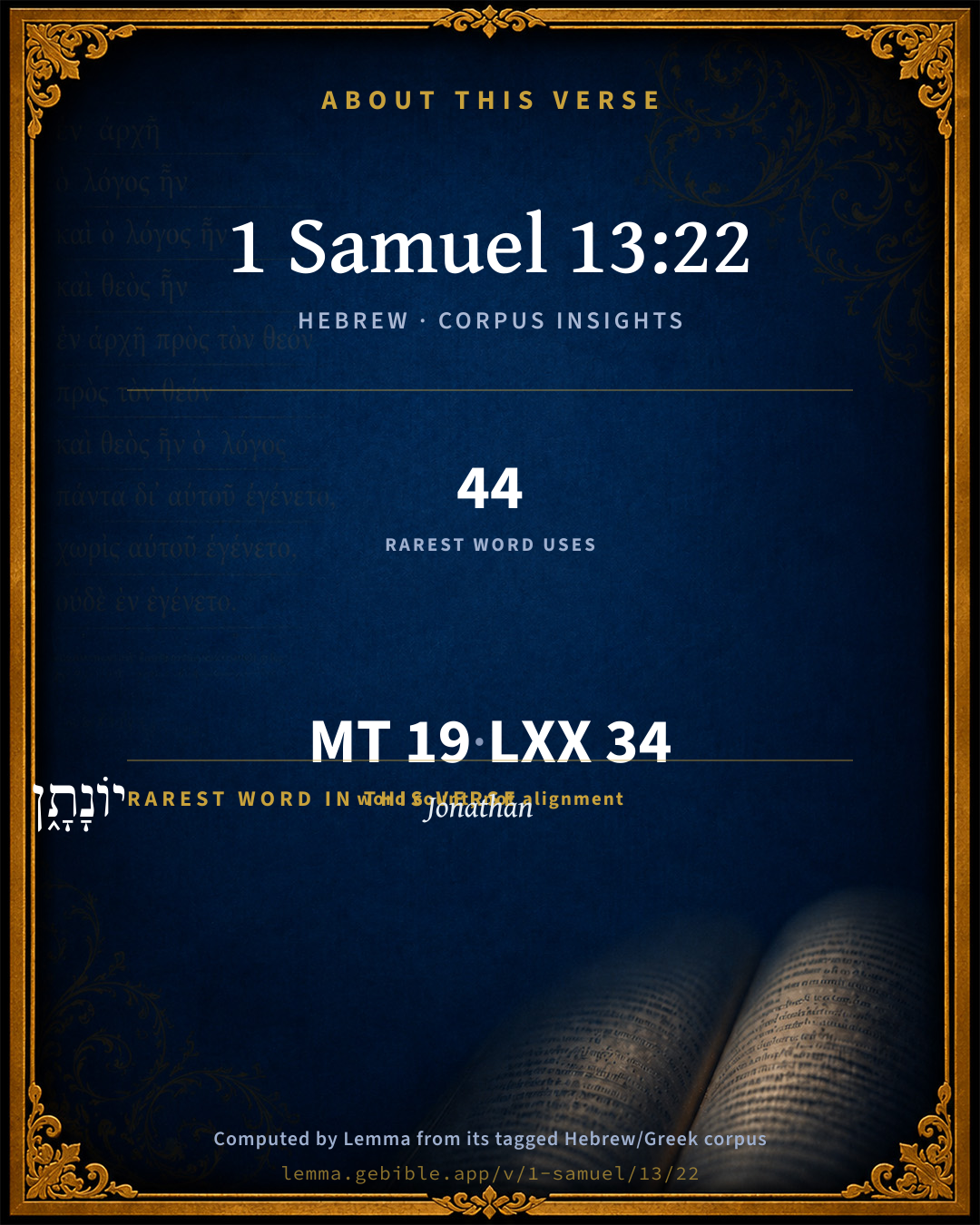
יוֹנָתָ֑ן Jonathan H3129 occurs in 36 verses of the Hebrew Bible. Also found in:

Grammatical profile

  • 3 verbs
  • 12 nouns
  • 2 prepositions
  • 2 particles

Verb forms

  • וְהָיָה֙ Qal · Perfect
  • נִמְצָ֜א Niphal · Perfect
  • וַתִּמָּצֵ֣א Niphal · Sequential Imperfect

Repetition

Words recur within this verse — often emphatic in Hebrew:

  • נִמְצָ֜א to find H4672 ×2
  • שָׁא֖וּל Saul H7586 ×2
  • יוֹנָתָ֑ן Jonathan H3129 ×2
  • אֶת with H854 ×2

Hebrew & Septuagint length

In English translation the verse runs 43 words from the Hebrew and 45 from the Septuagint (LXX English) — closely comparable.

A rough comparison of the two English renderings, which tokenize alike — not a word-level alignment.

Word counts can differ between the Hebrew and the Greek without any difference in meaning — e.g. the Hebrew direct-object marker אֵת has no separate Greek word, and Greek often adds the article ὁ.

In the original languages it is 19 Hebrew tokens and 34 Greek tokens — but the two are counted differently (Hebrew bundles its prefixes and suffixes into one token; the Greek is in lemma form), so that isn’t a like-for-like length.

Cross-references

6

Topical passages linked to 1 Samuel 13:22 in the Treasury of Scripture Knowledge — connected by theme and wording, ordered by reader-vote popularity; previews shown in the World English Bible.

  • Judges 5:8 They chose new gods; Then was war in the gates: Was there a shield or spear seen Among forty thousand in Israel?
  • 1 Samuel 17:47 and that all this assembly may know that Yahweh doesn't save with sword and spear: for the battle is Yahweh's, and he will give you into our hand.
  • 1 Samuel 17:50 So David prevailed over the Philistine with a sling and with a stone, and struck the Philistine, and killed him; but there was no sword in the hand of David.
  • Zechariah 4:6 Then he answered and spoke to me, saying, "This is the word of Yahweh to Zerubbabel, saying, 'Not by might, nor by power, but by my Spirit,' says Yahweh of Hosts.
  • 1 Corinthians 1:27–29 but God chose the foolish things of the world that he might put to shame those who are wise. God chose the weak things of the world, that he might put to shame the things that are strong;
  • 2 Corinthians 4:7 But we have this treasure in clay vessels, that the exceeding greatness of the power may be of God, and not from ourselves.

Cross-references courtesy of OpenBible.info (CC BY 4.0).

Hebrew and Greek witnesses Masoretic Hebrew ↔ Greek Septuagint

The same verse in the two great witnesses to the Old Testament, shown verse-for-verse.

These are two independent witnesses, not word-aligned to each other, and the Septuagint is shown in lemma (dictionary) form.

Hebrew 1 Samuel 13:22 Masoretic · Westminster Leningrad Codex

וְהָיָה֙ בְּי֣וֹם מִלְחֶ֔מֶת וְלֹ֨א נִמְצָ֜א חֶ֤רֶב וַחֲנִית֙ בְּיַ֣ד כָּל הָעָ֔ם אֲשֶׁ֥ר אֶת שָׁא֖וּל וְאֶת יוֹנָתָ֑ן וַתִּמָּצֵ֣א לְשָׁא֔וּל וּלְיוֹנָתָ֖ן בְּנֽוֹ

So it came to pass in the day of battle, that there was neither sword nor spear found in the hand of any of the people who were with Saul and Jonathan: but with Saul and with Jonathan his son was there found.

World English Bible · Public Domain

Greek LXX 1 Samuel 13:22 Septuagint · lemma form

καί γίγνομαι ἐν ὁ ἡμέρα ὁ πόλεμος μαχεμας καί οὐ εὑρίσκω ῥομφαία καί δόρυ ἐν χείρ πᾶς ὁ λαός ὁ μετά σαούλ καί μετά ιωναθαν καί εὑρίσκω ὁ σαούλ καί ὁ ιωναθαν υἱός αὐτός

And it came to pass in the days of the war of Machmas, that there was not a sword or spear found in the hand of all the people, that were with Saul and Jonathan; but with Saul and Jonathan his son was there found.

LXX2012 (modern English Septuagint) · Public Domain

Hebrew: Westminster Leningrad Codex (CC BY 4.0). Greek: Septuagint (public domain); English from LXX2012 (modern English Septuagint) (Public Domain). How the Septuagint differs from the Hebrew →

Targum (Aramaic paraphrase)

1

The Targum is the ancient Jewish Aramaic paraphrase of the Hebrew Scriptures — an interpretive translation, not the Hebrew text itself. Onkelos (literal) and Pseudo-Jonathan (expansive) render the Torah, and Jonathan the Prophets. Coverage is partial: where no permissively-licensed English translation exists for a verse, only the Aramaic is shown. This is verse-level text, not a word-by-word alignment to the Hebrew.

  1. Targum Jonathan Prophets (Joshua–Malachi)
    וַהֲוָה בְּיוֹמָא דִקְרָבָא וְלָא אִשְׁתְּכַח חַרְבָּא וּמוּרְנִיתָא בְּיַד כָּל עַמָא דְעִם שָׁאוּל וְעִם יוֹנָתָן וּמַשְׁכְּחָא לְשָׁאוּל וּלְיוֹנָתָן בְּרֵיהּ:

    (no public-domain English translation for this verse)

    Targum Jonathan — Aramaic: “Mikraot Gedolot” (public domain). English: “Sefaria Community Translation” (CC0 1.0 (public-domain dedication)); “London "Chaldee Paraphrase," 1871” (public domain). Text via Sefaria.

Commentary

Notes on 1 Samuel 13:22 from classic Christian and Jewish commentators (each source and its license shown beneath its notes). The classic Christian expositions comment on the surrounding passage and are grouped to its opening verse, so a note may address several verses; the Jewish commentaries on the Tanakh (Rashi and others) are per-verse, so they appear only where the commentator wrote on this verse.

Lemma curates 59 commentaries, every one of them public domain or Creative Commons licensed, each selected and text-cleaned for this edition rather than reprinted as found. About our sources →

Trapp's Complete Commentary

John Trapp

1Sa 13:22 So it came to pass in the day of battle, that there was neither sword nor spear found in the hand of any of the people that [were] with Saul and Jonathan: but with Saul and with Jonathan his son was there found.

Ver. 22. There was neither sword nor spear found.] And yet the Israelites had the day, and returned laden both with arms and victory. No armour is of proof against the Almighty. Excellently Gregory, Armati ab inermibus victi sunt ut totum quod vincitur Omnipotentis Dei laudibus tribuatur.

But with Saul and with Jonathan his son.] The Hebrews say that the angels brought them these arms; but that is not likely.

John Trapp, A Commentary or Exposition upon All the Books of the Old and New Testament (1647–1656) — public domain. Text from a community e-Sword module.

Joseph Benson's Commentary

1Sa 13:22. There was neither sword nor spear — This, it seems, must be restrained to the six hundred that were with Saul and Jonathan; for there were, no doubt, a considerable number of swords and spears among the Israelites, but they generally hid them, as now they did their persons, from the Philistines. And the Philistines had not yet attained to so great a power over them as wholly to disarm them, but thought it sufficient to prevent the making of new arms, knowing that the old ones would shortly be decayed and useless. There were likewise other arms more common in those times and places than swords and spears; to wit, bows and arrows, and slings and stones. And besides these, people anciently often used clubs, wherewith to beat down their enemies; and, before the invention of spears with iron points, they had sharp stakes hardened in the fire, as many authors inform us.

Joseph Benson's Commentary on the Old and New Testaments (1811–1818) — public domain. Text from a community e-Sword module.

Geneva Bible (1599)

Geneva Bible translators

To declare that the victory only came of God, and not by their force.

Geneva Bible (1599) marginal notes — public domain. Text via Bolls.life.

Adam Clarke's Commentary

Verse 22. In the day of battle - these was neither sword nor spear] But if the Israelites enjoyed such profound peace and undisturbed dominion under Samuel, how is it that they were totally destitute of arms, a state which argues the lowest circumstances of oppression and vassalage? In answer to this we may observe, that the bow and the sling were the principal arms of the Israelites; for these they needed no smith: the most barbarous nations, who have never seen iron, have nevertheless bows and arrows; the arrow heads generally made of flint. Arrows of this kind are found among the inhabitants of the South Sea islands; and even axes, and different implements of war, all made of stone, cut and polished by stone, are frequent among them. The arms of the aboriginal Irish have been of this kind. I have frequently seen heads of axes and arrows of stone, which have been dug up out of the ground, formed with considerable taste and elegance. The former the common people term thunderbolts; the latter, elf-stones. Several of these from Ireland, from Zetland, and from the South Sea islands, are now before me.

Now it is possible that the Israelites had still bows and arrows: these they could have without the smith; and it is as likely that they had slings, and for these they needed none. But then these were missiles; if they came into close fight, they would avail them nothing: for attacks of this kind they would require swords and spears; of these none were found but with Saul and Jonathan.

WE see, in this chapter, Israel brought to as low a state as they were under Eli; when they were totally discomfited, their priests slain, their ark taken, and the judge dead. After that, they rose by the strong hand of God; and in this way they are now to rise, principally by means of David, whose history will soon commence.

Adam Clarke's Commentary on the Bible (1810–1826) — public domain. Text from a community e-Sword/MySword module.

Ellicott's Commentary for English Readers

(22) There was neither sword nor spear.—These words must not be pressed too literally. The general result of the raids alluded to in 1Sa_13:16-17 was that in the open valleys of Southern Canaan, especially in the Benjamite territory, the districts whence Saul and Jonathan could most easily recruit their thinned and dispirited forces, there was an absence of arms. This fact is especially dwelt upon, for the Philistines appear to have armed their fighting men to the teeth. (Compare the description of their champion, Goliath, who is described as “clad in armour.”)

But with Saul.—These words probably signify that the companies of regulars, who throughout this disastrous period were always with the king and prince, were—in contrast to the country people around—fully armed. (See allusion, for instance, to Jonathan and his armour-bearer in the next chapter.)

A Bible Commentary for English Readers, edited by Charles John Ellicott (1878–1897) — public domain. Text from a community e-Sword module.

John Gill's Exposition

So it came to pass in the day of battle,.... When that drew near, and they were called to it, and obliged to fight or flee, or surrender:

that there were neither sword nor spear found in the hand of any of the people that were with Saul and Jonathan: which was not owing to their leaving them behind in the camp, or casting them away from them through fear, as they followed Saul with trembling, but to the cause now mentioned. In what manner some preceding battles were fought with the Philistines and Ammonites, notwithstanding, have been accounted for on Sa1 13:19, but it is strange that the Israelites did not furnish themselves with the arms of the Philistines at the defeat of them in Ebenezer, Sa1 7:10 and with the arms of the Ammonites at Jabeshgilead, Sa1 11:11 and that such a warlike prince as Saul appeared at his first setting out to be should not in the first place take care to provide armour for his men by some means or another; for that those that left him should have arms, and not those that abode with him, does not seem reasonable. It may be the Benjamites, being expert in slinging, were indifferent to and neglected the use of any other weapon, or method of fighting:

but with Saul and with Jonathan his son was there found; swords and spears, and with them only.

John Gill's Exposition of the Whole Bible (1746–1763) — public domain (CC PDM 1.0). Text via the HelloAO Bible API.

Albert Barnes' Notes on the Bible

This seems to be mentioned here, in anticipation of the narrative in the next chapter, to enhance the victory gained, through God’s help 1Sa 14:23, by the comparatively unarmed Israelites over their enemies. What with occasional skirmishes with the Philistines, the necessity of using their arms for domestic purposes, accidental losses, and the ordinary wear and tear, coupled with the impossibility of renewing their arms from the want of smiths and forges, the people that were with Saul and Jonathan came to be very imperfectly armed. It has been observed, moreover, that the Benjamites were more famous for the use of the sling than for any other weapon Jdg 20:16, and this would be an additional cause of the paucity of swords and spears.

Albert Barnes' Notes on the Bible (1834–1885) — public domain. Text from a community e-Sword/MySword module.

Matthew Poole's English Annotations

Quest. How could the Israelites smite either the garrison of the Philistines, above, 1Sa 13:3, or the host of the Ammonites, 1Sa 11:11, without arms? And when they had conquered them, why did they not take away their arms, and reserve them to their own use?

Answ. 1. This want of swords and spears is not affirmed concerning all Israel, but is restrained unto those six hundred who were with Saul and Jonathan, whom God by his providence might suffer to be without those arms, that the glory of the following victory might be wholly ascribed to God; as for the very same reason God would have but three hundred men left with Gideon, and those armed only with trumpets, and pitchers, and lamps Jdg 7. There were no doubt a considerable number of swords and spears among the Israelites, but they generally hid them, as now they did their persons, from the Philistines. And the Philistines had not yet attained to so great a power over them, as wholly to disarm them, but thought it sufficient to prevent the making of new arms, knowing that the old ones would shortly be decayed and useless.

2. There were other arms more common in those times and places than swords and spears, to wit, bows and arrows, and slings and stones; as appears from Jdg 20:16; 2Sa 1:18,22; 2Ki 3:25; 1Ch 12:1,2; besides clubs, and instruments of agriculture, which might easily be turned into weapons of war.

3. God so governed the affairs of the Israelites, that they had no great number of swords or spears, Jdg 5:8, that so they might be kept in more dependence upon and subjection unto God, wherein their safety and happiness consisted. And therefore that famous victory obtained against the Philistines in Samuel’s days, was not got by the sword of men, but only by thunder from heaven, 1Sa 7:10.

Matthew Poole's English Annotations on the Holy Bible (1683–1685) — public domain. Text from a community e-Sword/MySword module.

The Pulpit Commentary

There was neither sword, etc. Armed only with clubs and their farming implements, it is no wonder that the people were afraid of fighting the Philistines, who, as we gather from the description of Goliath"s armour, were clad in mail; nor is it surprising that they despised and neglected Saul and his few men, whom probably they regarded as an unarmed mob of rustics. The Ammonites probably were far less efficiently armed than the Philistines, who, as commanding the sea coast, could import weapons from Greece.

The Pulpit Commentary (1880–1919), ed. H.D.M. Spence-Jones & Joseph S. Exell — public domain. Text from a community e-Sword module.

John Wesley's Explanatory Notes

Sword - It seems restrained to the six hundred that were with Saul and Jonathan; for there were no doubt a considerable number of swords and spears among the Israelites, but they generally hid them, as now they did their persons, from the Philistines. And the Philistines had not yet attained to so great a power over them, as wholly to disarm them, but thought it sufficient to prevent the making of new arms; knowing that the old ones would shortly be decayed, and useless. There were likewise other arms more common in those times and places, than swords and spears; to wit, bows and arrows, and slings and stones.

John Wesley, Explanatory Notes Upon the Whole Bible (1754–1765) — public domain. Text via the GEBible commentary corpus.

unfoldingWord translationNotes

Door43 World Missions Community

General Information:

The narrative continues.

there were no swords or spears

This explains in part why Saul's army was afraid. They did not have any weapons to fight.

translationWords

Saul (OT)

unfoldingWord translationNotes — © Distant Shores Media and the Door43 World Missions Community, licensed CC BY-SA 4.0. Source: git.door43.org/Door43/en_tn.

Rashi

Rabbi Shlomo Yitzchaki (Rashi)

But they could be found with Shaul. By means of a miracle.

Rashi on the Tanakh — English translations: “The Judaica Press complete Tanach with Rashi, translated by A. J. Rosenberg” (CC BY 4.0); “Pentateuch with Rashi's commentary by M. Rosenbaum and A.M. Silbermann, 1929-1934” (public domain); “The Metsudah Tanach series, Lakewood, N.J” (CC BY 4.0); and “The Book of Joshua, Metsudah Publications, 1997” (CC BY 4.0). Text via Sefaria.

Lesson kit

Teaching starters — assembled from the data on this page, not authored interpretation. Every prompt links to the verse data it draws on. Edit before teaching.

1 Samuel, in the Historical, opens this verse with 19 words (15 distinct Hebrew lemmas). Its most distinctive word is Yôwnâthân (“Jonathan”). A historical commentator’s framing appears above. Read the whole chapter for the surrounding context.

Discussion questions

  1. The word Yôwnâthân carries the sense “Jonathan.” How does it shape the verse?
  2. Judges 18:30 shares the word «Jonathan» with this verse. How do the two illuminate each other?
  3. “to find” occurs 2× in this one verse. What is the effect of the repetition?
  4. These translations render this verse differently. What is at stake in choosing one wording over another?
  5. The verb «וְהָיָה֙» is Qal Perfect. How does its form color the action?
  6. Reading how Trapp's Complete Commentary and Joseph Benson's Commentary read this verse, where do the two commentators agree and where do they part?

Things to notice

Reading settings

Reading text

Shown beneath each verse's original-language words.

Old Testament
Old Testament edition

Read the OT as the Masoretic Hebrew (MT) or the Greek Septuagint (LXX).

English shown for the Greek Septuagint (in the Hebrew ↔ Greek comparison).

Comparing translations? Open the Compare panel on any verse page to stack up to four side by side.