
1 Kings 2:32

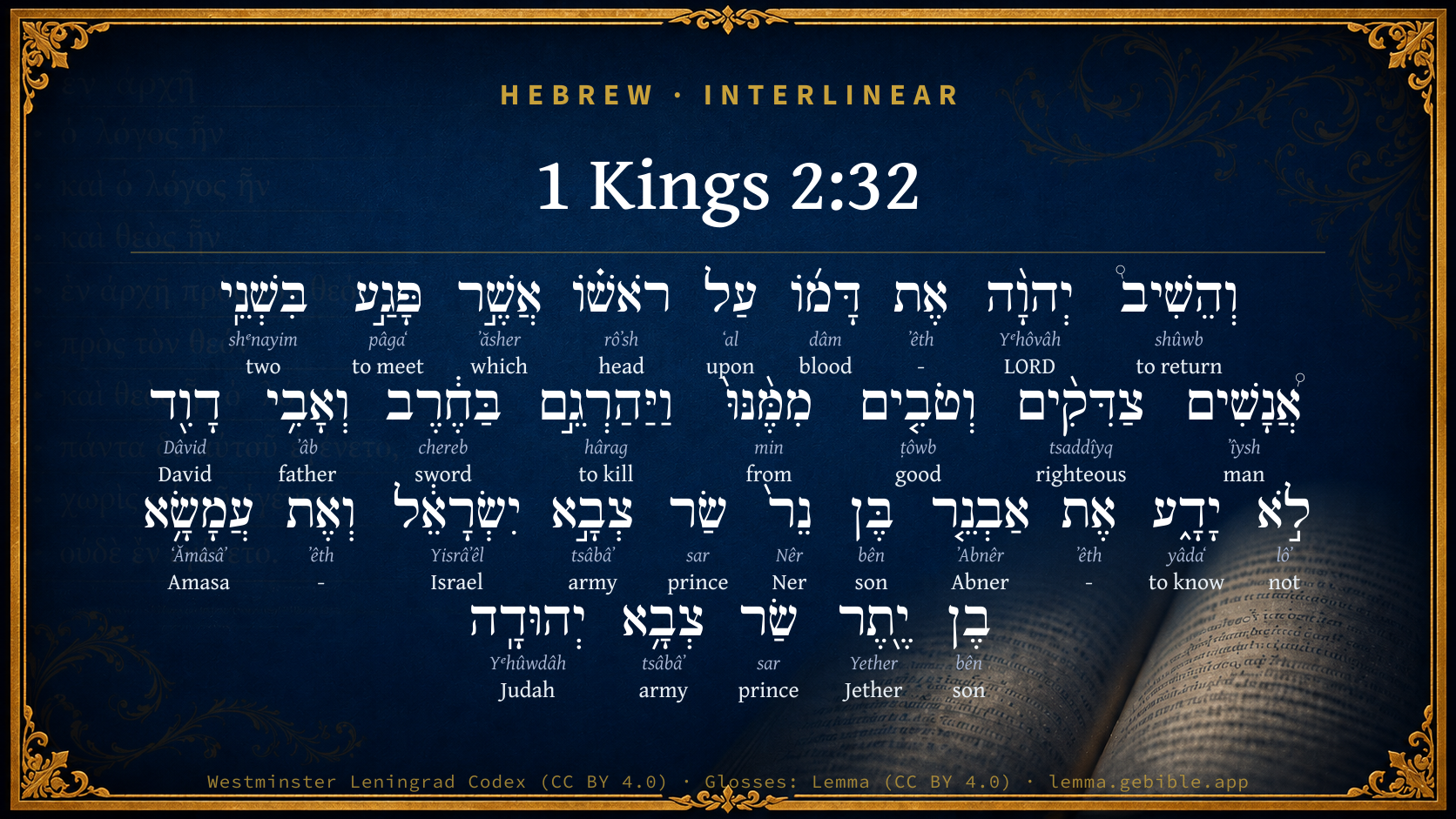
Hebrew (Westminster Leningrad Codex) 1 Kings 2:32 appears in the Hebrew Old Testament. The text above is from the Westminster Leningrad Codex. Each word links to its Strong’s number, a concise gloss, and parsing drawn from the Open Scriptures Hebrew Bible morphology. Click any word for its full Brown-Driver-Briggs (BDB) entry.
Download image
Cite this verse

1 Kings 2:32 (World English Bible). Public Domain. Lemma interlinear Bible study tool, https://lemma.gebible.app/v/1-kings/2/32.

Show BibTeX & RIS
BibTeX
RIS
English Translation
Yahweh will return his blood on his own head, because he fell on two men more righteous and better than he, and killed them with the sword, and my father David didn't know it, [to wit], Abner the son of Ner, captain of the host of Israel, and Amasa the son of Jether, captain of the host of Judah.
World English Bible · Public Domain
Download a study sheet

One document with this verse’s original text, its word-by-word gloss line, the meaning frame, cross-references with their text, attributed commentary, and full source and license credits — printable, and it pastes into notes with its structure intact.

This verse Autodidact and up

Study sheet (.html) Plain text (.txt)

A passage Seminary Student

Up to 50 verses in one chapter. A passage sheet keeps up to 6 commentary sources and 12 cross-references per verse, in the order this page ranks them, and says so on the sheet whenever that leaves anything out. Ask for a single verse and you get the Autodidact verse sheet above.

Everything on this page stays free to read, with no account — the sheet is a download of what is already on screen, not access to it.

Want to remove ads? Support Godless Engineer
Compare translations 3

The same verse in 3 English versions, stacked beneath the original-language interlinear above. Click any original word for its lexicon entry.

Each is an independent rendering of the whole verse — the interlinear is not word-aligned to these translations.

Highlighted words mark where these versions differ — a whole-verse word diff, not a word-by-word alignment.

  • World English Bible Public Domain
    Yahweh will return his blood on his own head, because he fell on two men more righteous and better than he, and killed them with the sword, and my father David didn't know it, [to wit], Abner the son of Ner, captain of the host of Israel, and Amasa the son of Jether, captain of the host of Judah.
  • King James Version Public Domain
    And the LORD shall return his blood upon his own head, who fell upon two men more righteous and better than he, and slew them with the sword, my father David not knowing thereof, to wit, Abner the son of Ner, captain of the host of Israel, and Amasa the son of Jether, captain of the host of Judah.
  • unfoldingWord Literal Text CC BY-SA 4.0
    And Yahweh will return his blood on his head because he attacked two men more righteous and better than him, and he killed them with the sword, and my father David did not know, Abner, the son of Ner, the commander of the army of Israel, and Amasa, the son of Jether, the commander of the army of Judah.

unfoldingWord Literal Text — © unfoldingWord, licensed CC BY-SA 4.0. Word-aligned USFM3 via Door43 (git.door43.org/unfoldingWord/en_ult).

Versions to compare (up to 4)

3 of 4 selected

Show all 18 translations

Every available English version of this verse, each an independent rendering of the whole verse.

  • World English Bible Public Domain
    Yahweh will return his blood on his own head, because he fell on two men more righteous and better than he, and killed them with the sword, and my father David didn't know it, [to wit], Abner the son of Ner, captain of the host of Israel, and Amasa the son of Jether, captain of the host of Judah.
  • Berean Standard Bible Public Domain
    The LORD will bring his bloodshed back upon his own head, for without the knowledge of my father David he struck down two men more righteous and better than he when he put to the sword Abner son of Ner, commander of Israel’s army, and Amasa son of Jether, commander of Judah’s army.
  • Majority Standard Bible Public Domain
    The LORD will bring his bloodshed back upon his own head, for without the knowledge of my father David he struck down two men more righteous and better than he when he put to the sword Abner son of Ner, commander of Israel’s army, and Amasa son of Jether, commander of Judah’s army.
  • King James Version Public Domain
    And the LORD shall return his blood upon his own head, who fell upon two men more righteous and better than he, and slew them with the sword, my father David not knowing thereof, to wit, Abner the son of Ner, captain of the host of Israel, and Amasa the son of Jether, captain of the host of Judah.
  • American Standard Version (1901) Public Domain
    And Jehovah will return his blood upon his own head, because he fell upon two men more righteous and better than he, and slew them with the sword, and my father David knew it not, `to wit', Abner the son of Ner, captain of the host of Israel, and Amasa the son of Jether, captain of the host of Judah.
  • Revised Version (1885) Public Domain
    And the LORD shall return his blood upon his own head, because he fell upon two men more righteous and better than he, and slew them with the sword, and my father David knew it not, to wit, Abner the son of Ner, captain of the host of Israel, and Amasa the son of Jether, captain of the host of Judah.
  • Geneva Bible (1599) Public Domain
    And the Lord shall bring his blood vpon his owne head: for he smote two men more righteous and better then he, and slew them with the sword, and my father Dauid knew not: to wit, Abner the sonne of Ner, captaine of the hoste of Israel, and Amasa the sonne of Iether captaine of the hoste of Iudah.
  • Douay-Rheims (1899) Public Domain
    And the Lord shall return his blood upon his own head, because he murdered two men, just and better than himself: and slew them with the sword, my father David not knowing it, Abner the son of Ner, general of the army of Israel, and Amasa the son of Jether, general of the army of Juda.
  • Young's Literal Translation Public Domain
    and Jehovah hath turned back his blood on his own head, who hath fallen on two men more righteous and better than he, and slayeth them with the sword, -- and my father David knew not -- Abner son of Ner, head of the host of Israel, and Amasa son of Jether, head of the host of Judah;
  • Literal Standard Version CC BY-SA 4.0
    and YHWH has turned back his blood on his own head, [on him] who has fallen on two men more righteous and better than he, and slays them with the sword—and my father David did not know—Abner son of Ner, head of the host of Israel, and Amasa son of Jether, head of the host of Judah;
  • Unlocked Literal Bible CC BY-SA 4.0
    May Yahweh return his blood on his own head, because he attacked two men more righteous and better than himself and killed them with the sword, Abner son of Ner, the captain of the army of Israel, and Amasa son of Jether, the captain of the army of Judah, without my father David knowing it.
  • unfoldingWord Literal Text CC BY-SA 4.0
    And Yahweh will return his blood on his head because he attacked two men more righteous and better than him, and he killed them with the sword, and my father David did not know, Abner, the son of Ner, the commander of the army of Israel, and Amasa, the son of Jether, the commander of the army of Judah.
  • Darby Bible Public Domain
    And Jehovah shall requite the blood which he shed upon his own head, because he fell upon two men more righteous and better than he, and slew them with the sword, without my father David's knowledge: Abner the son of Ner, captain of the host of Israel, and Amasa the son of Jether, captain of the host of Judah.
  • World Messianic Bible Public Domain
    The LORD will return his blood on his own head, because he fell on two men more righteous and better than he, and killed them with the sword, and my father David didn’t know it: Abner the son of Ner, captain of the army of Israel, and Amasa the son of Jether, captain of the army of Judah.
  • Webster's Bible Public Domain
    And the LORD shall return his blood upon his own head, who fell upon two men more righteous and better than he, and slew them with the sword, my father David not knowing of it, to wit, Abner the son of Ner captain of the host of Israel, and Amasa the son of Jether, captain of the host of Judah.
  • Free Bible Version CC BY-SA 4.0
    The Lord will pay him back for the blood he shed, for without my father David's knowledge, he killed two good men who were better than he was. With his sword he killed Abner, son of Ner, commander of Israel's army, and Amasa, son of Jether, commander of Judah's army.
  • Bible in Basic English Public Domain
    And the Lord will send back his blood on his head, because of the attack he made on two men more upright and better than himself, putting them to the sword without my father's knowledge; even Abner, the son of Ner, captain of the army of Israel, and Amasa, the son of Jether, captain of the army of Judah.
  • JPS Tanakh (1917) Public Domain
    And the LORD will return his blood upon his own head, because he fell upon two men more righteous and better than he, and slew them with the sword, and my father David knew it not: Abner the son of Ner, captain of the host of Israel, and Amasa the son of Jether, captain of the host of Judah.

Literal Standard Version (2020), Covenant Press — licensed CC BY-SA 4.0. Text via the HelloAO Bible API (eBible.org). Unlocked Literal Bible (unfoldingWord) — licensed CC BY-SA 4.0. Text via the HelloAO Bible API (eBible.org). unfoldingWord Literal Text — © unfoldingWord, licensed CC BY-SA 4.0. Word-aligned USFM3 via Door43 (git.door43.org/unfoldingWord/en_ult). Free Bible Version, Dr. Jonathan Gallagher — licensed CC BY-SA 4.0. Text via the HelloAO Bible API (eBible.org).

Word by word

More ways to search: Search by grammar → Find every occurrence → Compare this word →

Practice this passage: Drill this verse → Learn its vocabulary →

יֶ֖תֶר
Yether
H3500
“Jether”
Noun, Proper
Part of Speech
Noun
Type
Proper
Full BDB Definition

Origin: the same as H3499

TWOT: None

Jether = "abundance" - father-in-law of Moses - oldest son of Gideon - father of Jephunneh and the chief of a line of warriors of the line of Asher - father of Amasa, the commander of Absalom's army - son of Jada, a descendant of Hezron, of the tribe of Judah - a son of Ezra, a Judaite
  1. וְהֵשִׁיב֩ shûwb H7725 “and · to return” Conjunction + Verb, Hiphil, Sequential Perfect, 3rd Person, Masculine, Singular
  2. יְהוָ֨ה Yᵉhôvâh H3068 “LORD” Noun, Proper
  3. אֶת ʼêth H853 “-” Particle, Direct Object
  4. דָּמ֜וֹ dâm H1818 “blood · his” Noun, Common, Masculine, Singular, Construct + Suffix, Personal, 3rd Person, Masculine, Singular
  5. עַל ʻal H5921 “upon” Preposition
  6. רֹאשׁ֗וֹ rôʼsh H7218 “head · his” Noun, Common, Masculine, Singular, Construct + Suffix, Personal, 3rd Person, Masculine, Singular
  7. אֲשֶׁ֣ר ʼăsher H834 “which” Particle, Relative
  8. פָּגַ֣ע pâgaʻ H6293 “to meet” Verb, Qal, Perfect, 3rd Person, Masculine, Singular
  9. בִּשְׁנֵֽי shᵉnayim H8147 “in/at · two” Preposition + Adjective, Cardinal number, Masculine, Dual, Construct
  10. אֲ֠נָשִׁים ʼîysh H376 “men” Noun, Common, Masculine, Plural, Absolute
  11. צַדִּקִ֨ים tsaddîyq H6662 “righteous” Adjective, Adjective, Masculine, Plural, Absolute
  12. וְטֹבִ֤ים ṭôwb H2896 “and · good” Conjunction + Adjective, Adjective, Masculine, Plural, Absolute
  13. מִמֶּ֨נּוּ֙ min H4480 “from · us” Preposition + Suffix, Personal, 1st Person, Common, Plural
  14. וַיַּהַרְגֵ֣ם hârag H2026 “and · to kill · them” Conjunction + Verb, Qal, Sequential Imperfect, 3rd Person, Masculine, Singular + Suffix, Personal, 3rd Person, Masculine, Plural
  15. בַּחֶ֔רֶב chereb H2719 “in/at the · sword” Preposition, Determined + Noun, Common, Feminine, Singular, Absolute
  16. וְאָבִ֥י ʼâb H1 “and · father · my” Conjunction + Noun, Common, Masculine, Singular, Construct + Suffix, Personal, 1st Person, Common, Singular
  17. דָוִ֖ד Dâvid H1732 “David” Noun, Proper
  18. לֹ֣א lôʼ H3808 “not” Particle, Negative
  19. יָדָ֑ע yâdaʻ H3045 “to know” Verb, Qal, Perfect, 3rd Person, Masculine, Singular
  20. אֶת ʼêth H853 “-” Particle, Direct Object
  21. אַבְנֵ֤ר ʼAbnêr H74 “Abner” Noun, Proper
  22. בֶּן bên H1121 “son of” Noun, Common, Masculine, Singular, Construct
  23. נֵר֙ Nêr H5369 “Ner” Noun, Proper
  24. שַׂר sar H8269 “prince of” Noun, Common, Masculine, Singular, Construct
  25. צְבָ֣א tsâbâʼ H6635 “army of” Noun, Common, Both, Singular, Construct
  26. יִשְׂרָאֵ֔ל Yisrâʼêl H3478 “Israel” Noun, Proper
  27. וְאֶת ʼêth H853 “and · -” Conjunction + Particle, Direct Object
  28. עֲמָשָׂ֥א ʻĂmâsâʼ H6021 “Amasa” Noun, Proper
  29. בֶן bên H1121 “son of” Noun, Common, Masculine, Singular, Construct
  30. שַׂר sar H8269 “prince of” Noun, Common, Masculine, Singular, Construct
  31. צְבָ֥א tsâbâʼ H6635 “army of” Noun, Common, Both, Singular, Construct
  32. יְהוּדָֽה Yᵉhûwdâh H3063 “Judah” Noun, Proper

About this verse

These counts appear in no published source. They are computed here, from the morphology-tagged text and Lemma’s own curated glosses. What Lemma adds →

33
words
28
distinct lemmas
Historical
section

Notable vocabulary

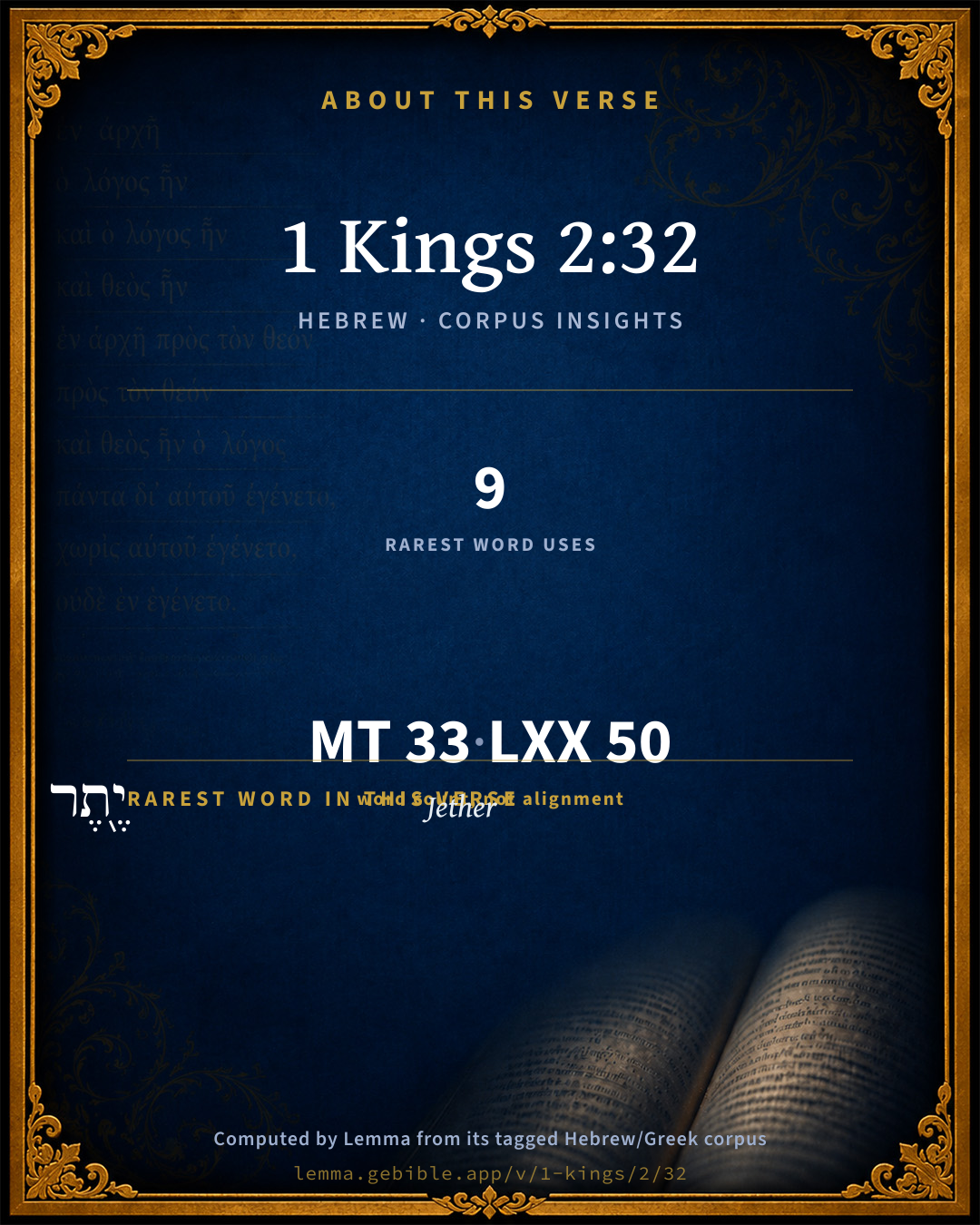
The rarest word here is יֶ֖תֶר Jether H3500 — appearing just 9 times in the whole Hebrew Bible.

Shared distinctive vocabulary

יֶ֖תֶר Jether H3500 occurs in 8 verses of the Hebrew Bible. Also found in:

Grammatical profile

  • 4 verbs
  • 19 nouns
  • 3 adjectives
  • 2 prepositions
  • 5 particles

Verb forms

  • וְהֵשִׁיב֩ Hiphil · Sequential Perfect
  • פָּגַ֣ע Qal · Perfect
  • וַיַּהַרְגֵ֣ם Qal · Sequential Imperfect
  • יָדָ֑ע Qal · Perfect

Repetition

Words recur within this verse — often emphatic in Hebrew:

  • בֶּן son H1121 ×2
  • שַׂר prince H8269 ×2
  • צְבָ֣א army H6635 ×2

Hebrew & Septuagint length

In English translation the verse runs 59 words from the Hebrew and 61 from the Septuagint (LXX English) — closely comparable.

A rough comparison of the two English renderings, which tokenize alike — not a word-level alignment.

Word counts can differ between the Hebrew and the Greek without any difference in meaning — e.g. the Hebrew direct-object marker אֵת has no separate Greek word, and Greek often adds the article ὁ.

In the original languages it is 33 Hebrew tokens and 50 Greek tokens — but the two are counted differently (Hebrew bundles its prefixes and suffixes into one token; the Greek is in lemma form), so that isn’t a like-for-like length.

Cross-references

14

Topical passages linked to 1 Kings 2:32 in the Treasury of Scripture Knowledge — connected by theme and wording, ordered by reader-vote popularity; previews shown in the World English Bible.

  • Judges 9:24 that the violence done to the seventy sons of Jerubbaal might come, and that their blood might be laid on Abimelech their brother, who killed them, and on the men of Shechem, who strengthened his hands to kill his brothers.
  • Judges 9:57 and all the wickedness of the men of Shechem did God requite on their heads: and on them came the curse of Jotham the son of Jerubbaal.
  • 2 Chronicles 21:13 but have walked in the way of the kings of Israel, and have made Judah and the inhabitants of Jerusalem to play the prostitute, like as the house of Ahab did, and also have slain your brothers of your father's house, who were better than yourself:
  • Psalms 7:16 The trouble he causes shall return to his own head. His violence shall come down on the crown of his own head.
  • 2 Samuel 3:26–27 When Joab was come out from David, he sent messengers after Abner, and they brought him back from the well of Sirah: but David didn't know it.
  • 2 Samuel 20:9–10 Joab said to Amasa, Is it well with you, my brother? Joab took Amasa by the beard with his right hand to kiss him.
  • 1 Kings 2:5 Moreover you know also what Joab the son of Zeruiah did to me, even what he did to the two captains of the hosts of Israel, to Abner the son of Ner, and to Amasa the son of Jether, whom he killed, and shed the blood of war in peace, and put the blood of war on his sash that was about his loins, and in his shoes that were on his feet.
  • Genesis 4:11 Now you are cursed because of the ground, which has opened its mouth to receive your brother's blood from your hand.
  • 1 Samuel 15:28 Samuel said to him, Yahweh has torn the kingdom of Israel from you this day, and has given it to a neighbor of yours who is better than you.
  • 2 Samuel 3:37 So all the people and all Israel understood that day that it was not of the king to kill Abner the son of Ner.
  • 2 Samuel 4:11 How much more, when wicked men have slain a righteous person in his own house on his bed, shall I not now require his blood of your hand, and take you away from the earth?
  • 2 Samuel 17:25 Absalom set Amasa over the host instead of Joab. Now Amasa was the son of a man, whose name was Ithra the Israelite, who went in to Abigail the daughter of Nahash, sister to Zeruiah, Joab's mother.
  • 1 Kings 2:44 The king said moreover to Shimei, You know all the wickedness which your heart is privy to, that you did to David my father: therefore Yahweh shall return your wickedness on your own head.
  • Esther 1:19 If it please the king, let there go forth a royal commandment from him, and let it be written among the laws of the Persians and the Medes, that it not be altered, that Vashti come no more before king Ahasuerus; and let the king give her royal estate to another who is better than she.

Cross-references courtesy of OpenBible.info (CC BY 4.0).

Hebrew and Greek witnesses Masoretic Hebrew ↔ Greek Septuagint

The same verse in the two great witnesses to the Old Testament, shown verse-for-verse.

These are two independent witnesses, not word-aligned to each other, and the Septuagint is shown in lemma (dictionary) form.

Hebrew 1 Kings 2:32 Masoretic · Westminster Leningrad Codex

וְהֵשִׁיב֩ יְהוָ֨ה אֶת דָּמ֜וֹ עַל רֹאשׁ֗וֹ אֲשֶׁ֣ר פָּגַ֣ע בִּשְׁנֵֽי אֲ֠נָשִׁים צַדִּקִ֨ים וְטֹבִ֤ים מִמֶּ֨נּוּ֙ וַיַּהַרְגֵ֣ם בַּחֶ֔רֶב וְאָבִ֥י דָוִ֖ד לֹ֣א יָדָ֑ע אֶת אַבְנֵ֤ר בֶּן נֵר֙ שַׂר צְבָ֣א יִשְׂרָאֵ֔ל וְאֶת עֲמָשָׂ֥א בֶן יֶ֖תֶר שַׂר צְבָ֥א יְהוּדָֽה

Yahweh will return his blood on his own head, because he fell on two men more righteous and better than he, and killed them with the sword, and my father David didn't know it, [to wit], Abner the son of Ner, captain of the host of Israel, and Amasa the son of Jether, captain of the host of Judah.

World English Bible · Public Domain

Greek LXX 1 Kings 2:32 Septuagint · lemma form

καί ἀποστρέφω κύριος ὁ αἷμα ὁ ἀδικία αὐτός εἰς κεφαλή αὐτός ὡς ἀποἀντάω ὁ δύο ἄνθρωπος ὁ δίκαιος καί ἀγαθός ὑπέρ αὐτός καί ἀποκτείνω αὐτός ἐν ῥομφαία καί ὁ πατήρ ἐγώ δαυίδ οὐ γιγνώσκω ὁ αἷμα αὐτός ὁ αβεννηρ υἱός νηρ ἀρχιστράτηγος ἰσραήλ καί ὁ αμεσσα υἱός ιεθερ ἀρχιστράτηγος ιουδα

And the Lord has returned upon his own head the blood of his unrighteousness, inasmuch as he attacked two men more righteous and better than himself, and killed them with the sword, and my father David knew not of their blood, even Abenner the son of Ner the commander-in-chief of Israel, and Amessa the son of Jether the commander-in-chief of Juda.

LXX2012 (modern English Septuagint) · Public Domain

On this verse, The Pulpit Commentary discusses the Septuagint’s reading. Read the note in Commentary ↓

Hebrew: Westminster Leningrad Codex (CC BY 4.0). Greek: Septuagint (public domain); English from LXX2012 (modern English Septuagint) (Public Domain). How the Septuagint differs from the Hebrew →

Targum (Aramaic paraphrase)

1

The Targum is the ancient Jewish Aramaic paraphrase of the Hebrew Scriptures — an interpretive translation, not the Hebrew text itself. Onkelos (literal) and Pseudo-Jonathan (expansive) render the Torah, and Jonathan the Prophets. Coverage is partial: where no permissively-licensed English translation exists for a verse, only the Aramaic is shown. This is verse-level text, not a word-by-word alignment to the Hebrew.

  1. Targum Jonathan Prophets (Joshua–Malachi)
    וְיָתֵיב יְיָ יַת חוֹבַת קְטוֹלֵיהּ בְּרֵישֵׁיהּ דִשְׁלַט בִּתְרֵין גַבְרַיָא דְזַכָּאִין וְטָבִין מִנֵיהּ וְקַטְלִינוּן בְּחַרְבָּא וְאַבָּא דָוִד לָא יְדַע יַת אַבְנֵר בַּר נֵר רַב חֵילָא דְיִשְׂרָאֵל וְיַת עֲמָשָׂא בַר יֶתֶר רַב חֵילָא דְבֵית יְהוּדָה:

    (no public-domain English translation for this verse)

    Targum Jonathan — Aramaic: “Mikraot Gedolot” (public domain). English: “Sefaria Community Translation” (CC0 1.0 (public-domain dedication)); “London "Chaldee Paraphrase," 1871” (public domain). Text via Sefaria.

Commentary

Notes on 1 Kings 2:32 from classic Christian and Jewish commentators (each source and its license shown beneath its notes). The classic Christian expositions comment on the surrounding passage and are grouped to its opening verse, so a note may address several verses; the Jewish commentaries on the Tanakh (Rashi and others) are per-verse, so they appear only where the commentator wrote on this verse.

Lemma curates 59 commentaries, every one of them public domain or Creative Commons licensed, each selected and text-cleaned for this edition rather than reprinted as found. About our sources →

Trapp's Complete Commentary

John Trapp

1Ki 2:32 And the LORD shall return his blood upon his own head, who fell upon two men more righteous and better than he, and slew them with the sword, my father David not knowing [thereof, to wit], Abner the son of Ner, captain of the host of Israel, and Amasa the son of Jether, captain of the host of Judah.

Ver. 32. My father David not knowing of it.] This he is careful to insert for the honour of his father.

John Trapp, A Commentary or Exposition upon All the Books of the Old and New Testament (1647–1656) — public domain. Text from a community e-Sword module.

Joseph Benson's Commentary

1Ki 2:32-34. The Lord shall return his blood — The guilt of the blood which he hath shed. Upon his own head — Shall make him alone bear the punishment of his iniquity. Who fell upon two men more righteous than he — Of more ingenuous and generous tempers, abhorring such treacherous practices; and both of them devoted to, and employed in my father’s service. Prejudice, however, and anger seem here too much to have dictated Solomon’s expressions; for, it is certain, Joab had always been a firm friend to David, and had done him considerable service at a time when both Abner and Amasa had acted against him. Upon the head of his seed for ever — Either as long as he shall have a posterity, or for a long time, as that phrase is frequently used. So that Solomon here pronounces that Joab’s own death should not expiate his guilt; but that his posterity should suffer for it in future generations, according to what David had said, 2Sa 3:28-29. If Solomon spoke by inspiration of God when he uttered these words, no doubt the prediction was fulfilled, and God visited the sins of the father upon the children, as he often does, when the children tread in their progenitors’ sinful steps. But whether, or how far, this was the case, the Scriptures give us no information. But upon David and upon his seed — shall there be peace — In and by this execution of justice upon Joab and such malefactors, my throne shall be established, and God will bless me and mine with peace and prosperity, He was buried in his own house — That is, in some ground belonging and adjoining to his house, and accounted a part of the mansion. In the wilderness — So they called those parts of the country which were but thinly inhabited.

Joseph Benson's Commentary on the Old and New Testaments (1811–1818) — public domain. Text from a community e-Sword module.

The Cambridge Bible for Schools and Colleges

gen. ed. J. J. S. Perowne

32. his blood] i.e. The blood which he hath shed.

my father David not knowing thereof] The verb is a finite tense and not a participle, and the clause may therefore be rendered ‘and my father D. knew it not.’

Abner] See notes on 1Ki_2:5 above. In that verse both Abner and Amasa are called captains of the host of Israel, while here the latter is distinguished as captain of the host of Judah. That the division in the people was well marked long before the revolt of the ten tribes against Rehoboam may be seen from the strife which took place about David’s return after the death of Absalom (2Sa_19:41-43). Also when Joab numbered the people (2Sa_24:9) the census of the two hosts was given in separately.

The Cambridge Bible for Schools and Colleges (gen. ed. J. J. S. Perowne; Cambridge University Press, 1878–1918) — public domain. Text from a community e-Sword module.

John Gill's Exposition

Their blood shall therefore return upon the head of Joab, and upon the head of his seed for ever,.... Not only upon Joab, but upon his posterity as long as there would be any; signifying, that Joab's death would not be a sufficient satisfaction, but the punishment of his murders would be continued to his offspring: see Sa2 3:29;

but upon David, and upon his seed, and upon his house, and upon his throne, shall there be peace for ever from the Lord; such traitors and murderers being removed, peace and happiness might be expected and believed would attend the family and kingdom of David; whether this be considered as a prayer, or a prophecy, it can and will have its full accomplishment only in the kingdom of the Messiah the son of David, of the increase of whose government, and the peace thereof, there shall be no end, Isa 9:7.

John Gill's Exposition of the Whole Bible (1746–1763) — public domain (CC PDM 1.0). Text via the HelloAO Bible API.

Albert Barnes' Notes on the Bible

Shalt return his blood - i. e. “his shedding of blood.”

Albert Barnes' Notes on the Bible (1834–1885) — public domain. Text from a community e-Sword/MySword module.

Matthew Poole's English Annotations

His blood, i.e. the guilt of the blood which he shed.

More righteous and better than he; of more ingenuous and generous tempers, abhorring from all such treacherous practices; and both of them then devoted to and employed in my service.

Matthew Poole's English Annotations on the Holy Bible (1683–1685) — public domain. Text from a community e-Sword/MySword module.

The Pulpit Commentary

And the Lord shall return LXX ejpestreye, returns, or returned his blood LXX toav aujtou, i.e., the blood he had shed. Cf. vers. 33, 44 upon his own head, who fell upon same word as in vers. 29, 31. So that it was strictly a retaliation. The lex talionis was carried out to the letter two men more righteous and better than he, and slew them with the sword, my father David not knowing. Heb. "and my father David knew not," i.e., was not privy thereto. Solomon thinks of the unjust suspicions which these crimes cast upon his father.

The Pulpit Commentary (1880–1919), ed. H.D.M. Spence-Jones & Joseph S. Exell — public domain. Text from a community e-Sword module.

unfoldingWord translationNotes

Door43 World Missions Community

General Information:

King Solomon explains why Joab should die.

May Yahweh return his blood on his own head

The word "his" refers to Joab. "Blood" is a metonym for murder. And, the idiom "his blood on his own head" means the person should be considered guilty for murder. AT: "Joab has murdered people, and I want Yahweh to hold him guilty for what he has done" (See: Metonymy and Idiom)

more righteous and better

These words mean basically the same thing and emphasize that Abner and Amasa were much better men than Joab. (See: Doublet)

may their blood return on the head of Joab and on the head of his descendants

The word "blood" is a metonym for murder. And, the idiom "blood return on the head of" means the person should be considered guilty for murder. AT: "I want Yahweh to hold Joab and his descendants guilty" (See: Metonymy and Idiom)

to his house, and to his throne

The words "house" and "throne" are metonyms for the family and the kingdom. AT: "to David's descendants and to David's kingdom" (See: Metonymy)

translationWords

Yahweh

righteous

sword

Abner

Israel

Judah

David

descend

eternity

throne

peace

unfoldingWord translationNotes — © Distant Shores Media and the Door43 World Missions Community, licensed CC BY-SA 4.0. Source: git.door43.org/Door43/en_tn.

Lesson kit

Teaching starters — assembled from the data on this page, not authored interpretation. Every prompt links to the verse data it draws on. Edit before teaching.

1 Kings, in the Historical, opens this verse with 33 words (28 distinct Hebrew lemmas). Its most distinctive word is Yether (“Jether”). A historical commentator’s framing appears above. Read the whole chapter for the surrounding context.

Discussion questions

  1. How does “Jether” (Yether) shape what this verse is saying?
  2. Exodus 4:18 shares the word «Jether» with this verse. How do the two illuminate each other?
  3. “son” occurs 2× in this one verse. What is the effect of the repetition?
  4. The translations on this page render this verse differently — a whole-verse word diff, not a word-by-word alignment. What might account for the different wordings?
  5. The verb «וְהֵשִׁיב֩» is Hiphil Sequential Perfect. How does its form color the action?
  6. Reading how Trapp's Complete Commentary and Joseph Benson's Commentary read this verse, where do the two commentators agree and where do they part?

Things to notice

Reading settings

Reading text

Shown beneath each verse's original-language words.

Old Testament
Old Testament edition

Read the OT as the Masoretic Hebrew (MT) or the Greek Septuagint (LXX).

English shown for the Greek Septuagint (in the Hebrew ↔ Greek comparison).

Comparing translations? Open the Compare panel on any verse page to stack up to four side by side.