Joshua 6:21

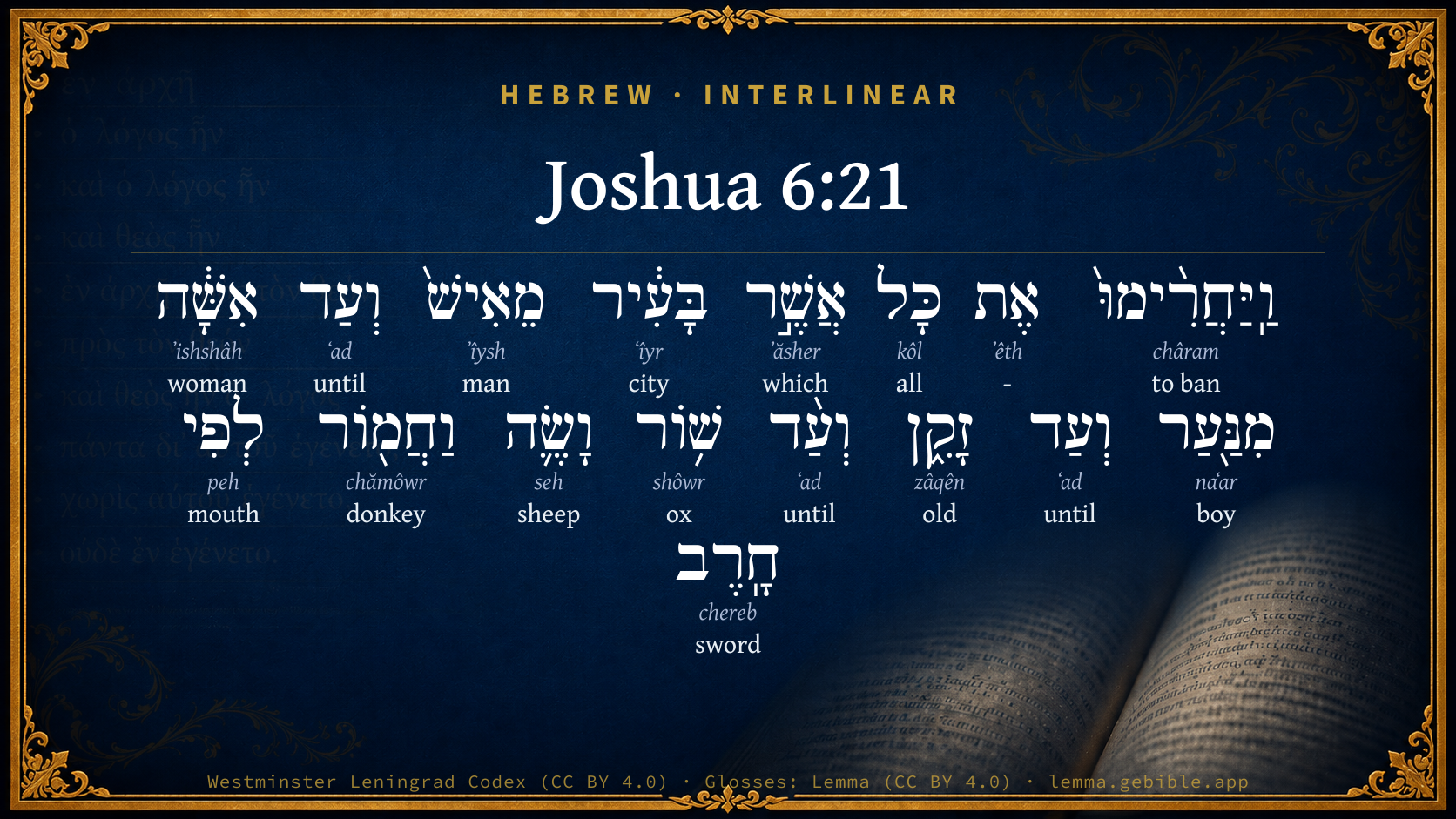
Hebrew (Westminster Leningrad Codex) Joshua 6:21 appears in the Hebrew Old Testament. The text above is from the Westminster Leningrad Codex. Each word links to its Strong’s number, a concise gloss, and parsing drawn from the Open Scriptures Hebrew Bible morphology. Click any word for its full Brown-Driver-Briggs (BDB) entry.
Download image
Cite this verse

Joshua 6:21 (World English Bible). Public Domain. Lemma interlinear Bible study tool, https://lemma.gebible.app/v/joshua/6/21.

Show BibTeX & RIS
BibTeX
RIS
English Translation
They utterly destroyed all that was in the city, both man and woman, both young and old, and ox, and sheep, and donkey, with the edge of the sword.
World English Bible · Public Domain
Download a study sheet

One document with this verse’s original text, its word-by-word gloss line, the meaning frame, cross-references with their text, attributed commentary, and full source and license credits — printable, and it pastes into notes with its structure intact.

This verse Autodidact and up

Study sheet (.html) Plain text (.txt)

A passage Seminary Student

Up to 50 verses in one chapter. A passage sheet keeps up to 6 commentary sources and 12 cross-references per verse, in the order this page ranks them, and says so on the sheet whenever that leaves anything out. Ask for a single verse and you get the Autodidact verse sheet above.

Everything on this page stays free to read, with no account — the sheet is a download of what is already on screen, not access to it.

Want to remove ads? Support Godless Engineer
Compare translations 3

The same verse in 3 English versions, stacked beneath the original-language interlinear above. Click any original word for its lexicon entry.

Each is an independent rendering of the whole verse — the interlinear is not word-aligned to these translations.

Highlighted words mark where these versions differ — a whole-verse word diff, not a word-by-word alignment.

  • World English Bible Public Domain
    They utterly destroyed all that was in the city, both man and woman, both young and old, and ox, and sheep, and donkey, with the edge of the sword.
  • King James Version Public Domain
    And they utterly destroyed all that was in the city, both man and woman, young and old, and ox, and sheep, and ass, with the edge of the sword.
  • unfoldingWord Literal Text CC BY-SA 4.0
    And they devoted all that in the city, from man and to woman, from young and to old, and to ox and sheep and donkey, to the mouth of the sword.

unfoldingWord Literal Text — © unfoldingWord, licensed CC BY-SA 4.0. Word-aligned USFM3 via Door43 (git.door43.org/unfoldingWord/en_ult).

Versions to compare (up to 4)

3 of 4 selected

Show all 18 translations

Every available English version of this verse, each an independent rendering of the whole verse.

  • World English Bible Public Domain
    They utterly destroyed all that was in the city, both man and woman, both young and old, and ox, and sheep, and donkey, with the edge of the sword.
  • Berean Standard Bible Public Domain
    At the edge of the sword they devoted to destruction everything in the city—man and woman, young and old, oxen, sheep, and donkeys.
  • Majority Standard Bible Public Domain
    With the edge of the sword they devoted to destruction everything in the city—man and woman, young and old, oxen, sheep, and donkeys.
  • King James Version Public Domain
    And they utterly destroyed all that was in the city, both man and woman, young and old, and ox, and sheep, and ass, with the edge of the sword.
  • American Standard Version (1901) Public Domain
    And they utterly destroyed all that was in the city, both man and woman, both young and old, and ox, and sheep, and ass, with the edge of the sword.
  • Revised Version (1885) Public Domain
    And they utterly destroyed all that was in the city, both man and woman, both young and old, and ox, and sheep, and ass, with the edge of the sword.
  • Geneva Bible (1599) Public Domain
    And they vtterly destroyed all that was in the citie, both man and woman, yong, and olde, and oxe, and sheepe, and asse, with the edge of the sword.
  • Douay-Rheims (1899) Public Domain
    And killed all that were in it, man and woman, young and old. The oxen also and the sheep, and the asses, they slew with the edge of the sword.
  • Young's Literal Translation Public Domain
    and they devote all that `is' in the city, from man even unto woman, from young even unto aged, even unto ox, and sheep, and ass, by the mouth of the sword.
  • Literal Standard Version CC BY-SA 4.0
    and they devote all that [is] in the city, from man even to woman, from young even to aged, even to ox, and sheep, and donkey, by the mouth of the sword.
  • Unlocked Literal Bible CC BY-SA 4.0
    They completely destroyed all that was in the city by the edge of the sword—man and woman, young and old, oxen, sheep and donkeys.
  • unfoldingWord Literal Text CC BY-SA 4.0
    And they devoted all that in the city, from man and to woman, from young and to old, and to ox and sheep and donkey, to the mouth of the sword.
  • Darby Bible Public Domain
    And they utterly destroyed all that was in the city; both man and woman, young and old, and ox, and sheep, and ass, with the edge of the sword.
  • World Messianic Bible Public Domain
    They utterly destroyed all that was in the city, both man and woman, both young and old, and ox, sheep, and donkey, with the edge of the sword.
  • Webster's Bible Public Domain
    And they utterly destroyed all that was in the city, both man and woman, young and old, and ox, and sheep, and ass, with the edge of the sword.
  • Free Bible Version CC BY-SA 4.0
    They destroyed everything in the city: men and women, young and old, cattle, sheep, and donkeys, all were killed by the sword.
  • Bible in Basic English Public Domain
    And they put everything in the town to the curse; men and women, young and old, ox and sheep and ass, they put to death without mercy.
  • JPS Tanakh (1917) Public Domain
    And they utterly destroyed all that was in the city, both man and woman, both young and old, and ox, and sheep, and ass, with the edge of the sword.

Literal Standard Version (2020), Covenant Press — licensed CC BY-SA 4.0. Text via the HelloAO Bible API (eBible.org). Unlocked Literal Bible (unfoldingWord) — licensed CC BY-SA 4.0. Text via the HelloAO Bible API (eBible.org). unfoldingWord Literal Text — © unfoldingWord, licensed CC BY-SA 4.0. Word-aligned USFM3 via Door43 (git.door43.org/unfoldingWord/en_ult). Free Bible Version, Dr. Jonathan Gallagher — licensed CC BY-SA 4.0. Text via the HelloAO Bible API (eBible.org).

Word by word

More ways to search: Search by grammar → Find every occurrence → Compare this word →

Practice this passage: Drill this verse → Learn its vocabulary →

וָשֶׂ֛ה
seh
H7716
“and · sheep”
Conjunction + Noun, Common, Both, Singular, Absolute
Part of Speech
Conjunction + Noun
Type
Common
Gender
Both
Number
Singular
State
Absolute
Full BDB Definition

Origin: probably from H7582 through the idea of pushing out to graze

TWOT: 2237

one of a flock, lamb, sheep, goat, young sheep, young goat - sheep, goat - flock (collective)
  1. וַֽיַּחֲרִ֨ימוּ֙ châram H2763 “and · to ban” Conjunction + Verb, Hiphil, Sequential Imperfect, 3rd Person, Masculine, Plural
  2. אֶת ʼêth H853 “-” Particle, Direct Object
  3. כָּל kôl H3605 “all of” Noun, Common, Masculine, Singular, Construct
  4. אֲשֶׁ֣ר ʼăsher H834 “which” Particle, Relative
  5. בָּעִ֔יר ʻîyr H5892 “in/at the · city” Preposition, Determined + Noun, Common, Feminine, Singular, Absolute
  6. מֵאִישׁ֙ ʼîysh H376 “from · man” Preposition + Noun, Common, Masculine, Singular, Absolute
  7. וְעַד ʻad H5704 “and · until” Conjunction + Preposition
  8. אִשָּׁ֔ה ʼishshâh H802 “woman” Noun, Common, Feminine, Singular, Absolute
  9. מִנַּ֖עַר naʻar H5288 “from · boy” Preposition + Noun, Common, Masculine, Singular, Absolute
  10. וְעַד ʻad H5704 “and · until” Conjunction + Preposition
  11. זָקֵ֑ן zâqên H2205 “old” Adjective, Adjective, Masculine, Singular, Absolute
  12. וְעַ֨ד ʻad H5704 “and · until” Conjunction + Preposition
  13. שׁ֥וֹר shôwr H7794 “ox” Noun, Common, Masculine, Singular, Absolute
  14. וַחֲמ֖וֹר chămôwr H2543 “and · donkey” Conjunction + Noun, Common, Both, Singular, Absolute
  15. לְפִי peh H6310 “to/for · mouth of” Preposition + Noun, Common, Masculine, Singular, Construct
  16. חָֽרֶב chereb H2719 “sword” Noun, Common, Feminine, Singular, Absolute

About this verse

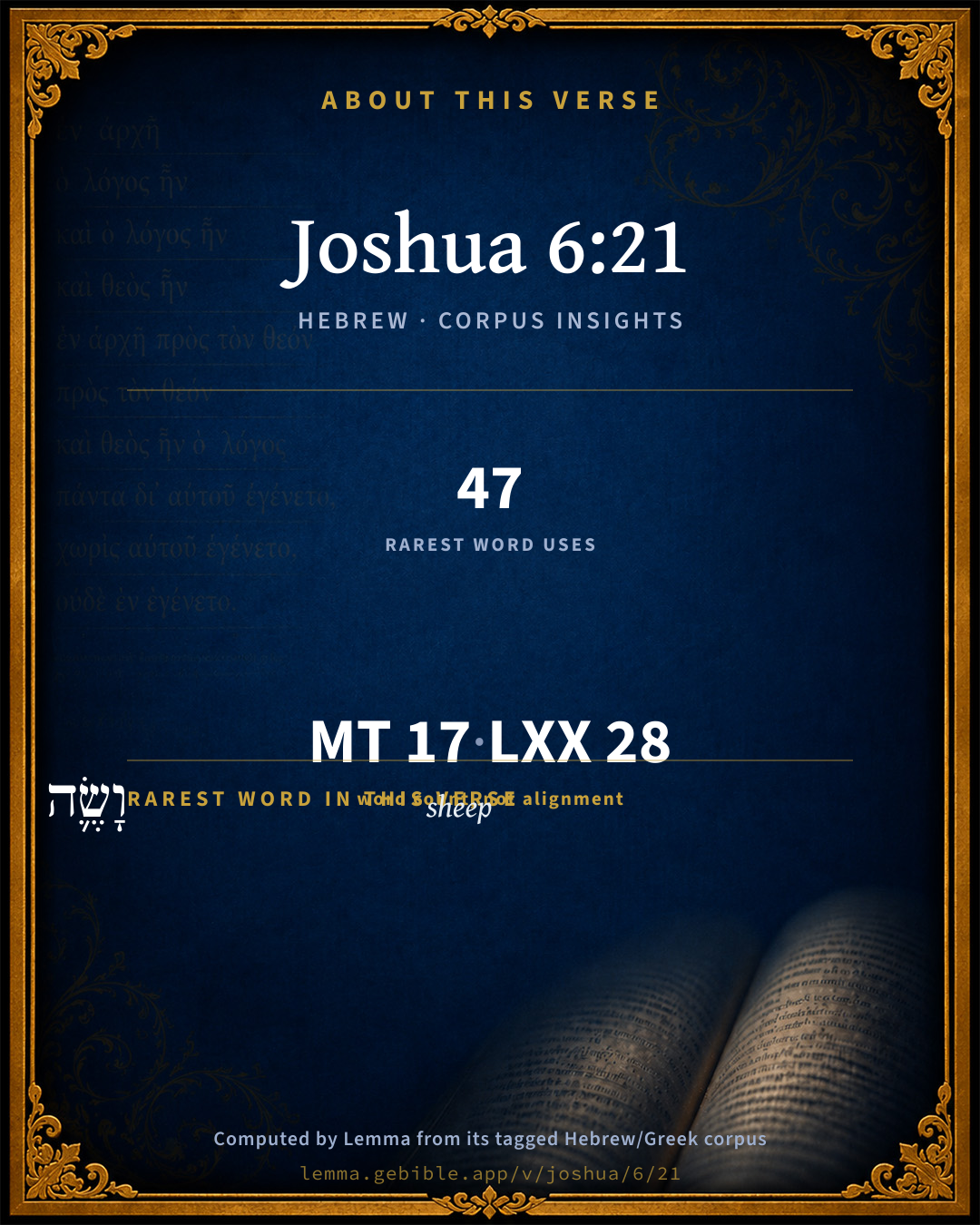
These counts appear in no published source. They are computed here, from the morphology-tagged text and Lemma’s own curated glosses. What Lemma adds →

17
words
15
distinct lemmas
Historical
section

Shared distinctive vocabulary

וָשֶׂ֛ה sheep H7716 occurs in 39 verses of the Hebrew Bible. Also found in:

Grammatical profile

  • 1 verb
  • 10 nouns
  • 1 adjective
  • 3 prepositions
  • 2 particles

Verb forms

  • וַֽיַּחֲרִ֨ימוּ֙ Hiphil · Sequential Imperfect

Repetition

A word recurs within this verse — often emphatic in Hebrew:

  • וְעַד until H5704 ×3

Hebrew & Septuagint length

In English translation the verse runs 29 words from the Hebrew and 31 from the Septuagint (LXX English) — closely comparable.

A rough comparison of the two English renderings, which tokenize alike — not a word-level alignment.

Word counts can differ between the Hebrew and the Greek without any difference in meaning — e.g. the Hebrew direct-object marker אֵת has no separate Greek word, and Greek often adds the article ὁ.

In the original languages it is 17 Hebrew tokens and 28 Greek tokens — but the two are counted differently (Hebrew bundles its prefixes and suffixes into one token; the Greek is in lemma form), so that isn’t a like-for-like length.

Cross-references

15

Topical passages linked to Joshua 6:21 in the Treasury of Scripture Knowledge — connected by theme and wording, ordered by reader-vote popularity; previews shown in the World English Bible.

  • Psalms 137:8–9 Daughter of Babylon, doomed to destruction, He will be happy who rewards you, As you have served us.
  • Jeremiah 48:18 You daughter who dwells in Dibon, come down from your glory, and sit in thirst; for the destroyer of Moab is come up against you, he has destroyed your strongholds.
  • Deuteronomy 2:34 We took all his cities at that time, and utterly destroyed every inhabited city, with the women and the little ones; we left none remaining:
  • Deuteronomy 7:2–3 and when Yahweh your God shall deliver them up before you, and you shall strike them; then you shall utterly destroy them: you shall make no covenant with them, nor show mercy to them;
  • Deuteronomy 7:16 You shall consume all the peoples who Yahweh your God shall deliver to you; your eye shall not pity them: neither shall you serve their gods; for that will be a snare to you.
  • Deuteronomy 20:16–17 But of the cities of these peoples, that Yahweh your God gives you for an inheritance, you shall save alive nothing that breathes;
  • Joshua 9:24–25 They answered Joshua, and said, Because it was certainly told your servants, how that Yahweh your God commanded his servant Moses to give you all the land, and to destroy all the inhabitants of the land from before you; therefore we were sore afraid for our lives because of you, and have done this thing.
  • Joshua 10:28 Joshua took Makkedah on that day, and struck it with the edge of the sword, and the king of it: he utterly destroyed them and all the souls who were therein; he left none remaining; and he did to the king of Makkedah as he had done to the king of Jericho.
  • Joshua 10:39 and he took it, and the king of it, and all the cities of it; and they struck them with the edge of the sword, and utterly destroyed all the souls who were therein; he left none remaining: as he had done to Hebron, so he did to Debir, and to the king of it; as he had done also to Libnah, and to the king of it.
  • Joshua 11:14 All the spoil of these cities, and the cattle, the children of Israel took for a prey to themselves; but every man they struck with the edge of the sword, until they had destroyed them, neither left they any who breathed.
  • 1 Samuel 15:3 Now go and strike Amalek, and utterly destroy all that they have, and don't spare them; but kill both man and woman, infant and suckling, ox and sheep, camel and donkey.
  • 1 Samuel 15:8 He took Agag the king of the Amalekites alive, and utterly destroyed all the people with the edge of the sword.
  • 1 Samuel 15:18–19 and Yahweh sent you on a journey, and said, 'Go, and utterly destroy the sinners the Amalekites, and fight against them until they are consumed.'
  • 1 Kings 20:42 He said to him, Thus says Yahweh, Because you have let go out of your hand the man whom I had devoted to destruction, therefore your life shall go for his life, and your people for his people.
  • Revelation 18:21 A mighty angel took up a stone like a great millstone and cast it into the sea, saying, "Thus with violence will Babylon, the great city, be thrown down, and will be found no more at all.

Cross-references courtesy of OpenBible.info (CC BY 4.0).

Hebrew and Greek witnesses Masoretic Hebrew ↔ Greek Septuagint

The same verse in the two great witnesses to the Old Testament, shown verse-for-verse.

These are two independent witnesses, not word-aligned to each other, and the Septuagint is shown in lemma (dictionary) form.

Hebrew Joshua 6:21 Masoretic · Westminster Leningrad Codex

וַֽיַּחֲרִ֨ימוּ֙ אֶת כָּל אֲשֶׁ֣ר בָּעִ֔יר מֵאִישׁ֙ וְעַד אִשָּׁ֔ה מִנַּ֖עַר וְעַד זָקֵ֑ן וְעַ֨ד שׁ֥וֹר וָשֶׂ֛ה וַחֲמ֖וֹר לְפִי חָֽרֶב

They utterly destroyed all that was in the city, both man and woman, both young and old, and ox, and sheep, and donkey, with the edge of the sword.

World English Bible · Public Domain

Greek LXX Joshua 6:21 Septuagint · lemma form

καί ἀναθεματίζω αὐτός ἰησοῦς καί ὅσος εἰμί ἐν ὁ πόλις ἀπό ἀνήρ καί ἕως γυνή ἀπό νεανίσκος καί ἕως πρεσβύτης καί ἕως μόσχος καί ὑποζύγιον ἐν στόμα ῥομφαία

and Joshua devoted it to destruction, and all things that were in the city, man and woman, young man and old, and calf and ass, with the edge of the sword.

LXX2012 (modern English Septuagint) · Public Domain

Hebrew: Westminster Leningrad Codex (CC BY 4.0). Greek: Septuagint (public domain); English from LXX2012 (modern English Septuagint) (Public Domain). How the Septuagint differs from the Hebrew →

Targum (Aramaic paraphrase)

1

The Targum is the ancient Jewish Aramaic paraphrase of the Hebrew Scriptures — an interpretive translation, not the Hebrew text itself. Onkelos (literal) and Pseudo-Jonathan (expansive) render the Torah, and Jonathan the Prophets. Coverage is partial: where no permissively-licensed English translation exists for a verse, only the Aramaic is shown. This is verse-level text, not a word-by-word alignment to the Hebrew.

  1. Targum Jonathan Prophets (Joshua–Malachi)
    וּגְמָרוּ יַת כָּל דִבְקַרְתָּא מִגְבַר וְעַד אִתָּא מֵעוּלֵימָא וְעַד סָבָא וְעַד תּוֹר וְאִמַר וַחֲמָר לְפִתְגַם דְחֶרֶב:

    (no public-domain English translation for this verse)

    Targum Jonathan — Aramaic: “Mikraot Gedolot” (public domain). English: “Sefaria Community Translation” (CC0 1.0 (public-domain dedication)); “London "Chaldee Paraphrase," 1871” (public domain). Text via Sefaria.

Commentary

Notes on Joshua 6:21 from classic Christian and Jewish commentators (each source and its license shown beneath its notes). The classic Christian expositions comment on the surrounding passage and are grouped to its opening verse, so a note may address several verses; the Jewish commentaries on the Tanakh (Rashi and others) are per-verse, so they appear only where the commentator wrote on this verse.

Lemma curates 59 commentaries, every one of them public domain or Creative Commons licensed, each selected and text-cleaned for this edition rather than reprinted as found. About our sources →

Trapp's Complete Commentary

John Trapp

Jos 6:21 And they utterly destroyed all that [was] in the city, both man and woman, young and old, and ox, and sheep, and ass, with the edge of the sword.

Ver. 21. And they utterly destroyed all.] So God had commanded them; {Deu 20:16-17} and the iniquity of these Amorites was now full. {Gen 15:16} Let us look upon these writs of execution recorded in Scripture, and be warned.

John Trapp, A Commentary or Exposition upon All the Books of the Old and New Testament (1647–1656) — public domain. Text from a community e-Sword module.

Joseph Benson's Commentary

Jos 6:21. Young and old — Being commanded to do so by the sovereign Lord of every man’s life; and being informed by God before that the Canaanites were abominably wicked, and deserved the severest punishments. As for the infants, they were at the disposal of their Creator; and it was a great favour to them to take them away in their infancy, rather than reserve them to those dreadful calamities to which those who survived them were exposed.

Joseph Benson's Commentary on the Old and New Testaments (1811–1818) — public domain. Text from a community e-Sword module.

The Preacher's Complete Homiletical Commentary

Joseph S. Exell (gen. ed.)

CRITICAL NOTES.—

Jos_6:23. And left them without the camp] Till they had undergone ceremonial purification they would be regarded as unclean, and, as such, they were forbidden to come where the Lord dwelt (cf. Num_5:2-3).

MAIN HOMILETICS OF THE PARAGRAPH.—Jos_6:21-25

THE DESTRUCTION OF THE CANAANITES

In slaying all the inhabitants of Jericho, with the exception of Rahab and her kindred, it cannot be too distinctly borne in mind that the Israelites were fulfilling the will and obeying the command of God. From Deu_20:10-18, it is clear that although mercy was to be shewn to all cities out of Canaan, the Israelites were to spare no one in the cities of the land itself. The command was, “Thou shalt save alive nothing that breatheth:” the very sign of life was to be the token for death. In carrying out this terrible mission, the Israelites were not to consult any vindictive feelings of their own; they were to act throughout as servants of God. The subject of these verses is not human cruelty, but Divine severity. It is not for us to “justify the ways of God to men;” it would be equally wrong to turn from any of those acts on which God has laid emphasis, because they may not be pleasant to our feelings. God meant us to think on what He does: that is why His solemn works are recorded. In the light which six thousand years have shed on the name and character of God, all His acts should be received with unquestioning trust: His name written under any work whatever should be a sufficient guarantee of its rectitude. When the Judge bears such a character—a character even more Divine than His glorious name—it is good philosophy to argue, “Shall not the Judge of all the earth do right?” Consider:

I. The grounds for the destruction of these idolatrous people. What is there about the case to assure us that this is no departure from the invariable justness and righteousness of God?

1. It should not be forgotten that God has a right to the lives of all men. That right is being continually asserted. In London alone, some one dies every eight minutes. God claims our little children who are too young to know what sin means, and our aged parents and friends also. Sometimes a dreadful accident sweeps away its scores, or even its hundreds; or it may be that a fearful pestilence takes, in a few weeks, many thousands to the grave. At the back of every death is the will of God. The ancient Persians believed in two gods, Ormudz and Ahriman; the former, the cause of light and good things, the latter, the cause of darkness and evil things. In the very teeth of that mistake Jehovah proclaims, through Isaiah, “I form the light, and create darkness: I make peace, and create evil: I the Lord do all these things.” God claims to do the things which wound and break our hearts, as well as the things which heal them. The Saviour dares to stand prospectively by the slain martyrs of His Church, and in view of their shed blood and burned bodies to expound: “Are not two sparrows sold for a farthing? and one of them shall not fall on the ground without your Father. But the very hairs of your head are all numbered. Fear ye not therefore, ye are of more value than many sparrows.” God claims to stand by every death that occurs from disease or accident: He claims not less the right to employ the sword of man as an instrument for the overthrow of the wicked, and a means whereby He may call even His children home. If diseases and accidents may be the messengers of a just God, why not the sword also? Even men claim the right to destroy murderers. God claims the right to take life in single cases, and we bow in reverence to His demand. Joshua acts as God’s instrument in slaying Achan; but no less does Elijah act as God’s instrument in the destruction of the four hundred and fifty prophets of Baal. The demand in one case is on a larger scale than the other, the principle is the same in both. It may be asked, Would not the effect of slaying all the Canaanites be morally injurious to the Israelites as their executioners? Could they possibly slay whole cities of men, women, and children, without becoming degraded and brutalised themselves? Probably the effect must be bad, if there were not some adequate reason. If there were a solemn need for this slaughter, in order that myriads might be rescued from the miserable degradations of idolatry, it might altogether change and correct the influence on the minds of the executioners. But no theorizing on that point is necessary: as a matter of fact, the generation of men who did this dreadful work of slaughter were a great deal holier than their children. The lessons of this solemn judgment were written deeply on the hearts of the Israelites, and it was not till after they had passed away that the iniquity recorded in the book of Judges was committed.

2. Apart from the Divine right to human life, the provocations of the Canaanites were very great. (a) They were gross idolaters. For one thing, they worshipped Baal, in which worship the most degraded cruelties were practised. Little children were offered in sacrifice, and, in the time of Jehoshaphat, we find that the king of Moab offered for a burnt offering either his own eldest son or the son of the king of Edom. Another of the idolatries of the Canaanites was the worship of Ashtoreth, the Sidonian goddess of impurity, the lewd rites connected with which warrant the suggestion that the death of these children by the sword was merciful, compared with the life otherwise before them. (b) The Canaanites, who worshipped idols like these, must have known much of the true God. They were descendants of Noah, and with very few intervening generations. Ham, the father of Canaan, was one of the eight persons saved in the ark, and from his lips Canaan could not but have heard solemnly of God’s awful judgment in the deluge. As has been pointed out, if Canaan lived as long as some of the children of Shem, his life and personal influence would have reached on through about half the period between the deluge and the overthrow of Jericho. The Canaanites had also received repeated warnings, which reached backward to the destruction of Sodom. All the pious traditions of Noah’s godliness, and the subsequent warnings given because of the sinfulness of the Hamite branch of his descendants, had been alike despised. We have only to look at this case calmly to see how much reason there was for this sword of destruction.

3. God’s purpose was to remove this idolatry from the land. We need not regard the whole of the inhabitants of the land as destroyed. They evidently had the alternative of flight, and God’s fear is said to have been sent in advance of the Israelites to induce the idolaters to escape (cf. Exo_23:27-30). It is a matter of history that many are known thus to have fled to other lands. Those who chose to remain were to die, lest the Israelites should be corrupted. It might be asked, Might not the women and children have been spared? This, also, needs no consideration as a theory: some were spared, and the result was the gross idolatry of the Israelites themselves. The very history of the generations which followed, vindicates with painful sufficiency the necessity for this terrible command.

4. While we mark here the severity of the Lord, we should also think on His longsuffering and His justice. The covenant with Abraham, that his seed should inherit this land, was made more than four hundred and fifty years before, and God had then said, “Thou shalt go to thy fathers in peace; thou shalt be buried in a good old age: but in the fourth generation thy seed shall come hither again: for the iniquity of the Amorites is not yet full.” God waited for four centuries and a half; He would not consume these idolaters till the measure of their guilt made it imperative, nor would He allow Israel to take possession of the land so long as its original occupants were suffered to live. While we stand in awe before the severity of Jehovah, we are also compelled to behold that He is “merciful and gracious, longsuffering, and abundant in goodness and truth.”

II. The lessons which God, through this terrible judgment, would impress upon the contemporary and after world.

1. His unwavering determination to punish sin. Longsuffering does but make wrath seem more awful: it shews that there was no viudictiveness in the Divine anger, but it lays terrible stress on its deliberateness. God “will by no means clear the guilty.” Our sin must be borne personally, or be confessed by faith, and put away in Jesus.

2. God’s peculiar hatred of the sin of idolatry. This deliberately proposes other gods, and He alone will be worshipped. Israel was to be punished for this just as severely as Canaan (cf. Deu_13:6-16). This also was in mercy. There can only be One God for eternity; idolatry could not but lead to everlasting spiritual ruin.

3. Emphatic assertion was to be given to the fact that Divine anger is not fictitious. Even good men, and some of these especially, have ever been wont to lean to the side of Divine love, so as to lose sight of the realness of Divine wrath. The need for these terrible records is proclaimed by nothing more earnestly than by the readiness of men to blot out, or interpret feebly, the sternest words of Scripture.

4. We are to learn the importance of taking heed to occasional warnings. The overthrow of the cities of the plain, and of the Egyptians, the wonders of the Red Sea and the wilderness, and the dividing of the Jordan, are preliminary to the destruction of a nation.

5. God would teach the world, through all time, the awful meaning of His own silence. It is not enough that we do not often behold the judgments of the Lord; the only place for safety is to stand where we can hear Him speak in love. These four hundred and fifty years were, notwithstanding some warnings, years of comparative calm. It would be only too easy for the Canaanites not to hear much of the voice of the Lord in judgments as far back as Sodom, and as far off as Egypt. But the silence of God was only such stillness as often precedes the storm. Ought not some to interpret prosperity and calm in the same way now? It has been written for our admonition, “These things hast thou done, and I kept silence: thou thoughtest that I was altogether such an one as thyself; but I will reprove thee, and set them in order before thine eyes. Now consider this, ye that forget God, lest I tear you in pieces, and there be none to deliver.”

OUTLINES AND COMMENTS ON THE VERSES

Jos_6:21. “Every living thing in Jericho—man, woman, child, cattle—must die.” Our folly would think this merciless; but there can be no mercy in injustice, and nothing but injustice in not fulfilling the charge of God.

“The death of malefactors, the condemnation of wicked men, seem harsh to us; but we must learn of God that there is a punishing mercy. Cursed be that mercy that opposes the God of mercy.” [Bp. Hall.]

“The destruction of these Canaanite cities followed upon an immediate Divine direction (Exo_17:14; Deu_7:2; Deu_20:16; 1Sa_15:3); at another time the Israelites vow the same (Num_21:2). Again, in other cases, the devotement, in its inward direction and in its outward, takes place in consequence of appointments of the law (Lev_20:2; Deu_13:16 ff.). By this a limit was set to all caprice; for the holiness of Israel, in rigid separation from everything of a heathen nature, and from every abomination of idolatry (Exo_23:32; Deu_20:18), was to be the only ground of the ban. Otherwise every murderer might with hypocritical mien have appealed to such a devotement of his neighbour. He who seized upon anything for himself that had been devoted paid the penalty with his life (Jos_6:18; Deu_13:17; Jos_7:11 ff.).” [Lange.]

Jos_6:22-23. THE DELIVERANCE OF-RAHAB AND HER KINDRED.

I. The sacredness of representative acts is as great as that of personal acts. Joshua made the promise of the spies as binding as if it were his own act, and the Lord bad regard to it no less than Joshua; for Rahab’s house, though built upon or against the wall, stood safely after the wall had fallen. Representative acts are common all through society, and practically society often holds them to be imperatively binding. “No man liveth to himself.” We are always committing other people to responsibilities by our deeds, even though we do not act officially on their behalf. Thus, too, we suffer in the sin of Adam, and are saved in the obedience of Christ.

II. The hope which comes from faith in God is as certainly salvation to the very sinful as to those who are outwardly righteous. “By faith Rahab the harlot perished not with them that believed not.” Having acknowledged in heart and by her deeds that the God of Israel was the only God, her safety was in Him whom she trusted, and not in her past life. This woman, who was a sinner, was as safe in Jericho, though God Himself fought against it, as righteous Daniel in the lions’ den. God loves all men; and when they accept Him by faith, it is He who is their Saviour, not their character. A young woman in Scotland left her home, and became a companion of the street-girls of Glasgow. Her mother sought her far and wide, but in vain. At last she caused her picture to be hung in various places of public resort in the city, which her daughter might be likely to frequent. Many gave that picture a passing glance. One lingered by it, and could not break away. It was the same dear face that looked down upon her in her childhood. Her mother had not forgotten her, nor cast off her sinning child, or she would never have sent her portrait to hang pleading with the wandering one from that wall. The very lips seemed to open, and to whisper, “Come home: I forgive you, and I love you still.” So thought the poor penitent, and bursting into tears she hastened back once more to the home and the life in which mother and daughter could again be one. So God here seems to pourtray His own heart for the Rahabites of all time. He, too, is saying, through this pardoned woman of Jericho, “Come home: I forgive you, and love you still.” Those who hear His voice and do His bidding, are as safe in His forgiveness as any other of His children.

III. The salvation of the soul comprises the salvation of everything else that is necessary, so long as it is necessary. Both the book of Joshua and the Epistle to the Hebrews lead us to hope that Rahab was spiritually as well as temporally saved. That being so, her very house stands so long as it is necessary to shield her. The Lord throws down the rest of the wall, but not this part. Presently, when Rahab is delivered, the house may be burned in common with the other houses of the city. If we love God, all that we have is safe so long as it is wanted to assist in shielding us. When this is no longer the case, we need not mourn over our burnt dwelling-places, out of which the owner has been so graciously delivered. We might often sing over our saved selves, where we foolishly weep over our destroyed or removed belongings.

IV. The saved member of any one family should mean, at least often, a saved household. Rahab and “all that she had” were delivered. It seems very dreadful to think of one member of a large family loving Christ, and living with them for years on earth, and yet at last going to heaven alone. It seems as though there could be neither love nor humanity in the creature who was delivered; or hardly a promise in the Bible, and only a God who gave no heed to prayer.

V. Those whom the Lord saves are not only to know deliverance from outward danger and death, they are to seek an inner and actual life. These ceremonially un clean ones were to tarry without the camp till they had been purified. Proselytes were thus taught to feel that none of the old heathenism must be brought in to defile the children of the Lord and they themselves must be separated from their former lives ere they could dwell before the Ark of the Divine Presence. Those who only come to the cross, must never expect to reacl the crown. We need not only justification, but sanctification also. Nothing that defileth entereth in before God above.

VI. The salvation of the Lord has not only forgiveness of sin, but forgetfulness of it also. Salmon, at ancestor of David, afterwards married Rahab. God thus graciously suffered her name to have a place in the gene alogy of the Saviour; in addition to which, honourable mention is made by the Holy Spirit of her faith. It is as though Divine mercy would not only save the worst, but also hold before them hope of the highest honours. David did not speak vainly when he said, “As far as the east is from the west, so far hath He removed our transgressions from us.”

“It troubleth me not to conceive how, the rest of the wall falling flat, Rahab’s house, built thereon, should stand upright; seeing Divine power, which miraculously gave the rule, might accordingly make the exception.” [Fuller.]

“Judgment and mercy shewn by the devotement of Jericho on the one hand, and on the other by the deliverance of Rahab.

“The rescue of Rahab considered in reference

(1) to her character;

(2) to the conscientiousness of Joshua, who would have the word which had been given kept;

(3) to the future of the kingdom of God. Rahab the heathen woman is received into Israel, that through Israel the heathen also might be saved.” [Lange.]

Jos_6:24. God would have us blot out even the traces of past iniquity. Sin is the abominable thing which the Lord hateth; where He exposes it, it is but that He may hide it for ever. Calvary reveals human sin only “to cast it into the depths of the sea” forever. The Scriptures continually represent God as “covering sin,” “blotting it out,” or as “casting it behind His back.”

God takes of the gifts which men have obtained, not because He has need of them, but because they have need to render Him honour, and to acknowledge that by His strength all has been won. That which God takes as His own, He still leaves for the help of His servants.

Jos_6:25. “I. God’s promises are as certain as if they had already been fulfilled and gone into effect. II. God thinks also of compassion when He is most angry, for in the midst of wrath He is gracious. III. What God curses no man must bless, and what God blesses let no man curse.” [Cramer.]

The Preacher's Complete Homiletical Commentary (gen. ed. Joseph S. Exell; Funk & Wagnalls, c. 1892) — public domain (pre-1929). A full-Bible homiletical/sermon-outline anthology covering 65 of 66 books (2 John is absent from the source module). Text from a community e-Sword module.

Adam Clarke's Commentary

Verse 21. They utterly destroyed - both man, and woman, c.] As this act was ordered by God himself, who is the Maker and Judge of all men, it must be right: for the Judge of all the earth cannot do wrong. Nothing that breathed was permitted to live hence the oxen, sheep, and asses, were destroyed, as well as the inhabitants.

Adam Clarke's Commentary on the Bible (1810–1826) — public domain. Text from a community e-Sword/MySword module.

Ellicott's Commentary for English Readers

(21) And ox, and sheep, and ass.—Even the animals must be destroyed, that Israel might not seem to be slaughtering the Canaanites for the sake of plunder. Everything was ordered in such a way as to mark the vengeance of God.

A Bible Commentary for English Readers, edited by Charles John Ellicott (1878–1897) — public domain. Text from a community e-Sword module.

The Cambridge Bible for Schools and Colleges

gen. ed. J. J. S. Perowne

21. they utterly destroyed] In the instance of the other cities of Canaan, as in those of Sihon and Og, the inhabitants were destroyed, but he cattle were preserved. Comp. (a) Jos_8:26; Jos_10:28; (b) Deu_2:34; Deu_3:6. In the case of Jericho not only the inhabitants, but the cattle also were destroyed.

the edge of the sword] Comp. Gen_34:26, and many places in Joshua.

The Cambridge Bible for Schools and Colleges (gen. ed. J. J. S. Perowne; Cambridge University Press, 1878–1918) — public domain. Text from a community e-Sword module.

John Gill's Exposition

And they utterly destroyed all that was in the city,.... All the inhabitants of it, by the direction of Joshua, and according to the order of the Lord, Deu 7:1; being guilty of capital crimes, which deserved death, as idolatry, incest, &c.

both men and women, young and old; neither sex nor age were spared:

and ox, and sheep, and ass, with the edge of the sword; in which creatures chiefly lay the substance of the eastern people; see Job 1:3.

John Gill's Exposition of the Whole Bible (1746–1763) — public domain (CC PDM 1.0). Text via the HelloAO Bible API.

Matthew Poole's English Annotations

Being commanded to do so by the sovereign Lord of every man’s life; and being informed by God before that the Canaanites were abominably wicked, and deserved the severest punishments. As for the infants, they were guilty of original sin, and otherwise at the disposal of their Creator, as the clay is in the hands of the potter; but if they had been wholly innocent, it was a great favour to them to take them away in infancy, rather than reserve them to those dreadful calamities which those who survived them were liable to.

Matthew Poole's English Annotations on the Holy Bible (1683–1685) — public domain. Text from a community e-Sword/MySword module.

Whedon's Commentary on the Bible

Daniel D. Whedon

21. They utterly destroyed all that was in the city — The Israelites in this indiscriminate massacre were simply obeying a plain command of God, (Deu_20:16-17,) and hence the charge of cruelty, if any, must be brought not against Israel, but God. And there have not been wanting men to urge the question, On what principles can the righteousness of God in this case be vindicated? A sufficient answer is furnished in the following considerations, condensed from Dr. Paley’s sermon in justification of God’s dealings with the Canaanites: (1.) They were destroyed for their excessive, wilful, habitual, and incurable wickedness. Lev_18:24-30. Their “abominable customs” show that the grossest vices had become inherent, in their national character, and constituted even a part of their religion, for they were “done unto their gods.” Because of these heinous sins, and not to make way for the Israelites, they were cut off. (2.) God’s treatment of these crimes was impartial. The Jews, the chosen and favoured people, are told that for like sins the land shall “vomit you out also.” “As the nations which the Lord destroyed before your face, so shall ye perish.” (3.) God suffered long with the Canaanites. In the days of Abraham, four generations before, it was said, “The iniquity of the Amorites is not yet full;” (Gen_15:16;) for this reason that patriarch was not put in possession of their country. They had not profited by the pure example of Abraham, Isaac, and Jacob, nor had they taken warning from the fate of Sodom and Gomorrah. (4.) If the destruction be just, the manner is of little importance, whether by earthquake, pestilence, or famine, which spare neither age nor sex, or by the hand of their enemies. In all national punishments the innocent are of necessity confounded with the guilty. The Israelites were God’s sheriffs, charged with the duty of inflicting capital punishment upon an incorrigible nation. Without the command from God they would have sinned in this act, the same as a man would sin who should kill a fellow man from motives of private resentment, and not by a warrant from the chief magistrate. (5.) There was a peculiar fitness in the destruction of the Canaanites by the agency of Joshua. The people of those ages were affected by no proof of the power of their gods so deeply as by their giving them victory in war. All the neighbouring nations, for whose admonition this dreadful example was intended, were hereby convinced not only of the supreme power of the God of Israel, but also of his utter abhorrence of the abominations for which the Canaanites were destroyed. (6.) Vices of all kinds, especially licentiousness, are astonishingly infectious. If any of these idolatrous tribes were spared they would taint the Hebrews. A little leaven leaveneth the whole lump. Hence, “Thou shall utterly destroy them, that they teach you not to do after all their abominations, which they have done unto their gods.” Deu_20:17-18. Moreover, this growing corruption might have polluted the whole ancient world if it had not received this signal and public demonstration of God’s indignation.

Daniel D. Whedon (gen. ed.), Commentary on the Old and New Testaments (1874–1909) — public domain. Text from a community e-Sword module.

The Pulpit Commentary

And they utterly destroyed all that was in the city. For a discussion of the difficulties arising from this fulfilment of a stern decree, see Introduction.

The Pulpit Commentary (1880–1919), ed. H.D.M. Spence-Jones & Joseph S. Exell — public domain. Text from a community e-Sword module.

John Wesley's Explanatory Notes

Young and old - Being commanded to do so by the sovereign Lord of every man's life; and being informed by God before that the Canaanites were abominably wicked, and deserved the severest punishments. As for the infants, they were guilty of original sin, and otherwise at the disposal of their creator; but if they had been wholly innocent, it was a great favour to them to take them away in infancy, rather than reserve them to those dreadful calamities which those who survived them were liable to.

John Wesley, Explanatory Notes Upon the Whole Bible (1754–1765) — public domain. Text via the GEBible commentary corpus.

Lesson kit

Teaching starters — assembled from the data on this page, not authored interpretation. Every prompt links to the verse data it draws on. Edit before teaching.

Joshua, in the Historical, opens this verse with 17 words (15 distinct Hebrew lemmas). Its most distinctive word is seh (“sheep”). A historical commentator’s framing appears above. Read the whole chapter for the surrounding context.

Discussion questions

  1. What does “sheep” (seh) contribute to the verse as a whole?
  2. How does Genesis 22:7, which shares the word «sheep», read alongside this verse?
  3. What does the repetition of “until” (3× in this one verse) do in this verse?
  4. The translations on this page render this verse differently — a whole-verse word diff, not a word-by-word alignment. What might account for the different wordings?
  5. «וַֽיַּחֲרִ֨ימוּ֙» is a Hiphil Sequential Imperfect verb. How does that grammatical form shape the action described?
  6. Compare how Trapp's Complete Commentary and Joseph Benson's Commentary read this verse. Where do they agree or differ?

Things to notice

Reading settings

Reading text

Shown beneath each verse's original-language words.

Old Testament
Old Testament edition

Read the OT as the Masoretic Hebrew (MT) or the Greek Septuagint (LXX).

English shown for the Greek Septuagint (in the Hebrew ↔ Greek comparison).

Comparing translations? Open the Compare panel on any verse page to stack up to four side by side.