
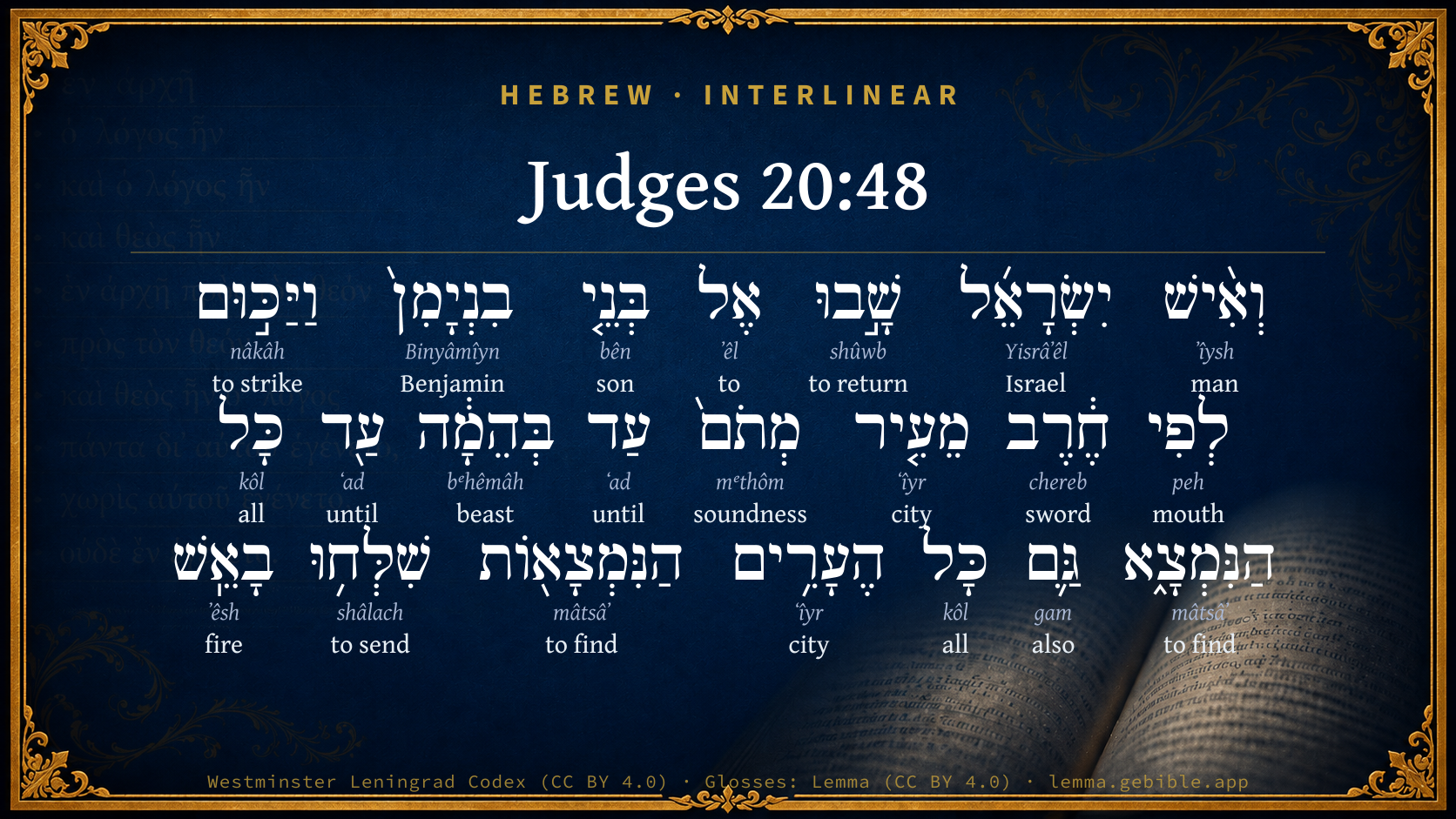
Judges 20:48

Hebrew (Westminster Leningrad Codex) Judges 20:48 appears in the Hebrew Old Testament. The text above is from the Westminster Leningrad Codex. Each word links to its Strong’s number, a concise gloss, and parsing drawn from the Open Scriptures Hebrew Bible morphology. Click any word for its full Brown-Driver-Briggs (BDB) entry.
Download image
Cite this verse

Judges 20:48 (World English Bible). Public Domain. Lemma interlinear Bible study tool, https://lemma.gebible.app/v/judges/20/48.

Show BibTeX & RIS
BibTeX
RIS
English Translation
The men of Israel turned again on the children of Benjamin, and struck them with the edge of the sword, both the entire city, and the cattle, and all that they found: moreover all the cities which they found they set on fire.
World English Bible · Public Domain
Highlights
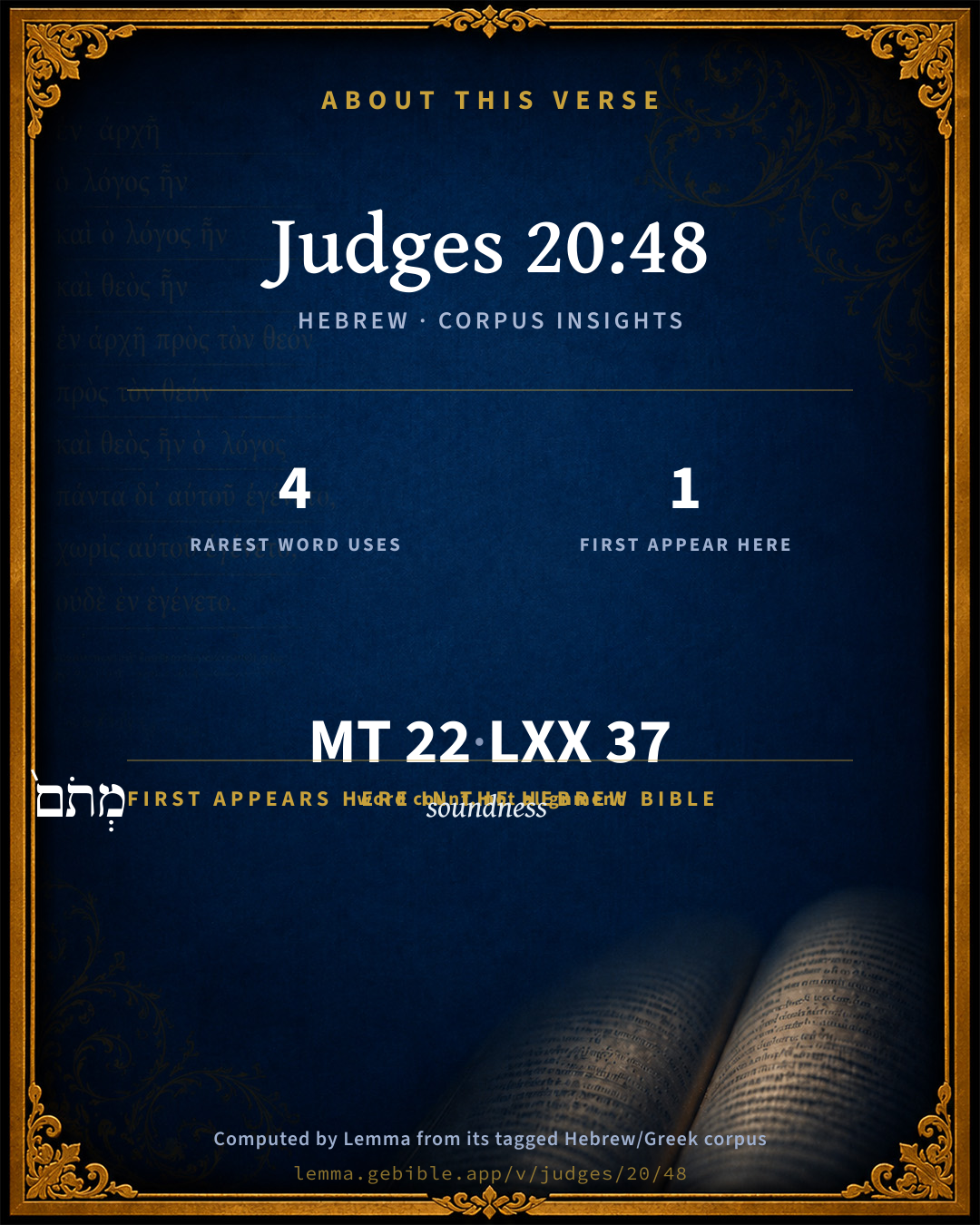
  • 1 first appearance in the Hebrew Bible
Full analysis ↓
Download a study sheet

One document with this verse’s original text, its word-by-word gloss line, the meaning frame, cross-references with their text, attributed commentary, and full source and license credits — printable, and it pastes into notes with its structure intact.

This verse Autodidact and up

Study sheet (.html) Plain text (.txt)

A passage Seminary Student

Up to 50 verses in one chapter. A passage sheet keeps up to 6 commentary sources and 12 cross-references per verse, in the order this page ranks them, and says so on the sheet whenever that leaves anything out. Ask for a single verse and you get the Autodidact verse sheet above.

Everything on this page stays free to read, with no account — the sheet is a download of what is already on screen, not access to it.

Want to remove ads? Support Godless Engineer
Compare translations 3

The same verse in 3 English versions, stacked beneath the original-language interlinear above. Click any original word for its lexicon entry.

Each is an independent rendering of the whole verse — the interlinear is not word-aligned to these translations.

Highlighted words mark where these versions differ — a whole-verse word diff, not a word-by-word alignment.

  • World English Bible Public Domain
    The men of Israel turned again on the children of Benjamin, and struck them with the edge of the sword, both the entire city, and the cattle, and all that they found: moreover all the cities which they found they set on fire.
  • King James Version Public Domain
    And the men of Israel turned again upon the children of Benjamin, and smote them with the edge of the sword, as well the men of every city, as the beast, and all that came to hand: also they set on fire all the cities that they came to.
  • unfoldingWord Literal Text CC BY-SA 4.0
    Then the men of Israel returned to the sons of Benjamin, and they struck them to the mouth of the sword, from a city of entirety to cattle to everything found. Also, all of the cities found, they sent into fire.

unfoldingWord Literal Text — © unfoldingWord, licensed CC BY-SA 4.0. Word-aligned USFM3 via Door43 (git.door43.org/unfoldingWord/en_ult).

Versions to compare (up to 4)

3 of 4 selected

Show all 18 translations

Every available English version of this verse, each an independent rendering of the whole verse.

  • World English Bible Public Domain
    The men of Israel turned again on the children of Benjamin, and struck them with the edge of the sword, both the entire city, and the cattle, and all that they found: moreover all the cities which they found they set on fire.
  • Berean Standard Bible Public Domain
    And the men of Israel turned back against the other Benjamites and put to the sword all the cities, including the animals and everything else they found. And they burned down all the cities in their path.
  • Majority Standard Bible Public Domain
    And the men of Israel turned back against the other Benjamites and put to the sword all the cities, including the animals and everything else they found. And they burned down all the cities in their path.
  • King James Version Public Domain
    And the men of Israel turned again upon the children of Benjamin, and smote them with the edge of the sword, as well the men of every city, as the beast, and all that came to hand: also they set on fire all the cities that they came to.
  • American Standard Version (1901) Public Domain
    And the men of Israel turned again upon the children of Benjamin, and smote them with the edge of the sword, both the entire city, and the cattle, and all that they found: moreover all the cities which they found they set on fire.
  • Revised Version (1885) Public Domain
    And the men of Israel turned again upon the children of Benjamin, and smote them with the edge of the sword, both the entire city, and the cattle and all that they found: moreover all the cities which they found they set on fire.
  • Geneva Bible (1599) Public Domain
    Then the men of Israel returned vnto the children of Beniamin, and smote them with the edge of the sword from the men of the citie vnto the beasts, and all that came to hand: also they set on fire all the cities that they coulde come by.
  • Douay-Rheims (1899) Public Domain
    But the children of Israel returning, put all the remains of the city to the sword, both men and beasts, and all the cities and villages of Benjamin were consumed with devouring flames.
  • Young's Literal Translation Public Domain
    And the men of Israel have turned back unto the sons of Benjamin, and smite them by the mouth of the sword out of the city, -- men unto cattle, unto all that is found; also all the cities which are found they have sent into fire.
  • Literal Standard Version CC BY-SA 4.0
    And the men of Israel have turned back to the sons of Benjamin, and strike them by the mouth of the sword out of the city—men even to livestock, even to all that is found; they have also sent all the cities which are found into the fire.
  • Unlocked Literal Bible CC BY-SA 4.0
    The soldiers of Israel turned back against the people of Benjamin and struck them with the edge of the sword, the city, including the animals and everything that they found. They also burned down every town in their path.
  • unfoldingWord Literal Text CC BY-SA 4.0
    Then the men of Israel returned to the sons of Benjamin, and they struck them to the mouth of the sword, from a city of entirety to cattle to everything found. Also, all of the cities found, they sent into fire.
  • Darby Bible Public Domain
    And the men of Israel turned back against the Benjaminites, and smote them with the edge of the sword, men and beasts and all that they found. And all the towns which they found they set on fire.
  • World Messianic Bible Public Domain
    The men of Israel turned again on the children of Benjamin, and struck them with the edge of the sword—including the entire city, the livestock, and all that they found. Moreover they set all the cities which they found on fire.
  • Webster's Bible Public Domain
    And the men of Israel turned again upon the children of Benjamin, and smote them with the edge of the sword, as well the men of every city, as the beast, and all that came to hand: also they set on fire all the cities that they came to.
  • Free Bible Version CC BY-SA 4.0
    The Israelites went back into the territory of the Benjamites, and going from town to town, they killed everything: people, animals, everything they found. Then they burned down every town on their way.
  • Bible in Basic English Public Domain
    And the men of Israel, turning again against the children of Benjamin, put to the sword without mercy all the towns and the cattle and everything there was, burning every town which came into their hands.
  • JPS Tanakh (1917) Public Domain
    And the men of Israel turned back upon the children of Benjamin, and smote them with the edge of the sword, both the entire city, and the cattle, and all that they found; moreover all the cities which they found they set on fire.

Literal Standard Version (2020), Covenant Press — licensed CC BY-SA 4.0. Text via the HelloAO Bible API (eBible.org). Unlocked Literal Bible (unfoldingWord) — licensed CC BY-SA 4.0. Text via the HelloAO Bible API (eBible.org). unfoldingWord Literal Text — © unfoldingWord, licensed CC BY-SA 4.0. Word-aligned USFM3 via Door43 (git.door43.org/unfoldingWord/en_ult). Free Bible Version, Dr. Jonathan Gallagher — licensed CC BY-SA 4.0. Text via the HelloAO Bible API (eBible.org).

Word by word

More ways to search: Search by grammar → Find every occurrence → Compare this word →

Practice this passage: Drill this verse → Learn its vocabulary →

מְתֹם֙
mᵉthôm
H4974
“soundness”
Noun, Common, Masculine, Singular, Absolute
Part of Speech
Noun
Type
Common
Gender
Masculine
Number
Singular
State
Absolute
Full BDB Definition

Origin: from H8552

TWOT: 2522e

soundness, entirety, entire
  1. וְאִ֨ישׁ ʼîysh H376 “and · man of” Conjunction + Noun, Common, Masculine, Singular, Construct
  2. יִשְׂרָאֵ֜ל Yisrâʼêl H3478 “Israel” Noun, Proper
  3. שָׁ֣בוּ shûwb H7725 “to return” Verb, Qal, Perfect, 3rd Person, Common, Plural
  4. אֶל ʼêl H413 “to” Preposition
  5. בְּנֵ֤י bên H1121 “sons of” Noun, Common, Masculine, Plural, Construct
  6. בִנְיָמִן֙ Binyâmîyn H1144 “Benjamin” Noun, Proper
  7. וַיַּכּ֣וּם nâkâh H5221 “and · to strike · them” Conjunction + Verb, Hiphil, Sequential Imperfect, 3rd Person, Masculine, Plural + Suffix, Personal, 3rd Person, Masculine, Plural
  8. לְפִי peh H6310 “to/for · mouth of” Preposition + Noun, Common, Masculine, Singular, Construct
  9. חֶ֔רֶב chereb H2719 “sword” Noun, Common, Feminine, Singular, Absolute
  10. מֵעִ֤יר ʻîyr H5892 “from · city of” Preposition + Noun, Common, Feminine, Singular, Construct
  11. עַד ʻad H5704 “until” Preposition
  12. בְּהֵמָ֔ה bᵉhêmâh H929 “beast” Noun, Common, Feminine, Singular, Absolute
  13. עַ֖ד ʻad H5704 “until” Preposition
  14. כָּל kôl H3605 “all of” Noun, Common, Masculine, Singular, Construct
  15. הַנִּמְצָ֑א mâtsâʼ H4672 “the · finding” Particle, Definite Article + Verb, Niphal, Participle Active, Masculine, Singular, Absolute
  16. גַּ֛ם gam H1571 “also” Particle, Accusative
  17. כָּל kôl H3605 “all of” Noun, Common, Masculine, Singular, Construct
  18. הֶעָרִ֥ים ʻîyr H5892 “the · cities” Particle, Definite Article + Noun, Common, Feminine, Plural, Absolute
  19. הַנִּמְצָא֖וֹת mâtsâʼ H4672 “the · finding” Particle, Definite Article + Verb, Niphal, Participle Active, Feminine, Plural, Absolute
  20. שִׁלְּח֥וּ shâlach H7971 “to send” Verb, Piel, Perfect, 3rd Person, Common, Plural
  21. בָאֵֽשׁ ʼêsh H784 “in/at the · fire” Preposition, Determined + Noun, Common, Both, Singular, Absolute

About this verse

These counts appear in no published source. They are computed here, from the morphology-tagged text and Lemma’s own curated glosses. What Lemma adds →

22
words
18
distinct lemmas
Historical
section

Notable vocabulary

The rarest word here is מְתֹם֙ soundness H4974 — appearing just 4 times in the whole Hebrew Bible.

First appearance in Scripture

This word makes its first canonical appearance in the Hebrew Bible here:

  • מְתֹם֙ soundness H4974

Shared distinctive vocabulary

מְתֹם֙ soundness H4974 occurs in 4 verses of the Hebrew Bible. Also found in:

Grammatical profile

  • 5 verbs
  • 13 nouns
  • 3 prepositions
  • 1 particle

Verb forms

  • שָׁ֣בוּ Qal · Perfect
  • וַיַּכּ֣וּם Hiphil · Sequential Imperfect
  • הַנִּמְצָ֑א Niphal · Participle Active
  • הַנִּמְצָא֖וֹת Niphal · Participle Active
  • שִׁלְּח֥וּ Piel · Perfect

Repetition

Words recur within this verse — often emphatic in Hebrew:

  • מֵעִ֤יר city H5892 ×2
  • עַד until H5704 ×2
  • כָּל all H3605 ×2
  • הַנִּמְצָ֑א to find H4672 ×2

Hebrew & Septuagint length

In English translation the verse runs 43 words from the Hebrew and 48 from the Septuagint (LXX English) — closely comparable.

A rough comparison of the two English renderings, which tokenize alike — not a word-level alignment.

Word counts can differ between the Hebrew and the Greek without any difference in meaning — e.g. the Hebrew direct-object marker אֵת has no separate Greek word, and Greek often adds the article ὁ.

In the original languages it is 22 Hebrew tokens and 37 Greek tokens — but the two are counted differently (Hebrew bundles its prefixes and suffixes into one token; the Greek is in lemma form), so that isn’t a like-for-like length.

Cross-references

4

Topical passages linked to Judges 20:48 in the Treasury of Scripture Knowledge — connected by theme and wording, ordered by reader-vote popularity; previews shown in the World English Bible.

  • Deuteronomy 13:15–17 you shall surely strike the inhabitants of that city with the edge of the sword, destroying it utterly, and all that is therein and the cattle of it, with the edge of the sword.
  • 2 Chronicles 25:13 But the men of the army whom Amaziah sent back, that they should not go with him to battle, fell on the cities of Judah, from Samaria even to Beth Horon, and struck of them three thousand, and took much spoil.
  • 2 Chronicles 28:6–9 For Pekah the son of Remaliah killed in Judah one hundred twenty thousand in one day, all of them valiant men; because they had forsaken Yahweh, the God of their fathers.
  • Proverbs 18:19 A brother offended is more difficult than a fortified city; And disputes are like the bars of a castle.

Cross-references courtesy of OpenBible.info (CC BY 4.0).

Hebrew and Greek witnesses Masoretic Hebrew ↔ Greek Septuagint

The same verse in the two great witnesses to the Old Testament, shown verse-for-verse.

These are two independent witnesses, not word-aligned to each other, and the Septuagint is shown in lemma (dictionary) form.

Hebrew Judges 20:48 Masoretic · Westminster Leningrad Codex

וְאִ֨ישׁ יִשְׂרָאֵ֜ל שָׁ֣בוּ אֶל בְּנֵ֤י בִנְיָמִן֙ וַיַּכּ֣וּם לְפִי חֶ֔רֶב מֵעִ֤יר מְתֹם֙ עַד בְּהֵמָ֔ה עַ֖ד כָּל הַנִּמְצָ֑א גַּ֛ם כָּל הֶעָרִ֥ים הַנִּמְצָא֖וֹת שִׁלְּח֥וּ בָאֵֽשׁ

The men of Israel turned again on the children of Benjamin, and struck them with the edge of the sword, both the entire city, and the cattle, and all that they found: moreover all the cities which they found they set on fire.

World English Bible · Public Domain

Greek LXX Judges 20:48 Septuagint · lemma form

καί ὁ υἱός ἰσραήλ ἐπιστρέφω πρός υἱός βενιαμίν καί πατάσσω αὐτός ἐν στόμα ῥομφαία ἀπό πόλις μεθλα καί ἕως κτῆνος καί ἕως πᾶς ὁ εὑρίσκω εἰς πᾶς ὁ πόλις καί ὁ πόλις ὁ εὑρίσκω ἐνπίμπρημι ἐν πῦρ

And the children of Israel returned to the children of Benjamin, and struck them with the edge of the sword from the city of Methla, even to the cattle, and every thing that was found in all the cities: and they burnt with fire the cities they found.

LXX2012 (modern English Septuagint) · Public Domain

Hebrew: Westminster Leningrad Codex (CC BY 4.0). Greek: Septuagint (public domain); English from LXX2012 (modern English Septuagint) (Public Domain). How the Septuagint differs from the Hebrew →

Targum (Aramaic paraphrase)

1

The Targum is the ancient Jewish Aramaic paraphrase of the Hebrew Scriptures — an interpretive translation, not the Hebrew text itself. Onkelos (literal) and Pseudo-Jonathan (expansive) render the Torah, and Jonathan the Prophets. Coverage is partial: where no permissively-licensed English translation exists for a verse, only the Aramaic is shown. This is verse-level text, not a word-by-word alignment to the Hebrew.

  1. Targum Jonathan Prophets (Joshua–Malachi)
    וֶאֱנַשׁ יִשְׂרָאֵל תָּבוּ לְוַת בְּנֵי בִנְיָמִין וּמְחוֹנוּן לְפִּתְגַם דְחָרֶב מִקִרְוֵיהוֹן גַמְרִינוּן עַד בְּעִירָא עַד כָּל דְאִשְׁתְּכַח אַף כָּל קִרְוַיָא דְאִשְׁתַּכָּחָא אוֹקִידוּ בְּנוּרָא:

    (no public-domain English translation for this verse)

    Targum Jonathan — Aramaic: “Mikraot Gedolot” (public domain). English: “Sefaria Community Translation” (CC0 1.0 (public-domain dedication)); “London "Chaldee Paraphrase," 1871” (public domain). Text via Sefaria.

Commentary

Notes on Judges 20:48 from classic Christian and Jewish commentators (each source and its license shown beneath its notes). The classic Christian expositions comment on the surrounding passage and are grouped to its opening verse, so a note may address several verses; the Jewish commentaries on the Tanakh (Rashi and others) are per-verse, so they appear only where the commentator wrote on this verse.

Lemma curates 59 commentaries, every one of them public domain or Creative Commons licensed, each selected and text-cleaned for this edition rather than reprinted as found. About our sources →

Trapp's Complete Commentary

John Trapp

Jdg 20:48 And the men of Israel turned again upon the children of Benjamin, and smote them with the edge of the sword, as well the men of [every] city, as the beast, and all that came to hand: also they set on fire all the cities that they came to.

Ver. 48. And smote them with the edge.] If this were done out of the heat and fury of war only, and not by the command of God, they were to blame. That once flourishing commonwealth of the Lacedemonians was likewise utterly overturned at the battle of Leuctra, by reason of a rape there committed by two noble Spartans upon the two daughters of Scedasus, who complained thereof to the Ephori, but could get no remedy.

John Trapp, A Commentary or Exposition upon All the Books of the Old and New Testament (1647–1656) — public domain. Text from a community e-Sword module.

Joseph Benson's Commentary

Jdg 20:48. The men of Israel turned again, &c. — Left their pursuit of the Benjamites in the wilderness, and turned toward the country of Benjamin. Those that came to Gibeah and into the field, whom the Israelites had already destroyed, were men that drew the sword, that is, soldiers. But there were a great many husbandmen, shepherds, and others, whom, in their fury, they now slew. And all that came to hand — Even women and children. For they had devoted to destruction all that came not up to Mizpeh, when they were summoned, (Jdg 21:5,) which none of the Benjamites did; for which reason they slew also the men, women, and children of Jabesh-gilead, Jdg 21:10. But this was certainly a most inhuman barbarity, expressly contrary to the laws of God, which had forbidden the innocent to be punished with the guilty, Deu 24:16.

Joseph Benson's Commentary on the Old and New Testaments (1811–1818) — public domain. Text from a community e-Sword module.

Geneva Bible (1599)

Geneva Bible translators

If they belonged to the Benjamites.

Geneva Bible (1599) marginal notes — public domain. Text via Bolls.life.

Jamieson, Fausset & Brown

Robert Jamieson, A. R. Fausset & David Brown

the men of Israel turned again upon the children of Benjamin, and smote them with the edge of the sword--This frightful vengeance, extending from Gibeah to the whole territory of Benjamin, was executed under the impetuous impulse of highly excited passions. But doubtless the Israelites were only the agents of inflicting the righteous retributions of God; and the memory of this terrible crisis, which led almost to the extermination of a whole tribe, was conducive to the future good of the whole nation.

Next: Judges Chapter 21

Jamieson, Fausset & Brown — Commentary Critical and Explanatory on the Whole Bible (1871) — public domain (CC PDM 1.0). Text via the HelloAO Bible API.

Ellicott's Commentary for English Readers

(48) As well the men of every city, as the beast.—The phrase is literally, from the city, men down to beast, reading methim, “men,” for methom, “entire.” The dreadful meaning which lies beyond these short and simple words is the absolute extermination of a whole tribe of Israel, MEN, WOMEN, AND CHILDREN, CITIES AND CATTLE, with the exception of 600 fugitives. There is something almost inconceivably horrible and appalling in the thought of thousands of poor women and innocent children ruthlessly butchered in cold blood in this internecine war between brother Israelites. The whole tribe were placed under the ban of extirpation, as though they had been Canaanites, just as mercilessly as Sihon and his people had been extirpated (Deu_2:34; Deu_13:15-16), or Jericho (Jos_6:17; Jos_6:21), or Ai (Jos_8:25-26). Their feelings were doubtless exasperated by the fearful destruction which Benjamin had inflicted upon them, as well as by religious horror at the conduct of the tribe; and for the rest, we can only say that “the times of this ignorance God winked at.” The good side of the deed lies in its motive: it expressed an intense horror against moral pollution. The evil side lay in its ruthless savagery. In both aspects it agrees both with the recorded and the traditional character of Phinehas (Num_25:8; Num_31:6). (See Note on Jdg_11:39.)

A Bible Commentary for English Readers, edited by Charles John Ellicott (1878–1897) — public domain. Text from a community e-Sword module.

The Cambridge Bible for Schools and Colleges

gen. ed. J. J. S. Perowne

48. This v. (from B) records the destruction of the Benjamites who had not taken part in the conflict.

the entire city] The marg. is to be preferred, lit. the city of men, a phrase only found again in Deu_2:34; Deu_3:6, and there, as here, in connexion with devoting a city or people to destruction. The Israelites were determined to make the tribe of Benjamin a ḥérem: cf. Jdg_21:10-11, Jdg_1:17 n.

The Cambridge Bible for Schools and Colleges (gen. ed. J. J. S. Perowne; Cambridge University Press, 1878–1918) — public domain. Text from a community e-Sword module.

Albert Barnes' Notes on the Bible

They treated Benjamin as devoted to utter destruction, as Jericho had been Jos 6:17, Jos 6:21, and the whole tribe was all but actually extirpated. We see in the punishment inflicted the same ferocity which marked both the crime and the Levite’s mode of requiring vengeance.

Albert Barnes' Notes on the Bible (1834–1885) — public domain. Text from a community e-Sword/MySword module.

Haydock's Catholic Bible Commentary

And villages, is not expressed in Hebrew, &c. But as both cities, and all the inhabitants were destroyed, the villages would share the same fate, (Haydock) as being under a curse. The Israelites concluded, from the exemplary vengeance which had been taken of Sodom and Gomorra, that they were authorized to treat their brethren in guilt with the utmost severity. (Calmet)

George Leo Haydock (1774–1849), Haydock's Catholic Family Bible and Commentary, 1859 edition — public domain. Excludes Psalms (Douay-Rheims chapter numbering differs from Protestant) and Deuterocanonical books (Catholic canon only).

Matthew Poole's English Annotations

Having destroyed those that came to Gibeah, and into the field, now they follow them home to their several habitations.

The men of every city; comprehensively taken, so as to include women and children. If this seem harsh and bloody, either it may be ascribed to military fury; or rather, it may be justified; partly, from that high guilt brought upon the whole tribe, in which it is no wonder if their infants suffered, which was not unusual in such cases, as Num 31:17; 1Sa 15:3; Jos 7:15; partly, from that command of God in a parallel case, Deu 13:15; and partly, from that solemn oath by which they had anathematized or devoted to death all that came not up to Mizpeh, Jdg 21:5, which none of the Benjamites did; for which cause also they destroyed all the men, women, and children of Jabesh-gilead, Jdg 21:10.

Matthew Poole's English Annotations on the Holy Bible (1683–1685) — public domain. Text from a community e-Sword/MySword module.

Whedon's Commentary on the Bible

Daniel D. Whedon

48. Israel turned again upon… Benjamin — Turned upon the old men, women, and children that remained unarmed and helpless in the cities; and smote men and cattle together, and burned the cities, just as they had done when warring with the idolatrous or Canaanites.

Daniel D. Whedon (gen. ed.), Commentary on the Old and New Testaments (1874–1909) — public domain. Text from a community e-Sword module.

The Pulpit Commentary

Turned again, not the same word as the turned of vers. 45, 47, but turned back, came again by the way by which they had gone in pursuit of the Benjamites, and on their return towards Bethel (Jud_1:21:2) entered into all the Benjamlte cities, which lay thick together east and north of Gibeah, and ruthlessly put all the remaining population to the sword; burning all the cities, and treating the whole tribe of Benjamin, with all that belonged to them, as a herem, a thing devoted to utter destruction, like Jericho.

The Pulpit Commentary (1880–1919), ed. H.D.M. Spence-Jones & Joseph S. Exell — public domain. Text from a community e-Sword module.

John Wesley's Explanatory Notes

Turned again - Having destroyed those that came to Gibeah, and into the field, now they follow them home to their several habitations. Men - Comprehensively taken, so as to include women and children. If this seem harsh and bloody, either it may be ascribed to military fury; or perhaps it may be partly justified, from that command of God in a parallel case, Deut. xiii, 15, and from that solemn oath by which they had devoted to death all that came not up to Mizpeh, chap. xxi, 5, which none of the Benjamites did.

John Wesley, Explanatory Notes Upon the Whole Bible (1754–1765) — public domain. Text via the GEBible commentary corpus.

Rashi

Rabbi Shlomo Yitzchaki (Rashi)

Turned to the sons of Binyomin in all the cities.

Completely annihilating the cities. They annihilated all the inhabitants of the cities,

Including the cattle—the people are included in "completely annihilating," since מְּתֹם denotes absolute annihilation. There is a problem with the location of one thousand, as twenty-six thousand were counted in the cities, and seven hundred at Givoh; here, those who fell totaled twenty-five thousand, one hundred troops, and six hundred escaped to Rimon cliff. Evidently, one thousand fled to the cities, and fell the following day when the Bnei Yisroel turned to the cities of Binyomin to annihilate the women and children.

Rashi on the Tanakh — English translations: “The Judaica Press complete Tanach with Rashi, translated by A. J. Rosenberg” (CC BY 4.0); “Pentateuch with Rashi's commentary by M. Rosenbaum and A.M. Silbermann, 1929-1934” (public domain); “The Metsudah Tanach series, Lakewood, N.J” (CC BY 4.0); and “The Book of Joshua, Metsudah Publications, 1997” (CC BY 4.0). Text via Sefaria.

Lesson kit

Teaching starters — assembled from the data on this page, not authored interpretation. Every prompt links to the verse data it draws on. Edit before teaching.

Judges, in the Historical, opens this verse with 22 words (18 distinct Hebrew lemmas). Its most distinctive word is mᵉthôm (“soundness”). A historical commentator’s framing appears above. Read the whole chapter for the surrounding context.

Discussion questions

  1. How does “soundness” (mᵉthôm) shape what this verse is saying?
  2. The word “soundness” first appears here in Scripture. What is being introduced at this debut?
  3. Psalms 38:3 shares the word «soundness» with this verse. How do the two illuminate each other?
  4. “city” occurs 2× in this one verse. What is the effect of the repetition?
  5. These translations render this verse differently; the difference is in the English rendering, not the original. What questions does that raise?
  6. The verb «שָׁ֣בוּ» is Qal Perfect. How does its form color the action?
  7. Reading how Trapp's Complete Commentary and Joseph Benson's Commentary read this verse, where do the two commentators agree and where do they part?

Things to notice

Reading settings

Reading text

Shown beneath each verse's original-language words.

Old Testament
Old Testament edition

Read the OT as the Masoretic Hebrew (MT) or the Greek Septuagint (LXX).

English shown for the Greek Septuagint (in the Hebrew ↔ Greek comparison).

Comparing translations? Open the Compare panel on any verse page to stack up to four side by side.