
Ezra 9:7

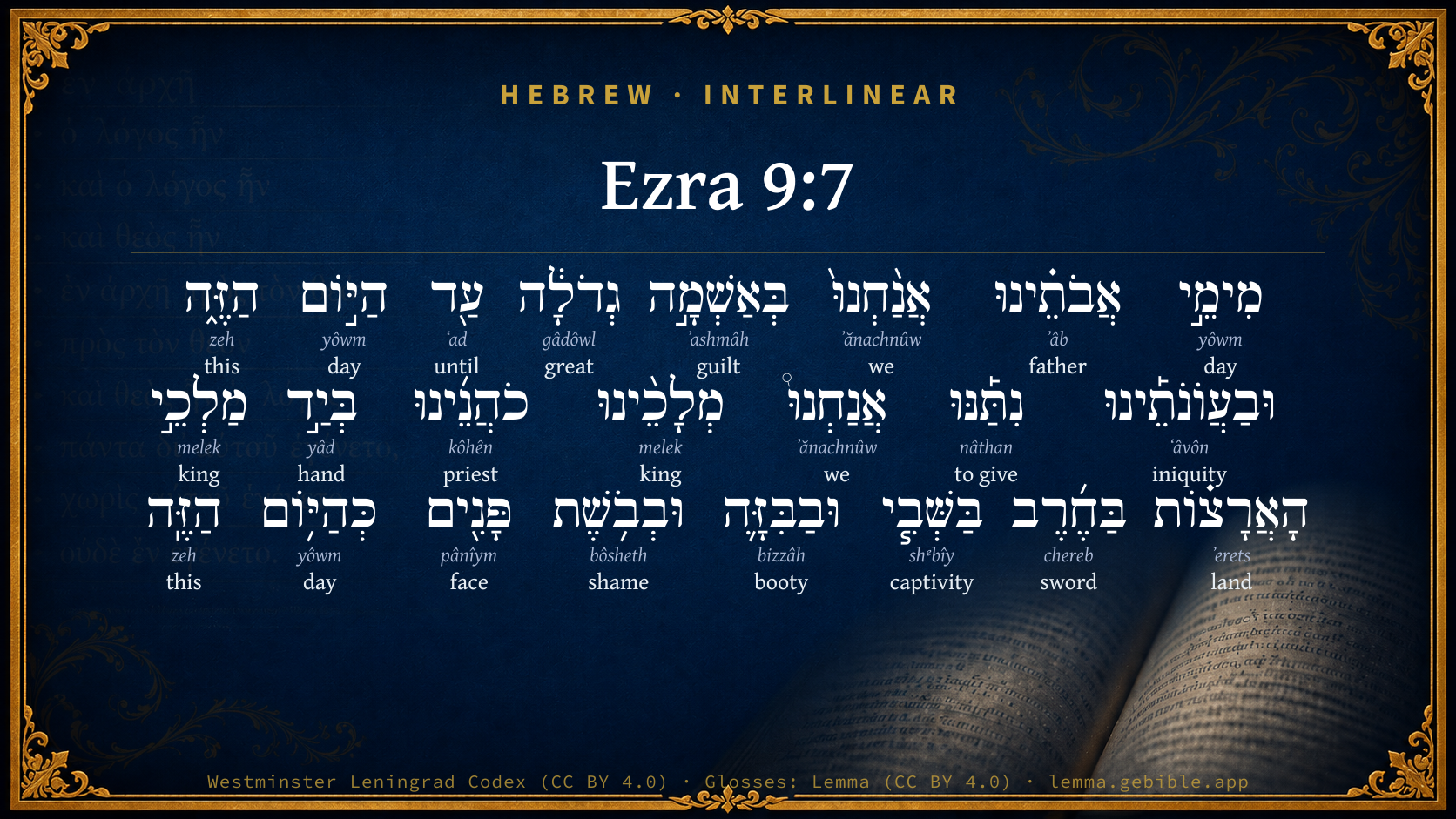
Hebrew (Westminster Leningrad Codex) Ezra 9:7 appears in the Hebrew Old Testament. The text above is from the Westminster Leningrad Codex. Each word links to its Strong’s number, a concise gloss, and parsing drawn from the Open Scriptures Hebrew Bible morphology. Click any word for its full Brown-Driver-Briggs (BDB) entry.
Download image
Cite this verse

Ezra 9:7 (World English Bible). Public Domain. Lemma interlinear Bible study tool, https://lemma.gebible.app/v/ezra/9/7.

Show BibTeX & RIS
BibTeX
RIS
English Translation
Since the days of our fathers we have been exceeding guilty to this day; and for our iniquities have we, our kings, and our priests, been delivered into the hand of the kings of the lands, to the sword, to captivity, and to plunder, and to confusion of face, as it is this day.
World English Bible · Public Domain
Download a study sheet

One document with this verse’s original text, its word-by-word gloss line, the meaning frame, cross-references with their text, attributed commentary, and full source and license credits — printable, and it pastes into notes with its structure intact.

This verse Autodidact and up

Study sheet (.html) Plain text (.txt)

A passage Seminary Student

Up to 50 verses in one chapter. A passage sheet keeps up to 6 commentary sources and 12 cross-references per verse, in the order this page ranks them, and says so on the sheet whenever that leaves anything out. Ask for a single verse and you get the Autodidact verse sheet above.

Everything on this page stays free to read, with no account — the sheet is a download of what is already on screen, not access to it.

Want to remove ads? Support Godless Engineer
Compare translations 3

The same verse in 3 English versions, stacked beneath the original-language interlinear above. Click any original word for its lexicon entry.

Each is an independent rendering of the whole verse — the interlinear is not word-aligned to these translations.

Highlighted words mark where these versions differ — a whole-verse word diff, not a word-by-word alignment.

  • World English Bible Public Domain
    Since the days of our fathers we have been exceeding guilty to this day; and for our iniquities have we, our kings, and our priests, been delivered into the hand of the kings of the lands, to the sword, to captivity, and to plunder, and to confusion of face, as it is this day.
  • King James Version Public Domain
    Since the days of our fathers have we been in a great trespass unto this day; and for our iniquities have we, our kings, and our priests, been delivered into the hand of the kings of the lands, to the sword, to captivity, and to a spoil, and to confusion of face, as it is this day.
  • unfoldingWord Literal Text CC BY-SA 4.0
    From the days of our fathers until this day we are in great guilt. And in our iniquities, we ourselves, our kings, and our priests have been given into the hand of the kings of the lands by sword, by captivity, and by plunder, and by shame of face, as this day.

unfoldingWord Literal Text — © unfoldingWord, licensed CC BY-SA 4.0. Word-aligned USFM3 via Door43 (git.door43.org/unfoldingWord/en_ult).

Versions to compare (up to 4)

3 of 4 selected

Show all 18 translations

Every available English version of this verse, each an independent rendering of the whole verse.

  • World English Bible Public Domain
    Since the days of our fathers we have been exceeding guilty to this day; and for our iniquities have we, our kings, and our priests, been delivered into the hand of the kings of the lands, to the sword, to captivity, and to plunder, and to confusion of face, as it is this day.
  • Berean Standard Bible Public Domain
    From the days of our fathers to this day, our guilt has been great. Because of our iniquities, we and our kings and priests have been delivered into the hands of the kings of the earth and put to the sword and captivity, to pillage and humiliation, as we are this day.
  • Majority Standard Bible Public Domain
    From the days of our fathers to this day, our guilt has been great. Because of our iniquities, we and our kings and priests have been delivered into the hands of the kings of the earth and subjected to the sword and to captivity, to pillage and humiliation, as we are this day.
  • King James Version Public Domain
    Since the days of our fathers have we been in a great trespass unto this day; and for our iniquities have we, our kings, and our priests, been delivered into the hand of the kings of the lands, to the sword, to captivity, and to a spoil, and to confusion of face, as it is this day.
  • American Standard Version (1901) Public Domain
    Since the days of our fathers we have been exceeding guilty unto this day; and for our iniquities have we, our kings, and our priests, been delivered into the hand of the kings of the lands, to the sword, to captivity, and to plunder, and to confusion of face, as it is this day.
  • Revised Version (1885) Public Domain
    Since the days of our fathers we have been exceeding guilty unto this day; and for our iniquities have we, our kings, and our priests, been delivered into the hand of the kings of the lands, to the sword, to captivity, and to spoiling, and to confusion of face, as it is this day.
  • Geneva Bible (1599) Public Domain
    From the dayes of our fathers haue we bin in a great trespasse vnto this day, and for our iniquities haue we, our Kings, and our Priestes bene deliuered into the hand of the kings of the lands, vnto the sword, into captiuitie, into a spoyle, and into confusion of face, as appeareth this day.
  • Douay-Rheims (1899) Public Domain
    From the days of our fathers: and we ourselves also have sinned grievously unto this day, and for our iniquities we and our kings, and our priests have been delivered into the hands of the kings of the lands, and to the sword, and to captivity, and to spoil, and to confusion of face, as it is at this day.
  • Young's Literal Translation Public Domain
    `From the days of our fathers we `are' in great guilt unto this day, and in our iniquities we have been given -- we, our kings, our priests -- into the hand of the kings of the lands, with sword, with captivity, and with spoiling, and with shame of face, as `at' this day.
  • Literal Standard Version CC BY-SA 4.0
    From the days of our fathers we [are] in great guilt to this day, and in our iniquities we have been given—we, our kings, our priests—into the hand of the kings of the lands, with sword, with captivity, and with spoiling, and with shame of face, as [at] this day.
  • Unlocked Literal Bible CC BY-SA 4.0
    From the days of our ancestors until now we have been in great guilt. In our iniquities we, our kings, and our priests were given into the hand of kings of this world, to the sword, to captivity, and to plunder and ashamed faces, as we are today.
  • unfoldingWord Literal Text CC BY-SA 4.0
    From the days of our fathers until this day we are in great guilt. And in our iniquities, we ourselves, our kings, and our priests have been given into the hand of the kings of the lands by sword, by captivity, and by plunder, and by shame of face, as this day.
  • Darby Bible Public Domain
    Since the days of our fathers, we have been in great trespass to this day; and for our iniquities we, our kings, our priests, have been given into the hand of the kings of the lands, to the sword, and to captivity, and to spoil, and to confusion of face, as it is this day.
  • World Messianic Bible Public Domain
    Since the days of our fathers we have been exceedingly guilty to this day; and for our iniquities we, our kings, and our priests have been delivered into the hand of the kings of the lands, to the sword, to captivity, to plunder, and to confusion of face, as it is this day.
  • Webster's Bible Public Domain
    Since the days of our fathers have we been in a great trespass to this day; and for our iniquities have we, our kings, and our priests, been delivered into the hand of the kings of the lands, to the sword, to captivity, and to a spoil, and to confusion of face, as it is this day.
  • Free Bible Version CC BY-SA 4.0
    From the time of our forefathers to now, we have been deeply guilty. Because of our sins, we, our kings, and our priests have been handed over to the kings of the earth, killed and taken prisoner, robbed and humiliated, just like we are today.
  • Bible in Basic English Public Domain
    From the days of our fathers till this day we have been great sinners; and for our sins, we and our kings and our priests have been given up into the hands of the kings of the lands, to the sword and to prison and to loss of goods and to shame of face, as it is this day.
  • JPS Tanakh (1917) Public Domain
    Since the days of our fathers we have been exceeding guilty unto this day; and for our iniquities have we, our kings, and our priests, been delivered into the hand of the kings of the lands, to the sword, to captivity, and to spoiling, and to confusion of face, as it is this day.

Literal Standard Version (2020), Covenant Press — licensed CC BY-SA 4.0. Text via the HelloAO Bible API (eBible.org). Unlocked Literal Bible (unfoldingWord) — licensed CC BY-SA 4.0. Text via the HelloAO Bible API (eBible.org). unfoldingWord Literal Text — © unfoldingWord, licensed CC BY-SA 4.0. Word-aligned USFM3 via Door43 (git.door43.org/unfoldingWord/en_ult). Free Bible Version, Dr. Jonathan Gallagher — licensed CC BY-SA 4.0. Text via the HelloAO Bible API (eBible.org).

Word by word

More ways to search: Search by grammar → Find every occurrence → Compare this word →

Practice this passage: Drill this verse → Learn its vocabulary →

וּבַבִּזָּ֛ה
bizzâh
H961
“and · in/at the · booty”
Conjunction + Preposition, Determined + Noun, Common, Feminine, Singular, Absolute
Part of Speech
Conjunction + Preposition + Noun
Type
Common
Gender
Feminine
Number
Singular
State
Absolute
Full BDB Definition

Origin: from H957

TWOT: 225 (?) 225b

spoil, booty
  1. מִימֵ֣י yôwm H3117 “from · days of” Preposition + Noun, Common, Masculine, Plural, Construct
  2. אֲבֹתֵ֗ינוּ ʼâb H1 “fathers · our” Noun, Common, Masculine, Plural, Construct + Suffix, Personal, 1st Person, Common, Plural
  3. אֲנַ֨חְנוּ֙ ʼănachnûw H587 “we” Pronoun, Personal, 1st Person, Common, Plural
  4. בְּאַשְׁמָ֣ה ʼashmâh H819 “in/at · guilt” Preposition + Noun, Common, Feminine, Singular, Absolute
  5. גְדֹלָ֔ה gâdôwl H1419 “great” Adjective, Adjective, Feminine, Singular, Absolute
  6. עַ֖ד ʻad H5704 “until” Preposition
  7. הַיּ֣וֹם yôwm H3117 “the · day” Particle, Definite Article + Noun, Common, Masculine, Singular, Absolute
  8. הַזֶּ֑ה zeh H2088 “the · this” Particle, Definite Article + Pronoun, Demonstrative, Masculine, Singular
  9. וּבַעֲוֺנֹתֵ֡ינוּ ʻâvôn H5771 “and · in/at · iniquities · our” Conjunction + Preposition + Noun, Common, Both, Plural, Construct + Suffix, Personal, 1st Person, Common, Plural
  10. נִתַּ֡נּוּ nâthan H5414 “to give” Verb, Niphal, Perfect, 1st Person, Common, Plural
  11. אֲנַחְנוּ֩ ʼănachnûw H587 “we” Pronoun, Personal, 1st Person, Common, Plural
  12. מְלָכֵ֨ינוּ melek H4428 “kings · our” Noun, Common, Masculine, Plural, Construct + Suffix, Personal, 1st Person, Common, Plural
  13. כֹהֲנֵ֜ינוּ kôhên H3548 “priests · our” Noun, Common, Masculine, Plural, Construct + Suffix, Personal, 1st Person, Common, Plural
  14. בְּיַ֣ד yâd H3027 “in/at · hand of” Preposition + Noun, Common, Both, Singular, Construct
  15. מַלְכֵ֣י melek H4428 “kings of” Noun, Common, Masculine, Plural, Construct
  16. הָאֲרָצ֗וֹת ʼerets H776 “the · lands” Particle, Definite Article + Noun, Common, Both, Plural, Absolute
  17. בַּחֶ֜רֶב chereb H2719 “in/at the · sword” Preposition, Determined + Noun, Common, Feminine, Singular, Absolute
  18. בַּשְּׁבִ֧י shᵉbîy H7628 “in/at the · captivity” Preposition, Determined + Noun, Common, Both, Singular, Absolute
  19. וּבְבֹ֥שֶׁת bôsheth H1322 “and · in/at · shame of” Conjunction + Preposition + Noun, Common, Feminine, Singular, Construct
  20. פָּנִ֖ים pânîym H6440 “face(s)” Noun, Common, Both, Plural, Absolute
  21. כְּהַיּ֥וֹם yôwm H3117 “like/as · the · day” Preposition + Particle, Definite Article + Noun, Common, Masculine, Singular, Absolute
  22. הַזֶּֽה zeh H2088 “the · this” Particle, Definite Article + Pronoun, Demonstrative, Masculine, Singular

About this verse

These counts appear in no published source. They are computed here, from the morphology-tagged text and Lemma’s own curated glosses. What Lemma adds →

23
words
18
distinct lemmas
Historical
section

Notable vocabulary

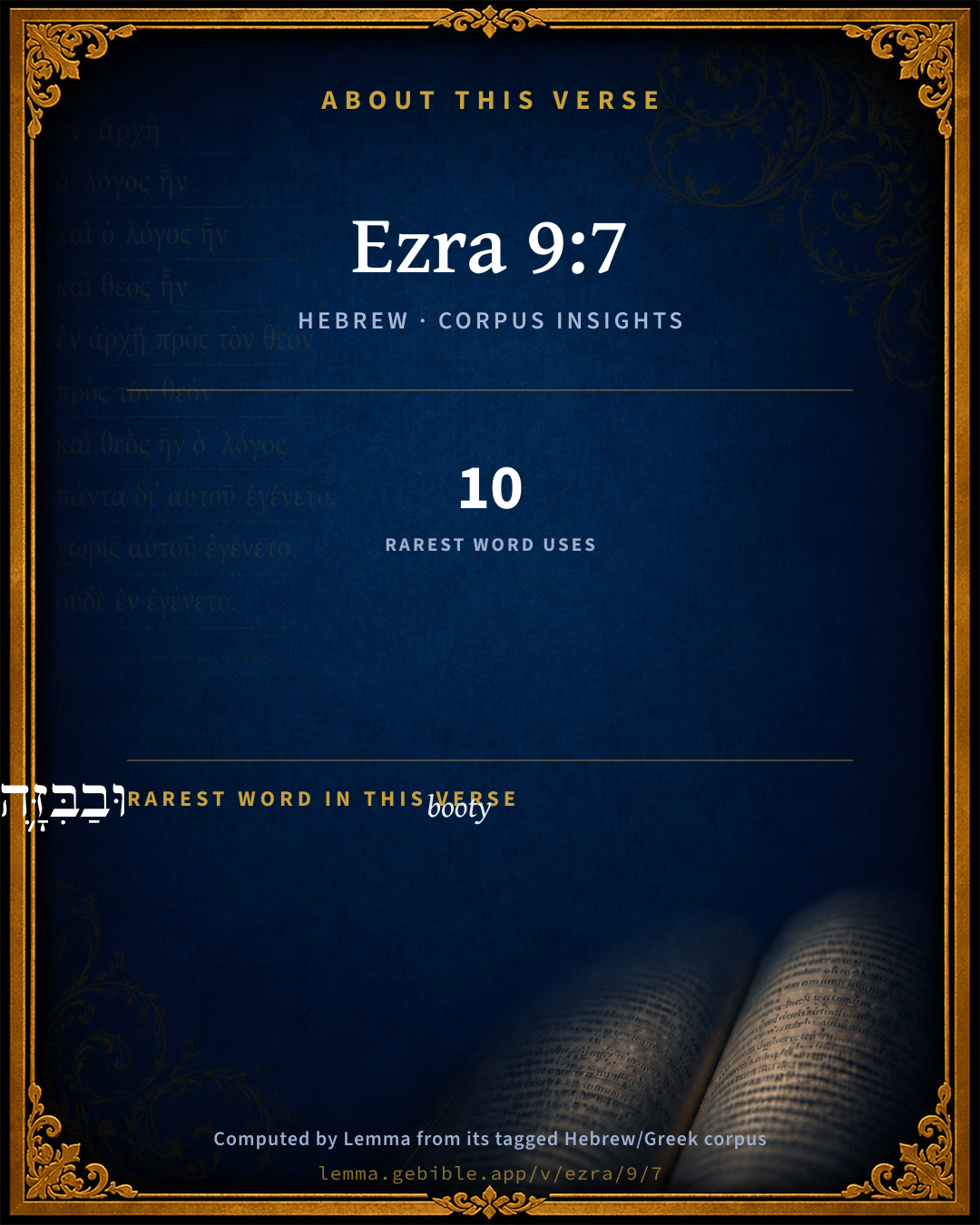
The rarest word here is וּבַבִּזָּ֛ה booty H961 — appearing just 10 times in the whole Hebrew Bible.

Shared distinctive vocabulary

וּבַבִּזָּ֛ה booty H961 occurs in 10 verses of the Hebrew Bible. Also found in:

Grammatical profile

  • 1 verb
  • 16 nouns
  • 1 adjective
  • 4 pronouns
  • 1 preposition

Verb forms

  • נִתַּ֡נּוּ Niphal · Perfect

Repetition

Words recur within this verse — often emphatic in Hebrew:

  • מִימֵ֣י day H3117 ×3
  • מְלָכֵ֨ינוּ king H4428 ×2
  • אֲנַ֨חְנוּ֙ we H587 ×2
  • הַזֶּ֑ה this H2088 ×2

Hebrew & Septuagint length

In English translation the verse runs 54 words from the Hebrew and 59 from the Septuagint (LXX English) — closely comparable.

A rough comparison of the two English renderings, which tokenize alike — not a word-level alignment.

Word counts can differ between the Hebrew and the Greek without any difference in meaning — e.g. the Hebrew direct-object marker אֵת has no separate Greek word, and Greek often adds the article ὁ.

Cross-references

28

Topical passages linked to Ezra 9:7 in the Treasury of Scripture Knowledge — connected by theme and wording, ordered by reader-vote popularity; previews shown in the World English Bible.

  • 2 Chronicles 29:6 For our fathers have trespassed, and done that which was evil in the sight of Yahweh our God, and have forsaken him, and have turned away their faces from the habitation of Yahweh, and turned their backs.
  • Daniel 9:5–8 we have sinned, and have dealt perversely, and have done wickedly, and have rebelled, even turning aside from your precepts and from your ordinances;
  • Leviticus 26:14–46 "'But if you will not listen to me, and will not do all these commandments;
  • Numbers 32:14 Behold, you are risen up in your fathers' place, an increase of sinful men, to augment yet the fierce anger of Yahweh toward Israel.
  • Deuteronomy 4:25–28 When you shall father children, and children's children, and you shall have been long in the land, and shall corrupt yourselves, and make an engraved image in the form of anything, and shall do that which is evil in the sight of Yahweh your God, to provoke him to anger;
  • Deuteronomy 28:15–68 But it shall come to pass, if you will not listen to the voice of Yahweh your God, to observe to do all his commandments and his statutes which I command you this day, that all these curses shall come on you, and overtake you.
  • Deuteronomy 29:22–28 The generation to come, your children who shall rise up after you, and the foreigner who shall come from a far land, shall say, when they see the plagues of that land, and the sicknesses with which Yahweh has made it sick;
  • Deuteronomy 30:17–19 But if your heart turn away, and you will not hear, but shall be drawn away, and worship other gods, and serve them;
  • Deuteronomy 31:20–22 For when I shall have brought them into the land which I swore to their fathers, flowing with milk and honey, and they shall have eaten and filled themselves, and grown fat; then will they turn to other gods, and serve them, and despise me, and break my covenant.
  • Deuteronomy 32:15–28 But Jeshurun grew fat, and kicked: You have grown fat, you are grown thick, you are become sleek; Then he forsook God who made him, Lightly esteemed the Rock of his salvation.
  • 1 Samuel 12:15 but if you will not listen to the voice of Yahweh, but rebel against the commandment of Yahweh, then will the hand of Yahweh be against you, as it was against your fathers.
  • 1 Kings 9:6–9 But if you shall turn away from following me, you or your children, and not keep my commandments and my statutes which I have set before you, but shall go and serve other gods, and worship them;
  • 2 Kings 17:5–8 Then the king of Assyria came up throughout all the land, and went up to Samaria, and besieged it three years.
  • 2 Kings 18:9–12 It happened in the fourth year of king Hezekiah, which was the seventh year of Hoshea son of Elah king of Israel, that Shalmaneser king of Assyria came up against Samaria, and besieged it.
  • 2 Kings 24:1–4 In his days Nebuchadnezzar king of Babylon came up, and Jehoiakim became his servant three years: then he turned and rebelled against him.
  • 2 Chronicles 30:7 Don't be you like your fathers, and like your brothers, who trespassed against Yahweh, the God of their fathers, so that he gave them up to desolation, as you see.
  • 2 Chronicles 36:16–19 but they mocked the messengers of God, and despised his words, and scoffed at his prophets, until the wrath of Yahweh arose against his people, until there was no remedy.
  • Nehemiah 9:30 Yet many years did you bear with them, and testified against them by your Spirit through your prophets: yet would they not give ear: therefore gave you them into the hand of the peoples of the lands.
  • Nehemiah 9:32–34 Now therefore, our God, the great, the mighty, and the awesome God, who keep covenant and loving kindness, don't let all the travail seem little before you, that has come on us, on our kings, on our princes, and on our priests, and on our prophets, and on our fathers, and on all your people, since the time of the kings of Assyria to this day.
  • Nehemiah 9:36–37 Behold, we are servants this day, and as for the land that you gave to our fathers to eat the fruit of it and the good of it, behold, we are servants in it.
  • Psalms 106:6–7 We have sinned with our fathers. We have committed iniquity. We have done wickedly.
  • Jeremiah 25:18 [to wit], Jerusalem, and the cities of Judah, and the kings of it, and the princes of it, to make them a desolation, an astonishment, a hissing, and a curse, as it is this day;
  • Jeremiah 44:22 so that Yahweh could no longer bear, because of the evil of your doings, and because of the abominations which you have committed; therefore is your land become a desolation, and an astonishment, and a curse, without inhabitant, as it is this day.
  • Lamentations 5:7 Our fathers sinned, and are no more; We have borne their iniquities.
  • Daniel 9:11–14 Yes, all Israel have transgressed your law, even turning aside, that they should not obey your voice: therefore has the curse been poured out on us, and the oath that is written in the law of Moses the servant of God; for we have sinned against him.
  • Zechariah 1:4–5 Don't you be like your fathers, to whom the former prophets proclaimed, saying: Thus says Yahweh of hosts, 'Return now from your evil ways, and from your evil doings;' but they did not hear, nor listen to me, says Yahweh.
  • Matthew 23:30–33 and say, 'If we had lived in the days of our fathers, we wouldn't have been partakers with them in the blood of the prophets.'
  • Acts 7:51–52 "You stiff-necked and uncircumcised in heart and ears, you always resist the Holy Spirit! As your fathers did, so you do.

Cross-references courtesy of OpenBible.info (CC BY 4.0).

Hebrew and Greek witnesses Masoretic Hebrew ↔ Greek Septuagint

The same verse in the two great witnesses to the Old Testament, shown verse-for-verse.

These are two independent witnesses, not word-aligned to each other, and the Septuagint is shown in lemma (dictionary) form.

Hebrew Ezra 9:7 Masoretic · Westminster Leningrad Codex

מִימֵ֣י אֲבֹתֵ֗ינוּ אֲנַ֨חְנוּ֙ בְּאַשְׁמָ֣ה גְדֹלָ֔ה עַ֖ד הַיּ֣וֹם הַזֶּ֑ה וּבַעֲוֺנֹתֵ֡ינוּ נִתַּ֡נּוּ אֲנַחְנוּ֩ מְלָכֵ֨ינוּ כֹהֲנֵ֜ינוּ בְּיַ֣ד מַלְכֵ֣י הָאֲרָצ֗וֹת בַּחֶ֜רֶב בַּשְּׁבִ֧י וּבַבִּזָּ֛ה וּבְבֹ֥שֶׁת פָּנִ֖ים כְּהַיּ֥וֹם הַזֶּֽה

Since the days of our fathers we have been exceeding guilty to this day; and for our iniquities have we, our kings, and our priests, been delivered into the hand of the kings of the lands, to the sword, to captivity, and to plunder, and to confusion of face, as it is this day.

World English Bible · Public Domain

Greek LXX Ezra 9:7 Septuagint · lemma form

ἀπό ἡμέρα πατήρ ἐγώ εἰμί ἐν πλημμέλεια μέγας ἕως ὁ ἡμέρα οὗτος καί ἐν ὁ ἀνομία ἐγώ παραδίδωμι ἐγώ καί ὁ βασιλεύς ἐγώ καί ὁ υἱός ἐγώ ἐν χείρ βασιλεύς ὁ ἔθνος ἐν ῥομφαία καί ἐν αἰχμαλωσία καί ἐν διαρπαγή καί ἐν αἰσχύνη πρόσωπον ἐγώ ὡς ὁ ἡμέρα οὗτος

From the days of our fathers we have been in a great trespass until this day: and because of our iniquities we, and our kings, and our children, have been delivered into the hand of the kings of the Gentiles by the sword, and by captivity, and by spoil, and with shame of our face, as at this day.

LXX2012 (modern English Septuagint) · Public Domain

In the Septuagint this is one book — Esdras B (2 Esdras): Ezra is chapters 1–10, Nehemiah 11–23.

Hebrew: Westminster Leningrad Codex (CC BY 4.0). Greek: Septuagint (public domain); English from LXX2012 (modern English Septuagint) (Public Domain). How the Septuagint differs from the Hebrew →

Commentary

Notes on Ezra 9:7 from classic Christian and Jewish commentators (each source and its license shown beneath its notes). The classic Christian expositions comment on the surrounding passage and are grouped to its opening verse, so a note may address several verses; the Jewish commentaries on the Tanakh (Rashi and others) are per-verse, so they appear only where the commentator wrote on this verse.

Lemma curates 59 commentaries, every one of them public domain or Creative Commons licensed, each selected and text-cleaned for this edition rather than reprinted as found. About our sources →

The Cambridge Bible for Schools and Colleges

gen. ed. J. J. S. Perowne

7. The record of Israelite history, i.e. sin and its retribution. But for their sin, the Israelites would have had a far different history.

Since the days of our fathers] The exact phrase hardly occurs elsewhere except Mal_3:7 ‘From the days of your fathers ye have turned aside from mine ordinances’. The context there seems to show that, though the expression is purposely indefinite, it points back to the time when the Law was first given, and is equivalent to saying ‘from the first beginnings of the Israelite people’.

have we been in a great trespass] R.V. we have been exceedingly guilty. Marg. Heb. in great guiltiness. See note on Ezr_9:6.

we, our kings, and our priests] i.e. the nation, with its civil and sacred chiefs. Cf. the fuller category Neh_9:32 ‘Our kings … our princes … our priests … our prophets … our fathers’.

the kings of the lands] With special reference to ‘the kings of Assyria’ (Neh_9:32) and Babylon.

sword … captivity … spoil (R.V. spoiling) … confusion of face] Life, freedom, property, honour: items of the penalty. ‘Confusion of face’, lit. shame of face, i.e. dishonour. Cf. Dan_9:7-8 ‘Unto us confusion of face, as it is this day’, ‘To us belongeth confusion of face’. 2Ch_32:21 ‘So he returned with shame of face’. ‘Spoiling’: a late Hebrew word, occurring also in Est_9:10; Est_9:15-16; Dan_11:24; Dan_11:33; 2Ch_14:14; 2Ch_25:13; 2Ch_28:14.

as it is this day] cf. Ezr_9:15; Neh_9:10; Deu_6:24; Jer_44:22.

The Cambridge Bible for Schools and Colleges (gen. ed. J. J. S. Perowne; Cambridge University Press, 1878–1918) — public domain. Text from a community e-Sword module.

Trapp's Complete Commentary

John Trapp

Ezr 9:7 Since the days of our fathers [have] we [been] in a great trespass unto this day; and for our iniquities have we, our kings, [and] our priests, been delivered into the hand of the kings of the lands, to the sword, to captivity, and to a spoil, and to confusion of face, as [it is] this day.

Ver. 7. Since the days of our fathers] Confession with aggravation is that happy spunge that wipeth out all the blots and blurs of our lives; for, if we confess our sins, and therein lay load enough upon ourselves, as Ezra here, and Daniel doth, Dan 9:5 (mark how full in the mouth these good men are, out of the abundant hatred of sin in their hearts), "God is faithful and just to forgive us our sins," &c., 1Jn 1:9. But in confession we must not extenuate or excuse; every sin must swell as a toad in our eyes, and we must spit it out of our mouths with utmost indignation; showing the Lord the iniquity of our sin, the filthiness of our lewdness, the abomination of our provocations, Rom 7:13. Thus if we weigh our sins in a true balance, and put in so many weights as to bring to a just humiliation, to a godly sorrow; then it will prove a right apology, the same that the apostle maketh a fruit and sign of sound repentance, 2Co 7:11, quae magis deprecatione constat, quam depulsione criminum, such an apology as consisteth rather in deprecating than defending (Chemnit. Exam.).

Have we been in a great trespass unto this day] And so there hath been a concatenation, a continued series of our sins from one generation to another. We are a race of rebels, a seed of serpents, &c.

And for our iniquities have we, our kings, and our priests] Our national sins have produced national plagues; which yet we have not improved to a public or personal reformation. Many hands have drawn the cable with greatest violence; the leprosy hath overrun the whole body; there is (as physicians say of some diseases) corruptio totius substantiae, a general defection, a conjuncture of all persons, in all sins and miseries, which, like clouds, cluster together, and no clearing up by repentance.

And to confusion of face] So that we are a scorn to our enemies and a terror to ourselves; in a low and lamentable condition.

John Trapp, A Commentary or Exposition upon All the Books of the Old and New Testament (1647–1656) — public domain. Text from a community e-Sword module.

Joseph Benson's Commentary

Ezr 9:7-8. Since the days of our fathers have we been in a great trespass — We are not purged from the guilt of our fathers’ sins, but we are still feeling the sad effects of them; yea, and are repeating the same sins. And now for a little space grace hath been showed — It is but a little while since God hath delivered us, and yet we are already returned to our sin and folly. Or, we have enjoyed this favour but a little while, now we are sinning it away, and shortening our own happiness. To leave us a remnant to escape — That by his favour many of us should escape out of captivity; whom he calls but a remnant, because the greatest part of the Israelitish nation was yet in captivity. To give us a nail — Some kind of settlement; whereas before we were tossed and removed from place to place as our masters pleased. It is a metaphor from tents, which are fastened by cords and nails, or pins. In his holy place — In this holy land, as the land of Judah is called, Zec 2:12. Or, in Jerusalem, called the holy city, (Neh 11:1; Neh 11:18; Daniel 10:24,) which is peculiarly mentioned, because of the temple, which was the nail that fastened their tents, and gave them some hopes of continuing in their land. That our God may lighten our eyes — That he might revive and comfort our hearts. For, as darkness is often put for a state of sorrow and affliction, so light is put for joy and comfort. And give us a little reviving in our bondage — For we are not quite delivered, being even here in subjection to our former lords.

Joseph Benson's Commentary on the Old and New Testaments (1811–1818) — public domain. Text from a community e-Sword module.

Tyndale Open Study Notes

Tyndale Open Resources

9:7 Ezra forthrightly summarizes Israel’s past history. The people and their leaders had sinned and were justly punished. • just as we are today: The effects of Israel’s punishment were still evident in Jerusalem at this time.

Tyndale Open Study Notes — © Tyndale Open Resources, licensed CC BY-SA 4.0. Text via the HelloAO Bible API.

John Gill's Exposition

Since the days of our fathers have we been in a great trespass unto this day,.... The sins they were guilty of had been long continued in, which was an aggravation of them:

and for our iniquities have we, our kings, and our priests, been delivered into the hand of the kings of the lands; the ten tribes and their king into the hand of the king of Assyria, the kings of Judah, Jehoiakim, Jeconiah, and Zedekiah, into the hands of the king of Babylon, with the priests and people:

to the sword, to captivity, and to a spoil; some were slain with the sword, others carried captive, and the houses of them all plundered and spoiled:

and to confusion of face, as it is this day; being filled with shame when they reflected on their sins, the cause of those evils; and besides, the captivity of the ten tribes continued, and of many others, which exposed them to shame among their neighbours.

John Gill's Exposition of the Whole Bible (1746–1763) — public domain (CC PDM 1.0). Text via the HelloAO Bible API.

Albert Barnes' Notes on the Bible

Very similar in tone to this are the confessions of Nehemiah Neh 9:29-35 and of Daniel (see the marginal references). The captivity had done its work by deeply convincing of sin the Jewish nation that had previously been so proud and self-righteous.

Albert Barnes' Notes on the Bible (1834–1885) — public domain. Text from a community e-Sword/MySword module.

Haydock's Catholic Bible Commentary

At this day. Notwithstanding the favourable decrees of Cyrus, &c., the greatest part of the people continued in captivity, being dispersed, some into Egypt, others into distant countries, beyond the Euphrates. (Calmet)

George Leo Haydock (1774–1849), Haydock's Catholic Family Bible and Commentary, 1859 edition — public domain. Excludes Psalms (Douay-Rheims chapter numbering differs from Protestant) and Deuterocanonical books (Catholic canon only).

Matthew Poole's English Annotations

We have been in a great trespass unto this day: we are not purged from the guilt and filth of our fathers’ sins, but we are still feeling the sad effects of their sins in the continuing captivity of a great number of our brethren; and we are still repeating the same sins.

Matthew Poole's English Annotations on the Holy Bible (1683–1685) — public domain. Text from a community e-Sword/MySword module.

Whedon's Commentary on the Bible

Daniel D. Whedon

7. Sword… captivity… spoil — Bitterly true, as the very stones of Jerusalem might testify.

Confusion of face — Having nothing to answer to vindicate themselves, for their own sins had brought them thus low.

Daniel D. Whedon (gen. ed.), Commentary on the Old and New Testaments (1874–1909) — public domain. Text from a community e-Sword module.

The Pulpit Commentary

Since the days of our fathers. The historical sketches in Nehemiah (Neh_9:6-35) and the Acts (Act_7:2-53) show that this phrase might be taken in a very wide sense, and be regarded as including the "fathers" of the nation who came out of Egypt; but perhaps Ezra has rather in his mind the series of idolatries belonging to the kingly period, and extending from Solomon to Zedekiah. We, our kings, and our priests, have been delivered into the hand of the kings of the lands. Menahem into the hand of Pul, Pekah of Tiglath-Pileser, Hoshea of Shalmaneser or Sargon, Manasseh of Esarhaddon, Josiah of PharaohNecho, Jehoahaz, Jehoiakim, Jehoiachin, and Zedekiah, of Nebuchadnezzar. That the priests had their full share in the calamities of the captivity appears from 2Ki_25:18; Jer_52:24; Eze_1:1-3. And to confusion of face. i.e. To disgrace and shame. (compare Psa_44:13-15)

The Pulpit Commentary (1880–1919), ed. H.D.M. Spence-Jones & Joseph S. Exell — public domain. Text from a community e-Sword module.

John Wesley's Explanatory Notes

Have we been - We are not purged from the guilt of our fathers sins, but we are still feeling the sad effects of them; yea, and are repeating the same sins.

John Wesley, Explanatory Notes Upon the Whole Bible (1754–1765) — public domain. Text via the GEBible commentary corpus.

unfoldingWord translationNotes

Door43 World Missions Community

the days of our ancestors

"the time when our ancestors were alive"

in great guilt ... In our iniquities

The abstract nouns "guilt" and "iniquity" can be translated as an adjective and a verb, respectively. AT: "very guilty ... Because of the evil deeds we did" (See: Abstract Nouns)

we ... were given into the hand of kings

This can be translated in active form. AT: "you gave us ... into the hand of kings" (See: Active or Passive)

were given into the hand of kings of this world

Here "hand" represents power or control. AT: "were given into the control of the kings of this world" or "were given over to the kings of this world" (See: Metonymy)

to the sword, to captivity, and to plunder and ashamed faces

The sword is a metonym for people killing other people. The abstract nouns "captivity" and "plunder" can be stated as verb phrases. And, "faces" is a synecdoche representing the whole person. AT: "to our enemies to kill us, to capture us, to steal from us, and to cause us shame" (See: Metonymy and Abstract Nouns and Synecdoche)

translationWords

king

priest

sword

captive

unfoldingWord translationNotes — © Distant Shores Media and the Door43 World Missions Community, licensed CC BY-SA 4.0. Source: git.door43.org/Door43/en_tn.

Rashi

Rabbi Shlomo Yitzchaki (Rashi)

we were delivered Heb. נִתַּנוּ, like נִתַּנְנוּ. The “dagesh” in the “nun” is instead of another “nun,” like (II Chron. 14:10): “for we rely (תִשְּׁעַנוּ) on You,” like נִשְּׁעַנְנוּ. (Gen. 34:16): “... then we will give (וְנָתַנוּ) our daughters,” like וְנָתַנְנוּ.

as of this day as appears this day, for the Ten Tribes have already been exiled, and many of the exiles still remain in Babylon.

Rashi on the Tanakh — English translations: “The Judaica Press complete Tanach with Rashi, translated by A. J. Rosenberg” (CC BY 4.0); “Pentateuch with Rashi's commentary by M. Rosenbaum and A.M. Silbermann, 1929-1934” (public domain); “The Metsudah Tanach series, Lakewood, N.J” (CC BY 4.0); and “The Book of Joshua, Metsudah Publications, 1997” (CC BY 4.0). Text via Sefaria.

Lesson kit

Teaching starters — assembled from the data on this page, not authored interpretation. Every prompt links to the verse data it draws on. Edit before teaching.

Ezra, in the Historical, opens this verse with 23 words (18 distinct Hebrew lemmas). Its most distinctive word is bizzâh (“booty”). A historical commentator’s framing appears above. Read the whole chapter for the surrounding context.

Discussion questions

  1. What does “booty” (bizzâh) contribute to the verse as a whole?
  2. 2 Chronicles 14:14 shares the word «booty» with this verse. How do the two illuminate each other?
  3. “day” occurs 3× in this one verse. What is the effect of the repetition?
  4. These translations render this verse differently. What is at stake in choosing one wording over another?
  5. The verb «נִתַּ֡נּוּ» is Niphal Perfect. How does its form color the action?
  6. Reading how The Cambridge Bible for Schools and Colleges and Trapp's Complete Commentary read this verse, where do the two commentators agree and where do they part?

Things to notice

Reading settings

Reading text

Shown beneath each verse's original-language words.

Old Testament
Old Testament edition

Read the OT as the Masoretic Hebrew (MT) or the Greek Septuagint (LXX).

English shown for the Greek Septuagint (in the Hebrew ↔ Greek comparison).

Comparing translations? Open the Compare panel on any verse page to stack up to four side by side.