
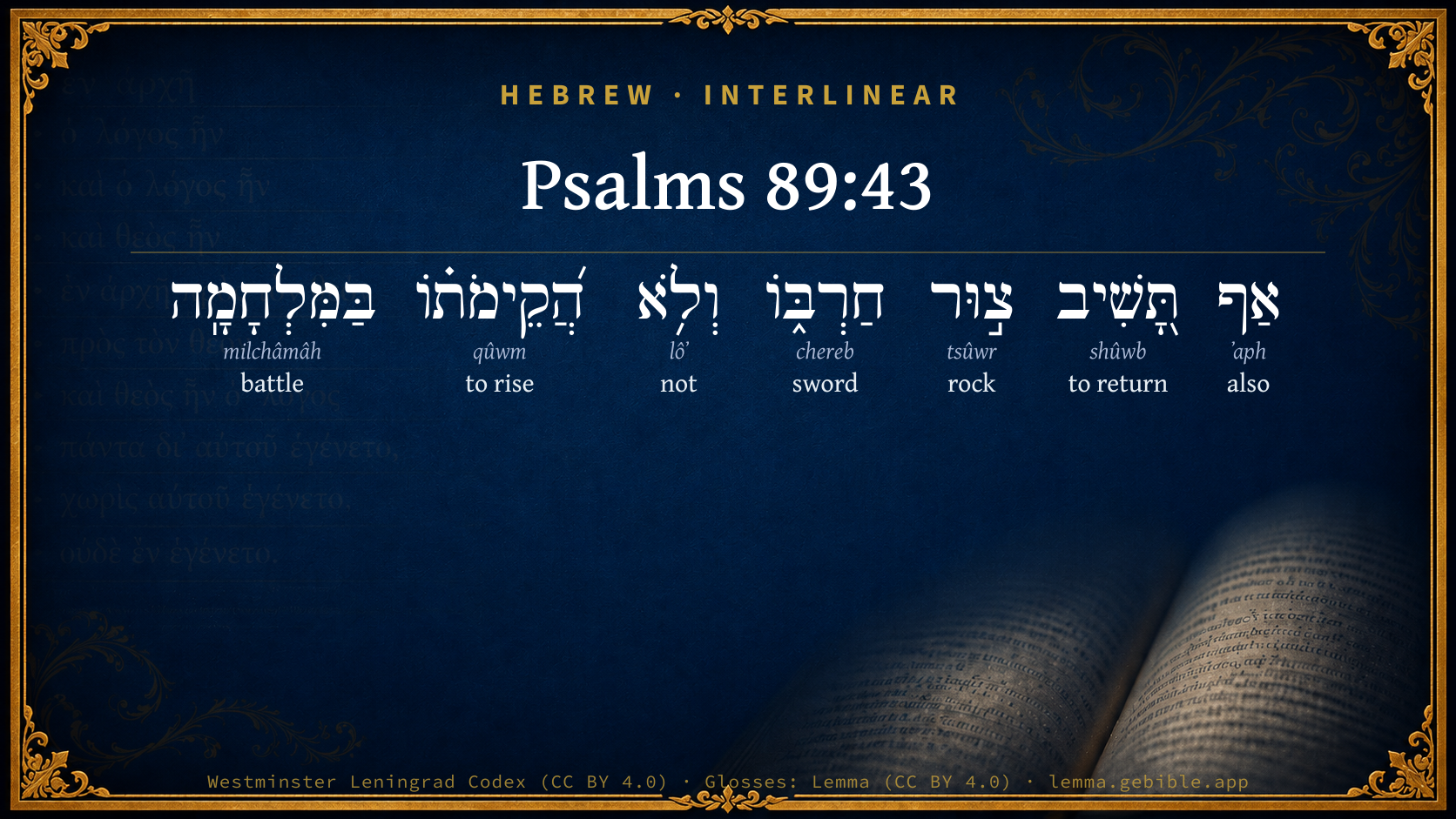
Psalms 89:43

Hebrew (Westminster Leningrad Codex) Psalms 89:43 appears in the Hebrew Old Testament. The text above is from the Westminster Leningrad Codex. Each word links to its Strong’s number, a concise gloss, and parsing drawn from the Open Scriptures Hebrew Bible morphology. Click any word for its full Brown-Driver-Briggs (BDB) entry.
Download image
Cite this verse

Psalms 89:43 (World English Bible). Public Domain. Lemma interlinear Bible study tool, https://lemma.gebible.app/v/psalms/89/43.

Show BibTeX & RIS
BibTeX
RIS
English Translation
Yes, you turn back the edge of his sword, And haven't supported him in battle.
World English Bible · Public Domain
Download a study sheet

One document with this verse’s original text, its word-by-word gloss line, the meaning frame, cross-references with their text, attributed commentary, and full source and license credits — printable, and it pastes into notes with its structure intact.

This verse Autodidact and up

Study sheet (.html) Plain text (.txt)

A passage Seminary Student

Up to 50 verses in one chapter. A passage sheet keeps up to 6 commentary sources and 12 cross-references per verse, in the order this page ranks them, and says so on the sheet whenever that leaves anything out. Ask for a single verse and you get the Autodidact verse sheet above.

Everything on this page stays free to read, with no account — the sheet is a download of what is already on screen, not access to it.

Want to remove ads? Support Godless Engineer
Compare translations 3

The same verse in 3 English versions, stacked beneath the original-language interlinear above. Click any original word for its lexicon entry.

Each is an independent rendering of the whole verse — the interlinear is not word-aligned to these translations.

Highlighted words mark where these versions differ — a whole-verse word diff, not a word-by-word alignment.

  • World English Bible Public Domain
    Yes, you turn back the edge of his sword, And haven't supported him in battle.
  • King James Version Public Domain
    Thou hast also turned the edge of his sword, and hast not made him to stand in the battle.
  • unfoldingWord Literal Text CC BY-SA 4.0
    You have also turned back the edge of his sword, and you have not made him stand in battle.

unfoldingWord Literal Text — © unfoldingWord, licensed CC BY-SA 4.0. Word-aligned USFM3 via Door43 (git.door43.org/unfoldingWord/en_ult).

Versions to compare (up to 4)

3 of 4 selected

Show all 18 translations

Every available English version of this verse, each an independent rendering of the whole verse.

  • World English Bible Public Domain
    Yes, you turn back the edge of his sword, And haven't supported him in battle.
  • Berean Standard Bible Public Domain
    You have bent the edge of his sword and have not sustained him in battle.
  • Majority Standard Bible Public Domain
    You have bent the edge of his sword and have not sustained him in battle.
  • King James Version Public Domain
    Thou hast also turned the edge of his sword, and hast not made him to stand in the battle.
  • American Standard Version (1901) Public Domain
    Yea, thou turnest back the edge of his sword, And hast not made him to stand in the battle.
  • Revised Version (1885) Public Domain
    Yea, thou turnest back the edge his sword, and hast not made him to stand in the battle.
  • Geneva Bible (1599) Public Domain
    Thou hast also turned the edge of his sworde, and hast not made him to stand in the battell.
  • Douay-Rheims (1899) Public Domain
    Thou hast set up the right hand of them that oppress him: thou hast made all his enemies to rejoice.
  • Young's Literal Translation Public Domain
    Also -- Thou turnest back the sharpness of his sword, And hast not established him in battle,
  • Literal Standard Version CC BY-SA 4.0
    Also—You turn back the sharpness of his sword, || And have not established him in battle,
  • Unlocked Literal Bible CC BY-SA 4.0
    You turn back the edge of his sword and have not made him stand when in battle.
  • unfoldingWord Literal Text CC BY-SA 4.0
    You have also turned back the edge of his sword, and you have not made him stand in battle.
  • Darby Bible Public Domain
    Yea, thou hast turned back the edge of his sword, and hast not made him stand in the battle.
  • World Messianic Bible Public Domain
    Yes, you turn back the edge of his sword, and haven’t supported him in battle.
  • Webster's Bible Public Domain
    \\89:42\\Thou hast set up the right hand of his adversaries; thou hast made all his enemies to rejoice.
  • Free Bible Version CC BY-SA 4.0
    You have repelled his sharp sword; you have not helped him in battle.
  • Bible in Basic English Public Domain
    His sword is turned back; you have not been his support in the fight.
  • JPS Tanakh (1917) Public Domain
    (89-44) Yea, Thou turnest back the edge of his sword, and hast not made him to stand in the battle.

Literal Standard Version (2020), Covenant Press — licensed CC BY-SA 4.0. Text via the HelloAO Bible API (eBible.org). Unlocked Literal Bible (unfoldingWord) — licensed CC BY-SA 4.0. Text via the HelloAO Bible API (eBible.org). unfoldingWord Literal Text — © unfoldingWord, licensed CC BY-SA 4.0. Word-aligned USFM3 via Door43 (git.door43.org/unfoldingWord/en_ult). Free Bible Version, Dr. Jonathan Gallagher — licensed CC BY-SA 4.0. Text via the HelloAO Bible API (eBible.org).

Word by word

More ways to search: Search by grammar → Find every occurrence → Compare this word →

Practice this passage: Drill this verse → Learn its vocabulary →

About this verse

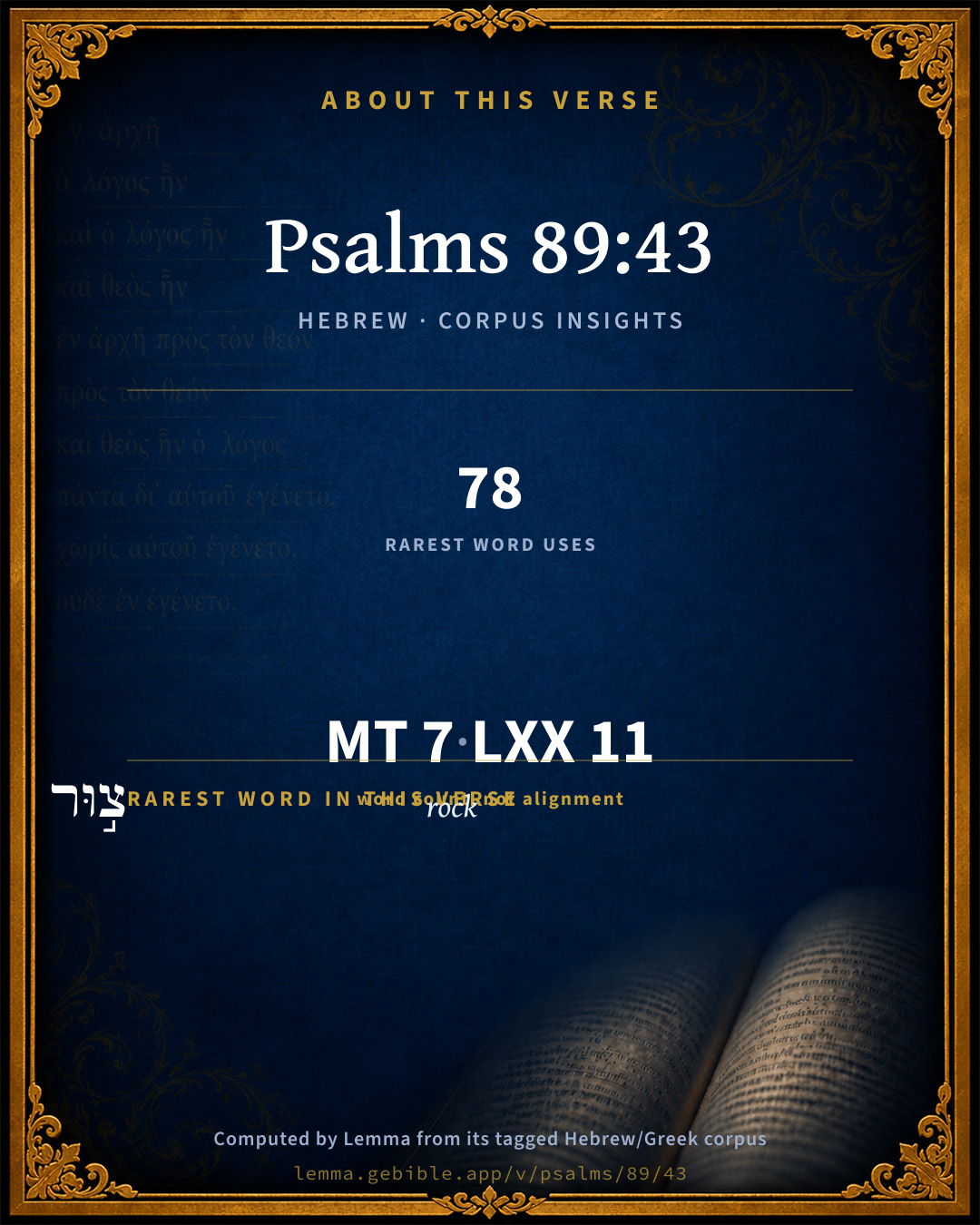
These counts appear in no published source. They are computed here, from the morphology-tagged text and Lemma’s own curated glosses. What Lemma adds →

7
words
7
distinct lemmas
Wisdom
section

Grammatical profile

  • 2 verbs
  • 3 nouns
  • 2 particles

Verb forms

  • תָּ֭שִׁיב Hiphil · Imperfect
  • הֲ֝קֵימֹת֗וֹ Hiphil · Perfect

Hebrew & Septuagint length

In English translation the verse runs 15 words from the Hebrew and 17 from the Septuagint (LXX English) — closely comparable.

A rough comparison of the two English renderings, which tokenize alike — not a word-level alignment.

Word counts can differ between the Hebrew and the Greek without any difference in meaning — e.g. the Hebrew direct-object marker אֵת has no separate Greek word, and Greek often adds the article ὁ.

In the original languages it is 7 Hebrew tokens and 11 Greek tokens — but the two are counted differently (Hebrew bundles its prefixes and suffixes into one token; the Greek is in lemma form), so that isn’t a like-for-like length.

Cross-references

8

Topical passages linked to Psalms 89:43 in the Treasury of Scripture Knowledge — connected by theme and wording, ordered by reader-vote popularity; previews shown in the World English Bible.

  • Leviticus 26:36–37 "'As for those of you who are left, I will send a faintness into their hearts in the lands of their enemies: and the sound of a driven leaf will put them to flight; and they shall flee, as one flees from the sword; and they will fall when no one pursues.
  • Numbers 14:42 Don't go up, for Yahweh isn't among you; that you not be struck down before your enemies.
  • Numbers 14:45 Then the Amalekite came down, and the Canaanite who lived in that mountain, and struck them and beat them down, even to Hormah.
  • Joshua 7:4–5 So there went up there of the people about three thousand men: and they fled before the men of Ai.
  • Joshua 7:8–12 Oh, Lord, what shall I say, after that Israel has turned their backs before their enemies!
  • 2 Chronicles 25:8 But if you will go, do [valiantly], be strong for the battle: God will cast you down before the enemy; for God has power to help, and to cast down.
  • Psalms 44:10 You make us turn back from the adversary. Those who hate us take spoil for themselves.
  • Ezekiel 30:21–25 Son of man, I have broken the arm of Pharaoh king of Egypt; and, behold, it has not been bound up, to apply [healing] medicines, to put a bandage to bind it, that it be strong to hold the sword.

Cross-references courtesy of OpenBible.info (CC BY 4.0).

Hebrew and Greek witnesses Masoretic Hebrew ↔ Greek Septuagint

The same verse in the two great witnesses to the Old Testament, shown verse-for-verse.

You’re reading Greek Psalm 88 (Hebrew Psalm 89). The Septuagint counts the superscription, so verse numbers can differ from the Hebrew — chapter-level alignment, not verse-by-verse. Numbering follows Rahlfs.

These are two independent witnesses, not word-aligned to each other, and the Septuagint is shown in lemma (dictionary) form.

Hebrew Psalms 89:43 Masoretic · Westminster Leningrad Codex

אַף תָּ֭שִׁיב צ֣וּר חַרְבּ֑וֹ וְלֹ֥א הֲ֝קֵימֹת֗וֹ בַּמִּלְחָמָֽה

Yes, you turn back the edge of his sword, And haven't supported him in battle.

World English Bible · Public Domain

Greek LXX Greek Psalm 88:43 Septuagint · lemma form

ὑψόω ὁ δεξιός ὁ ἐχθρός αὐτός εὐφραίνω πᾶς ὁ ἐχθρός αὐτός

You have turned back the help of his sword, and have not helped him in the battle.

LXX2012 (modern English Septuagint) · Public Domain

Hebrew: Westminster Leningrad Codex (CC BY 4.0). Greek: Septuagint (public domain); English from LXX2012 (modern English Septuagint) (Public Domain). How the Septuagint differs from the Hebrew →

Commentary

Notes on Psalms 89:43 from classic Christian and Jewish commentators (each source and its license shown beneath its notes). The classic Christian expositions comment on the surrounding passage and are grouped to its opening verse, so a note may address several verses; the Jewish commentaries on the Tanakh (Rashi and others) are per-verse, so they appear only where the commentator wrote on this verse.

Lemma curates 59 commentaries, every one of them public domain or Creative Commons licensed, each selected and text-cleaned for this edition rather than reprinted as found. About our sources →

Trapp's Complete Commentary

John Trapp

Psa 89:43 Thou hast also turned the edge of his sword, and hast not made him to stand in the battle.

Ver. 43. Thou hast also turned the edge] Disarmed and disabled him.

And hast not made him, &c.] But turned his courage into cowardice.

John Trapp, A Commentary or Exposition upon All the Books of the Old and New Testament (1647–1656) — public domain. Text from a community e-Sword module.

J. A. Alexander on Psalms

Joseph Addison Alexander

44. (Psa 89:43) Also thou turnest the edge of his sword, and dost not allow him to stand in the battle. The particle (Jx) at the beginning indicates a climax. Not only was his enemy superior, but himself delinquent and disgraced. Edge, literally rock, of his sword. The idea suggested may be that of hardness, as a hard edge is essential to a serviceable weapon. See my note on Isa 27:1. Some interpreters, however, think it best to adhere to the ordinary usage of rock in Hebrew as an emblem of strength, and to understand the whole phrase as meaning the strength of his sword, either in the strict sense or in that of strong sword, both of which are here appropriate. See above, on Psa 89:26. The construction in the last clause is ambiguous, as the pronoun may refer to sword or rock, no less grammatically than to its possessor. The general sense remains the same, however, as in the similar case above, Psa 89:29.

Joseph Addison Alexander, The Psalms Translated and Explained (1850) — public domain. Text from a community e-Sword module.

Adam Clarke's Commentary

Verse 43. Thou hast also turned the edge of his sword.] The arms and military prowess of thy people are no longer of any use to them; THOU art against them, and therefore they are fallen. In what a perilous and hopeless situation must that soldier be who, while defending his life against his mortal foe, has his sword broken, or its edge turned; or, in modern warfare, whose gun misses fire! The Gauls, when invaded by the Romans, had no method of hardening iron; at every blow their swords bended, so that they were obliged, before they could strike again, to put them under their foot or over their knee, to straighten them; and in most cases, before this could be done, their better armed foe had taken away their life! The edge of their sword was turned, so that they could not stand in battle; and hence the Gauls were conquered by the Romans.

Adam Clarke's Commentary on the Bible (1810–1826) — public domain. Text from a community e-Sword/MySword module.

Ellicott's Commentary for English Readers

(43) Edge of his sword.—The Hebrew is tsûr, i.e., rock, and a comparison with Jos_5:2 (margin) suggests that we have here a reminiscence of the “stone age.” The word “flint” for the edge of a weapon might easily survive the actual use of the implement itself. So we should still speak of “a foeman’s steel” even if the use of chemical explosives entirely abolished the use of sword and bayonet. This is one of the cases where the condition of modern science helps us in exegesis of the Bible. The ancient versions, who knew nothing of the stone or iron ages, paraphrase, by “strength,” or “help.”

A Bible Commentary for English Readers, edited by Charles John Ellicott (1878–1897) — public domain. Text from a community e-Sword module.

The Cambridge Bible for Schools and Colleges

gen. ed. J. J. S. Perowne

43. Yea, thou turnest back the edge of his sword (R.V.): i.e. not as A.V. might seem to mean, bluntest it, but as the parallelism shews, makest it give way in battle. Cp. 2Sa_1:22.

The Cambridge Bible for Schools and Colleges (gen. ed. J. J. S. Perowne; Cambridge University Press, 1878–1918) — public domain. Text from a community e-Sword module.

John Gill's Exposition

Thou hast made his glory to cease,.... The glory of his deity, though it did not properly cease, yet it seemed to do so, being covered, and out of sight, and seen but by a very few, while he appeared in the likeness of sinful flesh; and the glory of his humanity was made to cease, in which he was fairer than the children of men, and his visage was more marred than any man's, and his form than the sons of men; and the glory of his offices, prophetical, priestly, and kingly, which were reproached and vilified, and disputed and contradicted by the Jews, Mat 26:68, it may be rendered, "his purity" (b), which seemed to cease when he was clothed with our filthy garments; or had all our sins laid upon him, and imputed to him, by his Father; and he was made sin for us, who knew none: the Targum is,

"thou hast made the priests to cease who sprinkle upon the altar, and purify his people:''

and cast his throne down to the ground; this seems contrary, and is an objection to Psa 89:29, but is not; for not withstanding the usage of Christ by the Jews, who rejected him as the King Messiah; see Gill on Psa 89:39, yet he is now upon the same throne with his Father, and will sit upon a throne of glory when he comes to judge the world, and so in the New Jerusalem church state, and to all eternity.

(b) "puritatem ejus", Montanus, Michaelis.

John Gill's Exposition of the Whole Bible (1746–1763) — public domain (CC PDM 1.0). Text via the HelloAO Bible API.

Albert Barnes' Notes on the Bible

Thou hast also turned the edge of his sword - That is, Thou hast turned it away, so that when it is raised to strike, it does not descend on the object aimed at by the blow. The meaning is, that he had not been successful in battle, or had been defeated.

And hast not made him to stand in the battle - To stand firm; to hold his ground. He has been driven back; his forces have fled.

Albert Barnes' Notes on the Bible (1834–1885) — public domain. Text from a community e-Sword/MySword module.

Matthew Poole's English Annotations

Turned the edge of his sword; so that he can neither offend his enemies, nor defend himself.

Not made him to stand, but to flee and fall before his enemies; for more is understood than what is expressed.

Matthew Poole's English Annotations on the Holy Bible (1683–1685) — public domain. Text from a community e-Sword/MySword module.

The Treasury of David

Charles H. Spurgeon

Ver. 43. Also turned the edge of his sword. When he goes to war he is as unsuccessful as though his sword refused to cut, and gave way like a sword of lead. His weapons fail him.

And hast not made him to stand in the battle. His heart fails him as well as his swordhe wavers, he falls. This has happened even to naturally brave mena terrible dread has unmanned them. At this present the church has few swords of true Jerusalem metal; her sons are pliable, her ministers yield to pressure. We need men whose edge cannot be turned, firm for truth, keen against error, sharp towards sin, cutting their way into men's hearts. Courage and decision are more needed now than ever, for charity towards heresy is the fashionable vice, and indifference to all truth, under the name of liberal mindedness, is the crowning virtue of the age. The Lord send us men of the school of Elias, or, at least, of Luther and Knox.

Ver. 43. Thou hast also turned the edge of his sword, etc. The arms and military prowess of thy people are no longer of any use to them; Thou art against them, and therefore they are fallen. In what a perilous and hopeless situation must that soldier be who, defending his life against his mortal foe, has his sword broken, or its edge turned; or, in modern warfare, whose gun misses fire! The Gauls, when invaded by the Romans, had no method of hardening iron; at every blow their swords bent, so that they were obliged, before they could strike again, to put them under their foot or over their knee, to straighten them; and in most cases, before this could be done, their better armed foe had taken away their life! The edge of their sword was turned, so that they could not stand in battle; and hence the Gauls were conquered by the Romans. Adam Clarke.

Ver. 43. Thou hast also turned the edge of his sword, that it cannot do execution as it has done; and what is worse, thou hast "turned the edge" of his spirit, and taken off his courage, and hast not made him to stand, as he used to do, in the day of battle. The spirit of men is what the Father and Former of spirits makes them; nor can we stand with any strength or resolution, farther than God is pleased to uphold us. If men's hearts fail them, it is God that dispirits them; but it is sad with the church when those cannot stand that should stand up for it. Matthew Henry.

Ver. 43. Cases in which the sword of the gospel appears to have its edge turned.

Psalms 89:44*

Charles H. Spurgeon's The Treasury of David (1869–1885) — public domain. Psalms only. Text from a community e-Sword/MySword module.

Whedon's Commentary on the Bible

Daniel D. Whedon

43. Turned the edge of his sword—Contrast Psa_89:23

Daniel D. Whedon (gen. ed.), Commentary on the Old and New Testaments (1874–1909) — public domain. Text from a community e-Sword module.

The Pulpit Commentary

Thou hast also turned the edge of his sword; literally, the rock of his sword. It is not quite clear whether a "blunting of the sword," or a "turning to flight of those who drew the sword," is intended. In either ease the phrase implies military disaster. And hast not made him to stand in the battle; i.e. "hast caused him to give way before his enemies." The words imply defeat in the open field.

The Pulpit Commentary (1880–1919), ed. H.D.M. Spence-Jones & Joseph S. Exell — public domain. Text from a community e-Sword module.

Lesson kit

Teaching starters — assembled from the data on this page, not authored interpretation. Every prompt links to the verse data it draws on. Edit before teaching.

Psalms, in the Wisdom, opens this verse with 7 words (7 distinct Hebrew lemmas). Its most distinctive word is tsûwr (“rock”). A historical commentator’s framing appears above. Read the whole chapter for the surrounding context.

Discussion questions

  1. How does “rock” (tsûwr) shape what this verse is saying?
  2. Leviticus 26:36–37 shares this passage’s theme. How do the two illuminate each other?
  3. These translations render this verse differently; the difference is in the English rendering, not the original. What questions does that raise?
  4. The verb «תָּ֭שִׁיב» is Hiphil Imperfect. How does its form color the action?
  5. Reading how Trapp's Complete Commentary and J. A. Alexander on Psalms read this verse, where do the two commentators agree and where do they part?

Things to notice

Reading settings

Reading text

Shown beneath each verse's original-language words.

Old Testament
Old Testament edition

Read the OT as the Masoretic Hebrew (MT) or the Greek Septuagint (LXX).

English shown for the Greek Septuagint (in the Hebrew ↔ Greek comparison).

Comparing translations? Open the Compare panel on any verse page to stack up to four side by side.