
1 Samuel 21:9

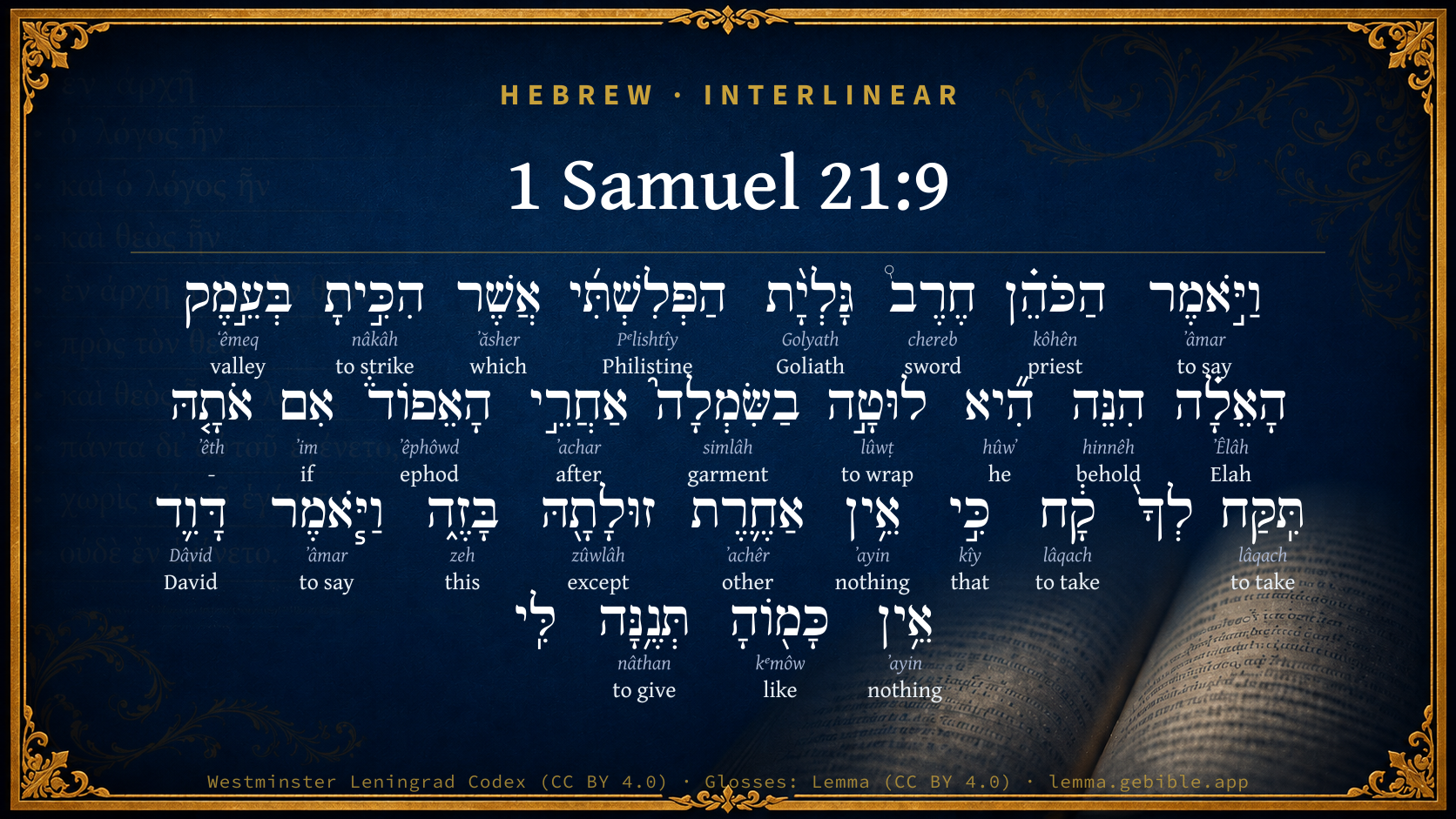
Hebrew (Westminster Leningrad Codex) 1 Samuel 21:9 appears in the Hebrew Old Testament. The text above is from the Westminster Leningrad Codex. Each word links to its Strong’s number, a concise gloss, and parsing drawn from the Open Scriptures Hebrew Bible morphology. Click any word for its full Brown-Driver-Briggs (BDB) entry.
Download image
Cite this verse

1 Samuel 21:9 (World English Bible). Public Domain. Lemma interlinear Bible study tool, https://lemma.gebible.app/v/1-samuel/21/9.

Show BibTeX & RIS
BibTeX
RIS
English Translation
The priest said, The sword of Goliath the Philistine, whom you killed in the valley of Elah, behold, it is here wrapped in a cloth behind the ephod: if you will take that, take it; for there is no other except that here. David said, There is none like that; give it me.
World English Bible · Public Domain
Highlights
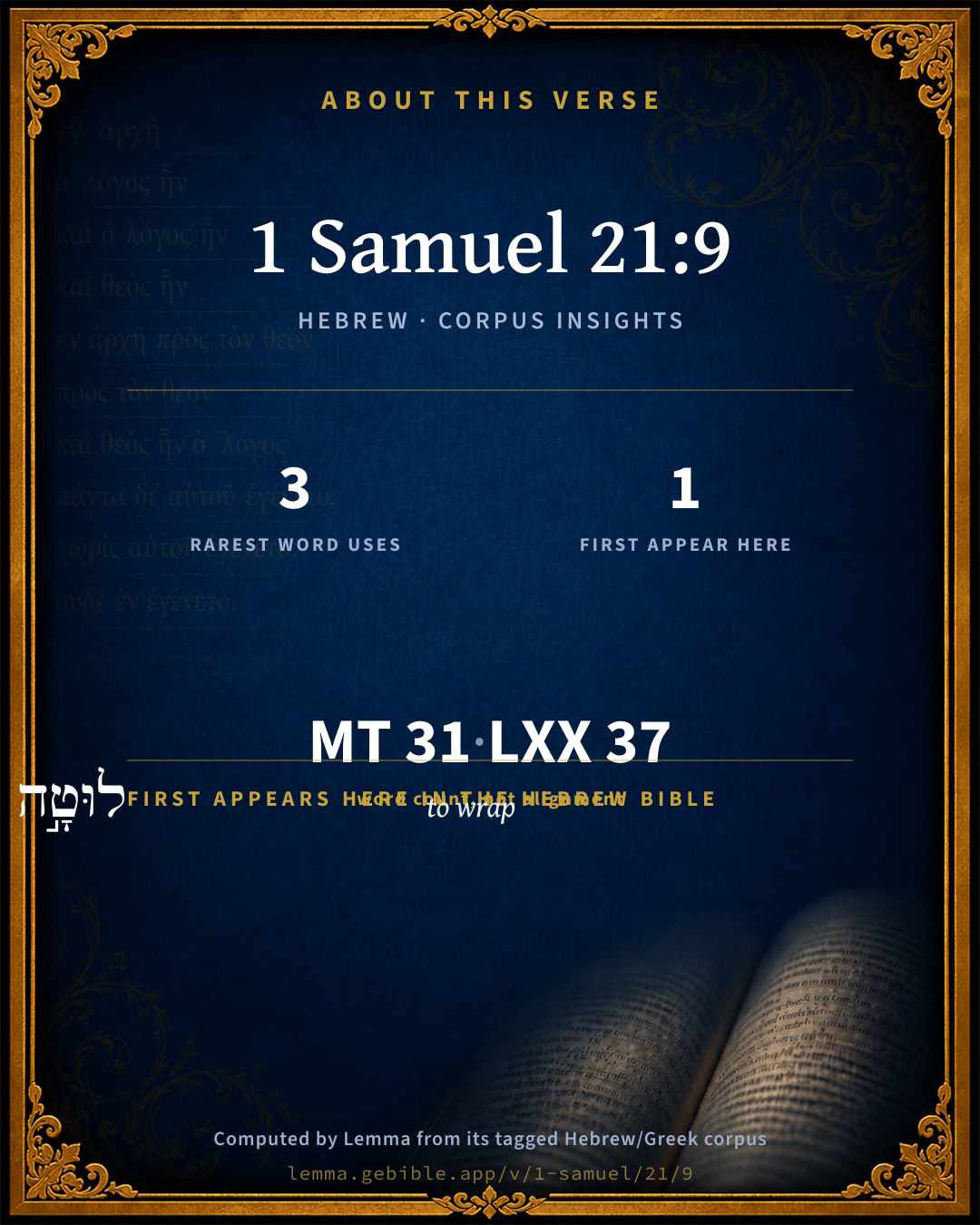
  • 1 first appearance in the Hebrew Bible
Full analysis ↓
Download a study sheet

One document with this verse’s original text, its word-by-word gloss line, the meaning frame, cross-references with their text, attributed commentary, and full source and license credits — printable, and it pastes into notes with its structure intact.

This verse Autodidact and up

Study sheet (.html) Plain text (.txt)

A passage Seminary Student

Up to 50 verses in one chapter. A passage sheet keeps up to 6 commentary sources and 12 cross-references per verse, in the order this page ranks them, and says so on the sheet whenever that leaves anything out. Ask for a single verse and you get the Autodidact verse sheet above.

Everything on this page stays free to read, with no account — the sheet is a download of what is already on screen, not access to it.

Want to remove ads? Support Godless Engineer
Compare translations 3

The same verse in 3 English versions, stacked beneath the original-language interlinear above. Click any original word for its lexicon entry.

Each is an independent rendering of the whole verse — the interlinear is not word-aligned to these translations.

Highlighted words mark where these versions differ — a whole-verse word diff, not a word-by-word alignment.

  • World English Bible Public Domain
    The priest said, The sword of Goliath the Philistine, whom you killed in the valley of Elah, behold, it is here wrapped in a cloth behind the ephod: if you will take that, take it; for there is no other except that here. David said, There is none like that; give it me.
  • King James Version Public Domain
    And the priest said, The sword of Goliath the Philistine, whom thou slewest in the valley of Elah, behold, it is here wrapped in a cloth behind the ephod: if thou wilt take that, take it: for there is no other save that here. And David said, There is none like that; give it me.
  • unfoldingWord Literal Text CC BY-SA 4.0
    And the priest said, “The sword of Goliath the Philistine, whom you struck in the Valley of Elah, behold, it wrapped in a cloak behind the ephod. If you would take it for yourself, take, for no other except it in this.” And David said, “ none like it. Give to me.”

unfoldingWord Literal Text — © unfoldingWord, licensed CC BY-SA 4.0. Word-aligned USFM3 via Door43 (git.door43.org/unfoldingWord/en_ult).

Versions to compare (up to 4)

3 of 4 selected

Show all 18 translations

Every available English version of this verse, each an independent rendering of the whole verse.

  • World English Bible Public Domain
    The priest said, The sword of Goliath the Philistine, whom you killed in the valley of Elah, behold, it is here wrapped in a cloth behind the ephod: if you will take that, take it; for there is no other except that here. David said, There is none like that; give it me.
  • Berean Standard Bible Public Domain
    The priest replied, “The sword of Goliath the Philistine, whom you killed in the Valley of Elah, is here; it is wrapped in a cloth behind the ephod. If you want, you may take it. For there is no other but this one.” And David said, “There is none like it; give it to me.”
  • Majority Standard Bible Public Domain
    The priest replied, “The sword of Goliath the Philistine, whom you killed in the Valley of Elah, is here; it is wrapped in a cloth behind the ephod. If you want, you may take it. For there is no other but this one here.” And David said, “There is none like it; give it to me.”
  • King James Version Public Domain
    And the priest said, The sword of Goliath the Philistine, whom thou slewest in the valley of Elah, behold, it is here wrapped in a cloth behind the ephod: if thou wilt take that, take it: for there is no other save that here. And David said, There is none like that; give it me.
  • American Standard Version (1901) Public Domain
    And the priest said, The sword of Goliath the Philistine, whom thou slewest in the vale of Elah, behold, it is here wrapped in a cloth behind the ephod: if thou wilt take that, take it; for there is no other save that here. And David said, There is none like that; give it me.
  • Revised Version (1885) Public Domain
    And the priest said, The sword of Goliath the Philistine, whom thou slowest in the vale of Elah, behold, it is here wrapped in a cloth behind the ephod: if thou wilt take that, take it: for there is no other save that here. And David said, There is none like that; give it me.
  • Geneva Bible (1599) Public Domain
    And the Priest said, The sword of Goliath the Philistim, whom thou slewest in the valley of Elah, behold, it is wrapt in a cloth behinde the Ephod: if thou wilt take that to thee, take it: for there is none other saue that here: And Dauid sayd, There is none to that, giue it me.
  • Douay-Rheims (1899) Public Domain
    And the priest said: Lo, here is the sword of Goliath the Philistine whom thou slewest in the valley of Terebinth, wrapped up in a cloth behind the ephod: if thou wilt take this, take it, for here is no other but this. And David said: There is none like that, give it me.
  • Young's Literal Translation Public Domain
    And the priest saith, `The sword of Goliath the Philistine, whom thou didst smite in the valley of Elah, lo, it is wrapt in a garment behind the ephod, if it thou dost take to thyself, take; for there is none other save it in this `place'.' And David saith, `There is none like it -- give it to me.'
  • Literal Standard Version CC BY-SA 4.0
    And the priest says, “The sword of Goliath the Philistine, whom you struck in the Valley of Elah, behold, it is wrapped in a garment behind the ephod, if you take it to yourself, take; for there is none other except it in this [place].” And David says, “There is none like it—give it to me.”
  • Unlocked Literal Bible CC BY-SA 4.0
    The priest said, “The sword of Goliath the Philistine, whom you killed in the Valley of Elah, is here wrapped in a cloth behind the ephod. If you want to take that, take it, for there is no other weapon here.” David said, “There is no other sword like that one; give it to me.”
  • unfoldingWord Literal Text CC BY-SA 4.0
    And the priest said, “The sword of Goliath the Philistine, whom you struck in the Valley of Elah, behold, it wrapped in a cloak behind the ephod. If you would take it for yourself, take, for no other except it in this.” And David said, “ none like it. Give to me.”
  • Darby Bible Public Domain
    And the priest said, The sword of Goliath the Philistine, whom thou slewest in the valley of terebinths, behold, it is here wrapped in a cloth behind the ephod; if thou wilt take that, take it; for there is no other save that here. And David said, There is none like that: give it me.
  • World Messianic Bible Public Domain
    The priest said, “Behold, the sword of Goliath the Philistine, whom you killed in the valley of Elah, is here wrapped in a cloth behind the ephod. If you would like to take that, take it, for there is no other except that here.” David said, “There is none like that. Give it to me.”
  • Webster's Bible Public Domain
    And the priest said, The sword of Goliath the Philistine, whom thou slewest in the valley of Elah, behold, it is here wrapped in a cloth behind the ephod: if thou wilt take that, take it: for there is no other save that here. And David said, There is none like that; give it to me.
  • Free Bible Version CC BY-SA 4.0
    The priest replied, “The sword of Goliath the Philistine is here—the one you killed in the Valley of Elah. It's wrapped in a cloth behind the ephod. You can take it if you want. It's the only one here.” “It's better than any other sword! Please give it to me,” David replied.
  • Bible in Basic English Public Domain
    And the priest said, The sword of Goliath the Philistine, whom you put to death in the valley of Elah, is here folded in a cloth at the back of the ephod: take that, if you will, for there is no other sword here. And David said, there is no other sword like that; give it to me.
  • JPS Tanakh (1917) Public Domain
    (21-10) And the priest said: 'The sword of Goliath the Philistine, whom thou slewest in the vale of Elah, behold, it is here wrapped in a cloth behind the ephod; if thou wilt take that, take it; for there is no other save that here.' And David said: 'There is none like that; give it me.'

Literal Standard Version (2020), Covenant Press — licensed CC BY-SA 4.0. Text via the HelloAO Bible API (eBible.org). Unlocked Literal Bible (unfoldingWord) — licensed CC BY-SA 4.0. Text via the HelloAO Bible API (eBible.org). unfoldingWord Literal Text — © unfoldingWord, licensed CC BY-SA 4.0. Word-aligned USFM3 via Door43 (git.door43.org/unfoldingWord/en_ult). Free Bible Version, Dr. Jonathan Gallagher — licensed CC BY-SA 4.0. Text via the HelloAO Bible API (eBible.org).

Word by word

More ways to search: Search by grammar → Find every occurrence → Compare this word →

Practice this passage: Drill this verse → Learn its vocabulary →

לוּטָ֣ה
lûwṭ
H3874
“wrapped”
Verb, Qal, Participle Passive, Feminine, Singular, Absolute
Part of Speech
Verb
Stem
Qal
Form
Participle Passive
Gender
Feminine
Number
Singular
State
Absolute
Full BDB Definition

Origin: a primitive root

TWOT: 1092

to wrap closely or tightly, enwrap, envelop - (Qal) to wrap tightly - (Hiphil) to envelop, wrap
  1. וַיֹּ֣אמֶר ʼâmar H559 “and · to say” Conjunction + Verb, Qal, Sequential Imperfect, 3rd Person, Masculine, Singular
  2. הַכֹּהֵ֗ן kôhên H3548 “the · priest” Particle, Definite Article + Noun, Common, Masculine, Singular, Absolute
  3. חֶרֶב֩ chereb H2719 “sword of” Noun, Common, Feminine, Singular, Construct
  4. גָּלְיָ֨ת Golyath H1555 “Goliath” Noun, Proper
  5. הַפְּלִשְׁתִּ֜י Pᵉlishtîy H6430 “the · Philistine” Particle, Definite Article + Noun, Gentilic, Masculine, Singular, Absolute
  6. אֲשֶׁר ʼăsher H834 “which” Particle, Relative
  7. הִכִּ֣יתָ nâkâh H5221 “to strike” Verb, Hiphil, Perfect, 2nd Person, Masculine, Singular
  8. בְּעֵ֣מֶק ʻêmeq H6010 “in/at · valley of” Preposition + Noun, Common, Masculine, Singular, Construct
  9. הָאֵלָ֗ה ʼÊlâh H425 “Elah” Noun, Proper
  10. הִנֵּה hinnêh H2009 “behold” Particle, Demonstrative
  11. הִ֞יא hûwʼ H1931 “he” Pronoun, Personal, 3rd Person, Feminine, Singular
  12. בַשִּׂמְלָה֮ simlâh H8071 “in/at the · garment” Preposition, Determined + Noun, Common, Feminine, Singular, Absolute
  13. אַחֲרֵ֣י ʼachar H310 “after” Preposition
  14. הָאֵפוֹד֒ ʼêphôwd H646 “the · ephod” Particle, Definite Article + Noun, Common, Masculine, Singular, Absolute
  15. אִם ʼim H518 “if” Conjunction
  16. אֹתָ֤הּ ʼêth H853 “- · her” Particle, Direct Object + Suffix, Personal, 3rd Person, Feminine, Singular
  17. תִּֽקַּח lâqach H3947 “to take” Verb, Qal, Imperfect, 2nd Person, Masculine, Singular
  18. קָ֔ח lâqach H3947 “take” Verb, Qal, Imperative, 2nd Person, Masculine, Singular
  19. כִּ֣י kîy H3588 “that” Conjunction
  20. אֵ֥ין ʼayin H369 “nothing” Particle, Negative
  21. אַחֶ֛רֶת ʼachêr H312 “other” Adjective, Adjective, Feminine, Singular, Absolute
  22. זוּלָתָ֖הּ zûwlâh H2108 “except · her” Preposition + Suffix, Personal, 3rd Person, Feminine, Singular
  23. בָּזֶ֑ה zeh H2088 “in/at · this” Preposition + Pronoun, Demonstrative, Masculine, Singular
  24. וַיֹּ֧אמֶר ʼâmar H559 “and · to say” Conjunction + Verb, Qal, Sequential Imperfect, 3rd Person, Masculine, Singular
  25. דָּוִ֛ד Dâvid H1732 “David” Noun, Proper
  26. אֵ֥ין ʼayin H369 “nothing” Particle, Negative
  27. כָּמ֖וֹהָ kᵉmôw H3644 “like · her” Preposition + Suffix, Personal, 3rd Person, Feminine, Singular
  28. תְּנֶ֥נָּה nâthan H5414 “give · her” Verb, Qal, Imperative, 2nd Person, Masculine, Singular + Suffix, Personal, 3rd Person, Feminine, Singular

About this verse

These counts appear in no published source. They are computed here, from the morphology-tagged text and Lemma’s own curated glosses. What Lemma adds →

31
words
26
distinct lemmas
Historical
section

Notable vocabulary

The rarest word here is לוּטָ֣ה to wrap H3874 — appearing just 3 times in the whole Hebrew Bible.

First appearance in Scripture

This word makes its first canonical appearance in the Hebrew Bible here:

  • לוּטָ֣ה to wrap H3874

Shared distinctive vocabulary

לוּטָ֣ה to wrap H3874 occurs in 3 verses of the Hebrew Bible. Also found in:

Grammatical profile

  • 7 verbs
  • 9 nouns
  • 1 adjective
  • 2 pronouns
  • 5 prepositions
  • 2 conjunctions
  • 5 particles

Verb forms

  • וַיֹּ֣אמֶר Qal · Sequential Imperfect
  • הִכִּ֣יתָ Hiphil · Perfect
  • לוּטָ֣ה Qal · Participle Passive
  • תִּֽקַּח Qal · Imperfect
  • קָ֔ח Qal · Imperative
  • וַיֹּ֧אמֶר Qal · Sequential Imperfect
  • תְּנֶ֥נָּה Qal · Imperative

Repetition

Words recur within this verse — often emphatic in Hebrew:

  • וַיֹּ֣אמֶר to say H559 ×2
  • תִּֽקַּח to take H3947 ×2
  • אֵ֥ין nothing H369 ×2

Hebrew & Septuagint length

In English translation the verse runs 53 words from the Hebrew and 55 from the Septuagint (LXX English) — closely comparable.

A rough comparison of the two English renderings, which tokenize alike — not a word-level alignment.

Word counts can differ between the Hebrew and the Greek without any difference in meaning — e.g. the Hebrew direct-object marker אֵת has no separate Greek word, and Greek often adds the article ὁ.

In the original languages it is 31 Hebrew tokens and 37 Greek tokens — but the two are counted differently (Hebrew bundles its prefixes and suffixes into one token; the Greek is in lemma form), so that isn’t a like-for-like length.

Cross-references

4

Topical passages linked to 1 Samuel 21:9 in the Treasury of Scripture Knowledge — connected by theme and wording, ordered by reader-vote popularity; previews shown in the World English Bible.

  • 1 Samuel 17:2 Saul and the men of Israel were gathered together, and encamped in the valley of Elah, and set the battle in array against the Philistines.
  • Exodus 28:6–14 "They shall make the ephod of gold, of blue, and purple, scarlet, and fine twined linen, the work of the skillful workman.
  • 1 Samuel 17:50–54 So David prevailed over the Philistine with a sling and with a stone, and struck the Philistine, and killed him; but there was no sword in the hand of David.
  • 1 Samuel 31:10 They put his armor in the house of the Ashtaroth; and they fastened his body to the wall of Beth-shan.

Cross-references courtesy of OpenBible.info (CC BY 4.0).

Hebrew and Greek witnesses Masoretic Hebrew ↔ Greek Septuagint

The same verse in the two great witnesses to the Old Testament, shown verse-for-verse.

These are two independent witnesses, not word-aligned to each other, and the Septuagint is shown in lemma (dictionary) form.

Hebrew 1 Samuel 21:9 Masoretic · Westminster Leningrad Codex

וַיֹּ֣אמֶר הַכֹּהֵ֗ן חֶרֶב֩ גָּלְיָ֨ת הַפְּלִשְׁתִּ֜י אֲשֶׁר הִכִּ֣יתָ בְּעֵ֣מֶק הָאֵלָ֗ה הִנֵּה הִ֞יא לוּטָ֣ה בַשִּׂמְלָה֮ אַחֲרֵ֣י הָאֵפוֹד֒ אִם אֹתָ֤הּ תִּֽקַּח לְךָ֙ קָ֔ח כִּ֣י אֵ֥ין אַחֶ֛רֶת זוּלָתָ֖הּ בָּזֶ֑ה וַיֹּ֧אמֶר דָּוִ֛ד אֵ֥ין כָּמ֖וֹהָ תְּנֶ֥נָּה לִּֽי

The priest said, The sword of Goliath the Philistine, whom you killed in the valley of Elah, behold, it is here wrapped in a cloth behind the ephod: if you will take that, take it; for there is no other except that here. David said, There is none like that; give it me.

World English Bible · Public Domain

Greek LXX 1 Samuel 21:9 Septuagint · lemma form

καί εἶπον δαυίδ πρός αβιμελεχ ὁράω εἰ εἰμί ἐνταῦθα ὑπό ὁ χείρ σύ δόρυ ἤ ῥομφαία ὅτι ὁ ῥομφαία ἐγώ καί ὁ σκεῦος οὐ λαμβάνω ἐν ὁ χείρ ἐγώ ὅτι εἰμί ὁ ῥῆμα ὁ βασιλεύς κατά σπουδή

And the priest said, Behold the sword of Goliath the Philistine, whom you struck in the valley of Ela; and it is wrapped in a cloth: if you will take it, take it for yourself, for there is no other except it here. And David said, Behold, there is none like it; give it me.

LXX2012 (modern English Septuagint) · Public Domain

On this verse, Ellicott's Commentary for English Readers discusses the Septuagint’s reading. Read the note in Commentary ↓

Hebrew: Westminster Leningrad Codex (CC BY 4.0). Greek: Septuagint (public domain); English from LXX2012 (modern English Septuagint) (Public Domain). How the Septuagint differs from the Hebrew →

Targum (Aramaic paraphrase)

1

The Targum is the ancient Jewish Aramaic paraphrase of the Hebrew Scriptures — an interpretive translation, not the Hebrew text itself. Onkelos (literal) and Pseudo-Jonathan (expansive) render the Torah, and Jonathan the Prophets. Coverage is partial: where no permissively-licensed English translation exists for a verse, only the Aramaic is shown. This is verse-level text, not a word-by-word alignment to the Hebrew.

  1. Targum Jonathan Prophets (Joshua–Malachi)
    וַאֲמַר דָוִד לַאֲחִימֶלֶךְ אִלוּ אִית כָּא תְּחוֹת יְדָךְ מוּרְנִיתָא אוֹ חַרְבָּא אֲרֵי אַף חַרְבִּי וְאַף מָנֵי לָא נַסְבֵית בִּידִי אֲרֵי הֲוָה פִּתְגַם מַלְכָּא בִּבְהִילוּ:

    (no public-domain English translation for this verse)

    Targum Jonathan — Aramaic: “Mikraot Gedolot” (public domain). English: “Sefaria Community Translation” (CC0 1.0 (public-domain dedication)); “London "Chaldee Paraphrase," 1871” (public domain). Text via Sefaria.

Commentary

Notes on 1 Samuel 21:9 from classic Christian and Jewish commentators (each source and its license shown beneath its notes). The classic Christian expositions comment on the surrounding passage and are grouped to its opening verse, so a note may address several verses; the Jewish commentaries on the Tanakh (Rashi and others) are per-verse, so they appear only where the commentator wrote on this verse.

Lemma curates 59 commentaries, every one of them public domain or Creative Commons licensed, each selected and text-cleaned for this edition rather than reprinted as found. About our sources →

Jamieson, Fausset & Brown

Robert Jamieson, A. R. Fausset & David Brown

HE TAKES GOLIATH'S SWORD. (Sa1 21:9)

sword of Goliath--(See on Sa1 17:54).

behind the ephod--in the place allowed for keeping the sacred vestments, of which the ephod is mentioned as the chief. The giant's sword was deposited in that safe custody as a memorial of the divine goodness in delivering Israel.

There is none like that--not only for its size and superior temper, but for its being a pledge of the divine favor to him, and a constant stimulus to his faith.

Jamieson, Fausset & Brown — Commentary Critical and Explanatory on the Whole Bible (1871) — public domain (CC PDM 1.0). Text via the HelloAO Bible API.

Trapp's Complete Commentary

John Trapp

1Sa 21:9 And the priest said, The sword of Goliath the Philistine, whom thou slewest in the valley of Elah, behold, it [is here] wrapped in a cloth behind the ephod: if thou wilt take that, take [it]: for [there is] no other save that here. And David said, [There is] none like that; give it me.

Ver. 9. And the priest said, The sword of Goliath.] This priest had no other weapon: the high priest of Rome is a great warrior: professeth to hold both the swords: and is herein the picture and successor of Timotheus Herulus, that warlike bishop of Alexandria, A.D. 467.

Wrapped in a cloth behind the ephod,] i.e., Behind the vestry, or priest’s wardrobe; kept there for a monument of that famous victory; dedicated by David, and therefore some {a} think, neither lawful nor fit for him, being to go among the Philistines, who could not but know it. But necessity hath no law; and why he desired it, see on 1Sa 21:8.

There is none like that.] Say we so of the sword of the Spirit, the word, when preached especially. As milk warmed is fitter for nourishment, and as the rain from heaven hath a fatness with it, and a special influence more than standing waters: so there is not that life, operation, and blessing in the word read as preached.

{a} Pellican.

John Trapp, A Commentary or Exposition upon All the Books of the Old and New Testament (1647–1656) — public domain. Text from a community e-Sword module.

The Biblical Illustrator

Joseph S. Exell

1Sa_21:9

And David said, There is none like that: give it me.

Goliaths sword

I. First, then, the history of Goliaths sword. See it, in the first instance, hanging at the giants side. The man himself is mighty. Hark how he challenges the hosts of Israel. The after history of this sword is interesting. What became of it after David, having no sword of his own, put it to the giants throat and cut off his head with it? It was Goliaths no longer; it was Davids, really. It is evident that he was not content to have it ornamenting his own residence--he would give it to the Lord. He found it in his heart to hang the sword in the Holy Place, that God might have the glory. What happened next? Why, long afterwards, when David wanted a sword, God gave this very weapon back to him. Nobody is ever the poorer for lending to the Lord. God gave the sword back to David in the hour of his extremity. Now I want to say to you, surely you remember some great deliverance of days gone by. You remember the weapons with which God enabled you to carve your way through obstacles which you supposed must overwhelm you. You are getting into a tight place again, are you? Well, call to mind the previous experience; grasp the old sword, and trust the same, unchanging God. Use the promise that helped you out before.

II. But we shall, I hope, get still further blessing when we think of this sword from a spiritual point of view. These things may well be called an allegory. The war is still waging. The Philistine is still in the land. And what is Davids sword? The sword is Gods Word, Divine Truth, the Gospel of the Grace of God. The Word of God is quick and powerful, sharper than any two-edged sword, piercing even to the dividing asunder of soul and spirit, and of the joints and marrow, and is a discerner of the thoughts and intents of the heart. We do not want another weapon. There is nothing to induce us to try another. We have watched the others trying them. They have had such poor success that it makes us the more content with the old Jerusalem blade. (Thomas Spurgeon.)

Tried Weapons

We propose to treat this text with special reference to the sword of the Spirit, which is the Word of God.

1. There is none like it for variety of adaptation.

2. As for argument, where can we find a blade more keenly argumentative?

3. I would impress all young readers with the comprehensiveness of the Bible, with its universality of adaptation to all the circumstances and necessities of human life.

4. There is none like it for ease of carriage. There are weapons that are very difficult to carry, but the sword of the Lord is not one of them.

5. There is none like it for universality of use. Children and sick persons can use it; the poorest man can avail himself of it; the busiest man may find a moment for its exercise.

6. The sick can use this sword of the Lord. (J. Parker, D. D.)

The Biblical Illustrator, edited by Joseph S. Exell (c. 1880s–1900s) — public domain. Text from a community e-Sword module.

Tyndale Open Study Notes

Tyndale Open Resources

21:9 The sword of Goliath, which David used to decapitate the giant (17:51), had been taken as war spoils, as had Goliath’s head (17:54). • The ephod mentioned here might not have been the priestly garment of the same name; some passages give the impression that an ephod could also be a statue (Judg 8:27; 18:17).

Tyndale Open Study Notes — © Tyndale Open Resources, licensed CC BY-SA 4.0. Text via the HelloAO Bible API.

Geneva Bible (1599)

Geneva Bible translators

Behind that place, where the high Priest’s garment lay.

Geneva Bible (1599) marginal notes — public domain. Text via Bolls.life.

Adam Clarke's Commentary

Verse 9. The sword of Goliath] It has already been conjectured (see 1Sa 17:1-58) that the sword of Goliath was laid up as a trophy in the tabernacle.

Adam Clarke's Commentary on the Bible (1810–1826) — public domain. Text from a community e-Sword/MySword module.

Ellicott's Commentary for English Readers

(9) The sword of Goliath the Philistine.—It was in safe guardianship, that trusty sword of the mightiest of the Philistines, stained perhaps with the blood of the brave but unworthy priests, Hophni and Phineas, the sons of Eli, whom Goliath was believed to have slain in the fatal battle when the Ark was taken, and the power of Israel shattered for many a long year. It was wrapped up and lying in a place of honour behind the sacred ephod with the Urim and Thummim—wrapped up, it has been suggested, in the blood-stained war cloak of the dead Philistine, for the word translated “cloth” is used in Isa_9:5 of military attire.

Give it me.—David grasped the sword with a childlike expression of joy; its sight and touch revived the old bright faith and the sure trust in the strength of Israel on which he leaned when, as a boy, he fought with the wild beasts which infested the wild pasture-lands where he kept his father’s flocks (the Shepherd of David was the Holy One; blessed be He.—Midrash Rabbah, 59), and which guided his trembling hand the day he slew the giant in the face of the watching hosts. The sight and touch of the glorious trophy revived the old sure trust which in these dark days of betrayal and persecution was beginning to fail that gallant spirit of David’s. It does not appear from the story that the Philistine’s sword was of extraordinary size; that it was a tried weapon of approved temper and strength is certain, but its chief preciousness consisted, of course, in its storied associations. The Dean of Canterbury suggests it was probably of the ordinary pattern imported from Greece. The LXX. adds here, “and he gave it to him.”

A Bible Commentary for English Readers, edited by Charles John Ellicott (1878–1897) — public domain. Text from a community e-Sword module.

The Cambridge Bible for Schools and Colleges

gen. ed. J. J. S. Perowne

9. behind the ephod] Hung up in a secure place, behind the most sacred part of the high-priestly vestments. It was probably dedicated as a memorial of the victory on the conclusion of the Philistine war. See 1Sa_17:54.

There is none like that] The monument of God’s deliverance in the past was a pledge of His help for the future.

The Cambridge Bible for Schools and Colleges (gen. ed. J. J. S. Perowne; Cambridge University Press, 1878–1918) — public domain. Text from a community e-Sword module.

John Gill's Exposition

And the priest said, the sword of Goliath the Philistine, whom thou slewest in the valley of Elah,.... See Sa1 17:2,

behold, it is here wrapped in a cloth behind the ephod; the garment of the high priest, in which were the Urim and Thummim, and the breastplate, or the linen vestments of the priests; see Sa1 22:18; which were laid up in a chamber for their use; and behind them the sword of Goliath was wrapped up in a linen cloth, and reserved as a monument of the goodness of God to Israel, and the salvation of them wrought by the hands of David, who slew Goliath with this his own sword, and brought it with him. The Targum understands this word, rendered "behind", not of the place where the sword was, but of the time when the priest said this, and paraphrases the words,"after he had inquired for him by the ephod;''see Sa1 22:10,

if thou wilt take that, take it; as if he should say, it is not mine to give thee, but thou mayest take it if thou pleasest; none has a better right to it; it is what thou tookest from the Philistine, and may take it again for thy use if thou art so inclined; and thou must either take this or none:

for there is no other save that here; in the tabernacle, nor even in the priest's house, nor in the city; for it was a city of priests, who did not wear swords:

and David said, there is none like that, give it me; and which, as he was capable of wielding and making use of, as it is plain he was by cutting off Goliath's head with it; so it might serve to strengthen his faith in God, as often as he looked upon it, that he would keep and preserve him, and in due time deliver him out of the hands of Saul, and all his enemies.

John Gill's Exposition of the Whole Bible (1746–1763) — public domain (CC PDM 1.0). Text via the HelloAO Bible API.

Albert Barnes' Notes on the Bible

Wrapped in a cloth behind the ephod - Rather, “in the cloak,” Goliath’s military cloak, which was part of the dedicated trophy. The ephod was naturally hung up where the high priest alone could get at it.

Albert Barnes' Notes on the Bible (1834–1885) — public domain. Text from a community e-Sword/MySword module.

Haydock's Catholic Bible Commentary

This. Chaldean observes, he gave this sword "after he had consulted the Lord with the ephod." In a just war, the ornaments of the temples may be used. Pro republic i plerumque templa nudantur. (Seneca) (Grotius, Jur. iii. 5, 2.) (Calmet) --- Tostatus believes that David would restore this sword, as soon as he had procured other arms.

George Leo Haydock (1774–1849), Haydock's Catholic Family Bible and Commentary, 1859 edition — public domain. Excludes Psalms (Douay-Rheims chapter numbering differs from Protestant) and Deuterocanonical books (Catholic canon only).

Matthew Poole's English Annotations

Behind the ephod, i.e. behind that holy place allotted for the keeping of the sacred or priestly garments; all which are here comprehended under the ephod; which, as the chief of the kind, is put for all the rest. Here it was laid up as a sacred monument of God’s power and goodness, and that famous victory, related 1Sa 17.

There is none like that; because it not only served him for his use, for he was a strong and tall man, and one that could wield that sword, as we saw, 1Sa 17, but was also a pledge of God’s favour to him, and a great encouragement to his faith.

Matthew Poole's English Annotations on the Holy Bible (1683–1685) — public domain. Text from a community e-Sword/MySword module.

Whedon's Commentary on the Bible

Daniel D. Whedon

9. Wrapped in a cloth behind the ephod — It is probable that, after he had exhibited Goliath’s sword at his own home, (1Sa_17:54,) David had it deposited in the sanctuary as a dedicatory offering. Here it had now been hanging many years, carefully kept behind the high priest’s shoulder-dress. David now thought that he might justly claim it as his own. Ahimelech’s allowing him to take it was construed by Doeg as further evidence of collusion between them.

Daniel D. Whedon (gen. ed.), Commentary on the Old and New Testaments (1874–1909) — public domain. Text from a community e-Sword module.

John Wesley's Explanatory Notes

Ephod - That is, behind that holy place allotted for the keeping of the sacred, or priestly garments; all which are here comprehended under the ephod; which, as the chief is put for all the rest. Here it was laid up as a sacred monument of God's power and goodness. None like it - Because it not only served him for his use, for he was a strong and tall man, and one that could wield that sword, but was also a pledge of God's favour to him. Whenever be looked upon it, it would be a support to his faith, by reminding him of what God had already done.

John Wesley, Explanatory Notes Upon the Whole Bible (1754–1765) — public domain. Text via the GEBible commentary corpus.

Rashi

Rabbi Shlomo Yitzchaki (Rashi)

Perhaps you have in your possession. And if there is here.

Urgent. Hurried.

Rashi on the Tanakh — English translations: “The Judaica Press complete Tanach with Rashi, translated by A. J. Rosenberg” (CC BY 4.0); “Pentateuch with Rashi's commentary by M. Rosenbaum and A.M. Silbermann, 1929-1934” (public domain); “The Metsudah Tanach series, Lakewood, N.J” (CC BY 4.0); and “The Book of Joshua, Metsudah Publications, 1997” (CC BY 4.0). Text via Sefaria.

Lesson kit

Teaching starters — assembled from the data on this page, not authored interpretation. Every prompt links to the verse data it draws on. Edit before teaching.

1 Samuel, in the Historical, opens this verse with 31 words (26 distinct Hebrew lemmas). Its most distinctive word is lûwṭ (“to wrap”). A historical commentator’s framing appears above. Read the whole chapter for the surrounding context.

Discussion questions

  1. What does “to wrap” (lûwṭ) contribute to the verse as a whole?
  2. The word “to wrap” first appears here in Scripture. What is being introduced at this debut?
  3. 1 Kings 19:13 shares the word «to wrap» with this verse. How do the two illuminate each other?
  4. “to say” occurs 2× in this one verse. What is the effect of the repetition?
  5. The translations on this page render this verse differently — a whole-verse word diff, not a word-by-word alignment. What might account for the different wordings?
  6. The verb «וַיֹּ֣אמֶר» is Qal Sequential Imperfect. How does its form color the action?
  7. Reading how Jamieson, Fausset & Brown and Trapp's Complete Commentary read this verse, where do the two commentators agree and where do they part?

Things to notice

Reading settings

Reading text

Shown beneath each verse's original-language words.

Old Testament
Old Testament edition

Read the OT as the Masoretic Hebrew (MT) or the Greek Septuagint (LXX).

English shown for the Greek Septuagint (in the Hebrew ↔ Greek comparison).

Comparing translations? Open the Compare panel on any verse page to stack up to four side by side.