
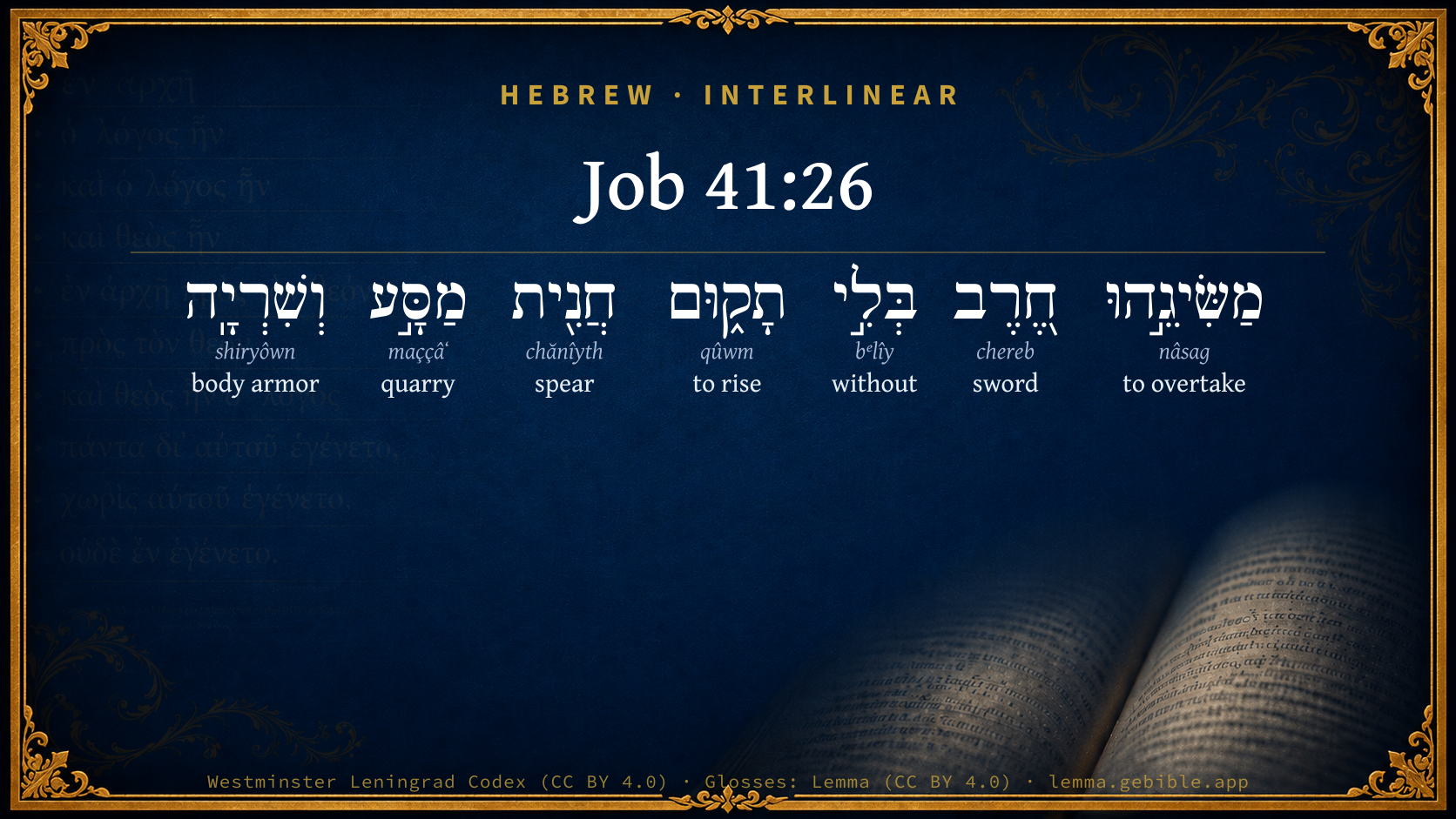
Job 41:26

Hebrew (Westminster Leningrad Codex) Job 41:26 appears in the Hebrew Old Testament. The text above is from the Westminster Leningrad Codex. Each word links to its Strong’s number, a concise gloss, and parsing drawn from the Open Scriptures Hebrew Bible morphology. Click any word for its full Brown-Driver-Briggs (BDB) entry.
Download image
Cite this verse

Job 41:26 (World English Bible). Public Domain. Lemma interlinear Bible study tool, https://lemma.gebible.app/v/job/41/26.

Show BibTeX & RIS
BibTeX
RIS
English Translation
If one lay at him with the sword, it can't avail; Nor the spear, the dart, nor the pointed shaft.
World English Bible · Public Domain
Download a study sheet

One document with this verse’s original text, its word-by-word gloss line, the meaning frame, cross-references with their text, attributed commentary, and full source and license credits — printable, and it pastes into notes with its structure intact.

This verse Autodidact and up

Study sheet (.html) Plain text (.txt)

A passage Seminary Student

Up to 50 verses in one chapter. A passage sheet keeps up to 6 commentary sources and 12 cross-references per verse, in the order this page ranks them, and says so on the sheet whenever that leaves anything out. Ask for a single verse and you get the Autodidact verse sheet above.

Everything on this page stays free to read, with no account — the sheet is a download of what is already on screen, not access to it.

Want to remove ads? Support Godless Engineer
Compare translations 3

The same verse in 3 English versions, stacked beneath the original-language interlinear above. Click any original word for its lexicon entry.

Each is an independent rendering of the whole verse — the interlinear is not word-aligned to these translations.

Highlighted words mark where these versions differ — a whole-verse word diff, not a word-by-word alignment.

  • World English Bible Public Domain
    If one lay at him with the sword, it can't avail; Nor the spear, the dart, nor the pointed shaft.
  • King James Version Public Domain
    The sword of him that layeth at him cannot hold: the spear, the dart, nor the habergeon.
  • unfoldingWord Literal Text CC BY-SA 4.0
    The sword reaching it does not stand; the spear, the dart, the javelin.

unfoldingWord Literal Text — © unfoldingWord, licensed CC BY-SA 4.0. Word-aligned USFM3 via Door43 (git.door43.org/unfoldingWord/en_ult).

Versions to compare (up to 4)

3 of 4 selected

Show all 14 translations

Every available English version of this verse, each an independent rendering of the whole verse.

  • World English Bible Public Domain
    If one lay at him with the sword, it can't avail; Nor the spear, the dart, nor the pointed shaft.
  • Berean Standard Bible Public Domain
    The sword that reaches him has no effect, nor does the spear or dart or arrow.
  • Majority Standard Bible Public Domain
    The sword that reaches him has no effect, nor does the spear or dart or arrow.
  • King James Version Public Domain
    The sword of him that layeth at him cannot hold: the spear, the dart, nor the habergeon.
  • American Standard Version (1901) Public Domain
    If one lay at him with the sword, it cannot avail; Nor the spear, the dart, nor the pointed shaft.
  • Revised Version (1885) Public Domain
    If one lay at him with the sword, it cannot avail; nor the spear, the dart, nor the pointed shaft.
  • Young's Literal Translation Public Domain
    The sword of his overtaker standeth not, Spear -- dart -- and lance.
  • Literal Standard Version CC BY-SA 4.0
    The sword of his overtaker does not stand, || Spear, dart, and breastplate.
  • Unlocked Literal Bible CC BY-SA 4.0
    If a sword strikes him, it does nothing— and neither does a spear, an arrow, or any other pointed weapon.
  • unfoldingWord Literal Text CC BY-SA 4.0
    The sword reaching it does not stand; the spear, the dart, the javelin.
  • Darby Bible Public Domain
    If any reach him with a sword, it cannot hold; neither spear, nor dart, nor harpoon.
  • World Messianic Bible Public Domain
    If one attacks him with the sword, it can’t prevail; nor the spear, the dart, nor the pointed shaft.
  • Free Bible Version CC BY-SA 4.0
    Swords just bounce off it, as do spears, darts, and javelins.
  • JPS Tanakh (1917) Public Domain
    (41-18) If one lay at him with the sword, it will not hold; nor the spear, the dart, nor the pointed shaft.

Literal Standard Version (2020), Covenant Press — licensed CC BY-SA 4.0. Text via the HelloAO Bible API (eBible.org). Unlocked Literal Bible (unfoldingWord) — licensed CC BY-SA 4.0. Text via the HelloAO Bible API (eBible.org). unfoldingWord Literal Text — © unfoldingWord, licensed CC BY-SA 4.0. Word-aligned USFM3 via Door43 (git.door43.org/unfoldingWord/en_ult). Free Bible Version, Dr. Jonathan Gallagher — licensed CC BY-SA 4.0. Text via the HelloAO Bible API (eBible.org).

Word by word

More ways to search: Search by grammar → Find every occurrence → Compare this word →

Practice this passage: Drill this verse → Learn its vocabulary →

About this verse

These counts appear in no published source. They are computed here, from the morphology-tagged text and Lemma’s own curated glosses. What Lemma adds →

7
words
7
distinct lemmas
Wisdom
section

Notable vocabulary

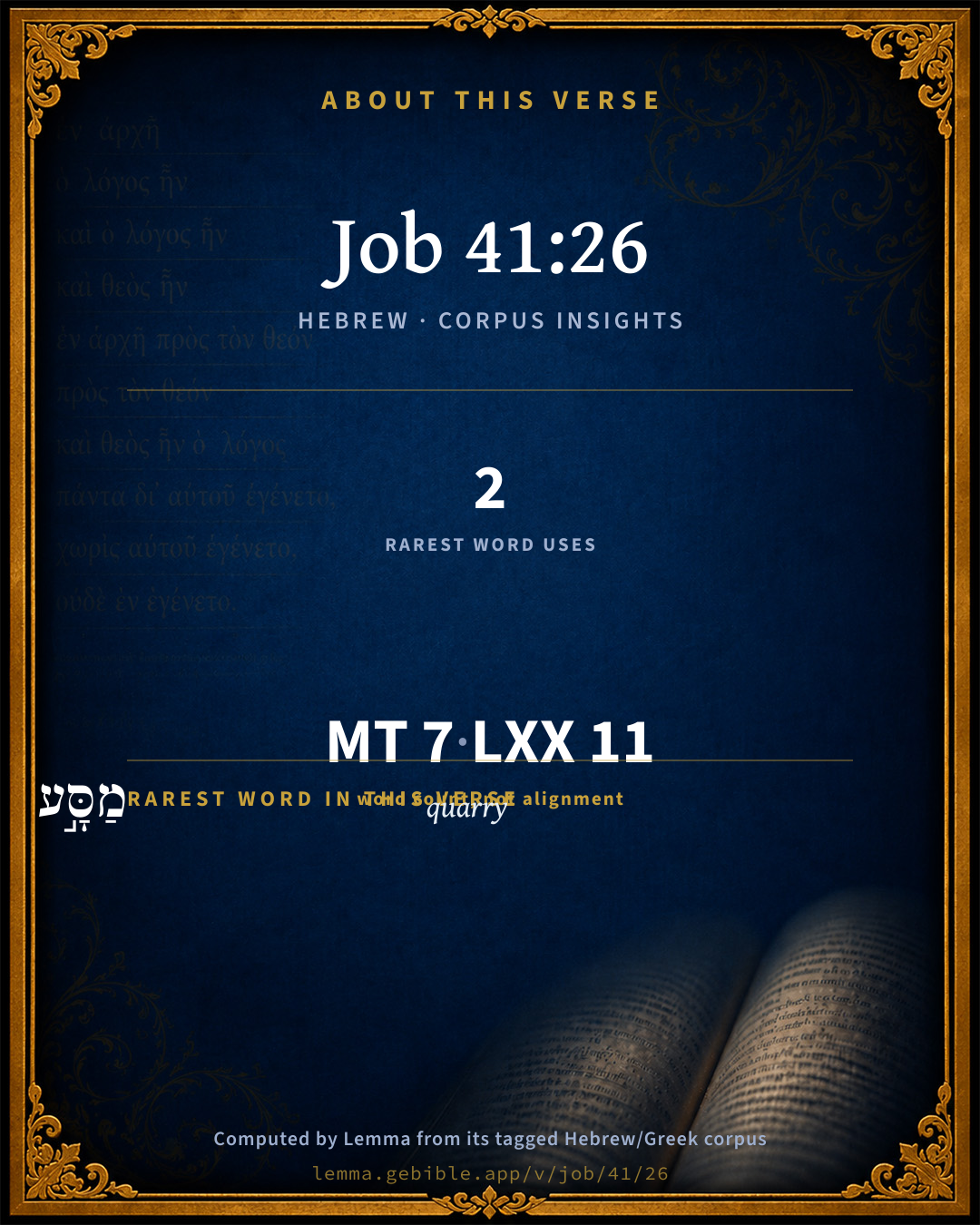
The rarest word here is מַסָּ֣ע quarry H4551 — appearing just 2 times in the whole Hebrew Bible.

Shared distinctive vocabulary

מַסָּ֣ע quarry H4551 occurs in 2 verses of the Hebrew Bible. Also found in:

Grammatical profile

  • 2 verbs
  • 4 nouns
  • 1 particle

Verb forms

  • מַשִּׂיגֵ֣הוּ Hiphil · Participle Active
  • תָק֑וּם Qal · Imperfect

Hebrew & Septuagint length

In the original languages it is 7 Hebrew tokens and 11 Greek tokens — but the two are counted differently (Hebrew bundles its prefixes and suffixes into one token; the Greek is in lemma form), so that isn’t a like-for-like length.

Cross-references

1

Topical passages linked to Job 41:26 in the Treasury of Scripture Knowledge — connected by theme and wording, ordered by reader-vote popularity; previews shown in the World English Bible.

  • Job 39:21–24 He paws in the valley, and rejoices in his strength: He goes out to meet the armed men.

Cross-references courtesy of OpenBible.info (CC BY 4.0).

Hebrew and Greek witnesses Masoretic Hebrew ↔ Greek Septuagint

The same verse in the two great witnesses to the Old Testament, shown verse-for-verse.

These are two independent witnesses, not word-aligned to each other, and the Septuagint is shown in lemma (dictionary) form.

Hebrew Job 41:26 Masoretic · Westminster Leningrad Codex

מַשִּׂיגֵ֣הוּ חֶ֭רֶב בְּלִ֣י תָק֑וּם חֲנִ֖ית מַסָּ֣ע וְשִׁרְיָֽה

If one lay at him with the sword, it can't avail; Nor the spear, the dart, nor the pointed shaft.

World English Bible · Public Domain

Greek LXX Job 41:26 Septuagint · lemma form

πᾶς ὑψηλός ὁράω αὐτός δέ βασιλεύς πᾶς ὁ ἐν ὁ ὕδωρ

No English rendering of this Greek verse — the small residue in the structurally divergent books.

On this verse, Albert Barnes' Notes on the Bible discusses the Septuagint’s reading. Read the note in Commentary ↓

Hebrew: Westminster Leningrad Codex (CC BY 4.0). Greek: Septuagint (public domain); English from a public-domain English Septuagint. How the Septuagint differs from the Hebrew →

Commentary

Notes on Job 41:26 from classic Christian and Jewish commentators (each source and its license shown beneath its notes). The classic Christian expositions comment on the surrounding passage and are grouped to its opening verse, so a note may address several verses; the Jewish commentaries on the Tanakh (Rashi and others) are per-verse, so they appear only where the commentator wrote on this verse.

Lemma curates 59 commentaries, every one of them public domain or Creative Commons licensed, each selected and text-cleaned for this edition rather than reprinted as found. About our sources →

Trapp's Complete Commentary

John Trapp

Job 41:26 The sword of him that layeth at him cannot hold: the spear, the dart, nor the habergeon.

Ver. 26. The sword of him that layeth at him cannot hold] So close are his scales, so thick his skin, that there is no wounding of him. There was not of old, it seemeth. But now there is a way found of shooting and piercing him, so that he dieth with a horrible noise and outcry.

Nor the habergeon] A defensive weapon will be as useless as those other offensive; for the whale will soon swallow up the armed as well as the unarmed.

John Trapp, A Commentary or Exposition upon All the Books of the Old and New Testament (1647–1656) — public domain. Text from a community e-Sword module.

Joseph Benson's Commentary

Job 41:26. The sword of him that layeth at him — That approacheth to him, and dares to strike at him; cannot hold — Hebrew, בלי תקום, beli takum, cannot stand. Either, 1st, Cannot endure the stroke, but will be broken by it; or, 2d, Cannot take hold of him, or abide fixed in him; but is instantly beaten back by the excessive hardness of his skin, which cannot be pierced by it. This also seems much better to agree to the crocodile, whose skin no sword, nor dart, nor (as some add) musket-ball can pierce, than to the whale, whose skin is easily pierced, as experience shows, except the whales here spoken of were of another kind than those we are acquainted with. Nor the habergeon — Hebrew, שׁריה, shirjah, which the margin of our Bible renders, breast-plate, and Ab. Ezra, a coat of mail, as the word means 1Sa 17:38. But Heath and Houbigant translate it here, the pike; and it evidently means some missile weapon.

Joseph Benson's Commentary on the Old and New Testaments (1811–1818) — public domain. Text from a community e-Sword module.

Jamieson, Fausset & Brown

Robert Jamieson, A. R. Fausset & David Brown

cannot hold--on his hard skin.

habergeon--coat of mail; avail must be taken by zeugma out of "hold," as the verb in the second clause: "hold" cannot apply to the "coat of mail."

Jamieson, Fausset & Brown — Commentary Critical and Explanatory on the Whole Bible (1871) — public domain (CC PDM 1.0). Text via the HelloAO Bible API.

Adam Clarke's Commentary

Verse 26. Habergeon.] The hauberk, the Norman armour for the head, neck, and breast, formed of rings. See on Ne 4:16.

Adam Clarke's Commentary on the Bible (1810–1826) — public domain. Text from a community e-Sword/MySword module.

Ellicott's Commentary for English Readers

(26) The sword of him that layeth at him.—Literally, As to one approaching him (to slay him), his sword cannot stand; it will snap in his hand.

A Bible Commentary for English Readers, edited by Charles John Ellicott (1878–1897) — public domain. Text from a community e-Sword module.

The Cambridge Bible for Schools and Colleges

gen. ed. J. J. S. Perowne

26. that layeth at him] That is, that striketh at him; lit. he that layeth at him with the sword,—it doth not hold. The sword does not hold, or bite, but glances off his adamantine armour.

the habergeon] That is, the mail. “And be ye apparelled or clothed, saith Paul, with the habergeon, or coat armour of justice,” Latimer, Serm. p. 29 (Wright, Bible Word-Book).

26–29. He can be subdued by no weapon.

The Cambridge Bible for Schools and Colleges (gen. ed. J. J. S. Perowne; Cambridge University Press, 1878–1918) — public domain. Text from a community e-Sword module.

John Gill's Exposition

He esteemeth iron as straw,.... You may as well cast a straw at him as a bar of iron; it will make no impression on his steeled back, which is as a coat of mail to him; so Eustathius affirms (d) that the sharpest iron is rebounded and blunted by him;

and brass as rotten wood; or steel, any instrument made of it, though ever so strong or piercing.

(d) Apud ibid. (Bochard. Hierozoic. par. 2. l. 5. c. 17. col. 785.)

John Gill's Exposition of the Whole Bible (1746–1763) — public domain (CC PDM 1.0). Text via the HelloAO Bible API.

Albert Barnes' Notes on the Bible

The sword of him that layeth at him - The word “sword” here (חרב chereb) means undoubtedly “harpoon,” or a sharp instrument by which an attempt is made to pierce the skin of the monster.

Cannot hold - That is, in the hard skin. It does not penetrate it.

The spear, the dart - These were doubtless often used in the attempt to take the animal. The meaning is, that “they” would not hold or stick to the animal. They flew off when hurled at him.

Nor the habergeon - Margin, “breastplate.” Noyes, “javelin.” Prof. Lee, “lance.” Vulgate, “thorax, breastplate.” So the Septuagint, θώρακα thōraka. The word used here (שׁריה shiryâh), the same as שׁריון shiryôn 1Sa 17:5, 1Sa 17:38; Neh 4:16; 2Ch 26:14, means properly a “coat of mail,” and is so called from its shining - from שׁרה shârâh, “to shine.” It is not used in the sense of spear or javelin elsewhere, though perhaps it may have that meaning here - denoting a “bright” or “shining” weapon. This agrees best with the connection.

Albert Barnes' Notes on the Bible (1834–1885) — public domain. Text from a community e-Sword/MySword module.

Matthew Poole's English Annotations

That layeth at him; that approacheth to him, and dare strike at him.

Cannot hold, Heb. cannot stand, i.e. either,

1. Cannot endure the stroke, but will be broken by it. Or rather,

2. Cannot abide or take hold of him, or be fixed in him; but is instantly beaten back by the excessive hardness of the skin, which cannot be pierced by it, as may be gathered from this and other passages before and after it. This also seems better to agree to the crocodile, whose skin no sword, nor dart, nor musket bullet (as others add) can pierce, than to the whale, whose skin is easily pierced, as experience showeth in our whales; except the whale here spoken of were of another kind, which is not impossible.

Nor the habergeon; or, breastplate. As offensive weapons cannot hurt him, so defensive weapons cannot secure a man from him. But men that go upon the design of taking either whales or crocodiles do not use to fortify themselves in that manner. Some therefore take this to be another offensive weapon, a kind of dart, as this word signifies in the Arabic language; which is but a dialect of the Hebrew, and from which the true signification of many Hebrew words must be gathered.

Matthew Poole's English Annotations on the Holy Bible (1683–1685) — public domain. Text from a community e-Sword/MySword module.

Whedon's Commentary on the Bible

Daniel D. Whedon

26. The sword of him that layeth at him, etc. — If one (literally, he who) reaches him with the sword.

Cannot hold — Literally, stand, stand fast, keep hold.

The spear — Hhanith, Delitzsch erroneously supposes to be the long lance, in contradistinction to the kidhon. See on Job_41:29. The dart — Massa’h, from nasa’h. “to move on,” “to hasten,” probably signified some missile. The Septuagint and Targum regard this and the preceding word as one, and render it “spear.”

The habergeon — French, haubergeon. The rendering of our Authorized Version answers to the hauberk, the old Norman armour for the neck, head, and breast, formed of rings. (Dr. Clarke.) The shiryah, of which the Hebrew speaks, was a coat of mail. (Furst.) Others suppose some kind of missile to be meant. “The poet means to say, the defensive weapons, also, are useless, and that the breastplate of the warrior affords no protection against the monster.” — Umbreit.

Daniel D. Whedon (gen. ed.), Commentary on the Old and New Testaments (1874–1909) — public domain. Text from a community e-Sword module.

The Pulpit Commentary

The sword of him that layeth at him cannot hold. It either makes no impression or it snaps in his hand. Equally vain are the spear, the dart, and the javelin. Habergeon is a mistranslation.

The Pulpit Commentary (1880–1919), ed. H.D.M. Spence-Jones & Joseph S. Exell — public domain. Text from a community e-Sword module.

John Wesley's Explanatory Notes

Hold - Hebrew. cannot stand, cannot endure the stroke, but will be broken by it. The crocodile's skin, no sword, nor dart, nor musquet bullet can pierce.

John Wesley, Explanatory Notes Upon the Whole Bible (1754–1765) — public domain. Text via the GEBible commentary corpus.

Keil & Delitzsch

C. F. Keil & F. Delitzsch

26 If one reacheth him with the sword-it doth not hold;

Neither spear, nor dart, nor harpoon.

27 He esteemeth iron as straw,

Brass as rotten wood.

28 The son of the bow doth not cause him to flee,

Sling stones are turned to stubble with him.

29 Clubs are counted as stubble,

And he laugheth at the shaking of the spear.

משּׂיגהוּ, which stands first as nom. abs., "one reaching him," is equivalent to, if one or whoever reaches him, Ew. 357, c, to which בּלי תקוּם, it does not hold fast (בּלי with v. fin., as Hos 8:7; Hos 9:16, Chethb), is the conclusion. חרב is instrumental, as Psa 17:13. מסּע, from נסע, Arab. nz‛, to move on, hasten on, signifies a missile, as Arab. minz‛a, an arrow, manz‛a, a sling. The Targ. supports this latter signification here (funda quae projicit lapidem); but since קלא, the handling, is mentioned separately, the word appears to men missiles in general, or the catapult. In this combination of weapons of attack it is very questionable whether שׁריה is a cognate form of שׁריון (שׁרין), a coat of mail; probably it is equivalent to Arab. sirwe (surwe), an arrow with a long broad edge (comp. serı̂je, a short, round, as it seems, pear-shaped arrow-head), therefore either a harpoon or a peculiarly formed dart.

(Note: On the various kinds of Egyptian arrows, vid., Klemm. Culturgeschichte, v. 371f.)

"The son of the bow" (and of the אשׁפּה, pharetra) is the arrow. That the ἁπ. γεγρ. תותח signifies a club (war-club), is supported by the Arab. watacha, to beat. כּידון, in distinction from חנית (a long lance), is a short spear, or rather, since רעשׁ implies a whistling motion, a javelin. Iron the crocodile esteems as תּבן, tibn, chopped straw; sling stones are turned with him into קשׁ. Such is the name here at least, not for stumps of cut stubble that remain standing, but the straw itself, threshed and easily driven before the wind (Job 13:25), which is cut up for provender (Exo 5:12), generally dried (and for that reason light) stalks (e.g., of grass), or even any remains of plants (e.g., splinters of wood).

(Note: The Egyptio-Arabic usage has here more faithfully preserved the ancient signification of the word (vid., Fleischer, Glossae, p. 37) than the Syro-Arabic; for in Syria cut but still unthreshed corn, whether lying in swaths out in the field and weighted with stones to protect it against the whirlwinds that are frequent about noon, or corn already brought to the threshing-floors but not yet threshed, is called qashsh. - Wetzst.)

The plur. נחשׁבוּ, Job 41:29, does not seem to be occasioned by תותח being conceived collectively, but by the fact that, instead of saying תותח וכידון, the poet has formed וכידון into a separate clause. Parchon's (and Kimchi's) reading תוחח is founded upon an error.

Keil & Delitzsch — Biblical Commentary on the Old Testament (1861–1891) — public domain (CC PDM 1.0). Text via the HelloAO Bible API. (Old Testament only.)

Scofield Reference Notes

C. I. Scofield

habergeon

Or, breastplate.

The Scofield Reference Bible (1917 edition), notes by C. I. Scofield — public domain. Text from a community e-Sword module.

Rashi

Rabbi Shlomo Yitzchaki (Rashi)

He looks at all high things All the high things in the world he sees beneath himself, for so is the custom of the world, that whoever stands above sees the one below more than the one below sees [him]. Also, the one below has no power or victory against the one above. Now this leviathan sees all mighty men; that is to say, they have no power against him.

he is king over all proud beasts This is a repeated expression. He looks over all proud beasts and he is king over all the proud beasts, over all haughty creatures that I created in My world, who have no rule or dominion against him. Now how did you dare to lift your head before Me, since I perform all these wonders?

Rashi on the Tanakh — English translations: “The Judaica Press complete Tanach with Rashi, translated by A. J. Rosenberg” (CC BY 4.0); “Pentateuch with Rashi's commentary by M. Rosenbaum and A.M. Silbermann, 1929-1934” (public domain); “The Metsudah Tanach series, Lakewood, N.J” (CC BY 4.0); and “The Book of Joshua, Metsudah Publications, 1997” (CC BY 4.0). Text via Sefaria.

Lesson kit

Teaching starters — assembled from the data on this page, not authored interpretation. Every prompt links to the verse data it draws on. Edit before teaching.

Job, in the Wisdom, opens this verse with 7 words (7 distinct Hebrew lemmas). Its most distinctive word is maççâʻ (“quarry”). A historical commentator’s framing appears above. Read the whole chapter for the surrounding context.

Discussion questions

  1. How does “quarry” (maççâʻ) shape what this verse is saying?
  2. 1 Kings 6:7 shares the word «quarry» with this verse. How do the two illuminate each other?
  3. The translations on this page render this verse differently — a whole-verse word diff, not a word-by-word alignment. What might account for the different wordings?
  4. The verb «מַשִּׂיגֵ֣הוּ» is Hiphil Participle Active. How does its form color the action?
  5. Reading how Trapp's Complete Commentary and Joseph Benson's Commentary read this verse, where do the two commentators agree and where do they part?

Things to notice

Reading settings

Reading text

Shown beneath each verse's original-language words.

Old Testament
Old Testament edition

Read the OT as the Masoretic Hebrew (MT) or the Greek Septuagint (LXX).

English shown for the Greek Septuagint (in the Hebrew ↔ Greek comparison).

Comparing translations? Open the Compare panel on any verse page to stack up to four side by side.