Numbers 19:16

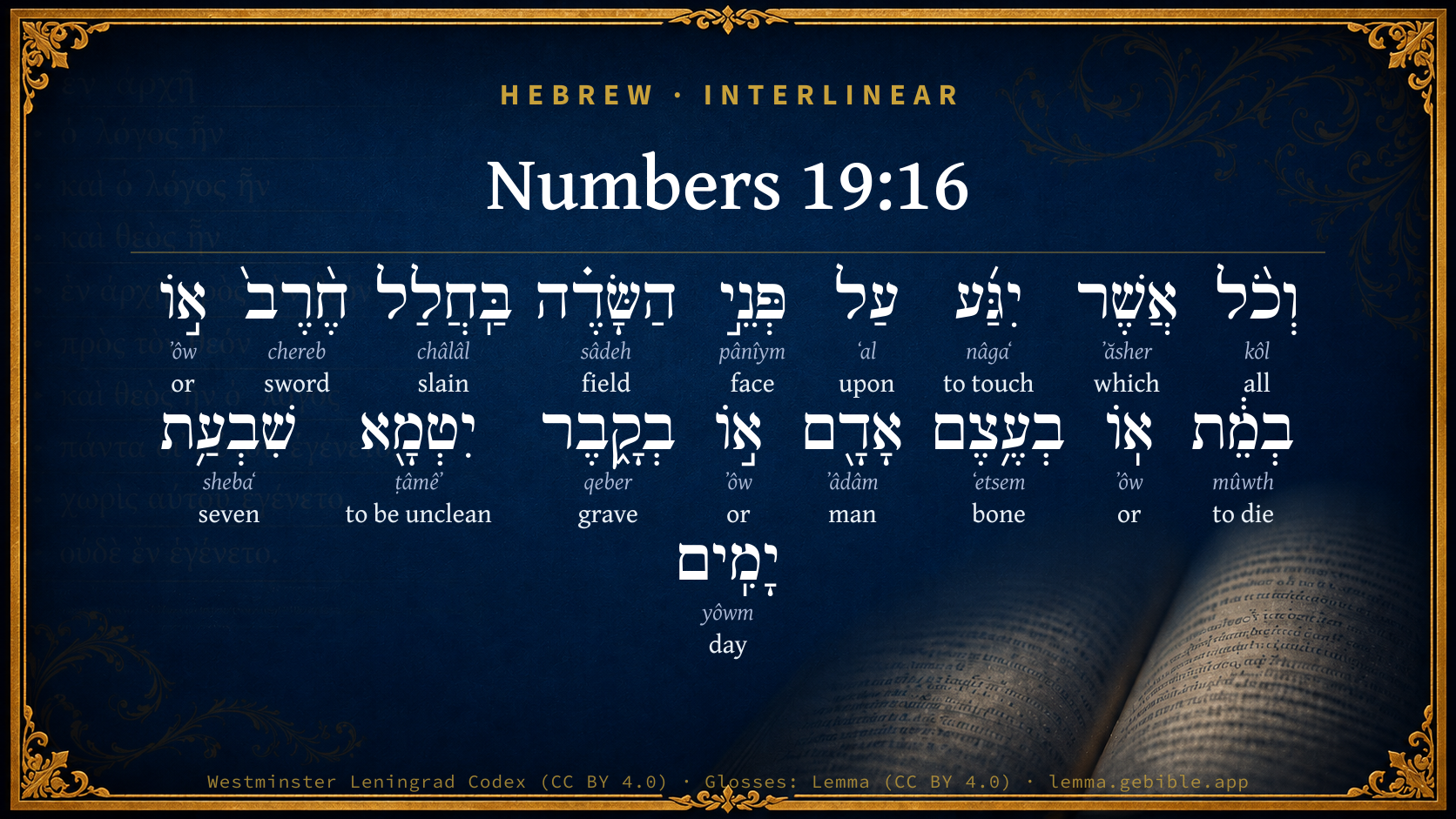
Hebrew (Westminster Leningrad Codex) Numbers 19:16 appears in the Hebrew Old Testament. The text above is from the Westminster Leningrad Codex. Each word links to its Strong’s number, a concise gloss, and parsing drawn from the Open Scriptures Hebrew Bible morphology. Click any word for its full Brown-Driver-Briggs (BDB) entry.
Download image
Cite this verse

Numbers 19:16 (World English Bible). Public Domain. Lemma interlinear Bible study tool, https://lemma.gebible.app/v/numbers/19/16.

Show BibTeX & RIS
BibTeX
RIS
English Translation
Whoever in the open field touches one who is slain with a sword, or a dead body, or a bone of a man, or a grave, shall be unclean seven days.
World English Bible · Public Domain
Download a study sheet

One document with this verse’s original text, its word-by-word gloss line, the meaning frame, cross-references with their text, attributed commentary, and full source and license credits — printable, and it pastes into notes with its structure intact.

This verse Autodidact and up

Study sheet (.html) Plain text (.txt)

A passage Seminary Student

Up to 50 verses in one chapter. A passage sheet keeps up to 6 commentary sources and 12 cross-references per verse, in the order this page ranks them, and says so on the sheet whenever that leaves anything out. Ask for a single verse and you get the Autodidact verse sheet above.

Everything on this page stays free to read, with no account — the sheet is a download of what is already on screen, not access to it.

Want to remove ads? Support Godless Engineer
Compare translations 3

The same verse in 3 English versions, stacked beneath the original-language interlinear above. Click any original word for its lexicon entry.

Each is an independent rendering of the whole verse — the interlinear is not word-aligned to these translations.

Highlighted words mark where these versions differ — a whole-verse word diff, not a word-by-word alignment.

  • World English Bible Public Domain
    Whoever in the open field touches one who is slain with a sword, or a dead body, or a bone of a man, or a grave, shall be unclean seven days.
  • King James Version Public Domain
    And whosoever toucheth one that is slain with a sword in the open fields, or a dead body, or a bone of a man, or a grave, shall be unclean seven days.
  • unfoldingWord Literal Text CC BY-SA 4.0
    And everyone who touches on the face of the field one slain of the sword or a dead or a bone of a man or a grave shall be unclean seven days.

unfoldingWord Literal Text — © unfoldingWord, licensed CC BY-SA 4.0. Word-aligned USFM3 via Door43 (git.door43.org/unfoldingWord/en_ult).

Versions to compare (up to 4)

3 of 4 selected

Show all 18 translations

Every available English version of this verse, each an independent rendering of the whole verse.

  • World English Bible Public Domain
    Whoever in the open field touches one who is slain with a sword, or a dead body, or a bone of a man, or a grave, shall be unclean seven days.
  • Berean Standard Bible Public Domain
    Anyone in the open field who touches someone who has been killed by the sword or has died of natural causes, or anyone who touches a human bone or a grave, will be unclean for seven days.
  • Majority Standard Bible Public Domain
    Anyone in the open field who touches someone who has been killed by the sword or has died of natural causes, or anyone who touches a human bone or a grave, will be unclean for seven days.
  • King James Version Public Domain
    And whosoever toucheth one that is slain with a sword in the open fields, or a dead body, or a bone of a man, or a grave, shall be unclean seven days.
  • American Standard Version (1901) Public Domain
    And whosoever in the open field toucheth one that is slain with a sword, or a dead body, or a bone of a man, or a grave, shall be unclean seven days.
  • Revised Version (1885) Public Domain
    And whosoever in the open field toucheth one that is slain with a sword, or a dead body, or a bone of a man, or a grave, shall be unclean seven days.
  • Geneva Bible (1599) Public Domain
    Also whosoeuer toucheth one that is slaine with a sworde in the fielde, or a dead person, or a bone of a dead man, or a graue, shall be vncleane seuen dayes.
  • Douay-Rheims (1899) Public Domain
    If any man in the field touch the corpse of a man that was slain, or that died of himself, or his bone, or his grave, he shall be unclean seven days.
  • Young's Literal Translation Public Domain
    `And every one who cometh, on the face of the field, against the pierced of a sword, or against the dead, or against a bone of man, or against a grave, is unclean seven days;
  • Literal Standard Version CC BY-SA 4.0
    And everyone on the face of the field who comes against the pierced of a sword, or against the dead, or against a bone of man, or against a grave, is unclean [for] seven days;
  • Unlocked Literal Bible CC BY-SA 4.0
    Similarly, anyone outside a tent who touches someone who has been killed with a sword, any other dead body, a human bone, or a grave—that person will be unclean for seven days.
  • unfoldingWord Literal Text CC BY-SA 4.0
    And everyone who touches on the face of the field one slain of the sword or a dead or a bone of a man or a grave shall be unclean seven days.
  • Darby Bible Public Domain
    And every one that toucheth one that is slain with a sword in the open fields, or a dead person, or the bone of a man, or a grave, shall be unclean seven days.
  • World Messianic Bible Public Domain
    “Whoever in the open field touches one who is slain with a sword, or a dead body, or a bone of a man, or a grave, shall be unclean seven days.
  • Webster's Bible Public Domain
    And whoever toucheth one that is slain with a sword in the open fields, or a dead body, or a bone of a man, or a grave, shall be unclean seven days.
  • Free Bible Version CC BY-SA 4.0
    If you're out in the open and you touch someone who has been killed by the sword or who has died naturally, or if you touch a human bone or a grave, then you'll be unclean for seven days.
  • Bible in Basic English Public Domain
    And anyone touching one who has been put to death with the sword in the open country, or the body of one who has come to his end by a natural death, or a man's bone, or the resting-place of a dead body, will be unclean for seven days.
  • JPS Tanakh (1917) Public Domain
    And whosoever in the open field toucheth one that is slain with a sword, or one that dieth of himself, or a bone of a man, or a grave, shall be unclean seven days.

Literal Standard Version (2020), Covenant Press — licensed CC BY-SA 4.0. Text via the HelloAO Bible API (eBible.org). Unlocked Literal Bible (unfoldingWord) — licensed CC BY-SA 4.0. Text via the HelloAO Bible API (eBible.org). unfoldingWord Literal Text — © unfoldingWord, licensed CC BY-SA 4.0. Word-aligned USFM3 via Door43 (git.door43.org/unfoldingWord/en_ult). Free Bible Version, Dr. Jonathan Gallagher — licensed CC BY-SA 4.0. Text via the HelloAO Bible API (eBible.org).

Word by word

More ways to search: Search by grammar → Find every occurrence → Compare this word →

Practice this passage: Drill this verse → Learn its vocabulary →

בְקָ֑בֶר
qeber
H6913
“in/at · grave”
Preposition + Noun, Common, Masculine, Singular, Absolute
Part of Speech
Preposition + Noun
Type
Common
Gender
Masculine
Number
Singular
State
Absolute
Full BDB Definition

Origin: from H6912

TWOT: 1984a

grave, sepulchre, tomb
  1. וְכֹ֨ל kôl H3605 “and · all” Conjunction + Noun, Common, Masculine, Singular, Absolute
  2. אֲשֶׁר ʼăsher H834 “which” Particle, Relative
  3. יִגַּ֜ע nâgaʻ H5060 “to touch” Verb, Qal, Imperfect, 3rd Person, Masculine, Singular
  4. עַל ʻal H5921 “upon” Preposition
  5. פְּנֵ֣י pânîym H6440 “face(s) of” Noun, Common, Both, Plural, Construct
  6. הַשָּׂדֶ֗ה sâdeh H7704 “the · field” Particle, Definite Article + Noun, Common, Masculine, Singular, Absolute
  7. בַּֽחֲלַל châlâl H2491 “in/at · slain of” Preposition + Adjective, Adjective, Masculine, Singular, Construct
  8. חֶ֨רֶב֙ chereb H2719 “sword” Noun, Common, Feminine, Singular, Absolute
  9. א֣וֹ ʼôw H176 “or” Conjunction
  10. בְמֵ֔ת mûwth H4191 “in/at · dying” Preposition + Verb, Qal, Participle Active, Masculine, Singular, Absolute
  11. אֽוֹ ʼôw H176 “or” Conjunction
  12. בְעֶ֥צֶם ʻetsem H6106 “in/at · bone of” Preposition + Noun, Common, Feminine, Singular, Construct
  13. אָדָ֖ם ʼâdâm H120 “man” Noun, Common, Masculine, Singular, Absolute
  14. א֣וֹ ʼôw H176 “or” Conjunction
  15. יִטְמָ֖א ṭâmêʼ H2930 “to be unclean” Verb, Qal, Imperfect, 3rd Person, Masculine, Singular
  16. שִׁבְעַ֥ת shebaʻ H7651 “seven” Adjective, Cardinal number, Masculine, Singular, Construct
  17. יָמִֽים yôwm H3117 “days” Noun, Common, Masculine, Plural, Absolute

About this verse

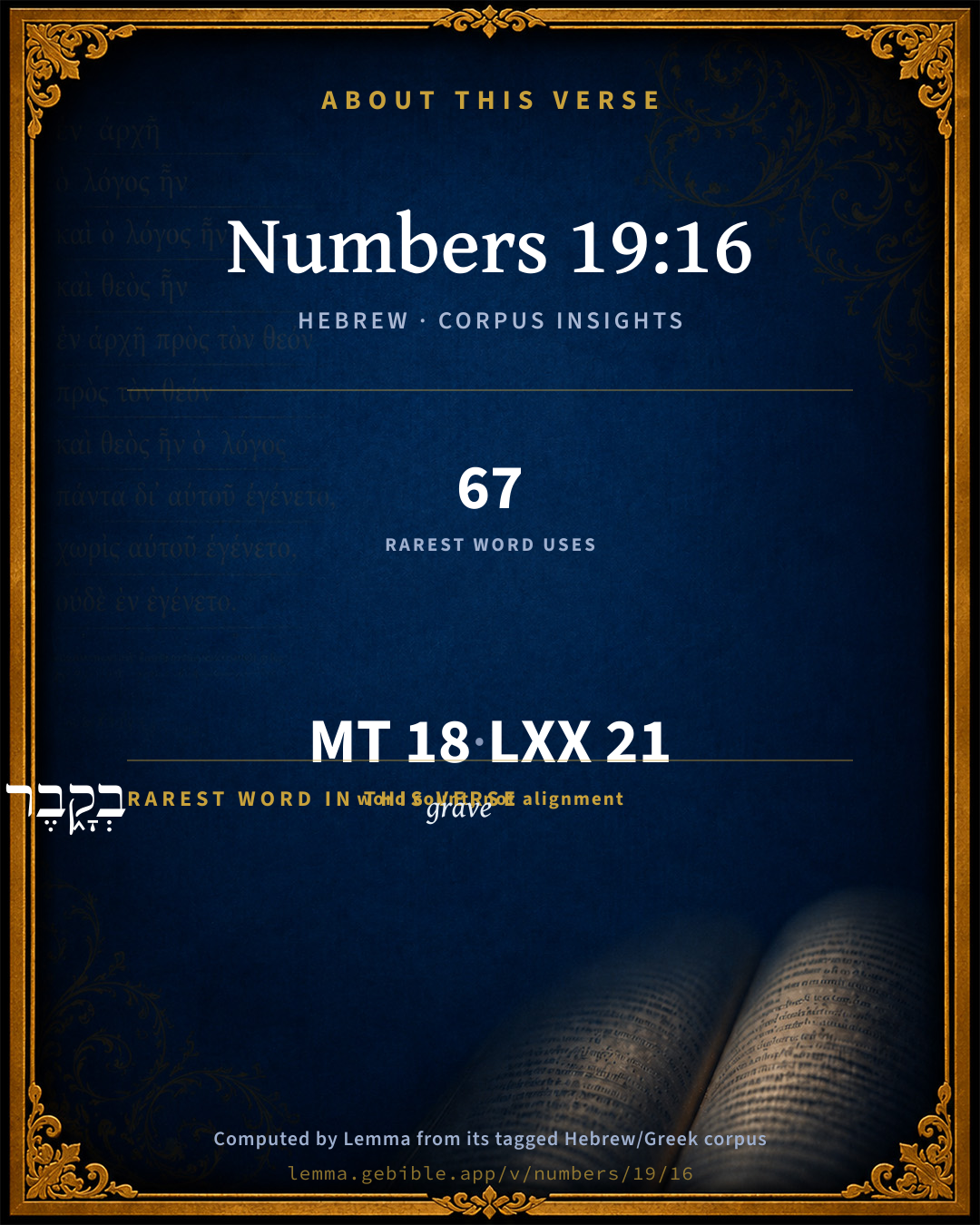
These counts appear in no published source. They are computed here, from the morphology-tagged text and Lemma’s own curated glosses. What Lemma adds →

18
words
16
distinct lemmas
Pentateuch
section

Grammatical profile

  • 3 verbs
  • 8 nouns
  • 2 adjectives
  • 1 preposition
  • 3 conjunctions
  • 1 particle

Verb forms

  • יִגַּ֜ע Qal · Imperfect
  • בְמֵ֔ת Qal · Participle Active
  • יִטְמָ֖א Qal · Imperfect

Repetition

A word recurs within this verse — often emphatic in Hebrew:

  • א֣וֹ or H176 ×3

Hebrew & Septuagint length

In English translation the verse runs 31 words from the Hebrew and 24 from the Septuagint (LXX English) — closely comparable.

A rough comparison of the two English renderings, which tokenize alike — not a word-level alignment.

Word counts can differ between the Hebrew and the Greek without any difference in meaning — e.g. the Hebrew direct-object marker אֵת has no separate Greek word, and Greek often adds the article ὁ.

In the original languages it is 18 Hebrew tokens and 21 Greek tokens — but the two are counted differently (Hebrew bundles its prefixes and suffixes into one token; the Greek is in lemma form), so that isn’t a like-for-like length.

Cross-references

5

Topical passages linked to Numbers 19:16 in the Treasury of Scripture Knowledge — connected by theme and wording, ordered by reader-vote popularity; previews shown in the World English Bible.

  • Numbers 31:19 Encamp you outside of the camp seven days: whoever has killed any person, and whoever has touched any slain, purify yourselves on the third day and on the seventh day, you and your captives.
  • Matthew 23:27 "Woe to you, scribes and Pharisees, hypocrites! For you are like whitened tombs, which outwardly appear beautiful, but inwardly are full of dead men's bones, and of all uncleanness.
  • Numbers 19:11 He who touches the dead body of any man shall be unclean seven days:
  • Luke 11:44 Woe to you, scribes and Pharisees, hypocrites! For you are like hidden graves, and the men who walk over them don't know it."
  • Ezekiel 39:11–16 It shall happen in that day, that I will give to Gog a place for burial in Israel, the valley of those who pass through on the east of the sea; and it shall stop those who pass through: and there shall they bury Gog and all his multitude; and they shall call it The valley of Hamon Gog.

Cross-references courtesy of OpenBible.info (CC BY 4.0).

Hebrew and Greek witnesses Masoretic Hebrew ↔ Greek Septuagint

The same verse in the two great witnesses to the Old Testament, shown verse-for-verse.

These are two independent witnesses, not word-aligned to each other, and the Septuagint is shown in lemma (dictionary) form.

Hebrew Numbers 19:16 Masoretic · Westminster Leningrad Codex

וְכֹ֨ל אֲשֶׁר יִגַּ֜ע עַל פְּנֵ֣י הַשָּׂדֶ֗ה בַּֽחֲלַל חֶ֨רֶב֙ א֣וֹ בְמֵ֔ת אֽוֹ בְעֶ֥צֶם אָדָ֖ם א֣וֹ בְקָ֑בֶר יִטְמָ֖א שִׁבְעַ֥ת יָמִֽים

Whoever in the open field touches one who is slain with a sword, or a dead body, or a bone of a man, or a grave, shall be unclean seven days.

World English Bible · Public Domain

Greek LXX Numbers 19:16 Septuagint · lemma form

καί πᾶς ὅς ἐάν ἅπτομαι ἐπί πρόσωπον ὁ πεδίον τραυματίας ἤ νεκρός ἤ ὀστέον ἀνθρώπινος ἤ μνῆμα ἑπτά ἡμέρα ἀκάθαρτος εἰμί

And every one who shall touch a man slain by violence, or a corpse, or human bone, or sepulchre, shall be unclean seven days.

LXX2012 (modern English Septuagint) · Public Domain

Hebrew: Westminster Leningrad Codex (CC BY 4.0). Greek: Septuagint (public domain); English from LXX2012 (modern English Septuagint) (Public Domain). How the Septuagint differs from the Hebrew →

Targum (Aramaic paraphrase)

2

The Targum is the ancient Jewish Aramaic paraphrase of the Hebrew Scriptures — an interpretive translation, not the Hebrew text itself. Onkelos (literal) and Pseudo-Jonathan (expansive) render the Torah, and Jonathan the Prophets. Coverage is partial: where no permissively-licensed English translation exists for a verse, only the Aramaic is shown. This is verse-level text, not a word-by-word alignment to the Hebrew.

  1. Targum Onkelos Torah (Genesis–Deuteronomy)
    וְכֹל דִי יִקְרַב עַל אַפֵּי חַקְלָא בִּקְטֵל חַרְבָּא אוֹ בְמִיתָא אוֹ בְגַרְמָא דֶאֱנָשָׁא אוֹ בְקִבְרָא יְהֵי מְסָאָב שַׁבְעָא יוֹמִין

    (no public-domain English translation for this verse)

    Targum Onkelos — Aramaic: “Onkelos Genesis” (public domain); “Onkelos Exodus” (public domain); “Onkelos Leviticus” (public domain); “Onkelos Numbers” (public domain); “Onkelos Deuteronomy” (public domain). English: “Sefaria Community Translation” (CC0 1.0 (public-domain dedication)); “J.W. Etheridge. The Targums of Onkelos and Jonathan Ben Uzziel on the Pentateuch. London: Longmans, Green, 1862” (public domain). Text via Sefaria.

  2. Targum Pseudo-Jonathan Torah (Genesis–Deuteronomy)
    וְכָל מַאן דְמִקְרַב עַל אַנְפֵּי בָרָא וְלָא בְּמִיתָא דְבִכְרֵיסָא דְאִמֵיהּ בִּקְטוֹל סַיְיפָא אוֹ בְּסַיְיפָא דְקָטִיל בֵּיהּ אוֹ בִּשְׁכִיבָא שְׁלֵימָא וַאֲפִילוּ בְּגַרְמֵיהּ כְּשַעַרְתָּא אוֹ בְגַרְמָא דְאֵינָשָׁא חַיָא דְפָרַשׁ מִנֵיהּ אוֹ בִּקְבוּרְתָּא וְגוֹלְלָא וְדוֹפְקָא יְהֵי מְסָאָב שׁוּבְעָא יוֹמִין

    And whoever shall touch not one who hath died in his mother's womb, but who hath been slain with the sword on the face of the field, or the sword with which he was slain, or the dead man himself, or a bone of his, or the hair, or the bone of a living man which hath been separated from him, or a grave, or a shroud, or the bier, shall be unclean seven days.

    Targum Pseudo-Jonathan — Aramaic: “Targum Jonathan on Genesis” (public domain); “Targum Jonathan on Exodus” (public domain); “Targum Jonathan on Leviticus” (public domain); “Targum Jonathan on Numbers” (public domain); “Targum Jonathan on Deuteronomy” (public domain). English: “The Targum of Jonathan ben Uzziel, trans. J. W. Etheridge, London, 1862” (public domain). Text via Sefaria.

Commentary

Notes on Numbers 19:16 from classic Christian and Jewish commentators (each source and its license shown beneath its notes). The classic Christian expositions comment on the surrounding passage and are grouped to its opening verse, so a note may address several verses; the Jewish commentaries on the Tanakh (Rashi and others) are per-verse, so they appear only where the commentator wrote on this verse.

Lemma curates 59 commentaries, every one of them public domain or Creative Commons licensed, each selected and text-cleaned for this edition rather than reprinted as found. About our sources →

Trapp's Complete Commentary

John Trapp

Num 19:16 And whosoever toucheth one that is slain with a sword in the open fields, or a dead body, or a bone of a man, or a grave, shall be unclean seven days.

Ver. 16. Shall be unclean seven days.] {See Trapp on "Lev 11:31"}

John Trapp, A Commentary or Exposition upon All the Books of the Old and New Testament (1647–1656) — public domain. Text from a community e-Sword module.

Joseph Benson's Commentary

Num 19:16-17. With a sword — Or by any other violent way. Running water — Waters flowing from a spring or river, which are the purest. These manifestly signify God’s Spirit, which is oft compared to water, and by which alone, through the sacrifice of Christ, true purification is obtained. Those who promise themselves benefit by the righteousness of Christ, while they submit not to the influence of his Spirit, do but deceive themselves, for they cannot be purified by the ashes, otherwise than in the running water.

Joseph Benson's Commentary on the Old and New Testaments (1811–1818) — public domain. Text from a community e-Sword module.

The Cambridge Bible for Schools and Colleges

gen. ed. J. J. S. Perowne

16. or a grave] The thought of defilement from unwitting contact with a grave underlies our Lord’s denunciation of the Pharisees in Luk_11:44.

The Cambridge Bible for Schools and Colleges (gen. ed. J. J. S. Perowne; Cambridge University Press, 1878–1918) — public domain. Text from a community e-Sword module.

John Gill's Exposition

And whosoever toucheth one that is slain with a sword in the open fields,.... That is killed by another, that dies a violent death, either by the sword or other means; one that touched such an one was unclean, or that touched the sword with which he was slain, as the Targum of Jonathan adds: "or a dead body": that dies a natural death, or suddenly, or in any way:

or a bone off a man; dug out of a grave, and lying by itself:

or a grave; the Targum adds, either the covering or side of a grave:

shall be unclean seven days; all which has respect to the defiling nature of sin, which is the cause of death and the grave.

John Gill's Exposition of the Whole Bible (1746–1763) — public domain (CC PDM 1.0). Text via the HelloAO Bible API.

Haydock's Catholic Bible Commentary

Grave. The Hebrews buried it at a distance from towns, and set up some mark to apprise all people, that they might not be defiled for seven days. (Calmet)

George Leo Haydock (1774–1849), Haydock's Catholic Family Bible and Commentary, 1859 edition — public domain. Excludes Psalms (Douay-Rheims chapter numbering differs from Protestant) and Deuterocanonical books (Catholic canon only).

Matthew Poole's English Annotations

With a sword, or by any other violent way.

Matthew Poole's English Annotations on the Holy Bible (1683–1685) — public domain. Text from a community e-Sword/MySword module.

Whedon's Commentary on the Bible

Daniel D. Whedon

16. A bone — Hence the requirement in Eze_39:15, was a safeguard against personal defilement.

A grave — This elucidates Mat_23:27.

Daniel D. Whedon (gen. ed.), Commentary on the Old and New Testaments (1874–1909) — public domain. Text from a community e-Sword module.

The Pulpit Commentary

One that is slain with a sword. This would apply especially, it would seem, to the field of battle; but the law must certainly have been relaxed in the case of soldiers. Or a bone of a man, or a grave. Thus the defilement was extended to the mouldering remains of humanity, anti even to the tombs (mnhmata . Cf. Luk_11:44) which held them.

The Pulpit Commentary (1880–1919), ed. H.D.M. Spence-Jones & Joseph S. Exell — public domain. Text from a community e-Sword module.

John Wesley's Explanatory Notes

With a sword - Or by any other violent way.

John Wesley, Explanatory Notes Upon the Whole Bible (1754–1765) — public domain. Text via the GEBible commentary corpus.

Rashi

Rabbi Shlomo Yitzchaki (Rashi)

על פני השדה [AND EVERYTHING WHICH TOUCHES] ON THE OPEN FIELD — Our Rabbis explained that this is intended to include the upper board and the side board of a coffin (which were on the surface of the field — that these, too, render a person unclean) (Chullin 72a). The literal meaning of the words על פני השדה is, however, that even where there is no אהל, covering, there too, the dead body may cause uncleanness, but only by contact with it.

Rashi on the Tanakh — English translations: “The Judaica Press complete Tanach with Rashi, translated by A. J. Rosenberg” (CC BY 4.0); “Pentateuch with Rashi's commentary by M. Rosenbaum and A.M. Silbermann, 1929-1934” (public domain); “The Metsudah Tanach series, Lakewood, N.J” (CC BY 4.0); and “The Book of Joshua, Metsudah Publications, 1997” (CC BY 4.0). Text via Sefaria.

Ramban (Nachmanides)

Rabbi Moshe ben Nachman (Ramban / Nachmanides)

AND WHOSOEVER TOUCHETH IN THE OPEN FIELD. “Our Rabbis have said that this includes the upper board and the side board [of a coffin, when found in the open field]. And the plain meaning [of the verse] is: in the open field where there are no tents, a corpse conveys uncleanness [only] by contact.” This is Rashi’s language. But in the opinion of the Sages the [law that the] upper and side boards of the coffin [convey uncleanness] is not derived from Scripture, but is a tradition [handed down by Moses who received it at Sinai]. Therefore a Nazirite [who has become impure by coming into contact with them] is not subject to [the law of] shaving his hair, and likewise [one who becomes impure through contact with them] is not liable to punishment for defiling the Sanctuary [by entering it when impure] or [by eating] the hallowed offerings [in such a state of uncleanness]. Rather, [the expression] in the open field is to be understood according to our Rabbis in its literal sense, i.e., that he touches a person who is slain by the sword, who has fallen in the open field, and there is nothing covering over the corpse. And since this verse is now [seemingly] superfluous, [since it has already been stated in Verse 11 above that one who touches a corpse becomes impure], the Rabbis derived from it the following interpretation, and they said in Tractate Nazir in the Chapter “The High Priest:” “And whosoever toucheth in the open field. This refers to one who ‘covers over’ a corpse” [and tells us that he becomes impure], since by covering over it he “touches” the open field. [According to this interpretation of the Rabbis the expression] bachalal cherev (slain by the sword) is lacking the [connective letter] vav — u’bachalal cherev, [meaning: “or slain by the sword”]., i.e., who leans over a corpse or covers it with his body, because in doing so he “touches” the corpse; 2) or whosoever touches directly one slain by the sword. And since Scripture says ‘pnei’ hasadeh [literally: “the face” of the field] and does not [just] say “the field”, Rabbi Yishmael further interpreted it to exclude the [case of a] foetus which died whilst still in its mother’s womb [so that if the midwife put her hand inside the mother and touched it, she does not become impure], because it is impurity which is “swallowed up,” and is not “upon the face” of the place.Scripture states slain ‘by the sword’ because it speaks of the usual [way of events], but the same law applies if the person was slain by a stone or fist. It mentions those killed and those who die [naturally, stating: one that is slain by the sword, or one that dieth of himself] in contrast to animals for [those animals, which are permitted as food] are pure if they are slaughtered properly, but if they die of their own accord [or were not slaughtered properly] convey impurity as carrion; whereas all human corpses convey impurity, regardless of how the person met his death]. Since it appears superfluous, however, our Rabbis interpreted it in the following manner, namely [that the expression one that is slain by the sword is intended to teach us] that the sword [with which the person was slain] is exactly like the slain person himself, and the whole purpose of the verse is to equate the slain and the sword, so as to say that it [the sword] becomes an avi avoth hatumah (a progenitor of a primary source of impurity), (a progenitor of a primary source of impurity) the sword which touched him should have become only an av hatumah (a primary source of impurity), while the rule is that it becomes an avi avoth hatumah just like the dead itself. Hence a person that touches the sword which was so defiled becomes an av hatumah (a primary source of impurity), and not a rishon l’tumah (a first degree of impurity) as would be the ordinary rule. See further on these laws in Vol. III, p. 148, Note 252. It should also be pointed out [for the sake of the following text of Ramban] that the above principle of the sword [becoming an avi avoth hatumah just as the corpse] applies also to all metal vessels which have been rendered impure by a corpse. just like the dead person himself, and it conveys impurity of seven days’ duration to people and vessels. It appears from the text of the Mishnah and Gemara (see Note 32 above). — For the term Gemara see in Vol. II p. 132, Note 204. that it [the sword and all metal vessels] convey impurity by contact and through carrying just like the corpse, but it is unlike the corpse in [that it does not] convey impurity by ohel [i.e., if it is in a tent or building together with a person or object, that person or object remains pure]. Perhaps the Rabbis based this exclusion on the verse dealing with the tent, which says: when ‘a man’ dieth in a tent, [thus implying that the law of “the tent,” i.e., that of conveying impurity by ohel], applies only to the dead body itself. And if a sword [or metal vessel] which became impure by [touching] a corpse were to convey impurity of ohel, the priests would be forbidden to enter all buildings [even after the removal of the corpse], for they all have a “sword” [i.e., some metal vessel] which has become impure, and it would defile them by ohel [and it is obviously impossible to say that priests may never enter all buildings]! It further appears in the Gemara that a sword [or metal vessel] which touches a corpse does not render a person [who touches it] impure to the extent that he requires to be sprinkled [with the waters of purification] on the third and seventh days, even though the person who touches [the sword or vessel] becomes a “father of impurity.” This is because in the second verse where He states and he shall sprinkle upon the tent it says, and upon him that touched the bone, or ‘the slain,’ or the dead or the grave, but it does not say “or one that is slain with a sword.” If so, the sword [and all metal vessels] are like the corpse [in degree of impurity] only to the extent that one who touches it is rendered impure for seven days’ duration, but not [to the extent that a sword conveys impurity] by ohel [as does a corpse], nor [to the extent that one who touches it] requires sprinkling [of the waters of purification]. Likewise a Nazirite does not have to cut off his hair [on account of being in a tent together with it], nor is there any prohibition at all against a priest touching it [whereas he is prohibited from touching the corpse itself.] This is the most likely and reasonable explanation, based on the words of our Rabbis. But we because of our sins are now impure in the exile, and we do not know of the purity of holiness until the spirit be poured upon us from on High, and G-d will sprinkle clean water upon us and we shall become pure. Amen, and may this be the will [of G-d] speedily in our days.

Ramban (Nachmanides) on the Tanakh — English translation: “Commentary on the Torah by Ramban (Nachmanides). Translated and annotated by Charles B. Chavel. New York, Shilo Pub. House, 1971-1976” (CC BY 4.0). Text via Sefaria.

Lesson kit

Teaching starters — assembled from the data on this page, not authored interpretation. Every prompt links to the verse data it draws on. Edit before teaching.

Numbers, in the Pentateuch, opens this verse with 18 words (16 distinct Hebrew lemmas). Its most distinctive word is qeber (“grave”). A historical commentator’s framing appears above. Read the whole chapter for the surrounding context.

Discussion questions

  1. How does “grave” (qeber) shape what this verse is saying?
  2. How does Numbers 31:19, which shares this passage’s theme, read alongside this verse?
  3. What does the repetition of “or” (3× in this one verse) do in this verse?
  4. These translations render this verse differently. What is at stake in choosing one wording over another?
  5. «יִגַּ֜ע» is a Qal Imperfect verb. How does that grammatical form shape the action described?
  6. Compare how Trapp's Complete Commentary and Joseph Benson's Commentary read this verse. Where do they agree or differ?

Things to notice

Reading settings

Reading text

Shown beneath each verse's original-language words.

Old Testament
Old Testament edition

Read the OT as the Masoretic Hebrew (MT) or the Greek Septuagint (LXX).

English shown for the Greek Septuagint (in the Hebrew ↔ Greek comparison).

Comparing translations? Open the Compare panel on any verse page to stack up to four side by side.