
Joshua 11:10

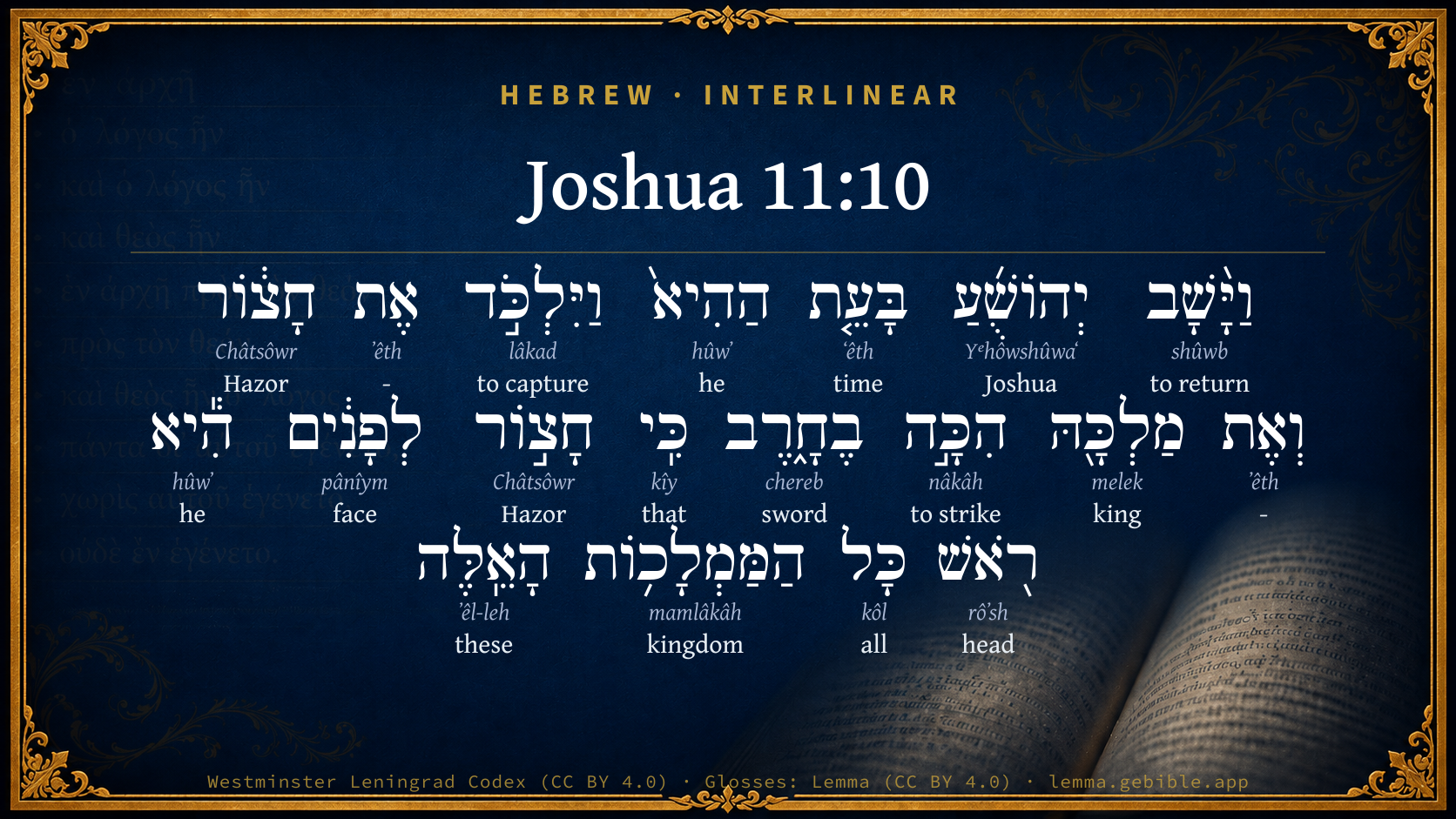
Hebrew (Westminster Leningrad Codex) Joshua 11:10 appears in the Hebrew Old Testament. The text above is from the Westminster Leningrad Codex. Each word links to its Strong’s number, a concise gloss, and parsing drawn from the Open Scriptures Hebrew Bible morphology. Click any word for its full Brown-Driver-Briggs (BDB) entry.
Download image
Cite this verse

Joshua 11:10 (World English Bible). Public Domain. Lemma interlinear Bible study tool, https://lemma.gebible.app/v/joshua/11/10.

Show BibTeX & RIS
BibTeX
RIS
English Translation
Joshua turned back at that time, and took Hazor, and struck the king of it with the sword: for Hazor before was the head of all those kingdoms.
World English Bible · Public Domain
Download a study sheet

One document with this verse’s original text, its word-by-word gloss line, the meaning frame, cross-references with their text, attributed commentary, and full source and license credits — printable, and it pastes into notes with its structure intact.

This verse Autodidact and up

Study sheet (.html) Plain text (.txt)

A passage Seminary Student

Up to 50 verses in one chapter. A passage sheet keeps up to 6 commentary sources and 12 cross-references per verse, in the order this page ranks them, and says so on the sheet whenever that leaves anything out. Ask for a single verse and you get the Autodidact verse sheet above.

Everything on this page stays free to read, with no account — the sheet is a download of what is already on screen, not access to it.

Want to remove ads? Support Godless Engineer
Compare translations 3

The same verse in 3 English versions, stacked beneath the original-language interlinear above. Click any original word for its lexicon entry.

Each is an independent rendering of the whole verse — the interlinear is not word-aligned to these translations.

Highlighted words mark where these versions differ — a whole-verse word diff, not a word-by-word alignment.

  • World English Bible Public Domain
    Joshua turned back at that time, and took Hazor, and struck the king of it with the sword: for Hazor before was the head of all those kingdoms.
  • King James Version Public Domain
    And Joshua at that time turned back, and took Hazor, and smote the king thereof with the sword: for Hazor beforetime was the head of all those kingdoms.
  • unfoldingWord Literal Text CC BY-SA 4.0
    And Joshua returned at that time and captured Hazor and struck its king with the sword, because Hazor, it formerly the head of all of these kingdoms.

unfoldingWord Literal Text — © unfoldingWord, licensed CC BY-SA 4.0. Word-aligned USFM3 via Door43 (git.door43.org/unfoldingWord/en_ult).

Versions to compare (up to 4)

3 of 4 selected

Show all 18 translations

Every available English version of this verse, each an independent rendering of the whole verse.

  • World English Bible Public Domain
    Joshua turned back at that time, and took Hazor, and struck the king of it with the sword: for Hazor before was the head of all those kingdoms.
  • Berean Standard Bible Public Domain
    At that time Joshua turned back and captured Hazor and put its king to the sword, because Hazor was formerly the head of all these kingdoms.
  • Majority Standard Bible Public Domain
    At that time Joshua turned back and captured Hazor and put its king to the sword, because Hazor was formerly the head of all these kingdoms.
  • King James Version Public Domain
    And Joshua at that time turned back, and took Hazor, and smote the king thereof with the sword: for Hazor beforetime was the head of all those kingdoms.
  • American Standard Version (1901) Public Domain
    And Joshua turned back at that time, and took Hazor, and smote the king thereof with the sword: for Hazor beforetime was the head of all those kingdoms.
  • Revised Version (1885) Public Domain
    And Jeshua turned back at that time, and took Hazor, and smote the king thereof with the sword: for Hazor beforetime was the head of all those kingdoms.
  • Geneva Bible (1599) Public Domain
    At that time also Ioshua turned backe, and tooke Hazor, and smote the King thereof with the sword: for Hazor before time was the head of all those kingdomes.
  • Douay-Rheims (1899) Public Domain
    And presently turning back he took Asor: and slew the king thereof with the sword. Now Asor of old was the head of all these kingdoms.
  • Young's Literal Translation Public Domain
    And Joshua turneth back at that time, and captureth Hazor, and its king he hath smitten by the sword; for Hazor formerly `is' head of all these kingdoms;
  • Literal Standard Version CC BY-SA 4.0
    And Joshua turns back at that time, and captures Hazor, and he has struck its king by the sword; for Hazor [was] formerly head of all these kingdoms;
  • Unlocked Literal Bible CC BY-SA 4.0
    Joshua turned back at that time and captured Hazor. He struck its king with the sword. (Hazor had been head of all these kingdoms.)
  • unfoldingWord Literal Text CC BY-SA 4.0
    And Joshua returned at that time and captured Hazor and struck its king with the sword, because Hazor, it formerly the head of all of these kingdoms.
  • Darby Bible Public Domain
    And Joshua turned back at that time, and took Hazor, and smote the king thereof with the sword; for Hazor was in times past the head of all those kingdoms.
  • World Messianic Bible Public Domain
    Joshua turned back at that time, and took Hazor, and struck its king with the sword; for Hazor used to be the head of all those kingdoms.
  • Webster's Bible Public Domain
    And Joshua at that time turned back, and took Hazor, and smote its king with the sword: for Hazor before-time was the head of all those kingdoms.
  • Free Bible Version CC BY-SA 4.0
    Then Joshua turned on Hazor. He captured it and killed its king, for Hazor was at that time the chief of all these kingdoms.
  • Bible in Basic English Public Domain
    At that time, Joshua went on to take Hazor and put its king to the sword: for in earlier times Hazor was the chief of all those kingdoms.
  • JPS Tanakh (1917) Public Domain
    And Joshua turned back at that time, and took Hazor, and smote the king thereof with the sword: for Hazor beforetime was the head of all those kingdoms.

Literal Standard Version (2020), Covenant Press — licensed CC BY-SA 4.0. Text via the HelloAO Bible API (eBible.org). Unlocked Literal Bible (unfoldingWord) — licensed CC BY-SA 4.0. Text via the HelloAO Bible API (eBible.org). unfoldingWord Literal Text — © unfoldingWord, licensed CC BY-SA 4.0. Word-aligned USFM3 via Door43 (git.door43.org/unfoldingWord/en_ult). Free Bible Version, Dr. Jonathan Gallagher — licensed CC BY-SA 4.0. Text via the HelloAO Bible API (eBible.org).

Word by word

More ways to search: Search by grammar → Find every occurrence → Compare this word →

Practice this passage: Drill this verse → Learn its vocabulary →

חָצ֔וֹר
Châtsôwr
H2674
“Hazor”
Noun, Proper
Part of Speech
Noun
Type
Proper
Full BDB Definition

Origin: a collective form of H2691

TWOT: None

Hazor = "castle" - a royal city of northern Palestine allotted to Naphtali - one of the cities of Judah in the extreme south - a town north of Jerusalem in which the Benjamites resided after the return from exile - a site in Arabia
  1. וַיָּ֨שָׁב shûwb H7725 “and · to return” Conjunction + Verb, Qal, Sequential Imperfect, 3rd Person, Masculine, Singular
  2. יְהוֹשֻׁ֜עַ Yᵉhôwshûwaʻ H3091 “Joshua” Noun, Proper
  3. בָּעֵ֤ת ʻêth H6256 “in/at the · time” Preposition, Determined + Noun, Common, Both, Singular, Absolute
  4. הַהִיא֙ hûwʼ H1931 “the · he” Particle, Definite Article + Pronoun, Personal, 3rd Person, Feminine, Singular
  5. וַיִּלְכֹּ֣ד lâkad H3920 “and · to capture” Conjunction + Verb, Qal, Sequential Imperfect, 3rd Person, Masculine, Singular
  6. אֶת ʼêth H853 “-” Particle, Direct Object
  7. וְאֶת ʼêth H853 “and · -” Conjunction + Particle, Direct Object
  8. מַלְכָּ֖הּ melek H4428 “king · her” Noun, Common, Masculine, Singular, Construct + Suffix, Personal, 3rd Person, Feminine, Singular
  9. הִכָּ֣ה nâkâh H5221 “to strike” Verb, Hiphil, Perfect, 3rd Person, Masculine, Singular
  10. בֶחָ֑רֶב chereb H2719 “in/at the · sword” Preposition, Determined + Noun, Common, Feminine, Singular, Absolute
  11. כִּֽי kîy H3588 “that” Conjunction
  12. חָצ֣וֹר Châtsôwr H2674 “Hazor” Noun, Proper
  13. לְפָנִ֔ים pânîym H6440 “to/for · face(s)” Preposition + Noun, Common, Both, Plural, Absolute
  14. הִ֕יא hûwʼ H1931 “he” Pronoun, Personal, 3rd Person, Feminine, Singular
  15. רֹ֖אשׁ rôʼsh H7218 “head of” Noun, Common, Masculine, Singular, Construct
  16. כָּל kôl H3605 “all of” Noun, Common, Masculine, Singular, Construct
  17. הַמַּמְלָכ֥וֹת mamlâkâh H4467 “the · kingdoms” Particle, Definite Article + Noun, Common, Feminine, Plural, Absolute
  18. הָאֵֽלֶּה ʼêl-leh H428 “the · these” Particle, Definite Article + Pronoun, Demonstrative, Common, Plural

About this verse

These counts appear in no published source. They are computed here, from the morphology-tagged text and Lemma’s own curated glosses. What Lemma adds →

19
words
16
distinct lemmas
Historical
section

Notable vocabulary

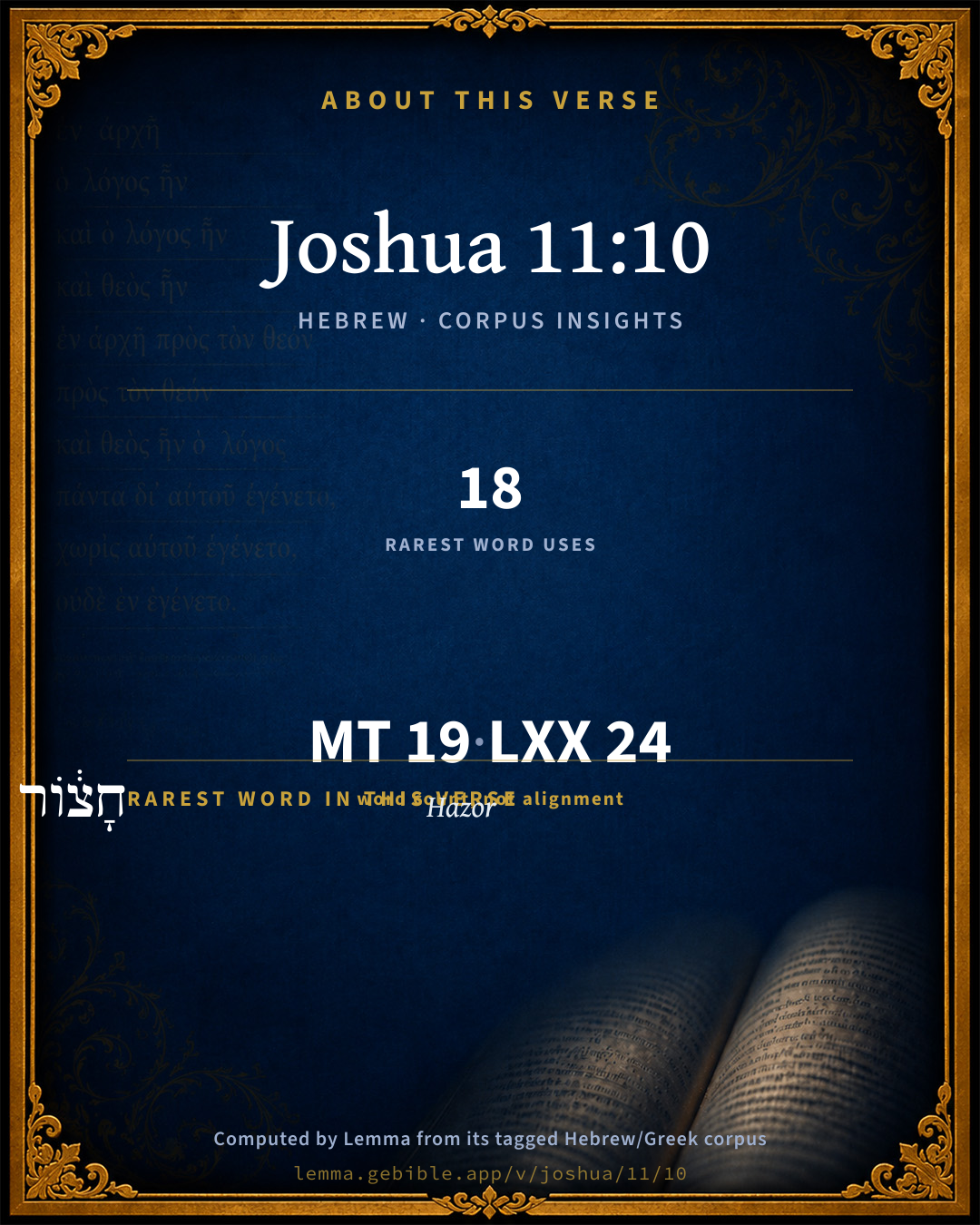
The rarest word here is חָצ֔וֹר Hazor H2674 — appearing just 18 times in the whole Hebrew Bible.

Shared distinctive vocabulary

חָצ֔וֹר Hazor H2674 occurs in 17 verses of the Hebrew Bible. Also found in:

Grammatical profile

  • 3 verbs
  • 10 nouns
  • 3 pronouns
  • 1 conjunction
  • 2 particles

Verb forms

  • וַיָּ֨שָׁב Qal · Sequential Imperfect
  • וַיִּלְכֹּ֣ד Qal · Sequential Imperfect
  • הִכָּ֣ה Hiphil · Perfect

Repetition

Words recur within this verse — often emphatic in Hebrew:

  • חָצ֔וֹר Hazor H2674 ×2
  • הַהִיא֙ he H1931 ×2

Hebrew & Septuagint length

In English translation the verse runs 28 words from the Hebrew and 23 from the Septuagint (LXX English) — closely comparable.

A rough comparison of the two English renderings, which tokenize alike — not a word-level alignment.

Word counts can differ between the Hebrew and the Greek without any difference in meaning — e.g. the Hebrew direct-object marker אֵת has no separate Greek word, and Greek often adds the article ὁ.

In the original languages it is 19 Hebrew tokens and 24 Greek tokens — but the two are counted differently (Hebrew bundles its prefixes and suffixes into one token; the Greek is in lemma form), so that isn’t a like-for-like length.

Cross-references

2

Topical passages linked to Joshua 11:10 in the Treasury of Scripture Knowledge — connected by theme and wording, ordered by reader-vote popularity; previews shown in the World English Bible.

  • Joshua 11:1 It happened, when Jabin king of Hazor heard of it, that he sent to Jobab king of Madon, and to the king of Shimron, and to the king of Achshaph,
  • Judges 4:2 Yahweh sold them into the hand of Jabin king of Canaan, who reigned in Hazor; the captain of whose host was Sisera, who lived in Harosheth of the Gentiles.

Cross-references courtesy of OpenBible.info (CC BY 4.0).

Hebrew and Greek witnesses Masoretic Hebrew ↔ Greek Septuagint

The same verse in the two great witnesses to the Old Testament, shown verse-for-verse.

These are two independent witnesses, not word-aligned to each other, and the Septuagint is shown in lemma (dictionary) form.

Hebrew Joshua 11:10 Masoretic · Westminster Leningrad Codex

וַיָּ֨שָׁב יְהוֹשֻׁ֜עַ בָּעֵ֤ת הַהִיא֙ וַיִּלְכֹּ֣ד אֶת חָצ֔וֹר וְאֶת מַלְכָּ֖הּ הִכָּ֣ה בֶחָ֑רֶב כִּֽי חָצ֣וֹר לְפָנִ֔ים הִ֕יא רֹ֖אשׁ כָּל הַמַּמְלָכ֥וֹת הָאֵֽלֶּה

Joshua turned back at that time, and took Hazor, and struck the king of it with the sword: for Hazor before was the head of all those kingdoms.

World English Bible · Public Domain

Greek LXX Joshua 11:10 Septuagint · lemma form

καί ἀποστρέφω ἰησοῦς ἐν ὁ καιρός ἐκεῖνος καί καταλαμβάνω ασωρ καί ὁ βασιλεύς αὐτός εἰμί δέ ασωρ ὁ πρότερος ἄρχω πᾶς ὁ βασιλεία οὗτος

And Joshua returned at that time, and took Asor and her king; now Asor in former time was the chief of these kingdoms.

LXX2012 (modern English Septuagint) · Public Domain

Hebrew: Westminster Leningrad Codex (CC BY 4.0). Greek: Septuagint (public domain); English from LXX2012 (modern English Septuagint) (Public Domain). How the Septuagint differs from the Hebrew →

Targum (Aramaic paraphrase)

1

The Targum is the ancient Jewish Aramaic paraphrase of the Hebrew Scriptures — an interpretive translation, not the Hebrew text itself. Onkelos (literal) and Pseudo-Jonathan (expansive) render the Torah, and Jonathan the Prophets. Coverage is partial: where no permissively-licensed English translation exists for a verse, only the Aramaic is shown. This is verse-level text, not a word-by-word alignment to the Hebrew.

  1. Targum Jonathan Prophets (Joshua–Malachi)
    וְתַב יְהוֹשֻׁעַ בְּעִדָנָא הַהִיא וּכְבַשׁ יַת חָצוֹר וְיַת מַלְכָּהּ קְטַל בְּחַרְבָּא אֲרֵי חָצוֹר מִלְקַדְמִין הִיא רֵישׁ כָּל מַלְכְּוָתָא הָאִלֵין:

    (no public-domain English translation for this verse)

    Targum Jonathan — Aramaic: “Mikraot Gedolot” (public domain). English: “Sefaria Community Translation” (CC0 1.0 (public-domain dedication)); “London "Chaldee Paraphrase," 1871” (public domain). Text via Sefaria.

Commentary

Notes on Joshua 11:10 from classic Christian and Jewish commentators (each source and its license shown beneath its notes). The classic Christian expositions comment on the surrounding passage and are grouped to its opening verse, so a note may address several verses; the Jewish commentaries on the Tanakh (Rashi and others) are per-verse, so they appear only where the commentator wrote on this verse.

Lemma curates 59 commentaries, every one of them public domain or Creative Commons licensed, each selected and text-cleaned for this edition rather than reprinted as found. About our sources →

Matthew Henry's Commentary

We have here the same improvement made of this victory as was made of that in the foregoing chapter. 1. The destruction of Hazor is particularly recorded, because in it, and by the king thereof, this daring design against Israel was laid, Jos 11:10, Jos 11:11. The king of Hazor, it seems, escaped with his life out of the battle, and thought himself safe when he had got back into his own city, and Joshua had gone in pursuit of the scattered troops another way. But it proved that that which he thought would be for his welfare was his trap; in it he was taken as in an evil net; there he was slain, and his city, for his sake, burned. Yet we find that the remains of it being not well looked after by Israel the Canaanites rebuilt it, and settled there under another king of the same name, Jdg 4:2. 2. The rest of the cities of that part of the country are spoken of only in general, that Joshua got them all into his hands, but did not burn them as he did Hazor, for Israel was to dwell in great and goodly cities which they builded not (Deu 6:10) and in these among the rest. And here we find Israel rolling in blood and treasure. (1.) In the blood of their enemies; they smote all the souls (Jos 11:1), neither left they any to breathe (Jos 11:14), that there might be none to infect them with the abominations of Canaan, and none to disturb them in the possession of it. The children were cut off, lest they should afterwards lay claim to any part of this land in the right of their parents. (2.) In the wealth of their enemies. The spoil, and the cattle, they took for a prey to themselves, Jos 11:14. As they were enriched with the spoil of their oppressors when they came out of Egypt, wherewith to defray the charges of their apprenticeship in the wilderness, so they were now enriched with the spoil of their enemies for a stock wherewith to set up in the land of Canaan. Thus is the wealth of the sinner laid up for the just.

Matthew Henry's Commentary on the Whole Bible (1708–1710) — public domain (CC PDM 1.0). Text via the HelloAO Bible API.

Trapp's Complete Commentary

John Trapp

Jos 11:10 And Joshua at that time turned back, and took Hazor, and smote the king thereof with the sword: for Hazor beforetime was the head of all those kingdoms.

Ver. 10. And smote the king thereof.] The new king. See Jos 10:37.

John Trapp, A Commentary or Exposition upon All the Books of the Old and New Testament (1647–1656) — public domain. Text from a community e-Sword module.

Joseph Benson's Commentary

Jos 11:10. The king — In his royal city, to which he fled out of the battle. Head of those kingdoms — Not of all Canaan, but of all those who were confederate with him in this expedition.

Joseph Benson's Commentary on the Old and New Testaments (1811–1818) — public domain. Text from a community e-Sword module.

Adam Clarke's Commentary

Verse 10. Took Hazor] See Clarke on Jos 11:1.

Adam Clarke's Commentary on the Bible (1810–1826) — public domain. Text from a community e-Sword/MySword module.

The Cambridge Bible for Schools and Colleges

gen. ed. J. J. S. Perowne

10. turned back] Far over the western hills Joshua pursued the flying hosts before he “turned back,” and took Hazor, and because of its prominence as the chief city of these petty northern kingdoms, burned it with fire.

The Cambridge Bible for Schools and Colleges (gen. ed. J. J. S. Perowne; Cambridge University Press, 1878–1918) — public domain. Text from a community e-Sword module.

John Gill's Exposition

And Joshua at that time turned back and took Hazor,.... After he had chased the Canaanites to the places mentioned, he returned to Hazor, near to which Joshua first fell upon them, but through the pursuit he was led on many miles beyond it: Bunting says (w), it was thirty two miles from Sidon:

and smote the king thereof with the sword; who, very probably, upon the surprise at the waters of Merom, fled to his capital for safety; but that being taken by Joshua, he was slain by him with the sword:

for Hazor beforetime was the head of all those kingdoms; before mentioned, Jos 11:1; but not of all the land of Canaan: Jerom (x) says, it was the metropolis of all the kingdoms of the Philistines; and though they were not now subject to it, and had kings of their own, yet it appears that the king of this place was in great authority, and regard was paid unto him; and this seems to be the reason why Joshua hasted to take this city, slay the king of it, and burn it with fire, because it had been the principal in this war, and might, if not prevented, raise new troubles; wherefore, as a precaution to that, and to deter the rest, he hastened the conquest and destruction of it.

(w) Travels, p. 96. (x) De loc. Heb. fol. 88. B.

John Gill's Exposition of the Whole Bible (1746–1763) — public domain (CC PDM 1.0). Text via the HelloAO Bible API.

Haydock's Catholic Bible Commentary

King. Jabin had thrown himself into the city, or perhaps a new king had been appointed, according to the custom of Persia, &c., when the former went to battle. Hence we find so many kings of Israel were chosen very young and while their fathers were living.

George Leo Haydock (1774–1849), Haydock's Catholic Family Bible and Commentary, 1859 edition — public domain. Excludes Psalms (Douay-Rheims chapter numbering differs from Protestant) and Deuterocanonical books (Catholic canon only).

Matthew Poole's English Annotations

Smote the king thereof; either in the former battle, though it be mentioned here; or rather in his royal city, to which he fled out of the battle.

The head of all those kingdoms; not of all Canaan, but of all those who were confederate with him in this expedition.

Matthew Poole's English Annotations on the Holy Bible (1683–1685) — public domain. Text from a community e-Sword/MySword module.

Whedon's Commentary on the Bible

Daniel D. Whedon

10. At that time — After he had utterly routed and pursued the enemy even to distant cities and villages, and had destroyed their horses and chariots. The pursuit may have lasted several days.

Turned back — From pursuing the foe.

Smote the king — Jabin, as soon as defeated, seems to have taken refuge in his capital. Joshua did not stop to take Hazor until after he had utterly dispersed the confederate army.

Daniel D. Whedon (gen. ed.), Commentary on the Old and New Testaments (1874–1909) — public domain. Text from a community e-Sword module.

The Pulpit Commentary

Turned back. From his march toward Sidon. For Hazor beforetime was the head of all those kingdoms (see note on ver. 1).

The Pulpit Commentary (1880–1919), ed. H.D.M. Spence-Jones & Joseph S. Exell — public domain. Text from a community e-Sword module.

John Wesley's Explanatory Notes

The king - In his royal city, to which he fled out of the battle. Head of these kingdoms - Not of all Canaan, but of all those who were confederate with him in this expedition.

John Wesley, Explanatory Notes Upon the Whole Bible (1754–1765) — public domain. Text via the GEBible commentary corpus.

unfoldingWord translationNotes

Door43 World Missions Community

He struck its king with the sword

"Joshua killed the king of Hazor with his sword"

Hazor had been head of all these kingdoms

Hazor being the most important city is spoken of as Hazor being the head of the other kingdoms. AT: Hazor had been the most important of all these kingdoms" (See: Metaphor and How to Translate Names)

They struck with the sword every living creature that was there ... so there was not any living creature left alive

These two phrases share similar meanings and emphasize complete destruction. (See: Parallelism)

he set them apart to be destroyed

The word "he" refers to Joshua and represents himself and his army. Completely destroying every living thing in the city is spoken of as if those living things were dedicated for destruction. AT: "the army completely destroyed them" (See: Synecdoche and Metaphor)

translationWords

Joshua

king

sword

kingdom

creature

unfoldingWord translationNotes — © Distant Shores Media and the Door43 World Missions Community, licensed CC BY-SA 4.0. Source: git.door43.org/Door43/en_tn.

Lesson kit

Teaching starters — assembled from the data on this page, not authored interpretation. Every prompt links to the verse data it draws on. Edit before teaching.

Joshua, in the Historical, opens this verse with 19 words (16 distinct Hebrew lemmas). Its most distinctive word is Châtsôwr (“Hazor”). A historical commentator’s framing appears above. Read the whole chapter for the surrounding context.

Discussion questions

  1. The word Châtsôwr carries the sense “Hazor.” How does it shape the verse?
  2. How does Joshua 11:1, which shares the word «Hazor», read alongside this verse?
  3. What does the repetition of “Hazor” (2× in this one verse) do in this verse?
  4. These translations render this verse differently. What is at stake in choosing one wording over another?
  5. «וַיָּ֨שָׁב» is a Qal Sequential Imperfect verb. How does that grammatical form shape the action described?
  6. Compare how Matthew Henry's Commentary and Trapp's Complete Commentary read this verse. Where do they agree or differ?

Things to notice

Reading settings

Reading text

Shown beneath each verse's original-language words.

Old Testament
Old Testament edition

Read the OT as the Masoretic Hebrew (MT) or the Greek Septuagint (LXX).

English shown for the Greek Septuagint (in the Hebrew ↔ Greek comparison).

Comparing translations? Open the Compare panel on any verse page to stack up to four side by side.