
2 Samuel 2:16

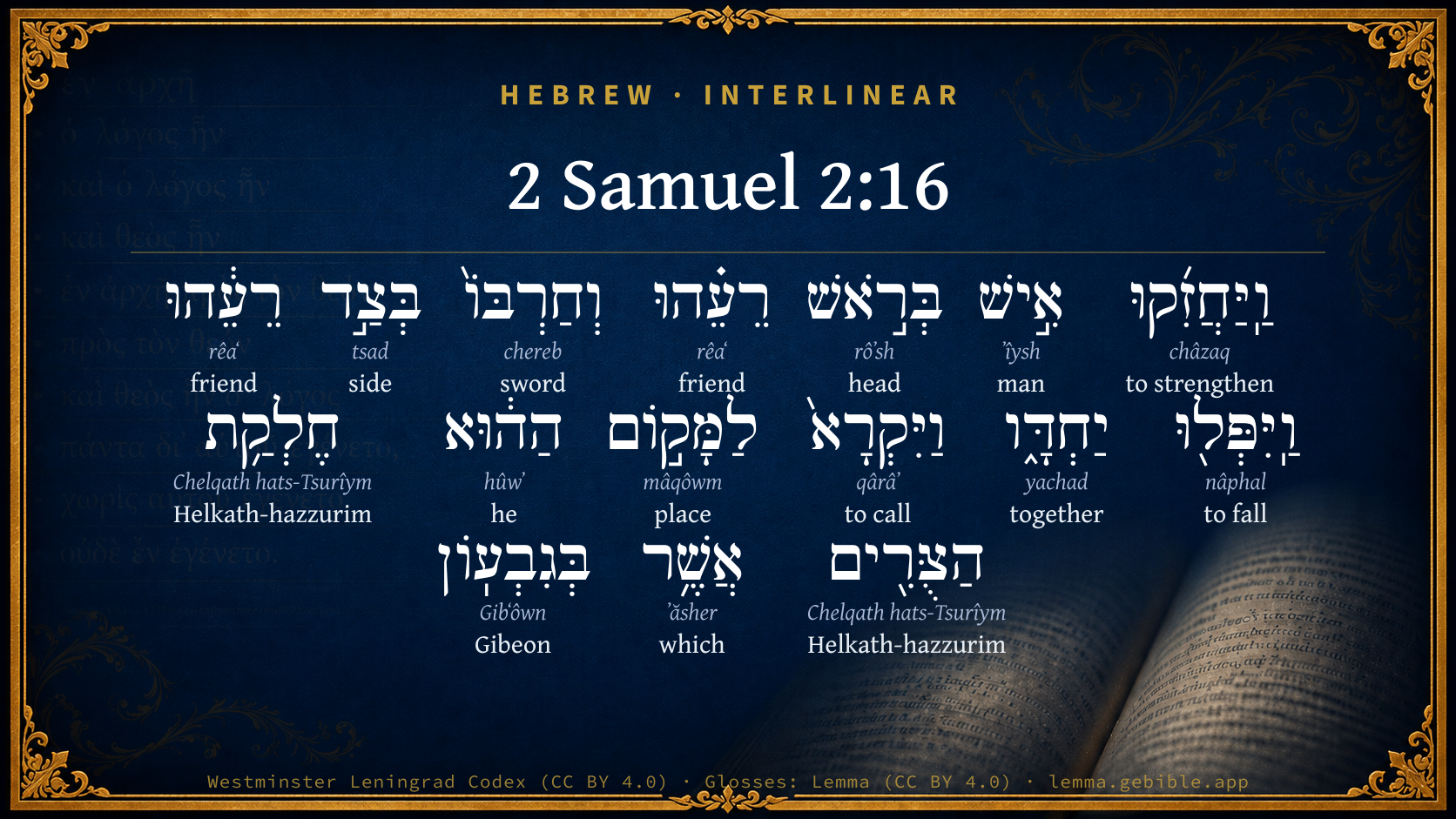
Hebrew (Westminster Leningrad Codex) 2 Samuel 2:16 appears in the Hebrew Old Testament. The text above is from the Westminster Leningrad Codex. Each word links to its Strong’s number, a concise gloss, and parsing drawn from the Open Scriptures Hebrew Bible morphology. Click any word for its full Brown-Driver-Briggs (BDB) entry.
Download image
Cite this verse

2 Samuel 2:16 (World English Bible). Public Domain. Lemma interlinear Bible study tool, https://lemma.gebible.app/v/2-samuel/2/16.

Show BibTeX & RIS
BibTeX
RIS
English Translation
They caught everyone his fellow by the head, and [thrust] his sword in his fellow's side; so they fell down together: therefore that place was called Helkath Hazzurim, which is in Gibeon.
World English Bible · Public Domain
Highlights Full analysis ↓
Download a study sheet

One document with this verse’s original text, its word-by-word gloss line, the meaning frame, cross-references with their text, attributed commentary, and full source and license credits — printable, and it pastes into notes with its structure intact.

This verse Autodidact and up

Study sheet (.html) Plain text (.txt)

A passage Seminary Student

Up to 50 verses in one chapter. A passage sheet keeps up to 6 commentary sources and 12 cross-references per verse, in the order this page ranks them, and says so on the sheet whenever that leaves anything out. Ask for a single verse and you get the Autodidact verse sheet above.

Everything on this page stays free to read, with no account — the sheet is a download of what is already on screen, not access to it.

Want to remove ads? Support Godless Engineer
Compare translations 3

The same verse in 3 English versions, stacked beneath the original-language interlinear above. Click any original word for its lexicon entry.

Each is an independent rendering of the whole verse — the interlinear is not word-aligned to these translations.

Highlighted words mark where these versions differ — a whole-verse word diff, not a word-by-word alignment.

  • World English Bible Public Domain
    They caught everyone his fellow by the head, and [thrust] his sword in his fellow's side; so they fell down together: therefore that place was called Helkath Hazzurim, which is in Gibeon.
  • King James Version Public Domain
    And they caught every one his fellow by the head, and thrust his sword in his fellow's side; so they fell down together: wherefore that place was called Helkathhazzurim, which is in Gibeon.
  • unfoldingWord Literal Text CC BY-SA 4.0
    And they seized, a man his fellow by the head, and his sword in the side of his fellow, and they fell together. So one called that place Helkath Hazzurim, which in Gibeon.

unfoldingWord Literal Text — © unfoldingWord, licensed CC BY-SA 4.0. Word-aligned USFM3 via Door43 (git.door43.org/unfoldingWord/en_ult).

Versions to compare (up to 4)

3 of 4 selected

Show all 18 translations

Every available English version of this verse, each an independent rendering of the whole verse.

  • World English Bible Public Domain
    They caught everyone his fellow by the head, and [thrust] his sword in his fellow's side; so they fell down together: therefore that place was called Helkath Hazzurim, which is in Gibeon.
  • Berean Standard Bible Public Domain
    Then each man grabbed his opponent by the head and thrust his sword into his opponent’s side, and they all fell together. So this place, which is in Gibeon, is called Helkath-hazzurim.
  • Majority Standard Bible Public Domain
    Then each man grabbed his opponent by the head and thrust his sword into his opponent’s side, and they all fell together. So this place, which is in Gibeon, is called Helkath-hazzurim.
  • King James Version Public Domain
    And they caught every one his fellow by the head, and thrust his sword in his fellow's side; so they fell down together: wherefore that place was called Helkathhazzurim, which is in Gibeon.
  • American Standard Version (1901) Public Domain
    And they caught every one his fellow by the head, and `thrust' his sword in his fellow's side; so they fell down together: wherefore that place was called Helkath-hazzurim, which is in Gibeon.
  • Revised Version (1885) Public Domain
    And they caught every one his fellow by the head, and thrust his sword in his fellow’s side; so they fell down together: wherefore that place was called Helkath-hazzurim, which is in Gibeon.
  • Geneva Bible (1599) Public Domain
    And euery one caught his fellowe by the head, and thrust his sword in his fellowes side, so they fell downe together: wherefore ye place was called Helkath-hazzurim, which is in Gibeon.
  • Douay-Rheims (1899) Public Domain
    And every one catching his fellow, by the head, thrust his sword into the side of his adversary, and they fell down together: and the name of the place was called: The field of the valiant, in Gabaon.
  • Young's Literal Translation Public Domain
    And they lay hold, each on the head of his companion, and his sword `is' in the side of his companion, and they fall together, and `one' calleth that place Helkath-Hazzurim, which `is' in Gibeon,
  • Literal Standard Version CC BY-SA 4.0
    And they each lay hold on the head of his companion, and his sword [is] in the side of his companion, and they fall together, and [one] calls that place Helkath-Hazzurim, which [is] in Gibeon,
  • Unlocked Literal Bible CC BY-SA 4.0
    Each man seized his opponent by the head and thrust his sword into the side of his opponent, and they fell down together. Therefore that place was called “Helkath Hazzurim,” or “Field of Swords,” which is in Gibeon.
  • unfoldingWord Literal Text CC BY-SA 4.0
    And they seized, a man his fellow by the head, and his sword in the side of his fellow, and they fell together. So one called that place Helkath Hazzurim, which in Gibeon.
  • Darby Bible Public Domain
    And they caught every one his fellow by the head, and [thrust] his sword in his fellow's side, and they fell down together. And that place was called Helkath-hazzurim, which is by Gibeon.
  • World Messianic Bible Public Domain
    They each caught his opponent by the head and thrust his sword in his fellow’s side; so they fell down together. Therefore that place in Gibeon was called Helkath Hazzurim.
  • Webster's Bible Public Domain
    And they caught every one his fellow by the head, and thrust his sword in his fellow's side: so they fell down together: wherefore that place was called Helkath-hazzurim, which is in Gibeon.
  • Free Bible Version CC BY-SA 4.0
    Each man grabbed his opponent's head and drove his sword into his opponent's side so that they all fell down dead together. That's why this place in Gibeon is called the Field of Sword-edges.
  • Bible in Basic English Public Domain
    And every one got the other by the head, driving his sword into the other's side, so they all went down together: and that place was named the Field of Sides, and it is in Gibeon.
  • JPS Tanakh (1917) Public Domain
    And they caught every one his fellow by the head, and thrust his sword in his fellow's side; so they fell down together; wherefore that place was called Helkath-hazzurim, which is in Gibeon.

Literal Standard Version (2020), Covenant Press — licensed CC BY-SA 4.0. Text via the HelloAO Bible API (eBible.org). Unlocked Literal Bible (unfoldingWord) — licensed CC BY-SA 4.0. Text via the HelloAO Bible API (eBible.org). unfoldingWord Literal Text — © unfoldingWord, licensed CC BY-SA 4.0. Word-aligned USFM3 via Door43 (git.door43.org/unfoldingWord/en_ult). Free Bible Version, Dr. Jonathan Gallagher — licensed CC BY-SA 4.0. Text via the HelloAO Bible API (eBible.org).

Word by word

More ways to search: Search by grammar → Find every occurrence → Compare this word →

Practice this passage: Drill this verse → Learn its vocabulary →

חֶלְקַ֥ת
Chelqath hats-Tsurîym
H2521
“Helkath-hazzurim”
Noun, Proper
Part of Speech
Noun
Type
Proper
Full BDB Definition

Origin: from H2520 and the pl. of H6697 , with the article inserted

TWOT: None

Helkath-hazzurim = "field of swords" - a place near the pool of Gibeon where Ishbosheth's men were killed by David's men under Joab
  1. וַֽיַּחֲזִ֜קוּ châzaq H2388 “and · to strengthen” Conjunction + Verb, Hiphil, Sequential Imperfect, 3rd Person, Masculine, Plural
  2. אִ֣ישׁ ʼîysh H376 “man” Noun, Common, Masculine, Singular, Absolute
  3. בְּרֹ֣אשׁ rôʼsh H7218 “in/at · head of” Preposition + Noun, Common, Masculine, Singular, Construct
  4. רֵעֵ֗הוּ rêaʻ H7453 “friend · his” Noun, Common, Masculine, Singular, Construct + Suffix, Personal, 3rd Person, Masculine, Singular
  5. וְחַרְבּוֹ֙ chereb H2719 “and · sword · his” Conjunction + Noun, Common, Feminine, Singular, Construct + Suffix, Personal, 3rd Person, Masculine, Singular
  6. בְּצַ֣ד tsad H6654 “in/at · side of” Preposition + Noun, Common, Masculine, Singular, Construct
  7. רֵעֵ֔הוּ rêaʻ H7453 “friend · his” Noun, Common, Masculine, Singular, Construct + Suffix, Personal, 3rd Person, Masculine, Singular
  8. וַֽיִּפְּל֖וּ nâphal H5307 “and · to fall” Conjunction + Verb, Qal, Sequential Imperfect, 3rd Person, Masculine, Plural
  9. יַחְדָּ֑ו yachad H3162 “together” Adverb
  10. וַיִּקְרָא֙ qârâʼ H7121 “and · to call” Conjunction + Verb, Qal, Sequential Imperfect, 3rd Person, Masculine, Singular
  11. לַמָּק֣וֹם mâqôwm H4725 “to/for the · place” Preposition, Determined + Noun, Common, Masculine, Singular, Absolute
  12. הַה֔וּא hûwʼ H1931 “the · he” Particle, Definite Article + Pronoun, Personal, 3rd Person, Masculine, Singular
  13. הַצֻּרִ֖ים Chelqath hats-Tsurîym H2521 “Helkath-hazzurim” Noun, Proper
  14. אֲשֶׁ֥ר ʼăsher H834 “which” Particle, Relative
  15. בְּגִבְעֽוֹן Gibʻôwn H1391 “in/at · Gibeon” Preposition + Noun, Proper

About this verse

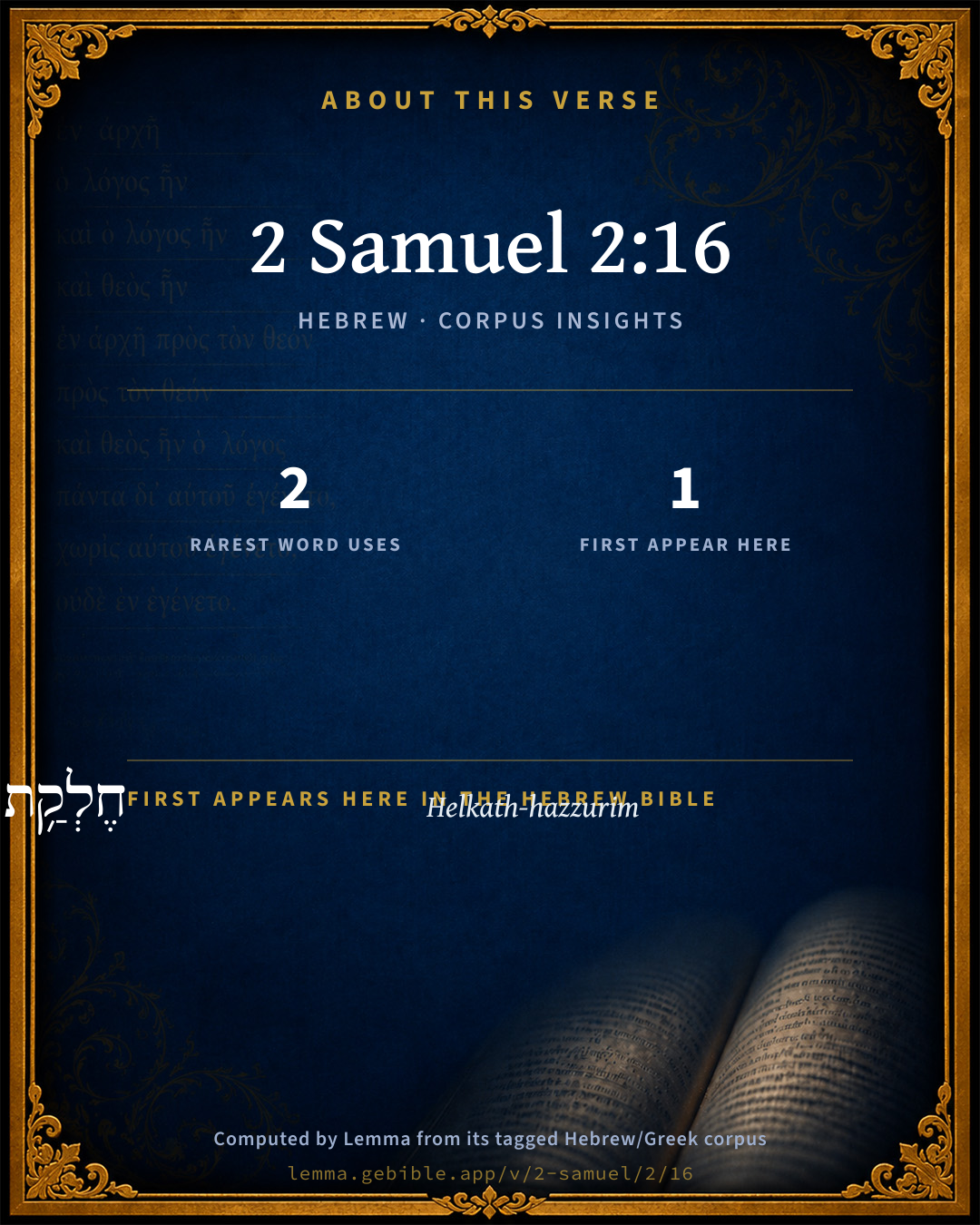
These counts appear in no published source. They are computed here, from the morphology-tagged text and Lemma’s own curated glosses. What Lemma adds →

16
words
14
distinct lemmas
Historical
section

Notable vocabulary

The rarest word here is חֶלְקַ֥ת Helkath-hazzurim H2521 — appearing just 2 times in the whole Hebrew Bible.

First appearance in Scripture

This word makes its first canonical appearance in the Hebrew Bible here:

  • חֶלְקַ֥ת Helkath-hazzurim H2521

Grammatical profile

  • 3 verbs
  • 10 nouns
  • 1 pronoun
  • 1 adverb
  • 1 particle

Verb forms

  • וַֽיַּחֲזִ֜קוּ Hiphil · Sequential Imperfect
  • וַֽיִּפְּל֖וּ Qal · Sequential Imperfect
  • וַיִּקְרָא֙ Qal · Sequential Imperfect

Repetition

Words recur within this verse — often emphatic in Hebrew:

  • רֵעֵ֗הוּ friend H7453 ×2
  • חֶלְקַ֥ת Helkath-hazzurim H2521 ×2

Hebrew & Septuagint length

In English translation the verse runs 32 words from the Hebrew and 47 from the Septuagint (LXX English) — the Septuagint runs noticeably longer here. See the side-by-side →

A rough comparison of the two English renderings, which tokenize alike — not a word-level alignment.

Word counts can differ between the Hebrew and the Greek without any difference in meaning — e.g. the Hebrew direct-object marker אֵת has no separate Greek word, and Greek often adds the article ὁ.

Hebrew and Greek witnesses Masoretic Hebrew ↔ Greek Septuagint

The same verse in the two great witnesses to the Old Testament, shown verse-for-verse.

Here the Septuagint runs noticeably longer than the Hebrew — LXX2012 (modern English Septuagint) 47 words vs World English Bible 32. A rough length comparison of the two English translations, not a word-level alignment — read both below.

These are two independent witnesses, not word-aligned to each other, and the Septuagint is shown in lemma (dictionary) form.

Hebrew 2 Samuel 2:16 Masoretic · Westminster Leningrad Codex

וַֽיַּחֲזִ֜קוּ אִ֣ישׁ בְּרֹ֣אשׁ רֵעֵ֗הוּ וְחַרְבּוֹ֙ בְּצַ֣ד רֵעֵ֔הוּ וַֽיִּפְּל֖וּ יַחְדָּ֑ו וַיִּקְרָא֙ לַמָּק֣וֹם הַה֔וּא חֶלְקַ֥ת הַצֻּרִ֖ים אֲשֶׁ֥ר בְּגִבְעֽוֹן

They caught everyone his fellow by the head, and [thrust] his sword in his fellow's side; so they fell down together: therefore that place was called Helkath Hazzurim, which is in Gibeon.

World English Bible · Public Domain

Greek LXX 2 Samuel 2:16 Septuagint · lemma form

καί κρατέω ἕκαστος ὁ χείρ ὁ κεφαλή ὁ πλησίον αὐτός καί μάχαιρα αὐτός εἰς πλευρά ὁ πλησίον αὐτός καί πίπτω κατά ὁ αὐτός καί καλέω ὁ ὄνομα ὁ τόπος ἐκεῖνος μερίς ὁ ἐπιβουλή ὅς εἰμί ἐν γαβαων

And they seized every one the head of his neighbor with his hand, and his sword was thrust into the side of his neighbor, and they fall down together: and the name of that place was called The portion of the treacherous ones, which is in Gabaon.

LXX2012 (modern English Septuagint) · Public Domain

On this verse, The Cambridge Bible for Schools and Colleges discusses the Septuagint’s reading. Read the note in Commentary ↓

Hebrew: Westminster Leningrad Codex (CC BY 4.0). Greek: Septuagint (public domain); English from LXX2012 (modern English Septuagint) (Public Domain). How the Septuagint differs from the Hebrew →

Targum (Aramaic paraphrase)

1

The Targum is the ancient Jewish Aramaic paraphrase of the Hebrew Scriptures — an interpretive translation, not the Hebrew text itself. Onkelos (literal) and Pseudo-Jonathan (expansive) render the Torah, and Jonathan the Prophets. Coverage is partial: where no permissively-licensed English translation exists for a verse, only the Aramaic is shown. This is verse-level text, not a word-by-word alignment to the Hebrew.

  1. Targum Jonathan Prophets (Joshua–Malachi)
    וְאַתְקִיפוּ גְבַר בְּרֵישׁ חַבְרֵיהּ וְחַרְבֵּיהּ בִּסְטַר חַבְרֵיהּ וּנְפָלוּ כַּחֲדָא וּקְרָא לְאַתְרָא הַהוּא אַחֲסָנַת קְטִלַיָא דִי בְּגִבְעוֹן:

    (no public-domain English translation for this verse)

    Targum Jonathan — Aramaic: “Mikraot Gedolot” (public domain). English: “Sefaria Community Translation” (CC0 1.0 (public-domain dedication)); “London "Chaldee Paraphrase," 1871” (public domain). Text via Sefaria.

Commentary

Notes on 2 Samuel 2:16 from classic Christian and Jewish commentators (each source and its license shown beneath its notes). The classic Christian expositions comment on the surrounding passage and are grouped to its opening verse, so a note may address several verses; the Jewish commentaries on the Tanakh (Rashi and others) are per-verse, so they appear only where the commentator wrote on this verse.

Lemma curates 59 commentaries, every one of them public domain or Creative Commons licensed, each selected and text-cleaned for this edition rather than reprinted as found. About our sources →

Trapp's Complete Commentary

John Trapp

2Sa 2:16 And they caught every one his fellow by the head, and [thrust] his sword in his fellow’s side; so they fell down together: wherefore that place was called Helkathhazzurim, which [is] in Gibeon.

Ver. 16. And they caught every one his fellow.] With such eagerness and fury met these gallants, that each in others’ side

“ Capulo tenus abdidit ensem, ”

sheathed his sword, for a proof of his valour. Talis fait Cadmaea Tugna. But was this valour, or madness rather? Courage or outrage, whether? Josephus saith - but not well - that Abner’s twelve men only were slain. {a}

Helkathhazzurim,] i.e., The field of strong men, or of rocks, i.e., of those that stood firm as rocks, till they fell in the place.

{a} Aliis placet agellum mucronum reddi. - Jun.

John Trapp, A Commentary or Exposition upon All the Books of the Old and New Testament (1647–1656) — public domain. Text from a community e-Sword module.

Geneva Bible (1599)

Geneva Bible translators

Meaning, his adversary.

Or, the field of strong men.

Geneva Bible (1599) marginal notes — public domain. Text via Bolls.life.

Adam Clarke's Commentary

Verse 16. Caught every one his fellow by the head] Probably by the beard, if these persons were not too young to have one, or by the hair of the head. Alexander ordered all the Macedonians to shave their beards; and being asked by Parmenio why they should do so, answered, "Dost thou not know that in battle there is no better hold than the beard?"

Helkath-hazzurim] "The portion of the mighty;" or, "The inheritance of those who were slain," according to the Targum.

Adam Clarke's Commentary on the Bible (1810–1826) — public domain. Text from a community e-Sword/MySword module.

Ellicott's Commentary for English Readers

(16) Helkath – hazzurim is interpreted in the margin “the field of strong men,” but the etymology is very doubtful. Most modern expositors understand it as meaning “the field of sharp edges.”

A Bible Commentary for English Readers, edited by Charles John Ellicott (1878–1897) — public domain. Text from a community e-Sword module.

The Cambridge Bible for Schools and Colleges

gen. ed. J. J. S. Perowne

16. And they caught, &c.] Self-defence was forgotten in the ferocity of the struggle, and all the combatants fell together by a mutual slaughter.

Helkath-hazzurim] This obscure name is variously explained as the field or plat, (a) of sharp edges, in allusion to the swords which proved so fatal; (b) of strong men, literally rocks, from the rock-like obstinacy with which they fought; so the Vulg. ager robustorum; (c) of plotters, the rendering of the LXX. (μερὶς τῶν ἐπιβούλων), which involves a slight change in the Hebrew word, implying that there was some foul play in the combat; (d) of sides, according to a conjectural emendation suggested in the Speaker’s Commentary, in allusion to the phrase “thrust his sword in his fellow’s side.” Either the first or second explanation is the most probable.

The Cambridge Bible for Schools and Colleges (gen. ed. J. J. S. Perowne; Cambridge University Press, 1878–1918) — public domain. Text from a community e-Sword module.

John Gill's Exposition

And they caught everyone his fellow by the head,.... By the hair of his head with his hand:

and thrust his sword in his fellow's side; which he had in the other:

so they fell down together; the twelve on each side, all the twenty four; some think only the twelve on Abner's side fell; but to me it seems that they all fell dead as one man, since they thrust their swords in each other's sides:

wherefore that place was called Helkathhazzurim, which is in Gibeon; the field of rocks, or of mighty men as strong as rocks, who stood as immovable, and would not give way, but fell and died in the field of battle; the Targum interprets it, the inheritance of the slain.

John Gill's Exposition of the Whole Bible (1746–1763) — public domain (CC PDM 1.0). Text via the HelloAO Bible API.

Albert Barnes' Notes on the Bible

Compare Livy’s history of the battle between the Horatii and Curiatii. This combat, like that, may have been proposed as a means of avoiding the effusion of blood of two nations united by consanguinity, and having a common powerful enemy in the Philistines.

Helkath-hazzurim - i. e. “the part, field, or plat Gen 23:19 of the sharp edges or blades.” This seems, on the whole, the best explanation of this rather obscure name.

Albert Barnes' Notes on the Bible (1834–1885) — public domain. Text from a community e-Sword/MySword module.

Haydock's Catholic Bible Commentary

Together. Some understand this only of Abner’s soldiers, as the original may be explained: "And they (David’s men) caught every on one his," &c. But it is more generally believed that all fell. (Calmet) --- Rufin has erroneously translated Josephus in the former sense, and has lead Comestor, Lyranus, &c., into this opinion. (Tirinus) --- Valiant. Hebrew, "the portion of the smooth stones, (hatsurim, 1 Kings xvii. 40. or) of the brave." (Calmet)

George Leo Haydock (1774–1849), Haydock's Catholic Family Bible and Commentary, 1859 edition — public domain. Excludes Psalms (Douay-Rheims chapter numbering differs from Protestant) and Deuterocanonical books (Catholic canon only).

Matthew Poole's English Annotations

By the head; by the hair of the head, which after their manner was of a considerable length, and therefore gave their enemy advantage; which every one of them endeavoured to get, and to improve against the other.

Helkath-hazzurim, or

the field of rocks, i. e. of men who stood like rocks, unmovable, each one dying upon the spot where he fought.

Matthew Poole's English Annotations on the Holy Bible (1683–1685) — public domain. Text from a community e-Sword/MySword module.

Whedon's Commentary on the Bible

Daniel D. Whedon

16. By the head — By the hair of the head or by the beard. Alexander, before entering into battle, ordered his men to shave their beards, because, said he, “in battle there is no better hold for the enemy than a beard.”

They fell down together — The whole twenty-four of them. “The left-handed Benjamites, and the right-handed men of Judah — their sword hands thus coming together — seized each his adversary by the head, and the whole number fell by the mutual wounds they received.” — Stanley.

Helkath-hazzurim — Hebrew, smoothness of the rocks; apparently in reference to a smooth, rocky surface on which the combatants fought. Other explanations of the name have been given, as, the field of the plotters; field of strong men; field of swords; field of sharp edges; but none of them are sufficiently careful of the meaning of the Hebrew words.

Daniel D. Whedon (gen. ed.), Commentary on the Old and New Testaments (1874–1909) — public domain. Text from a community e-Sword module.

The Pulpit Commentary

His sword in his fellow"s side. The absence of the verb in the original sets powerfully before us the rapidity of the whole action. But what an action! Twenty-four experienced men each take the other by the head, and, without any attempt at self-defence, thrust their swords into their opponents" side, and leave their own sides exposed to a similar thrust. Were they, then, unskilful in the use of weapons? Impossible. Were they blinded by hatred of one another? But no rancour would make a man forget his skill in defence. Here there is no variety, no checkered fortune of the combatants, but all twenty-four do and suffer just the same; and it is remarkable that they had swords only, and no shields. With shields on their arms, they could not have seized one another by the hair. It seems certain, therefore, that this mutual butchery was the "play;" nor can we conceive of a more murderous and savage proceeding. Abner, at the head of his fierce Benjamites, thought, perhaps, that Joab had no men among his followers willing to throw life away in so senseless a manner. But Joab was as ready as Abner, and possibly some code of false honour, such as used to make men practise duelling, required the acceptance of the challenge. And so, with their appetite for blood whetted by the sight of twenty-four murders, they hastened to begin the fight. Helkath-hazzurim. Literally this means "the field of flints;" but as the flint is constantly used for any hard rock, (Psa_78:20) the Authorized Version has admitted into the margin a paraphrase taken from the Vulgate, which supposes that by flints are meant "strong men," and renders, "the field of strong men." So in (Isa_26:4) "the flint," or rock, "of ages," is even translated "everlasting strength." Flints, however, were constantly used by the Israelites for knives whenever extreme sharpness was required. Thus for the circumcising of Israel, Jehovah commanded Joshua to prepare knives of flint; (Jos_5:2) and in course of time the sharp or whetted edge of a weapon was called its flint. Thus in, Psa_89:43 we read, "Thou hast turned back the flint of his sword." The name therefore probably means "the field of the sharp knives" (see margin of the Revised Version) and refers to the short swords with which they murdered one another.

The Pulpit Commentary (1880–1919), ed. H.D.M. Spence-Jones & Joseph S. Exell — public domain. Text from a community e-Sword module.

John Wesley's Explanatory Notes

By the head - By the hair of the head, which after their manner was of a considerable length. Helkath-kazzurim - Or, the field of rock; that is, of men who stood like rocks unmovable, each one dying upon the spot where he fought.

John Wesley, Explanatory Notes Upon the Whole Bible (1754–1765) — public domain. Text via the GEBible commentary corpus.

Scofield Reference Notes

C. I. Scofield

Helkathhazzurim

i.e. Field of Swords.

The Scofield Reference Bible (1917 edition), notes by C. I. Scofield — public domain. Text from a community e-Sword module.

unfoldingWord translationNotes

Door43 World Missions Community

they fell down together

This is a polite way of saying they died. AT: "they both died" (See: Euphemism)

Helkath Hazzurim

This is a name given to remind people what happened there. (See: How to Translate Names)

The battle was very severe that day

It may be helpful to explicitly state that this was the large battle that followed the contest of the young men. AT: "Then the others started to fight also. It was a very fierce battle that day" (See: Assumed Knowledge and Implicit Information)

translationWords

sword

Hebrew

Gibeon

Abner

unfoldingWord translationNotes — © Distant Shores Media and the Door43 World Missions Community, licensed CC BY-SA 4.0. Source: git.door43.org/Door43/en_tn.

Rashi

Rabbi Shlomo Yitzchaki (Rashi)

The Plain of Swords. Yonasan translates the plain of Killing on account of the swords just like you say [in Scriptures] (Tehilim 89, 44) "You also turned back the sharpness of his sword."

Rashi on the Tanakh — English translations: “The Judaica Press complete Tanach with Rashi, translated by A. J. Rosenberg” (CC BY 4.0); “Pentateuch with Rashi's commentary by M. Rosenbaum and A.M. Silbermann, 1929-1934” (public domain); “The Metsudah Tanach series, Lakewood, N.J” (CC BY 4.0); and “The Book of Joshua, Metsudah Publications, 1997” (CC BY 4.0). Text via Sefaria.

Lesson kit

Teaching starters — assembled from the data on this page, not authored interpretation. Every prompt links to the verse data it draws on. Edit before teaching.

2 Samuel, in the Historical, opens this verse with 16 words (14 distinct Hebrew lemmas). Its most distinctive word is Chelqath hats-Tsurîym (“Helkath-hazzurim”). The Greek Septuagint runs longer here. A historical commentator’s framing appears above. Read the whole chapter for the surrounding context.

Discussion questions

  1. The word Chelqath hats-Tsurîym carries the sense “Helkath-hazzurim.” How does it shape the verse?
  2. The word “Helkath-hazzurim” first appears here in Scripture. What is being introduced at this debut?
  3. “friend” occurs 2× in this one verse. What is the effect of the repetition?
  4. Compared with the Hebrew, the Septuagint runs longer here. What questions does that raise?
  5. These translations render this verse differently; the difference is in the English rendering, not the original. What questions does that raise?
  6. The verb «וַֽיַּחֲזִ֜קוּ» is Hiphil Sequential Imperfect. How does its form color the action?
  7. Reading how Trapp's Complete Commentary and Geneva Bible (1599) read this verse, where do the two commentators agree and where do they part?

Things to notice

  • 1 word makes its first canonical appearance in Scripture here.
  • These translations choose different wording for 14 words in this verse.
  • “friend” occurs 2× in this single verse.
  • 14 distinct Hebrew lemmas span 16 words in this verse.

Reading settings

Reading text

Shown beneath each verse's original-language words.

Old Testament
Old Testament edition

Read the OT as the Masoretic Hebrew (MT) or the Greek Septuagint (LXX).

English shown for the Greek Septuagint (in the Hebrew ↔ Greek comparison).

Comparing translations? Open the Compare panel on any verse page to stack up to four side by side.