
2 Kings 6:22

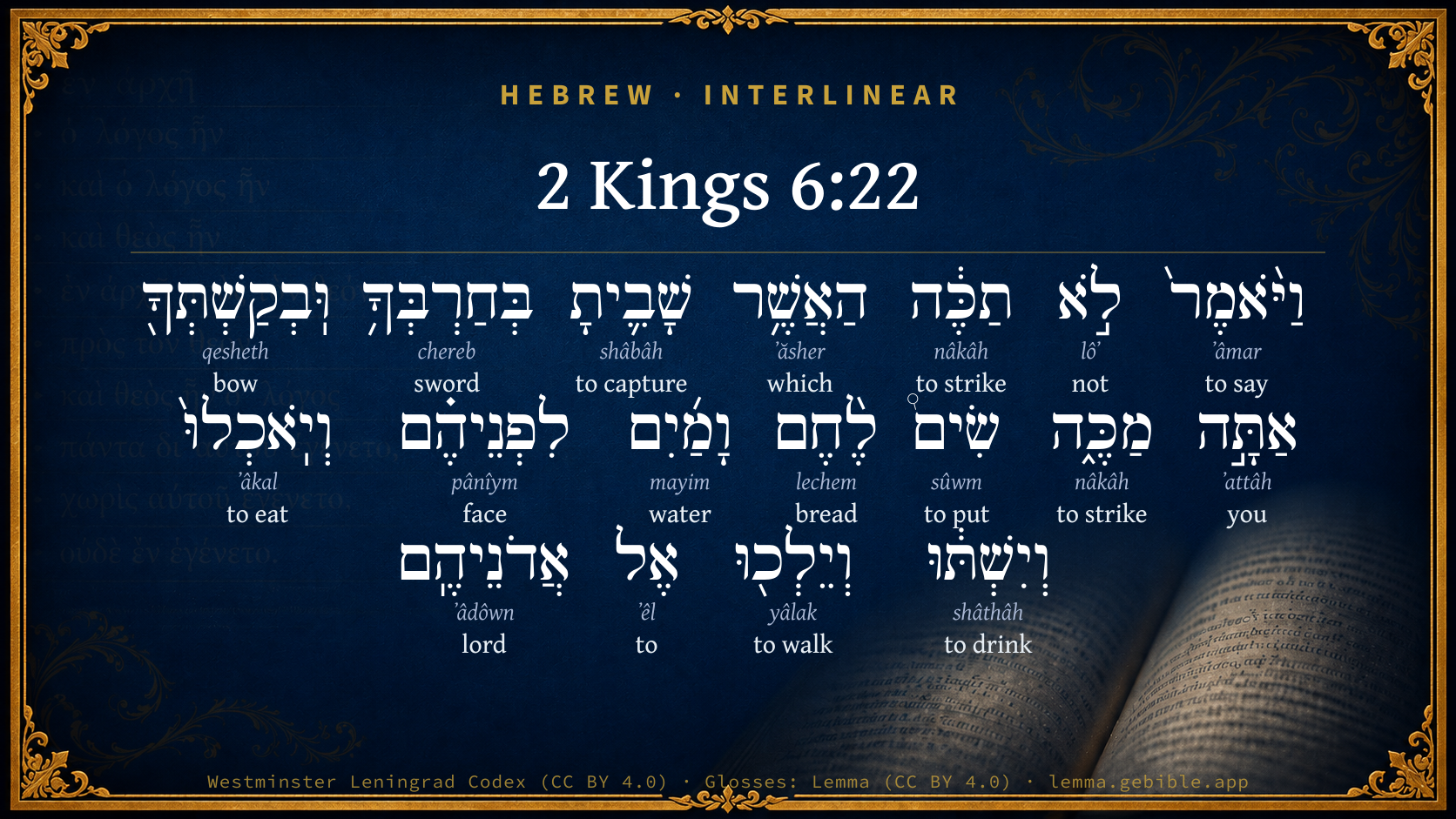
Hebrew (Westminster Leningrad Codex) 2 Kings 6:22 appears in the Hebrew Old Testament. The text above is from the Westminster Leningrad Codex. Each word links to its Strong’s number, a concise gloss, and parsing drawn from the Open Scriptures Hebrew Bible morphology. Click any word for its full Brown-Driver-Briggs (BDB) entry.
Download image
Cite this verse

2 Kings 6:22 (World English Bible). Public Domain. Lemma interlinear Bible study tool, https://lemma.gebible.app/v/2-kings/6/22.

Show BibTeX & RIS
BibTeX
RIS
English Translation
He answered, You shall not strike them: would you strike those whom you have taken captive with your sword and with your bow? set bread and water before them, that they may eat and drink, and go to their master.
World English Bible · Public Domain
Download a study sheet

One document with this verse’s original text, its word-by-word gloss line, the meaning frame, cross-references with their text, attributed commentary, and full source and license credits — printable, and it pastes into notes with its structure intact.

This verse Autodidact and up

Study sheet (.html) Plain text (.txt)

A passage Seminary Student

Up to 50 verses in one chapter. A passage sheet keeps up to 6 commentary sources and 12 cross-references per verse, in the order this page ranks them, and says so on the sheet whenever that leaves anything out. Ask for a single verse and you get the Autodidact verse sheet above.

Everything on this page stays free to read, with no account — the sheet is a download of what is already on screen, not access to it.

Want to remove ads? Support Godless Engineer
Compare translations 3

The same verse in 3 English versions, stacked beneath the original-language interlinear above. Click any original word for its lexicon entry.

Each is an independent rendering of the whole verse — the interlinear is not word-aligned to these translations.

Highlighted words mark where these versions differ — a whole-verse word diff, not a word-by-word alignment.

  • World English Bible Public Domain
    He answered, You shall not strike them: would you strike those whom you have taken captive with your sword and with your bow? set bread and water before them, that they may eat and drink, and go to their master.
  • King James Version Public Domain
    And he answered, Thou shalt not smite them: wouldest thou smite those whom thou hast taken captive with thy sword and with thy bow? set bread and water before them, that they may eat and drink, and go to their master.
  • unfoldingWord Literal Text CC BY-SA 4.0
    And he said, “Do not strike. Are you striking those whom you capture with your sword and with your bow? Put bread and water to their faces that they may eat and drink, and let them go to their master.”

unfoldingWord Literal Text — © unfoldingWord, licensed CC BY-SA 4.0. Word-aligned USFM3 via Door43 (git.door43.org/unfoldingWord/en_ult).

Versions to compare (up to 4)

3 of 4 selected

Show all 18 translations

Every available English version of this verse, each an independent rendering of the whole verse.

  • World English Bible Public Domain
    He answered, You shall not strike them: would you strike those whom you have taken captive with your sword and with your bow? set bread and water before them, that they may eat and drink, and go to their master.
  • Berean Standard Bible Public Domain
    “Do not kill them,” he replied. “Would you kill those you have captured with your own sword or bow? Set food and water before them, that they may eat and drink and then return to their master.”
  • Majority Standard Bible Public Domain
    “Do not kill them,” he replied. “Would you kill those you have captured with your own sword or bow? Set food and water before them, that they may eat and drink and then return to their master.”
  • King James Version Public Domain
    And he answered, Thou shalt not smite them: wouldest thou smite those whom thou hast taken captive with thy sword and with thy bow? set bread and water before them, that they may eat and drink, and go to their master.
  • American Standard Version (1901) Public Domain
    And he answered, Thou shalt not smite them: wouldest thou smite those whom thou hast taken captive with thy sword and with thy bow? set bread and water before them, that they may eat and drink, and go to their master.
  • Revised Version (1885) Public Domain
    And he answered, Thou shalt not smite them: wouldest thou smite those whom thou hast taken captive with thy sword and with thy bow? set bread and water before them, that they may eat and drink, and go to their master.
  • Geneva Bible (1599) Public Domain
    And he answered, Thou shalt not smite them: doest thou not smite them that thou hast taken with thy sworde, and with thy bowe? but set bread and water before them, that they may eate and drinke and goe to their master.
  • Douay-Rheims (1899) Public Domain
    And he said: Thou shalt not kill them: for thou didst not take them with thy sword, or thy bow, that thou mayst kill them: but set bread and water before them, that they may eat and drink, and go to their master.
  • Young's Literal Translation Public Domain
    And he saith, `Thou dost not smite; those whom thou hast taken captive with thy sword and with thy bow art thou smiting? set bread and water before them, and they eat, and drink, and go unto their lord.'
  • Literal Standard Version CC BY-SA 4.0
    And he says, “You do not strike; are you striking those whom you have taken captive with your sword and with your bow? Set bread and water before them, and they eat, and drink, and go to their lord.”
  • Unlocked Literal Bible CC BY-SA 4.0
    Elisha answered, “You must not kill them. Would you kill those whom you had taken captive with your sword and bow? Put bread and water before them, that they may eat and drink, and go to their master.”
  • unfoldingWord Literal Text CC BY-SA 4.0
    And he said, “Do not strike. Are you striking those whom you capture with your sword and with your bow? Put bread and water to their faces that they may eat and drink, and let them go to their master.”
  • Darby Bible Public Domain
    And he said, Thou shalt not smite [them]: wouldest thou smite those whom thou hast taken captive with thy sword and with thy bow? Set bread and water before them, that they may eat and drink, and go to their master.
  • World Messianic Bible Public Domain
    He answered, “You shall not strike them. Would you strike those whom you have taken captive with your sword and with your bow? Set bread and water before them, that they may eat and drink, then go to their master.”
  • Webster's Bible Public Domain
    And he answered, Thou shalt not smite them: wouldst thou smite those whom thou hast taken captive with thy sword and with thy bow? set bread and water before them, that they may eat and drink, and go to their master.
  • Free Bible Version CC BY-SA 4.0
    “No, don't you kill them!” he replied. “Would you kill prisoners you captured with your own sword or bow? Give them some food and water so that they may eat and drink, and then let them go back to their master.”
  • Bible in Basic English Public Domain
    But he said in answer, You are not to put them to death; have you any right to put to death those whom you have not taken prisoner with your sword and your bow? put bread and water before them, so that they may have food and drink and go to their master.
  • JPS Tanakh (1917) Public Domain
    And he answered: 'Thou shalt not smite them; hast thou taken captive with thy sword and with thy bow those whom thou wouldest smite? set bread and water before them, that they may eat and drink, and go to their master.'

Literal Standard Version (2020), Covenant Press — licensed CC BY-SA 4.0. Text via the HelloAO Bible API (eBible.org). Unlocked Literal Bible (unfoldingWord) — licensed CC BY-SA 4.0. Text via the HelloAO Bible API (eBible.org). unfoldingWord Literal Text — © unfoldingWord, licensed CC BY-SA 4.0. Word-aligned USFM3 via Door43 (git.door43.org/unfoldingWord/en_ult). Free Bible Version, Dr. Jonathan Gallagher — licensed CC BY-SA 4.0. Text via the HelloAO Bible API (eBible.org).

Word by word

More ways to search: Search by grammar → Find every occurrence → Compare this word →

Practice this passage: Drill this verse → Learn its vocabulary →

שָׁבִ֛יתָ
shâbâh
H7617
“to capture”
Verb, Qal, Perfect, 2nd Person, Masculine, Singular
Part of Speech
Verb
Stem
Qal
Form
Perfect
Person
2nd Person
Gender
Masculine
Number
Singular
Full BDB Definition

Origin: a primitive root

TWOT: 2311

to take captive - (Qal) - to take captive - captive (participle) - to lead captive - (Niphal) to be taken captive
  1. וַיֹּ֨אמֶר֙ ʼâmar H559 “and · to say” Conjunction + Verb, Qal, Sequential Imperfect, 3rd Person, Masculine, Singular
  2. לֹ֣א lôʼ H3808 “not” Particle, Negative
  3. תַכֶּ֔ה nâkâh H5221 “to strike” Verb, Hiphil, Imperfect, 2nd Person, Masculine, Singular
  4. הַאֲשֶׁ֥ר ʼăsher H834 “which” Particle, Interrogative + Particle, Relative
  5. בְּחַרְבְּךָ֥ chereb H2719 “in/at · sword · your” Preposition + Noun, Common, Feminine, Singular, Construct + Suffix, Personal, 2nd Person, Masculine, Singular
  6. וּֽבְקַשְׁתְּךָ֖ qesheth H7198 “and · in/at · bow · your” Conjunction + Preposition + Noun, Common, Feminine, Singular, Construct + Suffix, Personal, 2nd Person, Masculine, Singular
  7. אַתָּ֣ה ʼattâh H859 “you” Pronoun, Personal, 2nd Person, Masculine, Singular
  8. מַכֶּ֑ה nâkâh H5221 “striking” Verb, Hiphil, Participle Active, Masculine, Singular, Absolute
  9. שִׂים֩ sûwm H7760 “put” Verb, Qal, Imperative, 2nd Person, Masculine, Singular
  10. לֶ֨חֶם lechem H3899 “bread” Noun, Common, Both, Singular, Absolute
  11. וָמַ֜יִם mayim H4325 “and · water(s)” Conjunction + Noun, Common, Masculine, Plural, Absolute
  12. לִפְנֵיהֶ֗ם pânîym H6440 “to/for · face(s) · their” Preposition + Noun, Common, Both, Plural, Construct + Suffix, Personal, 3rd Person, Masculine, Plural
  13. וְיֹֽאכְלוּ֙ ʼâkal H398 “and · to eat” Conjunction + Verb, Qal, Jussive, 3rd Person, Masculine, Plural
  14. וְיִשְׁתּ֔וּ shâthâh H8354 “and · to drink” Conjunction + Verb, Qal, Jussive, 3rd Person, Masculine, Plural
  15. וְיֵלְכ֖וּ yâlak H3212 “and · to walk” Conjunction + Verb, Qal, Imperfect, 3rd Person, Masculine, Plural
  16. אֶל ʼêl H413 “to” Preposition
  17. אֲדֹנֵיהֶֽם ʼâdôwn H113 “lords · their” Noun, Common, Masculine, Plural, Construct + Suffix, Personal, 3rd Person, Masculine, Plural

About this verse

These counts appear in no published source. They are computed here, from the morphology-tagged text and Lemma’s own curated glosses. What Lemma adds →

18
words
17
distinct lemmas
Historical
section

Shared distinctive vocabulary

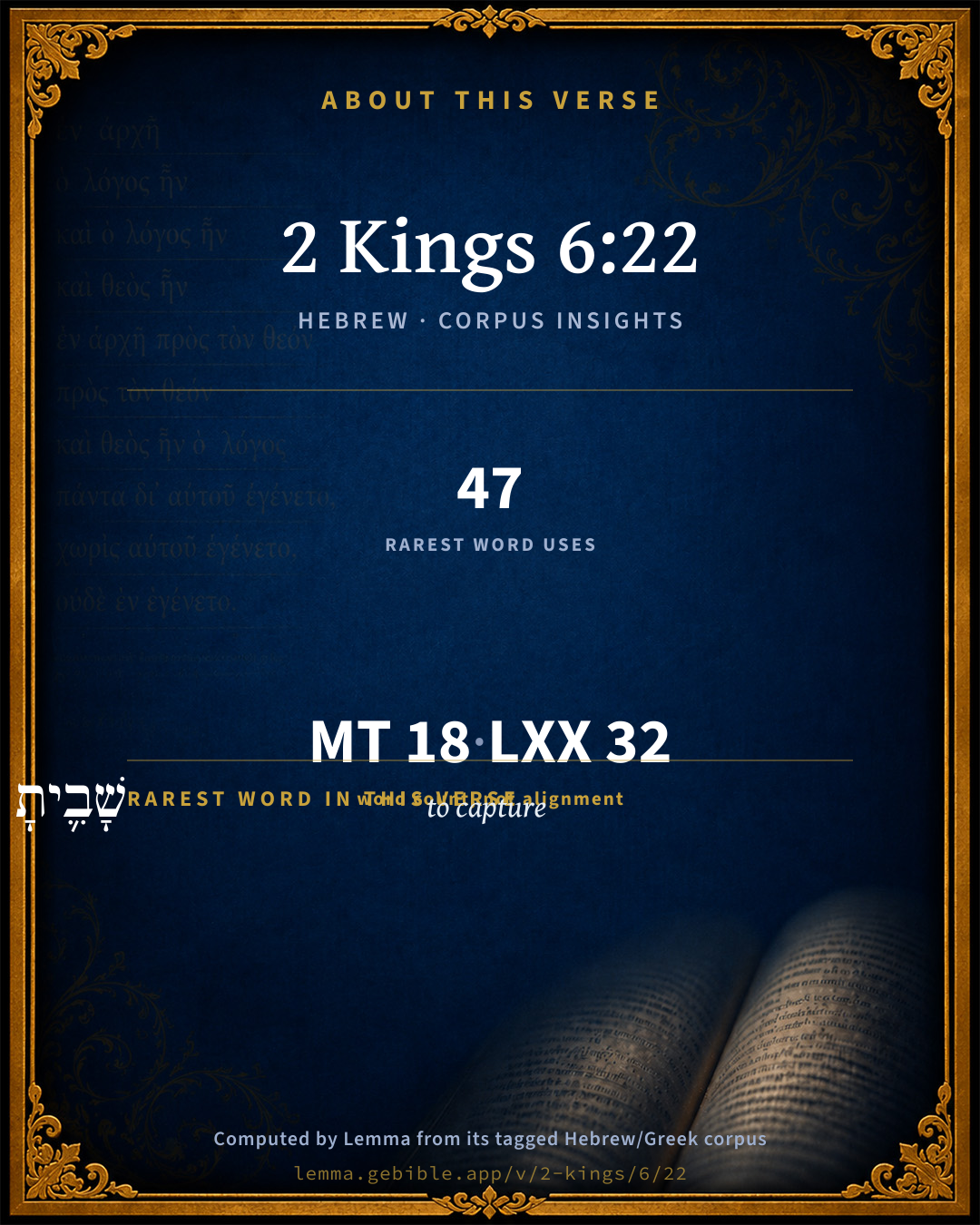
שָׁבִ֛יתָ to capture H7617 occurs in 42 verses of the Hebrew Bible. Also found in:

Grammatical profile

  • 8 verbs
  • 6 nouns
  • 1 pronoun
  • 1 preposition
  • 2 particles

Verb forms

  • וַיֹּ֨אמֶר֙ Qal · Sequential Imperfect
  • תַכֶּ֔ה Hiphil · Imperfect
  • שָׁבִ֛יתָ Qal · Perfect
  • מַכֶּ֑ה Hiphil · Participle Active
  • שִׂים֩ Qal · Imperative
  • וְיֹֽאכְלוּ֙ Qal · Jussive
  • וְיִשְׁתּ֔וּ Qal · Jussive
  • וְיֵלְכ֖וּ Qal · Imperfect

Repetition

A word recurs within this verse — often emphatic in Hebrew:

  • תַכֶּ֔ה to strike H5221 ×2

Hebrew & Septuagint length

In English translation the verse runs 40 words from the Hebrew and 42 from the Septuagint (LXX English) — closely comparable.

A rough comparison of the two English renderings, which tokenize alike — not a word-level alignment.

Word counts can differ between the Hebrew and the Greek without any difference in meaning — e.g. the Hebrew direct-object marker אֵת has no separate Greek word, and Greek often adds the article ὁ.

In the original languages it is 18 Hebrew tokens and 32 Greek tokens — but the two are counted differently (Hebrew bundles its prefixes and suffixes into one token; the Greek is in lemma form), so that isn’t a like-for-like length.

Cross-references

10

Topical passages linked to 2 Kings 6:22 in the Treasury of Scripture Knowledge — connected by theme and wording, ordered by reader-vote popularity; previews shown in the World English Bible.

  • Genesis 48:22 Moreover I have given to you one portion above your brothers, which I took out of the hand of the Amorite with my sword and with my bow."
  • Romans 12:20–21 Therefore "If your enemy is hungry, feed him. If he is thirsty, give him a drink. For in doing so, you will heap coals of fire on his head."
  • Deuteronomy 20:11–16 It shall be, if it make you answer of peace, and open to you, then it shall be, that all the people who are found therein shall become tributary to you, and shall serve you.
  • 2 Chronicles 28:8–15 The children of Israel carried away captive of their brothers two hundred thousand, women, sons, and daughters, and took also away much spoil from them, and brought the spoil to Samaria.
  • Hosea 2:18 In that day I will make a covenant for them with the animals of the field, And with the birds of the sky, And with the creeping things of the ground. I will break the bow, the sword, and the battle out of the land, And will make them lie down safely.
  • Joshua 24:12 I sent the hornet before you, which drove them out from before you, even the two kings of the Amorites; not with your sword, nor with your bow.
  • Psalms 44:6 For I will not trust in my bow, Neither shall my sword save me.
  • Proverbs 25:21–22 If your enemy is hungry, give him food to eat; If he is thirsty, give him water to drink:
  • Hosea 1:7 But I will have mercy on the house of Judah, and will save them by Yahweh their God, and will not save them by bow, nor by sword, nor by battle, by horses, nor by horsemen."
  • Matthew 5:44 But I tell you, love your enemies, bless those who curse you, do good to those who hate you, and pray for those who mistreat you and persecute you,

Cross-references courtesy of OpenBible.info (CC BY 4.0).

Hebrew and Greek witnesses Masoretic Hebrew ↔ Greek Septuagint

The same verse in the two great witnesses to the Old Testament, shown verse-for-verse.

These are two independent witnesses, not word-aligned to each other, and the Septuagint is shown in lemma (dictionary) form.

Hebrew 2 Kings 6:22 Masoretic · Westminster Leningrad Codex

וַיֹּ֨אמֶר֙ לֹ֣א תַכֶּ֔ה הַאֲשֶׁ֥ר שָׁבִ֛יתָ בְּחַרְבְּךָ֥ וּֽבְקַשְׁתְּךָ֖ אַתָּ֣ה מַכֶּ֑ה שִׂים֩ לֶ֨חֶם וָמַ֜יִם לִפְנֵיהֶ֗ם וְיֹֽאכְלוּ֙ וְיִשְׁתּ֔וּ וְיֵלְכ֖וּ אֶל אֲדֹנֵיהֶֽם

He answered, You shall not strike them: would you strike those whom you have taken captive with your sword and with your bow? set bread and water before them, that they may eat and drink, and go to their master.

World English Bible · Public Domain

Greek LXX 2 Kings 6:22 Septuagint · lemma form

καί εἶπον οὐ πατάσσω εἰ μή ὅς αἰχμαλωτεύω ἐν ῥομφαία σύ καί τόξον σύ σύ τύπτω παρατίθημι ἄρτος καί ὕδωρ ἐνώπιον αὐτός καί ἐσθίω καί πίνω καί ἀποἔρχομαι πρός ὁ κύριος αὐτός

And he said, You shall not strike them, unless you would strike those whom you have taken captive with your sword and with your bow: set bread and water before them, and let them eat and drink, and depart to their master.

LXX2012 (modern English Septuagint) · Public Domain

On this verse, Ellicott's Commentary for English Readers discusses the Septuagint’s reading. Read the note in Commentary ↓

Hebrew: Westminster Leningrad Codex (CC BY 4.0). Greek: Septuagint (public domain); English from LXX2012 (modern English Septuagint) (Public Domain). How the Septuagint differs from the Hebrew →

Targum (Aramaic paraphrase)

1

The Targum is the ancient Jewish Aramaic paraphrase of the Hebrew Scriptures — an interpretive translation, not the Hebrew text itself. Onkelos (literal) and Pseudo-Jonathan (expansive) render the Torah, and Jonathan the Prophets. Coverage is partial: where no permissively-licensed English translation exists for a verse, only the Aramaic is shown. This is verse-level text, not a word-by-word alignment to the Hebrew.

  1. Targum Jonathan Prophets (Joshua–Malachi)
    וַאֲמַר לָא תִקְטוֹל הָא דִשְׁבֵיתָא בְּחַרְבָּךְ וּבְקַשְׁתָּךְ אַתְּ קְטֵיל שַׁוֵי לַחְמָא וּמַיָא קֳדָמֵיהוֹן וְיֵכְלוּן וְיִשְׁתּוּן וְיֵזְלוּן לְרִבּוֹנֵיהוֹן:

    (no public-domain English translation for this verse)

    Targum Jonathan — Aramaic: “Mikraot Gedolot” (public domain). English: “Sefaria Community Translation” (CC0 1.0 (public-domain dedication)); “London "Chaldee Paraphrase," 1871” (public domain). Text via Sefaria.

Commentary

Notes on 2 Kings 6:22 from classic Christian and Jewish commentators (each source and its license shown beneath its notes). The classic Christian expositions comment on the surrounding passage and are grouped to its opening verse, so a note may address several verses; the Jewish commentaries on the Tanakh (Rashi and others) are per-verse, so they appear only where the commentator wrote on this verse.

Lemma curates 59 commentaries, every one of them public domain or Creative Commons licensed, each selected and text-cleaned for this edition rather than reprinted as found. About our sources →

Trapp's Complete Commentary

John Trapp

2Ki 6:22 And he answered, Thou shalt not smite [them]: wouldest thou smite those whom thou hast taken captive with thy sword and with thy bow? set bread and water before them, that they may eat and drink, and go to their master.

Ver. 22. Thou shalt not smite them.] Though Elisha well knew that they came down to Dothan with bloody purposes toward him. This was "not to be overcome of evil," as the next was to "overcome evil with good."

Set bread and water before them.] Oh, noble revenge I Thus, thus should a prophet punish his persecutors: "If thine enemy hunger, feed him," &c. {Rom 12:20 Pro 25:21} {See Trapp on "Rom 12:20"} {See Trapp on "Pro 25:21"}

And go to their master.] Praising their cheer, and convincing him of thy beneficence, a shame to his malevolence. We should confute the world’s miscarriages by our contrary practices.

John Trapp, A Commentary or Exposition upon All the Books of the Old and New Testament (1647–1656) — public domain. Text from a community e-Sword module.

Adam Clarke's Commentary

Verse 22. Whom thou hast taken captive] Those who in open battle either lay down their arms, or are surrounded, and have their retreat cut off, are entitled to their lives, much more those who are thus providentially put into thy hand, without having been in actual hostility against thee. Give them meat and drink, and send them home to their master, and let them thus know that thou fearest him not, and art incapable of doing an ungenerous or unmanly action.

Adam Clarke's Commentary on the Bible (1810–1826) — public domain. Text from a community e-Sword/MySword module.

Ellicott's Commentary for English Readers

(22) Thou shalt not.—Or, thou must not.

Wouldest thou smite . . . thy bow?—The Hebrew order is, “An quos ceperis gladío et arcu percussuruses?” (Comp. Gen_48:22.) Elisha says, “These men are virtually prisoners of war, and therefore are not to be slain in cold blood.”

The LXX., Targum, Syriac, and Vulg., ignore the interrogative particle. The Targum and Syriac render, “Lo those whom thou hast taken captive with thy sword, &c., thou dost (or mayst) kill.” (Comp. Deu_20:13.) The Vulg., “neque enim cepisti eos, ut percutias,” and the Arabic, “Didst thou take them captive with thy sword, &c., that thou shouldest slay them?” come to the same thing. These renderings are interesting, as they make Elisha deny the king’s right of disposal of these prisoners of Jehovah. The purpose of the miracle would have been frustrated by killing the Syrians. That purpose was to force their king and them to acknowledge the might of the true God.

A Bible Commentary for English Readers, edited by Charles John Ellicott (1878–1897) — public domain. Text from a community e-Sword module.

The Cambridge Bible for Schools and Colleges

gen. ed. J. J. S. Perowne

22. wouldest thou smite those whom thou hast taken captive] The prophet points out that the men are not even captives whom the king himself has taken. Had they been so, yet the laws of war would have forbidden their slaughter at such a time and in cold blood. Much more is it unlawful to slay these, who are God’s prisoners. Some have preferred to take the sentence as not interrogative. ‘Those whom thou hadst taken prisoners thou mightest be allowed to slay, but not these.’ Deu_20:13 sanctions the slaying prisoners of war; but it is doubtful whether the grammar of the original in this verse can be taken as anything but interrogative.

set bread and water before them] It is manifest that the prophet was setting forth a higher degree of humanity than was usual towards prisoners. We need not therefore be surprised, if in the former clause of the verse he does not speak according to the sterner precept of Deuteronomy, which was laid down in order that the idolaters might be exterminated from Canaan.

The Cambridge Bible for Schools and Colleges (gen. ed. J. J. S. Perowne; Cambridge University Press, 1878–1918) — public domain. Text from a community e-Sword module.

John Gill's Exposition

And it came to pass after this, that Benhadad king of Syria gathered all his host,.... Still retaining a grudge and enmity against Israel, and not at all softened by the kind and humane treatment his forces had met with, when in the hands of Israel; and finding he could do nothing in a secret way, by ambush, mustered all his forces together, to try what he could by open war:

and went up, and besieged Samaria; Jehoram king of Israel not being able to stop him till he came to his capital, which he laid close siege to.

John Gill's Exposition of the Whole Bible (1746–1763) — public domain (CC PDM 1.0). Text via the HelloAO Bible API.

Albert Barnes' Notes on the Bible

Wouldest thou smite ... - It is doubtful whether this sentence is really interrogative. Others translate - “Smite those whom thou hast taken captive with thy sword,” etc. A contrast is intended between ordinary captives - those made with the sword and bow - and these particular prisoners who have been given into the king’s hand by God. The former, Jehoram is told, he may slay, if he pleases Deu 20:13, the latter, he is informed, he must not slay (compare the marginal reference).

Albert Barnes' Notes on the Bible (1834–1885) — public domain. Text from a community e-Sword/MySword module.

Haydock's Catholic Bible Commentary

For thou. Hebrew, "Dost thou kill, &c.?" If those who have surrendered themselves in battle be often spared, though they might be slain by the strict laws of war, how much less ought these men to be treated with such severity? (Calmet) --- Sicut bellanti & resistenti violentia redditur: ita victo vel capto misericorida jam debetur. (St. Augustine, ep. 1. ad Bonif.) (Grotius) --- And water, all necessary provisions. (Worthington) --- These men were suffered to live that they might relate the wonders of God. (Theodoret, q. 20.)

George Leo Haydock (1774–1849), Haydock's Catholic Family Bible and Commentary, 1859 edition — public domain. Excludes Psalms (Douay-Rheims chapter numbering differs from Protestant) and Deuterocanonical books (Catholic canon only).

Matthew Poole's English Annotations

It is against the laws of humanity, and custom of war, to kill captives, though thou thyself hast taken them with thy own sword and bow, which may seem to give thee some colour of right to destroy them; but much more unworthy will it be in cold blood to kill these, whom not thy arms, but God’s miraculous providence, hath put into thy hands.

Set bread and water before them, i.e. give them meat and drink, which may refresh and strengthen them for their charity, in doing good to their enemies, which was much to the honour of the true religion; and of no less prudence, that hereby the hearts of the Syrians might be both mollified towards the Israelites, and afraid to oppose that people who had such an invincible Protector.

Matthew Poole's English Annotations on the Holy Bible (1683–1685) — public domain. Text from a community e-Sword/MySword module.

Whedon's Commentary on the Bible

Daniel D. Whedon

22. Wouldest thou smite — That is, according to many interpreters, thou wouldest not smite those whom thou hadst made prisoners of war, much less these whom God has miraculously delivered into thy hands. But it is a fact that the law authorized the Israelites to destroy their prisoners of war, (Deu_20:13,) and it was often actually done, and in more than one instance they were severely blamed for neglecting to do it. Better, therefore, with the Septuagint, Chaldee, Syriac, and Vulgate versions, not to render it as a question, but thus: That which thou hast captured with thy sword and with thy bow thou mayest smite; set bread and water before these, etc. That is, do not treat these who have been so marvellously delivered into thy hands as ordinary prisoners of war; feast them well and send them back, and thou shalt accomplish a far greater victory. This was an anticipation of the Gospel rule, “If thine enemy hunger, feed him; if he thirst, give him drink: for in so doing thou shalt heap coals of fire on his head.” Rom_12:20.

Daniel D. Whedon (gen. ed.), Commentary on the Old and New Testaments (1874–1909) — public domain. Text from a community e-Sword module.

The Pulpit Commentary

And he answered, Thou shalt not smite them. The prophet has no doubt. His prohibition is absolute. These prisoners, at any rate, are not to be slain. "The object of the miracle," as Keil says, "would have been frustrated, if the Syrians had been slain. For the intention was to show the Syrians that they had to do with a prophet of the true God, against whom no human power could be of any avail, that they might learn to fear the Almighty God" ("Commentary on 2 Kings," p. 3.27, Eng. trans.). There was also, perhaps, a further political object. By sparing the prisoners and treating them with kindness, it might be possible to touch the heart of the King of Syria, and dispose him towards peace. Wouldest thou smite those whom thou hast taken captive with thy sword and with thy bow? rather, Wouldest thou be smiting those, etc.? i.e. "Wouldest thou, in smiting these persons, be smiting those whom thou hadst made prisoners in war, so as to be able to justify thy conduct by Deu_20:13? No; thou wouldest not. Therefore thou shalt not smite them." Set bread and water before them. "Bread" and "water" stand for meat and drink generally. Elisha bids Jehoram entertain the captive Syrians hospitably, and then send them back to Benhadad. That they may eat and drink, and go to their master.

The Pulpit Commentary (1880–1919), ed. H.D.M. Spence-Jones & Joseph S. Exell — public domain. Text from a community e-Sword module.

John Wesley's Explanatory Notes

Wouldest thou smite - It is against the laws of humanity, to kill captives, though thou thyself hast taken them with thy own sword and bow; which might seem to give thee some colour to destroy them; but much more unworthy will it be in cold blood to kill these, whom not thy arms, but God's providence hath put into thy hands. Set bread - Give them meat and drink, which may refresh and strengthen them for their journey. This was an action of singular piety and charity, in doing good to their enemies, which was much to the honour of the true religion; and of no less prudence, that hereby the hearts of the Syrians might be mollified towards the Israelites.

John Wesley, Explanatory Notes Upon the Whole Bible (1754–1765) — public domain. Text via the GEBible commentary corpus.

unfoldingWord translationNotes

Door43 World Missions Community

Elisha answered

Elisha was replying to the king of Israel's question.

Would you kill those whom you had taken captive with your sword and bow?

Elisha uses this rhetorical question to rebuke the king and tell him not to kill these men. The words "sword and bow" are a metonym for war in which soldiers use swords and bows and arrows. This can be written as a statement. AT: "You would not kill men whom you had captured in war, so you should not kill these men." (See: Rhetorical Question and Metonymy)

Put bread and water before them, that they may eat and drink

Here "bread" refers to food in general. AT: "Give them food to eat and water to drink" (See: Synecdoche)

go to their master

This refers to the king of Aram.

So the king prepared much food for them

The king ordered his servants to prepare the food. He did not prepare the food himself. AT: "Then the king ordered his servants to prepare a lot of food for them" (See: Metonymy)

Those bands

"Those groups"

did not return for a long time into the land of Israel

This means that they did not attack Israel for a long time. AT: "stopped attacking the land of Israel for a long time" (See: Assumed Knowledge and Implicit Information)

translationWords

captive

sword

bow and arrow

unfoldingWord translationNotes — © Distant Shores Media and the Door43 World Missions Community, licensed CC BY-SA 4.0. Source: git.door43.org/Door43/en_tn.

Rashi

Rabbi Shlomo Yitzchaki (Rashi)

[Would you slay] those you captured, etc. Is it your custom to slay those whom you bring into captivity (and destroy them)?

Rashi on the Tanakh — English translations: “The Judaica Press complete Tanach with Rashi, translated by A. J. Rosenberg” (CC BY 4.0); “Pentateuch with Rashi's commentary by M. Rosenbaum and A.M. Silbermann, 1929-1934” (public domain); “The Metsudah Tanach series, Lakewood, N.J” (CC BY 4.0); and “The Book of Joshua, Metsudah Publications, 1997” (CC BY 4.0). Text via Sefaria.

Lesson kit

Teaching starters — assembled from the data on this page, not authored interpretation. Every prompt links to the verse data it draws on. Edit before teaching.

2 Kings, in the Historical, opens this verse with 18 words (17 distinct Hebrew lemmas). Its most distinctive word is shâbâh (“to capture”). A historical commentator’s framing appears above. Read the whole chapter for the surrounding context.

Discussion questions

  1. The word shâbâh carries the sense “to capture.” How does it shape the verse?
  2. Genesis 14:14 shares the word «to capture» with this verse. How do the two illuminate each other?
  3. “to strike” occurs 2× in this one verse. What is the effect of the repetition?
  4. These translations render this verse differently; the difference is in the English rendering, not the original. What questions does that raise?
  5. The verb «וַיֹּ֨אמֶר֙» is Qal Sequential Imperfect. How does its form color the action?
  6. Reading how Trapp's Complete Commentary and Adam Clarke's Commentary read this verse, where do the two commentators agree and where do they part?

Things to notice

Reading settings

Reading text

Shown beneath each verse's original-language words.

Old Testament
Old Testament edition

Read the OT as the Masoretic Hebrew (MT) or the Greek Septuagint (LXX).

English shown for the Greek Septuagint (in the Hebrew ↔ Greek comparison).

Comparing translations? Open the Compare panel on any verse page to stack up to four side by side.