
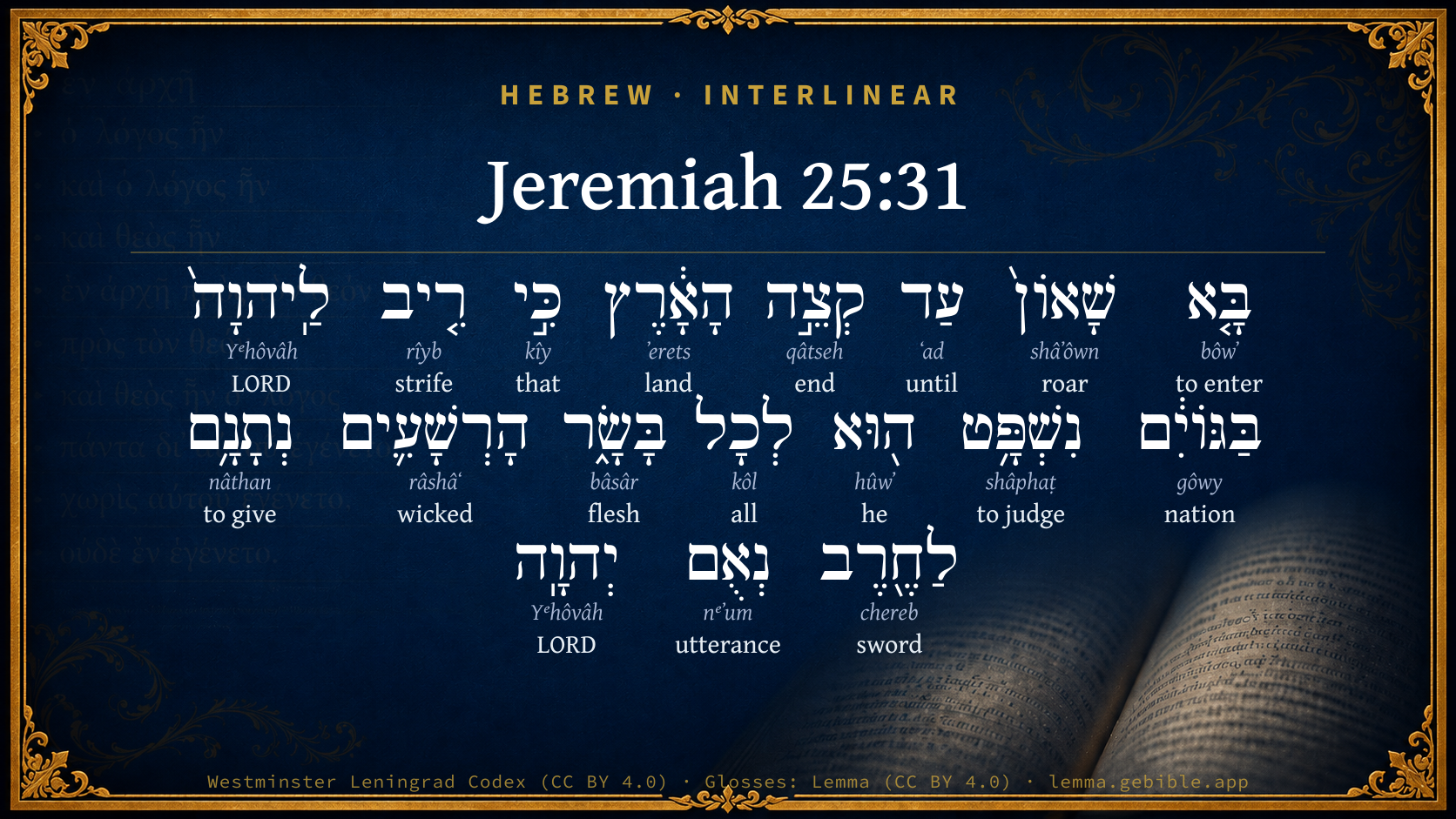
Jeremiah 25:31

Hebrew (Westminster Leningrad Codex) Jeremiah 25:31 appears in the Hebrew Old Testament. The text above is from the Westminster Leningrad Codex. Each word links to its Strong’s number, a concise gloss, and parsing drawn from the Open Scriptures Hebrew Bible morphology. Click any word for its full Brown-Driver-Briggs (BDB) entry.
Download image
Cite this verse

Jeremiah 25:31 (World English Bible). Public Domain. Lemma interlinear Bible study tool, https://lemma.gebible.app/v/jeremiah/25/31.

Show BibTeX & RIS
BibTeX
RIS
English Translation
A noise shall come even to the end of the earth; for Yahweh has a controversy with the nations; he will enter into judgment with all flesh: as for the wicked, he will give them to the sword, says Yahweh.
World English Bible · Public Domain
Download a study sheet

One document with this verse’s original text, its word-by-word gloss line, the meaning frame, cross-references with their text, attributed commentary, and full source and license credits — printable, and it pastes into notes with its structure intact.

This verse Autodidact and up

Study sheet (.html) Plain text (.txt)

A passage Seminary Student

Up to 50 verses in one chapter. A passage sheet keeps up to 6 commentary sources and 12 cross-references per verse, in the order this page ranks them, and says so on the sheet whenever that leaves anything out. Ask for a single verse and you get the Autodidact verse sheet above.

Everything on this page stays free to read, with no account — the sheet is a download of what is already on screen, not access to it.

Want to remove ads? Support Godless Engineer
Compare translations 3

The same verse in 3 English versions, stacked beneath the original-language interlinear above. Click any original word for its lexicon entry.

Each is an independent rendering of the whole verse — the interlinear is not word-aligned to these translations.

Highlighted words mark where these versions differ — a whole-verse word diff, not a word-by-word alignment.

  • World English Bible Public Domain
    A noise shall come even to the end of the earth; for Yahweh has a controversy with the nations; he will enter into judgment with all flesh: as for the wicked, he will give them to the sword, says Yahweh.
  • King James Version Public Domain
    A noise shall come even to the ends of the earth; for the LORD hath a controversy with the nations, he will plead with all flesh; he will give them that are wicked to the sword, saith the LORD.
  • unfoldingWord Literal Text CC BY-SA 4.0
    A tumult will come to the end of the earth, for Yahweh has a dispute with the nations. He is entering into judgment with all flesh; the wicked—he will give them to the sword’”—the declaration of Yahweh.

unfoldingWord Literal Text — © unfoldingWord, licensed CC BY-SA 4.0. Word-aligned USFM3 via Door43 (git.door43.org/unfoldingWord/en_ult).

Versions to compare (up to 4)

3 of 4 selected

Show all 18 translations

Every available English version of this verse, each an independent rendering of the whole verse.

  • World English Bible Public Domain
    A noise shall come even to the end of the earth; for Yahweh has a controversy with the nations; he will enter into judgment with all flesh: as for the wicked, he will give them to the sword, says Yahweh.
  • Berean Standard Bible Public Domain
    The tumult will resound to the ends of the earth because the LORD brings a charge against the nations. He brings judgment on all mankind and puts the wicked to the sword,’” declares the LORD.
  • Majority Standard Bible Public Domain
    The tumult will resound to the ends of the earth because the LORD brings a charge against the nations. He brings judgment on all mankind and puts the wicked to the sword,’” declares the LORD.
  • King James Version Public Domain
    A noise shall come even to the ends of the earth; for the LORD hath a controversy with the nations, he will plead with all flesh; he will give them that are wicked to the sword, saith the LORD.
  • American Standard Version (1901) Public Domain
    A noise shall come even to the end of the earth; for Jehovah hath a controversy with the nations; he will enter into judgment with all flesh: as for the wicked, he will give them to the sword, saith Jehovah.
  • Revised Version (1885) Public Domain
    A noise shall come even to the end of the earth; for the LORD hath a controversy with the nations, he will plead with all flesh; as for the wicked, he will give them to the sword, saith the LORD.
  • Geneva Bible (1599) Public Domain
    The sounde shall come to the endes of the earth: for the Lord hath a controuersie with the nations, and will enter into iudgement with all flesh, and he will giue them that are wicked, to the sworde, saith the Lord.
  • Douay-Rheims (1899) Public Domain
    The noise is come even to the ends of the earth: for the Lord entereth into judgement with the nations: he entereth into judgement with all flesh; the wicked I have delivered up to the sword, saith the Lord.
  • Young's Literal Translation Public Domain
    Wasting hath come unto the end of the earth, For a controversy hath Jehovah with nations, He hath executed judgment for all flesh, The wicked! He hath given them to the sword, An affirmation of Jehovah.
  • Literal Standard Version CC BY-SA 4.0
    A rumbling has come to the end of the earth, || For YHWH has a controversy with nations, || He has executed judgment for all flesh, || He has given the wicked to the sword,” || A declaration of YHWH.
  • Unlocked Literal Bible CC BY-SA 4.0
    The sound of battle will resound to the ends of the earth, for Yahweh brings charges against the nations, and he brings judgment on all flesh, and the wicked ones he will put to the sword—this is Yahweh's declaration.'
  • unfoldingWord Literal Text CC BY-SA 4.0
    A tumult will come to the end of the earth, for Yahweh has a dispute with the nations. He is entering into judgment with all flesh; the wicked—he will give them to the sword’”—the declaration of Yahweh.
  • Darby Bible Public Domain
    The noise shall come to the end of the earth: for Jehovah hath a controversy with the nations, he entereth into judgment with all flesh; as for the wicked, he will give them up to the sword, saith Jehovah.
  • World Messianic Bible Public Domain
    A noise will come even to the end of the earth; for the LORD has a controversy with the nations. He will enter into judgment with all flesh. As for the wicked, he will give them to the sword,”’ says the LORD.”
  • Webster's Bible Public Domain
    A noise shall come even to the ends of the earth; for the LORD hath a controversy with the nations, he will plead with all flesh; he will give them that are wicked to the sword, saith the LORD.
  • Free Bible Version CC BY-SA 4.0
    The sound will reach everywhere on the earth because the Lord is accusing the nations. He is judging everyone, executing the wicked, declares the Lord.
  • Bible in Basic English Public Domain
    A noise will come, even to the end of the earth; for the Lord has a cause against the nations, he will give his decision against all flesh; as for the evil-doers, he will give them to the sword, says the Lord.
  • JPS Tanakh (1917) Public Domain
    A noise is come even to the end of the earth; for the LORD hath a controversy with the nations, He doth plead with all flesh; as for the wicked, He hath given them to the sword, saith the LORD.

Literal Standard Version (2020), Covenant Press — licensed CC BY-SA 4.0. Text via the HelloAO Bible API (eBible.org). Unlocked Literal Bible (unfoldingWord) — licensed CC BY-SA 4.0. Text via the HelloAO Bible API (eBible.org). unfoldingWord Literal Text — © unfoldingWord, licensed CC BY-SA 4.0. Word-aligned USFM3 via Door43 (git.door43.org/unfoldingWord/en_ult). Free Bible Version, Dr. Jonathan Gallagher — licensed CC BY-SA 4.0. Text via the HelloAO Bible API (eBible.org).

Word by word

More ways to search: Search by grammar → Find every occurrence → Compare this word →

Practice this passage: Drill this verse → Learn its vocabulary →

שָׁאוֹן֙
shâʼôwn
H7588
“roar”
Noun, Common, Masculine, Singular, Absolute
Part of Speech
Noun
Type
Common
Gender
Masculine
Number
Singular
State
Absolute
Full BDB Definition

Origin: from H7582

TWOT: 2301c

roar, din, crash, uproar - roar (of water) - uproar (of revellers)
  1. בָּ֤א bôwʼ H935 “to enter” Verb, Qal, Perfect, 3rd Person, Masculine, Singular
  2. עַד ʻad H5704 “until” Preposition
  3. קְצֵ֣ה qâtseh H7097 “end of” Noun, Common, Both, Singular, Construct
  4. הָאָ֔רֶץ ʼerets H776 “the · land” Particle, Definite Article + Noun, Common, Both, Singular, Absolute
  5. כִּ֣י kîy H3588 “that” Conjunction
  6. רִ֤יב rîyb H7379 “strife” Noun, Common, Both, Singular, Absolute
  7. לַֽיהוָה֙ Yᵉhôvâh H3068 “to/for · LORD” Preposition + Noun, Proper
  8. בַּגּוֹיִ֔ם gôwy H1471 “in/at the · nations” Preposition, Determined + Noun, Common, Masculine, Plural, Absolute
  9. נִשְׁפָּ֥ט shâphaṭ H8199 “judging” Verb, Niphal, Participle Active, Masculine, Singular, Absolute
  10. ה֖וּא hûwʼ H1931 “he” Pronoun, Personal, 3rd Person, Masculine, Singular
  11. לְכָל kôl H3605 “to/for · all of” Preposition + Noun, Common, Masculine, Singular, Construct
  12. בָּשָׂ֑ר bâsâr H1320 “flesh” Noun, Common, Masculine, Singular, Absolute
  13. הָרְשָׁעִ֛ים râshâʻ H7563 “the · wicked” Particle, Definite Article + Adjective, Adjective, Masculine, Plural, Absolute
  14. נְתָנָ֥ם nâthan H5414 “to give · them” Verb, Qal, Perfect, 3rd Person, Masculine, Singular + Suffix, Personal, 3rd Person, Masculine, Plural
  15. לַחֶ֖רֶב chereb H2719 “to/for the · sword” Preposition, Determined + Noun, Common, Feminine, Singular, Absolute
  16. נְאֻם nᵉʼum H5002 “utterance of” Noun, Common, Masculine, Singular, Construct
  17. יְהוָֽה Yᵉhôvâh H3068 “LORD” Noun, Proper

About this verse

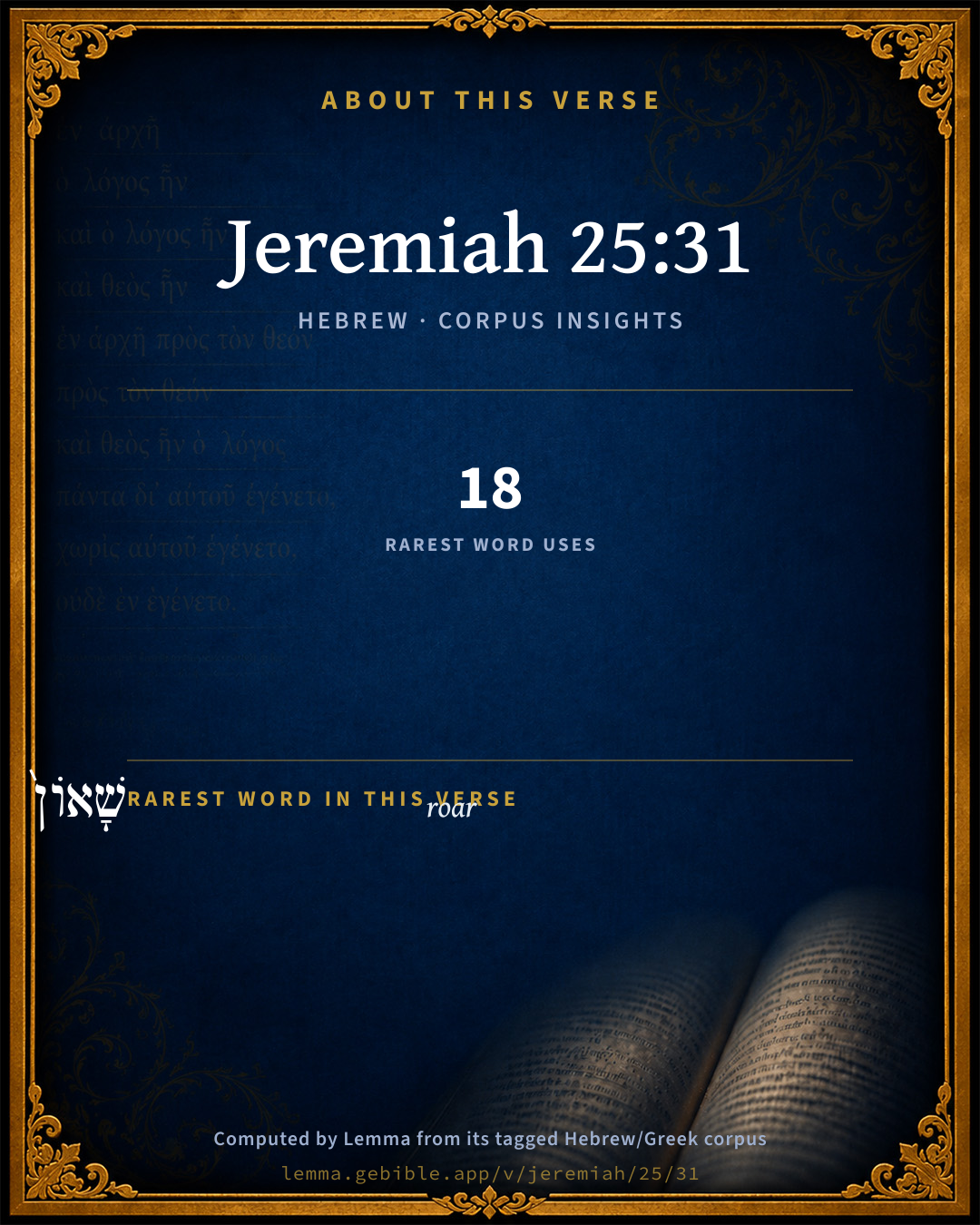
These counts appear in no published source. They are computed here, from the morphology-tagged text and Lemma’s own curated glosses. What Lemma adds →

18
words
17
distinct lemmas
Prophets
section

Notable vocabulary

The rarest word here is שָׁאוֹן֙ roar H7588 — appearing just 18 times in the whole Hebrew Bible.

Shared distinctive vocabulary

שָׁאוֹן֙ roar H7588 occurs in 16 verses of the Hebrew Bible. Also found in:

Grammatical profile

  • 3 verbs
  • 11 nouns
  • 1 adjective
  • 1 pronoun
  • 1 preposition
  • 1 conjunction

Verb forms

  • בָּ֤א Qal · Perfect
  • נִשְׁפָּ֥ט Niphal · Participle Active
  • נְתָנָ֥ם Qal · Perfect

Repetition

A word recurs within this verse — often emphatic in Hebrew:

  • לַֽיהוָה֙ LORD H3068 ×2

Cross-references

9

Topical passages linked to Jeremiah 25:31 in the Treasury of Scripture Knowledge — connected by theme and wording, ordered by reader-vote popularity; previews shown in the World English Bible.

  • Hosea 4:1 Hear the word of Yahweh, you children of Israel; For Yahweh has a charge against the inhabitants of the land: "Indeed there is no truth, Nor goodness, Nor knowledge of God in the land.
  • Joel 3:2 I will gather all nations, And will bring them down into the valley of Jehoshaphat; And I will execute judgment on them there for my people, And for my heritage, Israel, whom they have scattered among the nations. They have divided my land,
  • Isaiah 66:16 For by fire will Yahweh execute judgment, and by his sword, on all flesh; and the slain of Yahweh shall be many.
  • Micah 6:2 Hear, you mountains, Yahweh's controversy, And you enduring foundations of the earth; For Yahweh has a controversy with his people, And he will contend with Israel.
  • Ezekiel 20:35–36 and I will bring you into the wilderness of the peoples, and there will I enter into judgment with you face to face.
  • Isaiah 34:8 For Yahweh has a day of vengeance, a year of recompense for the cause of Zion.
  • Hosea 12:2 Yahweh also has a controversy with Judah, And will punish Jacob according to his ways; According to his deeds he will repay him.
  • Jeremiah 45:5 Seek you great things for yourself? Don't seek them; for, behold, I will bring evil on all flesh, says Yahweh; but your life will I give to you for a prey in all places where you go.
  • Ezekiel 38:22 With pestilence and with blood will I enter into judgment with him; and I will rain on him, and on his hordes, and on the many peoples who are with him, an overflowing shower, and great hailstones, fire, and sulfur.

Cross-references courtesy of OpenBible.info (CC BY 4.0).

Hebrew and Greek witnesses Masoretic Hebrew ↔ Greek Septuagint

The same verse in the two great witnesses to the Old Testament, shown verse-for-verse.

These are two independent witnesses, not word-aligned to each other, and the Septuagint is shown in lemma (dictionary) form.

Hebrew Jeremiah 25:31 Masoretic · Westminster Leningrad Codex

בָּ֤א שָׁאוֹן֙ עַד קְצֵ֣ה הָאָ֔רֶץ כִּ֣י רִ֤יב לַֽיהוָה֙ בַּגּוֹיִ֔ם נִשְׁפָּ֥ט ה֖וּא לְכָל בָּשָׂ֑ר הָרְשָׁעִ֛ים נְתָנָ֥ם לַחֶ֖רֶב נְאֻם יְהוָֽה

A noise shall come even to the end of the earth; for Yahweh has a controversy with the nations; he will enter into judgment with all flesh: as for the wicked, he will give them to the sword, says Yahweh.

World English Bible · Public Domain

Greek LXX Structure differs

In the Septuagint, Jeremiah is about an eighth shorter than the Hebrew and arranges its material differently — the Oracles Against the Nations (Hebrew chapters 46–51) appear in the middle of the Greek book, after 25:13. Because the chapter and verse boundaries do not line up, a verse-for-verse comparison with the Hebrew is not shown.

A verse-for-verse comparison isn’t shown here because the chapters and verses don’t line up. Switch to the LXX edition with the MT / LXX toggle above to read the Greek directly.

Hebrew: Westminster Leningrad Codex (CC BY 4.0). Greek: Septuagint (public domain); English from a public-domain English Septuagint. How the Septuagint differs from the Hebrew →

Targum (Aramaic paraphrase)

1

The Targum is the ancient Jewish Aramaic paraphrase of the Hebrew Scriptures — an interpretive translation, not the Hebrew text itself. Onkelos (literal) and Pseudo-Jonathan (expansive) render the Torah, and Jonathan the Prophets. Coverage is partial: where no permissively-licensed English translation exists for a verse, only the Aramaic is shown. This is verse-level text, not a word-by-word alignment to the Hebrew.

  1. Targum Jonathan Prophets (Joshua–Malachi)
    מְטָא אִתְרְגוֹשָׁא עַד סְיָפֵי אַרְעָא אֲרֵי דִינָא קֳדָם יְיָ בְּעַמְמַיָא מִתְפְּרַע הוּא לְכָל בִּשְׂרָא רַשִׁיעַיָא דִבְּהוֹן מַסְרִינוּן לְקַטָלָא אֲמַר יְיָ:

    (no public-domain English translation for this verse)

    Targum Jonathan — Aramaic: “Mikraot Gedolot” (public domain). English: “Sefaria Community Translation” (CC0 1.0 (public-domain dedication)); “London "Chaldee Paraphrase," 1871” (public domain). Text via Sefaria.

Commentary

Notes on Jeremiah 25:31 from classic Christian and Jewish commentators (each source and its license shown beneath its notes). The classic Christian expositions comment on the surrounding passage and are grouped to its opening verse, so a note may address several verses; the Jewish commentaries on the Tanakh (Rashi and others) are per-verse, so they appear only where the commentator wrote on this verse.

Lemma curates 59 commentaries, every one of them public domain or Creative Commons licensed, each selected and text-cleaned for this edition rather than reprinted as found. About our sources →

Trapp's Complete Commentary

John Trapp

Jer 25:31 A noise shall come [even] to the ends of the earth; for the LORD hath a controversy with the nations, he will plead with all flesh; he will give them [that are] wicked to the sword, saith the LORD.

Ver. 31. For the Lord hath a controversy with the nations.] {a} A disceptation, which showeth that his revenge to be taken upon them shall be just and lawful. It shall well appear to be so, at that day of wrath and revelation of the righteous judgment of God. {Rom 2:5}

{a} Disceptatio catholica.

John Trapp, A Commentary or Exposition upon All the Books of the Old and New Testament (1647–1656) — public domain. Text from a community e-Sword module.

The Biblical Illustrator

Joseph S. Exell

Jer_25:31

He will plead with all flesh.

No excuse needed for faith in God

I. God pleads with men chiefly through the Spirit of the life of Jesus Christ. This part of our life is a probation, like being at school; it is an apprenticeship to eternal life, a life in which we are to be journeymen and masters of the work of being good and doing good. We are learners here. Some learn their lifes lesson thoroughly, and others only partially. God means us to learn; and if a man will not do Gods will, he can only learn by the bitter pain of experience. There are only two ways of learning--either by doing Gods will, or by disobeying it; either way will bring us to our senses at some time or other, either in this world or in that which is to come.

II. Christianity urges that if we be wise every one will choose the highest aim of life. Unless we have some great object in view, our life is a task which is hard to bear; it is like being rubbed with sandpaper, everything seeming to be in unpleasant friction with us. Yet you cannot get a polish without friction; and so the friction of daily life that vexes and torments us, is an experience which is good for us. It is one of Gods means of polishing us; but it is unpleasant, like having small pebbles in ones boots. It is, however, a needful discipline. But were we humbly and lovingly to do Gods will, as you would have your little child do your will, life would not be a painful task, nor would it be a state of perpetual friction.

III. Christianity also teaches us that God is worthy to be both esteemed and loved.

IV. Christianity sweetly teaches us of the other life. Have you ever lived in the country, and after being away for a time felt the joy of returning home? (W. Birch.)

.

The Biblical Illustrator, edited by Joseph S. Exell (c. 1880s–1900s) — public domain. Text from a community e-Sword module.

Jamieson, Fausset & Brown

Robert Jamieson, A. R. Fausset & David Brown

controversy--cause at issue (Mic 6:2).

plead with all flesh-- (Isa 66:16). God shows the whole world that He does what is altogether just in punishing.

Jamieson, Fausset & Brown — Commentary Critical and Explanatory on the Whole Bible (1871) — public domain (CC PDM 1.0). Text via the HelloAO Bible API.

John Calvin's Commentaries

He pursues the same subject; he says that there would be a dreadful assault, and that it would extend to the extreme parts of the earth. The word שאון, shaun, means a noise or sound; but it is also taken for violence or assault; and either meaning would not be unsuitable here. The sound then, or assault, shall come to the extreme parts of the earth It then follows, that God had a strife with all nations; and here the Prophet seems to obviate a question that might have been raised, “What does this mean? that God will suddenly raise a commotion, after having been quiet and still for so many ages, without giving any symptom of his vengeance?” For we have said that the nations here mentioned had been long in a tranquil state. Hence the Prophet answers this unexpressed objection and says, that God had a contention with them.

The time of contending is not always: he who does not immediately bring his adversary before the judge, but deals kindly with him, and seeks to obtain amicably from him what is right, does not thereby forego what is justly due to him; but when he finds that the contumacy of his adversary is such that his kind dealing effects nothing, he may then litigate with him. The same thing is now expressed by the Prophet, even that God would now contend with the nations and dispute with all flesh God is indeed, properly speaking, the judge of the world; and there is no arbiter or a judge in heaven or on earth to be found before whom he can dispute; but yet this mode of speaking ought to be especially noticed; for God thus silences all those complaints which men are wont to make against him. Even they who are a hundred times proved guilty, yet complain against God when he severely punishes them, and they say that they are made to suffer more than they deserve. Hence God for this reason says, that when he punishes he does not exercise a tyrannical power, but that he does as it were dispute with sinners. At the same time he sets forth his own goodness by representing the end he has in view; for what he regards in rigidly punishing wickedness, is nothing else than to obtain his own rights; and as he cannot secure these by kind means, he extorts them as it were by the aid of laws.

Let us then observe, that nothing is detracted from God’s power and authority, when it is said, that he disputes or contends with men; but that in this way all those clamors are checked which the ungodly raise against him, as though he raged immoderately against them, and also that thus the end of all punishment is pointed out, even that God condescends to assume the character of an opponent, and proposes nothing else than to require what is reasonable and just, like him who having a cause to try before the judge, would willingly agree beforehand, if possible, with his adversary; but as he sees no hope, he has recourse to that remedy. So God contends with us; for except we were wholly irreclaimable, we might be restored to his favor; and reconciliation would be ready for us, were we only to allow him his rights.

John Calvin's Commentaries (1540-1563) — public domain. Text from the Calvin Translation Society English edition (1840s-50s) via the Christian Classics Ethereal Library (ccel.org). Calvin's coverage is partial (roughly two-thirds of the Bible); uncommented books and verses are honest gaps, never fabricated. The 19th-century editor's footnotes and remarks are omitted so the notes are faithfully Calvin's own voice.

Ellicott's Commentary for English Readers

(31) A noise.—i.e., the tumult of an advancing army (Isa_13:4; Isa_17:12).

A controversy.—The term properly denotes a legal process, like the “pleading” of Jer_2:9; Jer_2:35, rather than a debate or discussion, and is therefore rightly followed by the technical term “will plead” or “judge.” Jehovah appears, so to speak, as the Accuser in the suit in which He is also the supreme Judge.

A Bible Commentary for English Readers, edited by Charles John Ellicott (1878–1897) — public domain. Text from a community e-Sword module.

The Cambridge Bible for Schools and Colleges

gen. ed. J. J. S. Perowne

31. A noise] lit. a crash, battle-din. So in Jer_51:55; Isa_13:4; Isa_17:12; Hos_10:14; Amo_2:2.

plead] See on Jer_2:9.

The Cambridge Bible for Schools and Colleges (gen. ed. J. J. S. Perowne; Cambridge University Press, 1878–1918) — public domain. Text from a community e-Sword module.

John Gill's Exposition

Thus saith the Lord of hosts, behold, evil shall go forth from nation to nation,.... Begin in one nation, and then go on to another; first in Judea, and then in Egypt; and so on, like a catching distemper, or like fire that first consumes one house, and then another; and thus shall the cup go round from nation to nation, before prophesied of: thus, beginning at Judea, one nation after another was destroyed by the king of Babylon; then he and his monarchy were destroyed by the Medes and Persians; and then they by the Macedonians; and then the Greeks by the Romans;

and a great whirlwind shall be raised up from the coasts of the earth; or "from the sides of it" (t); that is, "from the ends of it"; as the Targum, which paraphrases it,

"and many people shall come openly from the ends of the earth;''

this was first verified in the Chaldean army under Nebuchadnezzar, compared to a whirlwind, Jer 4:13; and then in the Medes and Persians under Cyrus; and after that in the Greeks under Alexander; the great and last of all in the Romans under Titus Vespasian.

(t) "a lateribus terrae", Schmidt; "a finibus terrae", Vatablus.

John Gill's Exposition of the Whole Bible (1746–1763) — public domain (CC PDM 1.0). Text via the HelloAO Bible API.

Albert Barnes' Notes on the Bible

A noise - The trampling of an army in motion. Compare Amo 2:2.

A controversy - i. e., a suit at law.

Will plead - Or, will hold judgment. As judge He delivers the wicked to the sword.

Albert Barnes' Notes on the Bible (1834–1885) — public domain. Text from a community e-Sword/MySword module.

Haydock's Catholic Bible Commentary

Flesh. He will justify his conduct, particularly at the last day.

George Leo Haydock (1774–1849), Haydock's Catholic Family Bible and Commentary, 1859 edition — public domain. Excludes Psalms (Douay-Rheims chapter numbering differs from Protestant) and Deuterocanonical books (Catholic canon only).

Matthew Poole's English Annotations

There shall be such confusion, and noises as shall ring over all the world; for God’s quarrel is not against the Jews only, but other nations also. Nor will he in any thing he doth act unjustly; if they will join issue with him, he will plead with them, and make it appear to all that he acteth righteously. He will give up many to the sword, but they shall be such only as by their wickedness have deserved it, recompensing to them their own works and evil doings.

Matthew Poole's English Annotations on the Holy Bible (1683–1685) — public domain. Text from a community e-Sword/MySword module.

Whedon's Commentary on the Bible

Daniel D. Whedon

31. A noise — The din of war, the noise of great armies; hence full of terror and danger.

Daniel D. Whedon (gen. ed.), Commentary on the Old and New Testaments (1874–1909) — public domain. Text from a community e-Sword module.

The Pulpit Commentary

A noise. The word is used elsewhere for the tumultuous sound of a marching army. (see Isa_13:4 Isa_17:12) He will plead; rather, he will hold judgment. Jehovah"s "contending" sometimes involves the notion of punishing, e.g. Eze_38:22 Isa_66:16. In 2Ch_22:8, the same verb in the same conjugation is forcibly rendered in the Authorized Version, "to execute judgment.

Jehovah"s controversy with the nations.

This necessary controversy explains all the proceedings described from ver. 15 to the end of the chapter. Jeremiah is not a prophet to Israel only, but to all who are guilty of similar transgressions. The cup of God"s holy wrath goes on filling wherever he beholds wrongdoing. It is easy to see, if we only ponder a little, that some such outburst as this must come in all true prophecy. As the Apostle Paul puts it, the nations that sinned without law perished without law. The peculiar light vouchsafed to Israel was not the only light for which men were responsible to God. Accordingly we find that it seems to have been one main ground of appeal taken by the apostle to the Gentiles that God had not left himself without witness amongst them. If, on the one hand, he could denounce Israel for being so indifferent to the Law he had formally given, so, on the other hand, he could denounce the Gentiles for their negligence of the light of nature. Idolatry, as we perceive, had produced the most fearful results in Israel; but everywhere else it must, of course, have produced results quite as had, only they do not happen to occupy such a prominent position in history, And thus we have indicated to us here, as indeed in so many places elsewhere, the way in which to consider the decline and fall of great nations. It is not enough for the Christian to rest in the consideration of secondary causes. And if a nation"s decadence be so gradual and imperceptible as to show no obvious sign of what secondary causes may be operating, then there is all the more need to rise to the height of a true faith in God and believe that his judgments are assuredly at work. Wherever there is unbridled self-indulgence, still spreading wider and wider, there we may be sure God is carrying on those judgments which cannot fail. But is there not also a brighter side suggested by one passage in this chapter? As we read of all these lands to which, in a kind of apocalyptic vision, Jeremiah presented the cup of Jehovah"s fury, we cannot but think of that other list so graciously represented on the day of Pentecost. Nations, in the manifold wisdom of God, may rise, decline, and fall; but such a fate will trouble none save those who exaggerate patriotism into a cardinal virtue. The serious matter is when the individual will not show a timely wisdom, and in humble repentance put away his mistaken past, and in humble faith accept the redemption and guidance which God alone can provide. Y.

The Pulpit Commentary (1880–1919), ed. H.D.M. Spence-Jones & Joseph S. Exell — public domain. Text from a community e-Sword module.

Rashi

Rabbi Shlomo Yitzchaki (Rashi)

He contends He contends in judgment.

Rashi on the Tanakh — English translations: “The Judaica Press complete Tanach with Rashi, translated by A. J. Rosenberg” (CC BY 4.0); “Pentateuch with Rashi's commentary by M. Rosenbaum and A.M. Silbermann, 1929-1934” (public domain); “The Metsudah Tanach series, Lakewood, N.J” (CC BY 4.0); and “The Book of Joshua, Metsudah Publications, 1997” (CC BY 4.0). Text via Sefaria.

Lesson kit

Teaching starters — assembled from the data on this page, not authored interpretation. Every prompt links to the verse data it draws on. Edit before teaching.

Jeremiah, in the Prophets, opens this verse with 18 words (17 distinct Hebrew lemmas). Its most distinctive word is shâʼôwn (“roar”). A historical commentator’s framing appears above. Read the whole chapter for the surrounding context.

Discussion questions

  1. How does “roar” (shâʼôwn) shape what this verse is saying?
  2. Psalms 40:2 shares the word «roar» with this verse. How do the two illuminate each other?
  3. “LORD” occurs 2× in this one verse. What is the effect of the repetition?
  4. The translations on this page render this verse differently — a whole-verse word diff, not a word-by-word alignment. What might account for the different wordings?
  5. The verb «בָּ֤א» is Qal Perfect. How does its form color the action?
  6. Reading how Trapp's Complete Commentary and The Biblical Illustrator read this verse, where do the two commentators agree and where do they part?

Things to notice

Reading settings

Reading text

Shown beneath each verse's original-language words.

Old Testament
Old Testament edition

Read the OT as the Masoretic Hebrew (MT) or the Greek Septuagint (LXX).

English shown for the Greek Septuagint (in the Hebrew ↔ Greek comparison).

Comparing translations? Open the Compare panel on any verse page to stack up to four side by side.