
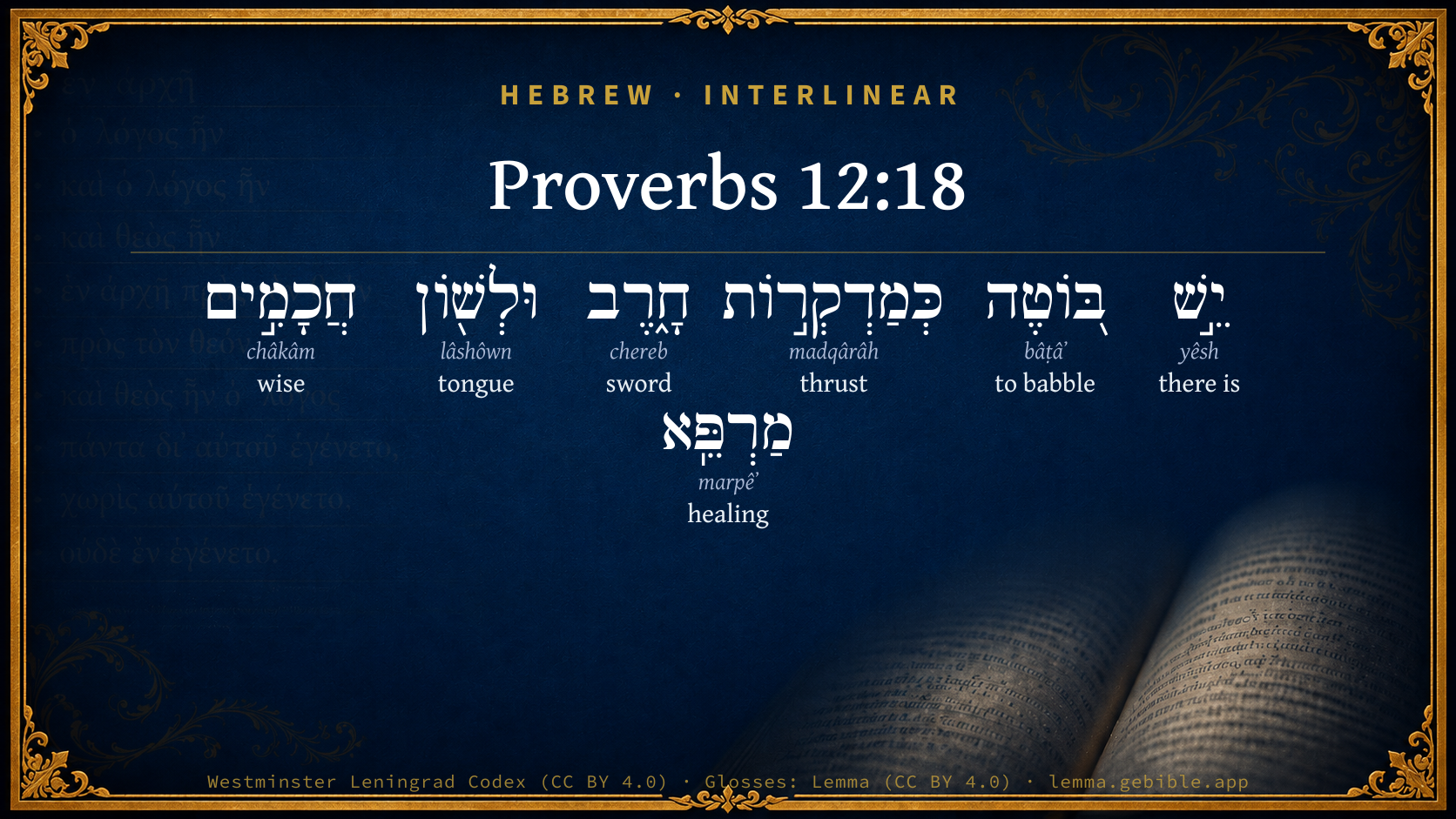
Proverbs 12:18

Hebrew (Westminster Leningrad Codex) Proverbs 12:18 appears in the Hebrew Old Testament. The text above is from the Westminster Leningrad Codex. Each word links to its Strong’s number, a concise gloss, and parsing drawn from the Open Scriptures Hebrew Bible morphology. Click any word for its full Brown-Driver-Briggs (BDB) entry.
Download image
Cite this verse

Proverbs 12:18 (World English Bible). Public Domain. Lemma interlinear Bible study tool, https://lemma.gebible.app/v/proverbs/12/18.

Show BibTeX & RIS
BibTeX
RIS
English Translation
There is one who speaks rashly like the piercing of a sword, But the tongue of the wise heals.
World English Bible · Public Domain
Highlights
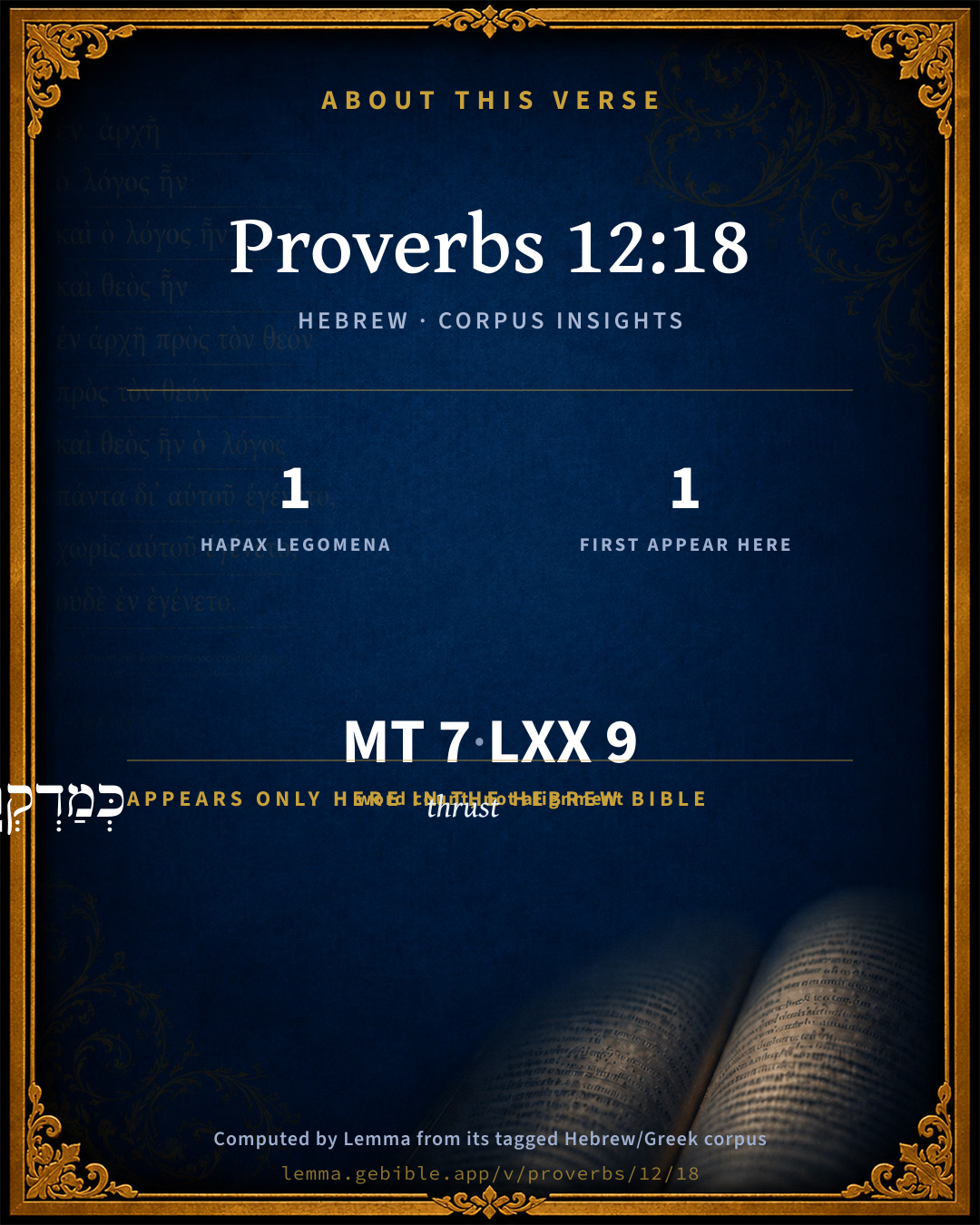
  • 1 hapax legomenon — only here in the Hebrew Bible
  • 1 first appearance in the Hebrew Bible
Full analysis ↓
Download a study sheet

One document with this verse’s original text, its word-by-word gloss line, the meaning frame, cross-references with their text, attributed commentary, and full source and license credits — printable, and it pastes into notes with its structure intact.

This verse Autodidact and up

Study sheet (.html) Plain text (.txt)

A passage Seminary Student

Up to 50 verses in one chapter. A passage sheet keeps up to 6 commentary sources and 12 cross-references per verse, in the order this page ranks them, and says so on the sheet whenever that leaves anything out. Ask for a single verse and you get the Autodidact verse sheet above.

Everything on this page stays free to read, with no account — the sheet is a download of what is already on screen, not access to it.

Want to remove ads? Support Godless Engineer
Compare translations 3

The same verse in 3 English versions, stacked beneath the original-language interlinear above. Click any original word for its lexicon entry.

Each is an independent rendering of the whole verse — the interlinear is not word-aligned to these translations.

Highlighted words mark where these versions differ — a whole-verse word diff, not a word-by-word alignment.

  • World English Bible Public Domain
    There is one who speaks rashly like the piercing of a sword, But the tongue of the wise heals.
  • King James Version Public Domain
    There is that speaketh like the piercings of a sword: but the tongue of the wise is health.
  • unfoldingWord Literal Text CC BY-SA 4.0
    There is one speaking thoughtlessly like the thrusts of a sword, but the tongue of the wise ones—healing.

unfoldingWord Literal Text — © unfoldingWord, licensed CC BY-SA 4.0. Word-aligned USFM3 via Door43 (git.door43.org/unfoldingWord/en_ult).

Versions to compare (up to 4)

3 of 4 selected

Show all 18 translations

Every available English version of this verse, each an independent rendering of the whole verse.

  • World English Bible Public Domain
    There is one who speaks rashly like the piercing of a sword, But the tongue of the wise heals.
  • Berean Standard Bible Public Domain
    Speaking rashly is like a piercing sword, but the tongue of the wise brings healing.
  • Majority Standard Bible Public Domain
    Speaking rashly is like a piercing sword, but the tongue of the wise brings healing.
  • King James Version Public Domain
    There is that speaketh like the piercings of a sword: but the tongue of the wise is health.
  • American Standard Version (1901) Public Domain
    There is that speaketh rashly like the piercings of a sword; But the tongue of the wise is health.
  • Revised Version (1885) Public Domain
    There is that speaketh rashly like the piercings of a sword: but the tongue of the wise is health.
  • Geneva Bible (1599) Public Domain
    There is that speaketh wordes like the prickings of a sworde: but the tongue of wise men is health.
  • Douay-Rheims (1899) Public Domain
    There is that promiseth, and is pricked as it were with a sword of conscience: but the tongue of the wise is health.
  • Young's Literal Translation Public Domain
    A rash speaker is like piercings of a sword, And the tongue of the wise is healing.
  • Literal Standard Version CC BY-SA 4.0
    A rash speaker is like piercings of a sword, || And the tongue of the wise is healing.
  • Unlocked Literal Bible CC BY-SA 4.0
    The words of one who speaks rashly are like the thrusts of a sword, but the tongue of the wise brings healing.
  • unfoldingWord Literal Text CC BY-SA 4.0
    There is one speaking thoughtlessly like the thrusts of a sword, but the tongue of the wise ones—healing.
  • Darby Bible Public Domain
    There is that babbleth like the piercings of a sword; but the tongue of the wise is health.
  • World Messianic Bible Public Domain
    There is one who speaks rashly like the piercing of a sword, but the tongue of the wise heals.
  • Webster's Bible Public Domain
    There is that speaketh like the piercings of a sword: but the tongue of the wise is health.
  • Free Bible Version CC BY-SA 4.0
    Some people's hasty words cut like a knife, but the words of the wise bring healing.
  • Bible in Basic English Public Domain
    There are some whose uncontrolled talk is like the wounds of a sword, but the tongue of the wise makes one well again.
  • JPS Tanakh (1917) Public Domain
    There is that speaketh like the piercings of a sword; but the tongue of the wise is health.

Literal Standard Version (2020), Covenant Press — licensed CC BY-SA 4.0. Text via the HelloAO Bible API (eBible.org). Unlocked Literal Bible (unfoldingWord) — licensed CC BY-SA 4.0. Text via the HelloAO Bible API (eBible.org). unfoldingWord Literal Text — © unfoldingWord, licensed CC BY-SA 4.0. Word-aligned USFM3 via Door43 (git.door43.org/unfoldingWord/en_ult). Free Bible Version, Dr. Jonathan Gallagher — licensed CC BY-SA 4.0. Text via the HelloAO Bible API (eBible.org).

Word by word

More ways to search: Search by grammar → Find every occurrence → Compare this word →

Practice this passage: Drill this verse → Learn its vocabulary →

About this verse

These counts appear in no published source. They are computed here, from the morphology-tagged text and Lemma’s own curated glosses. What Lemma adds →

7
words
7
distinct lemmas
Wisdom
section

Notable vocabulary

1 hapax legomenon — a word that appears only here in the entire Hebrew Bible:

  • כְּמַדְקְר֣וֹת thrust H4094

First appearance in Scripture

This word makes its first canonical appearance in the Hebrew Bible here:

  • כְּמַדְקְר֣וֹת thrust H4094

Shared distinctive vocabulary

בּ֭וֹטֶה to babble H981 occurs in 3 verses of the Hebrew Bible. Also found in:

Grammatical profile

  • 1 verb
  • 4 nouns
  • 1 adjective
  • 1 particle

Verb forms

  • בּ֭וֹטֶה Qal · Participle Active

Hebrew & Septuagint length

In English translation the verse runs 19 words from the Hebrew and 14 from the Septuagint (LXX English) — closely comparable.

A rough comparison of the two English renderings, which tokenize alike — not a word-level alignment.

Word counts can differ between the Hebrew and the Greek without any difference in meaning — e.g. the Hebrew direct-object marker אֵת has no separate Greek word, and Greek often adds the article ὁ.

In the original languages it is 7 Hebrew tokens and 9 Greek tokens — but the two are counted differently (Hebrew bundles its prefixes and suffixes into one token; the Greek is in lemma form), so that isn’t a like-for-like length.

Cross-references

15

Topical passages linked to Proverbs 12:18 in the Treasury of Scripture Knowledge — connected by theme and wording, ordered by reader-vote popularity; previews shown in the World English Bible.

  • Proverbs 16:24 Pleasant words are a honeycomb, Sweet to the soul, and health to the bones.
  • Proverbs 15:4 A gentle tongue is a tree of life, But deceit in it crushes the spirit.
  • Psalms 57:4 My soul is among lions. I lie among those who are set on fire, Even the sons of men, whose teeth are spears and arrows, And their tongue a sharp sword.
  • Proverbs 10:20–21 The tongue of the righteous is like choice silver. The heart of the wicked is of little worth.
  • Psalms 52:2 Your tongue plots destruction, Like a sharp razor, working deceitfully.
  • James 3:6–8 And the tongue is a fire. The world of iniquity among our members is the tongue, which defiles the whole body, and sets on fire the course of nature, and is set on fire by Gehenna.
  • Proverbs 4:22 For they are life to those who find them, And health to their whole body.
  • Proverbs 13:17 A wicked messenger falls into trouble, But a trustworthy envoy gains healing.
  • Proverbs 15:7 The lips of the wise spread knowledge; Not so with the heart of fools.
  • Proverbs 25:18 A man who gives false testimony against his neighbor Is like a club, a sword, or a sharp arrow.
  • Daniel 11:33 Those who are wise among the people shall instruct many; yet they shall fall by the sword and by flame, by captivity and by spoil, [many] days.
  • Psalms 64:3 Who sharpen their tongue like a sword, And aim their arrows, deadly words,
  • Psalms 59:7 Behold, they spew with their mouth. Swords are in their lips, "For," they say, "who hears us?"
  • Revelation 1:16 He had seven stars in his right hand. Out of his mouth proceeded a sharp two-edged sword. His face was like the sun shining at its brightest.
  • Revelation 22:2 in the middle of its street. On this side of the river and on that was the tree of life, bearing twelve kinds of fruits, yielding its fruit every month. The leaves of the tree were for the healing of the nations.

Cross-references courtesy of OpenBible.info (CC BY 4.0).

Hebrew and Greek witnesses Masoretic Hebrew ↔ Greek Septuagint

The same verse in the two great witnesses to the Old Testament, shown verse-for-verse.

These are two independent witnesses, not word-aligned to each other, and the Septuagint is shown in lemma (dictionary) form.

Hebrew Proverbs 12:18 Masoretic · Westminster Leningrad Codex

יֵ֣שׁ בּ֭וֹטֶה כְּמַדְקְר֣וֹת חָ֑רֶב וּלְשׁ֖וֹן חֲכָמִ֣ים מַרְפֵּֽא

There is one who speaks rashly like the piercing of a sword, But the tongue of the wise heals.

World English Bible · Public Domain

Greek LXX Proverbs 12:18 Septuagint · lemma form

εἰμί ὅς λέγω τιτρώσκω μάχαιρα γλῶσσα δέ σοφός ἰάομαι

Some wound as they speak, like swords; but the tongues of the wise heal.

LXX2012 (modern English Septuagint) · Public Domain

On this verse, Haydock's Catholic Bible Commentary discusses the Septuagint’s reading. Read the note in Commentary ↓

Hebrew: Westminster Leningrad Codex (CC BY 4.0). Greek: Septuagint (public domain); English from LXX2012 (modern English Septuagint) (Public Domain). How the Septuagint differs from the Hebrew →

Commentary

Notes on Proverbs 12:18 from classic Christian and Jewish commentators (each source and its license shown beneath its notes). The classic Christian expositions comment on the surrounding passage and are grouped to its opening verse, so a note may address several verses; the Jewish commentaries on the Tanakh (Rashi and others) are per-verse, so they appear only where the commentator wrote on this verse.

Lemma curates 59 commentaries, every one of them public domain or Creative Commons licensed, each selected and text-cleaned for this edition rather than reprinted as found. About our sources →

Trapp's Complete Commentary

John Trapp

Pro 12:18 There is that speaketh like the piercings of a sword: but the tongue of the wise [is] health.

Ver. 18. There is that speaketh lies like the piercings of a sword.] False witnesses do so, with a witness. As Doeg, {Psa 52:2} and his fellow hacksters with their murdering weapons in David’s bones, {Psa 42:10} whereby they killed him alive, and buried him in their throats, those gaping graves, open sepulchres. Abimelech and his fellow priests were killed with the tongue, as with a tuck or rapier; so was Naboth and his sons; so was our Saviour Christ himself. Reckon thou Shimei and Rabshakeh among the first and chiefest kill Christs, {Act 2:23; Act 3:15} saith one, because ever an honest mind is more afflicted with words than blows. You shall find some, saith Erasmus, that if death be threatened, can despise it; but to be belied they cannot brook, nor from revenge contain themselves. How was David enraged by Nabal’s railings! Moses, by the people’s murmurings! Jeremiah, by the derisions of the rude rabble. {Jer 20:7-8}

But the tongue of the wise is health.] Or, A medicine, as the tench is to the wounded fishes; or as that noble Lady Eleanor’s tongue was to her husband, Prince Edward, afterward Edward I, who, being traitorously wounded by a poisoned knife in the Holy Land, was perfectly cured by her daily licking his rankling wounds whilst he slept, and yet herself received no harm; {a} so sovereign a medicine is a good tongue, anointed with the virtue of love and wisdom. Wholesome words, as certain salves or treacles, cure the wounds of afflicted hearts, and extract the poison infused by evil tongues.

{a} Speed, Camden.

John Trapp, A Commentary or Exposition upon All the Books of the Old and New Testament (1647–1656) — public domain. Text from a community e-Sword module.

The Biblical Illustrator

Joseph S. Exell

Pro_12:18

The tongue of the wise is health.

Healthy and unhealthy speech

Some men pride themselves on the pungency of their speech. They delight in sharp answers, keen retorts, quick repartees, and boast themselves when they cut their opponents in two. There are others who are gifted in the expression of complaint, reproach, and criticism against the whole providence of life. They can say sharp and bitter things about God and man, and they can be satisfied because of the edge of their own epigram, no matter against whom or against what that edge is directed. The tongue of the wise man is slower, but healthier; the wise man weighs his words: he is anxious to be associated only with judgments that can be confirmed by experience and illustrated by wisdom. The wise man speaks healthily--that is to say, he speaks out of the abundance of his own health, and he speaks in a way that will double and strengthen the health of others. To come near him is to ascend a mountain and breathe the freshest air of heaven, or to go down by the seashore and receive messages across the great deeps, full of vigour, and truth, and strengthening influence. Wise men keep society healthy. But for their presence it would stagnate, and go from one degree of corruption to another until it became wholly pestilential. There are two speakers in the text, to the end of time there will probably be two speakers in the world--the critical speaker and the judicial speaker; the man all sharpness and the man all thankfulness. The business of Christian discipline is to tame the tongue, to chasten it, to teach it the speech of wisdom, and to instruct it as to the right time of utterance and the right time of silence. (J. Parker, D.D.)

The Biblical Illustrator, edited by Joseph S. Exell (c. 1880s–1900s) — public domain. Text from a community e-Sword module.

Joseph Benson's Commentary

Pro 12:18-19. There is that speaketh like the piercings of a sword — Words that are cutting and killing; opprobrious words, which grieve the spirits of those to whom they are spoken, and cut them to the heart; or slanders, which wound the reputation of those of whom they are uttered, and perhaps incurably; or whisperings and evil surmisings, which divide and cut asunder the bonds of love and friendship, and separate those that have been very dear to each other; but the tongue of the wise is health — His speech, both in judgment and in common discourse, is sound and wholesome in itself, and tends to the comfort and benefit of others, closing up those wounds which the backbiting tongue had made, restoring peace, accommodating matters, and persuading persons at variance to a reconciliation. The lip of truth shall be established, &c. — The speaker of truth is constant, and always consistent with himself, and the more and longer his words are tried, the more doth the truth of them appear; whereas liars, though they may make a fair show for a time, yet are easily and quickly convicted of falsehood. Truth may indeed be eclipsed for a little while, but it will come to light: it is great, and will prevail. “Those, therefore, that make a lie their refuge,” says Henry, “will find it a refuge of lies.” Houbigant translates this verse, “Perpetuity is in the lip of truth: the tongue of falsehood is for a point of time.”

Joseph Benson's Commentary on the Old and New Testaments (1811–1818) — public domain. Text from a community e-Sword module.

Geneva Bible (1599)

Geneva Bible translators

Which seek nothing more than to provoke others to anger.

Geneva Bible (1599) marginal notes — public domain. Text via Bolls.life.

Matthew Henry's Commentary

The tongue is death or life, poison or medicine, as it is used. 1. There are words that are cutting and killing, that are like the piercings of a sword. Opprobrious words grieve the spirits of those to whom they are spoken, and cut them to the heart. Slanders, like a sword, wound the reputation of those of whom they are uttered, and perhaps incurably. Whisperings and evil surmises, like a sword, divide and cut asunder the bounds of love and friendship, and separate those that have been dearest to each other. 2. There are words that are curing and healing: The tongue of the wise is health, closing up those wounds which the backbiting tongue had given, making all whole again, restoring peace, and accommodating matters in variance and persuading to reconciliation. Wisdom will find out proper remedies against the mischiefs that are made by detraction and evil-speaking.

Matthew Henry's Commentary on the Whole Bible (1708–1710) — public domain (CC PDM 1.0). Text via the HelloAO Bible API.

Jamieson, Fausset & Brown

Robert Jamieson, A. R. Fausset & David Brown

speaketh--literally, "speaketh hastily," or indiscreetly (Psa 106:33), as an angry man retorts harsh and provoking invectives.

tongue . . . health--by soothing and gentle language.

Jamieson, Fausset & Brown — Commentary Critical and Explanatory on the Whole Bible (1871) — public domain (CC PDM 1.0). Text via the HelloAO Bible API.

Adam Clarke's Commentary

Verse 18. There is that speaketh] Instead of בוטה boteh, blabbing out, blustering, several MSS. have בוטח boteach, TRUSTING: and instead of כמדקרות kemadkeroth, AS the piercings, seven MSS., with the Complutensian Polyglot, have במדקרות bemadkeroth, IN the piercings. "There is that trusteth in the piercings of a sword: but the tongue of the wise is health." But I suppose the former to be the true reading.

Adam Clarke's Commentary on the Bible (1810–1826) — public domain. Text from a community e-Sword/MySword module.

Ellicott's Commentary for English Readers

(18) There is that speaketh.—Rather, that babbleth, like the piercing of a sword, that chatters on, not noticing or caring how he may wound the feelings of others by his inconsiderate remarks.

The tongue of the wise is health.—Or, healing; soothing the wounds made by the other’s indiscriminate chatter.

A Bible Commentary for English Readers, edited by Charles John Ellicott (1878–1897) — public domain. Text from a community e-Sword module.

The Cambridge Bible for Schools and Colleges

gen. ed. J. J. S. Perowne

18. speaketh] Rather, speaketh rashly, R.V.; scattereth thoughtless words, as one might recklessly brandish a naked sword.

“Many a word at random spoken

May wound … a heart that’s broken.”

The Cambridge Bible for Schools and Colleges (gen. ed. J. J. S. Perowne; Cambridge University Press, 1878–1918) — public domain. Text from a community e-Sword module.

John Gill's Exposition

There is that speaketh like the piercings of a sword,.... Whose words are like sharp swords, cutting, wounding, dividing, killing; see Psa 57:4; such are the words of false witnesses, who by their false testimonies and perjuries are as guilty of the murder of men as cutthroats; such are the words of slanderers, backbiters, and talebearers, who grieve the innocent, wound their characters, destroy their good name and credit, and separate chief friends; and such are the words of antichrist, who looks like a lamb, but speaks like a dragon, Rev 13:11;

but the tongue of the wise is health; or "healing" (e); by giving a faithful testimony which sets matters right; by clearing and defending the character of those who are falsely accused and wrongfully charged; by making up differences, and reconciling persons at variance through the detracting and lying insinuations of others; and by speaking comfortable, cheerful, and refreshing words to the injured and abused; especially the tongue of a wise minister of the Gospel is health, or healing, to wounded souls, to whom he ministers the Gospel of the grace of God, which directs to Christ for healing, peace, pardon, righteousness, and eternal life.

(e) "medicinae", Junius & Tremellius; "medicina", Piscator, Cocceius; "sanatio", Michaelis; "sanatrix", Schultens.

John Gill's Exposition of the Whole Bible (1746–1763) — public domain (CC PDM 1.0). Text via the HelloAO Bible API.

Haydock's Catholic Bible Commentary

Promiseth. Septuagint, "there are, who speaking, wound with the sword; but," &c. Hebrew bote (Haydock) means also, making a foolish promise, which causes remorse. (Menochius) --- This was the case with Herod, when he was pleased with Herodias, Matthew xiv. 8. (Calmet) --- Hebrew, "speaketh like the piercings of the sword," (Protestants; Haydock) as detractors, and those who disseminate impious and scandalous maxims do.

George Leo Haydock (1774–1849), Haydock's Catholic Family Bible and Commentary, 1859 edition — public domain. Excludes Psalms (Douay-Rheims chapter numbering differs from Protestant) and Deuterocanonical books (Catholic canon only).

Matthew Poole's English Annotations

Speaketh like the piercings of a sword, hurtful and pernicious words, whereby they either corrupt men’s minds and manners, or scandalize them, or injure them in their reputation, estate, or life, or otherwise.

The tongue of the wise is health; his speech, both in judgment and in common discourse, is sound and wholesome in itself, and tending to the comfort and benefit of others.

Matthew Poole's English Annotations on the Holy Bible (1683–1685) — public domain. Text from a community e-Sword/MySword module.

Whedon's Commentary on the Bible

Daniel D. Whedon

18. There is that speaketh — Prates or babbles.

Piercings of a sword — Like knife-thrusts. His words are daggers.

But the tongue of the wise is health — Or healing; heals the wounds made by the idle and malicious babblers. Compare Psa_57:4; Psa_59:7.

Daniel D. Whedon (gen. ed.), Commentary on the Old and New Testaments (1874–1909) — public domain. Text from a community e-Sword module.

The Pulpit Commentary

There is that speaketh. The word implies speaking thoughtlessly, rashly; hence we may render, "a babbler," "prater." Such a one inflicts wounds with his senseless tattle. Like the piercings of a sword. The point of the simile is seen when we remember that the edge of the sword is called its "mouth" in the Hebrew. (Gen_34:26 Exo_17:13, etc.; comp. Psa_59:7 Psa_64:3) The Greek gnome says All oudenou . "A sword the body wounds, a word the soul. Vulgate, est qui promittit, which restricts the scope of the clause to the making of vain promises, (Lev_5:4 Num_30:7-9) continuing, et quasi gladio pungitur conscientiae, "And is pierced as it were by the sword of his conscience." where "conscience" is added to make the meaning plain. Such a man suffers remorse if he breaks his promise, or if, like Jephthah, he keeps it. The tongue of the wise is health; it does not pierce and wound like that of the chatterer, rather it soothes and heals even when it reproves. (Pro_4:22 Pro_10:11)

The Pulpit Commentary (1880–1919), ed. H.D.M. Spence-Jones & Joseph S. Exell — public domain. Text from a community e-Sword module.

John Wesley's Explanatory Notes

Health - Tends to the comfort and benefit of others.

John Wesley, Explanatory Notes Upon the Whole Bible (1754–1765) — public domain. Text via the GEBible commentary corpus.

Keil & Delitzsch

C. F. Keil & F. Delitzsch

18 There is that babbleth like the thrusts of a sword,

But the tongue of the wise is healing.

The second (cf. Pro 11:24) of the proverbs beginning with ישׁ. The verb בּטה (בּטא), peculiar to the Hebr., which in the modern Hebr. generally means "to speak out" (מבטא in the grammar: the pronunciation) (according to which the lxx, Syr., and Targ. translate it by אמר), means in biblical Hebr., especially with reference to the binding of oneself by an oath (Lev 5:4), and to solemn protestations (Num 30:7, Num 30:9, according to which Jerome, promittit): to utter incautiously in words, to speak without thought and at random, referred erroneously by Gesenius to the R. בט, to be hollow, probably a word imitative of the sound, like the Greek βατταρίζειν, to stammer, and βαττολογεῖν, to babble, which the lexicographers refer to a talkative person of the name of Βάττος, as our "salbadern" [= to talk foolishly] owes its origin to one Jenaer Bader on the Saal. Theod. and the Graec. Venet. give the false reading בּוטח (πεποιθώς). כּמדקרות חרב stands loco accusativi, the כּ being regarded as a noun: (effutiens verba) quae sunt instar confossionum gladii (Fl.). We also call such a man, who bridles his loquacity neither by reflection nor moderates it by indulgent reference to his fellow-men, a Schwertmaul (sword-mouth) or a Schandmaul (a mouth of shame = slanderer), and say that he has a tongue like a sword. But on the other hand, the tongue of the wise, which is in itself pure gentleness and a comfort to others, since, far from wounding, rather, by means of comforting, supporting, directing exhortation, exercises a soothing an calming influence. Regarding רפא, whence מרפּא, Dietrich in Gesenius' Lex. is right. The root-meaning of the verb רפא (cognate רפה, to be loose, Hiph. to let go, Hithpa. Pro 18:9, to show oneself slothful) is, as the Arab. kindred word rafâ, rafa, raf, rawf (râf) shows, that of stilling, softening, soothing, whence arises the meaning of healing (for which the Arab. has ṭabb and 'alkh); the meaning to repair, to mend, which the Arab. rafâ and rafa have, does not stand in a prior relation to to heal, as might appear from Job 13:4, but is a specializing of the general idea of reficere lying in mitigare, just as the patcher is called ἀκέστρια = ἠπήτρια,

(Note: Whether ῥάπτειν, explained neither by Curtius nor by Flick, stands in a relation to it, we leave out of view.)

from ἀκέομαι, which means equally to still and to heal. Since thus in רפא the meanings of mitigating and of healing are involved, it is plain that מרפא, as it means healing (the remedy) and at the same time (cf. θεραπεία, Rev 22:2) the preservation of health, Pro 4:22; Pro 6:15; Pro 16:24; Pro 29:1, so also may mean mildness (here and Pro 15:4), tranquillity (Pro 14:30; Ecc 10:4, calm patience in contrast to violent passion), and refreshing (Pro 13:17). Oetinger and Hitzig translate here "medicine;" our translation, "healing (the means of healing)," is not essentially different from it.

Keil & Delitzsch — Biblical Commentary on the Old Testament (1861–1891) — public domain (CC PDM 1.0). Text via the HelloAO Bible API. (Old Testament only.)

Bridges on Proverbs

Charles Bridges

Who has not felt the piercings of false, unkind, inconsiderate speeches? How keenly have the servants of God suffered from this sword!†1 Many will speak daggers without compunction, who would be afraid to use them. Surely it was not without reason, that our Lord charges an angry word or tongue with the guilt of murder. (Mat 5:21-22 .) The source of this mischief demonstrably shews its malignity. "The tongue is a fire, a world of iniquity, and it is set on fire of hell." (Jas 3:6 .) Indeed, ’a great and almost incredible calamity is it, that man, who was created for humanity, should be so corrupted , that no animal in the world is more ferocious and malignant.’†2

Yet is the little member no less powerful to heal than to wound. It gives instant healing to the piercings of the sword (Jdg 7:1-3 . 1Sa 19:1-7 ; 1Sa 25:32-33 ), even to the very wound, which it may have constrained to inflict.†3 But it is the tongue of the wise, that is health. Its unrestrained and unregulated vent might be hurtful. Wisdom is the guiding principle; not a loose loquacity, but a delicate discriminating tact, directing us, how, when, what, to whom to speak; sometimes repressing; sometimes quickening: "the tongue of the learned, to speak a word in season to him that is weary." (Isa 50:4 .) This is no negative responsibility. It is not enough, that there is no poison in the tongue. It must be healing, not only purified from "corrupt communication," but "ministering grace unto the hearers." (Eph 4:29 .) What need have we of the "indwelling of the word in all wisdom," that in "teaching and admonishing one another, our speech may be always with grace," wholesome and edifying, to the glory of our common Lord! (Col 3:16 ; Col 4:6 .)

Footnotes:

†1 Job 13:4; 16. 19. David, Psa 42:10 ; Psa 52:2 . Jer 18:18-23 . Lam 3:14 . Paul, 2Co 10:1-2, 10; 2Co 13:2-3 .

†2 Daillè on Col 3:8 .

†3 Psa 141:5. Compare the healing counsel, 2Co 2:6-11, with 1 Corinthians 5.

Charles Bridges, An Exposition of the Book of Proverbs (1846) — public domain. Text from a community e-Sword module.

Kretzmann's Popular Commentary

Paul E. Kretzmann

v. 18. There is that speaketh like the piercings of a sword, his speeches being as rude and sharp as knife thrusts, their intention being to hurt and injure; but the tongue of the wise is health, healing, intended to overcome the effect of sharp speeches and to bind up the wounds inflicted by foolish babblers.

Paul E. Kretzmann, Popular Commentary of the Bible (1921–1924) — public domain. Text from a community e-Sword module.

Rashi

Rabbi Shlomo Yitzchaki (Rashi)

There is one who speaks Heb. בוטה, speaks, as in (Lev. 5:4): “to pronounce (לבטה) with the lips.”

like the jabs of a sword For he stirs up the people and causes them to kill.

but the tongue of the wise which brings peace between one man and his fellow.

brings healing to that speech.

Rashi on the Tanakh — English translations: “The Judaica Press complete Tanach with Rashi, translated by A. J. Rosenberg” (CC BY 4.0); “Pentateuch with Rashi's commentary by M. Rosenbaum and A.M. Silbermann, 1929-1934” (public domain); “The Metsudah Tanach series, Lakewood, N.J” (CC BY 4.0); and “The Book of Joshua, Metsudah Publications, 1997” (CC BY 4.0). Text via Sefaria.

Lesson kit

Teaching starters — assembled from the data on this page, not authored interpretation. Every prompt links to the verse data it draws on. Edit before teaching.

Proverbs, in the Wisdom, opens this verse with 7 words (7 distinct Hebrew lemmas). Its most distinctive word is madqârâh (“thrust”). A historical commentator’s framing appears above. Read the whole chapter for the surrounding context.

Discussion questions

  1. The word madqârâh carries the sense “thrust.” How does it shape the verse?
  2. 1 word here appears nowhere else in the Hebrew Bible. Why might the author reach for such rare wording?
  3. This is the first place “thrust” appears in Scripture (first appears here). What does its debut here establish?
  4. How does Leviticus 5:4, which shares the word «to babble», read alongside this verse?
  5. These translations render this verse differently. What is at stake in choosing one wording over another?
  6. «בּ֭וֹטֶה» is a Qal Participle Active verb. How does that grammatical form shape the action described?
  7. Compare how Trapp's Complete Commentary and The Biblical Illustrator read this verse. Where do they agree or differ?

Things to notice

Reading settings

Reading text

Shown beneath each verse's original-language words.

Old Testament
Old Testament edition

Read the OT as the Masoretic Hebrew (MT) or the Greek Septuagint (LXX).

English shown for the Greek Septuagint (in the Hebrew ↔ Greek comparison).

Comparing translations? Open the Compare panel on any verse page to stack up to four side by side.