
Joshua 10:28

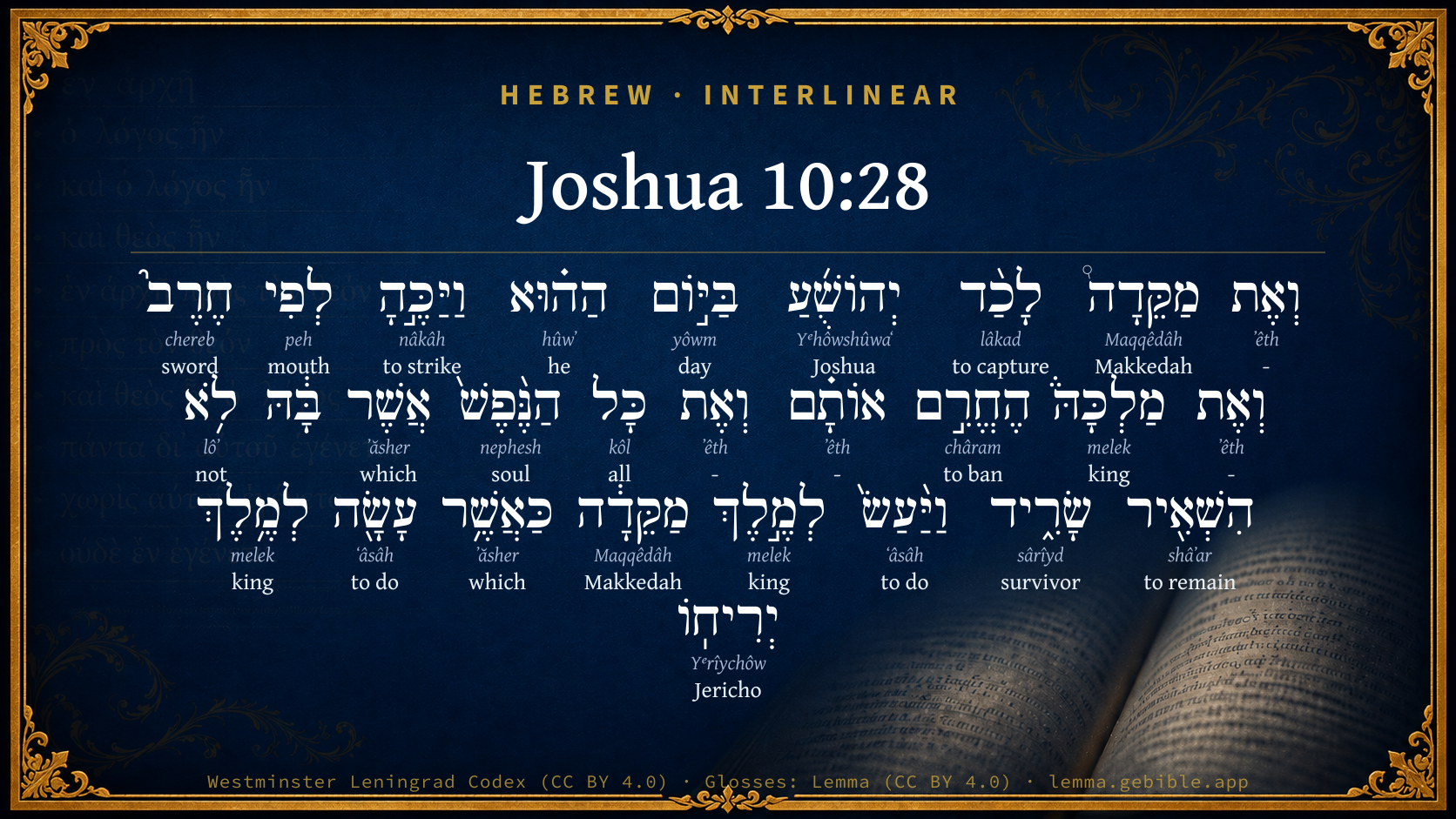
Hebrew (Westminster Leningrad Codex) Joshua 10:28 appears in the Hebrew Old Testament. The text above is from the Westminster Leningrad Codex. Each word links to its Strong’s number, a concise gloss, and parsing drawn from the Open Scriptures Hebrew Bible morphology. Click any word for its full Brown-Driver-Briggs (BDB) entry.
Download image
Cite this verse

Joshua 10:28 (World English Bible). Public Domain. Lemma interlinear Bible study tool, https://lemma.gebible.app/v/joshua/10/28.

Show BibTeX & RIS
BibTeX
RIS
English Translation
Joshua took Makkedah on that day, and struck it with the edge of the sword, and the king of it: he utterly destroyed them and all the souls who were therein; he left none remaining; and he did to the king of Makkedah as he had done to the king of Jericho.
World English Bible · Public Domain
Download a study sheet

One document with this verse’s original text, its word-by-word gloss line, the meaning frame, cross-references with their text, attributed commentary, and full source and license credits — printable, and it pastes into notes with its structure intact.

This verse Autodidact and up

Study sheet (.html) Plain text (.txt)

A passage Seminary Student

Up to 50 verses in one chapter. A passage sheet keeps up to 6 commentary sources and 12 cross-references per verse, in the order this page ranks them, and says so on the sheet whenever that leaves anything out. Ask for a single verse and you get the Autodidact verse sheet above.

Everything on this page stays free to read, with no account — the sheet is a download of what is already on screen, not access to it.

Want to remove ads? Support Godless Engineer
Compare translations 3

The same verse in 3 English versions, stacked beneath the original-language interlinear above. Click any original word for its lexicon entry.

Each is an independent rendering of the whole verse — the interlinear is not word-aligned to these translations.

Highlighted words mark where these versions differ — a whole-verse word diff, not a word-by-word alignment.

  • World English Bible Public Domain
    Joshua took Makkedah on that day, and struck it with the edge of the sword, and the king of it: he utterly destroyed them and all the souls who were therein; he left none remaining; and he did to the king of Makkedah as he had done to the king of Jericho.
  • King James Version Public Domain
    And that day Joshua took Makkedah, and smote it with the edge of the sword, and the king thereof he utterly destroyed, them, and all the souls that were therein; he let none remain: and he did to the king of Makkedah as he did unto the king of Jericho.
  • unfoldingWord Literal Text CC BY-SA 4.0
    And Joshua captured Makkedah on that day and struck it and its king to the mouth of the sword. He devoted them and every soul that in it. He did not leave a survivor. So he did to the king of Makkedah just as he had done to the king of Jericho.

unfoldingWord Literal Text — © unfoldingWord, licensed CC BY-SA 4.0. Word-aligned USFM3 via Door43 (git.door43.org/unfoldingWord/en_ult).

Versions to compare (up to 4)

3 of 4 selected

Show all 18 translations

Every available English version of this verse, each an independent rendering of the whole verse.

  • World English Bible Public Domain
    Joshua took Makkedah on that day, and struck it with the edge of the sword, and the king of it: he utterly destroyed them and all the souls who were therein; he left none remaining; and he did to the king of Makkedah as he had done to the king of Jericho.
  • Berean Standard Bible Public Domain
    On that day Joshua captured Makkedah and put it to the sword, along with its king. He devoted to destruction everyone in the city, leaving no survivors. So he did to the king of Makkedah as he had done to the king of Jericho.
  • Majority Standard Bible Public Domain
    On that day Joshua captured Makkedah and put it to the sword, along with its king. He devoted to destruction everyone in the city, leaving no survivors. So he did to the king of Makkedah as he had done to the king of Jericho.
  • King James Version Public Domain
    And that day Joshua took Makkedah, and smote it with the edge of the sword, and the king thereof he utterly destroyed, them, and all the souls that were therein; he let none remain: and he did to the king of Makkedah as he did unto the king of Jericho.
  • American Standard Version (1901) Public Domain
    And Joshua took Makkedah on that day, and smote it with the edge of the sword, and the king thereof: he utterly destroyed them and all the souls that were therein; he left none remaining; and he did to the king of Makkedah as he had done unto the king of Jericho.
  • Revised Version (1885) Public Domain
    And Joshua took Makkedah on that day, and smote it with the edge of the sword, and the king thereof; he utterly destroyed them and all the souls that were therein, he left none remaining: and he did to the king of Makkedah as he had done unto the king of Jericho.
  • Geneva Bible (1599) Public Domain
    And that same day Ioshua tooke Makkedah and smote it with the edge of the sword, and the King thereof destroyed he with them, and all the soules that were therein, he let none remaine: for hee did to the King of Makkedah as he had done vnto the King of Iericho.
  • Douay-Rheims (1899) Public Domain
    The same day Josue took Maceda and destroyed it, with the edge of the sword, and killed the king and all the inhabitants thereof: he left not in it the least remains. And he did to the king of Maceda, as he had done to the king of Jericho.
  • Young's Literal Translation Public Domain
    And Makkedah hath Joshua captured on that day, and he smiteth it by the mouth of the sword, and its king he hath devoted, them and every person who `is' in it -- he hath not left a remnant; and he doth to the king of Makkedah as he did to the king of Jericho.
  • Literal Standard Version CC BY-SA 4.0
    And Joshua has captured Makkedah on that day, and he strikes it by the mouth of the sword, and he has devoted its king, them and every person who [is] in it—he has not left a remnant; and he does to the king of Makkedah as he did to the king of Jericho.
  • Unlocked Literal Bible CC BY-SA 4.0
    In this way, Joshua captured Makkedah on that day and killed everyone there with the sword, including its king. He completely destroyed everyone in it. He left no survivor in it. He did to the king of Makkedah just as he had done to the king of Jericho.
  • unfoldingWord Literal Text CC BY-SA 4.0
    And Joshua captured Makkedah on that day and struck it and its king to the mouth of the sword. He devoted them and every soul that in it. He did not leave a survivor. So he did to the king of Makkedah just as he had done to the king of Jericho.
  • Darby Bible Public Domain
    And Joshua took Makkedah on that day, and smote it with the edge of the sword, and the king thereof, him and all the souls that were therein he utterly destroyed; he let none remain; and he did to the king of Makkedah as he had done to the king of Jericho.
  • World Messianic Bible Public Domain
    Joshua took Makkedah on that day, and struck it with the edge of the sword, with its king. He utterly destroyed it and all the souls who were in it. He left no one remaining. He did to the king of Makkedah as he had done to the king of Jericho.
  • Webster's Bible Public Domain
    And that day Joshua took Makkedah, and smote it with the edge of the sword, and the king of it he utterly destroyed, them, and all the souls that were in it; he let none remain: and he did to the king of Makkedah as he did to the king of Jericho.
  • Free Bible Version CC BY-SA 4.0
    That day Joshua captured Makkedah, killing all its inhabitants, including the king. He set it apart and completely destroyed it and everyone in it, leaving no survivors. He killed the king of Makkedah just as he had killed the king of Jericho.
  • Bible in Basic English Public Domain
    That day Joshua took Makkedah, and put it and its king to the sword; every soul in it he gave up to the curse without mercy: and he did to the king of Makkedah as he had done to the king of Jericho.
  • JPS Tanakh (1917) Public Domain
    And Joshua took Makkedah on that day, and smote it with the edge of the sword, and the king thereof; he utterly destroyed them and all the souls that were therein, he left none remaining; and he did to the king of Makkedah as he had done unto the king of Jericho.

Literal Standard Version (2020), Covenant Press — licensed CC BY-SA 4.0. Text via the HelloAO Bible API (eBible.org). Unlocked Literal Bible (unfoldingWord) — licensed CC BY-SA 4.0. Text via the HelloAO Bible API (eBible.org). unfoldingWord Literal Text — © unfoldingWord, licensed CC BY-SA 4.0. Word-aligned USFM3 via Door43 (git.door43.org/unfoldingWord/en_ult). Free Bible Version, Dr. Jonathan Gallagher — licensed CC BY-SA 4.0. Text via the HelloAO Bible API (eBible.org).

Word by word

More ways to search: Search by grammar → Find every occurrence → Compare this word →

Practice this passage: Drill this verse → Learn its vocabulary →

מַקֵּדָה֩
Maqqêdâh
H4719
“Makkedah”
Noun, Proper
Part of Speech
Noun
Type
Proper
Full BDB Definition

Origin: from the same as H5348 in the denominative sense of herding (compare H5349 )

TWOT: None

Makkedah = "place of shepherds" - the location of a cave in Judah where Joshua captured and executed five Canaanite kings during the conquest; located near Bethhoron and Libnah
  1. וְאֶת ʼêth H853 “and · -” Conjunction + Particle, Direct Object
  2. לָכַ֨ד lâkad H3920 “to capture” Verb, Qal, Perfect, 3rd Person, Masculine, Singular
  3. יְהוֹשֻׁ֜עַ Yᵉhôwshûwaʻ H3091 “Joshua” Noun, Proper
  4. בַּיּ֣וֹם yôwm H3117 “in/at the · day” Preposition, Determined + Noun, Common, Masculine, Singular, Absolute
  5. הַה֗וּא hûwʼ H1931 “the · he” Particle, Definite Article + Pronoun, Personal, 3rd Person, Masculine, Singular
  6. וַיַּכֶּ֣הָ nâkâh H5221 “and · to strike · her” Conjunction + Verb, Hiphil, Sequential Imperfect, 3rd Person, Masculine, Singular + Suffix, Personal, 3rd Person, Feminine, Singular
  7. לְפִי peh H6310 “to/for · mouth of” Preposition + Noun, Common, Masculine, Singular, Construct
  8. חֶרֶב֮ chereb H2719 “sword” Noun, Common, Feminine, Singular, Absolute
  9. וְאֶת ʼêth H853 “and · -” Conjunction + Particle, Direct Object
  10. מַלְכָּהּ֒ melek H4428 “king · her” Noun, Common, Masculine, Singular, Construct + Suffix, Personal, 3rd Person, Feminine, Singular
  11. הֶחֱרִ֣ם châram H2763 “to ban” Verb, Hiphil, Perfect, 3rd Person, Masculine, Singular
  12. אוֹתָ֗ם ʼêth H853 “- · them” Particle, Direct Object + Suffix, Personal, 3rd Person, Masculine, Plural
  13. וְאֶת ʼêth H853 “and · -” Conjunction + Particle, Direct Object
  14. כָּל kôl H3605 “all of” Noun, Common, Masculine, Singular, Construct
  15. הַנֶּ֨פֶשׁ֙ nephesh H5315 “the · soul” Particle, Definite Article + Noun, Common, Both, Singular, Absolute
  16. אֲשֶׁר ʼăsher H834 “which” Particle, Relative
  17. לֹ֥א lôʼ H3808 “not” Particle, Negative
  18. הִשְׁאִ֖יר shâʼar H7604 “to remain” Verb, Hiphil, Perfect, 3rd Person, Masculine, Singular
  19. שָׂרִ֑יד sârîyd H8300 “survivor” Noun, Common, Masculine, Singular, Absolute
  20. וַיַּ֨עַשׂ֙ ʻâsâh H6213 “and · to do” Conjunction + Verb, Qal, Sequential Imperfect, 3rd Person, Masculine, Singular
  21. לְמֶ֣לֶךְ melek H4428 “to/for · king of” Preposition + Noun, Common, Masculine, Singular, Construct
  22. מַקֵּדָ֔ה Maqqêdâh H4719 “Makkedah” Noun, Proper
  23. כַּאֲשֶׁ֥ר ʼăsher H834 “like/as · which” Preposition + Particle, Relative
  24. עָשָׂ֖ה ʻâsâh H6213 “to do” Verb, Qal, Perfect, 3rd Person, Masculine, Singular
  25. לְמֶ֥לֶךְ melek H4428 “to/for · king of” Preposition + Noun, Common, Masculine, Singular, Construct
  26. יְרִיחֽוֹ Yᵉrîychôw H3405 “Jericho” Noun, Proper

About this verse

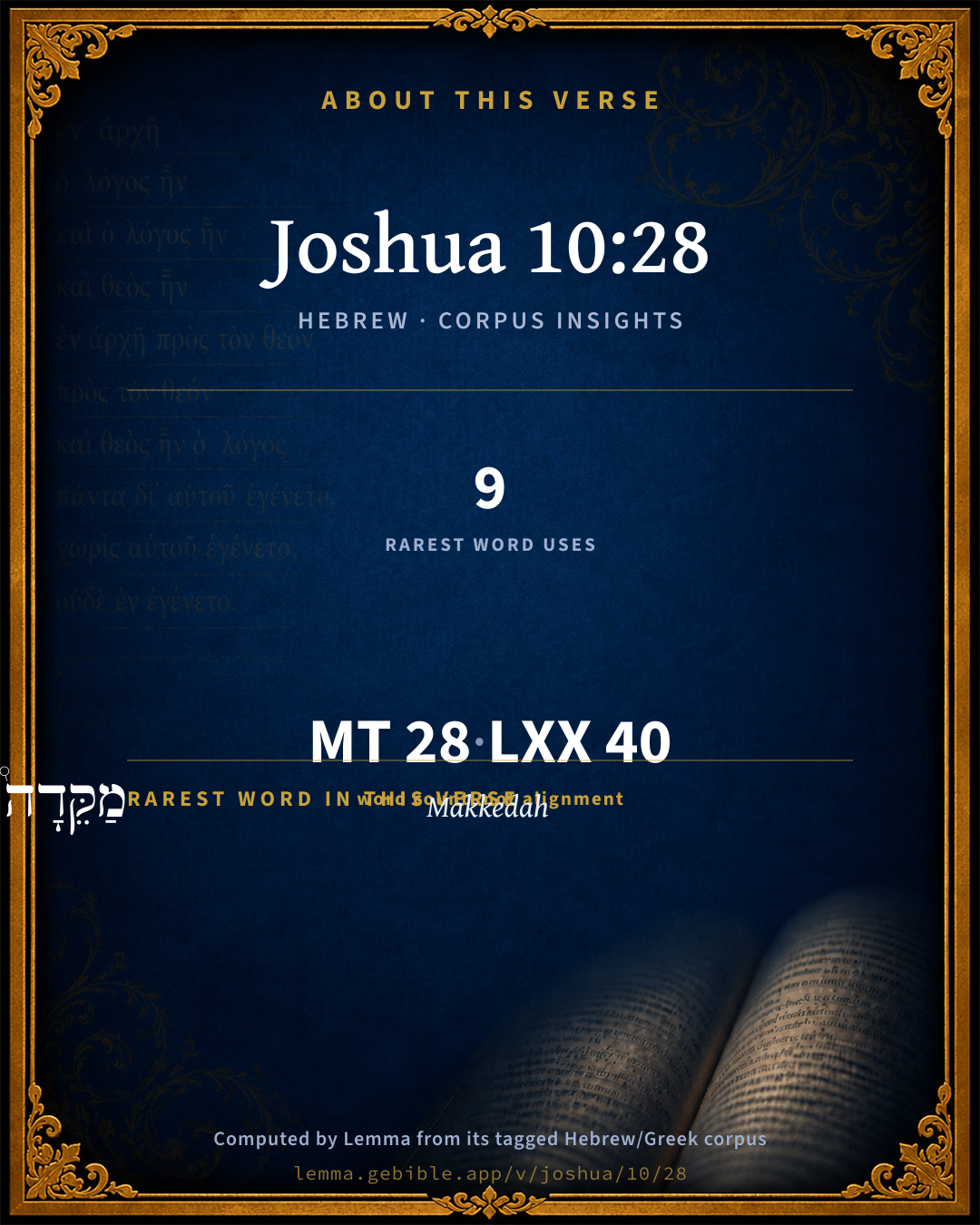
These counts appear in no published source. They are computed here, from the morphology-tagged text and Lemma’s own curated glosses. What Lemma adds →

28
words
19
distinct lemmas
Historical
section

Notable vocabulary

The rarest word here is מַקֵּדָה֩ Makkedah H4719 — appearing just 9 times in the whole Hebrew Bible.

Shared distinctive vocabulary

מַקֵּדָה֩ Makkedah H4719 occurs in 8 verses of the Hebrew Bible. Also found in:

Grammatical profile

  • 6 verbs
  • 13 nouns
  • 1 pronoun
  • 1 preposition
  • 7 particles

Verb forms

  • לָכַ֨ד Qal · Perfect
  • וַיַּכֶּ֣הָ Hiphil · Sequential Imperfect
  • הֶחֱרִ֣ם Hiphil · Perfect
  • הִשְׁאִ֖יר Hiphil · Perfect
  • וַיַּ֨עַשׂ֙ Qal · Sequential Imperfect
  • עָשָׂ֖ה Qal · Perfect

Repetition

Words recur within this verse — often emphatic in Hebrew:

  • מַלְכָּהּ֒ king H4428 ×3
  • מַקֵּדָה֩ Makkedah H4719 ×2
  • וַיַּ֨עַשׂ֙ to do H6213 ×2
  • אֲשֶׁר which H834 ×2

Hebrew & Septuagint length

In English translation the verse runs 52 words from the Hebrew and 57 from the Septuagint (LXX English) — closely comparable.

A rough comparison of the two English renderings, which tokenize alike — not a word-level alignment.

Word counts can differ between the Hebrew and the Greek without any difference in meaning — e.g. the Hebrew direct-object marker אֵת has no separate Greek word, and Greek often adds the article ὁ.

In the original languages it is 28 Hebrew tokens and 40 Greek tokens — but the two are counted differently (Hebrew bundles its prefixes and suffixes into one token; the Greek is in lemma form), so that isn’t a like-for-like length.

Cross-references

15

Topical passages linked to Joshua 10:28 in the Treasury of Scripture Knowledge — connected by theme and wording, ordered by reader-vote popularity; previews shown in the World English Bible.

  • Joshua 6:21 They utterly destroyed all that was in the city, both man and woman, both young and old, and ox, and sheep, and donkey, with the edge of the sword.
  • Deuteronomy 7:2 and when Yahweh your God shall deliver them up before you, and you shall strike them; then you shall utterly destroy them: you shall make no covenant with them, nor show mercy to them;
  • Deuteronomy 7:16 You shall consume all the peoples who Yahweh your God shall deliver to you; your eye shall not pity them: neither shall you serve their gods; for that will be a snare to you.
  • Deuteronomy 20:16–17 But of the cities of these peoples, that Yahweh your God gives you for an inheritance, you shall save alive nothing that breathes;
  • Joshua 8:2 You shall do to Ai and her king as you did to Jericho and her king: only the spoil of it, and the cattle of it, shall you take for a prey to yourselves: set you an ambush for the city behind it.
  • Joshua 10:30 and Yahweh delivered it also, and the king of it, into the hand of Israel; and he struck it with the edge of the sword, and all the souls who were therein; he left none remaining in it; and he did to the king of it as he had done to the king of Jericho.
  • Joshua 10:32 and Yahweh delivered Lachish into the hand of Israel; and he took it on the second day, and struck it with the edge of the sword, and all the souls who were therein, according to all that he had done to Libnah.
  • Joshua 10:35 and they took it on that day, and struck it with the edge of the sword; and all the souls who were therein he utterly destroyed that day, according to all that he had done to Lachish.
  • Joshua 10:37 and they took it, and struck it with the edge of the sword, and the king of it, and all the cities of it, and all the souls who were therein; he left none remaining, according to all that he had done to Eglon; but he utterly destroyed it, and all the souls who were therein.
  • Joshua 10:39 and he took it, and the king of it, and all the cities of it; and they struck them with the edge of the sword, and utterly destroyed all the souls who were therein; he left none remaining: as he had done to Hebron, so he did to Debir, and to the king of it; as he had done also to Libnah, and to the king of it.
  • Joshua 15:41 and Gederoth, Beth Dagon, and Naamah, and Makkedah; sixteen cities with their villages.
  • Psalms 21:8–9 Your hand will find out all of your enemies. Your right hand will find out those who hate you.
  • Luke 19:27 But bring those enemies of mine who didn't want me to reign over them here, and kill them before me.'"
  • 1 Corinthians 15:25 For he must reign until he has put all his enemies under his feet.
  • Psalms 110:1 Yahweh says to my Lord, "Sit at my right hand, Until I make your enemies your footstool for your feet."

Cross-references courtesy of OpenBible.info (CC BY 4.0).

Hebrew and Greek witnesses Masoretic Hebrew ↔ Greek Septuagint

The same verse in the two great witnesses to the Old Testament, shown verse-for-verse.

These are two independent witnesses, not word-aligned to each other, and the Septuagint is shown in lemma (dictionary) form.

Hebrew Joshua 10:28 Masoretic · Westminster Leningrad Codex

וְאֶת מַקֵּדָה֩ לָכַ֨ד יְהוֹשֻׁ֜עַ בַּיּ֣וֹם הַה֗וּא וַיַּכֶּ֣הָ לְפִי חֶרֶב֮ וְאֶת מַלְכָּהּ֒ הֶחֱרִ֣ם אוֹתָ֗ם וְאֶת כָּל הַנֶּ֨פֶשׁ֙ אֲשֶׁר בָּ֔הּ לֹ֥א הִשְׁאִ֖יר שָׂרִ֑יד וַיַּ֨עַשׂ֙ לְמֶ֣לֶךְ מַקֵּדָ֔ה כַּאֲשֶׁ֥ר עָשָׂ֖ה לְמֶ֥לֶךְ יְרִיחֽוֹ

Joshua took Makkedah on that day, and struck it with the edge of the sword, and the king of it: he utterly destroyed them and all the souls who were therein; he left none remaining; and he did to the king of Makkedah as he had done to the king of Jericho.

World English Bible · Public Domain

Greek LXX Joshua 10:28 Septuagint · lemma form

καί ὁ μακηδα λαμβάνω ἐν ὁ ἡμέρα ἐκεῖνος καί φονεύω αὐτός ἐν στόμα ξίφος καί ἐκὀλεθρεύω πᾶς ἐμπνέος ἐν αὐτός καί οὐ καταλείπω ἐν αὐτός οὐδείς διασώζω καί διαφεύγω καί ποιέω ὁ βασιλεύς μακηδα ὅς τρόπος ποιέω ὁ βασιλεύς ιεριχω

And they took Makeda on that day, and killed the inhabitants with the edge of the sword, and they utterly destroyed every living thing that was in it; and there was none left in it that was preserved and had escaped; and they did to the king of Makeda, as they did to the king of Jericho.

LXX2012 (modern English Septuagint) · Public Domain

On this verse, Keil & Delitzsch discusses the Septuagint’s reading. Read the note in Commentary ↓

Hebrew: Westminster Leningrad Codex (CC BY 4.0). Greek: Septuagint (public domain); English from LXX2012 (modern English Septuagint) (Public Domain). How the Septuagint differs from the Hebrew →

Targum (Aramaic paraphrase)

1

The Targum is the ancient Jewish Aramaic paraphrase of the Hebrew Scriptures — an interpretive translation, not the Hebrew text itself. Onkelos (literal) and Pseudo-Jonathan (expansive) render the Torah, and Jonathan the Prophets. Coverage is partial: where no permissively-licensed English translation exists for a verse, only the Aramaic is shown. This is verse-level text, not a word-by-word alignment to the Hebrew.

  1. Targum Jonathan Prophets (Joshua–Malachi)
    וְיַת מַקֵדָה כְּבַשׁ יְהוֹשֻׁעַ בְּיוֹמָא הַהוּא וּמְחָא לְפִתְגַם דְחָרֶב וְיַת מַלְכָּא גַמַר יַתְהוֹן וְיַת כָּל נַפְשָׁתָא דִי בָהּ לָא אַשְׁאֵר מְשֵׁזִיב וַעֲבַד לְמַלְכָּא דְמַקֵדָה כְּמָא דַעֲבַד לְמַלְכָּא דִירִיחוֹ:

    (no public-domain English translation for this verse)

    Targum Jonathan — Aramaic: “Mikraot Gedolot” (public domain). English: “Sefaria Community Translation” (CC0 1.0 (public-domain dedication)); “London "Chaldee Paraphrase," 1871” (public domain). Text via Sefaria.

Commentary

Notes on Joshua 10:28 from classic Christian and Jewish commentators (each source and its license shown beneath its notes). The classic Christian expositions comment on the surrounding passage and are grouped to its opening verse, so a note may address several verses; the Jewish commentaries on the Tanakh (Rashi and others) are per-verse, so they appear only where the commentator wrote on this verse.

Lemma curates 59 commentaries, every one of them public domain or Creative Commons licensed, each selected and text-cleaned for this edition rather than reprinted as found. About our sources →

Matthew Henry's Commentary

We are here informed how Joshua improved the late glorious victory he had obtained and the advantages he had gained by it, and to do this well is a general's praise.

I. Here is a particular account of the several cities which he immediately made himself master of. 1. The cities of three of the kings whom he had conquered in the field he went and took possession of, Lachish (Jos 10:31, Jos 10:32), Eglon (Jos 10:34, Jos 10:35), and Hebron, Jos 10:36, Jos 10:37. The other two, Jerusalem and Jarmuth, were not taken at this time; perhaps his forces were either so much fatigued with what they had done or so well content with what they had got that they had no mind to attack those places, and so they let slip the fairest opportunity they could ever expect of reducing them with ease, which afterwards was not done without difficulty, Jdg 1:8; Sa2 5:6. 2. Three other cities, and royal cities too, he took: Makkedah, into the neighbourhood of which the five kings had fled, which brought Joshua and his forces thither in pursuit of them, and so hastened its ruin (Jos 10:28), Libnah (Jos 10:29, Jos 10:30), and Debir, Jos 10:38, Jos 10:39. 3. One king that brought in his forces for the relief of Lachish, that had lost its king, proved to meddle to his own hurt; it was Horam king of Gezer, who, either in friendship to his neighbours or for his own security, offered to stop the progress of Joshua's arms, and was cut off with all his forces, Jos 10:33. Thus wicked men are often snared in their counsels, and, by opposing God in the way of his judgments, bring them the sooner on their own heads.

II. A general account of the country which was hereby reduced and brought into Israel's hands (Jos 10:40-42), that part of the land of Canaan of which they first got possession, which lay south of Jerusalem, and afterwards fell, for the most part, to the lot of the tribe of Judah. Observe in this narrative,

1. The great speed Joshua made in taking these cities, which, some think, is intimated in the manner of relating it, which is quick and concise. He flew like lightning from place to place; and though they all stood it out to the last extremity, and none of these cities opened their gates to him, yet in a little time he got them all into his hands, summoned them, and seized them, the same day (Jos 10:28), or in two days, Jos 10:32. Now that they were struck with fear, by the defeat of their armies and the death of their kings, Joshua prudently followed his blow. See what a great deal of work may be done in a little time, if we will but be busy and improve our opportunities.

2. The great severity Joshua used towards those he conquered. He gave no quarter to man, woman, nor child, put to the sword all the souls (Jos 10:28, Jos 10:30, Jos 10:32, Jos 10:35, etc.), utterly destroyed all that breathed (Jos 10:40), and left none remaining. Nothing could justify this military execution but that herein they did as the Lord God of Israel commanded (Jos 10:40), which was sufficient not only to bear them out, and save them for the imputation of cruelty, but to sanctify what they did, and make it an acceptable piece of service to his justice. God would hereby, (1.) Manifest his hatred of the idolatries and other abominations which the Canaanites had been guilty of, and leave us to judge how great the provocation was which they had given him by the greatness of the destruction which was brought upon them when the measure of their iniquity was full. (2.) He would hereby magnify his love to his people Israel, in giving so many men for them, and people for their life, Isa 43:4. When the heathen are to be cast out to make room for this vine (Psa 80:8) divine justice appears more prodigal than ever of human blood, that the Israelites might find themselves for ever obliged to spend their lives to the glory of that God who had sacrificed so many of the lives of his creatures to their interest. (3.) Hereby was typified the final and eternal destruction of all the impenitent implacable enemies of the Lord Jesus, who, having slighted the riches of his grace, must for ever feel the weight of his wrath, and shall have judgment without mercy. Nations that forget God shall be turned into hell, and no reproach at all to God's infinite goodness.

3. The great success of this expedition. The spoil of these cities was now divided among the men of war that plundered them; and the cities themselves, with the land about them, were shortly to be divided among the tribes, for the Lord fought for Israel, Jos 10:42. They could not have gotten the victory if God had not undertaken the battle; then we conquer when God fights for us; and, if he be for us, who can be against us?

Matthew Henry's Commentary on the Whole Bible (1708–1710) — public domain (CC PDM 1.0). Text via the HelloAO Bible API.

Jamieson, Fausset & Brown

Robert Jamieson, A. R. Fausset & David Brown

SEVEN MORE KINGS CONQUERED. (Jos 10:28-42)

that day Joshua took Makkedah--In this and the following verses is described the rapid succession of victory and extermination which swept the whole of southern Palestine into the hands of Israel. "All these kings and their land did Joshua take at one time, because the Lord God of Israel fought for Israel. And Joshua returned, and all Israel with him, unto the camp to Gilgal."

Next: Joshua Chapter 11

Jamieson, Fausset & Brown — Commentary Critical and Explanatory on the Whole Bible (1871) — public domain (CC PDM 1.0). Text via the HelloAO Bible API.

Trapp's Complete Commentary

John Trapp

Jos 10:28 And that day Joshua took Makkedah, and smote it with the edge of the sword, and the king thereof he utterly destroyed, them, and all the souls that [were] therein; he let none remain: and he did to the king of Makkedah as he did unto the king of Jericho.

Ver. 28. And the king thereof he utterly destroyed.] Because his sins had done much harm: (1.) By imitation, for Magnates magnetes; ( 2.) By imputation, for plectunter Achivi.

John Trapp, A Commentary or Exposition upon All the Books of the Old and New Testament (1647–1656) — public domain. Text from a community e-Sword module.

The Biblical Illustrator

Joseph S. Exell

Jos_10:28-43

All these kings and their laud did Joshua take at one time, because the Lord . . . fought for Israel.

Divine sovereignty

I. God has an indisputable right to dispense his favours to what persons and in what proportions he pleases. As the sole proprietor, it is His to dispose of.

1. Worldly goods. One is accordingly born to affluence, while another is cradled in poverty. Before they existed they could, of course, have no claims or demerits; and therefore the difference in their tot must be owing to His sovereign disposal of events.

2. Bodily constitution and health. As variety marks all other of Gods works, so here it happens that one is naturally robust, another sickly, a third deformed, &c. Who is it that maketh the strong, the beautiful, &c., to differ? The answer may be found in 2Sa_22:30; 2Sa_22:35.

3. Mental qualifications. The inspiration of the Almighty giveth understanding. Much, it is true, depends on personal application. But much depends on natural capacity; given to one five talents, to another two, and to another one; and much on the opportunities, instructors, &c., which God either gives or withholds.

4. Spiritual privileges. Mankind soon began to have greater or smaller advantages in this respect, as they descended from families more or less holy; and the case is the same to the present day. Instance the Israelites and heathens formerly; Christians and pagans now.

II. God has an equal right to resume or to transfer his favours.

1. We have seen that whatever we possess is of free favour at first, from the original proprietor of all. Such the acknowledgment of the psalmist, Of Thine own have I given Thee.

2. No person becomes a proprietor of his possessions merely because he has long enjoyed them. Every blessing is a loan resumable at pleasure; and instead of gaining a right by holding it, the holder is becoming more and more indebted. The property is still Gods (Psa_24:1; Psa_24:10; Psa_12:1-8.

3. On this ground He took His own land of promise from the Canaanites and transferred it to Israel. And He still puts down one and raises up another as it pleases Him.

III. God may justly punish every voluntary transgression of his righteous and equitable laws. Here we remark--

1. That His intelligent and moral creatures are what they are is owing to His sovereign pleasure. Thus Elihu (Job_35:10-11).

2. Since they are such, and capable of moral government, their nature requires a law, as a test of their obedience and for the exercise of their capabilities; and it is His prerogative, who is not only the sovereign Lord, but infinitely wise, to say what is right, to enact such law.

3. In order to make the law efficient it was necessary it should be guarded and enforced by penal sanctions. Whence it follows--

4. That truth requires, while sovereignty authorises, the just punishment of disobedience to His righteous and equitable commands.

IV. In executing his righteous purposes God may employ what agency or instrumentality he pleases. He doubtless can and may work immediately on any and every part of His creation. Yet He seldom does so. Oftentimes He employs angels, as in the case of Sennacherib or Herod. And oftentimes storm, pestilence, earthquake, &c. Deists do not object to these. Yet they cavil at Gods employing the sword of Israel; a difference merely in the circumstance of instrumentality. Let the subject teach us--

1. Reverence. Forasmuch as there is none like unto Thee, O Lord, &c. (Jer_10:6-7). The opposite disposition is reproved (Rom_9:20), and threatened (Isa_45:9-10).

2. Dependence. We enjoy no more or longer than He blesses us, and live no longer than He sustains (Psa_90:3; Psa_09:14; Psa_104:27-29).

3. Humility. Let not the wise man glory in his wisdom, &c. (Jer_9:23-24; 1Co_4:7).

4. Gratitude. Who maketh thee to differ? (Sketches of Sermons.)

Joshua returned, and all Israel with him, unto the camp to Gilgal--

The old camp and the new foe

It must have been a great rest and refreshment for the weary warriors to come to such a camp from time to time. It would be to them a Sabbath amid their arduous labours. From this place they would after each visit go more boldly out to deal harder blows against the uncircumcised Canaanites. And it is the same with us in the war which we wage against the inner and the outer foe. We have our headquarters too, a visit to which should stimulate us even more than a visit to Gilgal did the Israelites. What is our Gilgal? The Cross of the Lord Jesus Christ. That remains always our centre. We should come back to it at all times; not only when driven there by defeat, in order to have shelter, but also after every victory, in order to give thanks. Thus shall we maintain faith and a good conscience. Then issuing from such headquarters, so safe, so restful, so hallowed, so purifying, we shall be filled with a holy enthusiasm and unconquerable strength, and march like Israel from victory to victory. When Joshua had come back to the old headquarters word was brought to him of the gathering of a new foe. This was the most numerous army that had as yet been gathered against him. And it was the most powerful, as well as the most numerous army which Joshua had encountered. For the first time in this campaign we hear of war-horses being used, and the war-chariots of iron which were such a terror to the ancient infantry. This army is also better led than any other that had taken the field. Jabin was the commander-in-chief. One of his successors is called king of Canaan (Jdg_4:2-24), and therefore he would in all likelihood have been the head of the great confederacy. The word Jabin is not a name, but a title borne by the kings of Hazor, and signifies The Wise, just as Adoni-zedek means Lord of Righteousness. Therefore, as we have seen the religious head of the Canaanites marshalling the southern army, so here we see the wise head of the Canaanites marshalling the northern army. The southern might be called the coalition of the priest; the northern the coalition of the sage. How graphically is the spiritual experience of the Christian depicted by these conflicts! No sooner is one set of foes subdued than another arises. There is no rest here. There is also a similarity in the kind of opposition which we have to encounter. As the advance of Israel was opposed now by Adoni-zedek and now by Jabin, so the advance of truth is opposed now by apostate Christianity and now by pompous philosophy. As it is with the Church collectively so is it with the individual. He may lay his account sooner or later to face these two, often in the same order. First comes superstition, with its high-sounding titles, its endless genealogies, its imperious claims, its elaborate ritual, its sensuous will-worship, its irrational bondage. It is resisted, it is overcome. Then comes rationalism, and it cries, Well done. You have routed these infernal hosts. Now come with us. Finish the work you have so well begun. Cast from you the remaining rags of superstition. Follow the light of Reason. Shake off the remaining fetters and be free. Then the sage who argues thus will, like Jabin, muster whole hosts of imposing arguments. How quickly they come at his bidding: from north, south, east, and west, like the sand that is on the seashore for multitude. And when he reviews them, how imposing is their array I It is a critical time for the soul when he stands gazing on that imposing array, if he is not assured that the Lord is on his side; if he hears not, as did Joshua, the words, Be not afraid because of them, to-morrow will I deliver them up all slain before Israel. But for faith in the Divine presence and this sure word the soul is in a sad case, and with quaking heart and tottering knees will quit the high places of the field. Alas! alas! how many in our day are dazed by the hosts of unsanctified science! The Christian soldier is not worthy of his name who is not ready with unfeigned faith in the truth of God to proclaim it boldly, whether men hear or forbear, to oppose all the glittering phalanxes of false philosophy with the sword of the Spirit, which is the Word of God. As we look at this new army mustered to oppose Joshua, we cannot but renew our wonder at the infatuation of the Canaanites. What a solemn thought it is that the greatest miracles will not in themselves lead the heart of man to subjection! Yet, after all, why should we wonder at these Canaanites, when we have greater cause for wonder in the unbelief of many around us? What were all the miracles of which these Canaanites were cognisant compared with those with which we have been familiar since our childhood? (A. B. Mackay.)

.

The Biblical Illustrator, edited by Joseph S. Exell (c. 1880s–1900s) — public domain. Text from a community e-Sword module.

Whedon's Commentary on the Bible

Daniel D. Whedon

CONQUEST OF SOUTHERN PALESTINE, Jos_10:28-43.

28. That day — Joshua and a part of the host took Makkedah while the rest were pursuing the flying foe.

Destroyed… all the souls — All the human beings. For considerations justifying this indiscriminate extermination of the Canaanites, see note, Jos_6:21.

Daniel D. Whedon (gen. ed.), Commentary on the Old and New Testaments (1874–1909) — public domain. Text from a community e-Sword module.

Keil & Delitzsch

C. F. Keil & F. Delitzsch

Further prosecution of the victory, by the conquest of the fortified towns of the south, into which those who escaped the sword of the Israelites had thrown themselves.

Jos 10:28

On the same day on which the five kings were impaled, Joshua took Makkedah (see at Jos 10:10), and smote the town and its king with the edge of the sword, banning the town and all the persons in it, i.e., putting all the inhabitants to death (many MSS and some editions adopt the reading אתהּ for אתם, as in Jos 10:37), taking the cattle and the property in the town as booty, as in the case of Ai (Jos 8:27-28), and treating its king like the king of Jericho, who was suspended upon a stake, to judge from Jos 8:2, Jos 8:29, although this is not stated in Josh 6.

Jos 10:29-30

From Makkedah he went with all Israel, i.e., all the men of war, against Libnah, and after effecting the conquest of it, did just the same as he had done to Makkedah. Libnah was one of the towns of the plain or of the hill-country of Judah (Jos 15:42); it was allotted to the priests (Jos 21:13), revolted from Judah in the reign of Joram (Kg2 8:22), and was besieged by Sennacherib (Isa 37:8). It is to be sought on the north-west of Lachish, not on the south as Knobel erroneously infers from Isa 37:8. According to the Onom. (s. v. Lebna), it was at that time villa in regione Eleutheropolitana, quae appellatur Lobna. It has not been discovered yet; but according to the very probable conjecture of V. de Velde (Mem. p. 330), the ruins of it may perhaps be seen upon the hill called Ark el Menshiyeh, about two hours to the wets of Beit Jibrin.

(Note: Knobel is decidedly wrong in his supposition, that Libnah is to be seen in the considerable ruins called Hora, which lie in the plain (Seetzen and V. de Velde) and are called Hawara by Robinson. He founds his conjecture upon the fact that the name signifies white, and is the Arabic translation of the Hebrew name. But Hora is only two hours and a half to the north of Beersheba, and is not in the plain at all, but in the Negeb.)

Jos 10:31-32

Lachish, i.e., Um Lakis (see at Jos 10:3), shared the same fate.

Jos 10:33

Joshua also smote the king of Gezer, who had come with his people to help of Lachish, and left no one remaining. Nothing is said about the capture of the town of Gezer. According to Jos 16:10 and Jdg 1:29, it was still in the possession of the Canaanites when the land was divided, though this alone is not sufficient to prove that Joshua did not conquer it, as so many of the conquered towns were occupied by the Canaanites again after the Israelites had withdrawn. But its situation makes it very probable that Joshua did not conquer it at that time, as it was too much out of his road, and too far from Lachish. Gezer (lxx Γάζερ, in Ch1 14:16 Γαζηρά, in 1 Macc. Γαζήρα or Γάζαρα plur., in Josephus Γάζαρα, Ant. vii. 4, 1, viii. 6, 1, and also Γάδαρα, v. 1, 22, xii. 7, 4) was on the southern boundary of Ephraim (Jos 16:3), and was given up by that tribe to the Levites (Jos 16:9-10; Jos 21:20-21. It is very frequently mentioned. David pursued the Philistines to Gezer (Gazer), after they had been defeated at Gibeon or Geba (Sa2 5:25; Ch1 14:16). At a later period it was conquered by Pharaoh, and presented to his daughter, who was married to Solomon; and Solomon built, i.e., fortified it (Kg1 9:16-17). It was an important fortress in the wars of the Maccabees (1 Macc. 9:52; 2 Macc. 10:32; cf. 1 Macc. 4:15; 7:45; 13:53; 14:34; 15:28, 35). According to the Onom. (s. v. Gazer), it was four Roman miles to the north of Nicopolis, i.e., Anwas, and was called Γαζάρα. This is not only in harmony with Jos 16:3, according to which the southern border of Ephraim ran from Lower Bethhoron to Gezer, and then on to the sea, but also with all the other passages in which Gezer is mentioned,

(Note: The statement in 1 Macc. 7:45, that Judas Maccabaeus pursued the army of Nicanor, which had been beaten at Adasa, for a day's journey, as far as Gazera ("a day's journey from Adasa into Gazera"), is perfectly reconcilable with the situation of el Kubab; for, according to Josephus (Ant. xii. 10, 5), Adasa was thirty stadia from Bethhoron, and Bethhoron is ten miles to the west of Jubab (measuring in a straight line upon the map); so that Judas pursued the enemy fifteen miles - a distance which might very well be called "a day's journey," if we consider that the enemy, when flying, would not always take the straightest road, and might even make a stand at intervals, and so delay their pursuers. Still less do the statement in 1 Macc. 14:34, that Simon fortified Joppa on the sea, and Gazara on the border of Ashdod, the combination of Joppa, Gazara, and the tower that is in Jerusalem (1 Macc. 15:28, 35), and the fact that the country of Gadaris, with the town of Gadara, occurs between Joppa and Jamnia in Strabo xvi. 759, warrant us in making a distinction between Gazara (Gezer) and the place mentioned in the Onom., as Grimm does (on 1 Macc. 4:15), and identifying it with the village of Jazr, an hour and a half from Jaffa, although Arvieux calls this village Gesser. The objections of Van de Velde against the identity of Jubab and Gazer are without any force. It does not necessarily follow from the expression "went up," that Lachish stood on higher ground than Gezer, as going up often signifies nothing more than making a hostile attack upon a fortification. And no importance can be attached to the conjecture, that with the great distance of Jubab from Um Lakis, the king of Gezer would have come to the help of the kings of Makkedah and Libnah, who were much nearer and were attacked first, as the circumstances which determined his conduct are too thoroughly unknown to us, for it to be possible to pronounce an opinion upon the subject with any certainty.)

and answers very well to the situation of El Kubab, a village of considerable size on a steep hill at the extreme north of the mountain chain which runs to the north-west of Zorea, and slopes off towards the north into the broad plain of Merj el Omeir, almost in the middle of the road from Ramleh to Yalo. For this village, with which Van Semden identifies Gezer (Van de Velde, Mem. p. 315), was exactly four Roman miles north by west of Anwas, according to Robinson's map, and not quite four hours from Akir (Ekron), the most northerly city of the Philistines; so that Josephus (Ant. vii. 4, 1) could very properly describe Gazara as the frontier of the territory of the Philistines. Robinson discovered no signs of antiquity, it is true, on his journey through Kubab, but in all probability he did not look for them, as he did not regard the village as a place of any importance in connection with ancient history (Bibl. Res. pp. 143-4).

Jos 10:34-35

From Lachish Joshua proceeded eastwards against Eglon (Ajlan, see Jos 10:3), took the town, and did to it as he had done to Lachish.

Jos 10:36-37

From Eglon he went up from the lowland to the mountains, attacked Hebron and took it, and did to this town and its king, and the towns belonging to it, as he had already done to the others. The king of Hebron cannot of course be the one who was taken in the cave of Makkedah and put to death there, but his successor, who had entered upon the government while Joshua was occupied with the conquest of the towns mentioned in Jos 10:28-35, which may possibly have taken more than a year. "All the cities thereof" are the towns dependent upon Hebron as the capital of the kingdom.

Jos 10:38-39

Joshua then turned southwards with all Israel (i.e., all the army), attacked Debir and took it, and the towns dependent upon it, in the same manner as those mentioned before. Debir, formerly called Kirjath-sepher, i.e., book town, πόλις γραμμάτων (lxx Jos 15:15; Jdg 1:11), and Kirjath-sanna, i.e., in all probability the city of palm branches (Jos 15:49), was given up by Judah to the priests (Jos 21:15). It stood upon the mountains of Judah (Jos 15:49), to the south of Hebron, but has not yet been certainly discovered, though V. de Velde is probably correct in his supposition that it is to be seen in the ruins of Dilbeh, on the peak of a hill to the north of Wady Dilbeh, and on the road from Dhoberiyeh to Hebron, about two hours to the south-west of the latter. For, according to Dr. Stewart, there is a spring at Dilbeh, the water of which is conducted by an aqueduct into the Birket el Dilbeh, at the foot of the said hill, which would answer very well to the upper and lower springs at Debir, if only Debir might be placed, according to Jos 15:49, so far towards the north.

(Note: Knobel imagines that Debir is to be found in the modern village of Dhoberiyeh (Dhabarije), five hours to the south-west of Hebron, on the south-west border of the mountains of Judah, upon the top of a mountain, because, in addition to the situation of this village, which is perfectly reconcilable with Jos 15:49, there are remains of a square tower there (according to Krafft, a Roman tower), which point to an ancient fortification (vid., Rob. Pal. i. pp. 308ff.; Ritter, Erdk. xvi. pp. 202ff.), and because the name, which signifies "placed behind the back," agrees with Debir, the hinder part or back (?), and Kirjath-sepher, if interpreted by the Arabic words, which signify "extremitas, margo, ora." But both reasons prove very little. The meanings assigned to Debir and Kirjath-sepher are improbable and arbitrary. Moreover, it has not been shown that there are any springs near Dhoberiyeh, such as there were in the neighbourhood of Debir (Jos 15:19.). The view held by Rosenmller, and adopted by Bunsen, with regard to the situation of Debir, - namely, that it was the same as the modern Idwirbn or Dewirbn, an hour and a quarter to the west of Hebron, because there is a large spring there with an abundant supply of excellent water, which goes by the name of Ain Nunkr, - is also quite untenable; for it is entirely at variance with Jos 15:49, according to which Debir was not on the west of Hebron, but upon the mountains to the south, and rests entirely upon the erroneous assumption that, according to Jos 10:38 (ויּשׁב, he turned round), as Joshua came from Eglon, he conquered Hebron first, and after the conquest of this town turned back to Debir, to take it also. But שׁוּב, does not mean only to turn round or turn back: it signifies turning generally; and it is very evident that this is the sense in which it is used in Jos 10:38, since, according to Jos 15:49, Debir was on the south of Hebron.)

Moreover, not very long afterwards, probably during the time when the Israelites were occupied with the subjugation of northern Canaan, Hebron and Debir were taken again by the Canaanites, particularly the Anakites, as Joshua had not entirely destroyed them, although he had thoroughly cleared the mountains of Judah of them, but had left them still in the towns of the Philistines (Jos 11:21-22). Consequently, when the land was divided, there were Anakites living in both Hebron and Debir; so that Caleb, to whom these towns were given as his inheritance, had first of all to conquer them again, and to exterminate the Anakites (Jos 14:12; Jos 15:13-17 : cf. Jdg 1:10-13).

(Note: By this simple assumption we get rid of the pretended contradictions, which neological critics have discovered between Jos 10:36-39 on the one hand, and Jos 11:21-22, and Jos 14:12; Jos 15:13-17 on the other, and on account of which Knobel would assign the passages last named to a different document. On the first conquest of the land by Joshua, Masius observes that "in this expedition Joshua ran through the southern region with an armed band, in too hurried a manner to depopulate it entirely. All that he needed was to strike such terror into the hearts of all through his victories, that no one should henceforth offer any resistance to himself and to the people of God. Those whom he pursued, therefore, he destroyed according to the commands of God, not sparing a single one, but he did not search out every possible hiding-place in which any could be concealed. This was left as a gleaning to the valour of each particular tribe, when it should take possession of its own inheritance.")

Keil & Delitzsch — Biblical Commentary on the Old Testament (1861–1891) — public domain (CC PDM 1.0). Text via the HelloAO Bible API. (Old Testament only.)

Lange's Commentary on the Holy Scriptures

4. The Conquest of Southern Palestine

Jos_10:28-43

28And that day Joshua took Makkedah, and smote it with the edge of the sword, and the king thereof he utterly destroyed [devoted], them and all the souls that were therein; he let none remain [left none remaining, as in Jos_10:33; Jos_10:37; Jos_10:39, Jos_11:8, etc.]: and he did to the king of Makkedah as he did [had done] unto the king of Jericho.

29Then [And] Joshua passed from Makkedah, and all Israel with him, unto Libnah, and fought against Libnah: 30and the Lord [Jehovah] delivered it also, and the king thereof, into the hand of Israel; and he smote it with the edge of the sword, and all the souls that were therein; he let [left] none remain [remaining] in it; but [and, comp. Jos_10:28] did unto the king thereof as he did [had done] unto the king of Jericho.

31And Joshua passed from Libnah, and all Israel with him, unto Lachish, and encamped against it, and fought against it: 32And the Lord [Jehovah] delivered Lachish into the hand of Israel, which [who] took it on the second day, and smote it with the edge of the sword, and all the souls that were therein, according to all that he had done to Libnah.

33Then [At that time] Horam king of Gezer came up to help Lachish; and Joshua smote him and his people, until he had [omit: had] left him none, remaining.

34And from Lachish Joshua passed unto Eglon, and all Israel with him: and they encamped against it, and fought against it. 35And they took it on that day, and smote it with the edge of the sword, and all the souls that were therein he utterly destroyed [devoted] that day, according to all that he had done to Lachish.

36And Joshua went up from Eglon, and all Israel with him, unto Hebron; and they fought against it: 37And they took it, and smote it with the edge of the sword, and the king thereof, and all the cities, thereof, and all the souls that were therein; he left none remaining, according to all that he had done to Eglon, but [and] destroyed it utterly [devoted it], and all the souls that were therein.

38And Joshua returned, and all Israel with him, to Debir; and fought against it: 39And he took it and the king thereof, and all the cities thereof, and they smote them with the edge of the sword, and utterly destroyed [devoted] all the souls that were therein: he left none remaining: as he had done to Hebron so he did to Debir, and to the king thereof, [and] as he had done also [omit: also] to Libnah, and to her king.

40So [And] Joshua smote all the country of the hills, and of the south, and of the vale, and of the springs,13 and all their kings: he left none remaining, but [and] utterly destroyed [devoted] all that breathed, as the Lord [Jehovah] God of Israel commanded. 41And Joshua smote them from Kadesh-barnea even unto Gaza, and all the country of Goshen, even unto Gibeon. 42And all these kings and their land did Joshua take at one time; because the Lord [Jehovah] God of Israel fought for Israel. 43And Joshua returned, and all Israel with him, unto the camp to Gilgal.

EXEGETICAL AND CRITICAL

After the brilliant victory at Gibeon, Joshua, without special difficulty, conquered the whole of southern Palestine west of the Jordan. Particularly named are the cities Makkedah (Jos_10:28), Libnah (Jos_10:29), Lachish (Jos_10:31), Eglon (Jos_10:34), Hebron (Jos_10:36), and Debir (Jos_10:38-39). With Jos_10:40 the special enumeration of conquered cities ceases. We are then summarily informed that Joshua smote the whole land, the mountains, the south-land, the lowlands, and the foot-hills, from Kadesh-barnea to Gaza, and the whole land of Goshen unto Gibeon (Jos_10:40-41). This success attended him because God fought for Israel Jos_10:42). After completing the campaign Joshua returned to the camp at Gilgal on the Jordan (Jos_10:43). At this point, perhaps, we may most conveniently remark that when Hitzig (ubi sup. p. 103) holds all Joshua’s professed activity, after Gibeon, to be mere romance and no history, we, for reasons developed in the Introd. § 3, must decidedly differ with him.

Jos_10:28. Capture of Makkedah (Jos_10:10; Jos_10:16; Jos_10:21; Jos_15:41). Instead of אוֹתָם, according to many Codd. and various editions, as well as the analogy of Jos_10:37, אוֹתָהּ should be read.

He smote them with the edge of the sword, as previously Ai (Jos_8:24), as afterwards the other cities. This phrase occurs in the present section four times (Jos_10:28; Jos_10:30; Jos_10:32; Jos_10:35).

He left none remaining, likewise used four times (Jos_10:28; Jos_10:30; Jos_10:33; Jos_10:40). A complete destruction was effected, for Joshua devoted all that had breath (Jos_10:40).

Jos_10:29-32. Joshua turned from Makkedah, (which is possibly to be sought for in the region of the present Terkumia (Tricomias)), westward toward Libnah, and then from there southeastwardly toward Lachish, both which places are found, though with the mark of interrogation, on Kiepert’s map, but not on that of Van de Velde. [On Menke’s Map (III.) Lachish is placed slightly N. of W. from Libna.—Tr.]

Jos_10:33. According to the previous agreement (Jos_9:2) the king of Gezer, later Γαζαρα (2Ma_10:32, Joseph. Ant. viii. 6, 1,) and Γάδαρα (Joseph. Ant. v. 1, 22; xii. 7, 4) and Γαδαρίς (Strabo, 16, p. 759), now goes up to help Lachish. The city has not yet been discovered. Kiepert suspects that it lay northwest of Beth-horon, and so likewise Knobel on Jos_16:3; Van de Velde has no statement. This king too is destroyed.

Jos_10:34. Joshua now marches westward [eastward?] from Lachish to Eglon (’́Αγλα), now Adjlan, on the road from Jerusalem to Gaza; invests, takes, and destroys Eglon with all its inhabitants, like Lachish, Libnah, and Makkedah.

Jos_10:36-39. Eglon [Lachish?] was the westernmost point of which the bold leader of Israel obtained possession. In a tolerably direct line he marched next upon Hebron, the seat of the patriarchs, familiar in the history of Abraham, and which still lies in a charming region. This, city also he captures like the rest. The fate of Hebron is the same as that of the other Canaanite cities.

Jos_10:38. וישׁב Joshua now turned, as Exo_5:22; Num_18:9. He turns towards Debir (Jos_15:15; Jos_15:49). This Debir, earlier called Kirjath-sepher (Jos_15:15; Jdg_1:11) or Kirjath-sanno (Jos_15:49), is either, as Rosen supposes (Zeitschrift der D. M. G. xi. p. 50 ff.), followed by von Raumer (p. 184), the same as Idwirban, or Dewirban, three fourths of an hour west of Hebron, or, according to the view of Knobel (p. 435), Thaharijeh, or Dhoherijeh, as Kiepert and Van de Velde write it, an important place, inhabited down even to the present time, the first on the mountain of Judah as one goes toward Hebron from the south, and distant from the latter about five hours,—or, according to Van de Velde (Mem. p. 307), with whom Keil agrees = Dilbeh, on the top of a hill north of the Wady Dilbeh, about two hours south-west of Hebron. It is in favor of one of the two last conjectures that all the cities mentioned Jos_15:48-49, among which Debir also stands, lie entirely in the south, while Idwirban or Dewirban is west of Hebron and quite too far north for that group of cities to which it belongs. If we follow Rosen’s opinion as Bunsen has done, ויָּשָׁב must be translated “returned,” as it is by Bunsen. On the position of Thaharijeh, particularly, cf. Rob. i. 311, 12 (edh Dhoherijeh), Ritter, Erdkunde, xvi. [Gage’s Trans, iii. 193, 288, 289, 202, and Jos_15:15.] To this we shall recur in connection with the conquests which are referred to Caleb, Jos_14:6 ff; Jos_15:14 ff. According to Jdg_1:10 ff. the city of Hebron and even Debir was captured not until a later period.

Jos_10:40-43. No further statement of special conquests is made; there follows rather a comprehensive survey of Joshua’s successes at that time. Joshua smote the whole land. This is then more definitely specialized: (1) הָחָר, the mountain, i.e. the mountain of Judah, which extends southward from Jerusalem. It consists of calcareous limestone, and forms the watershed between the Mediterranean and Dead Seas, rising to the height of three thousand feet; in general an uneven and rocky district, especially in the southern portion, yet not without fruitful and inviting spots. (2.) הַנֶּגֶב, the land of the south, prop., from נגב, which in the Syr., Chald., and Sam. signifies to be dry, the dry, parched land, where the mountain brooks fail in the summer, so that in Psa_126:4, God is invoked to let them return again (vide Hitzig on this passage). It is the steppe which forms the southern portion of Judæa, a land “intermediate between wilderness and cultivated land,” precisely as the steppes of southern Russia, or the heath-land of North Germany. Because this steppe, this parched and sun-burnt land, lay in the south of Palestine (cf. Jos_15:2-4; Jos_15:21), נֶגֶב comes to mean generally, south, and נֶגְבָּה southward, Num_35:5; Exo_40:24; Jos_17:9-10. (3.) The low-landsהַשְּׁפֵלָה (Jos_11:16; Jos_15:33) from שָׁפל to be low, the strip of land in southern Palestine accurately indicated on Kiepert’s map as stretching along the sea from Joppa to Gaza (Jer_32:44; Jer_33:13). Much more populous, fertile, and beautiful than the Negeb. (4.) The declivities הָאֲשֵׁדוֹת, out of which the LXX. and Vulg. make a proper name: ’Ασηδώθ, Asedoth. Luther translates, “on the brooks,” [Eng. vers. “the springs”], in accordance with Num_21:15, where he renders אֶשֵׁד־הַנְּחָלִים “source of the brooks.” The explanation is this: אֶשֵׁד like אֲשֵׁדָה is to be derived from אָשַׁד, according to the Syriac, to pour, to rush down, = (1.) outpouring; (2.) place upon which something pours out, e.g.אַשְׁדּוֹת הַפִּסגָּה (Deu_3:17; Deu_4:49), the place whither the brooks of Mount Pisgah issue, the declivities of Pisgah.14 In our passage the declivities or “foot-hills” are those of the mountain of Judah, which slopes off gradually to the low-land:—the land of Goshen (Jos_10:41). This is to be carefully distinguished from Goshen in the land of Egypt (Gen_45:10; Gen_46:28 and often). Again Jos_11:16; Jos_15:51, a city of the same name is mentioned, perhaps the chief city of this region. Knobel derives the name from the Arabic, making it = pectus, lorica. Calmet maintains that the land of Goshen here mentioned is the same as the Egyptian. This needs no refutation.

Jos_10:41. From Kadesh-barnea unto Gaza,i.e. from the wilderness in which Kadesh-barnea lay (Num_13:3; Num_13:26; Num_20:1; Num_27:14, and often) to Gaza in the Shephelah, which is only about one hour from the Mediterranean Sea,—and the whole land of Goshen unto Gibeon, i.e. all the country between Gaza and Gibeon which lay on a line directly northeast from Gaza. Thus Joshua had become master of all southern Palestine between the Jordan valley and the Mediterranean Sea in one direction, and between the heights of Gibeon and the wilderness in the other. Jericho, Ai, Makkedah, Libnah, Lachish, Eglon, Hebron, Debir, had one after the other fallen and been destroyed, and whole districts, like Goshen, had submitted themselves. With the ruins of broken cities, and the bodies of their inhabitants, the land was covered on the mountains, as well as on the slopes, in the lowland, in the desert, on the border of the wilderness as well as on the banks of the Jordan. A divine judgment had fallen on the Canaanites. Jehovah, God of Israel, had Himself fought for his chosen people (Jos_10:42; Jos_10:14). And Joshua marches back, to find rest after such mighty exploits, in the camp at Gilgal (Jos_10:43).

DOCTRINAL AND ETHICAL

Of the extermination of the Canaanites, as well as of the idea of the devotement (חֶרֶם), we have already treated, and do not, therefore, here enter again on the subject. Cf. the Exegetical and Critical on Jos_2:11; Jos_6:17; also the Doctrinal and Ethical on Jos_6:15-27 [Introd. § 5, p. 21].

HOMILETICAL AND PRACTICAL

The section before us being no more than several of the following (chaps. 12, 13, 15, etc.), suited for texts of sermons, while for Bible-classes the exegetical notes will furnish the necessary explanations, we remark here once for all, that on this description of passages in our Book, the Homiletical and Practical comments will be omitted.

Footnotes:

[13][Jos_10:40.—The geographical definiteness of this statement might be indicated thus: And Joshua smote all the land: the mountain, and the south-country (the Negeb), and the low-land (the Shephelah), and the foot-hills, etc. See Exegetical note.—Tr.]

[14][We have proposed in the amended translation of this verse to render אֲשֵׁדוֹת, by “foot-hills” which, although not suggested by the etymology of the Hebrew word, seems to convey nearly the intended signification.—Tr.]

Lange's Commentary on the Holy Scriptures (Critical, Doctrinal, and Homiletical), ed. John Peter Lange, English translation edited by Philip Schaff (1864–1880) — public domain. Text from a community e-Sword module.

Tyndale Open Study Notes

Tyndale Open Resources

10:28-39 Joshua led the Israelites throughout southern Canaan, where they captured but did not burn a number of important cities. God had promised that Israel would dwell in cities they had not built (Deut 6:10).

10:28 He destroyed them all: See study note on 2:9-10.

Tyndale Open Study Notes — © Tyndale Open Resources, licensed CC BY-SA 4.0. Text via the HelloAO Bible API.

Geneva Bible (1599)

Geneva Bible translators

Or, every person, Josh. 6:21.

Geneva Bible (1599) marginal notes — public domain. Text via Bolls.life.

Adam Clarke's Commentary

Verse 28. That day Joshua took Makkedah] It is very possible that Makkedah was taken on the evening of the same day in which the miraculous solstice took place; but as to the other cities mentioned in this chapter, they certainly were subdued some days after, as it is not possible that an army, exhausted as this must have been with a whole night's march, and two days' hard fighting, could have proceeded farther than Makkedah that night; the other cities were successively taken in the following days.

Adam Clarke's Commentary on the Bible (1810–1826) — public domain. Text from a community e-Sword/MySword module.

Ellicott's Commentary for English Readers

(28) Joshua took Makkedah.—Perhaps better. had taken—i.e., before the execution of the five kings.

A Bible Commentary for English Readers, edited by Charles John Ellicott (1878–1897) — public domain. Text from a community e-Sword module.

The Cambridge Bible for Schools and Colleges

gen. ed. J. J. S. Perowne

28–39. The Conquest of Southern Palestine

28. And that day] The victory of Beth-horon did not stand alone. It involved other consequences in its train. It inaugurated a campaign, which may have lasted some weeks or even months, during which the whole of southern Canaan was swept into the hands of Israel.

took Makkedah] The cities distinctly specified as now subdued are Makkedah, Libnah, Lachish, Eglon, Hebron, Debir.

and smote it with the edge of the sword] As before at Ai (Jos_8:24). Four times does this expression occur in the present section.

he let none remain] This expression also occurs four times in the section.

as he did] See chap. Jos_6:21.

The Cambridge Bible for Schools and Colleges (gen. ed. J. J. S. Perowne; Cambridge University Press, 1878–1918) — public domain. Text from a community e-Sword module.

John Gill's Exposition

And Joshua passed from Makkedah,.... After he had taken it, and destroyed its inhabitants, and its king:

and all Israel with him; that is, all the men of war he took with him from the camp at Gilgal, from whence he went to the relief of Gibeon:

unto Libnah, and fought against Libnah; a city that fell to the tribe of Judah, Jos 15:42. Jerom (r) says, in his time it was a village, in the region of Eleutheropolis, and was called Libnah; according to Bunting (s) it was but two miles from Makkedah.

(r) De loc. Heb. fol. 92. M. (s) Travels of the Patriarchs, &c. p. 96.

John Gill's Exposition of the Whole Bible (1746–1763) — public domain (CC PDM 1.0). Text via the HelloAO Bible API.

Haydock's Catholic Bible Commentary

Remains of inhabitants. (Calmet) --- The king was gibbeted and stoned. (Haydock)

George Leo Haydock (1774–1849), Haydock's Catholic Family Bible and Commentary, 1859 edition — public domain. Excludes Psalms (Douay-Rheims chapter numbering differs from Protestant) and Deuterocanonical books (Catholic canon only).

Matthew Poole's English Annotations

That day, on which the sun stood still, or on which the five kings were hanged. Nor is it strange that so much work was done, and places so far distant taken, in one day, when the day was so long, and the Canaanites struck with such a terror. The king of Jericho was hanged, or otherwise killed, as appears from Jos 6:2.

Matthew Poole's English Annotations on the Holy Bible (1683–1685) — public domain. Text from a community e-Sword/MySword module.

The Pulpit Commentary

And that day, i.e., the day of the battle of Beth-horon. Not only did Joshua smite his enemies "unto Makkedah," but the incarceration of the kings in a cave at Makkedah showed that in the headlong flight of the enemy, Makkedah, which though not mentioned by name among the cities of the confederation, was no doubt, to a certain extent, implicated in it. It is worthy of remark that while Libnah, Debir, and Makkedah are mentioned among the cities destroyed in this campaign, though they are not named among the cities of the league, Jarmuth, on the contrary, though it is one of the cities named, does not appear to have been taken with the rest. With the edge of the sword. Literally, "to the mouth of the sword," from its devouring character. All the souls. All the human beings. The ban under which everything in Jericho was laid did not apply to the other cities, though (see note on Jos_8:26) all the inhabitants, without distinction, were to be exterminated.

The Pulpit Commentary (1880–1919), ed. H.D.M. Spence-Jones & Joseph S. Exell — public domain. Text from a community e-Sword module.

John Wesley's Explanatory Notes

And that day - On which the sun stood still. Nor is it strange that so much work was done, and places so far distant taken in one day, when the day was so long, and the Canaanites struck with such a terror.

John Wesley, Explanatory Notes Upon the Whole Bible (1754–1765) — public domain. Text via the GEBible commentary corpus.

Kretzmann's Popular Commentary

Paul E. Kretzmann

The Conquest of Southern Canaan

v. 28. And that day, while the five kings were suspended from trees, Joshua took Makkedah, and smote it with the edge of the sword, and the king thereof he utterly destroyed, them and all the souls that were therein, in the same manner of extermination employed in the case of Jericho and Ai; he let none remain; and he did to the king of Makkedah as he did unto the king of Jericho, Jos 6:21.

v. 29. Then Joshua passed from Makkedah, and all Israel with him, unto Libnah, a few miles to the south, and fought against Libnah;

v. 30. and the Lord delivered it also and the king thereof into the hand of Israel; and he smote it with the edge of the sword and all the souls that were therein; he let none remain in it, but did unto the king thereof as he did unto the king of Jericho.

v. 31. And Joshua passed from Libnah, and all Israel with him, unto Lachish, following up every advantage immediately, and encamped against it, and fought against it.

v. 32. And the Lord delivered Lachish, which was almost in the center of the country of the Philistines, southwest of Libnah, into the hand of Israel, which took it on the second day, and smote it with the edge of the sword, and all the souls that were therein, according to all that he had done to Libnah.

v. 33. Then Horam, king of Gezer, in Northern Philistia, came up, from the lowlands, to help Lachish; and Joshua smote him and his people until he had left him none remaining.

v. 34. And from Lachish Joshua passed unto Eglon, a few miles to the east, and all Israel with him; and they encamped against it, and fought against it;

v. 35. and they took it on that day, and smote it with the edge of the sword, and all the souls that were therein he utterly destroyed that day, according to all that he had done to Lachish.

v. 36. And Joshua went up from Eglon, and all Israel with him, unto Hebron, in the mountains, some thirty miles east; and they fought against it;

v. 37. and they took it, and smote it with the edge of the sword, and the king thereof, the successor to him who had been executed at Makkedah, and all the cities thereof, the tributary suburbs, and all the souls that were therein; he left none remaining, according’ to all that he had done to Eglon; but destroyed it utterly and all the souls that were therein.

v. 38. And Joshua returned, turned back, toward the southwest, and all Israel with him, to Debir, some ten miles from Hebron, and fought against it.

v. 39. And he took it and the king thereof and all the cities thereof, those under its jurisdiction; and they smote them with the edge of the sword, and utterly destroyed all the souls that were therein; he left none remaining; as he had done to Hebron, so he did to Debir and to the king thereof; as he had done also to Libnah and to her king. This territory, the extreme southern part of Canaan, was afterward again occupied by the Anakim and the Amorites, which made a second conquest of Hebron and the vicinity necessary.

v. 40. So Joshua smote all the country of the hills, the mountainous section of Central and Southern Canaan, and of the south, the plain forming the southern portion of Judea, and of the vale, the lowlands of the southwest, and of the springs, the foothills section, or piedmont region, from Joppa to Gaza, and all their kings; he left none remaining, but utterly destroyed all that breathed, as the Lord God of Israel commanded, Deu 20:16-17.

v. 41. And Joshua smote them from Kadesh-barnea even unto Gaza, all the land between the Jordan valley and the Mediterranean in one direction, and all the country of Goshen, a section of the southern mountains, even unto Gibeon, from the heights of Gibeon to the wilderness.

v. 42. And all these kings and their land did Joshua take at one time, in one campaign, because the Lord God of Israel fought for Israel.

v. 43. And Joshua returned, and all Israel with him, unto the camp, to Gilgal, where he still had his headquarters, and where his soldiers could rest after their strenuous exploits. God is great and wonderful and past understanding in His judgments, but also at all times holy and righteous.

Paul E. Kretzmann, Popular Commentary of the Bible (1921–1924) — public domain. Text from a community e-Sword module.

unfoldingWord translationNotes

Door43 World Missions Community

Makkedah

This is the name of a city. See how you translated it in Joshua 10:10. (See: How to Translate Names)

He completely destroyed everyone in it. He left no survivor in it

The second sentence summarizes the first sentence to emphasize that Joshua left no person or animal alive. (See: Parallelism)

translationWords

Joshua

sword

king

creature

Jericho

unfoldingWord translationNotes — © Distant Shores Media and the Door43 World Missions Community, licensed CC BY-SA 4.0. Source: git.door43.org/Door43/en_tn.

Lesson kit

Teaching starters — assembled from the data on this page, not authored interpretation. Every prompt links to the verse data it draws on. Edit before teaching.

Joshua, in the Historical, opens this verse with 28 words (19 distinct Hebrew lemmas). Its most distinctive word is Maqqêdâh (“Makkedah”). A historical commentator’s framing appears above. Read the whole chapter for the surrounding context.

Discussion questions

  1. What does “Makkedah” (Maqqêdâh) contribute to the verse as a whole?
  2. How does Joshua 10:10, which shares the word «Makkedah», read alongside this verse?
  3. What does the repetition of “king” (3× in this one verse) do in this verse?
  4. These translations render this verse differently. What is at stake in choosing one wording over another?
  5. «לָכַ֨ד» is a Qal Perfect verb. How does that grammatical form shape the action described?
  6. Compare how Matthew Henry's Commentary and Jamieson, Fausset & Brown read this verse. Where do they agree or differ?

Things to notice

Reading settings

Reading text

Shown beneath each verse's original-language words.

Old Testament
Old Testament edition

Read the OT as the Masoretic Hebrew (MT) or the Greek Septuagint (LXX).

English shown for the Greek Septuagint (in the Hebrew ↔ Greek comparison).

Comparing translations? Open the Compare panel on any verse page to stack up to four side by side.