Ezekiel 14:17

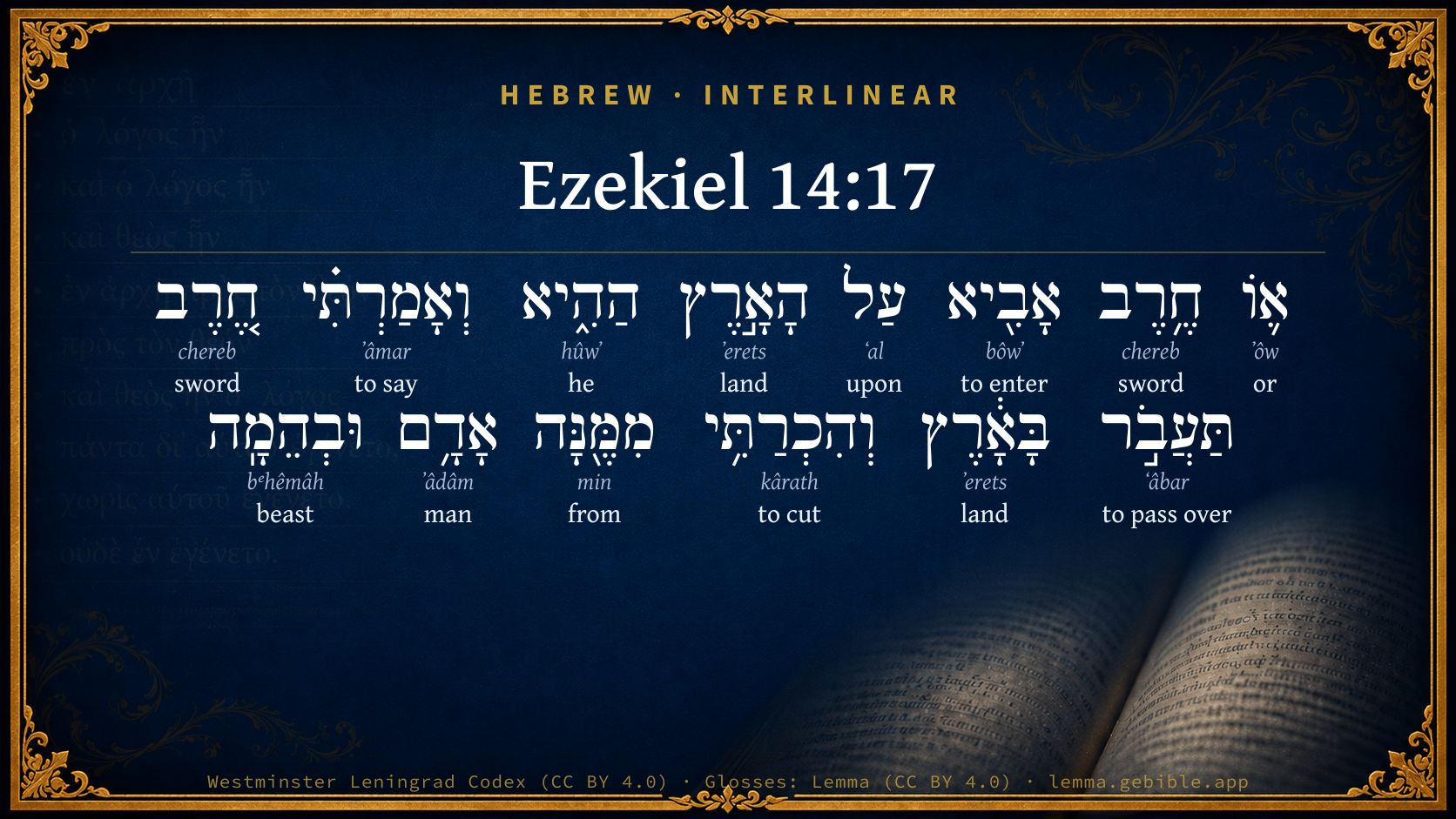
Hebrew (Westminster Leningrad Codex) Ezekiel 14:17 appears in the Hebrew Old Testament. The text above is from the Westminster Leningrad Codex. Each word links to its Strong’s number, a concise gloss, and parsing drawn from the Open Scriptures Hebrew Bible morphology. Click any word for its full Brown-Driver-Briggs (BDB) entry.
Download image
Cite this verse

Ezekiel 14:17 (World English Bible). Public Domain. Lemma interlinear Bible study tool, https://lemma.gebible.app/v/ezekiel/14/17.

Show BibTeX & RIS
BibTeX
RIS
English Translation
Or if I bring a sword on that land, and say, Sword, go through the land; so that I cut off from it man and animal;
World English Bible · Public Domain
Download a study sheet

One document with this verse’s original text, its word-by-word gloss line, the meaning frame, cross-references with their text, attributed commentary, and full source and license credits — printable, and it pastes into notes with its structure intact.

This verse Autodidact and up

Study sheet (.html) Plain text (.txt)

A passage Seminary Student

Up to 50 verses in one chapter. A passage sheet keeps up to 6 commentary sources and 12 cross-references per verse, in the order this page ranks them, and says so on the sheet whenever that leaves anything out. Ask for a single verse and you get the Autodidact verse sheet above.

Everything on this page stays free to read, with no account — the sheet is a download of what is already on screen, not access to it.

Want to remove ads? Support Godless Engineer
Compare translations 3

The same verse in 3 English versions, stacked beneath the original-language interlinear above. Click any original word for its lexicon entry.

Each is an independent rendering of the whole verse — the interlinear is not word-aligned to these translations.

Highlighted words mark where these versions differ — a whole-verse word diff, not a word-by-word alignment.

  • World English Bible Public Domain
    Or if I bring a sword on that land, and say, Sword, go through the land; so that I cut off from it man and animal;
  • King James Version Public Domain
    Or if I bring a sword upon that land, and say, Sword, go through the land; so that I cut off man and beast from it:
  • unfoldingWord Literal Text CC BY-SA 4.0
    Or if I bring a sword against that land and say, ‘Sword, go through the land and cut off both man and beast from it’,

unfoldingWord Literal Text — © unfoldingWord, licensed CC BY-SA 4.0. Word-aligned USFM3 via Door43 (git.door43.org/unfoldingWord/en_ult).

Versions to compare (up to 4)

3 of 4 selected

Show all 18 translations

Every available English version of this verse, each an independent rendering of the whole verse.

  • World English Bible Public Domain
    Or if I bring a sword on that land, and say, Sword, go through the land; so that I cut off from it man and animal;
  • Berean Standard Bible Public Domain
    Or if I bring a sword against that land and say, ‘Let a sword pass through it,’ so that I cut off from it both man and beast,
  • Majority Standard Bible Public Domain
    Or if I bring a sword against that land and say, ‘Let a sword pass through it,’ so that I cut off from it both man and beast,
  • King James Version Public Domain
    Or if I bring a sword upon that land, and say, Sword, go through the land; so that I cut off man and beast from it:
  • American Standard Version (1901) Public Domain
    Or if I bring a sword upon that land, and say, Sword, go through the land; so that I cut off from it man and beast;
  • Revised Version (1885) Public Domain
    Or if I bring a sword upon that land, and say, Sword, go through the land; so that I cut off from it man and beast;
  • Geneva Bible (1599) Public Domain
    Or if I bring a sworde vpon this land, and say, Sword, go through the land, so that I destroy man and beast out of it,
  • Douay-Rheims (1899) Public Domain
    Or if I bring the sword upon that land, and say to the sword: Pass through the land: and I destroy man and beast out of it:
  • Young's Literal Translation Public Domain
    `Or -- a sword I bring in against that land, and I have said: Sword, thou dost pass over through the land, and I have cut off from it man and beast --
  • Literal Standard Version CC BY-SA 4.0
    Or [if] I bring a sword in against that land, and I have said: Sword, pass over through the land, and I have cut off man and beast from it—
  • Unlocked Literal Bible CC BY-SA 4.0
    Or if I bring a sword against that land and say, 'Sword, go through the land and cut off both man and beast from it',
  • unfoldingWord Literal Text CC BY-SA 4.0
    Or if I bring a sword against that land and say, ‘Sword, go through the land and cut off both man and beast from it’,
  • Darby Bible Public Domain
    Or [if] I bring the sword upon that land, and say, Sword, go through the land, so that I cut off man and beast from it,
  • World Messianic Bible Public Domain
    “Or if I bring a sword on that land, and say, ‘Sword, go through the land, so that I cut off from it man and animal’—
  • Webster's Bible Public Domain
    Or if I bring a sword upon that land, and say, Sword, go through the land; so that I cut off man and beast from it:
  • Free Bible Version CC BY-SA 4.0
    I could bring war to that country and say, ‘Have a sword cut through it,’ so that I destroy both people and animals.
  • Bible in Basic English Public Domain
    Or if I send a sword against that land, and say, Sword, go through the land, cutting off from it man and beast:
  • JPS Tanakh (1917) Public Domain
    Or if I bring a sword upon that land, and say: Let the sword go through the land, so that I cut off from it man and beast;

Literal Standard Version (2020), Covenant Press — licensed CC BY-SA 4.0. Text via the HelloAO Bible API (eBible.org). Unlocked Literal Bible (unfoldingWord) — licensed CC BY-SA 4.0. Text via the HelloAO Bible API (eBible.org). unfoldingWord Literal Text — © unfoldingWord, licensed CC BY-SA 4.0. Word-aligned USFM3 via Door43 (git.door43.org/unfoldingWord/en_ult). Free Bible Version, Dr. Jonathan Gallagher — licensed CC BY-SA 4.0. Text via the HelloAO Bible API (eBible.org).

Word by word

More ways to search: Search by grammar → Find every occurrence → Compare this word →

Practice this passage: Drill this verse → Learn its vocabulary →

וּבְהֵמָֽה
bᵉhêmâh
H929
“and · beast”
Conjunction + Noun, Common, Feminine, Singular, Absolute
Part of Speech
Conjunction + Noun
Type
Common
Gender
Feminine
Number
Singular
State
Absolute
Full BDB Definition

Origin: from an unused root (probably meaning to be mute)

TWOT: 208a

beast, cattle, animal - beasts (collective of all animals) - cattle, livestock (of domestic animals) - wild beasts
  1. א֛וֹ ʼôw H176 “or” Conjunction
  2. חֶ֥רֶב chereb H2719 “sword” Noun, Common, Feminine, Singular, Absolute
  3. אָבִ֖יא bôwʼ H935 “to enter” Verb, Hiphil, Imperfect, 1st Person, Common, Singular
  4. עַל ʻal H5921 “upon” Preposition
  5. הָאָ֣רֶץ ʼerets H776 “the · land” Particle, Definite Article + Noun, Common, Both, Singular, Absolute
  6. הַהִ֑יא hûwʼ H1931 “the · he” Particle, Definite Article + Pronoun, Personal, 3rd Person, Feminine, Singular
  7. וְאָמַרְתִּ֗י ʼâmar H559 “and · to say” Conjunction + Verb, Qal, Sequential Perfect, 1st Person, Common, Singular
  8. חֶ֚רֶב chereb H2719 “sword” Noun, Common, Feminine, Singular, Absolute
  9. תַּעֲבֹ֣ר ʻâbar H5674 “to pass over” Verb, Qal, Imperfect, 3rd Person, Feminine, Singular
  10. בָּאָ֔רֶץ ʼerets H776 “in/at the · land” Preposition, Determined + Noun, Common, Both, Singular, Absolute
  11. וְהִכְרַתִּ֥י kârath H3772 “and · to cut” Conjunction + Verb, Hiphil, Sequential Perfect, 1st Person, Common, Singular
  12. מִמֶּ֖נָּה min H4480 “from · her” Preposition + Suffix, Personal, 3rd Person, Feminine, Singular
  13. אָדָ֥ם ʼâdâm H120 “man” Noun, Common, Masculine, Singular, Absolute

About this verse

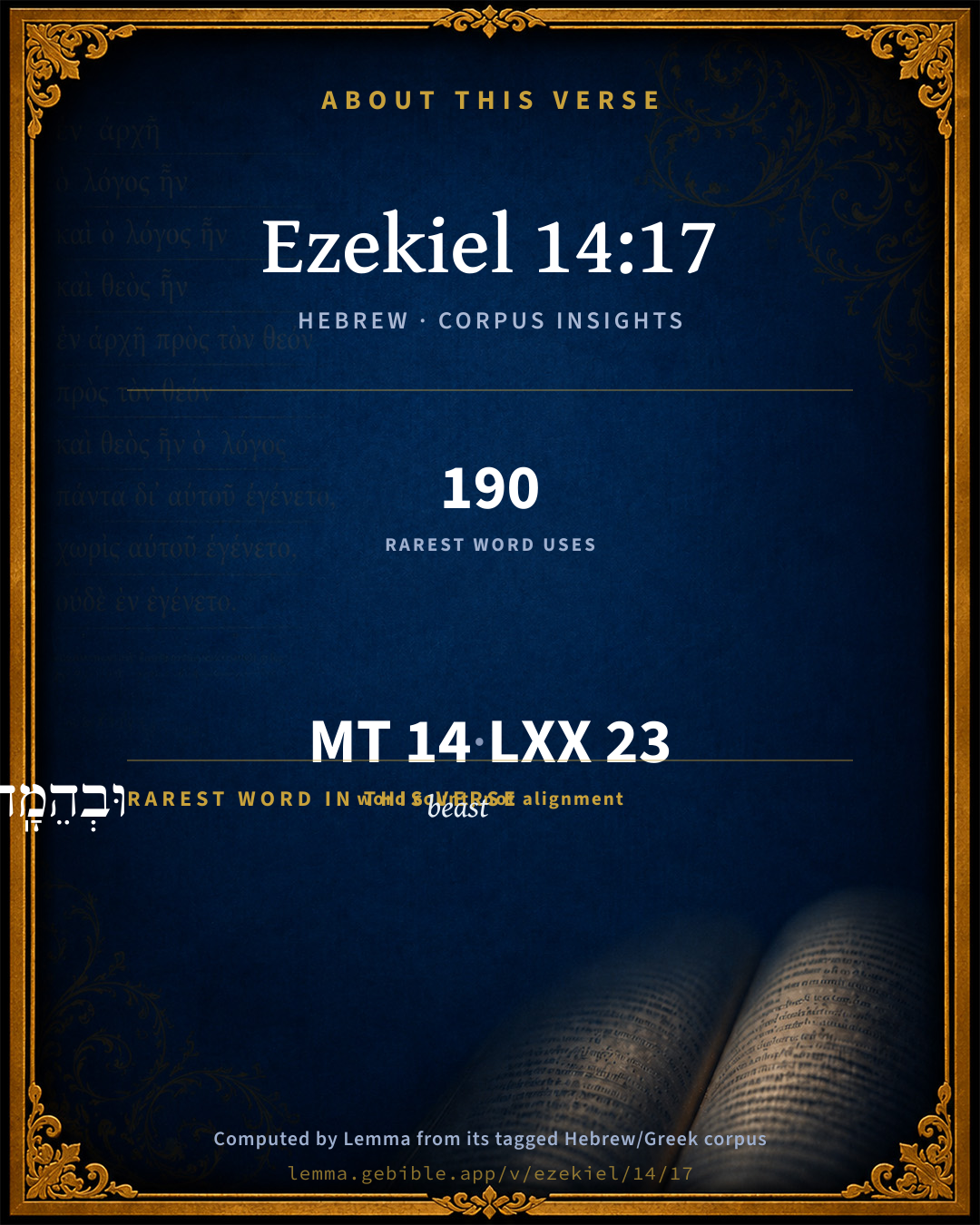
These counts appear in no published source. They are computed here, from the morphology-tagged text and Lemma’s own curated glosses. What Lemma adds →

14
words
12
distinct lemmas
Prophets
section

Grammatical profile

  • 4 verbs
  • 6 nouns
  • 1 pronoun
  • 2 prepositions
  • 1 conjunction

Verb forms

  • אָבִ֖יא Hiphil · Imperfect
  • וְאָמַרְתִּ֗י Qal · Sequential Perfect
  • תַּעֲבֹ֣ר Qal · Imperfect
  • וְהִכְרַתִּ֥י Hiphil · Sequential Perfect

Repetition

Words recur within this verse — often emphatic in Hebrew:

  • חֶ֥רֶב sword H2719 ×2
  • הָאָ֣רֶץ land H776 ×2

Hebrew & Septuagint length

In English translation the verse runs 26 words from the Hebrew and 28 from the Septuagint (LXX English) — closely comparable.

A rough comparison of the two English renderings, which tokenize alike — not a word-level alignment.

Word counts can differ between the Hebrew and the Greek without any difference in meaning — e.g. the Hebrew direct-object marker אֵת has no separate Greek word, and Greek often adds the article ὁ.

In the original languages it is 14 Hebrew tokens and 23 Greek tokens — but the two are counted differently (Hebrew bundles its prefixes and suffixes into one token; the Greek is in lemma form), so that isn’t a like-for-like length.

Cross-references

14

Topical passages linked to Ezekiel 14:17 in the Treasury of Scripture Knowledge — connected by theme and wording, ordered by reader-vote popularity; previews shown in the World English Bible.

  • Leviticus 26:25 I will bring a sword upon you, that will execute the vengeance of the covenant; and you will be gathered together within your cities: and I will send the pestilence among you; and you will be delivered into the hand of the enemy.
  • Ezekiel 21:3–4 and tell the land of Israel, Thus says Yahweh: Behold, I am against you, and will draw forth my sword out of its sheath, and will cut off from you the righteous and the wicked.
  • Ezekiel 5:12 A third part of you shall die with the pestilence, and with famine shall they be consumed in the midst of you; and a third part shall fall by the sword round about you; and a third part I will scatter to all the winds, and will draw out a sword after them.
  • Zephaniah 1:3 I will sweep away man and animal. I will sweep away the birds of the sky, the fish of the sea, and the heaps of rubble with the wicked. I will cut off man from the surface of the earth, says Yahweh.
  • Jeremiah 47:6 You sword of Yahweh, how long will it be before you be quiet? put up yourself into your scabbard; rest, and be still.
  • Ezekiel 14:13 Son of man, when a land sins against me by committing a trespass, and I stretch out my hand on it, and break the staff of the bread of it, and send famine on it, and cut off from it man and animal;
  • Ezekiel 25:13 therefore thus says the Lord Yahweh, I will stretch out my hand on Edom, and will cut off man and animal from it; and I will make it desolate from Teman; even to Dedan shall they fall by the sword.
  • Jeremiah 25:9 behold, I will send and take all the families of the north, says Yahweh, and [I will send] to Nebuchadrezzar the king of Babylon, my servant, and will bring them against this land, and against the inhabitants of it, and against all these nations round about; and I will utterly destroy them, and make them an astonishment, and a hissing, and perpetual desolations.
  • Jeremiah 33:12 Thus says Yahweh of Hosts: Yet again shall there be in this place, which is waste, without man and without animal, and in all the cities of it, a habitation of shepherds causing their flocks to lie down.
  • Ezekiel 5:17 and I will send on you famine and evil animals, and they shall bereave you; and pestilence and blood shall pass through you; and I will bring the sword on you: I, Yahweh, have spoken it.
  • Ezekiel 21:9–15 Son of man, prophesy, and say, Thus says Yahweh: Say, A sword, a sword, it is sharpened, and also furbished;
  • Ezekiel 29:8 Therefore thus says the Lord Yahweh: Behold, I will bring a sword on you, and will cut off from you man and animal.
  • Ezekiel 38:21–22 I will call for a sword against him to all my mountains, says the Lord Yahweh: every man's sword shall be against his brother.
  • Hosea 4:3 Therefore the land will mourn, And everyone who dwells therein will waste away. All living things in her, Even the animals of the field and the birds of the sky; Yes, the fish of the sea also die.

Cross-references courtesy of OpenBible.info (CC BY 4.0).

Hebrew and Greek witnesses Masoretic Hebrew ↔ Greek Septuagint

The same verse in the two great witnesses to the Old Testament, shown verse-for-verse.

These are two independent witnesses, not word-aligned to each other, and the Septuagint is shown in lemma (dictionary) form.

Hebrew Ezekiel 14:17 Masoretic · Westminster Leningrad Codex

א֛וֹ חֶ֥רֶב אָבִ֖יא עַל הָאָ֣רֶץ הַהִ֑יא וְאָמַרְתִּ֗י חֶ֚רֶב תַּעֲבֹ֣ר בָּאָ֔רֶץ וְהִכְרַתִּ֥י מִמֶּ֖נָּה אָדָ֥ם וּבְהֵמָֽה

Or if I bring a sword on that land, and say, Sword, go through the land; so that I cut off from it man and animal;

World English Bible · Public Domain

Greek LXX Ezekiel 14:17 Septuagint · lemma form

ἤ καί ῥομφαία ἐάν ἐπιἄγω ἐπί ὁ γῆ ἐκεῖνος καί εἶπον ῥομφαία διαἔρχομαι διά ὁ γῆ καί ἐκαἴρω ἐκ αὐτός ἄνθρωπος καί κτῆνος

Or again if I bring a sword upon that land, and say, Let the sword go through the land; and I cut off from them man and beast:

LXX2012 (modern English Septuagint) · Public Domain

Hebrew: Westminster Leningrad Codex (CC BY 4.0). Greek: Septuagint (public domain); English from LXX2012 (modern English Septuagint) (Public Domain). How the Septuagint differs from the Hebrew →

Targum (Aramaic paraphrase)

1

The Targum is the ancient Jewish Aramaic paraphrase of the Hebrew Scriptures — an interpretive translation, not the Hebrew text itself. Onkelos (literal) and Pseudo-Jonathan (expansive) render the Torah, and Jonathan the Prophets. Coverage is partial: where no permissively-licensed English translation exists for a verse, only the Aramaic is shown. This is verse-level text, not a word-by-word alignment to the Hebrew.

  1. Targum Jonathan Prophets (Joshua–Malachi)
    אוֹ דְקַטְלִין בְּחַרְבָּא אַיְיתֵי עַל אַרְעָא הַהִיא וְאֵימַר דְקַטְלִין בְּחַרְבָּא יֶעְדוּן בְּאַרְעָא וֶאֱשֵׁיצֵי מִנָהּ אֱנָשָׁא וּבְעִירָא:

    (no public-domain English translation for this verse)

    Targum Jonathan — Aramaic: “Mikraot Gedolot” (public domain). English: “Sefaria Community Translation” (CC0 1.0 (public-domain dedication)); “London "Chaldee Paraphrase," 1871” (public domain). Text via Sefaria.

Commentary

Notes on Ezekiel 14:17 from classic Christian and Jewish commentators (each source and its license shown beneath its notes). The classic Christian expositions comment on the surrounding passage and are grouped to its opening verse, so a note may address several verses; the Jewish commentaries on the Tanakh (Rashi and others) are per-verse, so they appear only where the commentator wrote on this verse.

Lemma curates 59 commentaries, every one of them public domain or Creative Commons licensed, each selected and text-cleaned for this edition rather than reprinted as found. About our sources →

Trapp's Complete Commentary

John Trapp

Eze 14:17 Or [if] I bring a sword upon that land, and say, Sword, go through the land; so that I cut off man and beast from it:

Ver. 17. Or if I bring a sword.] The sword, whensoever it comes is bathed in heaven. {Isa 34:5}

Sword, go through the land.] When the sword rideth circuit, as a judge, it is in commission. See Jer 47:6-7.

John Trapp, A Commentary or Exposition upon All the Books of the Old and New Testament (1647–1656) — public domain. Text from a community e-Sword module.

John Calvin's Commentaries

The Prophet now descends to the third kind of punishment. Hence God says, if he send a sword upon a land, he cannot be entreated so as not to consume it utterly, neither will he admit any man’s intercession, although the most holy dwell there, namely, Job, Noah, and Daniel. But the phrase used must be marked: if I shall say to the sword, pass through to exterminate and blot out the whole land, or cut off from it, both man and beast, because we here gather the great power of God’s secret government. For we think that wars are stirred up at random: and as men are in agitation, so also we imagine war to be nothing but confusion and turbulence. But God governs even wars by his inestimable wisdom, and also men and their swords: men are enraged, their swords fly about in their hands, and they seem to go hither and thither at random by blind impulse. But God here announces that he permits swords to pass through a land, and to destroy both men and cattle. If he had said, after the language used in many places, that he would arm men, it would not have been very wonderful: for everywhere throughout the Prophets he calls the Chaldaeans and Assyrians executors of his judgment. Hence that sentence of Jeremiah, Cursed is he who has done God’s work negligently. (Jeremiah 48:10.) But that work of God was the slaughter at Jerusalem. So also Nebuchadnezzar is called God’s servant and minister when he laid waste Egypt, and God promises him the reward of his labor. (Ezekiel 29:20.) So here Ezekiel proceeds further, not only that the hands of men are directed as God wishes, but also that their swords listen to his secret command, so that they neither pass by nor strike any man or animal except as far as God pleases. But if God so commands the swords, let us know that whenever men rise up against us, that our patience is exercised and our sins chastised in this way: and that the impious are God’s agents: and let us determine that we shall never profit by noise and resistance, since there is but one remedy, to humble ourselves under God’s strong hand. Now the fourth kind of punishment follows —

John Calvin's Commentaries (1540-1563) — public domain. Text from the Calvin Translation Society English edition (1840s-50s) via the Christian Classics Ethereal Library (ccel.org). Calvin's coverage is partial (roughly two-thirds of the Bible); uncommented books and verses are honest gaps, never fabricated. The 19th-century editor's footnotes and remarks are omitted so the notes are faithfully Calvin's own voice.

The Cambridge Bible for Schools and Colleges

gen. ed. J. J. S. Perowne

17. say, Sword, go through] This rendering assumes a grammatical anomaly. Rather, the sword shall go through.

Eze_14:19-20. The pestilence.

The Cambridge Bible for Schools and Colleges (gen. ed. J. J. S. Perowne; Cambridge University Press, 1878–1918) — public domain. Text from a community e-Sword module.

John Gill's Exposition

Though these three men were in it,.... Before mentioned:

as I live, saith the Lord God, they shall deliver neither sons nor daughters: believe me no more, or be it so and so, if they do; it is in the form of an oath, and in the same manner it is expressed in Eze 14:16;

but they only shall be delivered themselves; their own souls or lives, and by their righteousness, as in Eze 14:14.

John Gill's Exposition of the Whole Bible (1746–1763) — public domain (CC PDM 1.0). Text via the HelloAO Bible API.

Matthew Poole's English Annotations

He is Lord of hosts, and hath the militia of all the world in his hand, the sword is the right of the King of kings.

Bring a sword; raise war, and send enemies to invade it. That land; what land soever it be.

Go through the land: though inanimate things have not ears to hear, yet God speaks of them sometimes as if they had ears to hear, and understanding to discern; hereby intimating to us his overruling power, wisdom, justice, and sovereignty.

So that I cut off man: men cut off men in war, yet here God takes it to himself, he doth it by men.

And beast: though wars chiefly destroy men, yet the beasts of the field go to wreck too, the beasts that are serviceable in wars are waste, as horses and beasts of burden. The Eastern nations have brought store of camels and many elephants into the wars; beside the slaughter of these in fight, the spoiler wasting his enemy doth often destroy whole herds and flocks.

Matthew Poole's English Annotations on the Holy Bible (1683–1685) — public domain. Text from a community e-Sword/MySword module.

Whedon's Commentary on the Bible

Daniel D. Whedon

17-19. See Eze_5:12-17; Eze_21:3; Eze_38:21-22; Lev_26:22-26.

Daniel D. Whedon (gen. ed.), Commentary on the Old and New Testaments (1874–1909) — public domain. Text from a community e-Sword module.

John Wesley's Explanatory Notes

That land - What land soever it be.

John Wesley, Explanatory Notes Upon the Whole Bible (1754–1765) — public domain. Text via the GEBible commentary corpus.

unfoldingWord translationNotes

Door43 World Missions Community

if I bring a sword against that land

The word "sword" is a metonym for soldiers who kill people using swords. AT:

Sword, go through the land

Here the word "sword" represents the soldiers of an enemy army who attack with swords. AT: "Army, go through the land" (See: Metonymy)

cut off both man and beast from it

Yahweh speaks of killing people and animals as if it were cutting them off, like a person would cut a branch from a tree. AT: "kill both man and beast in the land" (See: Metaphor)

these three men

Noah, Daniel, and Job

only their own lives would be rescued

This can be stated in active form. AT: "they would only rescue their own lives" (See: Active or Passive)

translationWords

sword

cut off

declare

unfoldingWord translationNotes — © Distant Shores Media and the Door43 World Missions Community, licensed CC BY-SA 4.0. Source: git.door43.org/Door43/en_tn.

Rashi

Rabbi Shlomo Yitzchaki (Rashi)

sword Troops for battle.

Rashi on the Tanakh — English translations: “The Judaica Press complete Tanach with Rashi, translated by A. J. Rosenberg” (CC BY 4.0); “Pentateuch with Rashi's commentary by M. Rosenbaum and A.M. Silbermann, 1929-1934” (public domain); “The Metsudah Tanach series, Lakewood, N.J” (CC BY 4.0); and “The Book of Joshua, Metsudah Publications, 1997” (CC BY 4.0). Text via Sefaria.

Lesson kit

Teaching starters — assembled from the data on this page, not authored interpretation. Every prompt links to the verse data it draws on. Edit before teaching.

Ezekiel, in the Prophets, opens this verse with 14 words (12 distinct Hebrew lemmas). Its most distinctive word is bᵉhêmâh (“beast”). A historical commentator’s framing appears above. Read the whole chapter for the surrounding context.

Discussion questions

  1. The word bᵉhêmâh carries the sense “beast.” How does it shape the verse?
  2. Leviticus 26:25 shares this passage’s theme. How do the two illuminate each other?
  3. “sword” occurs 2× in this one verse. What is the effect of the repetition?
  4. These translations render this verse differently; the difference is in the English rendering, not the original. What questions does that raise?
  5. The verb «אָבִ֖יא» is Hiphil Imperfect. How does its form color the action?
  6. Reading how Trapp's Complete Commentary and John Calvin's Commentaries read this verse, where do the two commentators agree and where do they part?

Things to notice

Reading settings

Reading text

Shown beneath each verse's original-language words.

Old Testament
Old Testament edition

Read the OT as the Masoretic Hebrew (MT) or the Greek Septuagint (LXX).

English shown for the Greek Septuagint (in the Hebrew ↔ Greek comparison).

Comparing translations? Open the Compare panel on any verse page to stack up to four side by side.