Judges 3:16

Hebrew (Westminster Leningrad Codex) Judges 3:16 appears in the Hebrew Old Testament. The text above is from the Westminster Leningrad Codex. Each word links to its Strong’s number, a concise gloss, and parsing drawn from the Open Scriptures Hebrew Bible morphology. Click any word for its full Brown-Driver-Briggs (BDB) entry.
Download image
Cite this verse

Judges 3:16 (World English Bible). Public Domain. Lemma interlinear Bible study tool, https://lemma.gebible.app/v/judges/3/16.

Show BibTeX & RIS
BibTeX
RIS
English Translation
Ehud made him a sword which had two edges, a cubit in length; and he girded it under his clothing on his right thigh.
World English Bible · Public Domain
Highlights
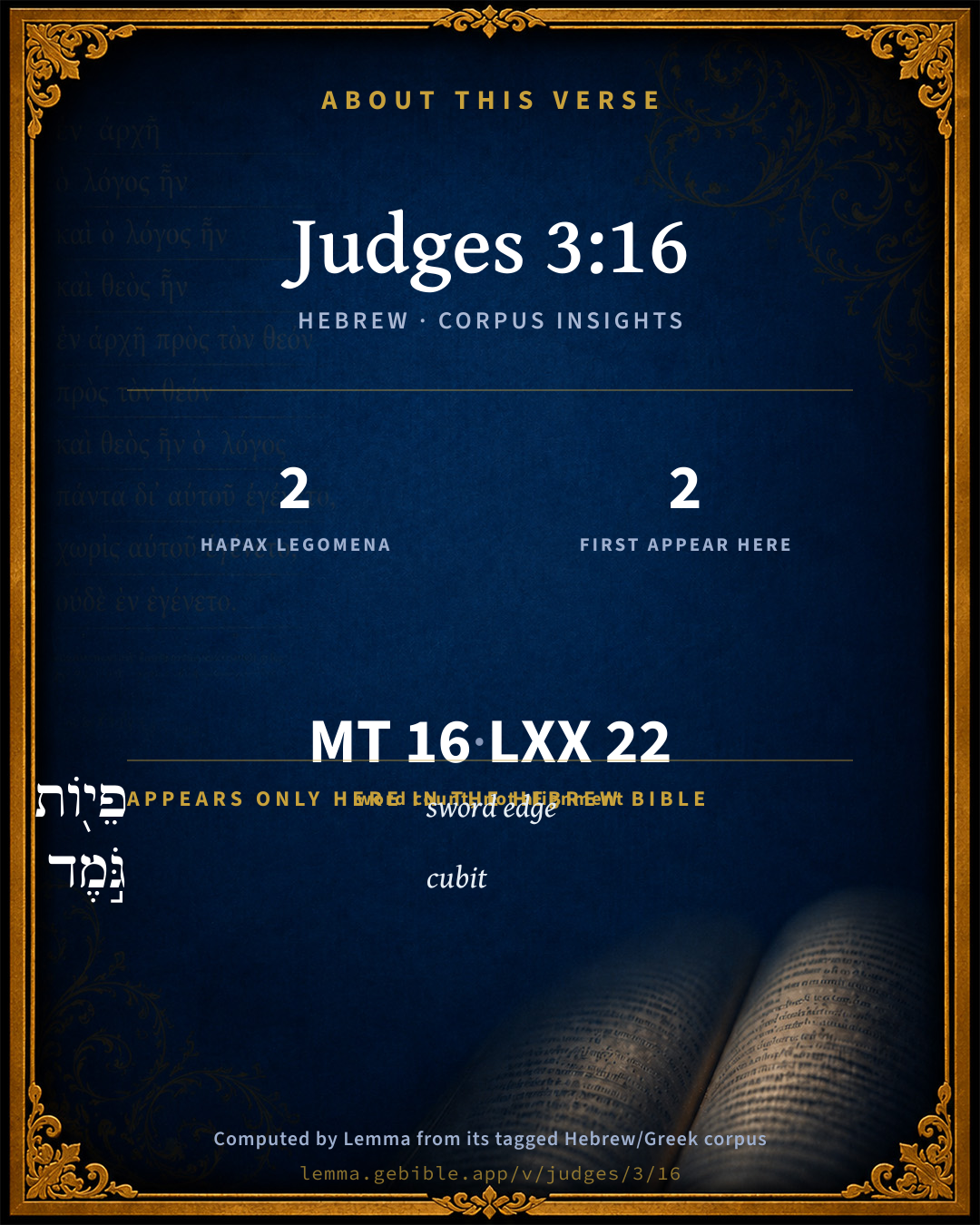
  • 2 hapax legomena — only here in the Hebrew Bible
  • 2 first appearances in the Hebrew Bible
Full analysis ↓
Download a study sheet

One document with this verse’s original text, its word-by-word gloss line, the meaning frame, cross-references with their text, attributed commentary, and full source and license credits — printable, and it pastes into notes with its structure intact.

This verse Autodidact and up

Study sheet (.html) Plain text (.txt)

A passage Seminary Student

Up to 50 verses in one chapter. A passage sheet keeps up to 6 commentary sources and 12 cross-references per verse, in the order this page ranks them, and says so on the sheet whenever that leaves anything out. Ask for a single verse and you get the Autodidact verse sheet above.

Everything on this page stays free to read, with no account — the sheet is a download of what is already on screen, not access to it.

Want to remove ads? Support Godless Engineer
Compare translations 3

The same verse in 3 English versions, stacked beneath the original-language interlinear above. Click any original word for its lexicon entry.

Each is an independent rendering of the whole verse — the interlinear is not word-aligned to these translations.

Highlighted words mark where these versions differ — a whole-verse word diff, not a word-by-word alignment.

  • World English Bible Public Domain
    Ehud made him a sword which had two edges, a cubit in length; and he girded it under his clothing on his right thigh.
  • King James Version Public Domain
    But Ehud made him a dagger which had two edges, of a cubit length; and he did gird it under his raiment upon his right thigh.
  • unfoldingWord Literal Text CC BY-SA 4.0
    And Ehud made a sword for himself, and two mouths to it; a cubit its length. And he bound it onto his right thigh beneath his clothing.

unfoldingWord Literal Text — © unfoldingWord, licensed CC BY-SA 4.0. Word-aligned USFM3 via Door43 (git.door43.org/unfoldingWord/en_ult).

Versions to compare (up to 4)

3 of 4 selected

Show all 18 translations

Every available English version of this verse, each an independent rendering of the whole verse.

  • World English Bible Public Domain
    Ehud made him a sword which had two edges, a cubit in length; and he girded it under his clothing on his right thigh.
  • Berean Standard Bible Public Domain
    Now Ehud had made for himself a double-edged sword a cubit long. He strapped it to his right thigh under his cloak
  • Majority Standard Bible Public Domain
    Now Ehud had made for himself a double-edged sword a cubit long. He strapped it to his right thigh under his cloak
  • King James Version Public Domain
    But Ehud made him a dagger which had two edges, of a cubit length; and he did gird it under his raiment upon his right thigh.
  • American Standard Version (1901) Public Domain
    And Ehud made him a sword which had two edges, a cubit in length; and he girded it under his raiment upon his right thigh.
  • Revised Version (1885) Public Domain
    And Ehud made him a sword which had two edges, of a cubit length; and he girded it under his raiment upon his right thigh.
  • Geneva Bible (1599) Public Domain
    And Ehud made him a dagger with two edges of a cubite length, and he did gird it vnder his rayment vpon his right thigh,
  • Douay-Rheims (1899) Public Domain
    And he made himself a two-edged sword, with a haft in the midst of the length of the palm of the hand, and was girded therewith under his garment on the right thigh.
  • Young's Literal Translation Public Domain
    and Ehud maketh for himself a sword, and it hath two mouths (a cubit `is' its length), and he girdeth it under his long robe on his right thigh;
  • Literal Standard Version CC BY-SA 4.0
    and Ehud makes a sword for himself, and it has two mouths (its length [is] a cubit), and he girds it under his long robe on his right thigh;
  • Unlocked Literal Bible CC BY-SA 4.0
    Ehud made himself a sword that had two edges, one cubit in length; he strapped it on under his clothing on his right thigh.
  • unfoldingWord Literal Text CC BY-SA 4.0
    And Ehud made a sword for himself, and two mouths to it; a cubit its length. And he bound it onto his right thigh beneath his clothing.
  • Darby Bible Public Domain
    And Ehud made for himself a sword with two edges, a cubit in length; and he girded it on his right thigh under his clothes.
  • World Messianic Bible Public Domain
    Ehud made himself a sword which had two edges, a cubit in length; and he wore it under his clothing on his right thigh.
  • Webster's Bible Public Domain
    But Ehud made him a dagger which had two edges, of a cubit length; and he girded it under his raiment upon his right thigh.
  • Free Bible Version CC BY-SA 4.0
    Ehud had made for himself a cubit long double-edged sword, and he strapped it to his right thigh under his clothes.
  • Bible in Basic English Public Domain
    So Ehud made himself a two-edged sword, a cubit long, which he put on at his right side under his robe.
  • JPS Tanakh (1917) Public Domain
    And Ehud made him a sword which had two edges, of a cubit length; and he girded it under his raiment upon his right thigh.

Literal Standard Version (2020), Covenant Press — licensed CC BY-SA 4.0. Text via the HelloAO Bible API (eBible.org). Unlocked Literal Bible (unfoldingWord) — licensed CC BY-SA 4.0. Text via the HelloAO Bible API (eBible.org). unfoldingWord Literal Text — © unfoldingWord, licensed CC BY-SA 4.0. Word-aligned USFM3 via Door43 (git.door43.org/unfoldingWord/en_ult). Free Bible Version, Dr. Jonathan Gallagher — licensed CC BY-SA 4.0. Text via the HelloAO Bible API (eBible.org).

Word by word

More ways to search: Search by grammar → Find every occurrence → Compare this word →

Practice this passage: Drill this verse → Learn its vocabulary →

פֵי֖וֹת
pêyâh
H6366
“sword edges”
Noun, Common, Masculine, Plural, Absolute
Part of Speech
Noun
Type
Common
Gender
Masculine
Number
Plural
State
Absolute
Full BDB Definition

Origin: from H6310

TWOT: 1738

edge (of a sword)
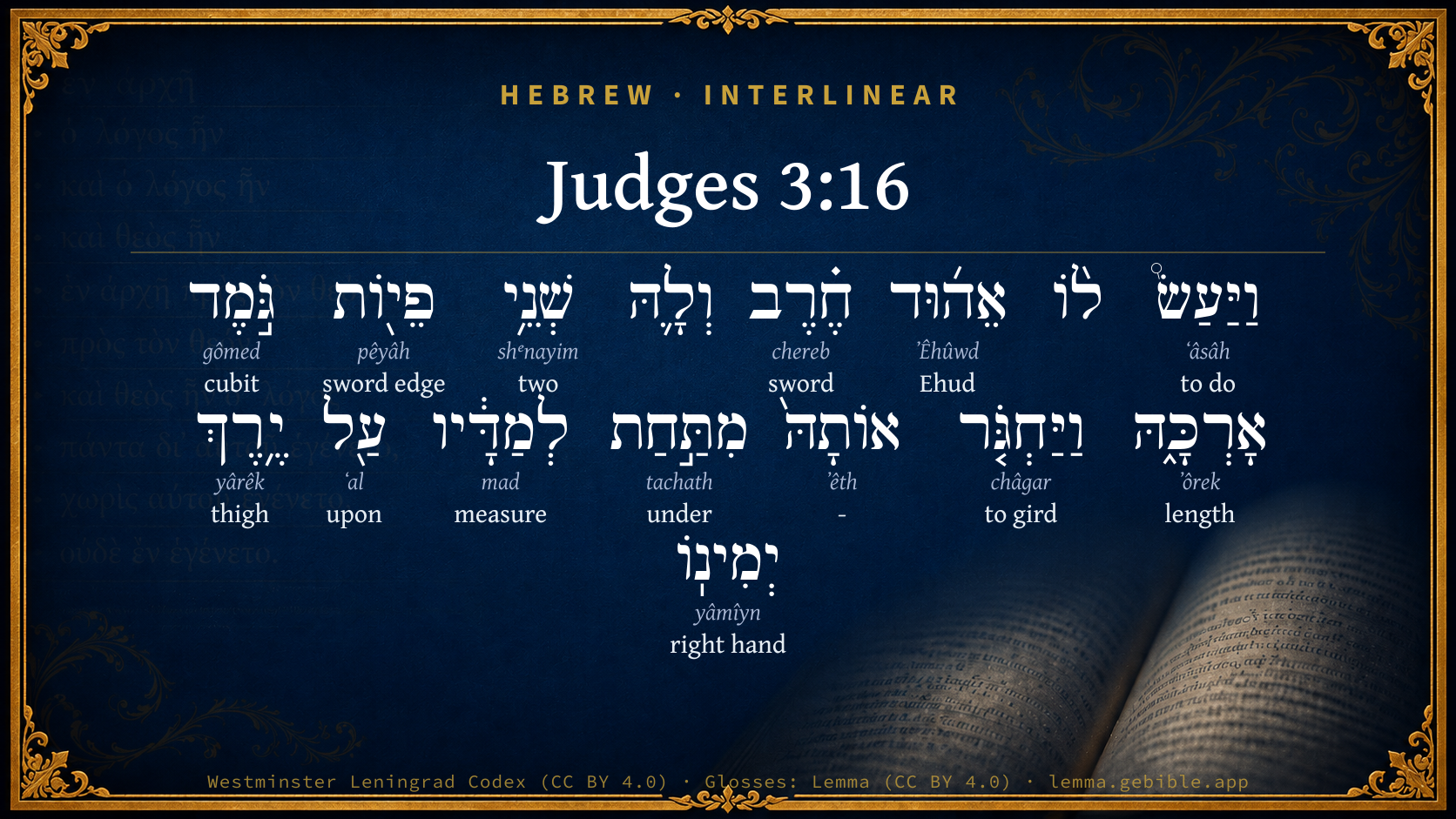
  1. וַיַּעַשׂ֩ ʻâsâh H6213 “and · to do” Conjunction + Verb, Qal, Sequential Imperfect, 3rd Person, Masculine, Singular
  2. אֵה֜וּד ʼÊhûwd H164 “Ehud” Noun, Proper
  3. חֶ֗רֶב chereb H2719 “sword” Noun, Common, Feminine, Singular, Absolute
  4. שְׁנֵ֥י shᵉnayim H8147 “two” Adjective, Cardinal number, Masculine, Dual, Construct
  5. גֹּ֣מֶד gômed H1574 “cubit” Noun, Common, Masculine, Singular, Absolute
  6. אָרְכָּ֑הּ ʼôrek H753 “length · her” Noun, Common, Masculine, Singular, Construct + Suffix, Personal, 3rd Person, Feminine, Singular
  7. וַיַּחְגֹּ֤ר châgar H2296 “and · to gird” Conjunction + Verb, Qal, Sequential Imperfect, 3rd Person, Masculine, Singular
  8. אוֹתָהּ֙ ʼêth H853 “- · her” Particle, Direct Object + Suffix, Personal, 3rd Person, Feminine, Singular
  9. מִתַּ֣חַת tachath H8478 “from · under” Preposition + Preposition
  10. לְמַדָּ֔יו mad H4055 “to/for · measures · his” Preposition + Noun, Common, Masculine, Plural, Construct + Suffix, Personal, 3rd Person, Masculine, Singular
  11. עַ֖ל ʻal H5921 “upon” Preposition
  12. יֶ֥רֶךְ yârêk H3409 “thigh of” Noun, Common, Feminine, Singular, Construct
  13. יְמִינֽוֹ yâmîyn H3225 “right hand · his” Noun, Common, Feminine, Singular, Construct + Suffix, Personal, 3rd Person, Masculine, Singular

About this verse

These counts appear in no published source. They are computed here, from the morphology-tagged text and Lemma’s own curated glosses. What Lemma adds →

16
words
14
distinct lemmas
Historical
section

Notable vocabulary

2 hapax legomena — words that appear only here in the entire Hebrew Bible:

  • פֵי֖וֹת sword edge H6366
  • גֹּ֣מֶד cubit H1574

First appearance in Scripture

These words make their first canonical appearance in the Hebrew Bible here:

  • פֵי֖וֹת sword edge H6366
  • גֹּ֣מֶד cubit H1574

Shared distinctive vocabulary

אֵה֜וּד Ehud H164 occurs in 8 verses of the Hebrew Bible. Also found in:

Grammatical profile

  • 2 verbs
  • 8 nouns
  • 1 adjective
  • 4 prepositions
  • 1 particle

Verb forms

  • וַיַּעַשׂ֩ Qal · Sequential Imperfect
  • וַיַּחְגֹּ֤ר Qal · Sequential Imperfect

Hebrew & Septuagint length

In English translation the verse runs 24 words from the Hebrew and 24 from the Septuagint (LXX English) — the same length.

A rough comparison of the two English renderings, which tokenize alike — not a word-level alignment.

Word counts can differ between the Hebrew and the Greek without any difference in meaning — e.g. the Hebrew direct-object marker אֵת has no separate Greek word, and Greek often adds the article ὁ.

In the original languages it is 16 Hebrew tokens and 22 Greek tokens — but the two are counted differently (Hebrew bundles its prefixes and suffixes into one token; the Greek is in lemma form), so that isn’t a like-for-like length.

Cross-references

7

Topical passages linked to Judges 3:16 in the Treasury of Scripture Knowledge — connected by theme and wording, ordered by reader-vote popularity; previews shown in the World English Bible.

  • Psalms 45:3 Gird your sword on your thigh, mighty one: Your splendor and your majesty.
  • Hebrews 4:12 For the word of God is living, and active, and sharper than any two-edged sword, and piercing even to the dividing of soul and spirit, of both joints and marrow, and is able to discern the thoughts and intentions of the heart.
  • Revelation 2:12 "To the angel of the assembly in Pergamum write: "He who has the sharp two-edged sword says these things:
  • Judges 3:21 Ehud put forth his left hand, and took the sword from his right thigh, and thrust it into his body:
  • Psalms 149:6 May the high praises of God be in their mouths, And a two-edged sword in their hand;
  • Song of Solomon 3:8 They all handle the sword, and are expert in war. Every man has his sword on his thigh, Because of fear in the night.
  • Revelation 1:16 He had seven stars in his right hand. Out of his mouth proceeded a sharp two-edged sword. His face was like the sun shining at its brightest.

Cross-references courtesy of OpenBible.info (CC BY 4.0).

Hebrew and Greek witnesses Masoretic Hebrew ↔ Greek Septuagint

The same verse in the two great witnesses to the Old Testament, shown verse-for-verse.

These are two independent witnesses, not word-aligned to each other, and the Septuagint is shown in lemma (dictionary) form.

Hebrew Judges 3:16 Masoretic · Westminster Leningrad Codex

וַיַּעַשׂ֩ ל֨וֹ אֵה֜וּד חֶ֗רֶב וְלָ֛הּ שְׁנֵ֥י פֵי֖וֹת גֹּ֣מֶד אָרְכָּ֑הּ וַיַּחְגֹּ֤ר אוֹתָהּ֙ מִתַּ֣חַת לְמַדָּ֔יו עַ֖ל יֶ֥רֶךְ יְמִינֽוֹ

Ehud made him a sword which had two edges, a cubit in length; and he girded it under his clothing on his right thigh.

World English Bible · Public Domain

Greek LXX Judges 3:16 Septuagint · lemma form

καί ποιέω ἑαυτοῦ αωδ μάχαιρα δίστομος σπιθαμή ὁ μῆκος αὐτός καί περιζώννυμι αὐτός ὑπό ὁ μανδύας ἐπί ὁ μηρός ὁ δεξιός αὐτός

And Aod made himself a dagger of two edges, of a span long, and he girded it under his cloak upon his right thigh.

LXX2012 (modern English Septuagint) · Public Domain

On this verse, Adam Clarke's Commentary discusses the Septuagint’s reading. Read the note in Commentary ↓

Hebrew: Westminster Leningrad Codex (CC BY 4.0). Greek: Septuagint (public domain); English from LXX2012 (modern English Septuagint) (Public Domain). How the Septuagint differs from the Hebrew →

Targum (Aramaic paraphrase)

1

The Targum is the ancient Jewish Aramaic paraphrase of the Hebrew Scriptures — an interpretive translation, not the Hebrew text itself. Onkelos (literal) and Pseudo-Jonathan (expansive) render the Torah, and Jonathan the Prophets. Coverage is partial: where no permissively-licensed English translation exists for a verse, only the Aramaic is shown. This is verse-level text, not a word-by-word alignment to the Hebrew.

  1. Targum Jonathan Prophets (Joshua–Malachi)
    וַעֲבַד לֵיהּ אֵהוּד חַרְבָּא וְלָהּ תְּרֵין פּוּמִין גַרְמִידָא אָרְכָּא וְזָרֵיז יָתָהּ מִלְרַע לִלְבוּשׁוֹהִי עַל יַרְכֵיהּ דְיַמִינֵיהּ:

    (no public-domain English translation for this verse)

    Targum Jonathan — Aramaic: “Mikraot Gedolot” (public domain). English: “Sefaria Community Translation” (CC0 1.0 (public-domain dedication)); “London "Chaldee Paraphrase," 1871” (public domain). Text via Sefaria.

Commentary

Notes on Judges 3:16 from classic Christian and Jewish commentators (each source and its license shown beneath its notes). The classic Christian expositions comment on the surrounding passage and are grouped to its opening verse, so a note may address several verses; the Jewish commentaries on the Tanakh (Rashi and others) are per-verse, so they appear only where the commentator wrote on this verse.

Lemma curates 59 commentaries, every one of them public domain or Creative Commons licensed, each selected and text-cleaned for this edition rather than reprinted as found. About our sources →

Trapp's Complete Commentary

John Trapp

Jdg 3:16 But Ehud made him a dagger which had two edges, of a cubit length; and he did gird it under his raiment upon his right thigh.

Ver. 16. Upon his right thigh.] As more convenient for him that was left handed; as those that are right handed used always to wear their weapons on the left side. Hence among the Turks for place the left hand is held uppermost, for a soldier: because it giveth a man possession of his companion’s sword. {a}

{a} Sir H. Blunt’s Voy. into Lev.

John Trapp, A Commentary or Exposition upon All the Books of the Old and New Testament (1647–1656) — public domain. Text from a community e-Sword module.

Joseph Benson's Commentary

Jdg 3:16. Ehud, made him a dagger — It is probable that none of the Israelites were suffered to wear arms, and therefore this particular is mentioned of Ehud; and that he wore it under his upper garment to conceal it: for it does not appear that he made it purposely for the occasion, in which we are told in the following verses, he employed it. A cubit length — Long enough for his design, and not too long for concealment. His right thigh — Which was most convenient both for the use of his left hand, and for avoiding suspicion.

Joseph Benson's Commentary on the Old and New Testaments (1811–1818) — public domain. Text from a community e-Sword module.

Geneva Bible (1599)

Geneva Bible translators

Or, caused a dagger to be made.

Geneva Bible (1599) marginal notes — public domain. Text via Bolls.life.

Jamieson, Fausset & Brown

Robert Jamieson, A. R. Fausset & David Brown

Ehud made him a dagger . . . and he did gird it . . . upon his right thigh--The sword was usually worn on the left side; so that Ehud's was the more likely to escape detection.

Jamieson, Fausset & Brown — Commentary Critical and Explanatory on the Whole Bible (1871) — public domain (CC PDM 1.0). Text via the HelloAO Bible API.

Adam Clarke's Commentary

Verse 16. A dagger which had two edges, of a cubit length] The word גמד gomed, which we translate cubit, is of very doubtful signification. As the root seems to signify contracted, it probably means an instrument made for the purpose shorter than usual, and something like the Italian stiletto. The Septuagint translate it by σπιθαμη, a span, and most of the versions understand it in the same sense.

Upon his right thigh.] Because he was left-handed. Ordinarily the sword is on the left side, that it may be readily drawn out by the right hand; but as Ehud was left-handed, to be convenient his sword must be on the right side.

Adam Clarke's Commentary on the Bible (1810–1826) — public domain. Text from a community e-Sword/MySword module.

Ellicott's Commentary for English Readers

(16) Made him a dagger which had two edges.—Probably, as in other servitudes, the children of Israel had been disarmed. The “two edges” (comp. Rev_1:16) show that it was not a mere knife (comp. Psa_144:6; Heb_4:12). Jerome, in the Vulgate, after rightly rendering the word ancipitem, adds, “having a handle in the midst,” which seems useless and meaningless, and has no equivalent in the Hebrew.

A cubit length.—The LXX. and Vulgate render it a span long (spithamçs, palmœ; Luther, eine elle lang). The Hebrew word is not ammâh, the usual word for a cubit, but gômed. A dagger of a span long hardly, however, suits the following narrative, and perhaps gômed is an archaic word for ammâh. It meant originally “a staff.”

Under his raiment.—The LXX. and Vulgate have “under his war-cloak” (LXX. manduan, Vulg. sagum). The LXX., however, are only adopting a method very common with them—of choosing a Greek or, as in this case, a Persian (Hesych.) word which resembles the Hebrew word (maddim) in sound. The root of the Hebrew word shows that a long flowing robe (vestís talaris) is intended. Dean Stanley suggests that he wore it as leader of the tribe. Prudentius describes Discord as “hiding a dagger under her robe.”

Upon his right thigh.—This would avert all suspicion. Doubtless the war-cloak was flung in folds over the left shoulder, and Eglon, unaware that the bearer of the tribute was left-handed, would see that the side at which arms were usually worn was covered with a flowing robe, and would not suspect the dagger hidden at the right side. Daggers were often, however, worn at the right side, when a sword was slung to the left. Amasa fell by a similar act of treachery. Joab, advancing to kiss him, clasped his beard with his right hand, while with his unsuspected left he gave the deadly thrust (2Sa_20:9-10).

A Bible Commentary for English Readers, edited by Charles John Ellicott (1878–1897) — public domain. Text from a community e-Sword module.

The Cambridge Bible for Schools and Colleges

gen. ed. J. J. S. Perowne

16. a sword … of a cubit length] The measure, a gômed, does not occur again in the O.T.; Jewish interpreters explain it as a short cubit, i.e. the length from the elbow to the knuckles, about 13½ in. (Gk. πυγμή). This is the measure required; Ehud’s weapon was a short two-edged sword, or long dagger, without a cross-piece (to judge from Jdg_3:22), such as could be buried, hilt and all, in the belly of the corpulent king.

The Cambridge Bible for Schools and Colleges (gen. ed. J. J. S. Perowne; Cambridge University Press, 1878–1918) — public domain. Text from a community e-Sword module.

John Gill's Exposition

And he brought a present unto Eglon king of Moab,.... Accompanied by two servants, as Josephus says (b), and who doubtless bore the presents; for that there were such with him that did is clear from Jdg 3:18; nor can it be thought that so great a personage as a judge in Israel should go alone and carry a present in his own hands; though it is possible, when come to the king of Moab, he might take it from his servants, and deliver it to him with his own hands:

and Eglon was a very fat man: and so the less active, and unable to decline and avoid the stroke, he might see, when about to be given him.

(b) Antiqu. l. 5. c. 4. sect. 2.

John Gill's Exposition of the Whole Bible (1746–1763) — public domain (CC PDM 1.0). Text via the HelloAO Bible API.

Albert Barnes' Notes on the Bible

Upon his right thigh - The proper side for a left-handed man. It would give him the appearance of being unarmed. The narrative shows clearly that his action was premeditated Jdg 3:21.

Albert Barnes' Notes on the Bible (1834–1885) — public domain. Text from a community e-Sword/MySword module.

Haydock's Catholic Bible Commentary

He made, or procured, though it was formerly honourable for a person to do such things himself. (Calmet) --- Hand. Hebrew gomed, is translated by the Protestants, "of a cubit length," (Haydock) though the term is never used elsewhere for that measure. Septuagint have spithame, a measure of 12 fingers. --- Garment. The sagum, as well as the Septuagint mandua, from the Hebrew mad, denote a military garment. But such a dress might have rendered Aod suspected, (Calmet) unless an uniform might then be deemed a suitable dress for an ambassador. (Haydock) --- Thigh. The Jews wore the sword there; (Psalm xliv. 4,) and it would be more convenient on the left thigh, as the nations of Gaul and Germany had it, while the Roman cavalry wore the sword on the right; and the infantry had two swords, the long one on the left, and a shorter, about an hand’s length, on the right. (Josephus, Jewish Wars iii. 3.) (Lipsius)

George Leo Haydock (1774–1849), Haydock's Catholic Family Bible and Commentary, 1859 edition — public domain. Excludes Psalms (Douay-Rheims chapter numbering differs from Protestant) and Deuterocanonical books (Catholic canon only).

Matthew Poole's English Annotations

A cubit length; long enough for his design, and not too long for carriage and concealment.

Upon his right thigh; which was most convenient, both for the use of his left hand, and for the avoiding of suspicion.

Matthew Poole's English Annotations on the Holy Bible (1683–1685) — public domain. Text from a community e-Sword/MySword module.

Whedon's Commentary on the Bible

Daniel D. Whedon

16. Of a cubit length — The Hebrew gomed, here rendered cubit, means a span, (Septuagint,) or a hand’s length, (Vulgate.) It occurs nowhere else in Scripture. Luther translates it an elle — twenty-three inches, a dagger too long to be hidden on the thigh.

Upon his right thigh — Where it would not be looked for by the king, and yet where it could be most easily unsheathed with the left hand.

Daniel D. Whedon (gen. ed.), Commentary on the Old and New Testaments (1874–1909) — public domain. Text from a community e-Sword module.

John Wesley's Explanatory Notes

A cubit length - Long enough for his design, and not too long for concealment. His right thigh - Which was most convenient both for the use of his left hand, and for avoiding suspicion.

John Wesley, Explanatory Notes Upon the Whole Bible (1754–1765) — public domain. Text via the GEBible commentary corpus.

Keil & Delitzsch

C. F. Keil & F. Delitzsch

Ehud availed himself of the opportunity to approach the king of the Moabites and put him to death, and thus to shake off the yoke of the Moabites from his nation. To this end he provided himself with a sword, which had two edges (פּיות from פּה, like שׂיו, Deu 22:1, from שׂה), a cubit long (גּמר, ἁπ. λεγ., signified primarily a staff, here a cubit, according to the Syriac and Arabic; not "a span," σπιθαμή, lxx), and "did gird it under his raiment upon his right thigh."

Keil & Delitzsch — Biblical Commentary on the Old Testament (1861–1891) — public domain (CC PDM 1.0). Text via the HelloAO Bible API. (Old Testament only.)

unfoldingWord translationNotes

Door43 World Missions Community

one cubit

If it is necessary to use a modern measurement of length, here are two ways of doing it. AT: "46 centimeters" or "about one half meter" (See: Biblical Distance)

he strapped it on under his clothing on his right thigh

"he tied it to his right thigh under his clothing"

thigh

the part of the leg between the knee and the hip

Now Eglon was a very fat man

Here "Now" is used here to mark a break in the main story line. Here the narrator tells background information about Eglon. (See: Background Information)

translationWords

sword

tribute

king

Moab

unfoldingWord translationNotes — © Distant Shores Media and the Door43 World Missions Community, licensed CC BY-SA 4.0. Source: git.door43.org/Door43/en_tn.

Rashi

Rabbi Shlomo Yitzchaki (Rashi)

One gomed long. An abridged amoh. In German, 'daumen lang'. In old French, 'espan courte'.

Over his right thigh. Since he was able to utilize his left hand, he would grasp it with the left hand.

Rashi on the Tanakh — English translations: “The Judaica Press complete Tanach with Rashi, translated by A. J. Rosenberg” (CC BY 4.0); “Pentateuch with Rashi's commentary by M. Rosenbaum and A.M. Silbermann, 1929-1934” (public domain); “The Metsudah Tanach series, Lakewood, N.J” (CC BY 4.0); and “The Book of Joshua, Metsudah Publications, 1997” (CC BY 4.0). Text via Sefaria.

Lesson kit

Teaching starters — assembled from the data on this page, not authored interpretation. Every prompt links to the verse data it draws on. Edit before teaching.

Judges, in the Historical, opens this verse with 16 words (14 distinct Hebrew lemmas). Its most distinctive word is pêyâh (“sword edge”). A historical commentator’s framing appears above. Read the whole chapter for the surrounding context.

Discussion questions

  1. What does “sword edge” (pêyâh) contribute to the verse as a whole?
  2. This verse holds 2 words here found nowhere else in the Hebrew Bible. What might the rare words draw attention to?
  3. 2 words here appear for the first time in Scripture. What is being introduced at this debut?
  4. Judges 3:15 shares the word «Ehud» with this verse. How do the two illuminate each other?
  5. These translations render this verse differently. What is at stake in choosing one wording over another?
  6. The verb «וַיַּעַשׂ֩» is Qal Sequential Imperfect. How does its form color the action?
  7. Reading how Trapp's Complete Commentary and Joseph Benson's Commentary read this verse, where do the two commentators agree and where do they part?

Things to notice

Reading settings

Reading text

Shown beneath each verse's original-language words.

Old Testament
Old Testament edition

Read the OT as the Masoretic Hebrew (MT) or the Greek Septuagint (LXX).

English shown for the Greek Septuagint (in the Hebrew ↔ Greek comparison).

Comparing translations? Open the Compare panel on any verse page to stack up to four side by side.