
1 Samuel 22:19

Hebrew (Westminster Leningrad Codex) 1 Samuel 22:19 appears in the Hebrew Old Testament. The text above is from the Westminster Leningrad Codex. Each word links to its Strong’s number, a concise gloss, and parsing drawn from the Open Scriptures Hebrew Bible morphology. Click any word for its full Brown-Driver-Briggs (BDB) entry.
Download image
Cite this verse

1 Samuel 22:19 (World English Bible). Public Domain. Lemma interlinear Bible study tool, https://lemma.gebible.app/v/1-samuel/22/19.

Show BibTeX & RIS
BibTeX
RIS
English Translation
Nob, the city of the priests, struck he with the edge of the sword, both men and women, children and nursing babies, and oxen and donkeys and sheep, with the edge of the sword.
World English Bible · Public Domain
Download a study sheet

One document with this verse’s original text, its word-by-word gloss line, the meaning frame, cross-references with their text, attributed commentary, and full source and license credits — printable, and it pastes into notes with its structure intact.

This verse Autodidact and up

Study sheet (.html) Plain text (.txt)

A passage Seminary Student

Up to 50 verses in one chapter. A passage sheet keeps up to 6 commentary sources and 12 cross-references per verse, in the order this page ranks them, and says so on the sheet whenever that leaves anything out. Ask for a single verse and you get the Autodidact verse sheet above.

Everything on this page stays free to read, with no account — the sheet is a download of what is already on screen, not access to it.

Want to remove ads? Support Godless Engineer
Compare translations 3

The same verse in 3 English versions, stacked beneath the original-language interlinear above. Click any original word for its lexicon entry.

Each is an independent rendering of the whole verse — the interlinear is not word-aligned to these translations.

Highlighted words mark where these versions differ — a whole-verse word diff, not a word-by-word alignment.

  • World English Bible Public Domain
    Nob, the city of the priests, struck he with the edge of the sword, both men and women, children and nursing babies, and oxen and donkeys and sheep, with the edge of the sword.
  • King James Version Public Domain
    And Nob, the city of the priests, smote he with the edge of the sword, both men and women, children and sucklings, and oxen, and asses, and sheep, with the edge of the sword.
  • unfoldingWord Literal Text CC BY-SA 4.0
    And Nob, the city of the priests, he struck to the mouth of the sword, from man and to woman, from child and to infant, and ox and donkey and sheep, to the mouth of the sword.

unfoldingWord Literal Text — © unfoldingWord, licensed CC BY-SA 4.0. Word-aligned USFM3 via Door43 (git.door43.org/unfoldingWord/en_ult).

Versions to compare (up to 4)

3 of 4 selected

Show all 18 translations

Every available English version of this verse, each an independent rendering of the whole verse.

  • World English Bible Public Domain
    Nob, the city of the priests, struck he with the edge of the sword, both men and women, children and nursing babies, and oxen and donkeys and sheep, with the edge of the sword.
  • Berean Standard Bible Public Domain
    He also put to the sword Nob, the city of the priests, with its men and women, children and infants, oxen, donkeys, and sheep.
  • Majority Standard Bible Public Domain
    He also put to the sword Nob, the city of the priests, with its men and women, children and infants, oxen, donkeys, and sheep.
  • King James Version Public Domain
    And Nob, the city of the priests, smote he with the edge of the sword, both men and women, children and sucklings, and oxen, and asses, and sheep, with the edge of the sword.
  • American Standard Version (1901) Public Domain
    And Nob, the city of the priests, smote he with the edge of the sword, both men and women, children and sucklings, and oxen and asses and sheep, with the edge of the sword.
  • Revised Version (1885) Public Domain
    And Nob, the city of the priests, smote he with the edge of the sword, both men and women, children and sucklings, and oxen and asses and sheep, with the edge of the sword.
  • Geneva Bible (1599) Public Domain
    Also Nob the citie of the Priestes smote he with the edge of the sword, both man and woman, both childe and suckling, both oxe and asse, and sheepe with the edge of the sword.
  • Douay-Rheims (1899) Public Domain
    And Nobe the city of the priests he smote with the edge of his sword, both men and women, children, and sucklings, and ox and ass, and sheep with the edge of the sword.
  • Young's Literal Translation Public Domain
    and Nob, the city of the priests, he hath smitten by the mouth of the sword, from man even unto woman, from infant even unto suckling, and ox, and ass, and sheep, by the mouth of the sword.
  • Literal Standard Version CC BY-SA 4.0
    and Nob, the city of the priests, he has struck by the mouth of the sword, from man and to woman, from infant and to suckling, and ox, and donkey, and sheep, by the mouth of the sword.
  • Unlocked Literal Bible CC BY-SA 4.0
    He also put to the sword Nob, the city of the priests; both men and women, children and infants, and oxen and donkeys and sheep he put to the sword.
  • unfoldingWord Literal Text CC BY-SA 4.0
    And Nob, the city of the priests, he struck to the mouth of the sword, from man and to woman, from child and to infant, and ox and donkey and sheep, to the mouth of the sword.
  • Darby Bible Public Domain
    And Nob, the city of the priests, he smote with the edge of the sword, both men and women, infants and sucklings, and oxen, and asses, and sheep, with the edge of the sword.
  • World Messianic Bible Public Domain
    He struck Nob, the city of the priests, with the edge of the sword—both men and women, children and nursing babies, and cattle, donkeys, and sheep, with the edge of the sword.
  • Webster's Bible Public Domain
    And Nob, the city of the priests, he smote with the edge of the sword, both men and women, children and sucklings, and oxen, and asses, and sheep, with the edge of the sword.
  • Free Bible Version CC BY-SA 4.0
    Then he went to Nob, the town of the priests, and slaughtered its men and women, children and infants, cattle, donkeys, and sheep.
  • Bible in Basic English Public Domain
    And Nob, the town of the priests, he put to the sword, all the men and women, children and babies at the breast, and oxen and asses and sheep.
  • JPS Tanakh (1917) Public Domain
    And Nob, the city of the priests, smote he with the edge of the sword, both men and women, children and sucklings, and oxen and asses and sheep, with the edge of the sword.

Literal Standard Version (2020), Covenant Press — licensed CC BY-SA 4.0. Text via the HelloAO Bible API (eBible.org). Unlocked Literal Bible (unfoldingWord) — licensed CC BY-SA 4.0. Text via the HelloAO Bible API (eBible.org). unfoldingWord Literal Text — © unfoldingWord, licensed CC BY-SA 4.0. Word-aligned USFM3 via Door43 (git.door43.org/unfoldingWord/en_ult). Free Bible Version, Dr. Jonathan Gallagher — licensed CC BY-SA 4.0. Text via the HelloAO Bible API (eBible.org).

Word by word

More ways to search: Search by grammar → Find every occurrence → Compare this word →

Practice this passage: Drill this verse → Learn its vocabulary →

נֹ֤ב
Nôb
H5011
“Nob”
Noun, Proper
Part of Speech
Noun
Type
Proper
Full BDB Definition

Origin: the same as H5108

TWOT: None

Nob = "high place" - a priestly city in the Benjamin situated on some eminence north but near Jerusalem
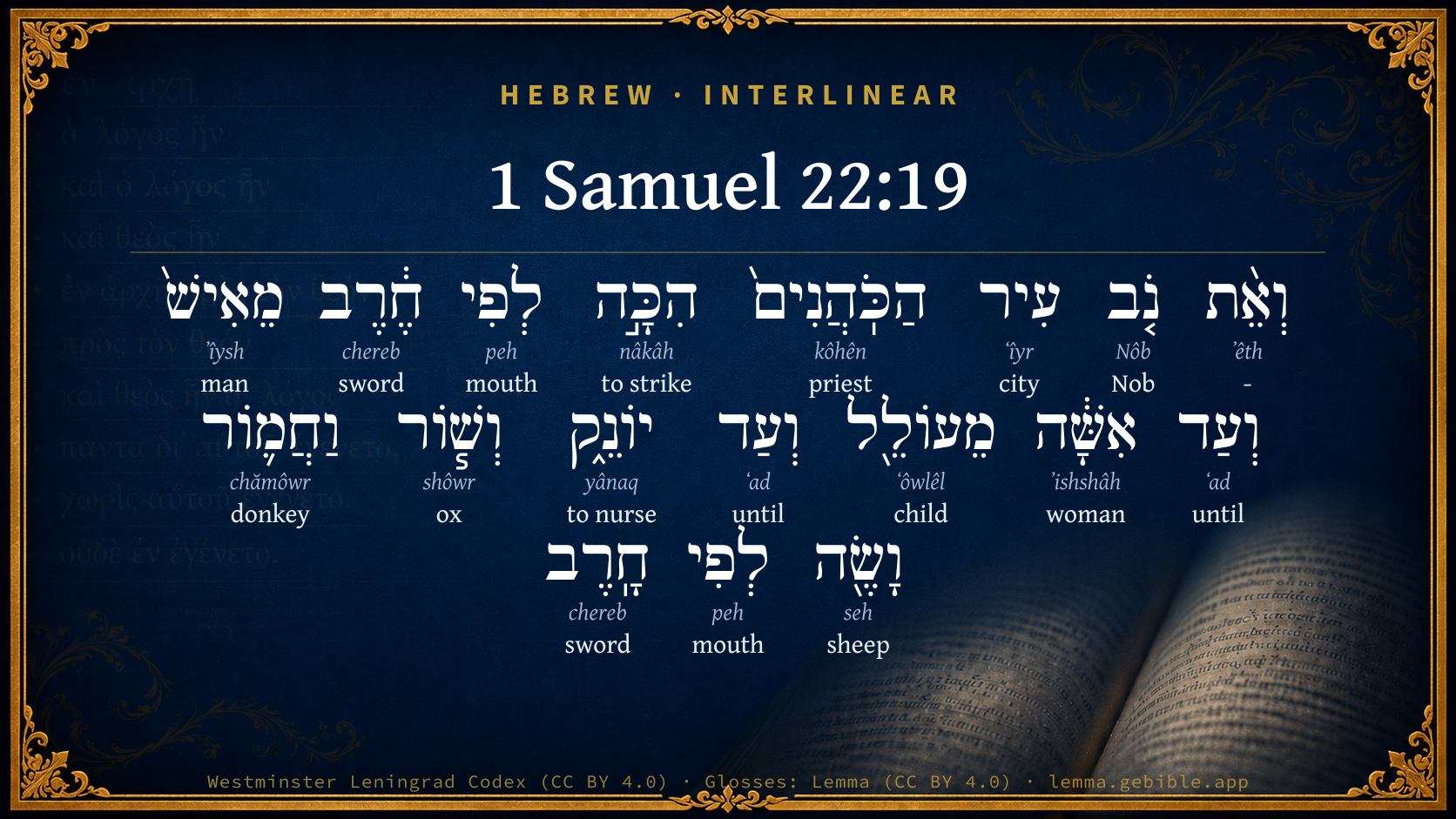
  1. וְאֵ֨ת ʼêth H853 “and · -” Conjunction + Particle, Direct Object
  2. עִיר ʻîyr H5892 “city of” Noun, Common, Feminine, Singular, Construct
  3. הַכֹּֽהֲנִים֙ kôhên H3548 “the · priests” Particle, Definite Article + Noun, Common, Masculine, Plural, Absolute
  4. הִכָּ֣ה nâkâh H5221 “to strike” Verb, Hiphil, Perfect, 3rd Person, Masculine, Singular
  5. לְפִי peh H6310 “to/for · mouth of” Preposition + Noun, Common, Masculine, Singular, Construct
  6. חֶ֔רֶב chereb H2719 “sword” Noun, Common, Feminine, Singular, Absolute
  7. מֵאִישׁ֙ ʼîysh H376 “from · man” Preposition + Noun, Common, Masculine, Singular, Absolute
  8. וְעַד ʻad H5704 “and · until” Conjunction + Preposition
  9. אִשָּׁ֔ה ʼishshâh H802 “woman” Noun, Common, Feminine, Singular, Absolute
  10. מֵעוֹלֵ֖ל ʻôwlêl H5768 “from · child” Preposition + Noun, Common, Masculine, Singular, Absolute
  11. וְעַד ʻad H5704 “and · until” Conjunction + Preposition
  12. יוֹנֵ֑ק yânaq H3243 “nursing” Verb, Qal, Participle Active, Masculine, Singular, Absolute
  13. וְשׁ֧וֹר shôwr H7794 “and · ox” Conjunction + Noun, Common, Masculine, Singular, Absolute
  14. וַחֲמ֛וֹר chămôwr H2543 “and · donkey” Conjunction + Noun, Common, Both, Singular, Absolute
  15. וָשֶׂ֖ה seh H7716 “and · sheep” Conjunction + Noun, Common, Both, Singular, Absolute
  16. לְפִי peh H6310 “to/for · mouth of” Preposition + Noun, Common, Masculine, Singular, Construct
  17. חָֽרֶב chereb H2719 “sword” Noun, Common, Feminine, Singular, Absolute

About this verse

These counts appear in no published source. They are computed here, from the morphology-tagged text and Lemma’s own curated glosses. What Lemma adds →

18
words
15
distinct lemmas
Historical
section

Notable vocabulary

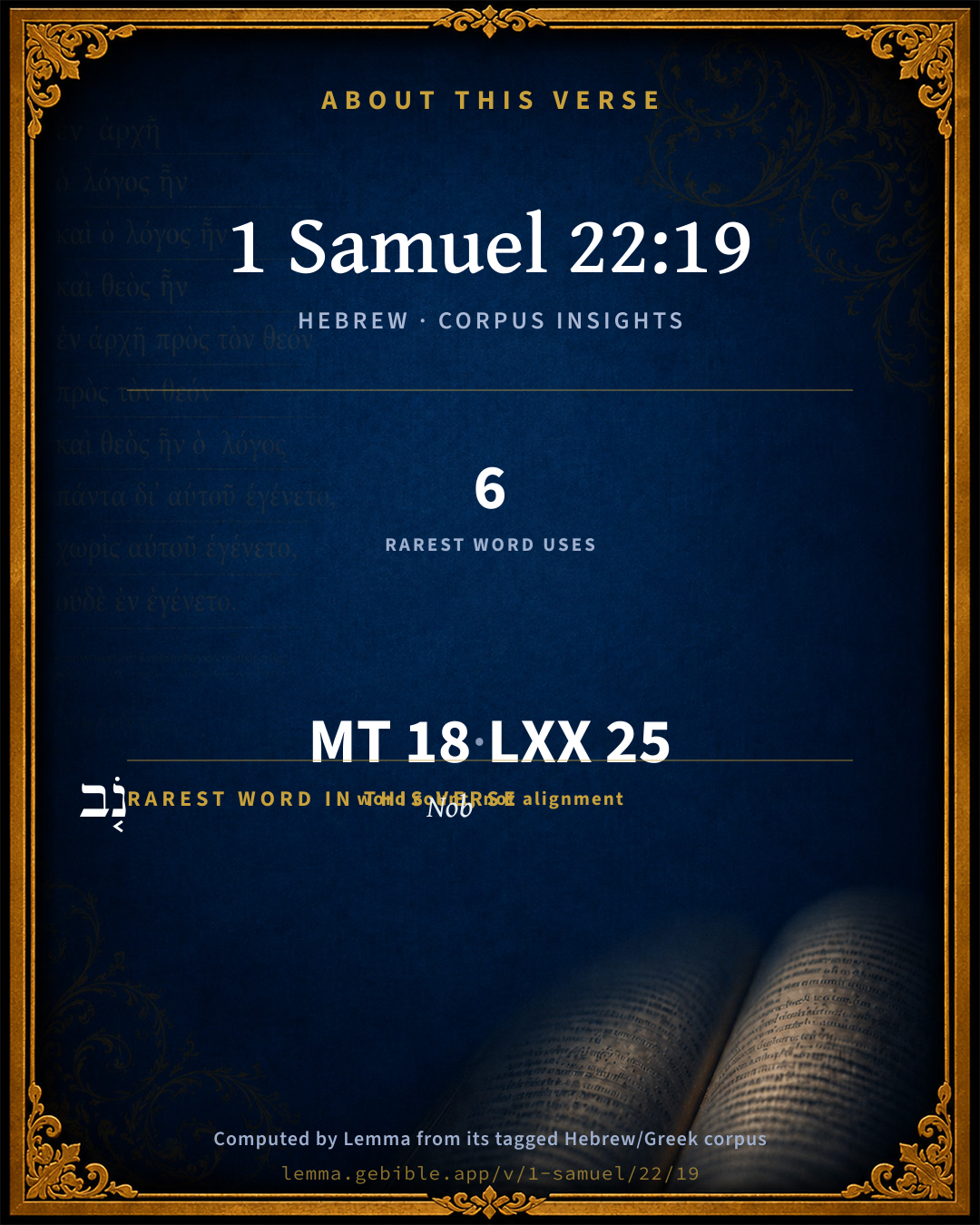
The rarest word here is נֹ֤ב Nob H5011 — appearing just 6 times in the whole Hebrew Bible.

Shared distinctive vocabulary

נֹ֤ב Nob H5011 occurs in 6 verses of the Hebrew Bible. Also found in:

Grammatical profile

  • 2 verbs
  • 13 nouns
  • 2 prepositions
  • 1 particle

Verb forms

  • הִכָּ֣ה Hiphil · Perfect
  • יוֹנֵ֑ק Qal · Participle Active

Repetition

Words recur within this verse — often emphatic in Hebrew:

  • לְפִי mouth H6310 ×2
  • חֶ֔רֶב sword H2719 ×2
  • וְעַד until H5704 ×2

Hebrew & Septuagint length

In English translation the verse runs 34 words from the Hebrew and 28 from the Septuagint (LXX English) — closely comparable.

A rough comparison of the two English renderings, which tokenize alike — not a word-level alignment.

Word counts can differ between the Hebrew and the Greek without any difference in meaning — e.g. the Hebrew direct-object marker אֵת has no separate Greek word, and Greek often adds the article ὁ.

In the original languages it is 18 Hebrew tokens and 25 Greek tokens — but the two are counted differently (Hebrew bundles its prefixes and suffixes into one token; the Greek is in lemma form), so that isn’t a like-for-like length.

Cross-references

11

Topical passages linked to 1 Samuel 22:19 in the Treasury of Scripture Knowledge — connected by theme and wording, ordered by reader-vote popularity; previews shown in the World English Bible.

  • 1 Samuel 15:3 Now go and strike Amalek, and utterly destroy all that they have, and don't spare them; but kill both man and woman, infant and suckling, ox and sheep, camel and donkey.
  • James 2:13 For judgment is without mercy to him who has shown no mercy. Mercy triumphs over judgment.
  • Joshua 6:17 The city shall be devoted, even it and all that is therein, to Yahweh: only Rahab the prostitute shall live, she and all who are with her in the house, because she hid the messengers that we sent.
  • Joshua 6:21 They utterly destroyed all that was in the city, both man and woman, both young and old, and ox, and sheep, and donkey, with the edge of the sword.
  • 1 Samuel 15:9 But Saul and the people spared Agag, and the best of the sheep, and of the oxen, and of the fatlings, and the lambs, and all that was good, and wouldn't utterly destroy them: but everything that was vile and refuse, that they destroyed utterly.
  • 1 Samuel 21:1 Then came David to Nob to Ahimelech the priest: and Ahimelech came to meet David trembling, and said to him, Why are you alone, and no man with you?
  • 1 Samuel 22:9 Then answered Doeg the Edomite, who stood by the servants of Saul, and said, I saw the son of Jesse coming to Nob, to Ahimelech the son of Ahitub.
  • 1 Samuel 22:11 Then the king sent to call Ahimelech the priest, the son of Ahitub, and all his father's house, the priests who were in Nob: and they came all of them to the king.
  • Nehemiah 11:32 at Anathoth, Nob, Ananiah,
  • Isaiah 10:32 This very day shall he halt at Nob: he shakes his hand at the mountain of the daughter of Zion, the hill of Jerusalem.
  • Hosea 10:14 Therefore a battle roar will arise among your people, And all your fortresses will be destroyed, As Shalman destroyed Beth Arbel in the day of battle. The mother was dashed in pieces with her children.

Cross-references courtesy of OpenBible.info (CC BY 4.0).

Hebrew and Greek witnesses Masoretic Hebrew ↔ Greek Septuagint

The same verse in the two great witnesses to the Old Testament, shown verse-for-verse.

These are two independent witnesses, not word-aligned to each other, and the Septuagint is shown in lemma (dictionary) form.

Hebrew 1 Samuel 22:19 Masoretic · Westminster Leningrad Codex

וְאֵ֨ת נֹ֤ב עִיר הַכֹּֽהֲנִים֙ הִכָּ֣ה לְפִי חֶ֔רֶב מֵאִישׁ֙ וְעַד אִשָּׁ֔ה מֵעוֹלֵ֖ל וְעַד יוֹנֵ֑ק וְשׁ֧וֹר וַחֲמ֛וֹר וָשֶׂ֖ה לְפִי חָֽרֶב

Nob, the city of the priests, struck he with the edge of the sword, both men and women, children and nursing babies, and oxen and donkeys and sheep, with the edge of the sword.

World English Bible · Public Domain

Greek LXX 1 Samuel 22:19 Septuagint · lemma form

καί ὁ νομβα ὁ πόλις ὁ ἱερεύς πατάσσω ἐν στόμα ῥομφαία ἀπό ἀνήρ ἕως γυνή ἀπό νήπιος ἕως θηλάζω καί μόσχος καί ὄνος καί πρόβατον

And he struck Nomba the city of the priest with the edge of the sword, both man, and woman, infant and suckling, and calf, and ox, and sheep.

LXX2012 (modern English Septuagint) · Public Domain

Hebrew: Westminster Leningrad Codex (CC BY 4.0). Greek: Septuagint (public domain); English from LXX2012 (modern English Septuagint) (Public Domain). How the Septuagint differs from the Hebrew →

Targum (Aramaic paraphrase)

1

The Targum is the ancient Jewish Aramaic paraphrase of the Hebrew Scriptures — an interpretive translation, not the Hebrew text itself. Onkelos (literal) and Pseudo-Jonathan (expansive) render the Torah, and Jonathan the Prophets. Coverage is partial: where no permissively-licensed English translation exists for a verse, only the Aramaic is shown. This is verse-level text, not a word-by-word alignment to the Hebrew.

  1. Targum Jonathan Prophets (Joshua–Malachi)
    וְיַת נוֹב קִרְיַת כַּהֲנַיָא קְטַל לְפִתְגַם דְחָרֶב מִגְבַר וְעַד אִתְּתָא מֵעוּלֵים וְעַד יַנִיק וְתוֹר וַחֲמָר וְאִימַר לְפִתְגָם דְחָרֶב:

    (no public-domain English translation for this verse)

    Targum Jonathan — Aramaic: “Mikraot Gedolot” (public domain). English: “Sefaria Community Translation” (CC0 1.0 (public-domain dedication)); “London "Chaldee Paraphrase," 1871” (public domain). Text via Sefaria.

Commentary

Notes on 1 Samuel 22:19 from classic Christian and Jewish commentators (each source and its license shown beneath its notes). The classic Christian expositions comment on the surrounding passage and are grouped to its opening verse, so a note may address several verses; the Jewish commentaries on the Tanakh (Rashi and others) are per-verse, so they appear only where the commentator wrote on this verse.

Lemma curates 59 commentaries, every one of them public domain or Creative Commons licensed, each selected and text-cleaned for this edition rather than reprinted as found. About our sources →

Trapp's Complete Commentary

John Trapp

1Sa 22:19 And Nob, the city of the priests, smote he with the edge of the sword, both men and women, children and sucklings, and oxen, and asses, and sheep, with the edge of the sword.

Ver. 19. And Nob, the city of the priests, smote he.] Josephus saith that he razed it, and burned it, and left the tabernacle of God, as much as lay in him, without a place, or priests to minister.

Both men and women, children and sucklings.] All of them to the number of three hundred and eighty-five, saith Josephus; all whom Beda reckoneth among the martyrs: and Osiander maketh this infanticide a type and figure of our Saviour’s flight into Egypt.

John Trapp, A Commentary or Exposition upon All the Books of the Old and New Testament (1647–1656) — public domain. Text from a community e-Sword module.

Joseph Benson's Commentary

1Sa 22:19. Both men and women, children and sucklings — In all the life of Saul there is no wickedness to be compared to this. He appears now to be wholly under the power of that evil spirit which had long tormented him. And this destruction could not but go to the heart of every pious Israelite, and make them wish a thousand times they had been content with the government of Samuel. Josephus, in relating this, reflects on the depravity of human nature, which, when it is in a private station, often strictly and willingly confines itself within the bounds of right and justice; but when it has gained an uncontrollable power, thinks it has a right to trample upon all laws, as well divine as human. We ought therefore to pray, as Justin Martyr says, that kings and rulers, together with a royal power, may be found having a sober mind. Or, as Le Clerc observes, we ought never to put such a power into any persons’ hands as to enable them to trample upon all laws and the common rights of mankind. Whether the Israelites assisted in the execution upon the inhabitants of Nob, does not appear; or whether it was performed by Doeg the Edomite, and the rest of Saul’s hirelings. But it was sufficiently shameful to the Israelites that they did not even stand up to prevent such a cruel massacre.

Joseph Benson's Commentary on the Old and New Testaments (1811–1818) — public domain. Text from a community e-Sword module.

Tyndale Open Study Notes

Tyndale Open Resources

22:19 Saul had been unwilling to carry out God’s orders to destroy completely the Amalekites and their possessions (15:3, 9). Yet now, in his rage, he did not hesitate to decimate the priests’ families and their possessions (see Prov 14:29; 16:14; 27:4).

Tyndale Open Study Notes — © Tyndale Open Resources, licensed CC BY-SA 4.0. Text via the HelloAO Bible API.

Jamieson, Fausset & Brown

Robert Jamieson, A. R. Fausset & David Brown

Nob, the city of the priests, smote he with the edge of the sword--The barbarous atrocities perpetrated against this city seem to have been designed to terrify all the subjects of Saul from affording either aid or an asylum to David. But they proved ruinous to Saul's own interest, as they alienated the priesthood and disgusted all good men in the kingdom.

Jamieson, Fausset & Brown — Commentary Critical and Explanatory on the Whole Bible (1871) — public domain (CC PDM 1.0). Text via the HelloAO Bible API.

Adam Clarke's Commentary

Verse 19. And Nob - smote he with the edge of the sword] This is one of the worst acts in the life of Saul; his malice was implacable, and his wrath was cruel, and there is no motive of justice or policy by which such a barbarous act can be justified.

Adam Clarke's Commentary on the Bible (1810–1826) — public domain. Text from a community e-Sword/MySword module.

Ellicott's Commentary for English Readers

(19) Nob, the city of the priests, smote he.—The vengeful king, not content with striking the men, the heads of the priestly houses, in his insane fury proceeded to treat the innocent city where they resided as a city under the ban “cherem,” as though it had been polluted with idolatry and wickedness, and therefore devoted to utter destruction. The only crime of Nob had been that its venerable chief citizen, Ahimelech the priest, had shown kindness to David, whom Saul hated with a fierce mad hate. In 2Sa_21:1 we read of a scourge in the form of a famine afflicting Israel during three years. The cause of this God-sent calamity is told us in the Lord’s words: “It was for Saul and his bloody house, because he slew the Gibeonites.” Now, this slaughter of the Gibeonites—evidently a dark crime—is nowhere specially related in the Old Testament books. Was it not this awful sequel to the crime of Gibeah, where the hapless Ahimelech and his eighty-five priests were murdered, that was referred to in the above mentioned passage—the awful sequel when Saul smote Nob, the city of the priests, with the sword? In that terrible catastrophe, were not the Gibeonites, hewers of wood and drawers of water for the Tabernacle (see Jos_9:21-27), slain? for we read how in the destruction of the ill fated city men, women and children, and all cattle perished. “Only once before had so terrible a calamity befallen the sons of Aaron, and that was when the Philistines destroyed Shiloh. But they were enemies, and had been provoked by the people bringing the Ark to battle; and even then the women and children seem to have escaped. It was left to the anointed king of Israel, who had himself settled the priests at Nob and restored Jehovah’s worship there, to perpetrate an act unparalleled in Jewish history for its barbarity.”—Dean Payne Smith.

A Bible Commentary for English Readers, edited by Charles John Ellicott (1878–1897) — public domain. Text from a community e-Sword module.

The Cambridge Bible for Schools and Colleges

gen. ed. J. J. S. Perowne

19. And Nob, &c.] In the madness of his self-willed fury Saul wreaked upon an innocent city in his own kingdom the vengeance he had failed to execute upon a guilty heathen nation at God’s command (1Sa_15:3). Thus the doom upon the house of Eli (1Sa_2:31) received a fresh fulfilment. So heavy a blow was inflicted upon the family of Ithamar, that when David organized the courses of the priests for the temple service only eight “chief men” could be found in it, against sixteen in the family of Eleazar (1Ch_24:4).

The Cambridge Bible for Schools and Colleges (gen. ed. J. J. S. Perowne; Cambridge University Press, 1878–1918) — public domain. Text from a community e-Sword module.

John Gill's Exposition

And Nob, the city of the priests, smote he with the edge of the sword,.... Either Doeg or Saul; who, as Josephus (i) says, sent men thither to slay all the inhabitants of it:

both men and women, children and sucklings; not sparing sex nor age:

and oxen, and asses, and sheep, with the edge of the sword; Saul, who was so tender hearted and merciful in the case of the Amalekites, when his orders from the Lord were utterly to destroy them, Sa1 15:2, that he spared their king, and the best of their cattle, Sa1 15:7; yet now so cruel to a city of the priests, as to destroy all the inhabitants of it, and cattle in it; and yet this bloody affair of Saul's is not taken notice of afterwards, only his slaughter of the Gibeonites, Sa2 21:1; and Abarbinel is of opinion, that the inhabitants of this place were Gibeonites, who were hewers of wood, and drawers of water, to the house of the Lord here, Jos 9:23. Now Saul was the more severe this city, to deter others from joining with David, who, if they did, must expect the same treatment.

(i) Antiqu. l. 6. c. 12. sect. 6.

John Gill's Exposition of the Whole Bible (1746–1763) — public domain (CC PDM 1.0). Text via the HelloAO Bible API.

Albert Barnes' Notes on the Bible

Both men and women ... - The language employed in the case of the Amalekites 1Sa 15:3 and of Jericho Jos 6:21. Nothing could be more truculent than Saul’s revenge.

Albert Barnes' Notes on the Bible (1834–1885) — public domain. Text from a community e-Sword/MySword module.

Haydock's Catholic Bible Commentary

Sword. Saul, now abandoned God, acts against all law. He probably, on this occasion, destroyed the inhabitants of Gabaon, to make place for the tabernacle, which was removed hither. (Calmet) See chap. xxvii. 12. --- He might also appoint Achitob high priest, the father of Sadoc, who supplanted Abiathar, 1 Paralipomenon xii., and xvi. 29. (Tirinus)

George Leo Haydock (1774–1849), Haydock's Catholic Family Bible and Commentary, 1859 edition — public domain. Excludes Psalms (Douay-Rheims chapter numbering differs from Protestant) and Deuterocanonical books (Catholic canon only).

Matthew Poole's English Annotations

He; either Saul, or Doeg, with the help of some others whom Saul appointed to that work. By this barbarous and bloody fact Saul thought to affright all his subjects from giving any countenance or assistance to David.

Matthew Poole's English Annotations on the Holy Bible (1683–1685) — public domain. Text from a community e-Sword/MySword module.

John Wesley's Explanatory Notes

Both men, &c. - In all the life of Saul, there is no wickedness to be compared to this. He appears now to be wholly under the power of that evil spirit which had long tormented him. And this destruction could not but go to the heart of every pious Israelite, and make them wish a thousand times, they had been content with the government of Samuel.

John Wesley, Explanatory Notes Upon the Whole Bible (1754–1765) — public domain. Text via the GEBible commentary corpus.

Keil & Delitzsch

C. F. Keil & F. Delitzsch

But not content with even this revenge, Saul had the whole city of Nob destroyed, like a city that was laid under the ban (vid., Deu 13:13.). So completely did Saul identify his private revenge with the cause of Jehovah, that he avenged a supposed conspiracy against his own person as treason against Jehovah the God-king.

Keil & Delitzsch — Biblical Commentary on the Old Testament (1861–1891) — public domain (CC PDM 1.0). Text via the HelloAO Bible API. (Old Testament only.)

Lesson kit

Teaching starters — assembled from the data on this page, not authored interpretation. Every prompt links to the verse data it draws on. Edit before teaching.

1 Samuel, in the Historical, opens this verse with 18 words (15 distinct Hebrew lemmas). Its most distinctive word is Nôb (“Nob”). A historical commentator’s framing appears above. Read the whole chapter for the surrounding context.

Discussion questions

  1. The word Nôb carries the sense “Nob.” How does it shape the verse?
  2. 1 Samuel 21:1 shares the word «Nob» with this verse. How do the two illuminate each other?
  3. “mouth” occurs 2× in this one verse. What is the effect of the repetition?
  4. The translations on this page render this verse differently — a whole-verse word diff, not a word-by-word alignment. What might account for the different wordings?
  5. The verb «הִכָּ֣ה» is Hiphil Perfect. How does its form color the action?
  6. Reading how Trapp's Complete Commentary and Joseph Benson's Commentary read this verse, where do the two commentators agree and where do they part?

Things to notice

Reading settings

Reading text

Shown beneath each verse's original-language words.

Old Testament
Old Testament edition

Read the OT as the Masoretic Hebrew (MT) or the Greek Septuagint (LXX).

English shown for the Greek Septuagint (in the Hebrew ↔ Greek comparison).

Comparing translations? Open the Compare panel on any verse page to stack up to four side by side.