
Numbers 14:3

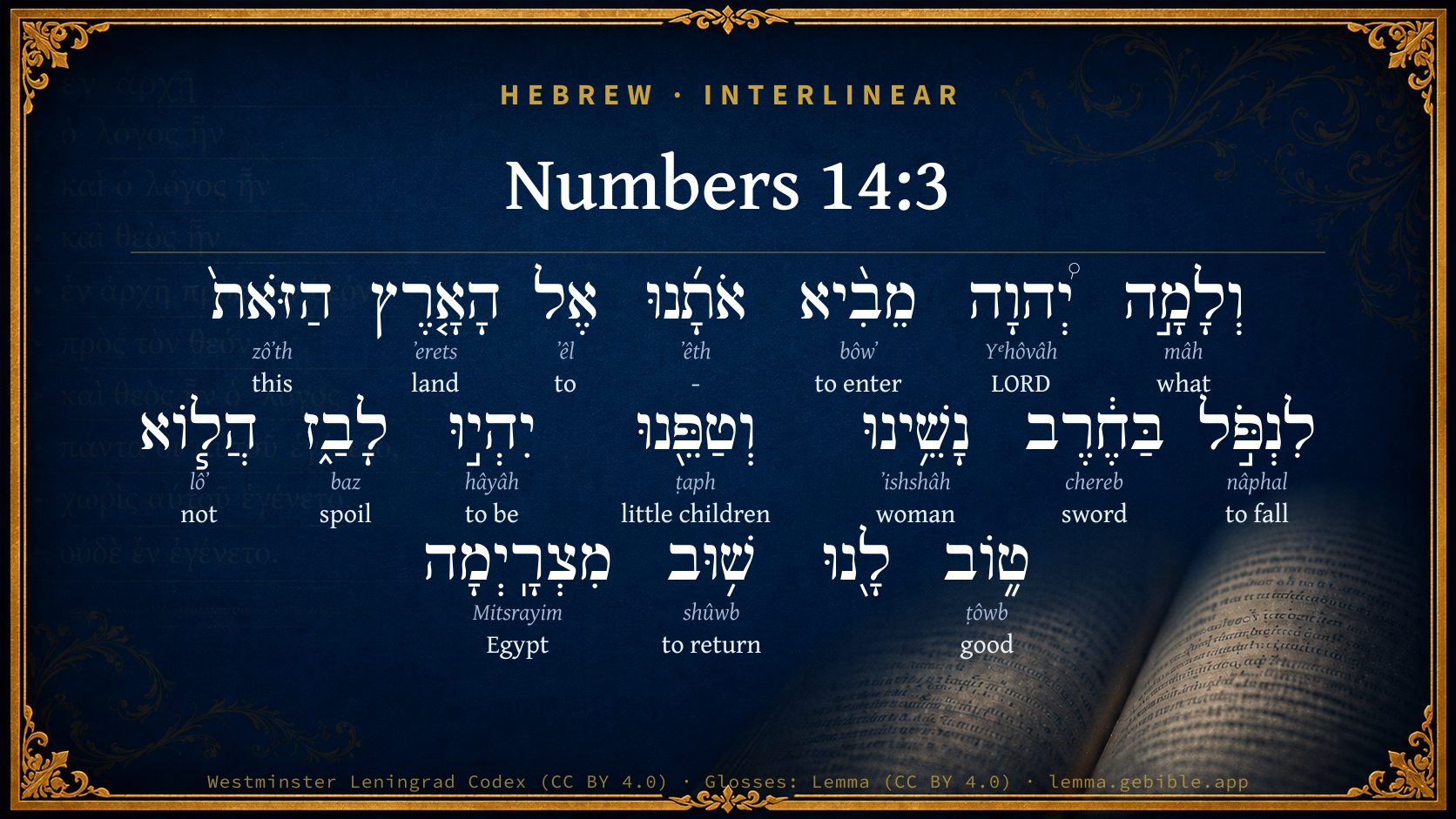
Hebrew (Westminster Leningrad Codex) Numbers 14:3 appears in the Hebrew Old Testament. The text above is from the Westminster Leningrad Codex. Each word links to its Strong’s number, a concise gloss, and parsing drawn from the Open Scriptures Hebrew Bible morphology. Click any word for its full Brown-Driver-Briggs (BDB) entry.
Download image
Cite this verse

Numbers 14:3 (World English Bible). Public Domain. Lemma interlinear Bible study tool, https://lemma.gebible.app/v/numbers/14/3.

Show BibTeX & RIS
BibTeX
RIS
English Translation
Why does Yahweh bring us to this land, to fall by the sword? Our wives and our little ones will be a prey: wouldn't it be better for us to return into Egypt?
World English Bible · Public Domain
Highlights Full analysis ↓
Download a study sheet

One document with this verse’s original text, its word-by-word gloss line, the meaning frame, cross-references with their text, attributed commentary, and full source and license credits — printable, and it pastes into notes with its structure intact.

This verse Autodidact and up

Study sheet (.html) Plain text (.txt)

A passage Seminary Student

Up to 50 verses in one chapter. A passage sheet keeps up to 6 commentary sources and 12 cross-references per verse, in the order this page ranks them, and says so on the sheet whenever that leaves anything out. Ask for a single verse and you get the Autodidact verse sheet above.

Everything on this page stays free to read, with no account — the sheet is a download of what is already on screen, not access to it.

Want to remove ads? Support Godless Engineer
Compare translations 3

The same verse in 3 English versions, stacked beneath the original-language interlinear above. Click any original word for its lexicon entry.

Each is an independent rendering of the whole verse — the interlinear is not word-aligned to these translations.

Highlighted words mark where these versions differ — a whole-verse word diff, not a word-by-word alignment.

  • World English Bible Public Domain
    Why does Yahweh bring us to this land, to fall by the sword? Our wives and our little ones will be a prey: wouldn't it be better for us to return into Egypt?
  • King James Version Public Domain
    And wherefore hath the LORD brought us unto this land, to fall by the sword, that our wives and our children should be a prey? were it not better for us to return into Egypt?
  • unfoldingWord Literal Text CC BY-SA 4.0
    And why is Yahweh bringing us to this land to fall by the sword? Our wives and our children will be for plunder. Is it not good for us to return to Egypt?”

unfoldingWord Literal Text — © unfoldingWord, licensed CC BY-SA 4.0. Word-aligned USFM3 via Door43 (git.door43.org/unfoldingWord/en_ult).

Versions to compare (up to 4)

3 of 4 selected

Show all 18 translations

Every available English version of this verse, each an independent rendering of the whole verse.

  • World English Bible Public Domain
    Why does Yahweh bring us to this land, to fall by the sword? Our wives and our little ones will be a prey: wouldn't it be better for us to return into Egypt?
  • Berean Standard Bible Public Domain
    Why is the LORD bringing us into this land to fall by the sword? Our wives and children will become plunder. Would it not be better for us to go back to Egypt?”
  • Majority Standard Bible Public Domain
    Why is the LORD bringing us into this land to fall by the sword? Our wives and children will become plunder. Would it not be better for us to go back to Egypt?”
  • King James Version Public Domain
    And wherefore hath the LORD brought us unto this land, to fall by the sword, that our wives and our children should be a prey? were it not better for us to return into Egypt?
  • American Standard Version (1901) Public Domain
    And wherefore doth Jehovah bring us unto this land, to fall by the sword? Our wives and our little ones will be a prey: were it not better for us to return into Egypt?
  • Revised Version (1885) Public Domain
    And wherefore doth the LORD bring us unto this land, to fall by the sword? Our wives and our little ones shall be a prey: were it not better for us to return into Egypt?
  • Geneva Bible (1599) Public Domain
    Wherefore nowe hath the Lord brought vs into this lande to fall vpon the sworde? our wiues, and our children shall be a pray: were it not better for vs to returne into Egypt?
  • Douay-Rheims (1899) Public Domain
    Would God that we had died in Egypt and would God we may die in this vast wilderness, and that the Lord may not bring us into this land, lest we fall by the sword, and our wives and children be led away captives. Is it not better to return into Egypt?
  • Young's Literal Translation Public Domain
    and why is Jehovah bringing us in unto this land to fall by the sword? our wives and our infants are become a prey; is it not good for us to turn back to Egypt?'
  • Literal Standard Version CC BY-SA 4.0
    And why is YHWH bringing us to this land to fall by the sword, [that] our wives and our infants become a prey? Is it not good for us to return to Egypt?”
  • Unlocked Literal Bible CC BY-SA 4.0
    Why did Yahweh bring us to this land to die by the sword? Our wives and our little ones will become victims. Is it not better for us to return to Egypt?”
  • unfoldingWord Literal Text CC BY-SA 4.0
    And why is Yahweh bringing us to this land to fall by the sword? Our wives and our children will be for plunder. Is it not good for us to return to Egypt?”
  • Darby Bible Public Domain
    And why is Jehovah bringing us to this land that we may fall by the sword, that our wives and our little ones may become a prey? Is it not better for us to return to Egypt?
  • World Messianic Bible Public Domain
    Why does the LORD bring us to this land, to fall by the sword? Our wives and our little ones will be captured or killed! Wouldn’t it be better for us to return into Egypt?”
  • Webster's Bible Public Domain
    And why hath the LORD brought us to this land, to fall by the sword, that our wives and our children should be a prey? were it not better for us to return into Egypt?
  • Free Bible Version CC BY-SA 4.0
    Why is the Lord taking us to this country only to get us killed? Our wives and children will be captured and taken away as slaves! Wouldn't we be better off going back to Egypt?”
  • Bible in Basic English Public Domain
    Why is the Lord taking us into this land to come to our death by the sword? Our wives and our little ones will get into strange hands: would it not be better for us to go back to Egypt?
  • JPS Tanakh (1917) Public Domain
    And wherefore doth the LORD bring us unto this land, to fall by the sword? Our wives and our little ones will be a prey; were it not better for us to return into Egypt?'

Literal Standard Version (2020), Covenant Press — licensed CC BY-SA 4.0. Text via the HelloAO Bible API (eBible.org). Unlocked Literal Bible (unfoldingWord) — licensed CC BY-SA 4.0. Text via the HelloAO Bible API (eBible.org). unfoldingWord Literal Text — © unfoldingWord, licensed CC BY-SA 4.0. Word-aligned USFM3 via Door43 (git.door43.org/unfoldingWord/en_ult). Free Bible Version, Dr. Jonathan Gallagher — licensed CC BY-SA 4.0. Text via the HelloAO Bible API (eBible.org).

Word by word

More ways to search: Search by grammar → Find every occurrence → Compare this word →

Practice this passage: Drill this verse → Learn its vocabulary →

לָבַ֑ז
baz
H957
“to/for · spoil”
Preposition + Noun, Common, Masculine, Singular, Absolute
Part of Speech
Preposition + Noun
Type
Common
Gender
Masculine
Number
Singular
State
Absolute
Full BDB Definition

Origin: from H962

TWOT: 225a

spoil, booty, robbery, spoiling
  1. וְלָמָ֣ה mâh H4100 “and · to/for · what” Conjunction + Preposition + Particle, Interrogative
  2. יְ֠הוָה Yᵉhôvâh H3068 “LORD” Noun, Proper
  3. מֵבִ֨יא bôwʼ H935 “entering” Verb, Hiphil, Participle Active, Masculine, Singular, Absolute
  4. אֹתָ֜נוּ ʼêth H853 “- · us” Particle, Direct Object + Suffix, Personal, 1st Person, Common, Plural
  5. אֶל ʼêl H413 “to” Preposition
  6. הָאָ֤רֶץ ʼerets H776 “the · land” Particle, Definite Article + Noun, Common, Both, Singular, Absolute
  7. הַזֹּאת֙ zôʼth H2063 “the · this” Particle, Definite Article + Pronoun, Demonstrative, Feminine, Singular
  8. לִנְפֹּ֣ל nâphal H5307 “to fall” Preposition + Verb, Qal, Infinitive Construct
  9. בַּחֶ֔רֶב chereb H2719 “in/at the · sword” Preposition, Determined + Noun, Common, Feminine, Singular, Absolute
  10. נָשֵׁ֥ינוּ ʼishshâh H802 “women · our” Noun, Common, Feminine, Plural, Construct + Suffix, Personal, 1st Person, Common, Plural
  11. וְטַפֵּ֖נוּ ṭaph H2945 “and · little children · our” Conjunction + Noun, Common, Masculine, Singular, Construct + Suffix, Personal, 1st Person, Common, Plural
  12. יִהְי֣וּ hâyâh H1961 “to be” Verb, Qal, Imperfect, 3rd Person, Masculine, Plural
  13. הֲל֧וֹא lôʼ H3808 “not” Particle, Interrogative + Particle, Negative
  14. ט֦וֹב ṭôwb H2896 “good” Adjective, Adjective, Masculine, Singular, Absolute
  15. שׁ֥וּב shûwb H7725 “to return” Verb, Qal, Infinitive Construct
  16. מִצְרָֽיְמָה Mitsrayim H4714 “Egypt · toward” Noun, Proper + Suffix, Demonstrative

About this verse

These counts appear in no published source. They are computed here, from the morphology-tagged text and Lemma’s own curated glosses. What Lemma adds →

18
words
17
distinct lemmas
Pentateuch
section

Notable vocabulary

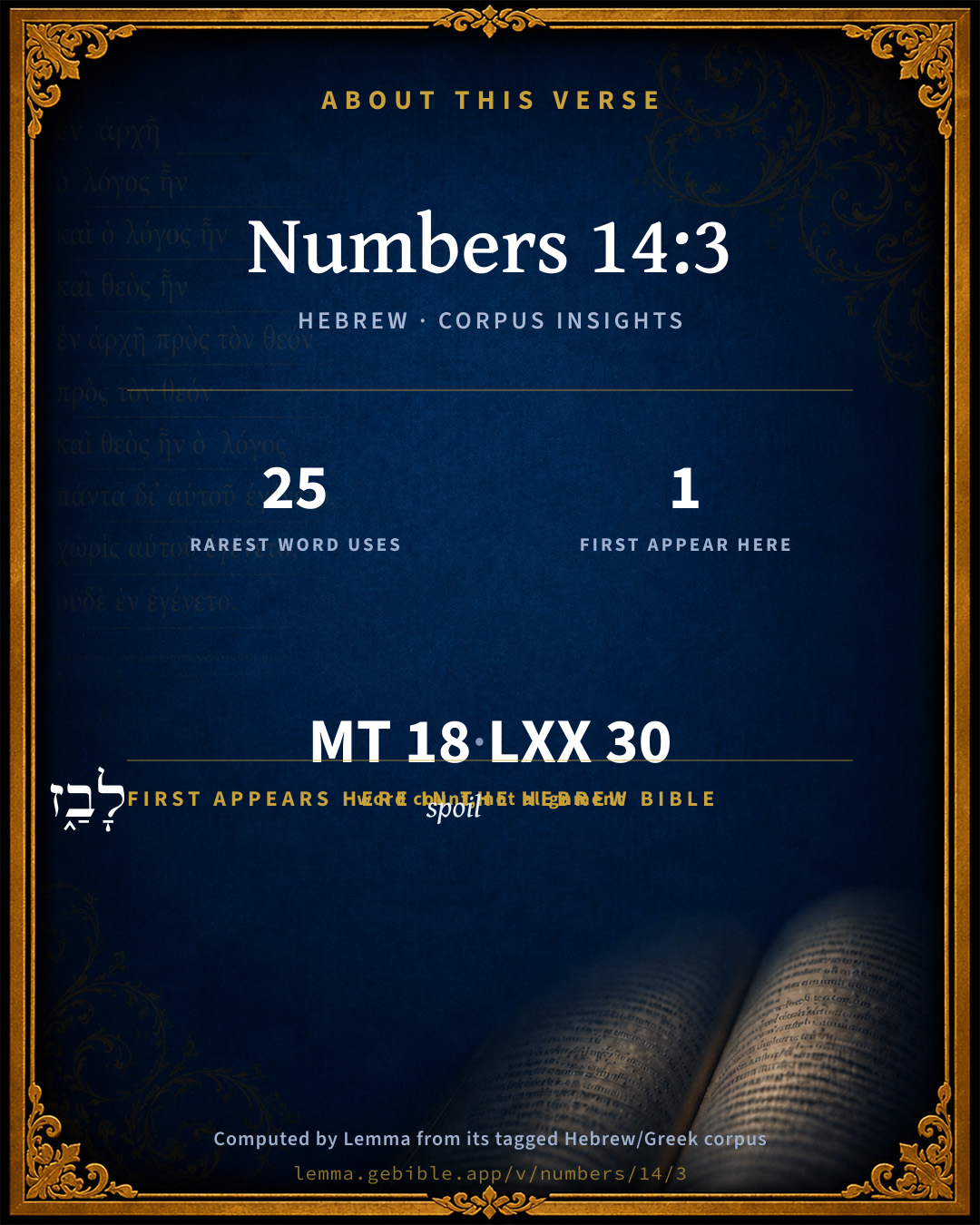
The rarest word here is לָבַ֑ז spoil H957 — appearing just 25 times in the whole Hebrew Bible.

First appearance in Scripture

This word makes its first canonical appearance in the Hebrew Bible here:

  • לָבַ֑ז spoil H957

Shared distinctive vocabulary

לָבַ֑ז spoil H957 occurs in 25 verses of the Hebrew Bible. Also found in:

Grammatical profile

  • 4 verbs
  • 7 nouns
  • 1 adjective
  • 1 pronoun
  • 2 prepositions
  • 3 particles

Verb forms

  • מֵבִ֨יא Hiphil · Participle Active
  • לִנְפֹּ֣ל Qal · Infinitive Construct
  • יִהְי֣וּ Qal · Imperfect
  • שׁ֥וּב Qal · Infinitive Construct

Hebrew & Septuagint length

In English translation the verse runs 33 words from the Hebrew and 50 from the Septuagint (LXX English) — the Septuagint runs noticeably longer here. See the side-by-side →

A rough comparison of the two English renderings, which tokenize alike — not a word-level alignment.

Word counts can differ between the Hebrew and the Greek without any difference in meaning — e.g. the Hebrew direct-object marker אֵת has no separate Greek word, and Greek often adds the article ὁ.

In the original languages it is 18 Hebrew tokens and 30 Greek tokens — but the two are counted differently (Hebrew bundles its prefixes and suffixes into one token; the Greek is in lemma form), so that isn’t a like-for-like length.

Cross-references

3

Topical passages linked to Numbers 14:3 in the Treasury of Scripture Knowledge — connected by theme and wording, ordered by reader-vote popularity; previews shown in the World English Bible.

  • Numbers 14:31–32 But your little ones, that you said should be a prey, them will I bring in, and they shall know the land which you have rejected.
  • Psalms 78:40 How often they rebelled against him in the wilderness, And grieved him in the desert!
  • Jeremiah 9:3 They bend their tongue, [as it were] their bow, for falsehood; and they are grown strong in the land, but not for truth: for they proceed from evil to evil, and they don't know me, says Yahweh.

Cross-references courtesy of OpenBible.info (CC BY 4.0).

Hebrew and Greek witnesses Masoretic Hebrew ↔ Greek Septuagint

The same verse in the two great witnesses to the Old Testament, shown verse-for-verse.

Here the Septuagint runs noticeably longer than the Hebrew — LXX2012 (modern English Septuagint) 50 words vs World English Bible 33. A rough length comparison of the two English translations, not a word-level alignment — read both below.

These are two independent witnesses, not word-aligned to each other, and the Septuagint is shown in lemma (dictionary) form.

Hebrew Numbers 14:3 Masoretic · Westminster Leningrad Codex

וְלָמָ֣ה יְ֠הוָה מֵבִ֨יא אֹתָ֜נוּ אֶל הָאָ֤רֶץ הַזֹּאת֙ לִנְפֹּ֣ל בַּחֶ֔רֶב נָשֵׁ֥ינוּ וְטַפֵּ֖נוּ יִהְי֣וּ לָבַ֑ז הֲל֧וֹא ט֦וֹב לָ֖נוּ שׁ֥וּב מִצְרָֽיְמָה

Why does Yahweh bring us to this land, to fall by the sword? Our wives and our little ones will be a prey: wouldn't it be better for us to return into Egypt?

World English Bible · Public Domain

Greek LXX Numbers 14:3 Septuagint · lemma form

καί ἵνα τίς κύριος εἰςἄγω ἐγώ εἰς ὁ γῆ οὗτος πίπτω ἐν πόλεμος ὁ γυνή ἐγώ καί ὁ παιδίον εἰμί εἰς διαρπαγή νῦν οὖν βελτίων ἐγώ εἰμί ἀποστρέφω εἰς αἴγυπτος

Would we had died in the land of Egypt! or in this wilderness, would we had died! and why does the Lord bring us into this land to fall in war? our wives and our children shall be for a prey: now then it is better to return into Egypt.

LXX2012 (modern English Septuagint) · Public Domain

On this verse, Haydock's Catholic Bible Commentary discusses the Septuagint’s reading. Read the note in Commentary ↓

Hebrew: Westminster Leningrad Codex (CC BY 4.0). Greek: Septuagint (public domain); English from LXX2012 (modern English Septuagint) (Public Domain). How the Septuagint differs from the Hebrew →

Targum (Aramaic paraphrase)

2

The Targum is the ancient Jewish Aramaic paraphrase of the Hebrew Scriptures — an interpretive translation, not the Hebrew text itself. Onkelos (literal) and Pseudo-Jonathan (expansive) render the Torah, and Jonathan the Prophets. Coverage is partial: where no permissively-licensed English translation exists for a verse, only the Aramaic is shown. This is verse-level text, not a word-by-word alignment to the Hebrew.

  1. Targum Onkelos Torah (Genesis–Deuteronomy)
    וּלְמָא יְיָ מָעֵל יָתָנָא לְּאַרְעָא הָדָא לְּמִנְפַּלּ בְּחַרְבָּא נְשָׁנָא וְטַּפְלָנָא יְהוֹן לְבִזָא הֲלָא טַב לָנָא דִי נְתוּב לְמִצְרָיִם

    (no public-domain English translation for this verse)

    Targum Onkelos — Aramaic: “Onkelos Genesis” (public domain); “Onkelos Exodus” (public domain); “Onkelos Leviticus” (public domain); “Onkelos Numbers” (public domain); “Onkelos Deuteronomy” (public domain). English: “Sefaria Community Translation” (CC0 1.0 (public-domain dedication)); “J.W. Etheridge. The Targums of Onkelos and Jonathan Ben Uzziel on the Pentateuch. London: Longmans, Green, 1862” (public domain). Text via Sefaria.

  2. Targum Pseudo-Jonathan Torah (Genesis–Deuteronomy)
    וּלְמָא יְיָ מָעִיל יָתָנָא לְאַרְעָא הֲדָא לְמֵיפַּל בְּחַרְבָּא דִכְנַעֲנָאֵי נְשָׁנָא וְטַפְלָנָא יְהוֹן לְמֵיבַז הֲלָא טַב לָנָא דְנָתוּב לְמִצְרָיִם

    Why is the Lord bringing us into this land, to fall by the sword of the Kenaanaah, and our wives and little ones to become a prey? Will it not be better to return into Mizraim?

    Targum Pseudo-Jonathan — Aramaic: “Targum Jonathan on Genesis” (public domain); “Targum Jonathan on Exodus” (public domain); “Targum Jonathan on Leviticus” (public domain); “Targum Jonathan on Numbers” (public domain); “Targum Jonathan on Deuteronomy” (public domain). English: “The Targum of Jonathan ben Uzziel, trans. J. W. Etheridge, London, 1862” (public domain). Text via Sefaria.

Commentary

Notes on Numbers 14:3 from classic Christian and Jewish commentators (each source and its license shown beneath its notes). The classic Christian expositions comment on the surrounding passage and are grouped to its opening verse, so a note may address several verses; the Jewish commentaries on the Tanakh (Rashi and others) are per-verse, so they appear only where the commentator wrote on this verse.

Lemma curates 59 commentaries, every one of them public domain or Creative Commons licensed, each selected and text-cleaned for this edition rather than reprinted as found. About our sources →

Trapp's Complete Commentary

John Trapp

Num 14:3 And wherefore hath the LORD brought us unto this land, to fall by the sword, that our wives and our children should be a prey? were it not better for us to return into Egypt?

Ver. 3. Were it not better for us to return into Egypt.] How could that be better? It is our wisest way, to crush the very first insurrections of unruly passions (do not great storms rise out of little gusts?); to smother the smoke thereof, which else will fume up into the head, and gather into so thick a cloud, as we shall soon lose the sight of ourselves, and what is best to be done.

John Trapp, A Commentary or Exposition upon All the Books of the Old and New Testament (1647–1656) — public domain. Text from a community e-Sword module.

Tyndale Open Study Notes

Tyndale Open Resources

14:3-4 The threats about which they complained were real, but the Israelites should have trusted the Lord. In the ancient Near East, women and children were often taken as plunder in the aftermath of battle. • return to Egypt: How quickly the Israelites forgot their bondage (Exod 2:23-24) and the hardship of the wilderness (Num 11:1)!

Tyndale Open Study Notes — © Tyndale Open Resources, licensed CC BY-SA 4.0. Text via the HelloAO Bible API.

Geneva Bible (1599)

Geneva Bible translators

To our enemies the Canaanites.

Geneva Bible (1599) marginal notes — public domain. Text via Bolls.life.

Ellicott's Commentary for English Readers

(3) And wherefore hath the Lord brought us unto this land . . .?—Better, And wherefore doth the Lord bring us into this land?—i.e., the land of Canaan, as clearly appears from the words which follow (comp. Num_15:18, where the same Hiphil participle is used). The destruction which the Israelites apprehended at this time was not a destruction by famine or drought, but by the sword of the Amorites and of the children of the Anakim. (Comp. Deu_1:27-28.)

That our wives and our children should be a prey—i.e., should fall into the hands of the enemy after their entrance into the land of Canaan. (Comp. Exo_15:14-17.) It is possible, however, that the land through which the Israelites were passing may be included here and in Num_14:14.

A Bible Commentary for English Readers, edited by Charles John Ellicott (1878–1897) — public domain. Text from a community e-Sword module.

The Cambridge Bible for Schools and Colleges

gen. ed. J. J. S. Perowne

3. wherefore is Jehovah about to bring us] The rebellious spirit is more flagrantly expressed in Deu_1:27.

The Cambridge Bible for Schools and Colleges (gen. ed. J. J. S. Perowne; Cambridge University Press, 1878–1918) — public domain. Text from a community e-Sword module.

John Gill's Exposition

Wherefore hath the Lord brought us unto this land,.... Unto the borders of it: their murmuring did not cease at Moses and Aaron, the instruments, but proceeded against God himself, who had done such wonderful things for them, not only in bringing them out of Egypt, but since they had been in the wilderness; and yet so ungrateful to complain of him and argue with him about favours bestowed on them, as if they were injuries done to them; and particularly as if God had no other intention in bringing them out of Egypt to the place where they were, but

to fall by the sword: the sword of the Canaanites, as the Targum of Jonathan adds:

that our wives and our children shall be a prey? to the same people; they supposed they should be killed, their wives abused, and their children made slaves of:

were it not better for us to return into Egypt? and so escape the hands of the inhabitants of Canaan, of whom they had terrible apprehensions from the report made of them.

John Gill's Exposition of the Whole Bible (1746–1763) — public domain (CC PDM 1.0). Text via the HelloAO Bible API.

Haydock's Catholic Bible Commentary

We may. The Latin manuscripts and Bibles before Sixtus V read, "in Egypt, and not in this," &c. But the present translation agrees with the Hebrew, Septuagint, and Chaldean. (Calmet) --- They obtained what they said they wished for, ver. 28; chap. xiv. 29; xxvi. 64. (Worthington) --- And that. Hebrew, &c., "and wherefore hath God brought us into this land, that we may fall," &c. In a rage they attribute a malicious design to God. (Calmet) --- Better. And who would have given them food in the wilderness? (Menochius)

George Leo Haydock (1774–1849), Haydock's Catholic Family Bible and Commentary, 1859 edition — public domain. Excludes Psalms (Douay-Rheims chapter numbering differs from Protestant) and Deuterocanonical books (Catholic canon only).

Matthew Poole's English Annotations

From the instruments they rise higher, and strike at God the chief cause and author of their journey; by which we see the prodigious growth and progress of sin when it is not resisted. Should be a prey to the Canaanites, whose land we were made to believe we should possess.

Matthew Poole's English Annotations on the Holy Bible (1683–1685) — public domain. Text from a community e-Sword/MySword module.

Whedon's Commentary on the Bible

Daniel D. Whedon

3. Wherefore hath… Lord — They began with opposing God’s faithful ministers; they end by arraigning himself. So men now greatly distress themselves over evils they are never called to endure. Wherefore is not in the vocabulary of faith.

Unto this land — Spoken, apparently, of Canaan, to which they had not yet been brought. Thus “they despised the pleasant land; they believed not his word.” Psa_106:24.

To fall by the sword — The unbelief of these rebels puts an evil intention for a beneficent purpose on the part of God, and thus maligns his character. Up to this time they seem to have cherished the illusion of a blood. less conquest of Canaan.

A prey — Captives and slaves of the victors.

Better… to return into Egypt — In their dread of the perils before them they overlook the greater evils behind: the sterile wilderness, with no manna from heaven nor water from the smitten rock; no pillar of cloud to go before; no protecting Jehovah to shield them from their foes; no mediating Moses to placate the divine wrath; no home of freedom, but only the lash of the taskmaster for the inheritance of their children forever.

Daniel D. Whedon (gen. ed.), Commentary on the Old and New Testaments (1874–1909) — public domain. Text from a community e-Sword module.

The Pulpit Commentary

Wherefore hath the Lord brought us. Rather, "wherefore doth the Lord bring us." aybime. Septuagint, eisagei . They were not actually in the land yet, but only on the threshold.

The Pulpit Commentary (1880–1919), ed. H.D.M. Spence-Jones & Joseph S. Exell — public domain. Text from a community e-Sword module.

John Wesley's Explanatory Notes

The Lord - From instruments they rise higher, and strike at God the cause and author of their journey: by which we see the prodigious growth and progress of sin when it is not resisted. A prey - To the Canaanites whose land we were made to believe we should possess.

John Wesley, Explanatory Notes Upon the Whole Bible (1754–1765) — public domain. Text via the GEBible commentary corpus.

Ramban (Nachmanides)

Rabbi Moshe ben Nachman (Ramban / Nachmanides)

AND WHY DOTH THE ETERNAL BRING US UNTO THIS LAND, TO FALL BY THE SWORD? OUR WIVES AND OUR LITTLE ONES WILL BE A PREY. They did not mention the false report [of the spies] about the Land, saying that the Land miscarrieth and is bad, because the people hid this statement [of the spies] from Moses, since the delegates themselves had not said so when they brought back word to him and to all the congregation, for Moses and Aaron would have testified against them that they spoke falsely. The spies themselves hid this from Moses, fully realizing that he knew the nature of the Land from Egypt and Midian which are near to it, as I have explained.. Therefore the spies [only] told the people this evil report in their tents, in a secretive manner.Now Moses said in the Book of Deuteronomy: And they brought us back word, and said: ‘Good is the Land which the Eternal our G-d giveth unto us.’ Yet ye would not go up, but rebelled against the commandment of the Eternal your G-d. The meaning thereof is that the spies did [indeed] tell Moses and Aaron and all the congregation that the Land is good, and surely it floweth with milk and honey, and the people rebelled against the commandment of the Eternal in not wanting to go up because of the statement [of the spies] that the people that dwell in the Land are fierce, Verse 28. — for G-d hath power to help, and to cast down, as is stated clearly there, The Eternal your G-d Who goeth before you, He shall fight for you. Therefore, since there was nothing to deter them [in the Land itself] except for the strength of the people, they should have trusted in the Name of G-d, for the battle is the Eternal’s. And we do not have to say [as does Rashi] that Moses said this [And ‘they’ brought us back word, and said, ‘Good is the Land etc.’] only about Joshua and Caleb, for why should the people listen to two [spies] and not believe [the report of] the ten! in the verse, and ‘they’ brought us back word, and said: ‘Good is the Land etc.’ (Deuteronomy 1:25) refers to all the spies. Moreover it says there [in Deuteronomy 1: 23]: and I took twelve men of you, and it is with reference to [all twelve of] them that he [Moses] said, and they brought us back word.

Ramban (Nachmanides) on the Tanakh — English translation: “Commentary on the Torah by Ramban (Nachmanides). Translated and annotated by Charles B. Chavel. New York, Shilo Pub. House, 1971-1976” (CC BY 4.0). Text via Sefaria.

Lesson kit

Teaching starters — assembled from the data on this page, not authored interpretation. Every prompt links to the verse data it draws on. Edit before teaching.

Numbers, in the Pentateuch, opens this verse with 18 words (17 distinct Hebrew lemmas). Its most distinctive word is baz (“spoil”). The Greek Septuagint runs longer here. A historical commentator’s framing appears above. Read the whole chapter for the surrounding context.

Discussion questions

  1. The word baz carries the sense “spoil.” How does it shape the verse?
  2. The word “spoil” first appears here in Scripture. What is being introduced at this debut?
  3. Numbers 14:31 shares the word «spoil» with this verse. How do the two illuminate each other?
  4. Compared with the Hebrew, the Septuagint runs longer here. What questions does that raise?
  5. These translations render this verse differently; the difference is in the English rendering, not the original. What questions does that raise?
  6. The verb «מֵבִ֨יא» is Hiphil Participle Active. How does its form color the action?
  7. Reading how Trapp's Complete Commentary and Tyndale Open Study Notes read this verse, where do the two commentators agree and where do they part?

Things to notice

Reading settings

Reading text

Shown beneath each verse's original-language words.

Old Testament
Old Testament edition

Read the OT as the Masoretic Hebrew (MT) or the Greek Septuagint (LXX).

English shown for the Greek Septuagint (in the Hebrew ↔ Greek comparison).

Comparing translations? Open the Compare panel on any verse page to stack up to four side by side.