
Job 1:17

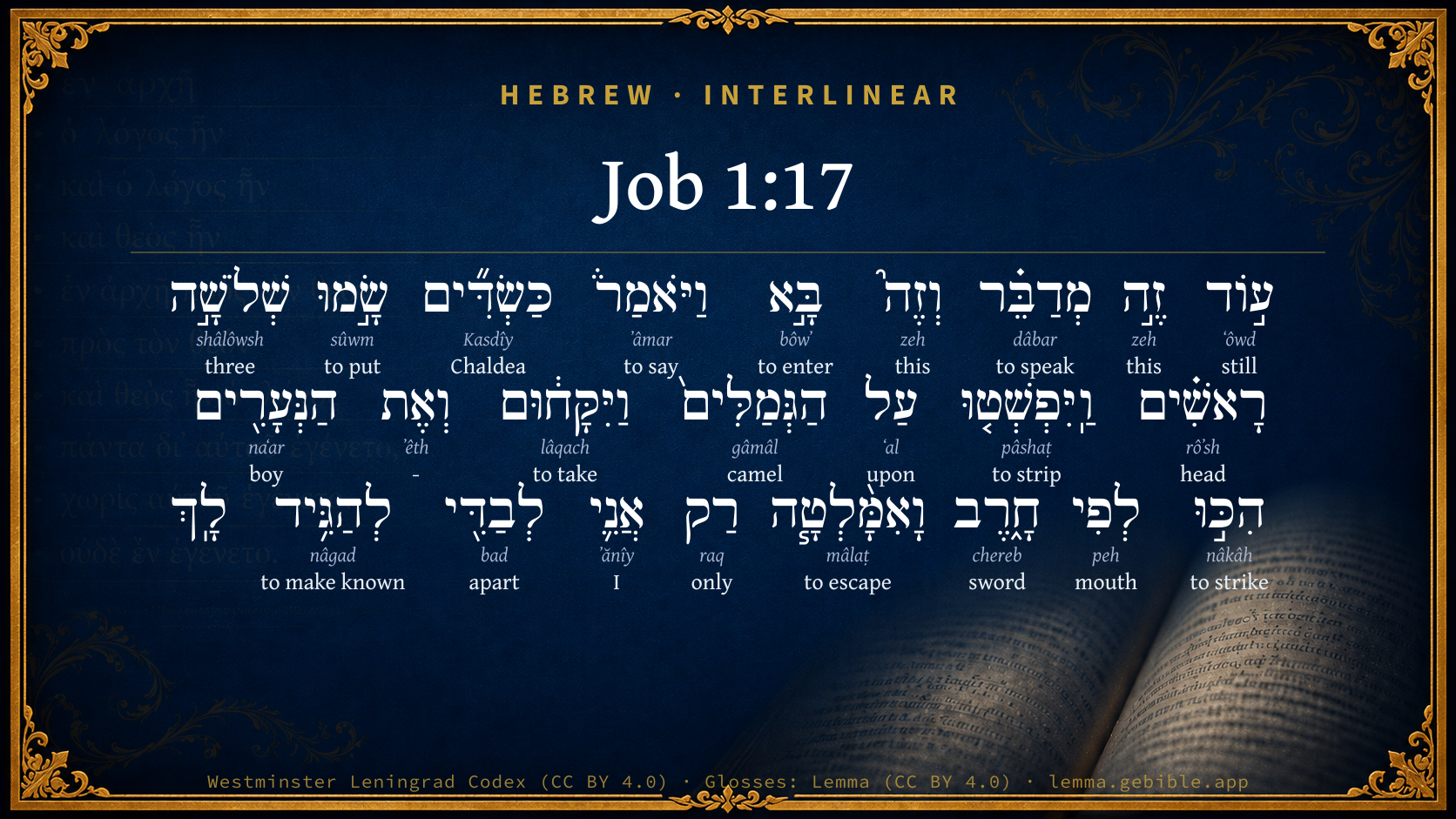
Hebrew (Westminster Leningrad Codex) Job 1:17 appears in the Hebrew Old Testament. The text above is from the Westminster Leningrad Codex. Each word links to its Strong’s number, a concise gloss, and parsing drawn from the Open Scriptures Hebrew Bible morphology. Click any word for its full Brown-Driver-Briggs (BDB) entry.
Download image
Cite this verse

Job 1:17 (World English Bible). Public Domain. Lemma interlinear Bible study tool, https://lemma.gebible.app/v/job/1/17.

Show BibTeX & RIS
BibTeX
RIS
English Translation
While he was still speaking, there came also another, and said, "The Chaldeans made three bands, and swept down on the camels, and have taken them away, yes, and killed the servants with the edge of the sword; and I alone have escaped to tell you."
World English Bible · Public Domain
Download a study sheet

One document with this verse’s original text, its word-by-word gloss line, the meaning frame, cross-references with their text, attributed commentary, and full source and license credits — printable, and it pastes into notes with its structure intact.

This verse Autodidact and up

Study sheet (.html) Plain text (.txt)

A passage Seminary Student

Up to 50 verses in one chapter. A passage sheet keeps up to 6 commentary sources and 12 cross-references per verse, in the order this page ranks them, and says so on the sheet whenever that leaves anything out. Ask for a single verse and you get the Autodidact verse sheet above.

Everything on this page stays free to read, with no account — the sheet is a download of what is already on screen, not access to it.

Want to remove ads? Support Godless Engineer
Compare translations 3

The same verse in 3 English versions, stacked beneath the original-language interlinear above. Click any original word for its lexicon entry.

Each is an independent rendering of the whole verse — the interlinear is not word-aligned to these translations.

Highlighted words mark where these versions differ — a whole-verse word diff, not a word-by-word alignment.

  • World English Bible Public Domain
    While he was still speaking, there came also another, and said, "The Chaldeans made three bands, and swept down on the camels, and have taken them away, yes, and killed the servants with the edge of the sword; and I alone have escaped to tell you."
  • King James Version Public Domain
    While he was yet speaking, there came also another, and said, The Chaldeans made out three bands, and fell upon the camels, and have carried them away, yea, and slain the servants with the edge of the sword; and I only am escaped alone to tell thee.
  • unfoldingWord Literal Text CC BY-SA 4.0
    That one still speaking and another came and said, “The Chaldeans formed three groups and rushed against the camels and took them, and they struck the servants with the edge of the sword, and only I alone have escaped to tell you.”

unfoldingWord Literal Text — © unfoldingWord, licensed CC BY-SA 4.0. Word-aligned USFM3 via Door43 (git.door43.org/unfoldingWord/en_ult).

Versions to compare (up to 4)

3 of 4 selected

Show all 18 translations

Every available English version of this verse, each an independent rendering of the whole verse.

  • World English Bible Public Domain
    While he was still speaking, there came also another, and said, "The Chaldeans made three bands, and swept down on the camels, and have taken them away, yes, and killed the servants with the edge of the sword; and I alone have escaped to tell you."
  • Berean Standard Bible Public Domain
    While he was still speaking, another messenger came and reported: “The Chaldeans formed three bands, raided the camels, and took them away. They put the servants to the sword, and I alone have escaped to tell you!”
  • Majority Standard Bible Public Domain
    While he was still speaking, another messenger came and reported: “The Chaldeans formed three bands, raided the camels, and took them away. They put the servants to the sword, and I alone have escaped to tell you!”
  • King James Version Public Domain
    While he was yet speaking, there came also another, and said, The Chaldeans made out three bands, and fell upon the camels, and have carried them away, yea, and slain the servants with the edge of the sword; and I only am escaped alone to tell thee.
  • American Standard Version (1901) Public Domain
    While he was yet speaking, there came also another, and said, The Chaldeans made three bands, and fell upon the camels, and have taken them away, yea, and slain the servants with the edge of the sword; and I only am escaped alone to tell thee.
  • Revised Version (1885) Public Domain
    While he was yet speaking, there came also another, and said, The Chaldeans made three bands, and fell upon the camels, and have taken them away, yea, and slain the servants with the edge of the sword; and I only am escaped alone to tell thee.
  • Geneva Bible (1599) Public Domain
    And whiles he was yet speaking, another came, and sayd, The Caldeans set on three bands, and fell vpon the camels, and haue taken them, and haue slayne the seruantes with the edge of the sworde: but I onely am escaped alone to tell thee.
  • Douay-Rheims (1899) Public Domain
    And while he also was yet speaking, there came another, and said: The Chaldeans made three troops, and have fallen upon the camels, and taken them, moreover they have slain the servants with the sword, and I alone have escaped to tell thee.
  • Young's Literal Translation Public Domain
    While this `one' is speaking another also hath come and saith, `Chaldeans made three heads, and rush on the camels, and take them, and the young men they have smitten by the mouth of the sword, and I am escaped -- only I alone -- to declare `it' to thee.'
  • Literal Standard Version CC BY-SA 4.0
    While this [one] is speaking another also has come and says, “Chaldeans made three heads, and rush on the camels, and take them, and they have struck the young men by the mouth of the sword, and I have escaped—only I alone—to declare [it] to you.”
  • Unlocked Literal Bible CC BY-SA 4.0
    While he was still speaking, another also came and said, “The Chaldeans formed three groups, attacked the camels, and have taken them away. As for the servants, they have struck them with the edge of the sword. I alone have escaped to tell you.”
  • unfoldingWord Literal Text CC BY-SA 4.0
    That one still speaking and another came and said, “The Chaldeans formed three groups and rushed against the camels and took them, and they struck the servants with the edge of the sword, and only I alone have escaped to tell you.”
  • Darby Bible Public Domain
    While he was yet speaking, there came another and said, The Chaldeans made three bands, and fell upon the camels and took them, and the servants have they smitten with the edge of the sword; and I only am escaped, alone, to tell thee.
  • World Messianic Bible Public Domain
    While he was still speaking, another also came and said, “The Kasdim made three bands, and swept down on the camels, and have taken them away, yes, and killed the servants with the edge of the sword; and I alone have escaped to tell you.”
  • Webster's Bible Public Domain
    While he was yet speaking, there came also another, and said, The Chaldeans made three bands, and fell upon the camels, and have carried them away, yes, and slain the servants with the edge of the sword; and I only have escaped alone to tell thee.
  • Free Bible Version CC BY-SA 4.0
    While he was still speaking another messenger arrived and said, “Three armed companies of Chaldeans attacked the camels and took them, killing the herdsmen. Only I escaped to bring you this news.”
  • Bible in Basic English Public Domain
    And this one was still talking when another came, and said, The Chaldaeans made themselves into three bands, and came down on the camels and took them away, putting the young men to the sword, and I was the only one who got away safe to give you the news.
  • JPS Tanakh (1917) Public Domain
    While he was yet speaking, there came also another, and said: 'The Chaldeans set themselves in three bands, and fell upon the camels, and have taken them away, yea, and slain the servants with the edge of the sword; and I only am escaped alone to tell thee.'

Literal Standard Version (2020), Covenant Press — licensed CC BY-SA 4.0. Text via the HelloAO Bible API (eBible.org). Unlocked Literal Bible (unfoldingWord) — licensed CC BY-SA 4.0. Text via the HelloAO Bible API (eBible.org). unfoldingWord Literal Text — © unfoldingWord, licensed CC BY-SA 4.0. Word-aligned USFM3 via Door43 (git.door43.org/unfoldingWord/en_ult). Free Bible Version, Dr. Jonathan Gallagher — licensed CC BY-SA 4.0. Text via the HelloAO Bible API (eBible.org).

Word by word

More ways to search: Search by grammar → Find every occurrence → Compare this word →

Practice this passage: Drill this verse → Learn its vocabulary →

וַֽיִּפְשְׁט֤וּ
pâshaṭ
H6584
“and · to strip”
Conjunction + Verb, Qal, Sequential Imperfect, 3rd Person, Masculine, Plural
Part of Speech
Conjunction + Verb
Stem
Qal
Form
Sequential Imperfect
Person
3rd Person
Gender
Masculine
Number
Plural
Full BDB Definition

Origin: a primitive root

TWOT: 1845

to strip, invade, strip off, make a dash, raid, spread out - (Qal) - to strip off, put off - to put off (one's shelter), make a dash - (Piel) to strip - (Hiphil) - to strip of - to strip off - to flay - (Hithpael) to strip oneself of
  1. ע֣וֹד ʻôwd H5750 “still” Adverb
  2. זֶ֣ה zeh H2088 “this” Pronoun, Demonstrative, Masculine, Singular
  3. מְדַבֵּ֗ר dâbar H1696 “speaking” Verb, Piel, Participle Active, Masculine, Singular, Absolute
  4. וְזֶה֮ zeh H2088 “and · this” Conjunction + Pronoun, Demonstrative, Masculine, Singular
  5. בָּ֣א bôwʼ H935 “to enter” Verb, Qal, Perfect, 3rd Person, Masculine, Singular
  6. וַיֹּאמַר֒ ʼâmar H559 “and · to say” Conjunction + Verb, Qal, Sequential Imperfect, 3rd Person, Masculine, Singular
  7. כַּשְׂדִּ֞ים Kasdîy H3778 “Chaldea” Noun, Proper
  8. שָׂ֣מוּ sûwm H7760 “to put” Verb, Qal, Perfect, 3rd Person, Common, Plural
  9. שְׁלֹשָׁ֣ה shâlôwsh H7969 “three” Adjective, Cardinal number, Masculine, Singular, Absolute
  10. רָאשִׁ֗ים rôʼsh H7218 “heads” Noun, Common, Masculine, Plural, Absolute
  11. עַל ʻal H5921 “upon” Preposition
  12. הַגְּמַלִּים֙ gâmâl H1581 “the · camels” Particle, Definite Article + Noun, Common, Masculine, Plural, Absolute
  13. וַיִּקָּח֔וּם lâqach H3947 “and · to take · them” Conjunction + Verb, Qal, Sequential Imperfect, 3rd Person, Masculine, Plural + Suffix, Personal, 3rd Person, Masculine, Plural
  14. וְאֶת ʼêth H853 “and · -” Conjunction + Particle, Direct Object
  15. הַנְּעָרִ֖ים naʻar H5288 “the · boys” Particle, Definite Article + Noun, Common, Masculine, Plural, Absolute
  16. הִכּ֣וּ nâkâh H5221 “to strike” Verb, Hiphil, Perfect, 3rd Person, Common, Plural
  17. לְפִי peh H6310 “to/for · mouth of” Preposition + Noun, Common, Masculine, Singular, Construct
  18. חָ֑רֶב chereb H2719 “sword” Noun, Common, Feminine, Singular, Absolute
  19. וָאִמָּ֨לְטָ֧ה mâlaṭ H4422 “and · to escape” Conjunction + Verb, Niphal, Sequential Imperfect, 1st Person, Common, Singular + Suffix, h
  20. רַק raq H7535 “only” Particle, Accusative
  21. אֲנִ֛י ʼănîy H589 “I” Pronoun, Personal, 1st Person, Common, Singular
  22. לְבַדִּ֖י bad H905 “to/for · apart · my” Preposition + Noun, Common, Masculine, Singular, Construct + Suffix, Personal, 1st Person, Common, Singular
  23. לְהַגִּ֥יד nâgad H5046 “to make known” Preposition + Verb, Hiphil, Infinitive Construct

About this verse

These counts appear in no published source. They are computed here, from the morphology-tagged text and Lemma’s own curated glosses. What Lemma adds →

25
words
23
distinct lemmas
Wisdom
section

Shared distinctive vocabulary

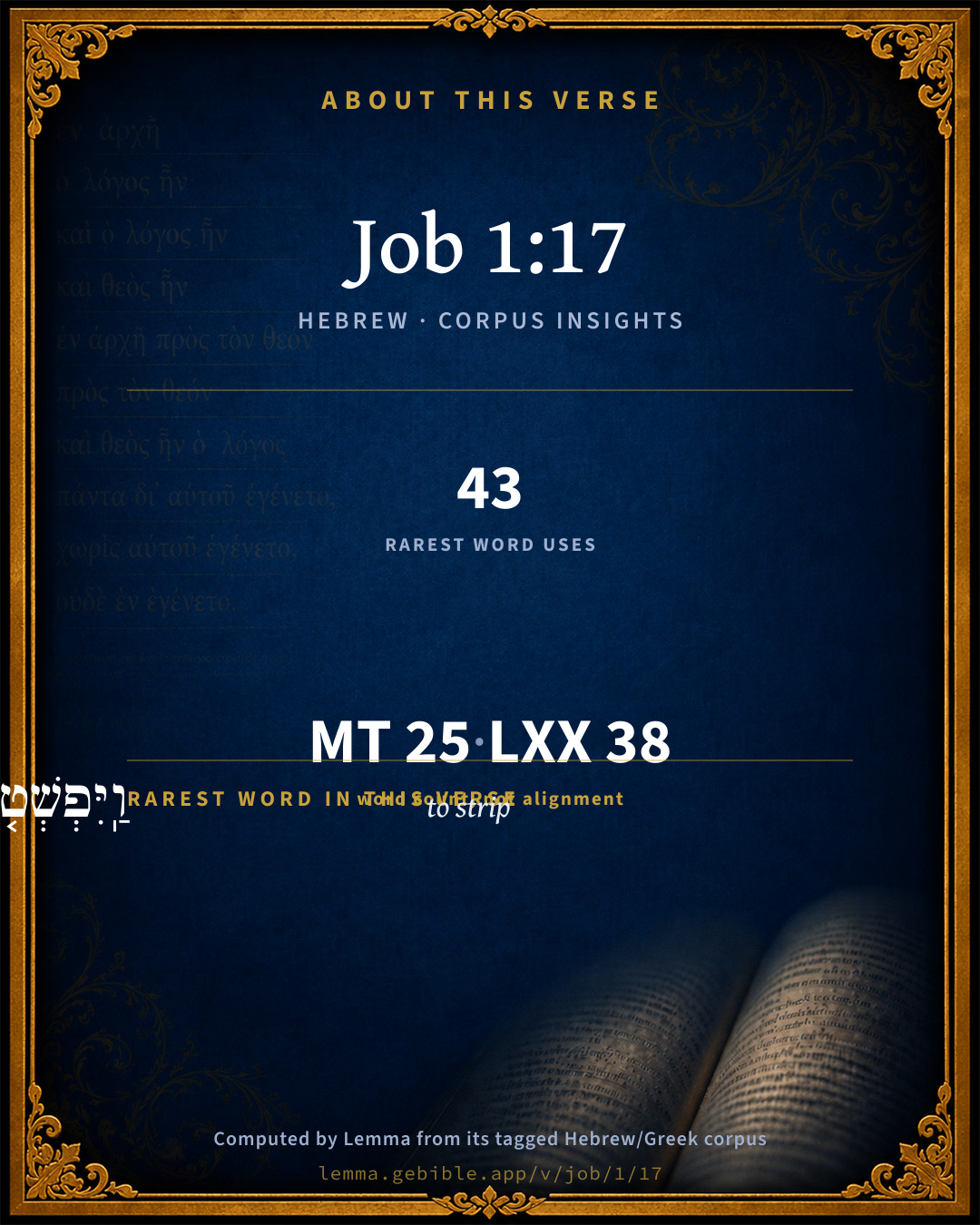
וַֽיִּפְשְׁט֤וּ to strip H6584 occurs in 42 verses of the Hebrew Bible. Also found in:

Grammatical profile

  • 9 verbs
  • 7 nouns
  • 1 adjective
  • 3 pronouns
  • 2 prepositions
  • 1 adverb
  • 2 particles

Verb forms

  • מְדַבֵּ֗ר Piel · Participle Active
  • בָּ֣א Qal · Perfect
  • וַיֹּאמַר֒ Qal · Sequential Imperfect
  • שָׂ֣מוּ Qal · Perfect
  • וַֽיִּפְשְׁט֤וּ Qal · Sequential Imperfect
  • וַיִּקָּח֔וּם Qal · Sequential Imperfect
  • הִכּ֣וּ Hiphil · Perfect
  • וָאִמָּ֨לְטָ֧ה Niphal · Sequential Imperfect
  • לְהַגִּ֥יד Hiphil · Infinitive Construct

Repetition

A word recurs within this verse — often emphatic in Hebrew:

  • זֶ֣ה this H2088 ×2

Hebrew & Septuagint length

In English translation the verse runs 46 words from the Hebrew and 47 from the Septuagint (LXX English) — closely comparable.

A rough comparison of the two English renderings, which tokenize alike — not a word-level alignment.

Word counts can differ between the Hebrew and the Greek without any difference in meaning — e.g. the Hebrew direct-object marker אֵת has no separate Greek word, and Greek often adds the article ὁ.

In the original languages it is 25 Hebrew tokens and 38 Greek tokens — but the two are counted differently (Hebrew bundles its prefixes and suffixes into one token; the Greek is in lemma form), so that isn’t a like-for-like length.

Cross-references

6

Topical passages linked to Job 1:17 in the Treasury of Scripture Knowledge — connected by theme and wording, ordered by reader-vote popularity; previews shown in the World English Bible.

  • Genesis 11:28 Haran died before his father Terah in the land of his birth, in Ur of the Chaldees.
  • Habakkuk 1:6 For, behold, I raise up the Chaldeans, that bitter and hasty nation, that march through the breadth of the earth, to possess dwelling places that are not theirs.
  • Genesis 11:31 Terah took Abram his son, Lot the son of Haran, his son's son, and Sarai his daughter-in-law, his son Abram's wife. They went forth from Ur of the Chaldees, to go into the land of Canaan. They came to Haran, and lived there.
  • Isaiah 23:13 Behold, the land of the Chaldeans: this people was not; the Assyrian founded it for those who dwell in the wilderness; they set up their towers; they overthrew the palaces of it; they made it a ruin.
  • 2 Samuel 1:3 David said to him, From whence come you? He said to him, Out of the camp of Israel am I escaped.
  • Job 1:15 and the Sabeans attacked, and took them away. Yes, they have killed the servants with the edge of the sword, and I alone have escaped to tell you."

Cross-references courtesy of OpenBible.info (CC BY 4.0).

Hebrew and Greek witnesses Masoretic Hebrew ↔ Greek Septuagint

The same verse in the two great witnesses to the Old Testament, shown verse-for-verse.

These are two independent witnesses, not word-aligned to each other, and the Septuagint is shown in lemma (dictionary) form.

Hebrew Job 1:17 Masoretic · Westminster Leningrad Codex

ע֣וֹד זֶ֣ה מְדַבֵּ֗ר וְזֶה֮ בָּ֣א וַיֹּאמַר֒ כַּשְׂדִּ֞ים שָׂ֣מוּ שְׁלֹשָׁ֣ה רָאשִׁ֗ים וַֽיִּפְשְׁט֤וּ עַל הַגְּמַלִּים֙ וַיִּקָּח֔וּם וְאֶת הַנְּעָרִ֖ים הִכּ֣וּ לְפִי חָ֑רֶב וָאִמָּ֨לְטָ֧ה רַק אֲנִ֛י לְבַדִּ֖י לְהַגִּ֥יד לָֽךְ

While he was still speaking, there came also another, and said, "The Chaldeans made three bands, and swept down on the camels, and have taken them away, yes, and killed the servants with the edge of the sword; and I alone have escaped to tell you."

World English Bible · Public Domain

Greek LXX Job 1:17 Septuagint · lemma form

ἔτι οὗτος λαλέω ἔρχομαι ἕτερος ἄγγελος καί εἶπον πρός ιωβ ὁ ἱππεύς ποιέω ἐγώ κεφαλή τρεῖς καί κυκλόω ὁ κάμηλος καί αἰχμαλωτεύω αὐτός καί ὁ παῖς ἀποκτείνω ἐν μάχαιρα σώζω δέ ἐγώ μόνος καί ἔρχομαι ὁ ἀποἀγγέλλω σύ

While he was yet speaking, there came another messenger, and said to Job, The horsemen formed three companies against us, and surrounded the camels, and took them for a prey, and killed the servants with the sword; and I only escaped, and am come to tell you.

LXX2012 (modern English Septuagint) · Public Domain

On this verse, Albert Barnes' Notes on the Bible discusses the Septuagint’s reading. Read the note in Commentary ↓

Hebrew: Westminster Leningrad Codex (CC BY 4.0). Greek: Septuagint (public domain); English from LXX2012 (modern English Septuagint) (Public Domain). How the Septuagint differs from the Hebrew →

Commentary

Notes on Job 1:17 from classic Christian and Jewish commentators (each source and its license shown beneath its notes). The classic Christian expositions comment on the surrounding passage and are grouped to its opening verse, so a note may address several verses; the Jewish commentaries on the Tanakh (Rashi and others) are per-verse, so they appear only where the commentator wrote on this verse.

Lemma curates 59 commentaries, every one of them public domain or Creative Commons licensed, each selected and text-cleaned for this edition rather than reprinted as found. About our sources →

Trapp's Complete Commentary

John Trapp

Job 1:17 While he [was] yet speaking, there came also another, and said, The Chaldeans made out three bands, and fell upon the camels, and have carried them away, yea, and slain the servants with the edge of the sword; and I only am escaped alone to tell thee.

Ver. 17. While he was yet speaking] See on Job 1:16.

The Chaldeans] A base and obscure people from the beginning, subject to the Assyrians, but yet more potent than the Sabeans, as appeareth by the three bands they made out. The Sabeans are noted by Strabo to be an idle and effeminate people. The Chaldeans are set forth in the Scripture to be a bitter and hasty nation, terrible and dreadful, fiercer than the evening wolves, &c., Hab 1:6-8. Satan proceeds by degrees to afflict Job, that he may at length overturn him; but beyond expectation, he held out all assaults, Instar rupia quae in mari vadoso horridi Iovis, et irati, ut ita dicam, Neptuni fervidis assultibus undique verberata non cedit aut minuitur, sed obtendit assuetum fluctibus latus, et firma duritie tumentis undae impetum sustinet ac frangit (Joan. Wower Polymath).

Made out three bands] Which were marshalled and set in array by the devil, who was their commander-in-chief. Sic saepe loricatus incedit Satan, et cataphractus, as Luther speaketh; he hath his legions among men also, who (like those vulturine eagles, Job 39:30) do glut-glut blood, as the Hebrew word there soundeth and signifieth.

And fell upon the camels] Heb. Spread themselves over them, rushed and ran violently, making an impression upon the camels.

And have carried them away] Heb. Have taken them to themselves, though Job had never dealt discourteously with these Chaldeans, nor had his camels trespassed them, but were carefully kept by the servants. Innocence is no target against injury; neither doth victory always argue a just cause.

Yea, and slain the servants, &c.] {See Trapp on "Job 1:15"}

John Trapp, A Commentary or Exposition upon All the Books of the Old and New Testament (1647–1656) — public domain. Text from a community e-Sword module.

Joseph Benson's Commentary

Job 1:17. There came also another — Bringing tidings still more afflictive than either of the two former; and said, The Chaldeans — Who also lived upon spoil, as Xenophon and others observe; made out three bands —

That they might come upon their prey several ways, and that nothing might be able to escape them; and fell upon the camels, and have carried them away — The three thousand camels which Job had; (see Job 1:3;) a prodigious loss indeed! slaying, at the same time, the servants that tended them. If the fire of God, and the sword of the plunderers, which fell upon Job’s honest servants that were in the way of their duty, had fallen upon the Sabean robbers that were doing mischief, God’s judgments therein would have been like the great mountains, evident and conspicuous; but when the way of the wicked prospers, and they carry off their booty, while just and good men are suddenly cut off, God’s righteousness is like the great deep, the bottom of which we cannot find, Psa 36:6.

Joseph Benson's Commentary on the Old and New Testaments (1811–1818) — public domain. Text from a community e-Sword module.

Jamieson, Fausset & Brown

Robert Jamieson, A. R. Fausset & David Brown

Chaldeans--not merely robbers as the Sabeans; but experienced in war, as is implied by "they set in array three bands" (Hab 1:6-8). RAWLINSON distinguishes three periods: 1. When their seat of empire was in the south, towards the confluence of the Tigris and Euphrates. The Chaldean period, from 2300 B.C. to 1500 B.C. In this period was Chedorlaomer (Gen 14:1), the Kudur of Hur or Ur of the Chaldees, in the Assyrian inscriptions, and the conqueror of Syria. 2. From 1500 to 625 B.C., the Assyrian period. 3. From 625 to 538 B.C. (when Cyrus the Persian took Babylon), the Babylonian period. "Chaldees" in Hebrew--Chasaim. They were akin, perhaps, to the Hebrews, as Abraham's sojourn in Ur, and the name "Chesed," a nephew of Abraham, imply. The three bands were probably in order to attack the three separate thousands of Job's camels (Job 1:3).

Jamieson, Fausset & Brown — Commentary Critical and Explanatory on the Whole Bible (1871) — public domain (CC PDM 1.0). Text via the HelloAO Bible API.

Adam Clarke's Commentary

Verse 17. The Chaldeans made out three bands] The Chaldeans inhabited each side of the Euphrates near to Babylon, which was their capital. They were also mixed with the wandering Arabs, and lived like them on rapine. They were the descendants of Chesed, son of Nahor and brother of Huz, from whom they had their name Casdim, which we translate Chaldeans. They divided themselves into three bands, in order the more speedily and effectually to encompass, collect, and drive off the three thousand camels: probably they mounted the camels and rode off.

Adam Clarke's Commentary on the Bible (1810–1826) — public domain. Text from a community e-Sword/MySword module.

Ellicott's Commentary for English Readers

(17) The Chaldeans.—Literally, Chasdim, or descendants of Chesed (Gen_22:22; see Note on Job_1:1). This name reappears in the classic Carduchia and in the modern Kurdistan, as well as in the more familiar Chaldæa; it being a well-known philological law that r and l and r and s are interchangeable. It is to be noted that this calamity arose from the opposite quarter to the last, illustrating the well-known fact that troubles never come alone, and that causes of a widely different nature seem to combine to overthrow the falling man.

A Bible Commentary for English Readers, edited by Charles John Ellicott (1878–1897) — public domain. Text from a community e-Sword module.

The Cambridge Bible for Schools and Colleges

gen. ed. J. J. S. Perowne

17. The third stroke. The name Chaldeans was perhaps given generally to the tribes that roamed between the cultivated land on the east of the Jordan and the Euphrates. Dividing an attacking force into several bands, so as to fall on the enemy on several sides, was a common piece of Oriental tactics, Jdg_7:16; Jdg_9:43; 1Sa_11:11.

The Cambridge Bible for Schools and Colleges (gen. ed. J. J. S. Perowne; Cambridge University Press, 1878–1918) — public domain. Text from a community e-Sword module.

John Gill's Exposition

While he was yet speaking, there came also another,.... Another messenger from another part of Job's possessions, where his camels were, and this before the last messenger had told his story out:

and said, the Chaldeans made out three bands, and fell upon the camels, and have carried them away; these were the 3000 camels, as in Job 1:3 and perhaps they were in three separate companies and places, 1000 in each, and therefore the Chaldeans divided themselves into three bands; or "appointed three heads" (f), as it may be rendered; there were three bodies of them under so many leaders and commanders, and this was done, that they might the more easily take them; and they "diffused or spread themselves" (g), as the word signifies, upon or about the camels; they surrounded them on all sides, or otherwise, these being swift creatures, would have run away from them: these Chaldeans or Chasdim were the descendants of Chesed, a son of Nahor, who was brother to Abraham, Gen 22:20, who settled in the east country, not far from Job: and this agrees with the character that Xenophon (h) gives of the Chaldeans, at least some of them, in later times; that they lived upon robbing and plundering others, having no knowledge of agriculture, but got their bread by force of arms; and such as these Satan could easily instigate to come and carry off Job's camels:

yea, and slain the servants with the edge of the sword, and I only am escaped alone to tell thee; See Gill on Job 1:15.

(f) "posuerunt tria capita", Montanus, Bolducius, Schmidt; "duces", Pagninus, Vatablus. (g) "et diffuderunt se", Mercerus, Schmidt "effuderunt se", Cocceius. (h) Cyropaedia, l. 3. c. 11.

John Gill's Exposition of the Whole Bible (1746–1763) — public domain (CC PDM 1.0). Text via the HelloAO Bible API.

Albert Barnes' Notes on the Bible

The Chaldeans - The Septuagint translates this, αἱ ἱππεῖς hai hippeis), “the horsemen.” Why they thus expressed it is unknown. It may be possible that the Chaldeans were supposed to be distinguished as horsemen, and were principally known as such in their predatory excursions. But it is impossible to account for all the changes made by the Septuagint in the text. Tho Syriac and the Chaldee render it correctly, “Chaldeans.” The Chaldeans (Hebrew כשׂדים kaśdı̂ym) were the ancient inhabitants of Babylonia. According to Vitringa (Commentary in Isa. tom. i. p. 412, c. xiii. 19), Gesenius (Commentary zu Isa 23:13), and Rosenmailer (Bib. Geog. 1, 2, p. 36ff), the Chaldees or Casdim were a warlike people who orignally inhabited the Carduchian mountains, north of Assyria, and the northern part of Mesopotamia. According to Xenophon (Cyrop. iii. 2, 7) the Chaldees dwelt in the mountains adjacent to Armenia and they were found in the same region in the campaign of the younger Cyrus, and the retreat of the ten thousand Greeks. Xen. Anaba. iv. 3, 4; v. 5, 9; viii. 8, 14.

They were allied to the Hebrews, as appears from Gen 22:22, where כשׂד keśed (whence “Kasdim”) the ancestor of the people is mentioned as a son of Nabor, and was consequently the nephew of Abraham. And further, Abraham himself emigrated to Canaan from Ur of the Chaldees כשׂדים אוּר 'ûr kaśdı̂ym, “Ur of the Kasdim”), Gen 11:28; and in Judith 5:6, the Hebrews themselves are said to be descended from the Chaldeans. The region around the river Chaboras, in the northern part of Mesopotamia, is called by Ezekiel Eze 1:3 “the land of the Chaldeans;” Jeremiah Jer 5:15 calls them “an ancient nation;” see the notes at Isa 23:13. The Chaldeans were a fierce and warlike people, and when they were subdued by the Assyrians, a portion of them appear to have been placed in Babylon to ward off the incursions of the neighboring Arabians. In time “they” gained the ascendency over their Assyrian masters, and grew into the mighty empire of Chaldea or Babylonia. A part of them, however, appear to have remained in their ancient country, and enjoyed under the Persians some degree of liberty. Gesenius supposes that the Kurds who have inhabited those regions, at least since the middle ages, are probably the descendants of that people. - A very vivid and graphic description of the Chaldeans is given by the prophet Habakkuk, which will serve to illustrate the passage before us, and show that they retained until his times the predatory and fierce character which they had in the days of Job; Job 1:6-11 :

For lo I raise up the Chaldeans,

A bitter and hasty nation,

Which marches far and wide in the earth.

To possess the dwellings which are not theirs.

They are terrible and dreadful,

Their judgments proceed only from themselves.

Swifter titan leopards are their horses,

And fiercer than the evening wolves.

Their horsemen prance proudly around;

And their horsemen shall come from afar and fly,

Like the eagle when he pounces on his prey.

They all shall come for violence,

In troops their glance is ever forward!

They gather captives like the sand!

And they scoff at kings,

And princes are a scorn unto them.

They deride every strong hold;

They cast up mounds of - earth and take it.

This warlike people ultimately obtained the ascendency in the Assyrian empire. About the year 597 B.C. Nabopolassar, a viceroy in Babylon, made himself independent of Assyria, contracted an alliance with Cyaxares, king of Media, and with his aid subdued Nineveh, and the whole of Assyria. From that time the Babylonian empire rose, and the history of the Chaldeans becomes the history of Babylon. - “Rob. Calmet.” In the time of Job, however, they were a predatory race that seem to have wandered far for the sake of plunder. They came from the North, or the East, as the Sabeans came from the South.

Made out three bands - literally, “three heads.” That is, they divided tbemselves, for the sake of plunder, into three parties. Perhaps the three thousand camels of Job Job 1:3 occupied three places remote from each other, and the object of the speaker is to say that the whole were taken.

And fell upon the camels - Margin, “And rushed.” The word is different from that which in Job 1:15 is rendered “fell.” The word used here פשׁט pâshaṭ means to spread out, to expand. It is spoken of hostile troops, 1Ch 14:9, 1Ch 14:13; of locusts which spread over a country, Nah 3:15; and of an army or company of marauders. Jdg 9:33, Jdg 9:44; 1Sa 27:8. This is its sense here.

Albert Barnes' Notes on the Bible (1834–1885) — public domain. Text from a community e-Sword/MySword module.

Haydock's Catholic Bible Commentary

Chaldeans. Some copies of the Septuagint read "horsemen." These nations inhabited the other side of the Euphrates, but made frequent incursions to plunder their neighbours. (Calmet)

George Leo Haydock (1774–1849), Haydock's Catholic Family Bible and Commentary, 1859 edition — public domain. Excludes Psalms (Douay-Rheims chapter numbering differs from Protestant) and Deuterocanonical books (Catholic canon only).

Matthew Poole's English Annotations

The Chaldeans, who also lived upon the spoil, as Xenophon and others observe.

Made out three bands, that they might come upon them several ways, and nothing might be able to escape them.

Matthew Poole's English Annotations on the Holy Bible (1683–1685) — public domain. Text from a community e-Sword/MySword module.

Whedon's Commentary on the Bible

Daniel D. Whedon

THIRD MESSENGER.

17. The Chaldaeans — Or, Chasdim. They appear to have been one of the many Cushite tribes inhabiting the great alluvial plain lying far to the north-east of Idumea, known as Babylonia or Chaldaea — the latter, according to Ptolemy, forming the south-western portion of the former. From the earliest times the people occupying this land, though of the Hamite race, have been distinguished for their cultivation of science and their discoveries in the arts. Their principal tribe was the Accad.

Gen_10:10. “With this race originated the art of writing, the building of cities, and the institution of a religious system.” — RAWLINSON, Herodotus, 1:256. When the Semitic tribes established themselves in Assyria, in the thirteenth century before Christ, they adopted the alphabet of the Accad. The tablets found at Nineveh are exclusively in the Accadian language. (See Rawlinson, ibid., and “Five Great Monarchies,” vol. i, ch. 3.) Yet these are the people who are moved to a merciless foray against the unoffending man of God. In later times they are described as “terrible” — “a bitter and hasty nation” — whose “horses are swifter than the leopards,” and “more fierce than the evening wolves.” Hab_1:6-11. The distance from Chaldaea to Idumaea is not far from five hundred miles. Yet “scarcely a year passes during which the border of Syria is not ravaged by plundering parties from Mesopotamia, and sometimes even from the shores of the Persian Gulf.… Raids are now, also, as they were in Job’s days, sudden, rapid, and unexpected.” — J.L. Porter. “Once at least in every year the Teyaheh [a tribe of the Bedawin] collect in force, often mustering as many as one thousand guns, and set off on camels for the country of the ‘Anazeh, a distance of more than twenty days’ journey. Having chosen for their expedition the season of the year when the camels are sent out to graze, they seldom fail to come across some large herd feeding at a distance from the camp and watched by a few attendants only. These they drive off, the men who possess guns forming a guard on either side and in the rear, and the rest leading the beasts. It sometimes, though rarely, happens that they get off clear with their booty before the owners are aware of the invasions; but in many cases they are hotly pursued, and compelled to relinquish their prey and take to their heels. In the last of these excursions the Teyaheh carried off more than six hundred head of cattle.” — PALMER, Desert of Exodus, 295.

Three bands — They formed themselves into three columns, (Jdg_7:16 : 1Sa_11:11,) according to the ancient tactics of war; literally, “set three heads (bands) and spread out,” (פשׁשׂ,) that they might encompass the three thousand camels, which are easily affrighted and then exceedingly difficult to take. These three bands, according to Jahn, were probably the center, left, and right wing. In illustration of the availableness of the camel, Wellsted (Arabia, 1:300) states that the usual pace of the Oman camels, when the Bedawin mount them for a desert journey, is a quick, hard trot from six to eight miles an hour. They will continue this for twenty to twenty-four consecutive hours, but increase their speed, on occasions which require it, to thirteen or fifteen miles an hour. Laborde tells us (Arabia, 264) that his camel carried him from Suez to Cairo (thirty-two leagues) in seventeen hours. Burckhardt (Notes, 2:79) describes a wager which the camel lost, but he had traveled one hundred and fifteen miles in eleven hours, though twice crossing the Nile in a ferry-boat.

FOURTH MESSENGER.

Daniel D. Whedon (gen. ed.), Commentary on the Old and New Testaments (1874–1909) — public domain. Text from a community e-Sword module.

The Pulpit Commentary

While he was yet speaking, there came also another (see the comment on ver. 16). The exact repetition of a clause, without the alteration of a word or a letter, is very archaic. (comp. Gen_1:4, Gen_1:8, Gen_1:13, Gen_1:19, Gen_1:23, Gen_1:31; and for another repetition, Gen_1:10, Gen_1:12, Gen_1:18, Gen_1:21, Gen_1:25) And said, The Chaldeans; literally, the Casdim ( which is the word uniformly used in the Hebrew where the Authorized Version has "Chaldeans" or "Chaldees." The native name seems to have been Kaldi or Kaldai, whence the Greek Caldaioi , and the Latin Chaldaei. It is very difficult to account for the Hebrews having substituted a sibilant for the liquid; but it was certainly done from the earliest period of their literature (Gen_11:31) to the latest (see Targums, passim). Some derive the Hebrew Casdim from "Chesed," one of the sons of Nahor; (Gen_22:22) but Abraham left Ur of the Chaldees before Chesed was born. (Gen_22:20) And there is no evidence of any connection between Chesed, who was born at Haran, and the Babylonian Chaldeans. The Chaldeans were probably early settlers in Babylonia; by degrees they were pressed to the south, and gave the name of Chaldea to Lower Babylonia, or the tract nearest to the Persian Gulf (Strab., 16:1, Ptolemy, "Geographia," 5:20). From a remote date they were a settled and civilized people; but no doubt originally they had the same predatory instincts as their neighbours. Made out three bands. Professor Lee translates, "appointed three captains," which is a possible meaning of the words; but the weight of authority supports the rendering of the Authorized Version. And fell upon the camels. Perhaps the most valuable part of Job"s possessions. Three thousand camels would be regarded as a splendid capture by any body of Oriental marauders. And have carried them away, yea, and slain the servants (literally, the young men, as in ver. 16) with the edge of the sword; and I only am escaped alone to tell thee (compare the comment on ver. 15).

The Pulpit Commentary (1880–1919), ed. H.D.M. Spence-Jones & Joseph S. Exell — public domain. Text from a community e-Sword module.

John Wesley's Explanatory Notes

Chaldeans - Who also lived upon spoil, as Xenephon and others observe.

John Wesley, Explanatory Notes Upon the Whole Bible (1754–1765) — public domain. Text via the GEBible commentary corpus.

Keil & Delitzsch

C. F. Keil & F. Delitzsch

The Third Messenger:

17 While he was yet speaking, there came also another, and said, The Chaldeans ranged themselves in three bands, and rushed upon the camels, and carried them away, and slew the servants with the edge of the sword; and I only am escaped alone to tell thee.

Without any authority, Ewald sees in this mention of the Chaldeans an indication of the composition of the book in the seventh century b.c., when the Chaldeans under Nabopolassar began to inherit the Assyrian power. Following Ewald, Renan observes that the Chaldeans first appear as such marauders about the time of Uzziah. But in Genesis we find mention of early Semitic Chaldeans among the mountain ranges lying to the north of Assyria and Mesopotamia; and later, Nahor Chaldeans of Mesopotamia, whose existence is traced back to the patriarchal times (vid., Genesis, p. 422),

(Note: This reference is to Delitzsch's Commentar ber die Genesis, 1860, a separate work from the Keil and Delitzsch series. - Tr.)

and who were powerful enough at any time to make a raid into Idumaea. To make an attack divided into several ראשׁים, heads, multitudes, bands (two - Gen. Job 14:15; three - Jdg 7:16, Sa1 11:11; or four - Judg. Job 9:34), is an ancient military stratagem; and פּשׁט, e.g., Jdg 9:33, is the proper word for attacks of such bands, either for plunder or revenge. In לפי־חרב, at the edge of the sword, l'epe, ל is like the usual acc. of manner.

Keil & Delitzsch — Biblical Commentary on the Old Testament (1861–1891) — public domain (CC PDM 1.0). Text via the HelloAO Bible API. (Old Testament only.)

Rashi

Rabbi Shlomo Yitzchaki (Rashi)

spread out on the camels This is an expression of plundering plunder according to their custom that as long as they are walking, they stick together and walk stealthily lest people recognize them and drive the cattle away. When they reach the place of the cattle, they spread out in the width of the herd, one on each side, in order to gather the cattle. Now these messengers were messengers of the Adversary, and in order to provoke him [Job] and cause him to sin, they first informed him of a small loss and later of a larger one. So is the sequence of all of them.

Rashi on the Tanakh — English translations: “The Judaica Press complete Tanach with Rashi, translated by A. J. Rosenberg” (CC BY 4.0); “Pentateuch with Rashi's commentary by M. Rosenbaum and A.M. Silbermann, 1929-1934” (public domain); “The Metsudah Tanach series, Lakewood, N.J” (CC BY 4.0); and “The Book of Joshua, Metsudah Publications, 1997” (CC BY 4.0). Text via Sefaria.

Lesson kit

Teaching starters — assembled from the data on this page, not authored interpretation. Every prompt links to the verse data it draws on. Edit before teaching.

Job, in the Wisdom, opens this verse with 25 words (23 distinct Hebrew lemmas). Its most distinctive word is pâshaṭ (“to strip”). A historical commentator’s framing appears above. Read the whole chapter for the surrounding context.

Discussion questions

  1. How does “to strip” (pâshaṭ) shape what this verse is saying?
  2. Genesis 37:23 shares the word «to strip» with this verse. How do the two illuminate each other?
  3. “this” occurs 2× in this one verse. What is the effect of the repetition?
  4. These translations render this verse differently. What is at stake in choosing one wording over another?
  5. The verb «מְדַבֵּ֗ר» is Piel Participle Active. How does its form color the action?
  6. Reading how Trapp's Complete Commentary and Joseph Benson's Commentary read this verse, where do the two commentators agree and where do they part?

Things to notice

Reading settings

Reading text

Shown beneath each verse's original-language words.

Old Testament
Old Testament edition

Read the OT as the Masoretic Hebrew (MT) or the Greek Septuagint (LXX).

English shown for the Greek Septuagint (in the Hebrew ↔ Greek comparison).

Comparing translations? Open the Compare panel on any verse page to stack up to four side by side.