Ezekiel 21:9

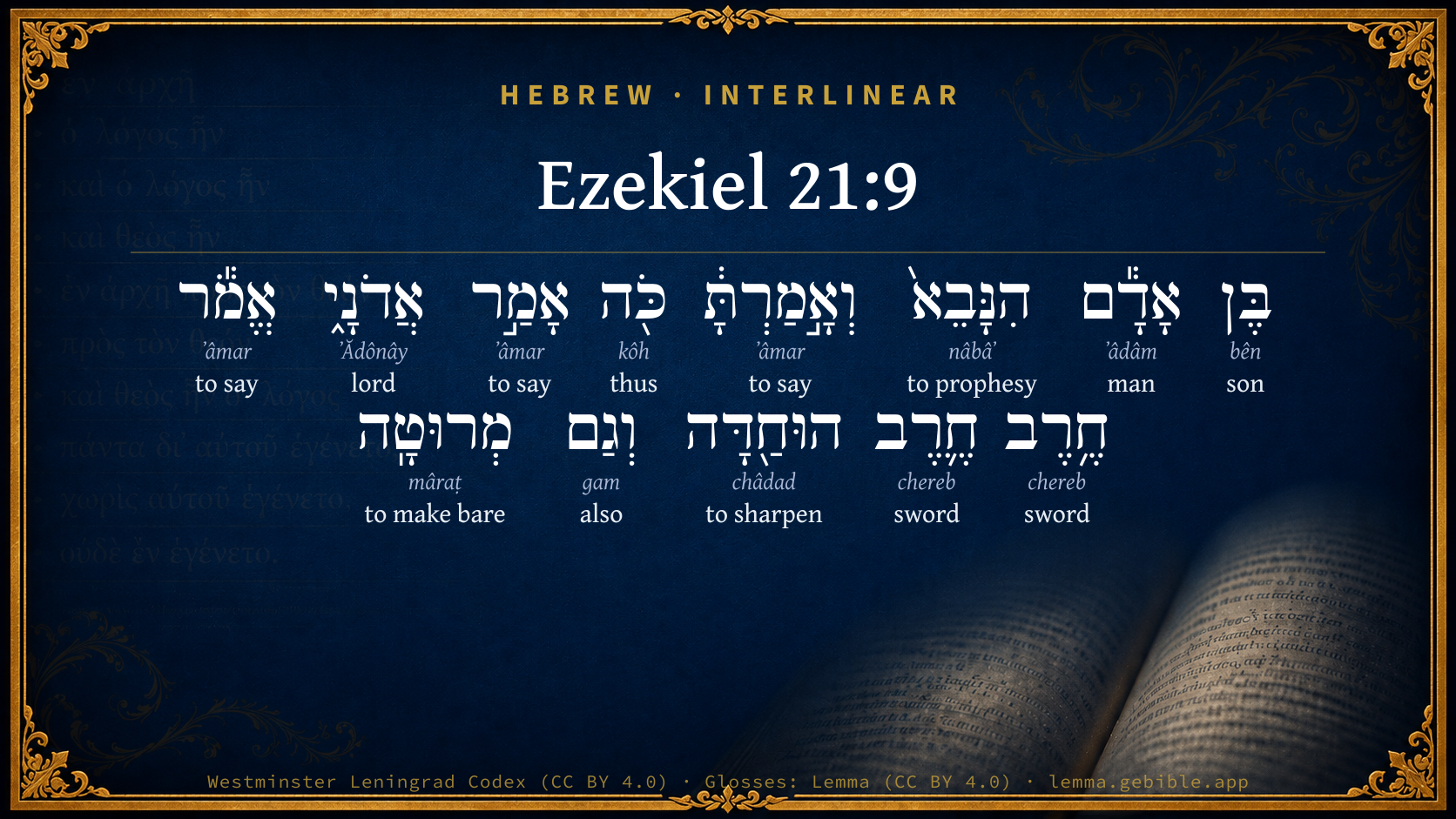
Hebrew (Westminster Leningrad Codex) Ezekiel 21:9 appears in the Hebrew Old Testament. The text above is from the Westminster Leningrad Codex. Each word links to its Strong’s number, a concise gloss, and parsing drawn from the Open Scriptures Hebrew Bible morphology. Click any word for its full Brown-Driver-Briggs (BDB) entry.
Download image
Cite this verse

Ezekiel 21:9 (World English Bible). Public Domain. Lemma interlinear Bible study tool, https://lemma.gebible.app/v/ezekiel/21/9.

Show BibTeX & RIS
BibTeX
RIS
English Translation
Son of man, prophesy, and say, Thus says Yahweh: Say, A sword, a sword, it is sharpened, and also furbished;
World English Bible · Public Domain
Download a study sheet

One document with this verse’s original text, its word-by-word gloss line, the meaning frame, cross-references with their text, attributed commentary, and full source and license credits — printable, and it pastes into notes with its structure intact.

This verse Autodidact and up

Study sheet (.html) Plain text (.txt)

A passage Seminary Student

Up to 50 verses in one chapter. A passage sheet keeps up to 6 commentary sources and 12 cross-references per verse, in the order this page ranks them, and says so on the sheet whenever that leaves anything out. Ask for a single verse and you get the Autodidact verse sheet above.

Everything on this page stays free to read, with no account — the sheet is a download of what is already on screen, not access to it.

Want to remove ads? Support Godless Engineer
Compare translations 3

The same verse in 3 English versions, stacked beneath the original-language interlinear above. Click any original word for its lexicon entry.

Each is an independent rendering of the whole verse — the interlinear is not word-aligned to these translations.

Highlighted words mark where these versions differ — a whole-verse word diff, not a word-by-word alignment.

  • World English Bible Public Domain
    Son of man, prophesy, and say, Thus says Yahweh: Say, A sword, a sword, it is sharpened, and also furbished;
  • King James Version Public Domain
    Son of man, prophesy, and say, Thus saith the LORD; Say, A sword, a sword is sharpened, and also furbished:
  • unfoldingWord Literal Text CC BY-SA 4.0
    “Son of man, prophesy and say, ‘The Lord says this: “Say: A sword! A sword! It will be sharpened and polished!

unfoldingWord Literal Text — © unfoldingWord, licensed CC BY-SA 4.0. Word-aligned USFM3 via Door43 (git.door43.org/unfoldingWord/en_ult).

Versions to compare (up to 4)

3 of 4 selected

Show all 18 translations

Every available English version of this verse, each an independent rendering of the whole verse.

  • World English Bible Public Domain
    Son of man, prophesy, and say, Thus says Yahweh: Say, A sword, a sword, it is sharpened, and also furbished;
  • Berean Standard Bible Public Domain
    “Son of man, prophesy and tell them that this is what the Lord says: ‘A sword, a sword, sharpened and polished—
  • Majority Standard Bible Public Domain
    “Son of man, prophesy and tell them that this is what the Lord says: ‘A sword, a sword, sharpened and polished—
  • King James Version Public Domain
    Son of man, prophesy, and say, Thus saith the LORD; Say, A sword, a sword is sharpened, and also furbished:
  • American Standard Version (1901) Public Domain
    Son of man, prophesy, and say, Thus saith Jehovah: Say, A sword, a sword, it is sharpened, and also furbished;
  • Revised Version (1885) Public Domain
    Son of man, prophesy, and say, Thus saith the LORD: Say, A sword, a sword, it is sharpened, and also furbished:
  • Geneva Bible (1599) Public Domain
    Sonne of man, prophecie, and say, Thus saith the Lord God, say, A sworde, a sworde both sharpe, and fourbished.
  • Douay-Rheims (1899) Public Domain
    Son of man, prophesy, and say: Thus saith the Lord God: Say: The sword, the sword is sharpened, and furbished.
  • Young's Literal Translation Public Domain
    `Son of man, prophesy, and thou hast said, Thus said Jehovah, say: A sword, a sword is sharpened, and also polished.
  • Literal Standard Version CC BY-SA 4.0
    “Son of man, prophesy, and you have said, Thus said YHWH: Say, A sword, a sword is sharpened, and also polished.
  • Unlocked Literal Bible CC BY-SA 4.0
    “Son of man, prophesy and say, 'The Lord says this: “Say: A sword! A sword! It will be sharpened and polished!
  • unfoldingWord Literal Text CC BY-SA 4.0
    “Son of man, prophesy and say, ‘The Lord says this: “Say: A sword! A sword! It will be sharpened and polished!
  • Darby Bible Public Domain
    Son of man, prophesy, and say, Thus saith Jehovah: Say, A sword, a sword is sharpened, and also furbished.
  • World Messianic Bible Public Domain
    “Son of man, prophesy, and say, ‘The LORD says: “A sword! A sword! It is sharpened, and also polished.
  • Webster's Bible Public Domain
    Son of man, prophesy, and say, Thus saith the LORD; Say, A sword, a sword is sharpened, and also furbished:
  • Free Bible Version CC BY-SA 4.0
    “Son of man, prophesy! Tell them this is what the Lord says: There's a sword, a sword that's being sharpened and polished.
  • Bible in Basic English Public Domain
    Son of man, say as a prophet, These are the words of the Lord: Say, A sword, a sword which has been made sharp and polished:
  • JPS Tanakh (1917) Public Domain
    (21-14) 'Son of man, prophesy, and say: Thus saith the LORD: Say: A sword, a sword, it is sharpened, and also furbished:

Literal Standard Version (2020), Covenant Press — licensed CC BY-SA 4.0. Text via the HelloAO Bible API (eBible.org). Unlocked Literal Bible (unfoldingWord) — licensed CC BY-SA 4.0. Text via the HelloAO Bible API (eBible.org). unfoldingWord Literal Text — © unfoldingWord, licensed CC BY-SA 4.0. Word-aligned USFM3 via Door43 (git.door43.org/unfoldingWord/en_ult). Free Bible Version, Dr. Jonathan Gallagher — licensed CC BY-SA 4.0. Text via the HelloAO Bible API (eBible.org).

Word by word

More ways to search: Search by grammar → Find every occurrence → Compare this word →

Practice this passage: Drill this verse → Learn its vocabulary →

הוּחַ֖דָּה
châdad
H2300
“to sharpen”
Verb, Hophal, Perfect, 3rd Person, Feminine, Singular
Part of Speech
Verb
Stem
Hophal
Form
Perfect
Person
3rd Person
Gender
Feminine
Number
Singular
Full BDB Definition

Origin: a primitive root

TWOT: 605

to be sharp, be alert, be keen - (Qal) to be sharp, be keen - (Hiphil) to sharpen - (Hophal) to be sharpened
  1. בֶּן bên H1121 “son of” Noun, Common, Masculine, Singular, Construct
  2. אָדָ֕ם ʼâdâm H120 “man” Noun, Common, Masculine, Singular, Absolute
  3. הִנָּבֵא֙ nâbâʼ H5012 “prophesy” Verb, Niphal, Imperative, 2nd Person, Masculine, Singular
  4. וְאָ֣מַרְתָּ֔ ʼâmar H559 “and · to say” Conjunction + Verb, Qal, Sequential Perfect, 2nd Person, Masculine, Singular
  5. כֹּ֖ה kôh H3541 “thus” Adverb
  6. אָמַ֣ר ʼâmar H559 “to say” Verb, Qal, Perfect, 3rd Person, Masculine, Singular
  7. אֲדֹנָ֑י ʼĂdônây H136 “Lord · my” Noun, Common, Masculine, Plural, Construct + Suffix, Personal, 1st Person, Common, Singular
  8. אֱמֹ֕ר ʼâmar H559 “say” Verb, Qal, Imperative, 2nd Person, Masculine, Singular
  9. חֶ֥רֶב chereb H2719 “sword” Noun, Common, Feminine, Singular, Absolute
  10. חֶ֛רֶב chereb H2719 “sword” Noun, Common, Feminine, Singular, Absolute
  11. וְגַם gam H1571 “and · also” Conjunction + Particle, Accusative
  12. מְרוּטָֽה mâraṭ H4803 “made bare” Verb, Qal, Participle Passive, Feminine, Singular, Absolute

About this verse

These counts appear in no published source. They are computed here, from the morphology-tagged text and Lemma’s own curated glosses. What Lemma adds →

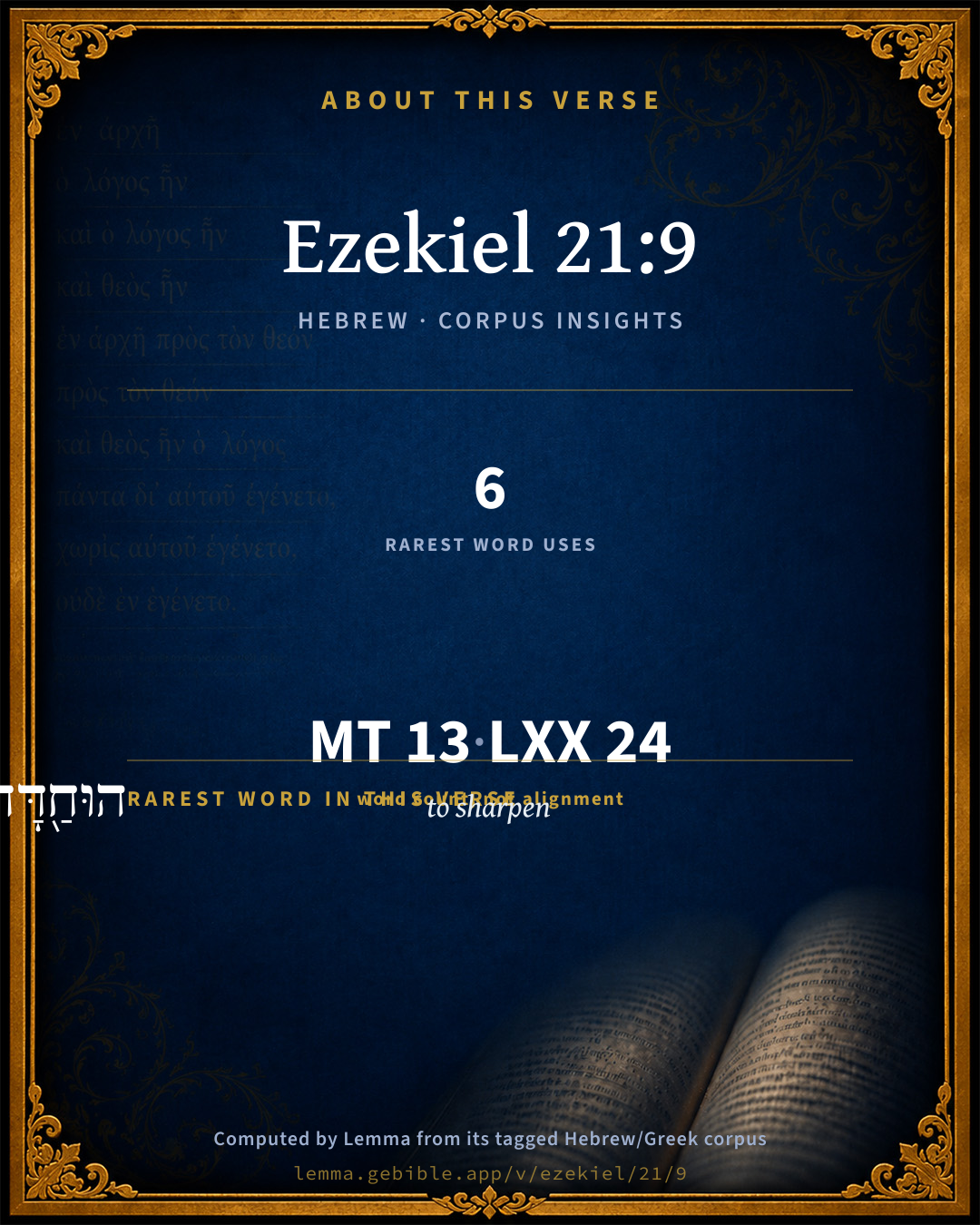
13
words
10
distinct lemmas
Prophets
section

Notable vocabulary

The rarest word here is הוּחַ֖דָּה to sharpen H2300 — appearing just 6 times in the whole Hebrew Bible.

Shared distinctive vocabulary

הוּחַ֖דָּה to sharpen H2300 occurs in 5 verses of the Hebrew Bible. Also found in:

Grammatical profile

  • 6 verbs
  • 5 nouns
  • 1 adverb
  • 1 particle

Verb forms

  • הִנָּבֵא֙ Niphal · Imperative
  • וְאָ֣מַרְתָּ֔ Qal · Sequential Perfect
  • אָמַ֣ר Qal · Perfect
  • אֱמֹ֕ר Qal · Imperative
  • הוּחַ֖דָּה Hophal · Perfect
  • מְרוּטָֽה Qal · Participle Passive

Repetition

Words recur within this verse — often emphatic in Hebrew:

  • וְאָ֣מַרְתָּ֔ to say H559 ×3
  • חֶ֥רֶב sword H2719 ×2

Hebrew & Septuagint length

In English translation the verse runs 20 words from the Hebrew and 19 from the Septuagint (LXX English) — closely comparable.

A rough comparison of the two English renderings, which tokenize alike — not a word-level alignment.

Word counts can differ between the Hebrew and the Greek without any difference in meaning — e.g. the Hebrew direct-object marker אֵת has no separate Greek word, and Greek often adds the article ὁ.

In the original languages it is 13 Hebrew tokens and 24 Greek tokens — but the two are counted differently (Hebrew bundles its prefixes and suffixes into one token; the Greek is in lemma form), so that isn’t a like-for-like length.

Cross-references

12

Topical passages linked to Ezekiel 21:9 in the Treasury of Scripture Knowledge — connected by theme and wording, ordered by reader-vote popularity; previews shown in the World English Bible.

  • Isaiah 34:5–6 For my sword has drunk its fill in the sky: behold, it shall come down on Edom, and on the people of my curse, to judgment.
  • Ezekiel 21:3 and tell the land of Israel, Thus says Yahweh: Behold, I am against you, and will draw forth my sword out of its sheath, and will cut off from you the righteous and the wicked.
  • Ezekiel 21:28 You, son of man, prophesy, and say, Thus says the Lord Yahweh concerning the children of Ammon, and concerning their reproach; and say you, A sword, a sword is drawn, for the slaughter it is furbished, to cause it to devour, that it may be as lightning;
  • Deuteronomy 32:41–42 If I whet my glittering sword, My hand take hold on judgment; I will render vengeance to my adversaries, Will recompense those who hate me.
  • Job 20:25 He draws it forth, and it comes out of his body. Yes, the glittering point comes out of his liver. Terrors are on him.
  • Psalms 7:11–13 God is a righteous judge, Yes, a God who has indignation every day.
  • Isaiah 27:1 In that day Yahweh with his hard and great and strong sword will punish leviathan the swift serpent, and leviathan the crooked serpent; and he will kill the monster that is in the sea.
  • Isaiah 66:16 For by fire will Yahweh execute judgment, and by his sword, on all flesh; and the slain of Yahweh shall be many.
  • Jeremiah 12:12 Destroyers are come on all the bare heights in the wilderness; for the sword of Yahweh devours from the one end of the land even to the other end of the land: no flesh has peace.
  • Jeremiah 15:2 It shall happen, when they tell you, Where shall we go forth? then you shall tell them, Thus says Yahweh: Such as are for death, to death; and such as are for the sword, to the sword; and such as are for the famine, to the famine; and such as are for captivity, to captivity.
  • Ezekiel 21:15 I have set the threatening sword against all their gates, that their heart may melt, and their stumblings be multiplied: ah! it is made as lightning, it is pointed for slaughter.
  • Amos 9:4 Though they go into captivity before their enemies, there I will command the sword, and it will kill them. I will set my eyes on them for evil, and not for good.

Cross-references courtesy of OpenBible.info (CC BY 4.0).

Hebrew and Greek witnesses Masoretic Hebrew ↔ Greek Septuagint

The same verse in the two great witnesses to the Old Testament, shown verse-for-verse.

These are two independent witnesses, not word-aligned to each other, and the Septuagint is shown in lemma (dictionary) form.

Hebrew Ezekiel 21:9 Masoretic · Westminster Leningrad Codex

בֶּן אָדָ֕ם הִנָּבֵא֙ וְאָ֣מַרְתָּ֔ כֹּ֖ה אָמַ֣ר אֲדֹנָ֑י אֱמֹ֕ר חֶ֥רֶב חֶ֛רֶב הוּחַ֖דָּה וְגַם מְרוּטָֽה

Son of man, prophesy, and say, Thus says Yahweh: Say, A sword, a sword, it is sharpened, and also furbished;

World English Bible · Public Domain

Greek LXX Ezekiel 21:9 Septuagint · lemma form

ἀντί ὅς ἐκὀλεθρεύω ἐκ σύ ἄδικος καί ἄνομος οὕτως ἐκἔρχομαι ὁ ἐγχειρίδιον ἐγώ ἐκ ὁ κολεός αὐτός ἐπί πᾶς σάρξ ἀπό ἀπηλιώτης ἕως βορέας

Son of man, prophesy, and you shall say, Thus says the Lord; Say, Sword, sword, be sharpened and rage,

LXX2012 (modern English Septuagint) · Public Domain

Hebrew: Westminster Leningrad Codex (CC BY 4.0). Greek: Septuagint (public domain); English from LXX2012 (modern English Septuagint) (Public Domain). How the Septuagint differs from the Hebrew →

Targum (Aramaic paraphrase)

1

The Targum is the ancient Jewish Aramaic paraphrase of the Hebrew Scriptures — an interpretive translation, not the Hebrew text itself. Onkelos (literal) and Pseudo-Jonathan (expansive) render the Torah, and Jonathan the Prophets. Coverage is partial: where no permissively-licensed English translation exists for a verse, only the Aramaic is shown. This is verse-level text, not a word-by-word alignment to the Hebrew.

  1. Targum Jonathan Prophets (Joshua–Malachi)
    חֲלַף דְאַגְלֵי מִנִיךְ זַכָּאָךְ בְּדִיל לְשֵׁיצָאָה חַיָבָךְ בְּכֵן תִּפּוֹק חַרְבִּי מִלִדְנָהּ עַל כָּל בִּסְרָא מִדָרוֹם לְצִפּוּנָא:

    (no public-domain English translation for this verse)

    Targum Jonathan — Aramaic: “Mikraot Gedolot” (public domain). English: “Sefaria Community Translation” (CC0 1.0 (public-domain dedication)); “London "Chaldee Paraphrase," 1871” (public domain). Text via Sefaria.

Commentary

Notes on Ezekiel 21:9 from classic Christian and Jewish commentators (each source and its license shown beneath its notes). The classic Christian expositions comment on the surrounding passage and are grouped to its opening verse, so a note may address several verses; the Jewish commentaries on the Tanakh (Rashi and others) are per-verse, so they appear only where the commentator wrote on this verse.

Lemma curates 59 commentaries, every one of them public domain or Creative Commons licensed, each selected and text-cleaned for this edition rather than reprinted as found. About our sources →

Trapp's Complete Commentary

John Trapp

Eze 21:9 Son of man, prophesy, and say, Thus saith the LORD; Say, A sword, a sword is sharpened, and also furbished:

Ver. 9 A sword, a sword is sharpened.] {a} Not only drawn, but sharpened, that it may wound swiftly and deadly; furbished also, that it may the more affray and make the quicker despatch. And that no doubt may be made of it, the ward sword is doubled.

{a} Exacutus et extersus, sharp and clean.

John Trapp, A Commentary or Exposition upon All the Books of the Old and New Testament (1647–1656) — public domain. Text from a community e-Sword module.

The Biblical Illustrator

Joseph S. Exell

Eze_21:9-11

Should we then make mirth?

Mirth unreasonable in the unconverted

I. Because they are under condemnation. The sword is sharpened to make a sore slaughter; it is furbished that it may glitter. Should we then make mirth? It is unreasonable in a condemned malefactor to make mirth. Would it not greatly shock every feeling mind to see a company of men condemned to die, meeting and making merry, talking lightly and jestingly, as if the sword was not over them?

II. Because Gods instruments of destruction are all ready. Not only are Christless persons condemned already, but the instruments of their destruction are prepared and quite ready, The sword of vengeance is sharpened and also furbished. The, disease by which every unconverted man is to die is quite ready--it is perhaps in his veins at this very moment. The accident by which he is to drop into eternity is quite ready--all the parts and means of it are arranged. The arrow that is to strike him is on the string--perhaps it has left the string, and is even now flying towards him.

III. Because the sword may come down at any one moment. Not only are Christless persons condemned already, and not only is the sword of vengeance quite ready, but the sword may come down at any one moment. It is not so with malefactors: their day is fixed and told them, so that they can count their time. If they have many days, they make merry today at least, and begin to be serious tomorrow. But not so Christless persons: their day is fixed, but it is not told them. It may be this very moment. Ah! should they then make mirth?

IV. Because God has made no promise to Christless souls to stay His hand one moment. God has laid Himself under no manner of obligation to you. He has nowhere promised that you shall see tomorrow, or that you shall hear another sermon. There is a day near at hand when you shall not see tomorrow.

V. It is a sore slaughter.

1. Sore, because it will be on all who are Christless.

2. Sore slaughter, because the sword is the sword of God. (R. MCheyne.)

Untimely mirth

Lightfoot says: I have heard it more than once and again, from the sheriffs who took all the gunpowder plotters and brought them up to London, that every night when they came to their lodging by the way, they had their music and dancing a good part of the night. One would think it strange that men in their case should be so merry. More marvellous still is it that those between whom and death there is but a step should sport away their time as if they should live on for ages. Though the place of torment is within a short march of all unregenerate men, yet see how they make mirth, grinning and jesting between the jaws of hell! (C. H. Spurgeon.)

The Biblical Illustrator, edited by Joseph S. Exell (c. 1880s–1900s) — public domain. Text from a community e-Sword module.

Joseph Benson's Commentary

Eze 21:9-10. Say, A sword, a sword is sharpened — The sword was unsheathed in the foregoing verses; here it is fitted to do execution, which the prophet is commanded to lament. 1. It is sharpened, that it may cut, and wound, and make sore slaughter. The wrath of God will put an edge upon it; and whatever instruments he shall be pleased to use in executing his judgments, he will fill them with strength, courage, and fury, according to the service they are employed in. 2. It is furbished, that it may glitter, to the terror of those against whom it is drawn. It shall be a kind of flaming sword. Though the glory of God’s justice may seem to have been eclipsed for a while, (like a sword rusting in the scabbard,) during the day of his patience, and the delay of his judgments; yet it will shine out again, and be made to glitter. 3. It is a victorious sword, nothing shall stand before it. It contemneth the rod of my son, as every tree — It makes no distinction between the sceptre and common wood; between the branches of the royal family, descended from David and Solomon, (who were honoured with the title of God’s sons,) and the meanest of the people. This seems to be the meaning of the clause, provided our translation be just; but it is rendered very differently in some other versions. The Vulgate reads, Qui moves sceptrum filii mei, succidisti omne lignum, Thou who removest the sceptre of my son, hast cut down every tree; which Capellus understands of Nebuchadnezzar, who took away the sceptre, and overturned the kingdom. The marginal reading, It is the rod of my son, it despiseth every tree, may be understood in two senses. It may either mean, It is the rod whereby I chastise my son, namely, my people Israel. These, collectively considered, are termed God’s son, Exo 4:22-23; Hos 11:1; as being selected and chosen from all others, to stand to him in the relation of sons and daughters. Or, it may signify, It is the rod of my son, the Messiah, appointed by me to be the judge of the world, and invested with authority to execute judgment. This rod despiseth every tree; for it is the rod of iron, whereby the Son of God breaks the power of his enemies, Psa 2:9, and dashes them in pieces like a potter’s vessel, without respect of persons.

Joseph Benson's Commentary on the Old and New Testaments (1811–1818) — public domain. Text from a community e-Sword module.

Jamieson, Fausset & Brown

Robert Jamieson, A. R. Fausset & David Brown

sword--namely, of God (Deu 32:41). The Chaldeans are His instrument.

Jamieson, Fausset & Brown — Commentary Critical and Explanatory on the Whole Bible (1871) — public domain (CC PDM 1.0). Text via the HelloAO Bible API.

John Gill's Exposition

And he hath given it to be furbished, that it might be handled,.... Either Nebuchadnezzar, or rather God, or the Son of God, prepared and brightened the sword, that it might be handled and made use of, either by the Chaldeans or Romans, to the destruction of the Jews. The Targum is,

"he gave their vengeance to be delivered into the hand of the king of Babylon.''

The sword is sharpened and furbished, to give it into the hand of the slayer; either the king of Babylon, Nebuchadnezzar; or the Roman emperor, Titus Vespasian.

John Gill's Exposition of the Whole Bible (1746–1763) — public domain (CC PDM 1.0). Text via the HelloAO Bible API.

Matthew Poole's English Annotations

As if he pointed to it, crying out as one that suddenly seeth some dreadful sight. A mighty sword, or many; so the ingemination may imply the forces of Nebuchadnezzar and his confederates.

Sharpened; prepared to wound, slay, and that with greater speed and sureness.

Furbished; to terrify the weaker courage, to dazzle the eyes of such as encounter it: in a word, the danger is as near as if an army come up in array, and their swords in their bends ready to go on and fight.

Matthew Poole's English Annotations on the Holy Bible (1683–1685) — public domain. Text from a community e-Sword/MySword module.

The Pulpit Commentary

The sword of war.

I THE SWORD OF WAR BRINGS FEARFUL TROUBLE. When the hoarded judgment bursts over the head of the guilty nation of Israel, it falls in the form of war. Those people who speak lightly of war as being "good for trade," as "opening careers for men," and as "developing manly virtues," etc., would do well to consider that the fearful monster is regarded in the Bible as the worst of plagues. David was a man of war and he knew what its horrors meant. It was with no nervous fear like that of King James who shuddered at the sight of a sword, with no sentimental tremors of an effeminate nature, that the old warrior David chose the horrors of a pestilence in preference to those of war. Note some of its evils.

1. Destructiveness. It must be a fallacy to regard it as "good for trade." Whatever temporary and artificial fillip commerce may receive during the actual campaign is paid for ten times over by the subsequent collapse. England was thrown back for generations by the Napoleonic wars. The soldiers are withdrawn from productive work; ordinary commerce is stopped; and a vast amount of property is directly destroyed.

2. Suffering. Every one who has witnessed the scenes of a battlefield turns from the recollection of them with loathing and horror. War is not a pageant of drums and trumpets and flying banners; it is a huge Inferno of groans and agonizing deaths. Thousands lie wounded on the field, some trampled on by charging steeds, some anguished for want of the drop of water which cannot be reached, sick with the blazing heat of the sun or chilled to the marrow in snow and frost. Thousands are cut off in the flower of their youth, sent prematurely to the grave before their real life work is begun. And every death means a household of bitter mourning in the old home.

3. Wickedness. War lets loose the lowest passions. Hatred and bloodthirsty vengeance are engendered, and men are brought down to the level of wild brutes. Too often savage lust follows, and the vilest outrages are committed.

II THE SWORD OF WAR MAY BE USED AS A DIVINE CHASTISEMENT.

1. Sharpened by sin. National misconduct lays a people open to the ravages of war. The curse may be earned immediately by insolent and unrighteous dealings with other nations; or it may be brought less directly and not as we could anticipate. Yet the awful fact remains National sin necessitates national judgment, and the most awful and yet the most common national judgment is war.

2. Directed by God. This was the case with the wars of judgment that visited Israel. Israel"s sin sharpened the sword, but God"s hand guided it. For the providence of God cannot be excluded, even from so lawless and monstrous a thing as war.

(1) This adds to its terror. It is fearful to know that God wills us to suffer from so dire a calamity. Then there can be no escaping it.

(2) This suggests hope of final rescue. Wherever God is, love is. The God of battles is the God of Bethlehem. He who sends the war to scourge also sends the gospel to save.

The Pulpit Commentary (1880–1919), ed. H.D.M. Spence-Jones & Joseph S. Exell — public domain. Text from a community e-Sword module.

John Wesley's Explanatory Notes

Furbished - Made clean and bright.

John Wesley, Explanatory Notes Upon the Whole Bible (1754–1765) — public domain. Text via the GEBible commentary corpus.

Rashi

Rabbi Shlomo Yitzchaki (Rashi)

Since I cut off from you and I knew that the nations would rejoice at your misfortune, I shall be wroth with them and incite Nebuchadnezzar against all of them, and that is what I wrote, “and all faces from the south will be scorched.”

Rashi on the Tanakh — English translations: “The Judaica Press complete Tanach with Rashi, translated by A. J. Rosenberg” (CC BY 4.0); “Pentateuch with Rashi's commentary by M. Rosenbaum and A.M. Silbermann, 1929-1934” (public domain); “The Metsudah Tanach series, Lakewood, N.J” (CC BY 4.0); and “The Book of Joshua, Metsudah Publications, 1997” (CC BY 4.0). Text via Sefaria.

Lesson kit

Teaching starters — assembled from the data on this page, not authored interpretation. Every prompt links to the verse data it draws on. Edit before teaching.

Ezekiel, in the Prophets, opens this verse with 13 words (10 distinct Hebrew lemmas). Its most distinctive word is châdad (“to sharpen”). A historical commentator’s framing appears above. Read the whole chapter for the surrounding context.

Discussion questions

  1. What does “to sharpen” (châdad) contribute to the verse as a whole?
  2. How does Proverbs 27:17, which shares the word «to sharpen», read alongside this verse?
  3. What does the repetition of “to say” (3× in this one verse) do in this verse?
  4. These translations render this verse differently; the difference is in the English rendering, not the original. What questions does that raise?
  5. «הִנָּבֵא֙» is a Niphal Imperative verb. How does that grammatical form shape the action described?
  6. Compare how Trapp's Complete Commentary and The Biblical Illustrator read this verse. Where do they agree or differ?

Things to notice

Reading settings

Reading text

Shown beneath each verse's original-language words.

Old Testament
Old Testament edition

Read the OT as the Masoretic Hebrew (MT) or the Greek Septuagint (LXX).

English shown for the Greek Septuagint (in the Hebrew ↔ Greek comparison).

Comparing translations? Open the Compare panel on any verse page to stack up to four side by side.