Psalms 37:14

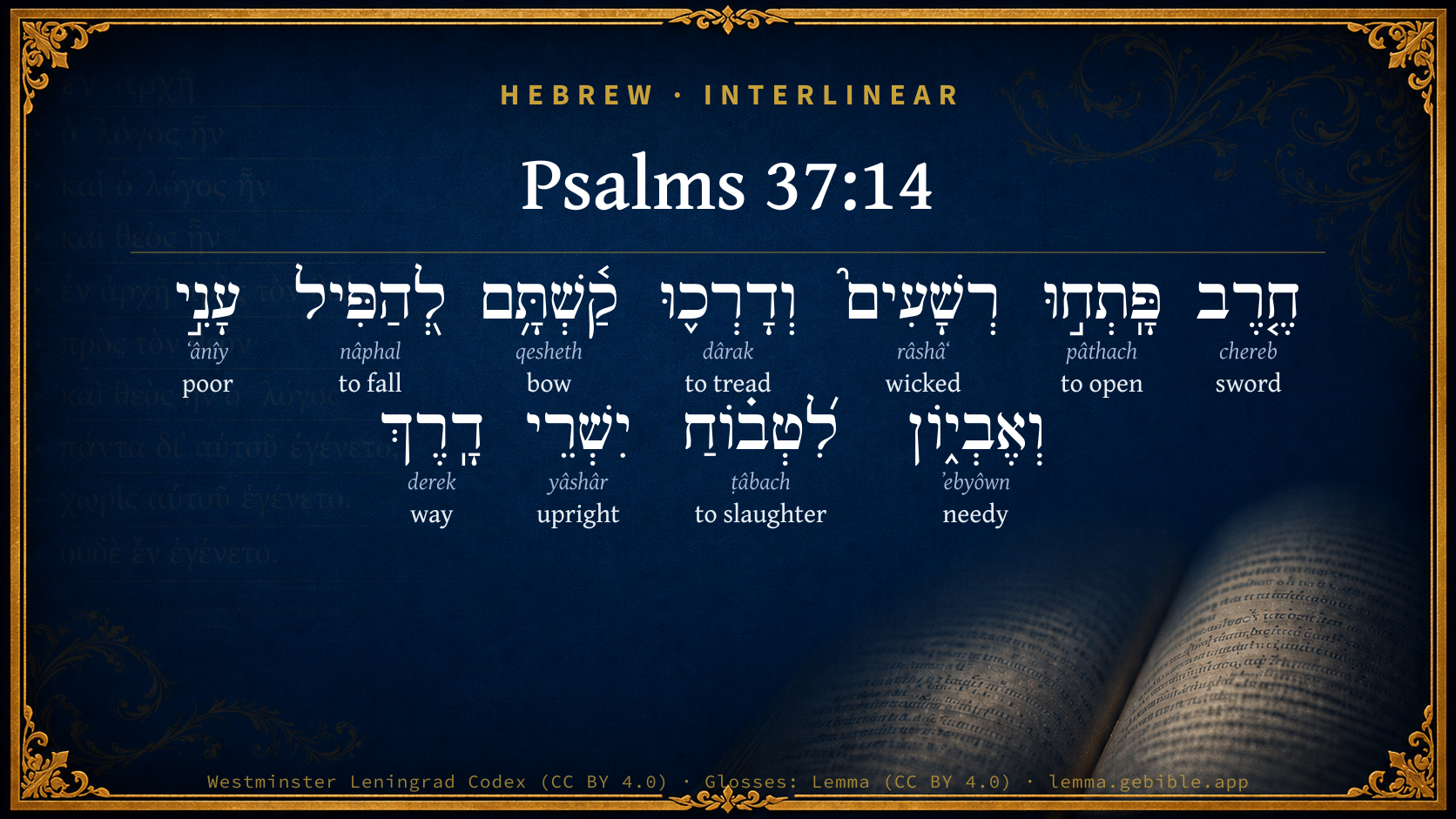
Hebrew (Westminster Leningrad Codex) Psalms 37:14 appears in the Hebrew Old Testament. The text above is from the Westminster Leningrad Codex. Each word links to its Strong’s number, a concise gloss, and parsing drawn from the Open Scriptures Hebrew Bible morphology. Click any word for its full Brown-Driver-Briggs (BDB) entry.
Download image
Cite this verse

Psalms 37:14 (World English Bible). Public Domain. Lemma interlinear Bible study tool, https://lemma.gebible.app/v/psalms/37/14.

Show BibTeX & RIS
BibTeX
RIS
English Translation
The wicked have drawn out the sword, and have bent their bow, To cast down the poor and needy, To kill those who are upright in the way.
World English Bible · Public Domain
Download a study sheet

One document with this verse’s original text, its word-by-word gloss line, the meaning frame, cross-references with their text, attributed commentary, and full source and license credits — printable, and it pastes into notes with its structure intact.

This verse Autodidact and up

Study sheet (.html) Plain text (.txt)

A passage Seminary Student

Up to 50 verses in one chapter. A passage sheet keeps up to 6 commentary sources and 12 cross-references per verse, in the order this page ranks them, and says so on the sheet whenever that leaves anything out. Ask for a single verse and you get the Autodidact verse sheet above.

Everything on this page stays free to read, with no account — the sheet is a download of what is already on screen, not access to it.

Want to remove ads? Support Godless Engineer
Compare translations 3

The same verse in 3 English versions, stacked beneath the original-language interlinear above. Click any original word for its lexicon entry.

Each is an independent rendering of the whole verse — the interlinear is not word-aligned to these translations.

Highlighted words mark where these versions differ — a whole-verse word diff, not a word-by-word alignment.

  • World English Bible Public Domain
    The wicked have drawn out the sword, and have bent their bow, To cast down the poor and needy, To kill those who are upright in the way.
  • King James Version Public Domain
    The wicked have drawn out the sword, and have bent their bow, to cast down the poor and needy, and to slay such as be of upright conversation.
  • unfoldingWord Literal Text CC BY-SA 4.0
    The wicked have opened a sword and have trodden their bow to bring down the poor and the needy, to slaughter the upright of way.

unfoldingWord Literal Text — © unfoldingWord, licensed CC BY-SA 4.0. Word-aligned USFM3 via Door43 (git.door43.org/unfoldingWord/en_ult).

Versions to compare (up to 4)

3 of 4 selected

Show all 18 translations

Every available English version of this verse, each an independent rendering of the whole verse.

  • World English Bible Public Domain
    The wicked have drawn out the sword, and have bent their bow, To cast down the poor and needy, To kill those who are upright in the way.
  • Berean Standard Bible Public Domain
    The wicked have drawn the sword and bent the bow to bring down the poor and needy, to slay those whose ways are upright.
  • Majority Standard Bible Public Domain
    The wicked have drawn the sword and bent the bow to bring down the poor and needy, to slay those whose ways are upright.
  • King James Version Public Domain
    The wicked have drawn out the sword, and have bent their bow, to cast down the poor and needy, and to slay such as be of upright conversation.
  • American Standard Version (1901) Public Domain
    The wicked have drawn out the sword, and have bent their bow, To cast down the poor and needy, To slay such as are upright in the way.
  • Revised Version (1885) Public Domain
    The wicked have drawn out the sword, and have bent their bow; to cast down the poor and needy, to slay such as be upright in the way:
  • Geneva Bible (1599) Public Domain
    The wicked haue drawen their sworde, and haue bent their bowe, to cast downe the poore and needie, and to slay such as be of vpright conuersation.
  • Douay-Rheims (1899) Public Domain
    The wicked have drawn out the sword: they have bent their bow. To cast down the poor and needy, to kill the upright of heart.
  • Young's Literal Translation Public Domain
    A sword have the wicked opened, And they have trodden their bow, To cause to fall the poor and needy, To slaughter the upright of the way.
  • Literal Standard Version CC BY-SA 4.0
    The wicked have opened a sword, || And they have bent their bow, || To cause the poor and needy to fall, || To slaughter the upright of the way.
  • Unlocked Literal Bible CC BY-SA 4.0
    The wicked have drawn out their swords and have bent their bows to cast down the oppressed and needy, to kill those who are upright.
  • unfoldingWord Literal Text CC BY-SA 4.0
    The wicked have opened a sword and have trodden their bow to bring down the poor and the needy, to slaughter the upright of way.
  • Darby Bible Public Domain
    The wicked have drawn out the sword, and have bent their bow, to cast down the afflicted and needy, to slay those that are upright in [the] way:
  • World Messianic Bible Public Domain
    The wicked have drawn out the sword, and have bent their bow, to cast down the poor and needy, to kill those who are upright on the path.
  • Webster's Bible Public Domain
    The wicked have drawn out the sword, and have bent their bow, to cast down the poor and needy, and to slay such as are of upright deportment.
  • Free Bible Version CC BY-SA 4.0
    The wicked draw their swords, and bend their bows to destroy the poor and needy, to kill those who live right.
  • Bible in Basic English Public Domain
    The evil-doers have taken out their swords, their bows are bent; for crushing the poor, and to put to death those who are upright in their ways.
  • JPS Tanakh (1917) Public Domain
    The wicked have drawn out the sword, and have bent their bow; to cast down the poor and needy, to slay such as are upright in the way;

Literal Standard Version (2020), Covenant Press — licensed CC BY-SA 4.0. Text via the HelloAO Bible API (eBible.org). Unlocked Literal Bible (unfoldingWord) — licensed CC BY-SA 4.0. Text via the HelloAO Bible API (eBible.org). unfoldingWord Literal Text — © unfoldingWord, licensed CC BY-SA 4.0. Word-aligned USFM3 via Door43 (git.door43.org/unfoldingWord/en_ult). Free Bible Version, Dr. Jonathan Gallagher — licensed CC BY-SA 4.0. Text via the HelloAO Bible API (eBible.org).

Word by word

More ways to search: Search by grammar → Find every occurrence → Compare this word →

Practice this passage: Drill this verse → Learn its vocabulary →

לִ֝טְב֗וֹחַ
ṭâbach
H2873
“to slaughter”
Preposition + Verb, Qal, Infinitive Construct
Part of Speech
Preposition + Verb
Stem
Qal
Form
Infinitive Construct
Full BDB Definition

Origin: a primitive root

TWOT: 786

to slaughter, slay, butcher, kill ruthlessly - (Qal) - to slaughter, butcher - to slay, kill ruthlessly (figuratively)
  1. חֶ֤רֶב chereb H2719 “sword” Noun, Common, Feminine, Singular, Absolute
  2. פָּֽתְח֣וּ pâthach H6605 “to open” Verb, Qal, Perfect, 3rd Person, Common, Plural
  3. רְשָׁעִים֮ râshâʻ H7563 “wicked” Adjective, Adjective, Masculine, Plural, Absolute
  4. וְדָרְכ֪וּ dârak H1869 “and · to tread” Conjunction + Verb, Qal, Perfect, 3rd Person, Common, Plural
  5. קַ֫שְׁתָּ֥ם qesheth H7198 “bow · their” Noun, Common, Feminine, Singular, Construct + Suffix, Personal, 3rd Person, Masculine, Plural
  6. לְ֭הַפִּיל nâphal H5307 “to fall” Preposition + Verb, Hiphil, Infinitive Construct
  7. עָנִ֣י ʻânîy H6041 “poor” Adjective, Adjective, Masculine, Singular, Absolute
  8. וְאֶבְי֑וֹן ʼebyôwn H34 “and · needy” Conjunction + Adjective, Adjective, Masculine, Singular, Absolute
  9. יִשְׁרֵי yâshâr H3477 “upright of” Adjective, Adjective, Masculine, Plural, Construct
  10. דָֽרֶךְ derek H1870 “way” Noun, Common, Both, Singular, Absolute

About this verse

These counts appear in no published source. They are computed here, from the morphology-tagged text and Lemma’s own curated glosses. What Lemma adds →

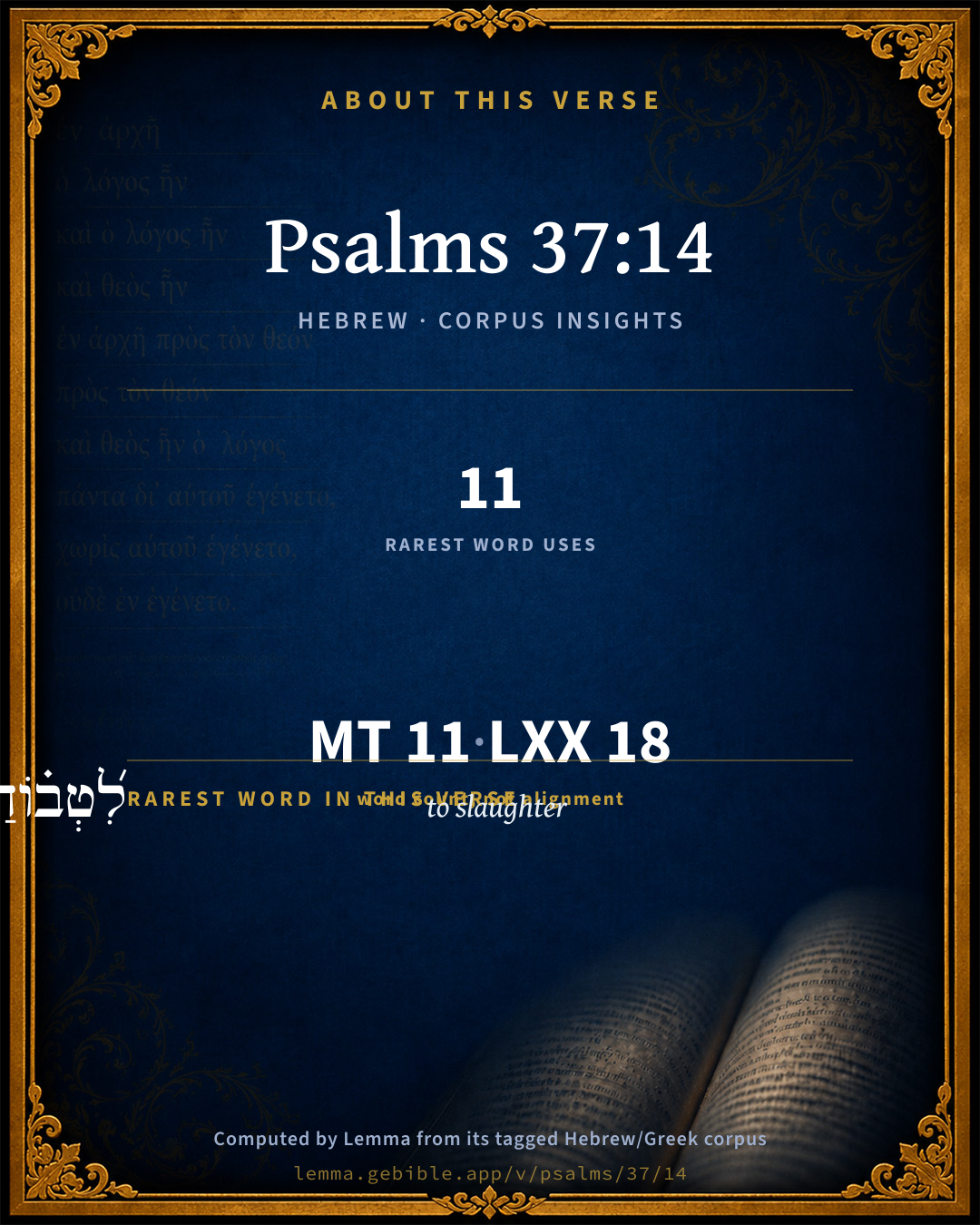
11
words
11
distinct lemmas
Wisdom
section

Notable vocabulary

The rarest word here is לִ֝טְב֗וֹחַ to slaughter H2873 — appearing just 11 times in the whole Hebrew Bible.

Shared distinctive vocabulary

לִ֝טְב֗וֹחַ to slaughter H2873 occurs in 11 verses of the Hebrew Bible. Also found in:

Grammatical profile

  • 4 verbs
  • 3 nouns
  • 4 adjectives

Verb forms

  • פָּֽתְח֣וּ Qal · Perfect
  • וְדָרְכ֪וּ Qal · Perfect
  • לְ֭הַפִּיל Hiphil · Infinitive Construct
  • לִ֝טְב֗וֹחַ Qal · Infinitive Construct

Hebrew & Septuagint length

In English translation the verse runs 28 words from the Hebrew and 25 from the Septuagint (LXX English) — closely comparable.

A rough comparison of the two English renderings, which tokenize alike — not a word-level alignment.

Word counts can differ between the Hebrew and the Greek without any difference in meaning — e.g. the Hebrew direct-object marker אֵת has no separate Greek word, and Greek often adds the article ὁ.

In the original languages it is 11 Hebrew tokens and 18 Greek tokens — but the two are counted differently (Hebrew bundles its prefixes and suffixes into one token; the Greek is in lemma form), so that isn’t a like-for-like length.

Cross-references

14

Topical passages linked to Psalms 37:14 in the Treasury of Scripture Knowledge — connected by theme and wording, ordered by reader-vote popularity; previews shown in the World English Bible.

  • Proverbs 29:27 A dishonest man detests the righteous, And the upright in their ways detest the wicked.
  • Psalms 11:2 For, behold, the wicked bend their bows. They set their arrows on the strings, That they may shoot in darkness at the upright in heart.
  • Proverbs 29:10 The bloodthirsty hate a man of integrity; And they seek the life of the upright.
  • 1 John 3:12 unlike Cain, who was of the evil one, and killed his brother. Why did he kill him? Because his works were evil, and his brother's righteous.
  • 1 Samuel 24:11 Moreover, my father, behold, yes, see the skirt of your robe in my hand; for in that I cut off the skirt of your robe, and didn't kill you, know you and see that there is neither evil nor disobedience in my hand, and I have not sinned against you, though you hunt after my life to take it.
  • 1 Samuel 24:17 He said to David, You are more righteous than I; for you have rendered to me good, whereas I have rendered to you evil.
  • Psalms 35:10 All my bones shall say, "Yahweh, who is like you, Who delivers the poor from him who is too strong for him, Yes, the poor and the needy from him who robs him?"
  • Psalms 64:2–6 Hide me from the conspiracy of the wicked, From the noisy crowd of the ones doing evil;
  • Acts 7:52 Which of the prophets didn't your fathers persecute? They killed those who foretold the coming of the Righteous One, of whom you have now become betrayers and murderers.
  • Acts 12:11 When Peter had come to himself, he said, "Now I truly know that the Lord has sent out his angel and delivered me out of the hand of Herod, and from everything the Jewish people were expecting."
  • Habakkuk 1:13 You who have purer eyes than to see evil, and who cannot look on perversity, why do you tolerate those who deal treacherously, and keep silent when the wicked swallows up the man who is more righteous than he,
  • Matthew 23:30–34 and say, 'If we had lived in the days of our fathers, we wouldn't have been partakers with them in the blood of the prophets.'
  • Acts 12:2–3 He killed James, the brother of John, with the sword.
  • Acts 12:23 Immediately an angel of the Lord struck him, because he didn't give God the glory, and he was eaten by worms and died.

Cross-references courtesy of OpenBible.info (CC BY 4.0).

Hebrew and Greek witnesses Masoretic Hebrew ↔ Greek Septuagint

The same verse in the two great witnesses to the Old Testament, shown verse-for-verse.

You’re reading Greek Psalm 36 (Hebrew Psalm 37). The Septuagint counts the superscription, so verse numbers can differ from the Hebrew — chapter-level alignment, not verse-by-verse. Numbering follows Rahlfs.

These are two independent witnesses, not word-aligned to each other, and the Septuagint is shown in lemma (dictionary) form.

Hebrew Psalms 37:14 Masoretic · Westminster Leningrad Codex

חֶ֤רֶב פָּֽתְח֣וּ רְשָׁעִים֮ וְדָרְכ֪וּ קַ֫שְׁתָּ֥ם לְ֭הַפִּיל עָנִ֣י וְאֶבְי֑וֹן לִ֝טְב֗וֹחַ יִשְׁרֵי דָֽרֶךְ

The wicked have drawn out the sword, and have bent their bow, To cast down the poor and needy, To kill those who are upright in the way.

World English Bible · Public Domain

Greek LXX Greek Psalm 36:14 Septuagint · lemma form

ῥομφαία σπάω ὁ ἁμαρτωλός ἐντείνω τόξον αὐτός ὁ καταβάλλω πτωχός καί πένης ὁ σφάζω ὁ εὐθύς ὁ καρδία

Sinners have drawn their swords, they have bent their bow, to cast down the poor and needy one, and to kill the upright in heart.

LXX2012 (modern English Septuagint) · Public Domain

On this verse, The Cambridge Bible for Schools and Colleges discusses the Septuagint’s reading. Read the note in Commentary ↓

Hebrew: Westminster Leningrad Codex (CC BY 4.0). Greek: Septuagint (public domain); English from LXX2012 (modern English Septuagint) (Public Domain). How the Septuagint differs from the Hebrew →

Commentary

Notes on Psalms 37:14 from classic Christian and Jewish commentators (each source and its license shown beneath its notes). The classic Christian expositions comment on the surrounding passage and are grouped to its opening verse, so a note may address several verses; the Jewish commentaries on the Tanakh (Rashi and others) are per-verse, so they appear only where the commentator wrote on this verse.

Lemma curates 59 commentaries, every one of them public domain or Creative Commons licensed, each selected and text-cleaned for this edition rather than reprinted as found. About our sources →

Trapp's Complete Commentary

John Trapp

Psa 37:14 The wicked have drawn out the sword, and have bent their bow, to cast down the poor and needy, [and] to slay such as be of upright conversation.

Ver. 14. The wicked have drawn out the sword, and have bent their bow] That they may assault the righteous, both cominus, nearer hand, and eminus, at a distance; for which purpose they come against him (like a walking armoury) with sword, bow, and other instruments of death; as resolved to kill and slay. "We are accounted as sheep for the slaughter," Rom 8:36.

John Trapp, A Commentary or Exposition upon All the Books of the Old and New Testament (1647–1656) — public domain. Text from a community e-Sword module.

The Treasury of David

Charles H. Spurgeon

Ver. 14. The wicked have drawn out the sword. They hold their weapon out of its sheath, and watch for a time to use it. And have bent their bow. One weapon is not enough, they carry another ready for action. They carry so strong a bow that they have trodden upon it to bend itthey will lose nothing for want of force or readiness. To cast down the poor and needy. These are their game, the objects of their accursed malice. These cowards attack not their equals, but seek out those excellent ones who, from the gentleness of their spirits and the poverty of their estates, are not able to defend themselves. Note how our meek and lowly Lord was beset by cruel foes, armed with all manner of weapons to slay him. And to slay such as be of upright conversation. Nothing short of the overthrow and death of the just will content the wicked. The sincere and straightforward are hated by the crafty schemers who delight in unrighteousness. See, then, the enemies of the godly doubly armed, and learn how true were our Lord's words, "If ye were of the world, the world would love its own: but because ye are not of this world, but I have chosen you our of the world, therefore the world hateth you."

Ver. 14-15. The tongue is a sword and a bow, which shooteth its arrows, even bitter words, against the humble and upright, Jesus and his disciples. But these are not the only weapons that have been drawn against them. How the malice of the Jews returned upon their own heads no one is ignorant, though few lay it to heart, and consider them as set forth for an example. George Horne.

Ver. 14-15. When the wicked are most near to do a mischief to the Lord's people, then is a mischief most near unto them. David Dickson.

Ver. 14. Upright conversation.

1. What it excludes. The horizontal or earthly, the crooked or crafty, the slanting or sinister.

2. What it includes. Motive, object, language, action.

3. What it achieves. It stands like a pillar; it supports like a column; it ascends like a tower; it adorns like a monument; it illuminates like a Pharos.

Psalms 37:15*

Ver. 14-15. See Psalms on "Ps 37:14" for further information.

Ver. 14-15. When the wicked are most near to do a mischief to the Lord's people, then is a mischief most near unto them. David Dickson.

Charles H. Spurgeon's The Treasury of David (1869–1885) — public domain. Psalms only. Text from a community e-Sword/MySword module.

Joseph Benson's Commentary

Psa 37:14-15. The wicked have drawn out the sword, &c. — They are furnished with all sorts of arms, and are ready to give the deadly blow. To slay such as be of upright conversation — Those against whom they have no quarrel, for any injury they have done them; but only for their integrity and righteousness, or because they are better than themselves, and will not comply with their wicked counsels and courses. Their sword shall enter into their own heart — God will not only defend the upright from their mischievous designs, but will make those designs to fall upon their own heads. “I cannot but think,” says a writer quoted here by Dr. Dodd, “that David understood by these weapons, with which he has furnished the ungodly, their bitter and malicious invectives, their false and foul reproaches, &c. These were the arms, in the use of which, as he frequently complains, they were admirably well skilled.” Thus, (Psa 57:4,) speaking of wicked men, he says, Whose teeth are spears and arrows, and their tongue a sharp sword. And if so, then Psa 37:15 “will mean that their intention will be frustrated; they shall not do the mischief they intended; their bows shall be broken — And their invectives and calumnies shall recoil and do themselves hurt; their sharp sword, their false and malicious tongues, shall pierce through their own soul. And that this was the psalmist’s meaning, who can doubt, after reading Psa 64:3, where the wicked doers are said to have whet their tongue like a sword, and to shoot out their arrows, even bitter words.”

Joseph Benson's Commentary on the Old and New Testaments (1811–1818) — public domain. Text from a community e-Sword module.

Keil & Delitzsch

C. F. Keil & F. Delitzsch

That which corresponds to the "treading" or stringing of the bow is the drawing from the sheath or unsheathing of the sword: פּתח, Eze 21:28, cf. Psa 55:22. The combination ישׁרי־דּרך is just like תמימי־דוך, Psa 119:1. The emphasis in Psa 37:14 is upon the suffix of בלבּם: they shall perish by their own weapon. קשּׁתותם has (in Baer) a Shebג dirimens, as also in Isa 5:28 in correct texts.

Keil & Delitzsch — Biblical Commentary on the Old Testament (1861–1891) — public domain (CC PDM 1.0). Text via the HelloAO Bible API. (Old Testament only.)

J. A. Alexander on Psalms

Joseph Addison Alexander

14. (Psa 37:14) The sword, put for all offensive weapons, and indeed for all destruclive agents. See above, on Psa 22:21 (20).—They have opened, i.e. loosened or uncovered, drawn.—The wicked, the whole class of evil-doers, whose destruction he had just foretold.—And have trodden, i.e. bent by treading on it. See above, on Psa 7:13 (12).—Their bow, often coupled with the sword, both in prose, as being literally the other most familiar implement of ancient warfare, and in poetry, as a parallel figure for destructive hostility.—To make fall, cast down, overthrow, the sufferer, the afflicted. See above, on Psa 9:13 (12).—And the poor, the destitute or needy one, a more specific term, often added to the generic one, which here precedes it. In all such cases, it is implied that the sufferers are the suffering righteous, the afflicted people of Jehovah.—To slay, or slaughter. The original expression is a very strong one, being properly applied to the slaughtering of cattle. See Exo 22:1, 1Sa 25:11. So in English a sanguinary battle is described as a great slaughter.—The straight, straightforward, upright, or sincere, (in) way, a common figure for the course of life or the habitual conduct. See above, on Psa 1:1. The mention of this moral quality confirms the explanation just given of the suffering, and needy, not as such considered, but as sufferers in the cause of truth and and righteousness, as suffering for God and from the malice of his enemies., the sword of these malignant foes, shall go into their heart, their own heart. They shall be destroyed by the very means which they prepared for the destruction of their betters. This idea of a providential lex talionis is one repeatedly expressed under various figurative forms. See above, Psa 7:16-17 (15, 16), Psa 9:16-17 (15, 16), and below, Psa 57:7 (6), and compare the imitation in Pro 26:27, and the historical example afforded by the case of Haman, Est 7:10.—And their bows, the parallel expression, as in ver. 14, for their implements of warfare and destruction, shall be broken, rendered useless. The substitution of the plural for the singular, and of a single verb for the expected repetition of the first clause, adds greatly to the force and beauty of the passage.

Joseph Addison Alexander, The Psalms Translated and Explained (1850) — public domain. Text from a community e-Sword module.

Tyndale Open Study Notes

Tyndale Open Resources

37:14-15 The weapons of the wicked will turn against them (cp. 7:12-13).

Tyndale Open Study Notes — © Tyndale Open Resources, licensed CC BY-SA 4.0. Text via the HelloAO Bible API.

Jamieson, Fausset & Brown

Robert Jamieson, A. R. Fausset & David Brown

sword, and . . . bow--for any instruments of violence.

slay--literally, "slaughter" (Sa1 25:11).

poor and needy--God's people (Psa 10:17; Psa 12:5). The punishment of the wicked as drawn on themselves--often mentioned (compare Psa 7:15-16; Psa 35:8).

Jamieson, Fausset & Brown — Commentary Critical and Explanatory on the Whole Bible (1871) — public domain (CC PDM 1.0). Text via the HelloAO Bible API.

Adam Clarke's Commentary

Verse 14. The wicked have drawn out the sword] There is an irreconcilable enmity in the souls of sinners against the godly; and there is much evidence that the idolatrous Babylonians whetted their tongue like a sword, and shot out their arrows, even bitter words, to malign the poor captives, and to insult them in every possible way.

Adam Clarke's Commentary on the Bible (1810–1826) — public domain. Text from a community e-Sword/MySword module.

John Calvin's Commentaries

14. The wicked draw their sword, and bend their bow. David now goes on to say, that the ungodly, being armed with sword and bow, threaten with death the children of God; and this he does in order to meet the temptation which would otherwise overwhelm them. The promises of God do not have place in a time of quietness and peace, but in the midst of severe and terrible conflicts. And, therefore, David now teaches us that the righteous are not deprived of that peace of which he had spoken a little before, although the wicked should threaten them with instant death. The sentence ought to be explained in this way: Although the wicked draw their swords and bend their bows to destroy the righteous, yet all their efforts shall return upon their own heads, and shall tend to their own destruction. But it is necessary to notice the particular terms in which the miserable condition of the righteous is here described, until God at length vouchsafe to help them. First, they are called poor and needy; and, secondly, they are compared to sheep devoted to destruction, because they have no power to withstand the violence of their enemies, but rather lie oppressed under their feet. Whence it follows, that a uniform state of enjoyment here is not promised to them in this psalm, but there is only set before them the hope of a blessed issue to their miseries and afflictions, in order to console them under them. But as it often happens that the wicked are hated and treated with severity for their iniquity, the Psalmist adds, that those who thus suffered were those who were of upright ways; meaning by this, that they were afflicted without cause. Formerly he described them as the upright in heart, by which he commended the inward purity of the heart; but now he commends uprightness in the conduct, and in fulfilling every duty towards our neighbor; and thus he shows not only that they are unjustly persecuted, because they have done no evil to their enemies, and have given them no cause of offense, but also, that though provoked by injuries, they nevertheless do not turn aside from the path of duty.

John Calvin's Commentaries (1540-1563) — public domain. Text from the Calvin Translation Society English edition (1840s-50s) via the Christian Classics Ethereal Library (ccel.org). Calvin's coverage is partial (roughly two-thirds of the Bible); uncommented books and verses are honest gaps, never fabricated. The 19th-century editor's footnotes and remarks are omitted so the notes are faithfully Calvin's own voice.

The Cambridge Bible for Schools and Colleges

gen. ed. J. J. S. Perowne

14. Sword and bow are not merely figurative expressions for any means of inflicting injury. The Psalm deals with a state of society in which the poor and defenceless were in constant danger of actual violence (Psa_37:32). Cp. Pro_1:10 ff.

the poor and needy] Or, the afflicted and needy. See notes on Psa_9:12; Psa_9:18 : and cp. Amo_8:4; Isa_32:7; Jer_22:16.

such as be of upright conversation] Lit. the upright of way: those whose life and conduct are upright. Cp. Psa_119:1. The LXX however reads upright in heart (Psa_36:10, and often).

conversation, as in Psa_50:23, has the obsolete sense of manner of life, behaviour.

14, 15. Stanza of Cheth. The machinations of the wicked recoil upon themselves. Cp. Psa_7:15 ff.; Psa_9:15 ff.

The Cambridge Bible for Schools and Colleges (gen. ed. J. J. S. Perowne; Cambridge University Press, 1878–1918) — public domain. Text from a community e-Sword module.

John Gill's Exposition

Their sword shall enter into their own heart,.... As Saul's did into his, Sa1 31:4;

and their bows shall be broken; the meaning is, that their efforts shall be fruitless, and their attempts in vain; the mischief they have contrived and designed for others shall fall upon themselves; see Psa 7:15; and therefore the saints should not be fretful and envious.

John Gill's Exposition of the Whole Bible (1746–1763) — public domain (CC PDM 1.0). Text via the HelloAO Bible API.

Albert Barnes' Notes on the Bible

The wicked have drawn out the sword - That is, they have prepared themselves with a full purpose to destroy the righteous.

And have bent their bow - literally, “have trodden the bow,” in allusion to the method by which the bow was bent: to wit, by placing the foot on it, and drawing the string back.

To cast down the poor and needy - To cause them to fall.

And to slay such as be of upright conversation - Margin, as in Hebrew: “the upright of way.” That is, those who are upright in their manner of life, or in their conduct.

Albert Barnes' Notes on the Bible (1834–1885) — public domain. Text from a community e-Sword/MySword module.

Matthew Poole's English Annotations

They are furnished with all sorts of arms, and are ready to give the deadly blow.

Such as be of upright conversation; such against whom they have no quarrel for any injury they have done them, but only for their integrity and righteousness, or because they are better than themselves, and will not comply with their wicked counsels and courses.

Matthew Poole's English Annotations on the Holy Bible (1683–1685) — public domain. Text from a community e-Sword/MySword module.

Whedon's Commentary on the Bible

Daniel D. Whedon

14. Drawn out the sword… bent their bow—Two acts preparatory to immediate destruction; but in Psa_37:15 the lex talionis—the law of universal justice—is seen to recoil these death weapons upon themselves.

Daniel D. Whedon (gen. ed.), Commentary on the Old and New Testaments (1874–1909) — public domain. Text from a community e-Sword module.

The Pulpit Commentary

The wicked have drawn out the sword, and bent their bow, to cast down the poor and needy. David is perhaps thinking especially of his own persecutors, Saul and Absalom, who pursued after him with armed men, and sought his life. (1Sa_23:8, 1Sa_23:14, 26 24:2 26:2 2Sa_17:24-26 2Sa_18:6-8) But he may also have in his mind the raids that powerful chiefs made upon their weak and peaceful neighbours. (Job_24:5-12) And to slay such as be of a right conversation; or, such as are upright in way; i.e. such as lead a righteous.

The Pulpit Commentary (1880–1919), ed. H.D.M. Spence-Jones & Joseph S. Exell — public domain. Text from a community e-Sword module.

unfoldingWord translationNotes

Door43 World Missions Community

The wicked

This refers to the wicked people. AT: "The wicked people" (See: Nominal Adjectives)

have drawn out their swords ... have bent their bows

Both "swords" and "bows" are weapons used to attack people. The fact that they are "drawn" and "bent" means they are ready to start attacking. AT: "have prepared their weapons in order to attack" (See: Synecdoche)

to cast down

This destruction of the needy people is spoken of as if they were clay pots that would break into pieces when thrown down on the ground. AT: "to destroy" (See: Metaphor)

the oppressed and needy

These terms both refer to people who are powerless to defend themselves. AT: "people who are not able to resist them" (See: Doublet)

Their swords will pierce their own hearts

Swords are examples of weapons and "hearts" represent the people. To "pierce the heart" is an idiom that means "to kill." AT: "Their weapons will be turned against them and they will kill themselves" (See: Synecdoche and Idiom)

translationWords

evil

oppress

sword

heart

bow and arrow

unfoldingWord translationNotes — © Distant Shores Media and the Door43 World Missions Community, licensed CC BY-SA 4.0. Source: git.door43.org/Door43/en_tn.

Rashi

Rabbi Shlomo Yitzchaki (Rashi)

initiated war the wicked initiated quarrel and strife without previous provocation.

Rashi on the Tanakh — English translations: “The Judaica Press complete Tanach with Rashi, translated by A. J. Rosenberg” (CC BY 4.0); “Pentateuch with Rashi's commentary by M. Rosenbaum and A.M. Silbermann, 1929-1934” (public domain); “The Metsudah Tanach series, Lakewood, N.J” (CC BY 4.0); and “The Book of Joshua, Metsudah Publications, 1997” (CC BY 4.0). Text via Sefaria.

Lesson kit

Teaching starters — assembled from the data on this page, not authored interpretation. Every prompt links to the verse data it draws on. Edit before teaching.

Psalms, in the Wisdom, opens this verse with 11 words (11 distinct Hebrew lemmas). Its most distinctive word is ṭâbach (“to slaughter”). A historical commentator’s framing appears above. Read the whole chapter for the surrounding context.

Discussion questions

  1. The word ṭâbach carries the sense “to slaughter.” How does it shape the verse?
  2. How does Genesis 43:16, which shares the word «to slaughter», read alongside this verse?
  3. These translations render this verse differently. What is at stake in choosing one wording over another?
  4. «פָּֽתְח֣וּ» is a Qal Perfect verb. How does that grammatical form shape the action described?
  5. Compare how Trapp's Complete Commentary and The Treasury of David read this verse. Where do they agree or differ?

Things to notice

Reading settings

Reading text

Shown beneath each verse's original-language words.

Old Testament
Old Testament edition

Read the OT as the Masoretic Hebrew (MT) or the Greek Septuagint (LXX).

English shown for the Greek Septuagint (in the Hebrew ↔ Greek comparison).

Comparing translations? Open the Compare panel on any verse page to stack up to four side by side.