
Ezekiel 6:11

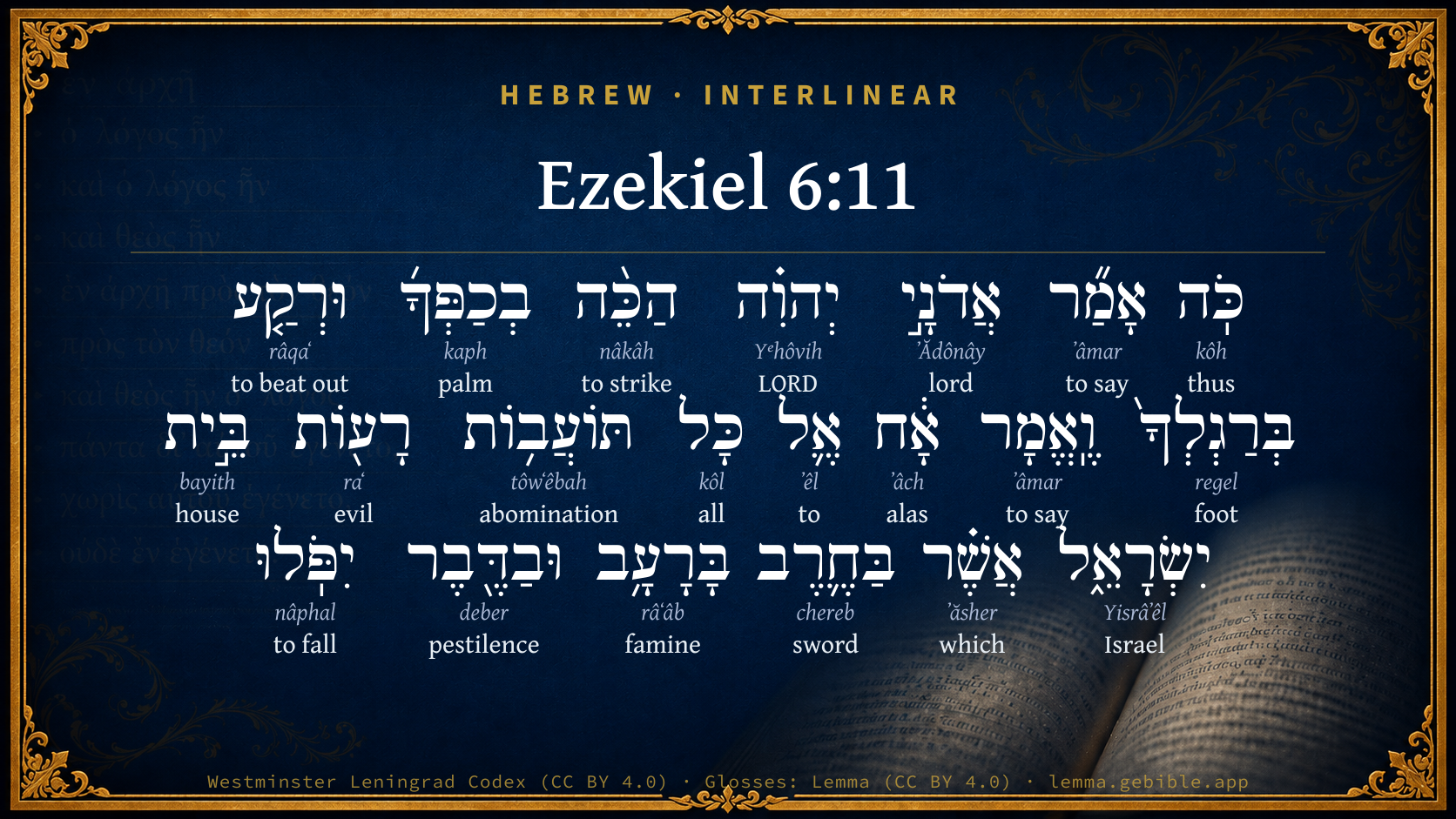
Hebrew (Westminster Leningrad Codex) Ezekiel 6:11 appears in the Hebrew Old Testament. The text above is from the Westminster Leningrad Codex. Each word links to its Strong’s number, a concise gloss, and parsing drawn from the Open Scriptures Hebrew Bible morphology. Click any word for its full Brown-Driver-Briggs (BDB) entry.
Download image
Cite this verse

Ezekiel 6:11 (World English Bible). Public Domain. Lemma interlinear Bible study tool, https://lemma.gebible.app/v/ezekiel/6/11.

Show BibTeX & RIS
BibTeX
RIS
English Translation
Thus says the Lord Yahweh: Smite with your hand, and stamp with your foot, and say, Alas! because of all the evil abominations of the house of Israel; for they shall fall by the sword, by the famine, and by the pestilence.
World English Bible · Public Domain
Highlights
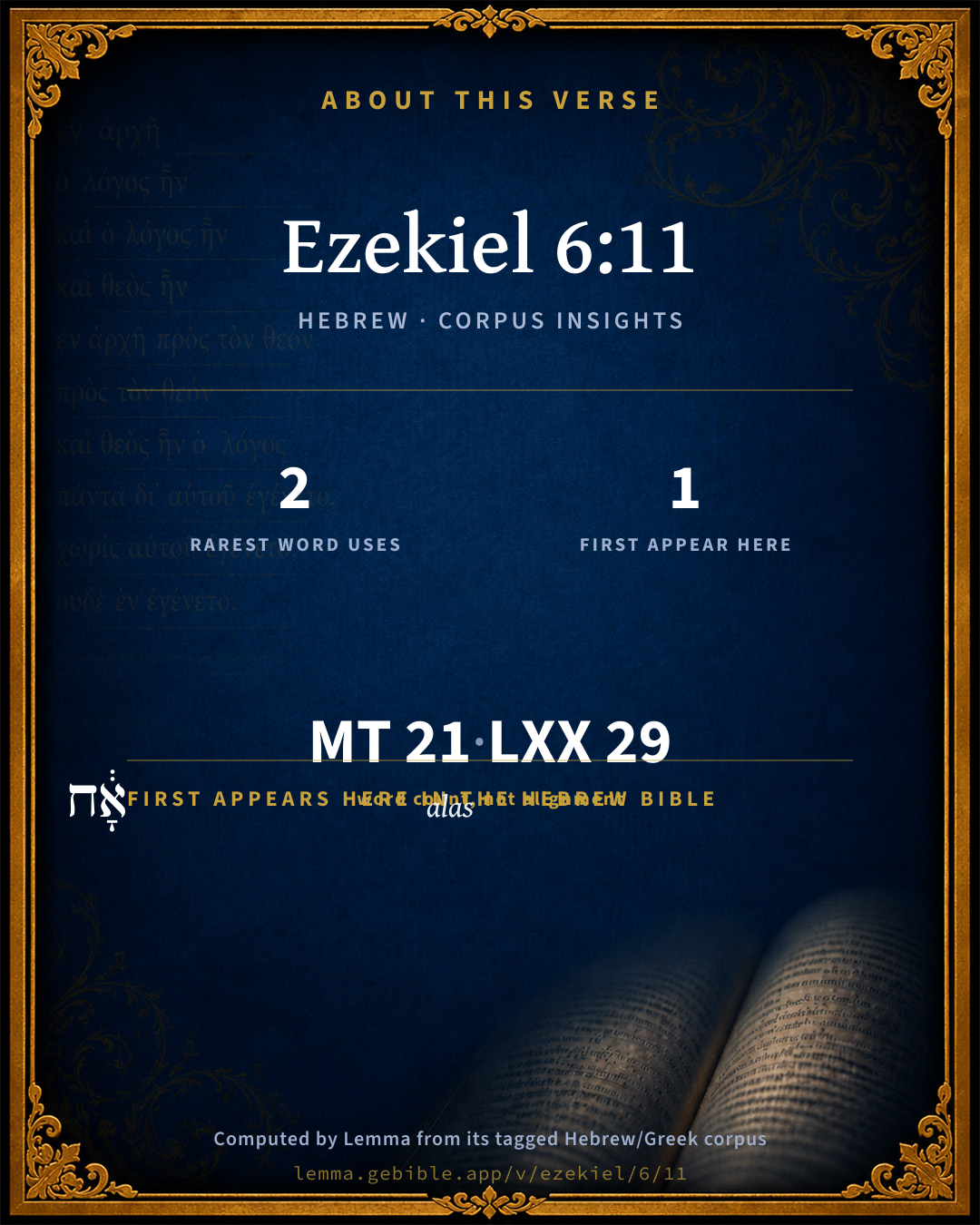
  • 1 first appearance in the Hebrew Bible
Full analysis ↓
Download a study sheet

One document with this verse’s original text, its word-by-word gloss line, the meaning frame, cross-references with their text, attributed commentary, and full source and license credits — printable, and it pastes into notes with its structure intact.

This verse Autodidact and up

Study sheet (.html) Plain text (.txt)

A passage Seminary Student

Up to 50 verses in one chapter. A passage sheet keeps up to 6 commentary sources and 12 cross-references per verse, in the order this page ranks them, and says so on the sheet whenever that leaves anything out. Ask for a single verse and you get the Autodidact verse sheet above.

Everything on this page stays free to read, with no account — the sheet is a download of what is already on screen, not access to it.

Want to remove ads? Support Godless Engineer
Compare translations 3

The same verse in 3 English versions, stacked beneath the original-language interlinear above. Click any original word for its lexicon entry.

Each is an independent rendering of the whole verse — the interlinear is not word-aligned to these translations.

Highlighted words mark where these versions differ — a whole-verse word diff, not a word-by-word alignment.

  • World English Bible Public Domain
    Thus says the Lord Yahweh: Smite with your hand, and stamp with your foot, and say, Alas! because of all the evil abominations of the house of Israel; for they shall fall by the sword, by the famine, and by the pestilence.
  • King James Version Public Domain
    Thus saith the Lord GOD; Smite with thine hand, and stamp with thy foot, and say, Alas for all the evil abominations of the house of Israel! for they shall fall by the sword, by the famine, and by the pestilence.
  • unfoldingWord Literal Text CC BY-SA 4.0
    The Lord Yahweh says this: Clap your hands and stomp your foot! Say, ‘Alas!’ because of all the evil abominations of the house of Israel! For they will fall by sword, famine, and plague.

unfoldingWord Literal Text — © unfoldingWord, licensed CC BY-SA 4.0. Word-aligned USFM3 via Door43 (git.door43.org/unfoldingWord/en_ult).

Versions to compare (up to 4)

3 of 4 selected

Show all 18 translations

Every available English version of this verse, each an independent rendering of the whole verse.

  • World English Bible Public Domain
    Thus says the Lord Yahweh: Smite with your hand, and stamp with your foot, and say, Alas! because of all the evil abominations of the house of Israel; for they shall fall by the sword, by the famine, and by the pestilence.
  • Berean Standard Bible Public Domain
    This is what the Lord GOD says: Clap your hands, stomp your feet, and cry out “Alas!” because of all the wicked abominations of the house of Israel, who will fall by sword and famine and plague.
  • Majority Standard Bible Public Domain
    This is what the Lord GOD says: Clap your hands, stomp your feet, and cry out “Alas!” because of all the wicked abominations of the house of Israel, who will fall by sword and famine and plague.
  • King James Version Public Domain
    Thus saith the Lord GOD; Smite with thine hand, and stamp with thy foot, and say, Alas for all the evil abominations of the house of Israel! for they shall fall by the sword, by the famine, and by the pestilence.
  • American Standard Version (1901) Public Domain
    Thus saith the Lord Jehovah: Smite with thy hand, and stamp with thy foot, and say, Alas! because of all the evil abominations of the house of Israel; for they shall fall by the sword, by the famine, and by the pestilence.
  • Revised Version (1885) Public Domain
    Thus saith the Lord GOD: Smite with thine hand, and stamp with thy foot, and say, Alas! because of all the evil abominations of the house of Israel: for they shall fall by the sword, by the famine, and by the pestilence.
  • Geneva Bible (1599) Public Domain
    Thus saith the Lord God, Smite with thine hand, and stretch forth with thy foote, and say, Alas, for all the wicked abominations of the house of Israel: for they shall fall by the sworde, by the famine, and by the pestilence.
  • Douay-Rheims (1899) Public Domain
    Thus saith the Lord God: Strike with thy hand, and stamp with thy foot, and say: Alas, for all the abominations of the evils of the house of Israel: for they shall fall by the sword, by the famine and by the pestilence.
  • Young's Literal Translation Public Domain
    Thus said the Lord Jehovah: `Smite with thy palm, and stamp with thy foot, And say: Alas, for all the evil abominations of the house of Israel, Who by sword, by famine, and by pestilence do fall.
  • Literal Standard Version CC BY-SA 4.0
    Thus said Lord YHWH: Strike with your palm, and stamp with your foot, || And say: Aah! For all the evil abominations of the house of Israel, || Which falls by sword, by famine, and by pestilence.
  • Unlocked Literal Bible CC BY-SA 4.0
    The Lord Yahweh says this: Clap your hands and stomp your foot! Say, 'Alas!' because of all the evil abominations of the house of Israel! For they will fall by sword, famine, and plague.
  • unfoldingWord Literal Text CC BY-SA 4.0
    The Lord Yahweh says this: Clap your hands and stomp your foot! Say, ‘Alas!’ because of all the evil abominations of the house of Israel! For they will fall by sword, famine, and plague.
  • Darby Bible Public Domain
    Thus saith the Lord Jehovah: Smite with thy hand, and stamp with thy foot, and say, Alas for all the abominations of the iniquities of the house of Israel! for they shall fall by the sword, by the famine, and by the pestilence.
  • World Messianic Bible Public Domain
    “The Lord GOD says: ‘Strike with your hand, and stamp with your foot, and say, “Alas!”, because of all the evil abominations of the house of Israel; for they will fall by the sword, by the famine, and by the pestilence.
  • Webster's Bible Public Domain
    Thus saith the Lord GOD; Smite with thy hand, and stamp with thy foot, and say, Alas, for all the evil abominations of the house of Israel! for they shall fall by the sword, by the famine, and by the pestilence.
  • Free Bible Version CC BY-SA 4.0
    This is what the Lord God says: Hit yourself with your hands, stomp your feet, and shout out ‘Oh no!’ Do this because of all the terrible wickedness of the people of Israel. They are going to die by the sword and famine and disease.
  • Bible in Basic English Public Domain
    This is what the Lord has said: Give blows with your hand, stamping with your foot, and say, O sorrow! because of all the evil and disgusting ways of the children of Israel: for death will overtake them by the sword and through need of food and by disease.
  • JPS Tanakh (1917) Public Domain
    Thus saith the Lord GOD: Smite with thy hand, and stamp with thy foot, and say: Alas! because of all the evil abominations of the house of Israel; for they shall fall by the sword, by the famine, and by the pestilence.

Literal Standard Version (2020), Covenant Press — licensed CC BY-SA 4.0. Text via the HelloAO Bible API (eBible.org). Unlocked Literal Bible (unfoldingWord) — licensed CC BY-SA 4.0. Text via the HelloAO Bible API (eBible.org). unfoldingWord Literal Text — © unfoldingWord, licensed CC BY-SA 4.0. Word-aligned USFM3 via Door43 (git.door43.org/unfoldingWord/en_ult). Free Bible Version, Dr. Jonathan Gallagher — licensed CC BY-SA 4.0. Text via the HelloAO Bible API (eBible.org).

Word by word

More ways to search: Search by grammar → Find every occurrence → Compare this word →

Practice this passage: Drill this verse → Learn its vocabulary →

אָ֔ח
ʼâch
H253
“alas”
Particle, Interjection
Part of Speech
Particle
Type
Interjection
Full BDB Definition

Origin: a variation for H162

TWOT: 60

ah!, alas!, woe!
  1. כֹּֽה kôh H3541 “thus” Adverb
  2. אָמַ֞ר ʼâmar H559 “to say” Verb, Qal, Perfect, 3rd Person, Masculine, Singular
  3. אֲדֹנָ֣י ʼĂdônây H136 “Lord · my” Noun, Common, Masculine, Plural, Construct + Suffix, Personal, 1st Person, Common, Singular
  4. יְהוִ֗ה Yᵉhôvih H3069 “LORD” Noun, Proper
  5. הַכֵּ֨ה nâkâh H5221 “strike” Verb, Hiphil, Imperative, 2nd Person, Masculine, Singular
  6. בְכַפְּךָ֜ kaph H3709 “in/at · palm · your” Preposition + Noun, Common, Feminine, Singular, Construct + Suffix, Personal, 2nd Person, Masculine, Singular
  7. וּרְקַ֤ע râqaʻ H7554 “and · beat out” Conjunction + Verb, Qal, Imperative, 2nd Person, Masculine, Singular
  8. בְּרַגְלְךָ֙ regel H7272 “in/at · foot · your” Preposition + Noun, Common, Feminine, Singular, Construct + Suffix, Personal, 2nd Person, Masculine, Singular
  9. וֶֽאֱמָר ʼâmar H559 “and · say” Conjunction + Verb, Qal, Imperative, 2nd Person, Masculine, Singular
  10. אֶ֛ל ʼêl H413 “to” Preposition
  11. כָּל kôl H3605 “all of” Noun, Common, Masculine, Singular, Construct
  12. תּוֹעֲב֥וֹת tôwʻêbah H8441 “abominations of” Noun, Common, Feminine, Plural, Construct
  13. רָע֖וֹת raʻ H7451 “evil of” Adjective, Adjective, Feminine, Plural, Construct
  14. בֵּ֣ית bayith H1004 “house of” Noun, Common, Masculine, Singular, Construct
  15. יִשְׂרָאֵ֑ל Yisrâʼêl H3478 “Israel” Noun, Proper
  16. אֲשֶׁ֗ר ʼăsher H834 “which” Particle, Relative
  17. בַּחֶ֛רֶב chereb H2719 “in/at the · sword” Preposition, Determined + Noun, Common, Feminine, Singular, Absolute
  18. בָּרָעָ֥ב râʻâb H7458 “in/at the · famine” Preposition, Determined + Noun, Common, Masculine, Singular, Absolute
  19. וּבַדֶּ֖בֶר deber H1698 “and · in/at the · pestilence” Conjunction + Preposition, Determined + Noun, Common, Masculine, Singular, Absolute
  20. יִפֹּֽלוּ nâphal H5307 “to fall” Verb, Qal, Imperfect, 3rd Person, Masculine, Plural

About this verse

These counts appear in no published source. They are computed here, from the morphology-tagged text and Lemma’s own curated glosses. What Lemma adds →

21
words
20
distinct lemmas
Prophets
section

Notable vocabulary

The rarest word here is אָ֔ח alas H253 — appearing just 2 times in the whole Hebrew Bible.

First appearance in Scripture

This word makes its first canonical appearance in the Hebrew Bible here:

  • אָ֔ח alas H253

Shared distinctive vocabulary

אָ֔ח alas H253 occurs in 2 verses of the Hebrew Bible. Also found in:

Grammatical profile

  • 5 verbs
  • 11 nouns
  • 1 adjective
  • 1 preposition
  • 1 adverb
  • 2 particles

Verb forms

  • אָמַ֞ר Qal · Perfect
  • הַכֵּ֨ה Hiphil · Imperative
  • וּרְקַ֤ע Qal · Imperative
  • וֶֽאֱמָר Qal · Imperative
  • יִפֹּֽלוּ Qal · Imperfect

Repetition

A word recurs within this verse — often emphatic in Hebrew:

  • אָמַ֞ר to say H559 ×2

Hebrew & Septuagint length

In English translation the verse runs 42 words from the Hebrew and 38 from the Septuagint (LXX English) — closely comparable.

A rough comparison of the two English renderings, which tokenize alike — not a word-level alignment.

Word counts can differ between the Hebrew and the Greek without any difference in meaning — e.g. the Hebrew direct-object marker אֵת has no separate Greek word, and Greek often adds the article ὁ.

In the original languages it is 21 Hebrew tokens and 29 Greek tokens — but the two are counted differently (Hebrew bundles its prefixes and suffixes into one token; the Greek is in lemma form), so that isn’t a like-for-like length.

Cross-references

17

Topical passages linked to Ezekiel 6:11 in the Treasury of Scripture Knowledge — connected by theme and wording, ordered by reader-vote popularity; previews shown in the World English Bible.

  • Ezekiel 5:12 A third part of you shall die with the pestilence, and with famine shall they be consumed in the midst of you; and a third part shall fall by the sword round about you; and a third part I will scatter to all the winds, and will draw out a sword after them.
  • Jeremiah 24:10 I will send the sword, the famine, and the pestilence, among them, until they be consumed from off the land that I gave to them and to their fathers.
  • Jeremiah 30:7 Alas! for that day is great, so that none is like it: it is even the time of Jacob's trouble; but he shall be saved out of it.
  • Ezekiel 9:4 Yahweh said to him, Go through the midst of the city, through the midst of Jerusalem, and set a mark on the foreheads of the men that sigh and that cry over all the abominations that are done in the midst of it.
  • Ezekiel 14:21 For thus says the Lord Yahweh: How much more when I send my four sore judgments on Jerusalem, the sword, and the famine, and the evil animals, and the pestilence, to cut off from it man and animal!
  • Ezekiel 21:14–17 You therefore, son of man, prophesy, and strike your hands together; and let the sword be doubled the third time, the sword of the deadly wounded: it is the sword of the great one who is deadly wounded, which enters into their chambers.
  • Ezekiel 25:6 For thus says the Lord Yahweh: Because you have clapped your hands, and stamped with the feet, and rejoiced with all the despite of your soul against the land of Israel;
  • Joel 1:15 Alas for the day! For the day of Yahweh is at hand, And it will come as destruction from the Almighty.
  • Numbers 24:10 Balak's anger was kindled against Balaam, and he struck his hands together; and Balak said to Balaam, I called you to curse my enemies, and, behold, you have altogether blessed them these three times.
  • Isaiah 58:1 Cry aloud, don't spare, lift up your voice like a trumpet, and declare to my people their disobedience, and to the house of Jacob their sins.
  • Jeremiah 9:1 Oh that my head were waters, and my eyes a spring of tears, that I might weep day and night for the slain of the daughter of my people!
  • Jeremiah 9:10 For the mountains will I take up a weeping and wailing, and for the pastures of the wilderness a lamentation, because they are burned up, so that none passes through; neither can men hear the voice of the cattle; both the birds of the sky and the animals are fled, they are gone.
  • Jeremiah 15:2–3 It shall happen, when they tell you, Where shall we go forth? then you shall tell them, Thus says Yahweh: Such as are for death, to death; and such as are for the sword, to the sword; and such as are for the famine, to the famine; and such as are for captivity, to captivity.
  • Jeremiah 16:4 They shall die grievous deaths: they shall not be lamented, neither shall they be buried; they shall be as dung on the surface of the ground; and they shall be consumed by the sword, and by famine; and their dead bodies shall be food for the birds of the sky, and for the animals of the earth.
  • Amos 5:16 Therefore thus says Yahweh, the God of hosts, the Lord: "Wailing will be in all the broad ways; And they will say in all the streets, 'Alas! Alas!' And they will call the farmer to mourning, And those who are skillful in lamentation to wailing.
  • Revelation 18:10 standing far away for the fear of her torment, saying, 'Woe, woe, the great city, Babylon, the strong city! For your judgment has come in one hour.'
  • Revelation 18:16–19 saying, 'Woe, woe, the great city, she who was dressed in fine linen, purple, and scarlet, and decked with gold and precious stones and pearls!

Cross-references courtesy of OpenBible.info (CC BY 4.0).

Hebrew and Greek witnesses Masoretic Hebrew ↔ Greek Septuagint

The same verse in the two great witnesses to the Old Testament, shown verse-for-verse.

These are two independent witnesses, not word-aligned to each other, and the Septuagint is shown in lemma (dictionary) form.

Hebrew Ezekiel 6:11 Masoretic · Westminster Leningrad Codex

כֹּֽה אָמַ֞ר אֲדֹנָ֣י יְהוִ֗ה הַכֵּ֨ה בְכַפְּךָ֜ וּרְקַ֤ע בְּרַגְלְךָ֙ וֶֽאֱמָר אָ֔ח אֶ֛ל כָּל תּוֹעֲב֥וֹת רָע֖וֹת בֵּ֣ית יִשְׂרָאֵ֑ל אֲשֶׁ֗ר בַּחֶ֛רֶב בָּרָעָ֥ב וּבַדֶּ֖בֶר יִפֹּֽלוּ

Thus says the Lord Yahweh: Smite with your hand, and stamp with your foot, and say, Alas! because of all the evil abominations of the house of Israel; for they shall fall by the sword, by the famine, and by the pestilence.

World English Bible · Public Domain

Greek LXX Ezekiel 6:11 Septuagint · lemma form

ὅδε λέγω κύριος κροτέω ὁ χείρ καί ψοφέω ὁ πούς καί εἶπον εὖγε εὖγε ἐπί πᾶς ὁ βδέλυγμα οἶκος ἰσραήλ ἐν ῥομφαία καί ἐν θάνατος καί ἐν λιμός πίπτω

Thus says the Lord; Clap with your hand, and stamp with your foot and say, Aha, aha! for all the abominations of the house of Israel: they shall fall by the sword, and by pestilence, and by famine.

LXX2012 (modern English Septuagint) · Public Domain

On this verse, The Cambridge Bible for Schools and Colleges discusses the Septuagint’s reading. Read the note in Commentary ↓

Hebrew: Westminster Leningrad Codex (CC BY 4.0). Greek: Septuagint (public domain); English from LXX2012 (modern English Septuagint) (Public Domain). How the Septuagint differs from the Hebrew →

Targum (Aramaic paraphrase)

1

The Targum is the ancient Jewish Aramaic paraphrase of the Hebrew Scriptures — an interpretive translation, not the Hebrew text itself. Onkelos (literal) and Pseudo-Jonathan (expansive) render the Torah, and Jonathan the Prophets. Coverage is partial: where no permissively-licensed English translation exists for a verse, only the Aramaic is shown. This is verse-level text, not a word-by-word alignment to the Hebrew.

  1. Targum Jonathan Prophets (Joshua–Malachi)
    כִּדְנַן אֲמַר יְיָ אֱלֹהִים טְפַּח בִּידָךְ וּרְפוֹס בְּרַגְלָךְ וַאֲמַר וַי עַל כָּל תּוֹעֲבָתָא בִּישְׁתָא בֵּית יִשְׂרָאֵל דִי בְּחַרְבָּא בְּכַפְנָא וּבְמוֹתָא יִתְרְמוּן:

    (no public-domain English translation for this verse)

    Targum Jonathan — Aramaic: “Mikraot Gedolot” (public domain). English: “Sefaria Community Translation” (CC0 1.0 (public-domain dedication)); “London "Chaldee Paraphrase," 1871” (public domain). Text via Sefaria.

Commentary

Notes on Ezekiel 6:11 from classic Christian and Jewish commentators (each source and its license shown beneath its notes). The classic Christian expositions comment on the surrounding passage and are grouped to its opening verse, so a note may address several verses; the Jewish commentaries on the Tanakh (Rashi and others) are per-verse, so they appear only where the commentator wrote on this verse.

Lemma curates 59 commentaries, every one of them public domain or Creative Commons licensed, each selected and text-cleaned for this edition rather than reprinted as found. About our sources →

Matthew Henry's Commentary

The same threatenings which we had before in the foregoing chapter, and in the former part of this, are here repeated, with a direction to the prophet to lament them, that those he prophesied to might be the more affected with the foresight of them.

I. He must by his gestures in preaching express the dep sense he had both of the iniquities and of the calamities of the house of Israel (Eze 6:11): Smite with thy hand and stamp with thy foot. Thus he must make it to appear that he was in earnest in what he said to them, that he firmly believed it and laid it to heart. Thus he must signify the just displeasure he had conceived at their sins, and the just dread he was under of the judgments coming upon them. Some would reject this use of these gestures, and call them antic and ridiculous; but God bids him use them because they might help to enforce the word upon some and give it the setting on; and those that know the worth of souls will be content to be laughed at by the wits, so they may but edify the weak. Two things the prophet must thus lament: - 1. National sins. Alas! for all the evil abominations of the house of Israel. Note, The sins of sinners are the sorrows of God's faithful servants, especially the evil abominations of the house of Israel, whose sins are more abominable and have more evil in them than the sins of others. Alas! What will be in the end hereof? 2. National judgments. To punish them for these abominations they shall fall by the sword, by the famine, and by the pestilence. Note, It is our duty to be affected not only with our own sins and sufferings, but with the sins and sufferings of others; and to look with compassion upon the miseries that wicked people bring upon themselves; as Christ beheld Jerusalem and wept over it.

II. He must inculcate what he had said before concerning the destruction that was coming upon them. 1. They shall be run down and ruined by a variety of judgments which shall find them out and follow them wherever they are (Eze 6:12): He that is far off, and thinks himself out of danger, because out of the reach of the Chaldeans' arrows, shall find himself not out of the reach of God's arrows, which fly day and night (Psa 91:5): He shall die of the pestilence. He that is near a place of strength, which he hopes will be to him a place of safety, shall fall by the sword, before he can retreat. He that is so cautious as not to venture out, but remains in the city, shall there die by the famine, the saddest death of all. Thus will God accomplish his fury, that is, do all that against them which he had purposed to do. 2. They shall read their sin in their punishment; for their slain men shall be among their idols, round about their altars, as was threatened before, Eze 6:5-7. There, where they had prostrated themselves in honour of their idols, God will lay them dead, to their own reproach and the reproach of their idols. They lived among them and shall die among them. They had offered sweet odours to their idols, but there shall their dead carcases send forth an offensive smell, as it were to atone for that misplaced incense. 3. The country shall be all laid waste, as, before, the cities (Eze 6:6): I will make the land desolate. That fruitful, pleasant, populous country, that has been as the garden of the Lord, the glory of all lands, shall be desolate, more desolate than the wilderness towards Diblath, Eze 6:14. It is called Diblathaim (Num 33:46; Jer 48:22), that great and terrible wilderness which is described, Deu 8:15, wherein were fiery serpents and scorpions. The land of Canaan is at this day one of the most barren desolate countries in the world. City and country are thus depopulated, that the altars may be laid waste and made desolate, Eze 6:6. Rather than their idolatrous altars shall be left standing, both town and country shall be laid in ruins. Sin is a desolating thing; therefore stand in awe and sin not.

Matthew Henry's Commentary on the Whole Bible (1708–1710) — public domain (CC PDM 1.0). Text via the HelloAO Bible API.

Trapp's Complete Commentary

John Trapp

Eze 6:11 Thus saith the Lord GOD; Smite with thine hand, and stamp with thy foot, and say, Alas for all the evil abominations of the house of Israel! for they shall fall by the sword, by the famine, and by the pestilence.

Ver. 11. Thus saith the Lord God.] Sic ait Dominator Dominus.

Smite with thine hand.] Manibus pedibusque obnixe omnia facito; do thine utmost by gestures and speeches to make this stupid people perceive their sin and danger.

Alas for all the evil abominations.] Propter omnes abominationes pessimas; { a} we cannot call sin bad enough; the worst word in a man’s belly is too good for it. O perdita Israel, dicere vult, quae tot malas abominationes operata es, &c.

{a} Oecolamp.

John Trapp, A Commentary or Exposition upon All the Books of the Old and New Testament (1647–1656) — public domain. Text from a community e-Sword module.

Albert Barnes' Notes on the Bible

The gleam of hope is but transitory. Darkness again gathers round, for as yet the prophet is predicting judgment.

Eze 6:11

Smite ... stamp - Well-known modes of expressing grief.

Eze 6:13

Sweet savor - Compare Gen 8:21. Words, applied to the smell of sacrifices accepted by God, applied here to idol-sacrifices in irony.

Eze 6:14

Toward Diblath - Or, “Diblathaim,” the “Diblathan” of the Moabite stone, one of the double cities of Moab (see Eze 25:9) to the east of which lay the great desert of Arabia. Some read: “unto Riblah” Jer 52:9 and take the margin rendering.

Albert Barnes' Notes on the Bible (1834–1885) — public domain. Text from a community e-Sword/MySword module.

Joseph Benson's Commentary

Eze 6:11-14. Smite with thy hand, and stamp with thy foot — Join to thy words the gestures which are proper to express grief and concern at the wickedness of thy people, and for their calamities that will ensue. For they shall fall by the sword, &c. — See note on Eze 5:12. He that is far off — And thinks himself out of danger, because he is out of the reach of the enemy; shall die of the pestilence — The arrow that I will shoot at him. And he that is near — Who stays in his own country, or who is near a place of strength, which he hopes will be to him a place of safety, yet shall fall by the sword before he can retreat to it. And he that remaineth — Who is so cautious as not to venture out, but remains in the city; shall die by the famine — The most miserable death of all: thus will I accomplish my fury — I will satisfy my just displeasure, and give them full measure of punishment: I will do all that against them which I had purposed to do. Then shall ye know — See note on Eze 6:10. When their slain men shall be among their idols — As was threatened before, Eze 6:5-7. Upon every high hill, &c. — There, where they had prostrated themselves in honour of their idols, God will lay them dead to their own reproach, and the reproach of their idols: they lived among them, and shall die among them: they had offered sweet odours to their idols, but there shall their dead carcasses send forth an offensive smell, as it were, to atone for that misplaced incense. So will I stretch out my hand — Put forth my almighty power; and make the land desolate — שׁממה, a desolation, a Hebraism, for most desolate: that fruitful, pleasant, populous country, which has been as the garden of Eden, the glory of all lands; shall be more desolate than the wilderness toward Diblath — Or Diblathaim, as it is called Num 33:46; the desert in the borders of Moab, part of that great and terrible wilderness, described Deu 8:15.

Joseph Benson's Commentary on the Old and New Testaments (1811–1818) — public domain. Text from a community e-Sword module.

Tyndale Open Study Notes

Tyndale Open Resources

6:11 Ezekiel’s message did not end on the encouraging thought of possible repentance. He returned to the theme of judgment with its three-fold calamity of war and famine and disease.

Tyndale Open Study Notes — © Tyndale Open Resources, licensed CC BY-SA 4.0. Text via the HelloAO Bible API.

Geneva Bible (1599)

Geneva Bible translators

By these signs he would that the Prophet should signify the great destruction to come.

Geneva Bible (1599) marginal notes — public domain. Text via Bolls.life.

Jamieson, Fausset & Brown

Robert Jamieson, A. R. Fausset & David Brown

Gesticulations vividly setting before the hearers the greatness of the calamity about to be inflicted. In indignation at the abominations of Israel extend thine hand towards Judea, as if about to "strike," and "stamp," shaking off the dust with thy foot, in token of how God shall "stretch out His hand upon them," and tread them down (Eze 6:14; Eze 21:14).

Jamieson, Fausset & Brown — Commentary Critical and Explanatory on the Whole Bible (1871) — public domain (CC PDM 1.0). Text via the HelloAO Bible API.

Adam Clarke's Commentary

Verse 11. Smite with thine hand, and stamp with thy foot] Show the utmost marks of thy astonishment and indignation, and dread of the evils that are coming upon them. Some have contended for the propriety of clapping and stamping in public worship from these words! It is scarcely a breach of charity to think that such persons are themselves incapable either of attending on or conducting the worship of God. To be consistent, they should copy the prophet in his other typical actions as well as these; and then we shall hear of their lying on their left side for three hundred and ninety days, and on their right side for forty days; shaving their heads, burning their hair, baking their bread with dung, &c. Now all these things, because they were typical and commanded, were proper in the prophet: in such persons as the above they would be evidences of insanity. Such extravagant acts are no part of God's worship.

Adam Clarke's Commentary on the Bible (1810–1826) — public domain. Text from a community e-Sword/MySword module.

John Calvin's Commentaries

This confirms what we have formerly seen concerning the slaughter of the ten tribes. The kingdom of Israel had been indeed afflicted, but because those remaining in their own country thought themselves free from further calamity, and gave themselves up to their idolatries more and more, it was on this account necessary that final destruction should be denounced against them. Since, then, words moved them but little, God adds a sign, according to his custom in obstinate cases. He orders the Prophet, by clapping of hands, and by extending his legs and feet, to show that the land was cursed. Divide, therefore, thy feet; for thus men are accustomed to do when they denounce anything gravely, or burn with indignation: they extend their legs in opposite directions; so I have rendered it verbally separate thy feet: the clapping of the hands has the same object. God wishes by this gesture that his word should be confirmed, not for the Prophets sake, but for the sake of the obstinacy of those who were deaf to all words, as we have said. Hence we truly comprehend how great was the stupidity of men, who, when God was thundering from heaven, yet remain secure, and do not cease to follow after their own desires: even when God inspires terror, they do nothing but laugh — this is monstrous. And yet we see it was an old disease, and I wish we of this day were free from what Ezekiel experienced.

Lastly, it is just as if he had been commanded to bring the Israelites into his presence When, therefore, he was commanded to cry alas! or, oh! upon all the abominations of the house of Israel, there is no doubt that his gesture as well as his exclamation ought to be efficacious. The reason also is added — that all shall perish by sword, pestilence, and famine We have said that these three kinds of punishment are always proposed, not because God strikes the despisers of his law with pestilence, the sword, and famine only, but because this method is more known and more common. God has innumerable hidden methods of punishing transgressors; but since, as I have said, this scourge is more used, hence the Prophets more frequently mention it.

The result is, that destruction to the kingdom of Israel was at hand, which they had never thought of; because God avenges the wickedness of his people not only by war, but by pestilence and famine. Sometimes by the figure, a part for the whole, it comprehends other punishments. And we know with how many miseries war is replete; for when once men begin to take up arms, the gate is opened to robberies and rapines, burnings, slaughters, debaucheries, and all violence; and in war all humanity and equity is buried. Then as to famine, we know that it usually renders men ravenous. But in pestilence the husband will desert the wife, every family is invaded by death, orphanhood afflicts one, and widowhood another. Since, therefore, these scourges of God draw with them infinite miseries, it is not to be wondered at if the Prophets use war, pestilence, and famine, for shortness, when they signify that those who provoke God too long shall perish. Now follows a clearer explanation —

John Calvin's Commentaries (1540-1563) — public domain. Text from the Calvin Translation Society English edition (1840s-50s) via the Christian Classics Ethereal Library (ccel.org). Calvin's coverage is partial (roughly two-thirds of the Bible); uncommented books and verses are honest gaps, never fabricated. The 19th-century editor's footnotes and remarks are omitted so the notes are faithfully Calvin's own voice.

Ellicott's Commentary for English Readers

(11) Smite with thine hand, and stamp with thy foot.—The prophecy returns again to its heavy tidings of woe. To clap the hands and stamp the feet, either singly (Num_24:10; Eze_21:14; Eze_21:17; Eze_22:13) or together (Eze_25:6), is a gesture of strong emotion or earnestness of purpose. The prophet is here directed to use it as indicating God’s unchangeable determination united to a sense of grievous wrong.

A Bible Commentary for English Readers, edited by Charles John Ellicott (1878–1897) — public domain. Text from a community e-Sword module.

The Cambridge Bible for Schools and Colleges

gen. ed. J. J. S. Perowne

11. Smite with thine hand] Ch. Eze_25:6, “Because thou (Ammon) hast clapped thine hands and stamped with the feet, and rejoiced with all the despite of thy soul against the land of Israel.” The gestures are those of scorn and ill-will, and of rejoicing over another’s misfortune; ch. Eze_22:13; Job_27:23. In ch. Eze_21:17 the same gesture is attributed to Jehovah.

Alas for all] Rather: Ha! for all. The interjection seems a shorter form of that used elsewhere, as ch. Eze_25:3, “Because thou (Ammon) saidst, Aha! for my sanctuary, when it was destroyed, and for the land of Israel, when it was desolate.” The prophet hates and scorns the evil practices of Israel so deeply, that he rejoices at the vengeance about to overtake them. The grammatical anomaly in “evil abominations of” is obviated in LXX. by omission of “evil.”

11–14. Renewal of the threat of destruction because of idolatry

The Cambridge Bible for Schools and Colleges (gen. ed. J. J. S. Perowne; Cambridge University Press, 1878–1918) — public domain. Text from a community e-Sword module.

John Gill's Exposition

He that is far off shall die of the pestilence,.... That flies from the enemy into the wilderness, or into other countries, thinking himself safe there, the plague shall seize him, and he shall die of that; there is no fleeing from God, and escaping his hand; when he resolves to punish for sin, he has various ways to execute his wrath:

and he that is near shall fall by the sword; that is out of the city, and near it, attempting to get away; but within the reach of the enemy, shall be slain by him:

and he that remaineth, and is besieged, shall die by the famine; that abides in the city, and does not attempt to go out; but continues in the siege, hoping the enemy will be obliged to depart, shall perish by the grievous famine. The Targum is,

"he that remains, and goes into the cities of siege, shall die with famine:''

thus will I accomplish my fury upon them; which before had been gradually, by little and little, falling upon them, in order to bring them to repentance; but being incorrigible, wrath is brought upon them to the uttermost; and God fulfils the whole counsel of his will in their destruction.

John Gill's Exposition of the Whole Bible (1746–1763) — public domain (CC PDM 1.0). Text via the HelloAO Bible API.

Haydock's Catholic Bible Commentary

Foot, through indignation or pity. (Calmet)

George Leo Haydock (1774–1849), Haydock's Catholic Family Bible and Commentary, 1859 edition — public domain. Excludes Psalms (Douay-Rheims chapter numbering differs from Protestant) and Deuterocanonical books (Catholic canon only).

Matthew Poole's English Annotations

Here are two actions commanded, and both signify a mixture of affection in the person, as wonder and amazement, indignation and displeasure, grief and sorrow, pity and commiseration, all which are required in the prophet, to show both the evil of sin he did see, and the evil of sufferings which he did foresee, on Israel.

Say, Alas; tell them what thou meanest by such unusual gestures, speak with grief; Alas!

Evil abominations; sins in full growth, ripe to the harvest, make him cry out.

By the sword, & c.; grievous miseries coming on his people and on his kindred. The house of Israel must fall, be ruined, laid desolate, and carried captive.

Matthew Poole's English Annotations on the Holy Bible (1683–1685) — public domain. Text from a community e-Sword/MySword module.

Whedon's Commentary on the Bible

Daniel D. Whedon

11. Smite with thine hand… and say, Alas — These are even to this day common expressions of emotional excitement among orientals. They denote either energetic signals for immediate action (Eze_21:14), or expressions of anger or grief (Eze_22:13; Num_24:10), or gestures of triumphant scorn (Eze_25:3-6). The prophet here is personifying for the moment the nations who are watching the siege of Jerusalem. He had previously pictured the horrors of the siege; he now pictures the insults of enemies. The view of Smend, that this expresses Ezekiel’s personal feeling, entirely misses the point. In this picture-prophecy Ezekiel never speaks or acts from a personal standpoint, but as representing now Jehovah, now Israel, and now the heathen.

Daniel D. Whedon (gen. ed.), Commentary on the Old and New Testaments (1874–1909) — public domain. Text from a community e-Sword module.

The Pulpit Commentary

Smite with thine hand, etc. The outward gestures were to give a dramatic emphasis to the mingled indignation and sorrow with which the prophet was to utter his woe. A like action meets us in Eze_21:12. Instances of its use for other feelings meet us in Eze_22:13; Num_24:10 (anger) Jer_31:19 (shame).

Vers. 11-14. Ministerial earnestness.

Earnestness is simply a fitting sense of duty. Earnestness is the outcome of reality. If a man has real conviction of his duty, and real compassion for others, he must be in earnest. Genuine earnestness is not equivalent to noise, display, hysterical excitement. It is wise and appropriate expression of feeling, and suitable to the occasion.

I EARNESTNESS IS MANIFEST IN GESTURE AND ACT, AS WELL AS IN SPEECH. The man who has a due sense of his momentous office will adopt every device that will gain a hearing or leave due impression upon his hearers. Earnestness is contagious. If the speaker is in earnest, the hearer will feel the glow. There is eloquence in a look, in a tone, in a movement of the hand, in a gesture of the body. Tears are impressive appeals. God commands this whole-souled earnestness. To get an entrance for God"s message into human hearts, every door must be tried, every avenue explored. To the extent that we can reach and move the obdurate souls of men, we are responsible for the result.

II EARNESTNESS IS SEEN IN UNTIRING REPETITIONS OF GOD"S MESSAGE. It may be an irksome task to the prophet to repeat often the same facts and counsels; but he is not to think of himself, nor of his own tastes. He is a servant, not a master. To repeat the same things is proof of their real and vital importance. We cannot substitute other messages, because other messages have not the same importance. The constant dropping of water wears out even granite rocks; and, to conquer the callous natures of men there is required "line upon line; precept upon precept; here a little, and there a little.

III EARNESTNESS IS SEEN IN ADDRESSING EVERY SIDE OF MAN"S NATURE. Some men are moved by fear, some by shame, some by the prospect of public dishonour. Many principles of human character are common to all men, yet do not dwell in men in equal proportions. In some, the moral sense is paramount. In some, feeling is predominant. In some, judgment and the logical faculty are supreme. The earnest prophet will appeal to each principle in turn. The approaching overthrow of the idols would impress some minds, The slaughter of their brethren and children beside the idolatrous altars would affect others. Exile and plague and premature death would touch the hearts of many. And the prospect of desolation in their own loved land ought to have moved the souls of all true Israelites. The exact pattern. Every face of the rebellious citadel must be assailed.

IV EARNESTNESS IS SEEN IN UNSELFISH CONCERN FOR THE HONOUR OF GOD. Over and over again is the statement repeated, as if on this the prophet delighted to dwell, "They shall know that I am the Lord." Not for a moment did the man of God forget that he was standing in the stead of God, and spake as the "Spirit gave him utterance." He was identified with God"s cause indissolubly. God and he were one. And although the interval of disorder and disloyalty might be long, the final outcome was glorious to contemplate an object pleasing to every devout eyeGod shall be known and honoured! The certainty of ultimate success fosters present courage, and inspires true earnestness. D.

The sorrow of the servant of God on account of the sins of his people.

saith the Lord God; Smite with thine hand, and stamp with thy foot," etc. Almost everything contained in the paragraph of which this verse forms a part (vers. 11-14) has already come under our notice in preceding portions of this book. But our text presents matter for profitable meditation. It teaches

I THAT THE TRUE SERVANT OF GOD REGARDS THE CHARACTER AND CONDUCT OF SINNERS WITH DEEP SORROW. "Alas for all the evil abominations of the house of Israel!" Idolatry was the great sin on account of which the prophet grieved. But our text suggests that idolatry is a multitudinous sin. It comprises many "abominations." In the worship of Peor the worshippers committed fornication; and in the worship of Moloch they committed homicide. In proportion as we participate in the spirit of Jesus Christ, we shall regard sin neither with levity, "Fools make a mock at sin;" nor with indifference; nor with extenuation of its guilt; but with deep grief. To the holy, sin must ever cause regret and pain of heart. Ezra mourned over it bitterly; (Ezr_9:3-6) so did the psalmist, (Psa_119:136, Psa_119:158) the Prophet Jeremiah (Jer_9:1 Jer_13:17) the Apostle Paul, (Rom_9:1-3) and our blessed Lord and Saviour (Mar_3:5; Luk_13:34 Luk_19:41, Luk_19:42) And in our text, grief for the sins of the people is expressed first, and for the miseries caused by their sins afterwards. There are many who mourn the losses and sufferings which result from sin, but comparatively few who mourn because of the sins themselves; yet these should awaken our sharpest sorrow.

II THE TRUE SERVANT OF GOD REGARDS THE JUDGMENTS WHICH COME UPON SINNERS WITH DEEP SORROW. "Alas! for they shall fall by the sword, by the famine, and by the pestilence." "The judgments of the Lord are true and righteous altogether;" and therefore his people should at least heartily acquiesce in them. But while consenting unto them, and cordially approving their righteousness, the godly will look with sorrow upon the woes which the wicked bring upon themselves by their sins. Nor is there anything wrong or unbecoming in this; for so our Lord viewed the miseries which he saw gathering over the guilty Jerusalem, (Luk_19:41-44) and so the pious and patriotic Jeremiah contemplated the captivity of the Lord"s flock. (Jer_13:17) One cannot lookupon calamity and suffering without sorrow, even when we know that these are the righteous retributions of sin. And if we could do so, there would not be anything either commendable or desirable in so doing.

III THE TRUE SERVANT OF GOD ENDEAVOURS TO IMPRESS OTHERS WITH THE WICKEDNESS OF SIN AND THE DREAD PENALTIES THEREOF. "Thus saith the Lord God; Smite with thine hand, and stamp with thy foot." These gestures indicate strong emotion, which may be of various kinds. Thus Balak "smote his hands together" in (Num_24:10) the Ammonites are represented as clapping their hands and stamping their feet in derision of the land of Israel; (Eze_25:6) and in the text these gestures are intended to express keen sorrow, as we see from the words with which they were accompanied: "Alas for all the evil abominations of the house of Israel!" Thus the prophet would denote his firm conviction of the certainty of the judgments which he announced, his earnest desire to impress the people with the reality and solemnity of these judgments, and his grief by reason of them. His entire being was, as it were, engaged in this expression of woe. "Words are transient," says Greenhill, "and leave little impression, but visible signs work more strongly, affect more deeply, and draw the spirits of beholders into a sympathy." And the servants of God in our own times cannot feel too deeply the wickedness of sin, or express their abhorrence thereof too strongly, if that abhorrence be genuine, or manifest too great a concern that sinners should flee from the wrath to come. If we realized the essential heinousness of sin, the unspeakable value of the soul, and the awful significance of its loss, we should deem no action unworthy, and no effort too great, if they were likely to lead sinners to turn from sin to the Saviour. "I know not," says Richard Baxter, "what others think of these concerns, but for my own part I am ashamed of my insensibility, and wonder at myself that I deal no more with my own and other men"s souls, as becomes one who looks for the great day of the Lord. I seldom come out of the pulpit but my conscience smites me that I have not been more serious and fervent. It is no trifling matter to stand up in the face of a congregation and deliver a message of salvation or damnation, as from the living God in the name of the Redeemer: it is no easy thing to speak so plainly that the most ignorant may understand; so seriously treat the deadest may feel; and so concerningly that contradictory cavillers may be silenced and awakened. W.J.

The Pulpit Commentary (1880–1919), ed. H.D.M. Spence-Jones & Joseph S. Exell — public domain. Text from a community e-Sword module.

John Wesley's Explanatory Notes

Smite - To shew thy wonder, indignation, sorrow, and pity, for their sins and sufferings.

John Wesley, Explanatory Notes Upon the Whole Bible (1754–1765) — public domain. Text via the GEBible commentary corpus.

Keil & Delitzsch

C. F. Keil & F. Delitzsch

The general divine instructions. - Eze 3:25. And thou, son of man, lo, they will lay cords upon thee, and bind thee therewith, so that thou canst not go out into their midst. Eze 3:26. And I shall make thy tongue cleave to thy palate, that thou mayest be dumb, and mayest not serve them as a reprover: for they are a stiff-necked generation. Eze 3:27. But when I speak to thee, I will open thy mouth, that thou mayest say to them, Thus sayeth the Lord Jehovah, Let him who wishes to hear, hear, and let him who neglects, neglect (to hear): for they are a stiff necked generation. - The meaning of this general injunction depends upon the determination of the subject in נתנוּ, Eze 3:25. Most expositors think of the prophet's countrymen, who are to bind him with cords so that he shall not be able to leave his house. The words ולא תצא appear to support this, as the suffix in בּתוכם indisputably refers to his countrymen. But this circumstance is by no means decisive; while against this view is the twofold difficulty - firstly, that a binding of the prophet with cords by his countrymen is scarcely reconcilable with what he performs in Ezekiel 4 and 5; secondly, of hostile attacks by the exiles upon the prophet there is not a trace to be discovered in the entire remainder of the book. The house of Israel is indeed repeatedly described as a stiff-necked race, as hardened and obdurate towards God's word; but any embitterment of feeling against the prophet, which should have risen so far as to bind him, or even to make direct attempts to prevent him from exercising his prophetic calling, can, after what is related in Eze 33:30-33 regarding the position of the people towards him, hardly be imagined. Further, the binding and fettering of the prophet is to be regarded as of the same kind with the cleaving of his tongue to his jaws, so that he should be silent and not speak (Eze 3:26). It is God, however, who suspends this dumbness over him; and according to Eze 4:8, it is also God who binds him with cords, so that he cannot stir from one side to the other. The demonstrative power of the latter passage is not to be weakened by the objection that it is a passage of an altogether different kind, and the connection altogether different (Hvernick). For the complete difference between the two passages would first have to be proved. The object, indeed, of the binding of the prophet in Eze 4:8 is different from that in our verse. Here it is to render it impossible for the prophet to go out of the house; in Eze 4:8, it is to prevent him from moving from one side to the other. But the one object does not exclude the other; both statements coincide, rather, in the general thought that the prophet must adapt himself entirely to the divine will - not only not leave the house, but lie also for 390 days upon one side without turning. - We might rather, with Kliefoth, understand Eze 4:8 to mean that God accomplished the binding of the prophet by human instruments - viz. that He caused him to be bound by foreigners (Eze 3:25). But this supposition also would only be justified, if either the sense of the words in Eze 3:25, or other good reasons, pronounced in favour of the view that it was the exiles who had bound the prophet. But as this is not the case, so we are not at liberty to explain the definite נתתּי, "I lay on" (Eze 4:8), according to the indefinite נתנוּ, "they lay on," or "one lays on" (Eze 3:25); but must, on the contrary, understand our verse in accordance with Eze 4:8, and (with Hitzig) think of heavenly powers as the subject to נתנוּ - as in Job 7:3; Dan 4:28; Luk 12:20 - without, in so doing, completely identifying the declaration in our verse with that in Luk 4:8, as if in the latter passage only that was brought to completion which had been here (Luk 3:25) predicted. If, however, the binding of the prophet proceeds from invisible powers, the expression is not to be understood literally - of a binding with material cords; - but God binds him by a spiritual power, so that he can neither leave his house nor go forth to his countrymen, nor, at a later time (Eze 4:8), change the position prescribed to him. This is done, however, not to prevent the exercise of his vocation, but, on the contrary, to make him fitted for the successful performance of the work commanded him. He is not to quit his house, nor enter into fellowship and intercourse with his exiled countrymen, that he may show himself, by separation from them, to be a prophet and organ of the Lord. On the same grounds he is also (Eze 3:26, Eze 3:27) to keep silence, and not even correct them with words, but only to speak when God opens his mount for that purpose; to remain, moreover, unconcerned whether they listen to his words or not (cf. Eze 2:4, Eze 2:7). He is to do both of these things, because his contemporaries are a stiff-necked race; cf. Eze 3:9 and Eze 2:5, Eze 2:7. That he may not speak from any impulse of his own, God will cause his tongue to cleave to his jaws, so that he cannot speak; cf. Psa 137:6. "That the prophet is to refrain from all speech - even from the utterance of the words given him by God - will, on the one hand, make the divine words which he utters appear the more distinctly as such; while, on the other, be an evidence to his hearers of the silent sorrow with which he is filled by the contents of the divine word, and with which they also ought justly to be filled" (Kliefoth).

Keil & Delitzsch — Biblical Commentary on the Old Testament (1861–1891) — public domain (CC PDM 1.0). Text via the HelloAO Bible API. (Old Testament only.)

unfoldingWord translationNotes

Door43 World Missions Community

General Information:

Yahweh continues to speak to Ezekiel.

The Lord Yahweh says this

Yahweh speaks of himself by name to remind Ezekiel and the people that what he is saying is important. AT: "I, the Lord Yahweh, say this" (See: First, Second, or Third Person)

Lord Yahweh

See how you translated this in Ezekiel 2:4.

Clap your hands and stomp your foot

Ezekiel was to do this symbolic action to get the people's attention. This was not applause. (See: Symbolic Language)

Alas

This word is spoken by those who see people doing bad things and realize that bad things will happen to the evildoers as a result. If your language has a similar word, you might want to use it here.

the house of Israel

The word "house" is a metonym for the family that lives in the house, in this case the Israelites, the descendants of Jacob over many years. See how you translated this in Ezekiel 3:1. AT: "the Israelites" or "the Israelite people group" (See: Metonymy)

they will fall by sword, famine, and plague.

To "fall" is a euphemism for to "die." The word "sword" is a metonym for soldiers who kill people using swords. AT:

I will accomplish my fury against them

"I will satisfy my anger against them" or "I will punish them until I am no longer angry"

translationWords

Lord Yahweh

evil

abomination

house

famine

plague

unfoldingWord translationNotes — © Distant Shores Media and the Door43 World Missions Community, licensed CC BY-SA 4.0. Source: git.door43.org/Door43/en_tn.

Rashi

Rabbi Shlomo Yitzchaki (Rashi)

and stamp Its context implies that it means to stamp one’s foot on the ground to flatten out the mud, and this is a custom of a mourner.

and say, Ah! A cry of grief and woe.

Rashi on the Tanakh — English translations: “The Judaica Press complete Tanach with Rashi, translated by A. J. Rosenberg” (CC BY 4.0); “Pentateuch with Rashi's commentary by M. Rosenbaum and A.M. Silbermann, 1929-1934” (public domain); “The Metsudah Tanach series, Lakewood, N.J” (CC BY 4.0); and “The Book of Joshua, Metsudah Publications, 1997” (CC BY 4.0). Text via Sefaria.

Lesson kit

Teaching starters — assembled from the data on this page, not authored interpretation. Every prompt links to the verse data it draws on. Edit before teaching.

Ezekiel, in the Prophets, opens this verse with 21 words (20 distinct Hebrew lemmas). Its most distinctive word is ʼâch (“alas”). A historical commentator’s framing appears above. Read the whole chapter for the surrounding context.

Discussion questions

  1. The word ʼâch carries the sense “alas.” How does it shape the verse?
  2. This is the first place “alas” appears in Scripture (first appears here). What does its debut here establish?
  3. How does Ezekiel 21:15, which shares the word «alas», read alongside this verse?
  4. What does the repetition of “to say” (2× in this one verse) do in this verse?
  5. These translations render this verse differently. What is at stake in choosing one wording over another?
  6. «אָמַ֞ר» is a Qal Perfect verb. How does that grammatical form shape the action described?
  7. Compare how Matthew Henry's Commentary and Trapp's Complete Commentary read this verse. Where do they agree or differ?

Things to notice

Reading settings

Reading text

Shown beneath each verse's original-language words.

Old Testament
Old Testament edition

Read the OT as the Masoretic Hebrew (MT) or the Greek Septuagint (LXX).

English shown for the Greek Septuagint (in the Hebrew ↔ Greek comparison).

Comparing translations? Open the Compare panel on any verse page to stack up to four side by side.