1 Samuel 22:10

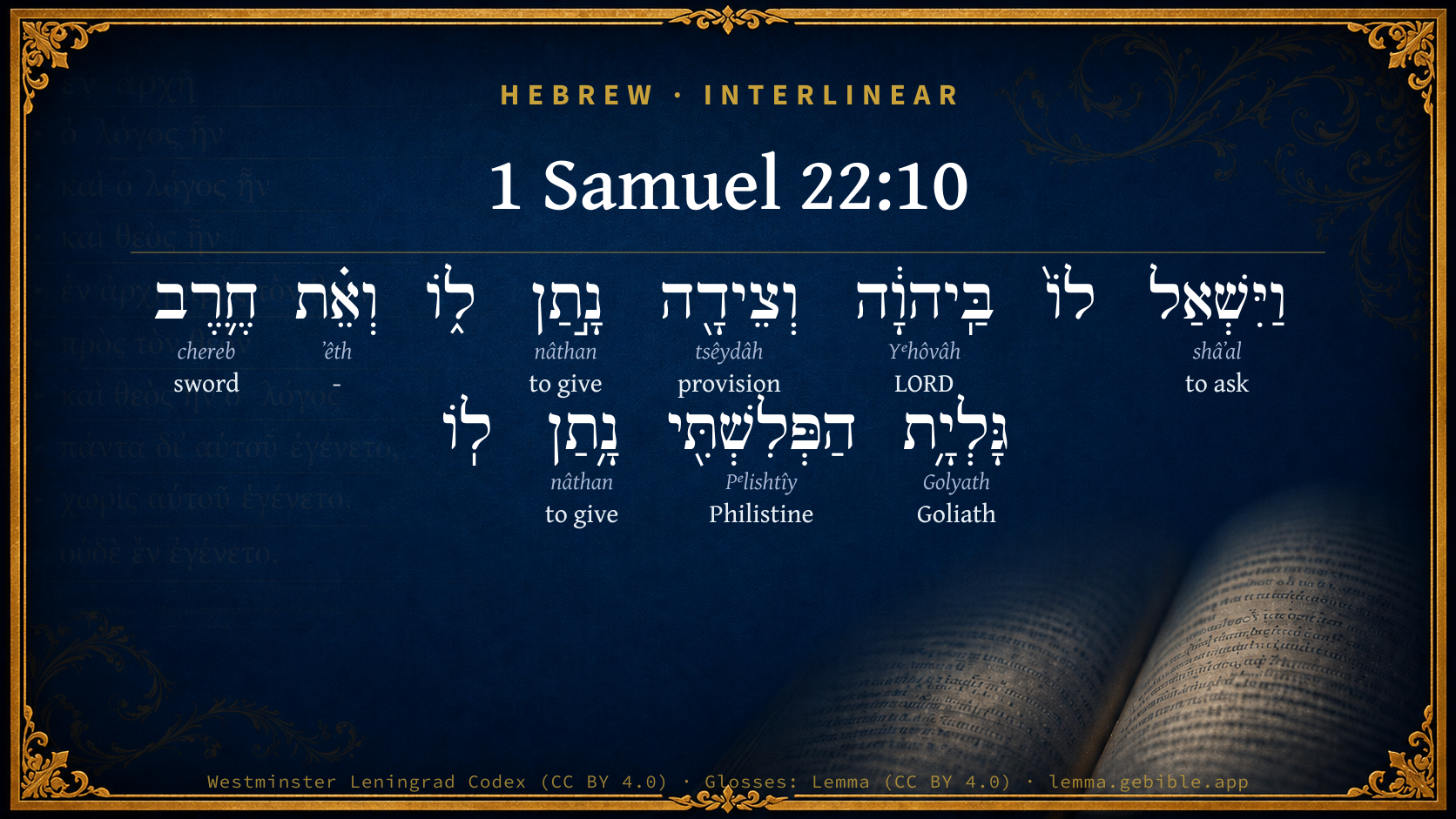
Hebrew (Westminster Leningrad Codex) 1 Samuel 22:10 appears in the Hebrew Old Testament. The text above is from the Westminster Leningrad Codex. Each word links to its Strong’s number, a concise gloss, and parsing drawn from the Open Scriptures Hebrew Bible morphology. Click any word for its full Brown-Driver-Briggs (BDB) entry.
Download image
Cite this verse

1 Samuel 22:10 (World English Bible). Public Domain. Lemma interlinear Bible study tool, https://lemma.gebible.app/v/1-samuel/22/10.

Show BibTeX & RIS
BibTeX
RIS
English Translation
He inquired of Yahweh for him, and gave him food, and gave him the sword of Goliath the Philistine.
World English Bible · Public Domain
Download a study sheet

One document with this verse’s original text, its word-by-word gloss line, the meaning frame, cross-references with their text, attributed commentary, and full source and license credits — printable, and it pastes into notes with its structure intact.

This verse Autodidact and up

Study sheet (.html) Plain text (.txt)

A passage Seminary Student

Up to 50 verses in one chapter. A passage sheet keeps up to 6 commentary sources and 12 cross-references per verse, in the order this page ranks them, and says so on the sheet whenever that leaves anything out. Ask for a single verse and you get the Autodidact verse sheet above.

Everything on this page stays free to read, with no account — the sheet is a download of what is already on screen, not access to it.

Want to remove ads? Support Godless Engineer
Compare translations 3

The same verse in 3 English versions, stacked beneath the original-language interlinear above. Click any original word for its lexicon entry.

Each is an independent rendering of the whole verse — the interlinear is not word-aligned to these translations.

Highlighted words mark where these versions differ — a whole-verse word diff, not a word-by-word alignment.

  • World English Bible Public Domain
    He inquired of Yahweh for him, and gave him food, and gave him the sword of Goliath the Philistine.
  • King James Version Public Domain
    And he inquired of the LORD for him, and gave him victuals, and gave him the sword of Goliath the Philistine.
  • unfoldingWord Literal Text CC BY-SA 4.0
    And he inquired of Yahweh for him, and he gave provisions to him. And he gave to him the sword of Goliath the Philistine.”

unfoldingWord Literal Text — © unfoldingWord, licensed CC BY-SA 4.0. Word-aligned USFM3 via Door43 (git.door43.org/unfoldingWord/en_ult).

Versions to compare (up to 4)

3 of 4 selected

Show all 18 translations

Every available English version of this verse, each an independent rendering of the whole verse.

  • World English Bible Public Domain
    He inquired of Yahweh for him, and gave him food, and gave him the sword of Goliath the Philistine.
  • Berean Standard Bible Public Domain
    Ahimelech inquired of the LORD for him and gave him provisions. He also gave him the sword of Goliath the Philistine.”
  • Majority Standard Bible Public Domain
    Ahimelech inquired of the LORD for him and gave him provisions. He also gave him the sword of Goliath the Philistine.”
  • King James Version Public Domain
    And he inquired of the LORD for him, and gave him victuals, and gave him the sword of Goliath the Philistine.
  • American Standard Version (1901) Public Domain
    And he inquired of Jehovah for him, and gave him victuals, and gave him the sword of Goliath the Philistine.
  • Revised Version (1885) Public Domain
    And he inquired of the LORD for him, and gave him victuals, and gave him the sword of Goliath the Philistine.
  • Geneva Bible (1599) Public Domain
    Who asked counsell of the Lord for him and gaue him vitailes, and he gaue him also the sword of Goliath the Philistim.
  • Douay-Rheims (1899) Public Domain
    And he consulted the Lord for him, and gave him victuals, and gave him the sword of Goliath the Philistine.
  • Young's Literal Translation Public Domain
    and he asketh for him at Jehovah, and provision hath given to him, and the sword of Goliath the Philistine hath given to him.
  • Literal Standard Version CC BY-SA 4.0
    and he inquires of YHWH for him, and has given provision to him, and has given the sword of Goliath the Philistine to him.”
  • Unlocked Literal Bible CC BY-SA 4.0
    He prayed to Yahweh that he might help him, and he gave him provisions and the sword of Goliath the Philistine.”
  • unfoldingWord Literal Text CC BY-SA 4.0
    And he inquired of Yahweh for him, and he gave provisions to him. And he gave to him the sword of Goliath the Philistine.”
  • Darby Bible Public Domain
    And he inquired of Jehovah for him, and gave him victuals, and gave him the sword of Goliath the Philistine.
  • World Messianic Bible Public Domain
    He inquired of the LORD for him, gave him food, and gave him the sword of Goliath the Philistine.”
  • Webster's Bible Public Domain
    And he inquired of the LORD for him, and gave him victuals, and gave him the sword of Goliath the Philistine.
  • Free Bible Version CC BY-SA 4.0
    Ahimelech asked advice from the Lord for him and gave him food. He gave him the sword of Goliath the Philistine as well.”
  • Bible in Basic English Public Domain
    And he got directions from the Lord for him, and gave him food, and put in his hand the sword of Goliath the Philistine.
  • JPS Tanakh (1917) Public Domain
    And he inquired of the LORD for him, and gave him victuals, and gave him the sword of Goliath the Philistine.'

Literal Standard Version (2020), Covenant Press — licensed CC BY-SA 4.0. Text via the HelloAO Bible API (eBible.org). Unlocked Literal Bible (unfoldingWord) — licensed CC BY-SA 4.0. Text via the HelloAO Bible API (eBible.org). unfoldingWord Literal Text — © unfoldingWord, licensed CC BY-SA 4.0. Word-aligned USFM3 via Door43 (git.door43.org/unfoldingWord/en_ult). Free Bible Version, Dr. Jonathan Gallagher — licensed CC BY-SA 4.0. Text via the HelloAO Bible API (eBible.org).

Word by word

More ways to search: Search by grammar → Find every occurrence → Compare this word →

Practice this passage: Drill this verse → Learn its vocabulary →

גָּלְיָ֥ת
Golyath
H1555
“Goliath”
Noun, Proper
Part of Speech
Noun
Type
Proper
Full BDB Definition

Origin: perhaps from H1540

TWOT: None

Goliath = "splendour" - the Philistine giant of Gath slain by David's sling
  1. וַיִּשְׁאַל shâʼal H7592 “and · to ask” Conjunction + Verb, Qal, Sequential Imperfect, 3rd Person, Masculine, Singular
  2. בַּֽיהוָ֔ה Yᵉhôvâh H3068 “in/at · LORD” Preposition + Noun, Proper
  3. וְצֵידָ֖ה tsêydâh H6720 “and · provision” Conjunction + Noun, Common, Both, Singular, Absolute
  4. נָ֣תַן nâthan H5414 “to give” Verb, Qal, Perfect, 3rd Person, Masculine, Singular
  5. וְאֵ֗ת ʼêth H853 “and · -” Conjunction + Particle, Direct Object
  6. חֶ֛רֶב chereb H2719 “sword of” Noun, Common, Feminine, Singular, Construct
  7. הַפְּלִשְׁתִּ֖י Pᵉlishtîy H6430 “the · Philistine” Particle, Definite Article + Noun, Gentilic, Masculine, Singular, Absolute
  8. נָ֥תַן nâthan H5414 “to give” Verb, Qal, Perfect, 3rd Person, Masculine, Singular

About this verse

These counts appear in no published source. They are computed here, from the morphology-tagged text and Lemma’s own curated glosses. What Lemma adds →

12
words
8
distinct lemmas
Historical
section

Notable vocabulary

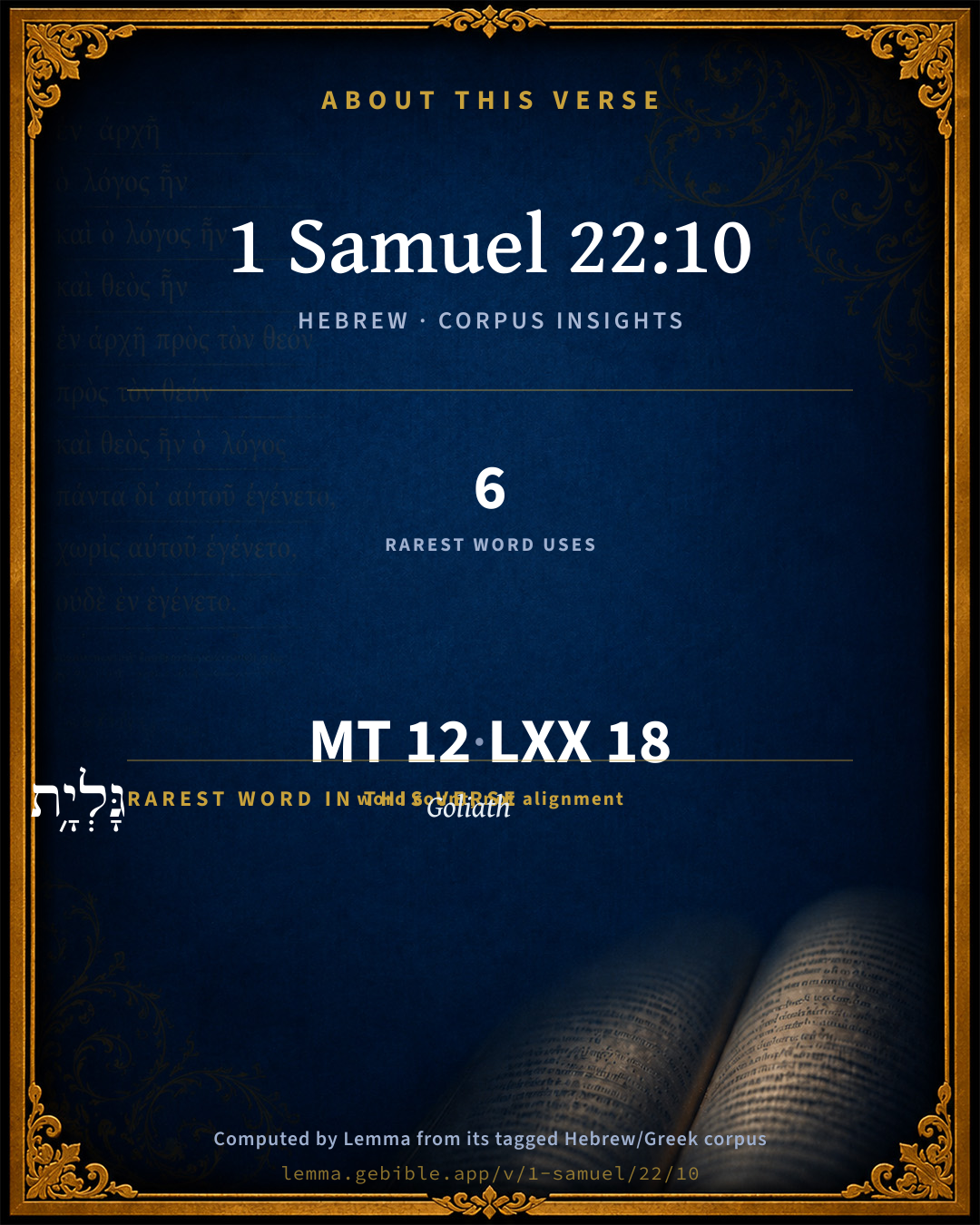
The rarest word here is גָּלְיָ֥ת Goliath H1555 — appearing just 6 times in the whole Hebrew Bible.

Shared distinctive vocabulary

גָּלְיָ֥ת Goliath H1555 occurs in 6 verses of the Hebrew Bible. Also found in:

Grammatical profile

  • 3 verbs
  • 5 nouns
  • 3 prepositions
  • 1 particle

Verb forms

  • וַיִּשְׁאַל Qal · Sequential Imperfect
  • נָ֣תַן Qal · Perfect
  • נָ֥תַן Qal · Perfect

Repetition

A word recurs within this verse — often emphatic in Hebrew:

  • נָ֣תַן to give H5414 ×2

Hebrew & Septuagint length

In English translation the verse runs 19 words from the Hebrew and 21 from the Septuagint (LXX English) — closely comparable.

A rough comparison of the two English renderings, which tokenize alike — not a word-level alignment.

Word counts can differ between the Hebrew and the Greek without any difference in meaning — e.g. the Hebrew direct-object marker אֵת has no separate Greek word, and Greek often adds the article ὁ.

In the original languages it is 12 Hebrew tokens and 18 Greek tokens — but the two are counted differently (Hebrew bundles its prefixes and suffixes into one token; the Greek is in lemma form), so that isn’t a like-for-like length.

Cross-references

9

Topical passages linked to 1 Samuel 22:10 in the Treasury of Scripture Knowledge — connected by theme and wording, ordered by reader-vote popularity; previews shown in the World English Bible.

  • Numbers 27:21 He shall stand before Eleazar the priest, who shall inquire for him by the judgment of the Urim before Yahweh: at his word shall they go out, and at his word they shall come in, both he, and all the children of Israel with him, even all the congregation.
  • 1 Samuel 23:2 Therefore David inquired of Yahweh, saying, Shall I go and strike these Philistines? Yahweh said to David, Go, and strike the Philistines, and save Keilah.
  • 1 Samuel 23:4 Then David inquired of Yahweh yet again. Yahweh answered him, and said, Arise, go down to Keilah; for I will deliver the Philistines into your hand.
  • 1 Samuel 30:8 David inquired of Yahweh, saying, If I pursue after this troop, shall I overtake them? He answered him, Pursue; for you shall surely overtake [them], and shall without fail recover [all].
  • 1 Samuel 10:22 Therefore they asked of Yahweh further, Is there yet a man to come here? Yahweh answered, Behold, he has hid himself among the baggage.
  • 1 Samuel 21:6–9 So the priest gave him holy [bread]; for there was no bread there but the show bread, that was taken from before Yahweh, to put hot bread in the day when it was taken away.
  • 1 Samuel 22:13 Saul said to him, Why have you conspired against me, you and the son of Jesse, in that you have given him bread, and a sword, and have inquired of God for him, that he should rise against me, to lie in wait, as at this day?
  • 1 Samuel 22:15 Have I today begun to inquire of God for him? be it far from me: don't let the king impute anything to his servant, nor to all the house of my father; for your servant knows nothing of all this, less or more.
  • 1 Samuel 23:12 Then said David, Will the men of Keilah deliver up to me and my men into the hand of Saul? Yahweh said, They will deliver you up.

Cross-references courtesy of OpenBible.info (CC BY 4.0).

Hebrew and Greek witnesses Masoretic Hebrew ↔ Greek Septuagint

The same verse in the two great witnesses to the Old Testament, shown verse-for-verse.

These are two independent witnesses, not word-aligned to each other, and the Septuagint is shown in lemma (dictionary) form.

Hebrew 1 Samuel 22:10 Masoretic · Westminster Leningrad Codex

וַיִּשְׁאַל לוֹ֙ בַּֽיהוָ֔ה וְצֵידָ֖ה נָ֣תַן ל֑וֹ וְאֵ֗ת חֶ֛רֶב גָּלְיָ֥ת הַפְּלִשְׁתִּ֖י נָ֥תַן לֽוֹ

He inquired of Yahweh for him, and gave him food, and gave him the sword of Goliath the Philistine.

World English Bible · Public Domain

Greek LXX 1 Samuel 22:10 Septuagint · lemma form

καί ἐρωτάω αὐτός διά ὁ θεός καί ἐπισιτισμός δίδωμι αὐτός καί ὁ ῥομφαία γολιαδ ὁ ἀλλόφυλος δίδωμι αὐτός

And the priest enquired of God for him, and gave him provision, and gave him the sword of Goliath the Philistine.

LXX2012 (modern English Septuagint) · Public Domain

Hebrew: Westminster Leningrad Codex (CC BY 4.0). Greek: Septuagint (public domain); English from LXX2012 (modern English Septuagint) (Public Domain). How the Septuagint differs from the Hebrew →

Targum (Aramaic paraphrase)

1

The Targum is the ancient Jewish Aramaic paraphrase of the Hebrew Scriptures — an interpretive translation, not the Hebrew text itself. Onkelos (literal) and Pseudo-Jonathan (expansive) render the Torah, and Jonathan the Prophets. Coverage is partial: where no permissively-licensed English translation exists for a verse, only the Aramaic is shown. This is verse-level text, not a word-by-word alignment to the Hebrew.

  1. Targum Jonathan Prophets (Joshua–Malachi)
    וְשָׁאִיל לֵיהּ בְּמֵימְרָא דַייָ וּזְוָדִין יְהַב לֵיהּ וְיַת חַרְבָּא דְגָלְיַת פְּלִשְׁתָּאָה יְהַב לֵיהּ:

    (no public-domain English translation for this verse)

    Targum Jonathan — Aramaic: “Mikraot Gedolot” (public domain). English: “Sefaria Community Translation” (CC0 1.0 (public-domain dedication)); “London "Chaldee Paraphrase," 1871” (public domain). Text via Sefaria.

Commentary

Notes on 1 Samuel 22:10 from classic Christian and Jewish commentators (each source and its license shown beneath its notes). The classic Christian expositions comment on the surrounding passage and are grouped to its opening verse, so a note may address several verses; the Jewish commentaries on the Tanakh (Rashi and others) are per-verse, so they appear only where the commentator wrote on this verse.

Lemma curates 59 commentaries, every one of them public domain or Creative Commons licensed, each selected and text-cleaned for this edition rather than reprinted as found. About our sources →

Trapp's Complete Commentary

John Trapp

1Sa 22:10 And he enquired of the LORD for him, and gave him victuals, and gave him the sword of Goliath the Philistine.

Ver. 10. And he inquired of the Lord for him.] Herein, saith Lyra, some think he lied; and indeed he did, though he did not in 1Sa 22:15. {See Trapp on "1Sa 22:9"} The truth is, God owed a revenge to the house of Eli, and now, by the delation of Doeg, taketh occasion to pay it. But they are very slight arguments that are here brought against the high priest to prove him guilty of treason; not much unlike those brought against the Lady Elizabeth in her sister Queen Mary’s days.

John Trapp, A Commentary or Exposition upon All the Books of the Old and New Testament (1647–1656) — public domain. Text from a community e-Sword module.

Joseph Benson's Commentary

1Sa 22:10. He inquired of the Lord for him — Some think Doeg slandered Ahimelech in this, because we read nothing of it in the foregoing chapter; and David in the Psalms speaks of his false tongue. But whether or not, he was guilty of great wickedness in concealing part of the truth, which in this case he ought to have declared, for Ahimelech’s just defence; namely, the artifice whereby David had deceived him, making him believe that he was going on the king’s business; so that the service which Ahimelech did to David was designed in honour of Saul. And gave him victuals, &c. — Very innocently, as Doeg very well knew. But he represented these as acts whereby Ahimelech had aided and abetted David in a conspiracy; which are the lies that David lays to his charge, nothing being further from the truth.

Joseph Benson's Commentary on the Old and New Testaments (1811–1818) — public domain. Text from a community e-Sword module.

Jamieson, Fausset & Brown

Robert Jamieson, A. R. Fausset & David Brown

he inquired of the Lord for him--Some suppose that this was a malicious fiction of Doeg to curry favor with the king, but Ahimelech seems to acknowledge the fact. The poor simple-minded high priest knew nothing of the existing family feud between Saul and David. The informer, if he knew it, said nothing of the cunning artifice by which David obtained the aid of Ahimelech. The facts looked against him, and the whole priesthood along with him were declared abettors of conspiracy [Sa1 22:16-17].

Jamieson, Fausset & Brown — Commentary Critical and Explanatory on the Whole Bible (1871) — public domain (CC PDM 1.0). Text via the HelloAO Bible API.

Adam Clarke's Commentary

Verse 10. And he inquired of the Lord for him] This circumstance is not related in history; but it is probably true, as David would most naturally wish to know where to direct his steps in this very important crisis.

Adam Clarke's Commentary on the Bible (1810–1826) — public domain. Text from a community e-Sword/MySword module.

Ellicott's Commentary for English Readers

(10) And he enquired of the Lord for him.—This is, however, by no means certain (see below); nothing was said about the Urim and Thummim being brought out and questioned by the high priest on the occasion of David’s visit. It is possible that Doeg was misled here by the fact of the high priest’s going into the sanctuary, where the ephod was, to fetch the sword of Goliath for David. This famous sword was laid up, we know, behind the ephod.

A Bible Commentary for English Readers, edited by Charles John Ellicott (1878–1897) — public domain. Text from a community e-Sword module.

The Cambridge Bible for Schools and Colleges

gen. ed. J. J. S. Perowne

10. he inquired of the Lord for him] See on 1Sa_10:23. This, though not expressly mentioned in ch. 21, was probably the chief object of David’s visit, and Ahimelech does not disclaim the charge (1Sa_22:15).

The Cambridge Bible for Schools and Colleges (gen. ed. J. J. S. Perowne; Cambridge University Press, 1878–1918) — public domain. Text from a community e-Sword module.

John Gill's Exposition

And he inquired of the Lord for him,.... Which not being expressed before, some have taken it to be a lie of Doeg's, he being charged with lying by David, Psa 52:3; but it is not at all improbable that David should desire him to inquire of the Lord for him, and that he did; and he seems to acknowledge it, Sa1 22:15; but according to the Jewish writers Doeg meant by this to prove a charge of treason both against David and Ahimelech; that the former made himself king, and the latter owned him to be so, since inquiry by Urim and Thummim was not made for a private person, but for a king (e):

and gave him victuals; hallowed bread, loaves of shewbread, which none but priests might eat of; such was his kindness to him:

and gave him the sword of Goliath the Philistine; which David took from him, and slew him with it. All this was true, but then he acted the deceitful part, with which he is charged in the above psalms, in not declaring how David had imposed upon the priest, by pretending he was sent in haste on the king's business; which was the reason he was so ill provided with servants, food, and armour; which if Doeg had reported faithfully, as he ought to have done, would have saved the credit and life of the priest, and of his family.

(e) Misn. Yoma, c. 7. sect. 5.

John Gill's Exposition of the Whole Bible (1746–1763) — public domain (CC PDM 1.0). Text via the HelloAO Bible API.

Albert Barnes' Notes on the Bible

He inquired of the Lord ... - This was not true, but Ahimelech’s going to fetch the sword from behind the ephod might have given occasion to the belief on Doeg’s part that he had put on the ephod to inquire of the Lord for David.

Albert Barnes' Notes on the Bible (1834–1885) — public domain. Text from a community e-Sword/MySword module.

Haydock's Catholic Bible Commentary

Consulted. Some think this was a falsehood, as it is not mentioned before. (Hugo) --- but Achimelech does not deny the fact, ver. 15. (Calmet)

George Leo Haydock (1774–1849), Haydock's Catholic Family Bible and Commentary, 1859 edition — public domain. Excludes Psalms (Douay-Rheims chapter numbering differs from Protestant) and Deuterocanonical books (Catholic canon only).

Matthew Poole's English Annotations

He inquired of the Lord for him: this is not recorded 1Sa 21, and therefore some think that Doeg, to curry favour with Saul, feigned this; for it is certain David chargeth him with the sin of lying, Psa 52:3, though it is not improbable that he told other lies also, not here expressed; and withal, he was guilty of concealing part of the truth, which in this case he was also obliged to declare for Ahimelech’s just defence, to wit, the cunning pretence and artifice whereby David circumvented Ahimelech. Others think this was true, because Ahimelech seems to confess it, 1Sa 22:15, though that may be spoken by way of concession. If it were so as Doeg declares, this was no new thing. Then he might add that it was not so, though this be not here mentioned; for it is evident that all his answer or apology is not here expressed; for here is not a word of the victuals or sword which he gave him.

Matthew Poole's English Annotations on the Holy Bible (1683–1685) — public domain. Text from a community e-Sword/MySword module.

Whedon's Commentary on the Bible

Daniel D. Whedon

10. He inquired of the Lord for him — We have no account of this in the narrative of David’s interview with Ahimelech, (1Sa_21:1-9;) and Doeg’s statement was probably only the bold utterance of his own suspicions; but the priest’s words in 1Sa_22:15 imply that he was in the habit of inquiring of the Lord for David. This was not the first time that he sought by urim to obtain Divine counsel for this most faithful of all the royal servants.

Daniel D. Whedon (gen. ed.), Commentary on the Old and New Testaments (1874–1909) — public domain. Text from a community e-Sword module.

John Wesley's Explanatory Notes

He inquired - David chargeth him with the sin of lying, Psalm lii, 3, and it is not improbable, that he told many lies not here expressed; and withal, he was guilty of concealing part of the truth, which in this case he was obliged to declare for Ahimelech's just defense, namely, the artifice whereby David circumvented Ahimelech: making him believe, that he was then going upon the king's business, so that the service he did to David, was designed in honour to Saul.

John Wesley, Explanatory Notes Upon the Whole Bible (1754–1765) — public domain. Text via the GEBible commentary corpus.

Lesson kit

Teaching starters — assembled from the data on this page, not authored interpretation. Every prompt links to the verse data it draws on. Edit before teaching.

1 Samuel, in the Historical, opens this verse with 12 words (8 distinct Hebrew lemmas). Its most distinctive word is Golyath (“Goliath”). A historical commentator’s framing appears above. Read the whole chapter for the surrounding context.

Discussion questions

  1. How does “Goliath” (Golyath) shape what this verse is saying?
  2. How does 1 Samuel 17:4, which shares the word «Goliath», read alongside this verse?
  3. What does the repetition of “to give” (2× in this one verse) do in this verse?
  4. These translations render this verse differently. What is at stake in choosing one wording over another?
  5. «וַיִּשְׁאַל» is a Qal Sequential Imperfect verb. How does that grammatical form shape the action described?
  6. Compare how Trapp's Complete Commentary and Joseph Benson's Commentary read this verse. Where do they agree or differ?

Things to notice

Reading settings

Reading text

Shown beneath each verse's original-language words.

Old Testament
Old Testament edition

Read the OT as the Masoretic Hebrew (MT) or the Greek Septuagint (LXX).

English shown for the Greek Septuagint (in the Hebrew ↔ Greek comparison).

Comparing translations? Open the Compare panel on any verse page to stack up to four side by side.