
Job 27:14

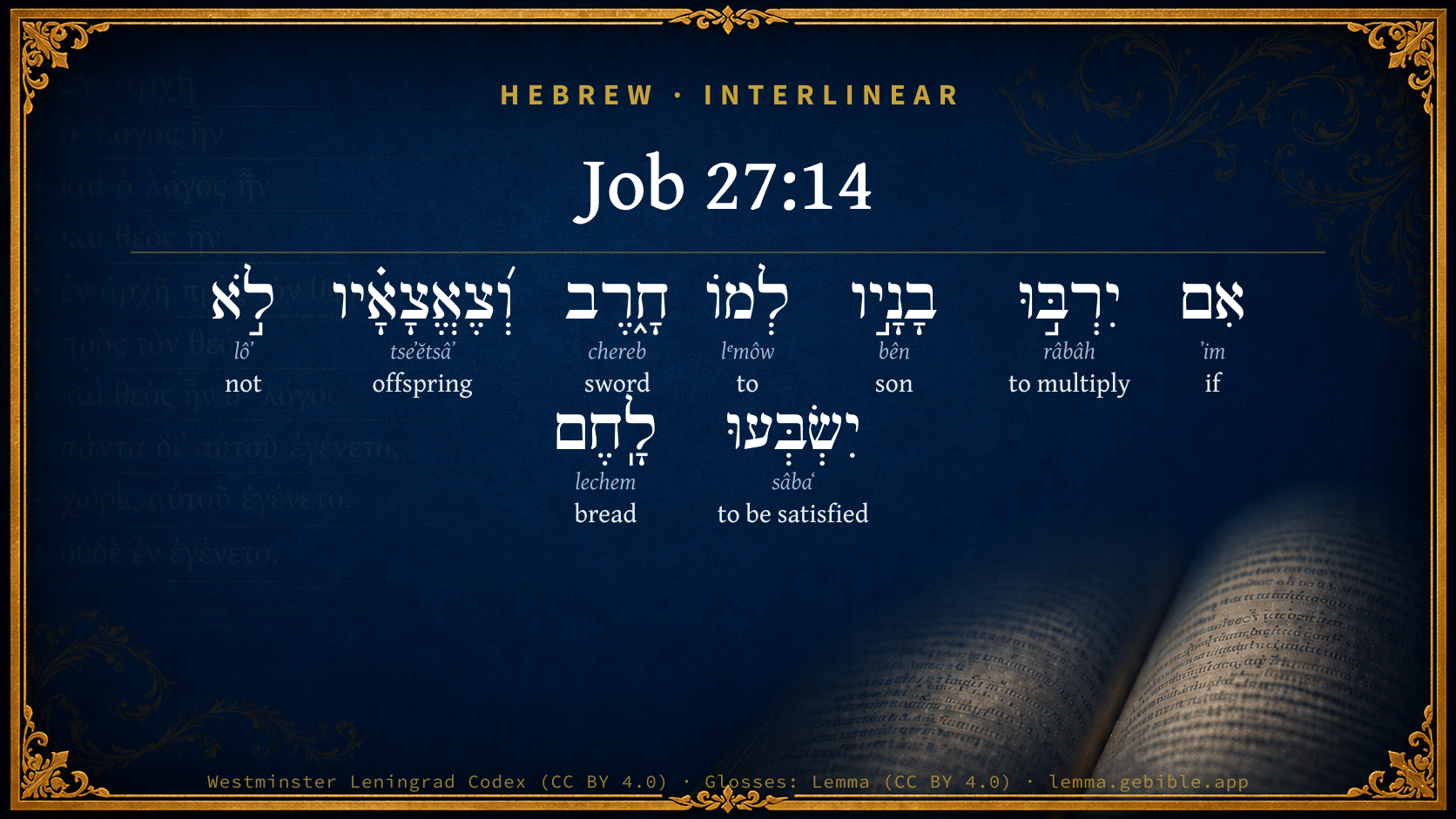
Hebrew (Westminster Leningrad Codex) Job 27:14 appears in the Hebrew Old Testament. The text above is from the Westminster Leningrad Codex. Each word links to its Strong’s number, a concise gloss, and parsing drawn from the Open Scriptures Hebrew Bible morphology. Click any word for its full Brown-Driver-Briggs (BDB) entry.
Download image
Cite this verse

Job 27:14 (World English Bible). Public Domain. Lemma interlinear Bible study tool, https://lemma.gebible.app/v/job/27/14.

Show BibTeX & RIS
BibTeX
RIS
English Translation
If his children are multiplied, it is for the sword. His offspring shall not be satisfied with bread.
World English Bible · Public Domain
Highlights
  • 1 first appearance in the Hebrew Bible
Full analysis ↓
Download a study sheet

One document with this verse’s original text, its word-by-word gloss line, the meaning frame, cross-references with their text, attributed commentary, and full source and license credits — printable, and it pastes into notes with its structure intact.

This verse Autodidact and up

Study sheet (.html) Plain text (.txt)

A passage Seminary Student

Up to 50 verses in one chapter. A passage sheet keeps up to 6 commentary sources and 12 cross-references per verse, in the order this page ranks them, and says so on the sheet whenever that leaves anything out. Ask for a single verse and you get the Autodidact verse sheet above.

Everything on this page stays free to read, with no account — the sheet is a download of what is already on screen, not access to it.

Want to remove ads? Support Godless Engineer
Compare translations 3

The same verse in 3 English versions, stacked beneath the original-language interlinear above. Click any original word for its lexicon entry.

Each is an independent rendering of the whole verse — the interlinear is not word-aligned to these translations.

Highlighted words mark where these versions differ — a whole-verse word diff, not a word-by-word alignment.

  • World English Bible Public Domain
    If his children are multiplied, it is for the sword. His offspring shall not be satisfied with bread.
  • King James Version Public Domain
    If his children be multiplied, it is for the sword: and his offspring shall not be satisfied with bread.
  • unfoldingWord Literal Text CC BY-SA 4.0
    If his children multiply, for the sword, and his offspring will not have enough bread.

unfoldingWord Literal Text — © unfoldingWord, licensed CC BY-SA 4.0. Word-aligned USFM3 via Door43 (git.door43.org/unfoldingWord/en_ult).

Versions to compare (up to 4)

3 of 4 selected

Show all 18 translations

Every available English version of this verse, each an independent rendering of the whole verse.

  • World English Bible Public Domain
    If his children are multiplied, it is for the sword. His offspring shall not be satisfied with bread.
  • Berean Standard Bible Public Domain
    Though his sons are many, they are destined for the sword; and his offspring will never have enough food.
  • Majority Standard Bible Public Domain
    Though his sons are many, they are destined for the sword; and his offspring will never have enough food.
  • King James Version Public Domain
    If his children be multiplied, it is for the sword: and his offspring shall not be satisfied with bread.
  • American Standard Version (1901) Public Domain
    If his children be multiplied, it is for the sword; And his offspring shall not be satisfied with bread.
  • Revised Version (1885) Public Domain
    If his children be multiplied, it is for the sword; and his offspring shall not be satisfied with bread.
  • Geneva Bible (1599) Public Domain
    If his children be in great nomber, the sworde shall destroy them, and his posteritie shall not be satisfied with bread.
  • Douay-Rheims (1899) Public Domain
    If his sons be multiplied, they shall be for the sword, and his grandsons shall not be filled with bread.
  • Young's Literal Translation Public Domain
    If his sons multiply -- for them `is' a sword. And his offspring `are' not satisfied `with' bread.
  • Literal Standard Version CC BY-SA 4.0
    If his sons multiply—a sword [is] for them. And his offspring [are] not satisfied [with] bread.
  • Unlocked Literal Bible CC BY-SA 4.0
    If his children multiply, it is for the sword; his offspring will never have enough food.
  • unfoldingWord Literal Text CC BY-SA 4.0
    If his children multiply, for the sword, and his offspring will not have enough bread.
  • Darby Bible Public Domain
    If his children be multiplied, it is for the sword, and his offspring shall not be satisfied with bread;
  • World Messianic Bible Public Domain
    If his children are multiplied, it is for the sword. His offspring will not be satisfied with bread.
  • Webster's Bible Public Domain
    If his children are multiplied, it is for the sword: and his offspring shall not be satisfied with bread.
  • Free Bible Version CC BY-SA 4.0
    even if they have many children, they will experience violent deaths or die of starvation.
  • Bible in Basic English Public Domain
    If his children are increased, it is for the sword; and his offspring have not enough bread.
  • JPS Tanakh (1917) Public Domain
    If his children be multiplied, it is for the sword; and his offspring shall not have bread enough.

Literal Standard Version (2020), Covenant Press — licensed CC BY-SA 4.0. Text via the HelloAO Bible API (eBible.org). Unlocked Literal Bible (unfoldingWord) — licensed CC BY-SA 4.0. Text via the HelloAO Bible API (eBible.org). unfoldingWord Literal Text — © unfoldingWord, licensed CC BY-SA 4.0. Word-aligned USFM3 via Door43 (git.door43.org/unfoldingWord/en_ult). Free Bible Version, Dr. Jonathan Gallagher — licensed CC BY-SA 4.0. Text via the HelloAO Bible API (eBible.org).

Word by word

More ways to search: Search by grammar → Find every occurrence → Compare this word →

Practice this passage: Drill this verse → Learn its vocabulary →

About this verse

These counts appear in no published source. They are computed here, from the morphology-tagged text and Lemma’s own curated glosses. What Lemma adds →

9
words
9
distinct lemmas
Wisdom
section

Notable vocabulary

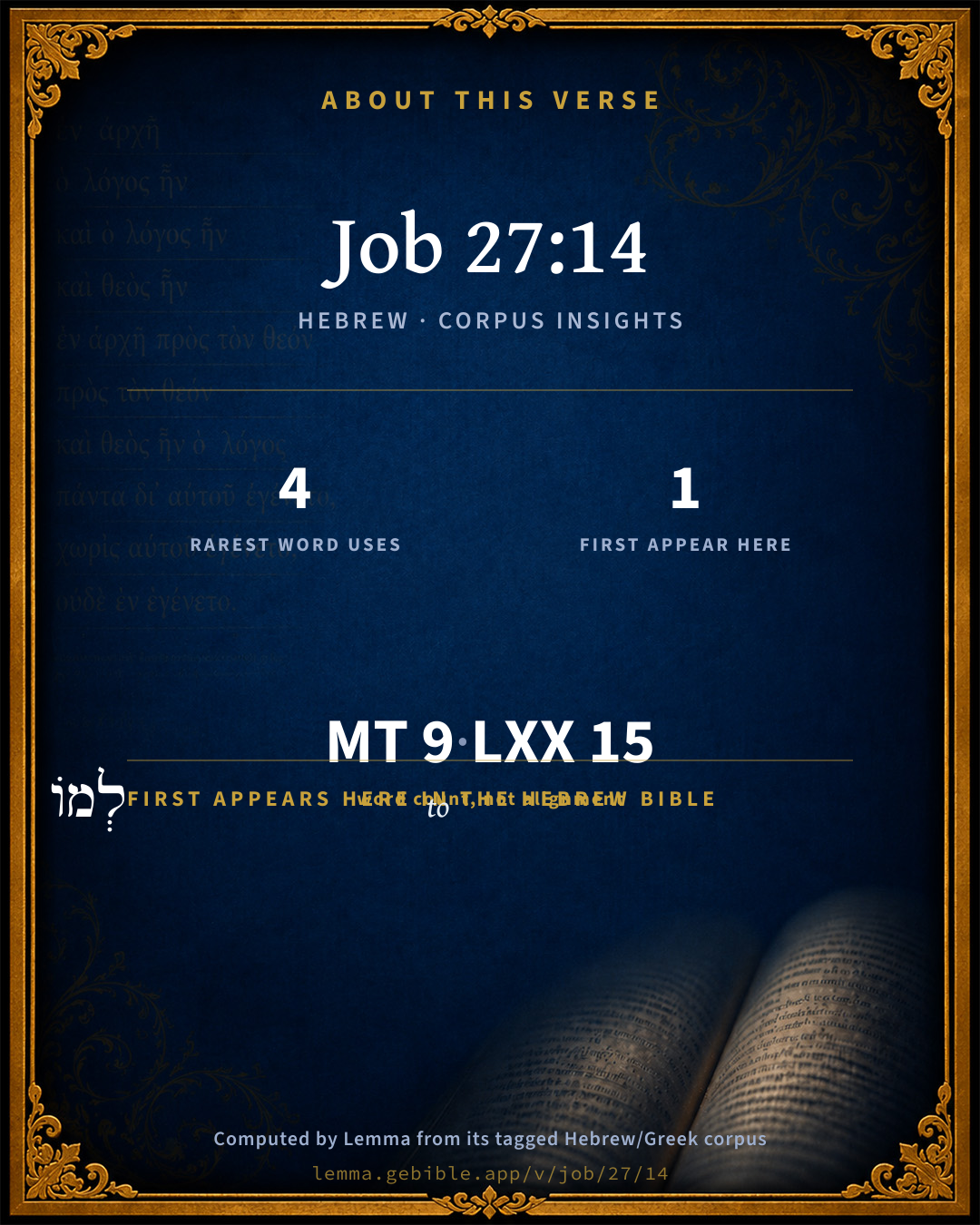
The rarest word here is לְמוֹ to H3926 — appearing just 4 times in the whole Hebrew Bible.

First appearance in Scripture

This word makes its first canonical appearance in the Hebrew Bible here:

Shared distinctive vocabulary

לְמוֹ to H3926 occurs in 4 verses of the Hebrew Bible. Also found in:

Grammatical profile

  • 2 verbs
  • 4 nouns
  • 1 preposition
  • 1 conjunction
  • 1 particle

Verb forms

  • יִרְבּ֣וּ Qal · Imperfect
  • יִשְׂבְּעוּ Qal · Imperfect

Hebrew & Septuagint length

In English translation the verse runs 18 words from the Hebrew and 19 from the Septuagint (LXX English) — closely comparable.

A rough comparison of the two English renderings, which tokenize alike — not a word-level alignment.

Word counts can differ between the Hebrew and the Greek without any difference in meaning — e.g. the Hebrew direct-object marker אֵת has no separate Greek word, and Greek often adds the article ὁ.

In the original languages it is 9 Hebrew tokens and 15 Greek tokens — but the two are counted differently (Hebrew bundles its prefixes and suffixes into one token; the Greek is in lemma form), so that isn’t a like-for-like length.

Cross-references

13

Topical passages linked to Job 27:14 in the Treasury of Scripture Knowledge — connected by theme and wording, ordered by reader-vote popularity; previews shown in the World English Bible.

  • Deuteronomy 28:41 You shall father sons and daughters, but they shall not be yours; for they shall go into captivity.
  • Job 20:10 His children shall seek the favor of the poor. His hands shall give back his wealth.
  • Luke 23:29 For behold, the days are coming in which they will say, 'Blessed are the barren, the wombs that never bore, and the breasts that never nursed.'
  • Deuteronomy 28:32 Your sons and your daughters shall be given to another people; and your eyes shall look, and fail with longing for them all the day: and there shall be nothing in the power of your hand.
  • 1 Samuel 2:5 Those who were full have hired out themselves for bread; Those who were hungry have ceased [to hunger]: Yes, the barren has borne seven; She who has many children languishes.
  • 2 Kings 9:7–8 You shall strike the house of Ahab your master, that I may avenge the blood of my servants the prophets, and the blood of all the servants of Yahweh, at the hand of Jezebel.
  • 2 Kings 10:6–10 Then he wrote a letter the second time to them, saying, If you be on my side, and if you will listen to my voice, take the heads of the men your master's sons, and come to me to Jezreel by tomorrow this time. Now the king's sons, being seventy persons, were with the great men of the city, who brought them up.
  • Esther 5:11 Haman recounted to them the glory of his riches, and the multitude of his children, and all the things in which the king had promoted him, and how he had advanced him above the princes and servants of the king.
  • Esther 9:5–10 The Jews struck all their enemies with the stroke of the sword, and with slaughter and destruction, and did what they would to those who hated them.
  • Job 15:22 He doesn't believe that he shall return out of darkness, He is waited for by the sword.
  • Job 21:11–12 They send forth their little ones like a flock. Their children dance.
  • Psalms 109:13 Let his posterity be cut off. In the generation following let their name be blotted out.
  • Hosea 9:13–14 Ephraim, like I have seen Tyre, is planted in a pleasant place; But Ephraim will bring out his children to the killer.

Cross-references courtesy of OpenBible.info (CC BY 4.0).

Hebrew and Greek witnesses Masoretic Hebrew ↔ Greek Septuagint

The same verse in the two great witnesses to the Old Testament, shown verse-for-verse.

These are two independent witnesses, not word-aligned to each other, and the Septuagint is shown in lemma (dictionary) form.

Hebrew Job 27:14 Masoretic · Westminster Leningrad Codex

אִם יִרְבּ֣וּ בָנָ֣יו לְמוֹ חָ֑רֶב וְ֝צֶאֱצָאָ֗יו לֹ֣א יִשְׂבְּעוּ לָֽחֶם

If his children are multiplied, it is for the sword. His offspring shall not be satisfied with bread.

World English Bible · Public Domain

Greek LXX Job 27:14 Septuagint · lemma form

ἐάν δέ πολύς γίγνομαι ὁ υἱός αὐτός εἰς σφαγή εἰμί ἐάν δέ καί ἀνδρόω προςαἰτέω

And if their children be many, they shall be for slaughter: and if they grow up, they shall beg.

LXX2012 (modern English Septuagint) · Public Domain

On this verse, John Gill's Exposition discusses the Septuagint’s reading. Read the note in Commentary ↓

Hebrew: Westminster Leningrad Codex (CC BY 4.0). Greek: Septuagint (public domain); English from LXX2012 (modern English Septuagint) (Public Domain). How the Septuagint differs from the Hebrew →

Commentary

Notes on Job 27:14 from classic Christian and Jewish commentators (each source and its license shown beneath its notes). The classic Christian expositions comment on the surrounding passage and are grouped to its opening verse, so a note may address several verses; the Jewish commentaries on the Tanakh (Rashi and others) are per-verse, so they appear only where the commentator wrote on this verse.

Lemma curates 59 commentaries, every one of them public domain or Creative Commons licensed, each selected and text-cleaned for this edition rather than reprinted as found. About our sources →

John Gill's Exposition

Those that remain of him,.... Of the wicked man after his death; or such that remain, and have escaped the sword and famine:

shall be buried in death: the pestilence, emphatically called death by the Hebrews, as by us the mortality, see Rev 6:8. This is another of God's sore public judgments wicked men, and is such a kind of death, by reason of the contagion of it, that a person is buried as soon as dead almost, being infectious to keep him; and so Mr. Broughton translates the words,

"his remnant shall be buried as soon as they are dead;''

or the disease of which such die being so very infectious sometimes, no one dares to bury them for fear of catching it, and so they lie unburied; which some take to be the sense of the phrase, either that they shall be hurried away to the grave, and so not be embalmed and lie in state, and have an honourable and pompous funeral, or that they shall have none at all, their death will be all the burial they shall have: or else the sense is, they shall die such a death as that death shall be their grave; and they shall have no other, as the men of the old world that were drowned in the flood, Gen 7:23; and Pharaoh and his host in the Red sea, Exo 15:4; and Korah, Dathan, and Abiram, who were swallowed up in the earth, Num 16:27; and such as are devoured by wild beasts; and if this last could be thought to be meant, we have all the four sore judgments of God in this verse and Job 27:14, sword, famine, pestilence, and evil beasts, see Eze 14:21,

and his widows shall not weep; leaving more than one behind him, polygamy being frequent in those times; or else these are his sons' wives, left widows by them, as Bar Tzemach thinks, they being the persons immediately spoken of, dying by various deaths before mentioned; but whether they be his widows, or theirs, they shall weep for neither of them; either because they themselves will be cut off with them; or their husbands dying shameful deaths, lamentation would be forbidden; or they would not be able to weep through the astonishment and stupor they should be seized with at their death; or having lived such miserable and uncomfortable lives with them, they should be so far from lamenting their death, that they should, as Jarchi interprets it, rejoice at it; the Septuagint version is,

"no one shall have mercy on their widows.''

John Gill's Exposition of the Whole Bible (1746–1763) — public domain (CC PDM 1.0). Text via the HelloAO Bible API.

Trapp's Complete Commentary

John Trapp

Job 27:14 If his children be multiplied, [it is] for the sword: and his offspring shall not be satisfied with bread.

Ver. 14. If his children be multiplied, it is for the sword] As were Ahab’s seventy sons, for instance, 2Ki 10:1, whom he had begotten after God had threatened to root out his posterity. He, therefore, as it were to cross the Almighty, gives himself so much the more strenuously to the work of generation; but this was (like Ephraim) to bring forth children to the murderer, Hos 4:13. See the like of Ahaziah and his forty-two brethren slain at the shearing house. {2Ki 10:14}

And his offspring] Heb. His issues, or egressions, his shoots or branches, his pledges: so Mercer rendereth it.

Shall not be satisfied with bread] i.e. Shall be pined and famished, which their wicked parents, by heaping and hoarding, sought to prevent, but it could not be. And this shall be a more cruel kind of death than the former, Lam 4:9. Drusus, the son of Tiberius Nero, was put to this death; so was our Richard II, at Pomfret Castle; Sanders, that traitor in Ireland; and many others.

John Trapp, A Commentary or Exposition upon All the Books of the Old and New Testament (1647–1656) — public domain. Text from a community e-Sword module.

Albert Barnes' Notes on the Bible

If his children be multiplied, it is for the sword - That is, they shall be slain in war. The first calamities which it is here said would come upon a man, relate to his family Job 27:14-18; the next are those that would come upon himself, Job 27:19-23. All the sentiments here expressed are found in the various speeches of the friends of Job, and, according to the interpretation suggested above, this is designed to represent their sentiments. They maintained that if a wicked man was blessed with a numerous family, and seemed to be prosperous, it was only that the punishment might come the more heavily upon him, for that they certainly would be cut off; see Job 18:19-20; Job 20:10.

And his offspring shall not be satisfied with bread - This sentiment was advanced by Zophar, Job 20:10; see the notes at that verse.

Albert Barnes' Notes on the Bible (1834–1885) — public domain. Text from a community e-Sword/MySword module.

Joseph Benson's Commentary

Job 27:14-15. It is for the sword — That they may be cut off by the sword, either of war or of justice: and his offspring, &c. — Shall be starved, or shall want necessaries. Those that remain of him — Who survive that sword and famine; shall be buried in death — “Shall be reduced to so great a degree of misery,” says Schultens, “that where they die, there they shall rot, and no person shall bury them: they shall have death itself, (so he renders the text,) for their sepulchre.” It is put in antithesis, or by way of contrast to the monuments of the rich. And his widows — For they had many wives; shall not weep — Because they, as well as other persons, groaned under his tyranny, and, therefore, rejoice in their deliverance from it.

Joseph Benson's Commentary on the Old and New Testaments (1811–1818) — public domain. Text from a community e-Sword module.

Whedon's Commentary on the Bible

Daniel D. Whedon

Strophe b — Having fully established his main position, that the virtuous may suffer, for instance as in his case, (2-10,) Job proceeds to give in detail the sufferings of a portion of the wicked in this present life. In admitting the sufferings of some of the wicked, he magnanimously proffers a ground of conciliation, with an implied condition that the friends should also admit the sufferings of the righteous, which they in the obstinacy of silence fail to do, Job_27:14-18.

14. His children — Calamity hangs over his home also; his children perish, too, some by war and some by famine. Job’s glowing description of a godless family in Job_21:8, he now qualifies by declaring their doom. It is painfully natural that desolate Job should first speak of the children of the wicked.

Daniel D. Whedon (gen. ed.), Commentary on the Old and New Testaments (1874–1909) — public domain. Text from a community e-Sword module.

Jamieson, Fausset & Brown

Robert Jamieson, A. R. Fausset & David Brown

His family only increases to perish by sword or famine (Jer 18:21; Job 5:20, the converse).

Jamieson, Fausset & Brown — Commentary Critical and Explanatory on the Whole Bible (1871) — public domain (CC PDM 1.0). Text via the HelloAO Bible API.

Adam Clarke's Commentary

Verse 14. If his children be multiplied] As numerous families were supposed to be a proof of the benediction of the Almighty, Job shows that this is not always the case; for the offspring of the wicked shall be partly cut off by violent deaths, and partly reduced to great poverty.

Adam Clarke's Commentary on the Bible (1810–1826) — public domain. Text from a community e-Sword/MySword module.

The Cambridge Bible for Schools and Colleges

gen. ed. J. J. S. Perowne

14. With the sentiment of this verse compare Job’s former words in regard to the wicked, “Their seed is established in their sight with them, and their offspring before their eyes. They send forth their little ones like a flock, and their children dance. They spend their days in wealth,” ch. Job_21:8 seq.

The Cambridge Bible for Schools and Colleges (gen. ed. J. J. S. Perowne; Cambridge University Press, 1878–1918) — public domain. Text from a community e-Sword module.

Haydock's Catholic Bible Commentary

CHAPTER XXVII.

Bread. Septuagint, "if they grow up to manhood, they shall beg," Psalm xxxvi 25. (Haydock)

George Leo Haydock (1774–1849), Haydock's Catholic Family Bible and Commentary, 1859 edition — public domain. Excludes Psalms (Douay-Rheims chapter numbering differs from Protestant) and Deuterocanonical books (Catholic canon only).

Matthew Poole's English Annotations

It is for the sword; that they may be cut off by the sword, either of war or of justice.

Shall not be satisfied with bread; shall be starved, or want necessaries. A figure called meiosis.

Matthew Poole's English Annotations on the Holy Bible (1683–1685) — public domain. Text from a community e-Sword/MySword module.

The Pulpit Commentary

If his children be multiplied, it is for the sword. Among the items of prosperity which Job had assigned to the wicked man in one of his previous discourses (Job_21:8, Job_21:11) was a numerous and flourishing offspring. Now he feels forced to admit that, frequently at any rate, this flourishing offspring is overtaken by calamity (Job_21:19) it falls by the sword, either in predatory warfare, to which it was bred up, or as the consequence of a blood-feud inherited from its progenitor. They who "take the sword," either in their own persons or in their posterity, "perish with the sword." And his offspring shall not be satisfied with bread. If they escape this fate, then, mostly, they fall into poverty, and suffer want, no one caring to relieve them, since they have an ill reputation, the memory of their parent"s wickedness clinging to them long after his decease.

The Pulpit Commentary (1880–1919), ed. H.D.M. Spence-Jones & Joseph S. Exell — public domain. Text from a community e-Sword module.

Rashi

Rabbi Shlomo Yitzchaki (Rashi)

If his sons increase they will increase for the sword. in death They will die amidst suffering and sicknesses, until his widows will be happy at their death and will not weep.

Rashi on the Tanakh — English translations: “The Judaica Press complete Tanach with Rashi, translated by A. J. Rosenberg” (CC BY 4.0); “Pentateuch with Rashi's commentary by M. Rosenbaum and A.M. Silbermann, 1929-1934” (public domain); “The Metsudah Tanach series, Lakewood, N.J” (CC BY 4.0); and “The Book of Joshua, Metsudah Publications, 1997” (CC BY 4.0). Text via Sefaria.

Lesson kit

Teaching starters — assembled from the data on this page, not authored interpretation. Every prompt links to the verse data it draws on. Edit before teaching.

Job, in the Wisdom, opens this verse with 9 words (9 distinct Hebrew lemmas). Its most distinctive word is lᵉmôw (“to”). A historical commentator’s framing appears above. Read the whole chapter for the surrounding context.

Discussion questions

  1. How does “to” (lᵉmôw) shape what this verse is saying?
  2. This is the first place “to” appears in Scripture (first appears here). What does its debut here establish?
  3. How does Job 29:21, which shares the word «to», read alongside this verse?
  4. These translations render this verse differently; the difference is in the English rendering, not the original. What questions does that raise?
  5. «יִרְבּ֣וּ» is a Qal Imperfect verb. How does that grammatical form shape the action described?
  6. Compare how John Gill's Exposition and Trapp's Complete Commentary read this verse. Where do they agree or differ?

Things to notice

Reading settings

Reading text

Shown beneath each verse's original-language words.

Old Testament
Old Testament edition

Read the OT as the Masoretic Hebrew (MT) or the Greek Septuagint (LXX).

English shown for the Greek Septuagint (in the Hebrew ↔ Greek comparison).

Comparing translations? Open the Compare panel on any verse page to stack up to four side by side.