
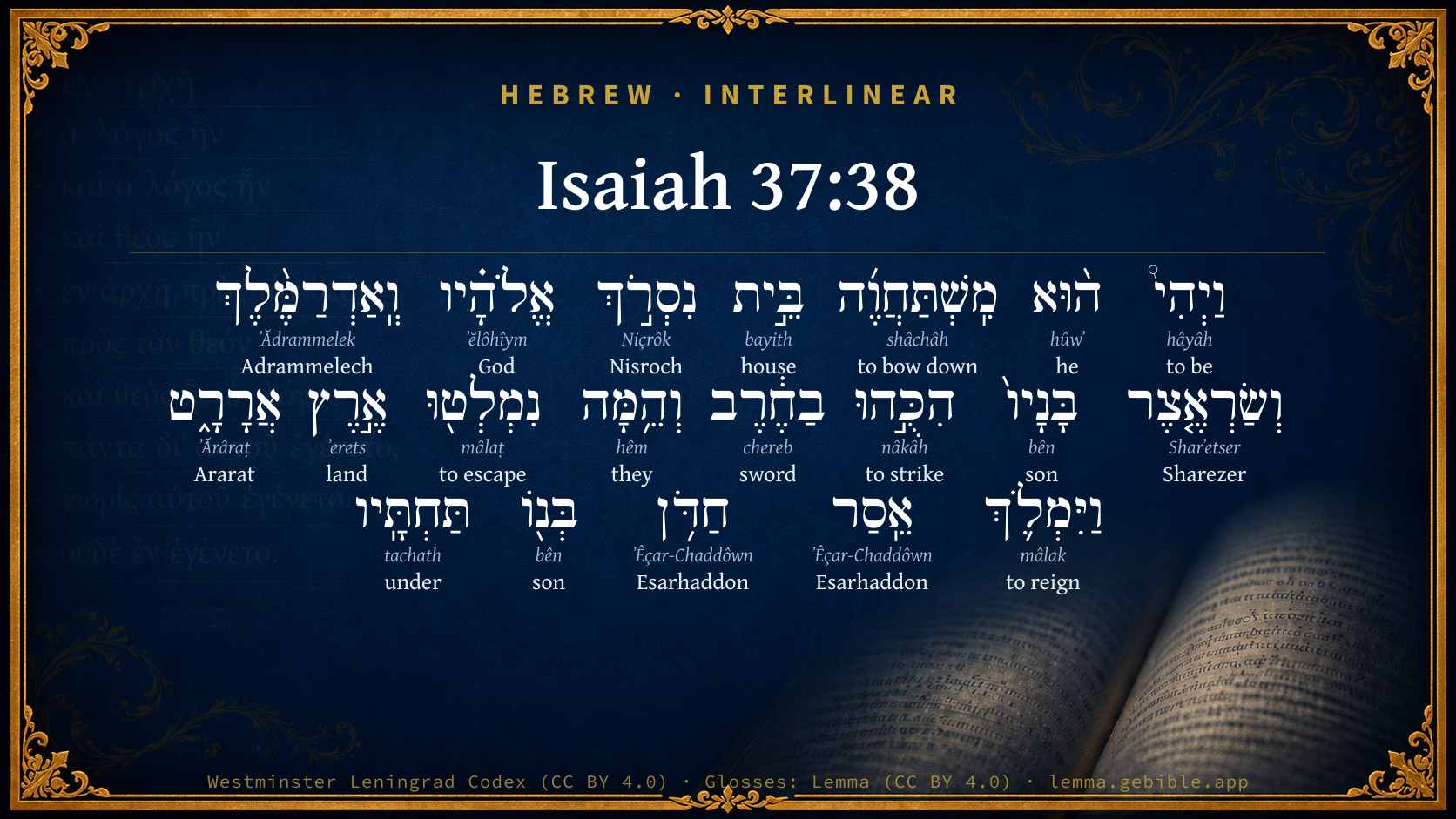
Isaiah 37:38

Hebrew (Westminster Leningrad Codex) Isaiah 37:38 appears in the Hebrew Old Testament. The text above is from the Westminster Leningrad Codex. Each word links to its Strong’s number, a concise gloss, and parsing drawn from the Open Scriptures Hebrew Bible morphology. Click any word for its full Brown-Driver-Briggs (BDB) entry.
Download image
Cite this verse

Isaiah 37:38 (World English Bible). Public Domain. Lemma interlinear Bible study tool, https://lemma.gebible.app/v/isaiah/37/38.

Show BibTeX & RIS
BibTeX
RIS
English Translation
It happened, as he was worshipping in the house of Nisroch his god, that Adrammelech and Sharezer his sons struck him with the sword; and they escaped into the land of Ararat. Esar Haddon his son reigned in his place.
World English Bible · Public Domain
Download a study sheet

One document with this verse’s original text, its word-by-word gloss line, the meaning frame, cross-references with their text, attributed commentary, and full source and license credits — printable, and it pastes into notes with its structure intact.

This verse Autodidact and up

Study sheet (.html) Plain text (.txt)

A passage Seminary Student

Up to 50 verses in one chapter. A passage sheet keeps up to 6 commentary sources and 12 cross-references per verse, in the order this page ranks them, and says so on the sheet whenever that leaves anything out. Ask for a single verse and you get the Autodidact verse sheet above.

Everything on this page stays free to read, with no account — the sheet is a download of what is already on screen, not access to it.

Want to remove ads? Support Godless Engineer
Compare translations 3

The same verse in 3 English versions, stacked beneath the original-language interlinear above. Click any original word for its lexicon entry.

Each is an independent rendering of the whole verse — the interlinear is not word-aligned to these translations.

Highlighted words mark where these versions differ — a whole-verse word diff, not a word-by-word alignment.

  • World English Bible Public Domain
    It happened, as he was worshipping in the house of Nisroch his god, that Adrammelech and Sharezer his sons struck him with the sword; and they escaped into the land of Ararat. Esar Haddon his son reigned in his place.
  • King James Version Public Domain
    And it came to pass, as he was worshipping in the house of Nisroch his god, that Adrammelech and Sharezer his sons smote him with the sword; and they escaped into the land of Armenia: and Esarhaddon his son reigned in his stead.
  • unfoldingWord Literal Text CC BY-SA 4.0
    And it happened, he was prostrating himself the house of Nisroch his god, and Adrammelech and Sharezer, his sons, struck him with the sword, and they, they escaped the land of Ararat. And Esarhaddon his son reigned in his place.

unfoldingWord Literal Text — © unfoldingWord, licensed CC BY-SA 4.0. Word-aligned USFM3 via Door43 (git.door43.org/unfoldingWord/en_ult).

Versions to compare (up to 4)

3 of 4 selected

Show all 18 translations

Every available English version of this verse, each an independent rendering of the whole verse.

  • World English Bible Public Domain
    It happened, as he was worshipping in the house of Nisroch his god, that Adrammelech and Sharezer his sons struck him with the sword; and they escaped into the land of Ararat. Esar Haddon his son reigned in his place.
  • Berean Standard Bible Public Domain
    One day, while he was worshiping in the temple of his god Nisroch, his sons Adrammelech and Sharezer put him to the sword and escaped to the land of Ararat. And his son Esar-haddon reigned in his place.
  • Majority Standard Bible Public Domain
    One day, while he was worshiping in the temple of his god Nisroch, his sons Adrammelech and Sharezer put him to the sword and escaped to the land of Ararat. And his son Esar-haddon reigned in his place.
  • King James Version Public Domain
    And it came to pass, as he was worshipping in the house of Nisroch his god, that Adrammelech and Sharezer his sons smote him with the sword; and they escaped into the land of Armenia: and Esarhaddon his son reigned in his stead.
  • American Standard Version (1901) Public Domain
    And it came to pass, as he was worshipping in the house of Nisroch his god, that Adrammelech and Sharezer his sons smote him with the sword; and they escaped into the land of Ararat. And Esar-haddon his son reigned in his stead.
  • Revised Version (1885) Public Domain
    And it came to pass, as he was worshipping in the house of Nisroch his god, that Adrammelech and Sharezer his sons smote him with the sword: and they escaped into the land of Ararat. And Esar-haddon his son reigned in his stead.
  • Geneva Bible (1599) Public Domain
    And as he was in the temple worshipping of Nisroch his god, Adramelech and Sharezer his sonnes slewe him with the sword, and they escaped into the land of Ararat: and Esarhaddon his sonne reigned in his steade.
  • Douay-Rheims (1899) Public Domain
    And it came to pass, as he was worshipping in the temple of Nesroch his god, that Adramelech and Sarasar his sons slew him with the sword: and they fled into the land of Ararat, and Asarhaddon his son reigned in his stead.
  • Young's Literal Translation Public Domain
    And it cometh to pass, he is bowing himself in the house of Nisroch his god, and Adrammelech and Sharezer his sons have smitten him with the sword, and they have escaped to the land of Ararat, and Esar-Haddon his son reigneth in his stead.
  • Literal Standard Version CC BY-SA 4.0
    And it comes to pass, he is bowing himself in the house of his god Nisroch, and his sons Adrammelech and Sharezer have struck him with the sword, and they have escaped to the land of Ararat, and his son Esar-Haddon reigns in his stead.
  • Unlocked Literal Bible CC BY-SA 4.0
    Later, as he was worshiping in the house of Nisrok his god, his sons Adrammelek and Sharezer killed him with the sword. Then they escaped into the land of Ararat. Then Esarhaddon his son reigned in his place.
  • unfoldingWord Literal Text CC BY-SA 4.0
    And it happened, he was prostrating himself the house of Nisroch his god, and Adrammelech and Sharezer, his sons, struck him with the sword, and they, they escaped the land of Ararat. And Esarhaddon his son reigned in his place.
  • Darby Bible Public Domain
    And it came to pass, as he was worshipping in the house of Nisroch his god, that Adrammelech and Sharezer his sons smote him with the sword; and they escaped into the land of Ararat. And Esarhaddon his son reigned in his stead.
  • World Messianic Bible Public Domain
    As he was worshiping in the house of Nisroch his god, Adrammelech and Sharezer his sons struck him with the sword; and they escaped into the land of Ararat. Esar Haddon his son reigned in his place.
  • Webster's Bible Public Domain
    And it came to pass, as he was worshiping in the house of Nisroch his god, that Adrammelech and Sharezer his sons smote him with the sword; and they escaped into the land of Armenia: and Esar-haddon his son reigned in his stead.
  • Free Bible Version CC BY-SA 4.0
    While he was worshiping in the temple of his god Nisroch, his sons Adrammelech and Sharezer killed him with the sword and then ran away to the land of Ararat. His son Esar-haddon succeeded him as king.
  • Bible in Basic English Public Domain
    And it came about, when he was worshipping in the house of Nisroch his god, that his sons Adrammelech and Sharezer put him to death with the sword, and they went in flight into the land of Ararat. And Esar-haddon, his son, became king in his place.
  • JPS Tanakh (1917) Public Domain
    And it came to pass, as he was worshipping in the house of Nisroch his god, that Adrammelech and Sarezer his sons smote him with the sword; and they escaped into the land of Ararat. And Esarhaddon his son reigned in his stead.

Literal Standard Version (2020), Covenant Press — licensed CC BY-SA 4.0. Text via the HelloAO Bible API (eBible.org). Unlocked Literal Bible (unfoldingWord) — licensed CC BY-SA 4.0. Text via the HelloAO Bible API (eBible.org). unfoldingWord Literal Text — © unfoldingWord, licensed CC BY-SA 4.0. Word-aligned USFM3 via Door43 (git.door43.org/unfoldingWord/en_ult). Free Bible Version, Dr. Jonathan Gallagher — licensed CC BY-SA 4.0. Text via the HelloAO Bible API (eBible.org).

Word by word

More ways to search: Search by grammar → Find every occurrence → Compare this word →

Practice this passage: Drill this verse → Learn its vocabulary →

נִסְרֹ֣ךְ
Niçrôk
H5268
“Nisroch”
Noun, Proper
Part of Speech
Noun
Type
Proper
Full BDB Definition

Origin: of foreign origin

TWOT: 1382

Nisroch = "the great eagle" - an idol of Nineveh worshipped by Sennacherib; symbolised by the eagle-headed human figure
  1. וַיְהִי֩ hâyâh H1961 “and · to be” Conjunction + Verb, Qal, Sequential Imperfect, 3rd Person, Masculine, Singular
  2. ה֨וּא hûwʼ H1931 “he” Pronoun, Personal, 3rd Person, Masculine, Singular
  3. מִֽשְׁתַּחֲוֶ֜ה shâchâh H7812 “bowing down” Verb, Hishtaphel, Participle Active, Masculine, Singular, Absolute
  4. בֵּ֣ית bayith H1004 “house of” Noun, Common, Masculine, Singular, Construct
  5. אֱלֹהָ֗יו ʼĕlôhîym H430 “God(s) · his” Noun, Common, Masculine, Plural, Construct + Suffix, Personal, 3rd Person, Masculine, Singular
  6. וְֽאַדְרַמֶּ֨לֶךְ ʼĂdrammelek H152 “and · Adrammelech” Conjunction + Noun, Proper
  7. וְשַׂרְאֶ֤צֶר Sharʼetser H8272 “and · Sharezer” Conjunction + Noun, Proper
  8. בָּנָיו֙ bên H1121 “sons · his” Noun, Common, Masculine, Plural, Construct + Suffix, Personal, 3rd Person, Masculine, Singular
  9. הִכֻּ֣הוּ nâkâh H5221 “to strike · him” Verb, Hiphil, Perfect, 3rd Person, Common, Plural + Suffix, Personal, 3rd Person, Masculine, Singular
  10. בַחֶ֔רֶב chereb H2719 “in/at the · sword” Preposition, Determined + Noun, Common, Feminine, Singular, Absolute
  11. וְהֵ֥מָּה hêm H1992 “and · they” Conjunction + Pronoun, Personal, 3rd Person, Masculine, Plural
  12. נִמְלְט֖וּ mâlaṭ H4422 “to escape” Verb, Niphal, Perfect, 3rd Person, Common, Plural
  13. אֶ֣רֶץ ʼerets H776 “land of” Noun, Common, Both, Singular, Construct
  14. אֲרָרָ֑ט ʼĂrâraṭ H780 “Ararat” Noun, Proper
  15. וַיִּמְלֹ֛ךְ mâlak H4427 “and · to reign” Conjunction + Verb, Qal, Sequential Imperfect, 3rd Person, Masculine, Singular
  16. אֵֽסַר ʼÊçar-Chaddôwn H634 “Esarhaddon” Noun, Proper
  17. חַדֹּ֥ן ʼÊçar-Chaddôwn H634 “Esarhaddon” Noun, Proper
  18. בְּנ֖וֹ bên H1121 “son · his” Noun, Common, Masculine, Singular, Construct + Suffix, Personal, 3rd Person, Masculine, Singular
  19. תַּחְתָּֽיו tachath H8478 “under · him” Preposition + Suffix, Personal, 3rd Person, Masculine, Singular

About this verse

These counts appear in no published source. They are computed here, from the morphology-tagged text and Lemma’s own curated glosses. What Lemma adds →

20
words
18
distinct lemmas
Prophets
section

Notable vocabulary

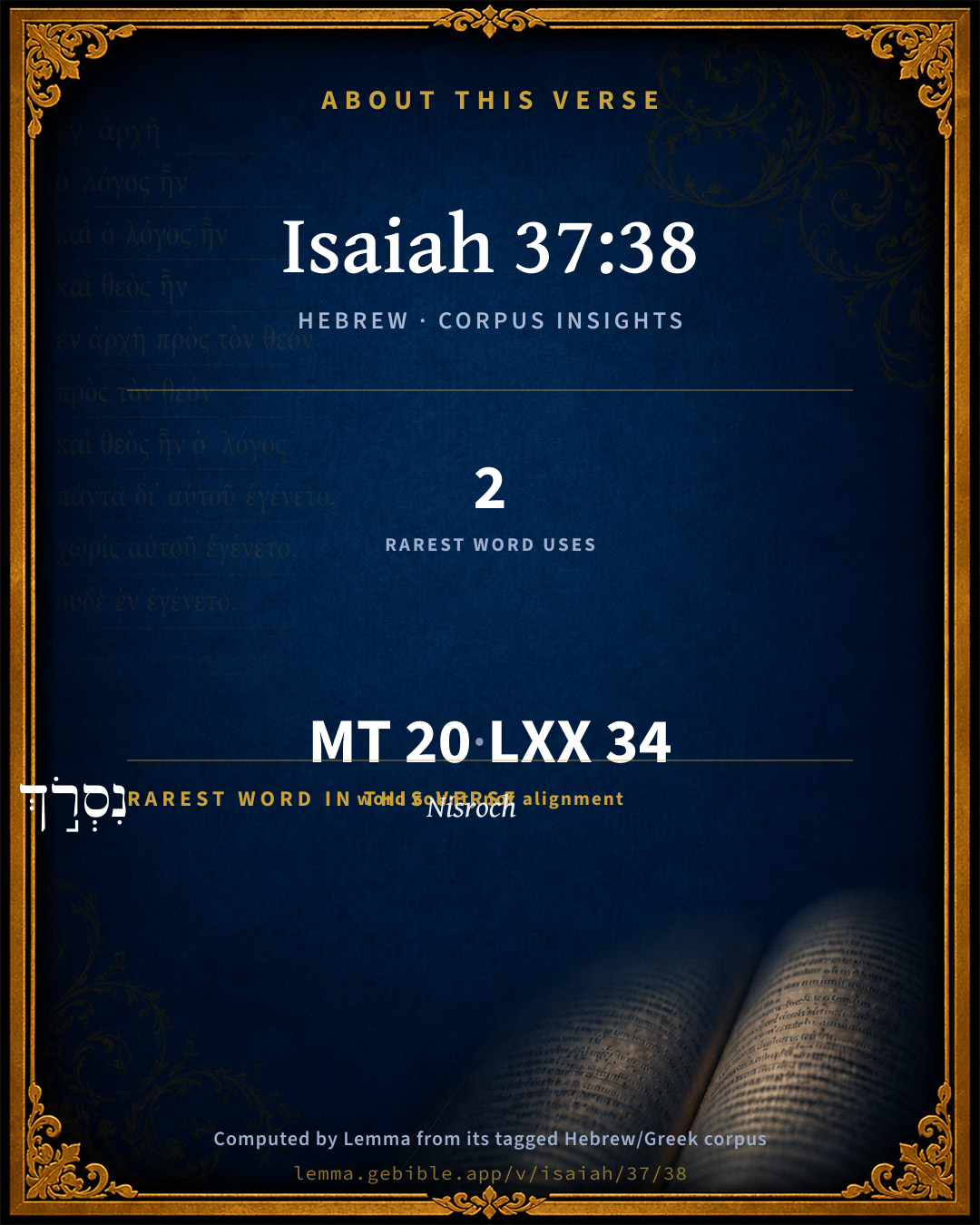
The rarest word here is נִסְרֹ֣ךְ Nisroch H5268 — appearing just 2 times in the whole Hebrew Bible.

Shared distinctive vocabulary

נִסְרֹ֣ךְ Nisroch H5268 occurs in 2 verses of the Hebrew Bible. Also found in:

Grammatical profile

  • 5 verbs
  • 12 nouns
  • 2 pronouns
  • 1 preposition

Verb forms

  • וַיְהִי֩ Qal · Sequential Imperfect
  • מִֽשְׁתַּחֲוֶ֜ה Hishtaphel · Participle Active
  • הִכֻּ֣הוּ Hiphil · Perfect
  • נִמְלְט֖וּ Niphal · Perfect
  • וַיִּמְלֹ֛ךְ Qal · Sequential Imperfect

Repetition

Words recur within this verse — often emphatic in Hebrew:

  • בָּנָיו֙ son H1121 ×2
  • אֵֽסַר Esarhaddon H634 ×2

Hebrew & Septuagint length

In English translation the verse runs 40 words from the Hebrew and 34 from the Septuagint (LXX English) — closely comparable.

A rough comparison of the two English renderings, which tokenize alike — not a word-level alignment.

Word counts can differ between the Hebrew and the Greek without any difference in meaning — e.g. the Hebrew direct-object marker אֵת has no separate Greek word, and Greek often adds the article ὁ.

In the original languages it is 20 Hebrew tokens and 34 Greek tokens — but the two are counted differently (Hebrew bundles its prefixes and suffixes into one token; the Greek is in lemma form), so that isn’t a like-for-like length.

Cross-references

12

Topical passages linked to Isaiah 37:38 in the Treasury of Scripture Knowledge — connected by theme and wording, ordered by reader-vote popularity; previews shown in the World English Bible.

  • Genesis 8:4 The ark rested in the seventh month, on the seventeenth day of the month, on Ararat's mountains.
  • Jeremiah 51:27 Set up a standard in the land, blow the trumpet among the nations, prepare the nations against her, call together against her the kingdoms of Ararat, Minni, and Ashkenaz: appoint a marshal against her; cause the horses to come up as the rough canker-worm.
  • Ezra 4:2 then they drew near to Zerubbabel, and to the heads of fathers' [houses], and said to them, Let us build with you; for we seek your God, as you do; and we sacrifice to him since the days of Esar Haddon king of Assyria, who brought us up here.
  • 2 Kings 19:36–37 So Sennacherib king of Assyria departed, and went and returned, and lived at Nineveh.
  • 2 Chronicles 32:14 Who was there among all the gods of those nations which my fathers utterly destroyed, that could deliver his people out of my hand, that your God should be able to deliver you out of my hand?
  • 2 Chronicles 32:19 They spoke of the God of Jerusalem, as of the gods of the peoples of the earth, which are the work of men's hands.
  • 2 Chronicles 32:21 Yahweh sent an angel, who cut off all the mighty men of valor, and the leaders and captains, in the camp of the king of Assyria. So he returned with shame of face to his own land. When he was come into the house of his god, those who came forth from his own bowels killed him there with the sword.
  • Isaiah 14:9 Sheol from beneath is moved for you to meet you at your coming; it stirs up the dead for you, even all the chief ones of the earth; it has raised up from their thrones all the kings of the nations.
  • Isaiah 14:12 How you are fallen from heaven, day-star, son of the morning! How you are cut down to the ground, who laid the nations low!
  • Isaiah 36:15 neither let Hezekiah make you trust in Yahweh, saying, Yahweh will surely deliver us; this city shall not be given into the hand of the king of Assyria.
  • Isaiah 36:18 Beware lest Hezekiah persuade you, saying, Yahweh will deliver us. Has any of the gods of the nations delivered his land out of the hand of the king of Assyria?
  • Isaiah 37:10 Thus shall you speak to Hezekiah king of Judah, saying, Don't let your God in whom you trust deceive you, saying, Jerusalem shall not be given into the hand of the king of Assyria.

Cross-references courtesy of OpenBible.info (CC BY 4.0).

Hebrew and Greek witnesses Masoretic Hebrew ↔ Greek Septuagint

The same verse in the two great witnesses to the Old Testament, shown verse-for-verse.

These are two independent witnesses, not word-aligned to each other, and the Septuagint is shown in lemma (dictionary) form.

Hebrew Isaiah 37:38 Masoretic · Westminster Leningrad Codex

וַיְהִי֩ ה֨וּא מִֽשְׁתַּחֲוֶ֜ה בֵּ֣ית נִסְרֹ֣ךְ אֱלֹהָ֗יו וְֽאַדְרַמֶּ֨לֶךְ וְשַׂרְאֶ֤צֶר בָּנָיו֙ הִכֻּ֣הוּ בַחֶ֔רֶב וְהֵ֥מָּה נִמְלְט֖וּ אֶ֣רֶץ אֲרָרָ֑ט וַיִּמְלֹ֛ךְ אֵֽסַר חַדֹּ֥ן בְּנ֖וֹ תַּחְתָּֽיו

It happened, as he was worshipping in the house of Nisroch his god, that Adrammelech and Sharezer his sons struck him with the sword; and they escaped into the land of Ararat. Esar Haddon his son reigned in his place.

World English Bible · Public Domain

Greek LXX Isaiah 37:38 Septuagint · lemma form

καί ἐν ὁ αὐτός προςκυνέω ἐν ὁ οἶκος νασαραχ ὁ παταχρον αὐτός αδραμελεχ καί σαρασαρ ὁ υἱός αὐτός πατάσσω αὐτός μάχαιρα αὐτός δέ διασώζω εἰς ἀρμενία καί βασιλεύω ασορδαν ὁ υἱός αὐτός ἀντί αὐτός

And while he was worshipping Nasarach his country's god in the house, Adramelech and Sarasar his sons struck him with swords; and they escaped into Armenia: and Asordan his son reigned in his stead.

LXX2012 (modern English Septuagint) · Public Domain

On this verse, Albert Barnes' Notes on the Bible discusses the Septuagint’s reading. Read the note in Commentary ↓

Hebrew: Westminster Leningrad Codex (CC BY 4.0). Greek: Septuagint (public domain); English from LXX2012 (modern English Septuagint) (Public Domain). How the Septuagint differs from the Hebrew →

Targum (Aramaic paraphrase)

1

The Targum is the ancient Jewish Aramaic paraphrase of the Hebrew Scriptures — an interpretive translation, not the Hebrew text itself. Onkelos (literal) and Pseudo-Jonathan (expansive) render the Torah, and Jonathan the Prophets. Coverage is partial: where no permissively-licensed English translation exists for a verse, only the Aramaic is shown. This is verse-level text, not a word-by-word alignment to the Hebrew.

  1. Targum Jonathan Prophets (Joshua–Malachi)
    וַהֲוָה הוּא סָגִיד בֵּית נִסְרוֹךְ טַעֲוָתֵהּ וְאַדַרְמֶלֶךְ וְשַׁרְאֶצַר בְנוֹהִי קַטְלוֹהִי בְּחַרְבָּא וְאִינוּן אִשְׁתֵּזֵבוּ לְאַרְעָא קַרְדוּ וּמְלַךְ אַסַרְחַדוֹן בְּרֵיהּ תְּחוֹתוֹהִי:

    And it came to pass, as he was worshipping in the temple of Nisroch his god, that Adramelech and Sharezer his sons slew him with the sword, and they escaped into the land of Kardu: and Eserhaddon his son reigned in his stead.

    Targum Jonathan — Aramaic: “Mikraot Gedolot” (public domain). English: “Sefaria Community Translation” (CC0 1.0 (public-domain dedication)); “London "Chaldee Paraphrase," 1871” (public domain). Text via Sefaria.

Commentary

Notes on Isaiah 37:38 from classic Christian and Jewish commentators (each source and its license shown beneath its notes). The classic Christian expositions comment on the surrounding passage and are grouped to its opening verse, so a note may address several verses; the Jewish commentaries on the Tanakh (Rashi and others) are per-verse, so they appear only where the commentator wrote on this verse.

Lemma curates 59 commentaries, every one of them public domain or Creative Commons licensed, each selected and text-cleaned for this edition rather than reprinted as found. About our sources →

The Biblical Illustrator

Joseph S. Exell

Isa_37:38

His sons smote him with the sword

Sennacheribs ignominy

The sacred history would seem to imply that this disastrous end came at once; but here twenty years of ignominy count for nothing.

The mills of God grind slowly, but they grind to powder. Sennacherib died in 681 B.C., some twelve years after Hezekiah. (B. Blake, B. D.)

Sennacheribs sons

The two parricides fled to the land of Ararat, therefore to Central Armenia; Armenian history derives the tribes of the Sassunians and Arzrunians from them. From the royal house of the latter, among whom the proper name Sennacherib was common, sprang Leo the Armenian, whom Genesius describes as of Assyrio-Armenian blood. If this is so, no fewer than ten Byzantine emperors may be regarded as descendants of Sennacherib. (F. Delitzsch, D. D.)

Humiliation of Napoleon I.

Napoleon said that God was always on the side of the biggest battalions, and God flung the lie back into his teeth. (S. K. Hocking.)

The end of worldly ambition

Take the greatest rulers that ever sat upon a throne. Alexander, who wept because there were no more nations left to conquer, at last set fire to a city and died in debauch. Hannibal died from poison administered by himself. Caesar, having conquered three hundred cities, was stabbed by his best friends. (G. S. Bowes.)

.

The Biblical Illustrator, edited by Joseph S. Exell (c. 1880s–1900s) — public domain. Text from a community e-Sword module.

Tyndale Open Study Notes

Tyndale Open Resources

37:38 One day: Sennacherib was probably killed in 681 BC, about twenty years after his withdrawal from Jerusalem. • Esarhaddon was king of Assyria from 680–669 BC. It is ironic that Sennacherib, who mocked the Lord, was killed by his sons in the temple of his god.

Tyndale Open Study Notes — © Tyndale Open Resources, licensed CC BY-SA 4.0. Text via the HelloAO Bible API.

Geneva Bible (1599)

Geneva Bible translators

Who was also called Sardanapalus, in whose days ten years after Sennacherib’s death the Chaldeans overcame the Assyrians by Merodach their king.

Or, Armenia.

Geneva Bible (1599) marginal notes — public domain. Text via Bolls.life.

Jamieson, Fausset & Brown

Robert Jamieson, A. R. Fausset & David Brown

Nisroch--Nisr, in Semitic, means "eagle;" the termination och, means "great." The eagle-headed human figure in Assyrian sculptures is no doubt Nisroch, the same as Asshur, the chief Assyrian god; the corresponding goddess was Asheera, or Astarte; this means a "grove," or sacred tree, often found as the symbol of the heavenly hosts (Saba) in the sculptures, as Asshur the Eponymus hero of Assyria (Gen 10:11) answered to the sun or Baal, Belus, the title of office, "Lord." This explains "image of the grove" (Kg2 21:7). The eagle was worshipper by the ancient Persians and Arabs.

Esar-haddon--In Ezr 4:2 he is mentioned as having brought colonists into Samaria. He is also thought to have been the king who carried Manasseh captive to Babylon (Ch2 33:11). He built the palace on the mound Nebbiyunus, and that called the southwest palace of Nimroud. The latter was destroyed by fire, but his name and wars are recorded on the great bulls taken from the building. He obtained his building materials from the northwest palaces of the ancient dynasty, ending in Pul.

Next: Isaiah Chapter 38

Jamieson, Fausset & Brown — Commentary Critical and Explanatory on the Whole Bible (1871) — public domain (CC PDM 1.0). Text via the HelloAO Bible API.

Adam Clarke's Commentary

Verse 38. His sons smote him] What an awful punishment of his blasphemy! Who can harden his neck against God, and be successful? God does not lightly pass by blasphemy against himself, his government, his word, his Son, or his people. Let the profligate take care!

Adam Clarke's Commentary on the Bible (1810–1826) — public domain. Text from a community e-Sword/MySword module.

Ellicott's Commentary for English Readers

(38) And it came to pass.—The Assyrian inscriptions fill up the gap of twenty years between the events which appear here, as if in immediate sequence, with five campaigns in the north and east of the Assyrian Empire, chiefly against the Babylonians, who revolted again under the son of Merôdach-baladan.

Nisroch.—Some experts (Oppert and Schrader) have found the name in the Khorsabad inscriptions, in a prayer of Sargon to Nisroch as the patron of marriage, but the identification is disputed by others, as G. Smith, Sayce, and Cheyne. The etymology of the name, as meaning the “eagle” deity, is also one of the open questions of Assyrian research.

Adrammelech and Sharezer.—The former name appears in that of a deity of Sepharvaim in 2Ki_17:31—its probable meaning being “the king of glory,” that of Sharezer, “the ruler preserves,” or, in a variant form, Sanatzu, “Sin (the moon-god) preserves.” The Assyrian records, so far as they are yet interpreted, make no mention of the murder, but an inscription of Esar-haddon’s, mutilated at the beginning, begins with an account of his victory over rebel princes, and the narrative of his campaign speaks of snowy mountains, which at least suggest Armenia (Heb. Ararat), (Records of the Past, iii. 101). Armenian traditions make the two parricides the founders of royal houses, the Sasserunians and Aizerunians. From the latter, in which the name of Sennacherib was common, sprang the Byzantine Emperor, Leo the Armenian. Esar-haddon is further memorable as having peopled Samaria with the mixed population of Babylonians, Cutheans, and others (2Ki_17:24; Ezr_4:10), from whom the later Samaritans were descended—as having taken Zidon and deported its inhabitants (Records of the Past, iv., p. 111)—as having left in scriptions at Nahr-el-kelb, near Beyrout, in which he describes himself as “King of Egypt, Thebes, and Ethiopia,” as having probably been the “king of Assyria” who carried Manasseh bound in fetters to Babylon. The will of Sennacherib (Records of the Past, i. 136), giving him his chief treasures, and renaming him with a new title of sovereignty (Assur-Ebil-Muni-pal, i.e., “Assur is lord, the establisher of the son “), seems to imply that he was a younger son, whom the fondness of Sennacherib had exalted above his elder brothers, who accordingly revenged themselves by the murder of their father.

A Bible Commentary for English Readers, edited by Charles John Ellicott (1878–1897) — public domain. Text from a community e-Sword module.

The Cambridge Bible for Schools and Colleges

gen. ed. J. J. S. Perowne

38. The official account of Sennacherib’s death as given in the Babylonian Chronicle (Col. 3:34–38) is as follows: “On 20 Tebet Sennacherib, king of Assyria, was killed by his son in a revolt. [23] years reigned Sennacherib in Assyria. From 20 Tebet to 2 Adar the revolt was maintained in Assyria. On 18 Sivan Esarhaddon, his son, ascended the throne in Assyria.” (Schrader, Keilinschriftliche Bibliothek, II. pp. 281 ff.) The event took place in 681, twenty years after Sennacherib’s disappearance from Palestine. During these years he claims to have conducted five successful campaigns; but he never found another opportunity to interfere in the affairs of Palestine, and the very fact that he lived so long may have been forgotten in Judah before this history was written.

Nisroch his god] No Assyrian deity of this name has as yet been found on the monuments.

Adrammelech and Sharezer] Both Assyrian names. The former is named as the parricide by profane historians (although not in the inscriptions); the latter only here. The motive for the crime is explained by the statement of Polyhistor, that Sennacherib had placed Esarhaddon on the throne of Babylon during his own lifetime, an act which would naturally excite the jealousy of his other sons (Budge, History of Esarhaddon, p. 2).

the land of Armenia] R.V. Ararat. Ararat is the Hebrew equivalent of the Assyr. Urartu, Armenia.

The Cambridge Bible for Schools and Colleges (gen. ed. J. J. S. Perowne; Cambridge University Press, 1878–1918) — public domain. Text from a community e-Sword module.

Albert Barnes' Notes on the Bible

As he was worshipping - Perhaps this time was selected because he might be then attended with fewer guards, or because they were able to surprise him without the possibility of his summoning his attendants to his rescue.

In the house - In the temple.

Of Nisroch his god - The god whom he particularly adored. Gesenius supposes that the word ‘Nisroch’ denotes an eagle, or a great eagle. The eagle was regarded as a sacred bird in the Persian religion, and was the symbol of Ormuzd. This god or idol had been probably introduced into Nineveh from Persia. Among the ancient Arabs the eagle occurs as an idol Josephus calls the idol Araskes; the author of the book of Tobit calls it Dagon. Vitringa supposes that it was the Assyrian Bel, and was worshipped under the figure of Mars, the god of war. More probably it was the figure of the eagle, though it might have been regarded as the god of war.

That Adrammelech and Sharezer his sons smote him with the sword - What was the cause of this rebellion and parricide is unknown. These two sons subsequently became, in Armenia, the heads of two celebrated families there, the Arzerunii, and the Genunii (see Jos. Ant. x. 1, 5, note).

And they escaped - This would lead us to suppose that it was some private matter which led them to commit the parricide, and that they did not do it with the expectation of succeeding to the crown.

Into the land of Armenia - Hebrew, as Margin, ‘Ararat.’ The Chaldee renders this, ‘The land of קרדוּ qaredû, that is, Kardi-anum, or, the mountains of the Kurds. The modern Kurdistan includes a considerable part of the ancient Assyria and Media, together with a large portion of Armenia. This expression is generally substituted for Ararat by the Syriac, Chaldee, and Arabic translators, when they do not retain the original word Ararat. It is a region among the mountains of Ararat or Armenia. The Syriac renders it in the same way - ‘Of Kurdoya’ (the Kurds). The Septuagint renders it, ‘Into Armenia.’ Jerome says that ‘Ararat was a champaign region in Armenia, through which the Araxes flowed, and was of considerable fertility.’ Ararat was a region or province in Armenia, near the middle of the country between the Araxes and the lakes Van and Oroomiah. It is still called by the Armenians Ararat. On one of the mountains in this region the ark of Noah rested Gen 8:4. The name ‘Ararat’ belongs properly to the region or country, and not to any particular mountain. For an account of this region, see Sir R. K. Porter’s Travels, vol. i. pp. 178ff; Smith and Dwight’s Researches in Armenia, vol. ii. pp. 73ff; and Morier’s Second Journey, p. 312. For a very interesting account of the situation of Ararat, including a description of an ascent to the summit of the mountain which besrs that name, see the Bib. Rep. for April, 1836, pp. 390-416. ‘The origin of the name Armenia is unknown. The Armenians call themselves after their fabulous progenitor Haig, and derive the name Armen from the son of Haig, Armenag. They are probably a tribe of the ancient Assyrians; their language and history speak alike in favor of it. Their traditions say also that Haig came from Babylon.’

Albert Barnes' Notes on the Bible (1834–1885) — public domain. Text from a community e-Sword/MySword module.

Matthew Poole's English Annotations

For the understanding of this, and the foregoing chapter, the reader is desired to consult my notes upon 2Ki 18:1-20:21.

Matthew Poole's English Annotations on the Holy Bible (1683–1685) — public domain. Text from a community e-Sword/MySword module.

The Pulpit Commentary

Nisroch his god. The name Nisroch has not been found in the Assyrian inscriptions, and is, in fact, read only in this place and the parallel passage of Kings. (2Ki_19:37) It has been supposed to represent Nusku, an Assyrian god of a somewhat low position, who, however, does not obtain mention in the historical inscriptions until the time of Asshur-bani-pal. Probably the name has suffered corruption. Asshur was, in fact, Sennacherib"s favourite deity, and it is remarkable that the LXX give in this place, not Nisroch, but Asarach. "Asarach" would seem to be "Asshur" with a guttural suffix. Adrammelech and Sharezer his sons smote him. The murder of Sennacherib by a son, whom he called "Ardumazanes," was related by Polyhistor (ap. Euseb., "Chronicles Can.," 1:5, Esar-haddon"s annals are imperfect at the commencement, but show that his authority was at first contested, and that he had to establish it by force of arms ("Records of the Past," vol. 3. pp. 103, 104). Adrammelech seems to have assumed the title of king (Abyden. up. Euscb., "Chronicles Can.," 1:9, and to have been put to death by his brother. Sharezer is not elsewhere mentioned. The name is Assyrian, as far as it goes, but is incomplete. Its full form was probably Nabu-sar-uzur or Nergal-sar-uzur (see "Eponym Canon," p. 63, B.C. 682 and 678). And escaped into the land of Armenia. So Moses of Chorene ("Hist. Armen.," 1:22). The Hebrew word is Ararat (Assyrian Urardu or Urartu), which was the more eastern portion of Armenia, and lay beyond the sphere of Assyrian influence. Esarhaddon his son reigned in his stead. Esarhaddon (Asshur-akh iddiua) appears to have ascended the throne in B.C. 681. It is highly improbable that Isaiah was then living, and therefore the verse can scarcely be from his pen. It has probably been transferred from 2 Kings (2Ki_19:37) in order to finish off the narrative. Esarhaddon outlived Hezekiah many years, and was brought into contact with Manasseh ("Eponym Canon," p. 139), whom he reckoned among his tributaries. (comp. 2Ch_33:11)

The Pulpit Commentary (1880–1919), ed. H.D.M. Spence-Jones & Joseph S. Exell — public domain. Text from a community e-Sword module.

J. A. Alexander on Isaiah

Joseph Addison Alexander

“And he was worshipping (in) the house of Nisroch his god, and Adrammelech and Sharezer his sons smote him with the sword, and they escaped (literally, saved themselves) into the land of Ararat, and Esarhaddon his son reigned in his stead.” The Jews have a tradition that Sennacherib intended to sacrifice his sons, and that they slew him in self-defense. Another tradition is, that he had fled into the temple of his god as an asylum. A simpler supposition is, that the time of his devotions was chosen by his murderers, as one when he would be least guarded or suspicious. The name Adrammelech occurs in 2Ki 17:31, as that of a Mesopotamian or Assyrian idol. Ararat, both here and in Gen 8:4, is the name of a region, corresponding more or less exactly to Armenia, or to that part of it in which the ark rested. The Armenians still call their country by this name. From the expression mountains of Ararat (Gen 8:4) has sprung the modern practice of applying this name to the particular eminence where Noah landed. The country of Ararat is described by Smith and Dwight, in their Researches in Armenia, vol. II pp. 73, etc.

Joseph Addison Alexander, The Prophecies of Isaiah (1846–1847; New York: Scribner, 1870–1878) — public domain. Text from a community e-Sword module.

unfoldingWord translationNotes

Door43 World Missions Community

as he was worshiping

"as Sennacherib was worshiping"

Nisrok

This is the name of a false god. (See: How to Translate Names)

Adrammelek ... Sharezer ... Esarhaddon

These are the names of men. (See: How to Translate Names)

with the sword

"with their swords"

translationWords

worship

house

false god

sword

Ararat

reign

unfoldingWord translationNotes — © Distant Shores Media and the Door43 World Missions Community, licensed CC BY-SA 4.0. Source: git.door43.org/Door43/en_tn.

Rashi

Rabbi Shlomo Yitzchaki (Rashi)

the temple of Nisroch A board (נֶסֶר) from Noah’s ark, as is related in the Aggadah of Chelek (San. 96a).

slew him by the sword for he said, “If you save me that my subjects do not kill me for I brought their sons here (sic) and they died, I will sacrifice my two sons before you.” They rose and slew him.

Rashi on the Tanakh — English translations: “The Judaica Press complete Tanach with Rashi, translated by A. J. Rosenberg” (CC BY 4.0); “Pentateuch with Rashi's commentary by M. Rosenbaum and A.M. Silbermann, 1929-1934” (public domain); “The Metsudah Tanach series, Lakewood, N.J” (CC BY 4.0); and “The Book of Joshua, Metsudah Publications, 1997” (CC BY 4.0). Text via Sefaria.

Lesson kit

Teaching starters — assembled from the data on this page, not authored interpretation. Every prompt links to the verse data it draws on. Edit before teaching.

Isaiah, in the Prophets, opens this verse with 20 words (18 distinct Hebrew lemmas). Its most distinctive word is Niçrôk (“Nisroch”). A historical commentator’s framing appears above. Read the whole chapter for the surrounding context.

Discussion questions

  1. The word Niçrôk carries the sense “Nisroch.” How does it shape the verse?
  2. 2 Kings 19:37 shares the word «Nisroch» with this verse. How do the two illuminate each other?
  3. “son” occurs 2× in this one verse. What is the effect of the repetition?
  4. The translations on this page render this verse differently — a whole-verse word diff, not a word-by-word alignment. What might account for the different wordings?
  5. The verb «וַיְהִי֩» is Qal Sequential Imperfect. How does its form color the action?
  6. Reading how The Biblical Illustrator and Tyndale Open Study Notes read this verse, where do the two commentators agree and where do they part?

Things to notice

Reading settings

Reading text

Shown beneath each verse's original-language words.

Old Testament
Old Testament edition

Read the OT as the Masoretic Hebrew (MT) or the Greek Septuagint (LXX).

English shown for the Greek Septuagint (in the Hebrew ↔ Greek comparison).

Comparing translations? Open the Compare panel on any verse page to stack up to four side by side.