
Deuteronomy 13:15

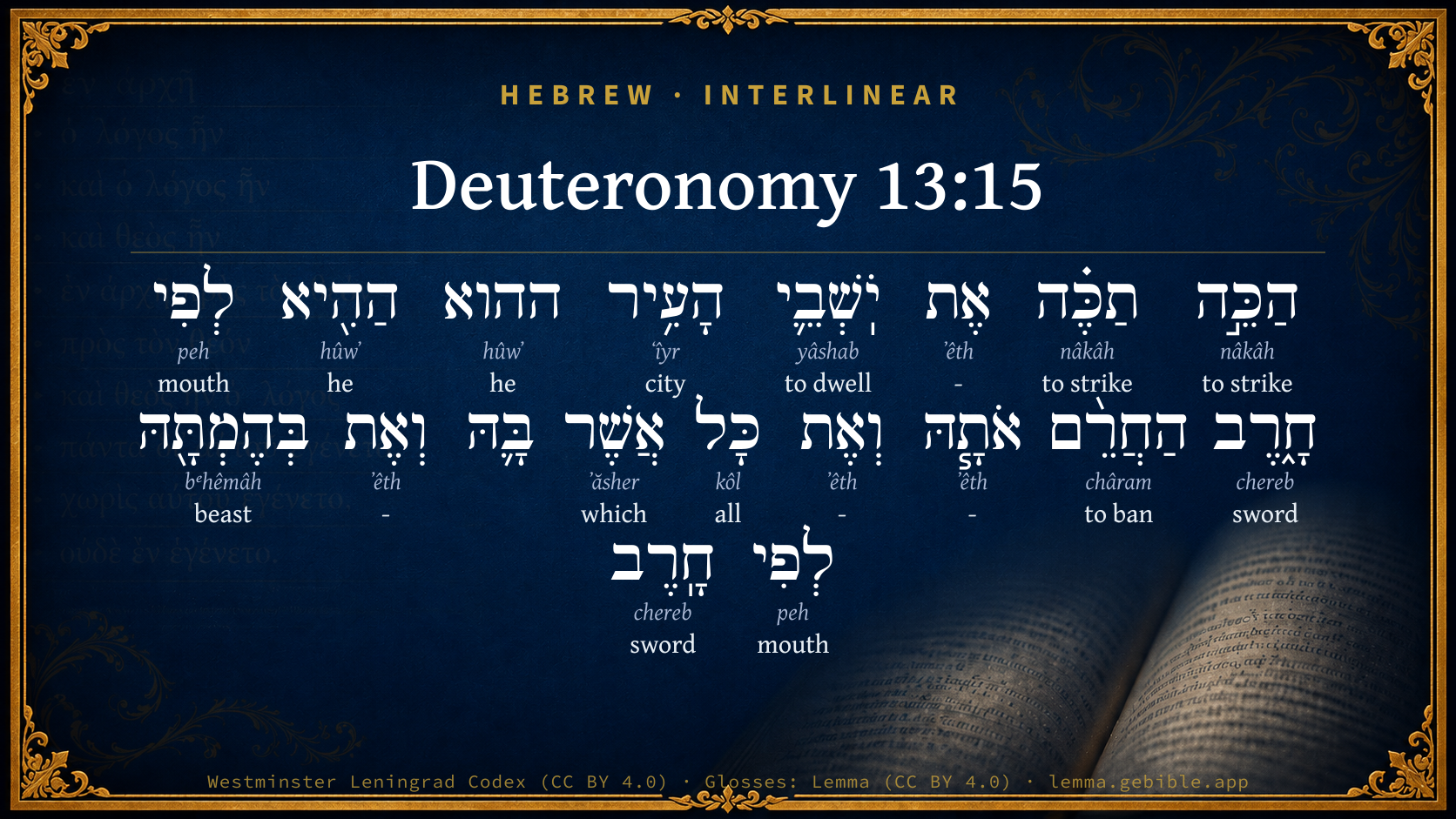
Hebrew (Westminster Leningrad Codex) Deuteronomy 13:15 appears in the Hebrew Old Testament. The text above is from the Westminster Leningrad Codex. Each word links to its Strong’s number, a concise gloss, and parsing drawn from the Open Scriptures Hebrew Bible morphology. Click any word for its full Brown-Driver-Briggs (BDB) entry.
Download image
Cite this verse

Deuteronomy 13:15 (World English Bible). Public Domain. Lemma interlinear Bible study tool, https://lemma.gebible.app/v/deuteronomy/13/15.

Show BibTeX & RIS
BibTeX
RIS
English Translation
you shall surely strike the inhabitants of that city with the edge of the sword, destroying it utterly, and all that is therein and the cattle of it, with the edge of the sword.
World English Bible · Public Domain
Download a study sheet

One document with this verse’s original text, its word-by-word gloss line, the meaning frame, cross-references with their text, attributed commentary, and full source and license credits — printable, and it pastes into notes with its structure intact.

This verse Autodidact and up

Study sheet (.html) Plain text (.txt)

A passage Seminary Student

Up to 50 verses in one chapter. A passage sheet keeps up to 6 commentary sources and 12 cross-references per verse, in the order this page ranks them, and says so on the sheet whenever that leaves anything out. Ask for a single verse and you get the Autodidact verse sheet above.

Everything on this page stays free to read, with no account — the sheet is a download of what is already on screen, not access to it.

Want to remove ads? Support Godless Engineer
Compare translations 3

The same verse in 3 English versions, stacked beneath the original-language interlinear above. Click any original word for its lexicon entry.

Each is an independent rendering of the whole verse — the interlinear is not word-aligned to these translations.

Highlighted words mark where these versions differ — a whole-verse word diff, not a word-by-word alignment.

  • World English Bible Public Domain
    you shall surely strike the inhabitants of that city with the edge of the sword, destroying it utterly, and all that is therein and the cattle of it, with the edge of the sword.
  • King James Version Public Domain
    Thou shalt surely smite the inhabitants of that city with the edge of the sword, destroying it utterly, and all that is therein, and the cattle thereof, with the edge of the sword.
  • unfoldingWord Literal Text CC BY-SA 4.0
    striking, you shall strike the dwellers of that city to the mouth of the sword, devoting it and all who in it and its livestock to the mouth of the sword.

unfoldingWord Literal Text — © unfoldingWord, licensed CC BY-SA 4.0. Word-aligned USFM3 via Door43 (git.door43.org/unfoldingWord/en_ult).

Versions to compare (up to 4)

3 of 4 selected

Show all 18 translations

Every available English version of this verse, each an independent rendering of the whole verse.

  • World English Bible Public Domain
    you shall surely strike the inhabitants of that city with the edge of the sword, destroying it utterly, and all that is therein and the cattle of it, with the edge of the sword.
  • Berean Standard Bible Public Domain
    you must surely put the inhabitants of that city to the sword. Devote to destruction all its people and livestock.
  • Majority Standard Bible Public Domain
    you must surely put the inhabitants of that city to the sword. Devote to destruction all its people and livestock.
  • King James Version Public Domain
    Thou shalt surely smite the inhabitants of that city with the edge of the sword, destroying it utterly, and all that is therein, and the cattle thereof, with the edge of the sword.
  • American Standard Version (1901) Public Domain
    thou shalt surely smite the inhabitants of that city with the edge of the sword, destroying it utterly, and all that is therein and the cattle thereof, with the edge of the sword.
  • Revised Version (1885) Public Domain
    thou shalt surely smite the inhabitants of that city with the edge of the sword, destroying it utterly, and all that is therein and the cattle thereof, with the edge of the sword.
  • Geneva Bible (1599) Public Domain
    Thou shalt euen slay the inhabitants of that citie with the edge of the sworde: destroy it vtterly, and all that is therein, and the cattel thereof with the edge of the sworde.
  • Douay-Rheims (1899) Public Domain
    Thou shalt forthwith kill the inhabitants of that city with the edge of the sword, and shalt destroy it and all things that are in it, even the cattle.
  • Young's Literal Translation Public Domain
    `Thou dost surely smite the inhabitants of that city by the mouth of the sword; devoting it, and all that `is' in it, even its cattle, by the mouth of the sword;
  • Literal Standard Version CC BY-SA 4.0
    you surely strike the inhabitants of that city by the mouth of the sword, devoting it and all that [is] in it, even its livestock, by the mouth of the sword.
  • Unlocked Literal Bible CC BY-SA 4.0
    You will surely attack the inhabitants of that city with the edge of the sword, completely destroy it and all the people who are in it, along with its livestock, with the edge of the sword.
  • unfoldingWord Literal Text CC BY-SA 4.0
    striking, you shall strike the dwellers of that city to the mouth of the sword, devoting it and all who in it and its livestock to the mouth of the sword.
  • Darby Bible Public Domain
    thou shalt surely smite the inhabitants of that city with the edge of the sword, devoting it to destruction, and all that is therein, and the cattle thereof, with the edge of the sword.
  • World Messianic Bible Public Domain
    you shall surely strike the inhabitants of that city with the edge of the sword, destroying it utterly, with all that is therein and its livestock, with the edge of the sword.
  • Webster's Bible Public Domain
    Thou shalt surely smite the inhabitants of that city with the edge of the sword, destroying it utterly, and all that is in it, and its cattle, with the edge of the sword.
  • Free Bible Version CC BY-SA 4.0
    then you have to kill the people living in that town with the sword. Set apart for destruction its people and its livestock.
  • Bible in Basic English Public Domain
    Then take up arms against the people of that town and give it up to the curse, with all its cattle and everything in it.
  • JPS Tanakh (1917) Public Domain
    (13-16) thou shalt surely smite the inhabitants of that city with the edge of the sword, destroying it utterly, and all that is therein and the cattle thereof, with the edge of the sword.

Literal Standard Version (2020), Covenant Press — licensed CC BY-SA 4.0. Text via the HelloAO Bible API (eBible.org). Unlocked Literal Bible (unfoldingWord) — licensed CC BY-SA 4.0. Text via the HelloAO Bible API (eBible.org). unfoldingWord Literal Text — © unfoldingWord, licensed CC BY-SA 4.0. Word-aligned USFM3 via Door43 (git.door43.org/unfoldingWord/en_ult). Free Bible Version, Dr. Jonathan Gallagher — licensed CC BY-SA 4.0. Text via the HelloAO Bible API (eBible.org).

Word by word

More ways to search: Search by grammar → Find every occurrence → Compare this word →

Practice this passage: Drill this verse → Learn its vocabulary →

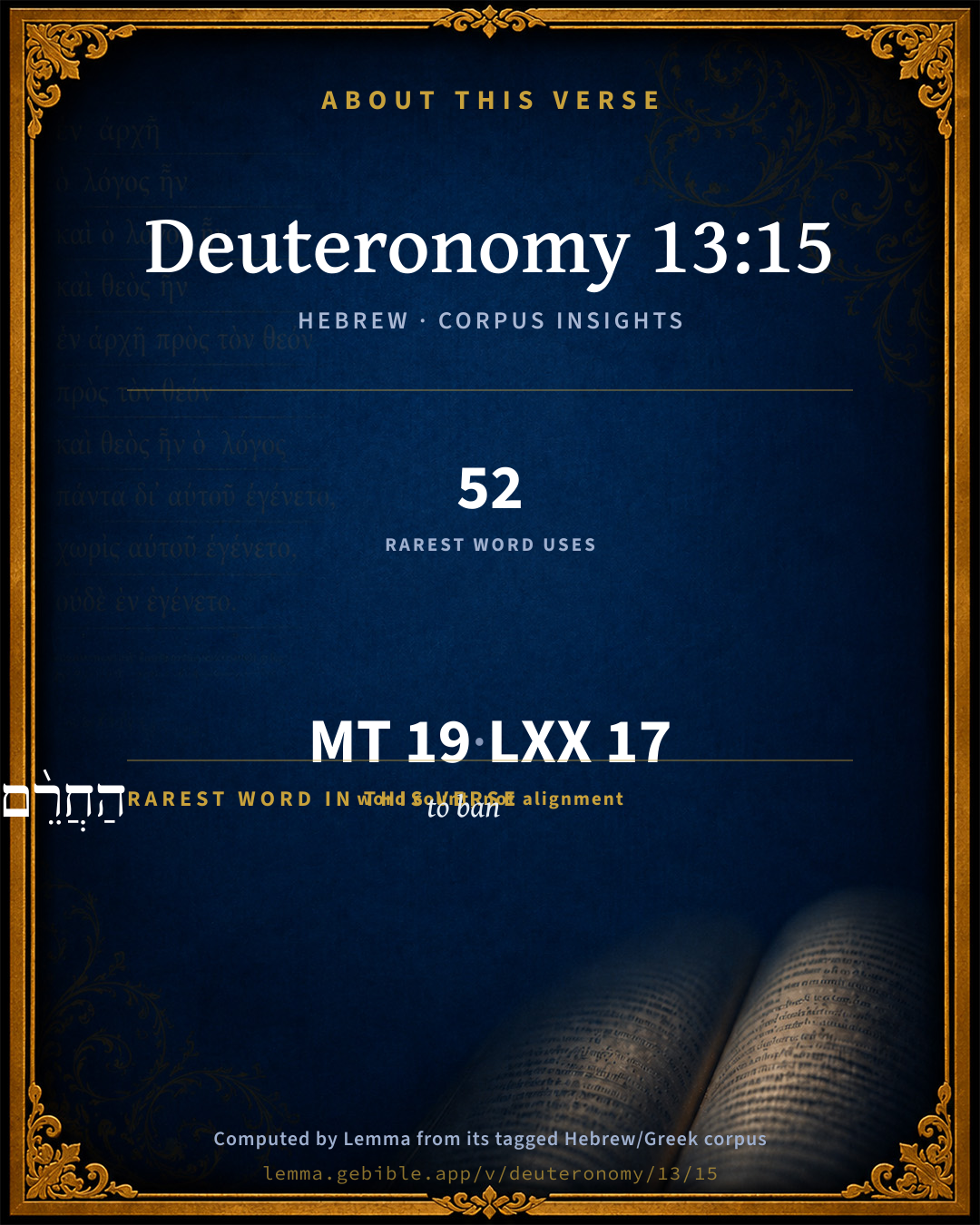
הַחֲרֵ֨ם
châram
H2763
“to ban”
Verb, Hiphil, Infinitive Absolute
Part of Speech
Verb
Stem
Hiphil
Form
Infinitive Absolute
Full BDB Definition

Origin: a primitive root

TWOT: 744 , 745

to ban, devote, destroy utterly, completely destroy, dedicate for destruction, exterminate - (Hiphil) - to prohibit (for common use), ban - to consecrate, devote, dedicate for destruction - to exterminate, completely destroy - (Hophal) - to be put under the ban, be devoted to destruction - to be devoted, be forfeited - to be completely destroyed - to split, slit, mutilate (a part of the body) - (Qal) to mutilate - (Hiphil) to divide
  1. הַכֵּ֣ה nâkâh H5221 “to strike” Verb, Hiphil, Infinitive Absolute
  2. תַכֶּ֗ה nâkâh H5221 “to strike” Verb, Hiphil, Imperfect, 2nd Person, Masculine, Singular
  3. אֶת ʼêth H853 “-” Particle, Direct Object
  4. יֹֽשְׁבֵ֛י yâshab H3427 “dwelling” Verb, Qal, Participle Active, Masculine, Plural, Construct
  5. הָעִ֥יר ʻîyr H5892 “the · city” Particle, Definite Article + Noun, Common, Feminine, Singular, Absolute
  6. ההוא hûwʼ H1931 “the · he” Particle, Definite Article + Pronoun, Personal, 3rd Person, Masculine, Singular
  7. הַהִ֖יא hûwʼ H1931 “the · he” Particle, Definite Article + Pronoun, Personal, 3rd Person, Feminine, Singular
  8. לְפִי peh H6310 “to/for · mouth of” Preposition + Noun, Common, Masculine, Singular, Construct
  9. חָ֑רֶב chereb H2719 “sword” Noun, Common, Feminine, Singular, Absolute
  10. אֹתָ֧הּ ʼêth H853 “- · her” Particle, Direct Object + Suffix, Personal, 3rd Person, Feminine, Singular
  11. וְאֶת ʼêth H853 “and · -” Conjunction + Particle, Direct Object
  12. כָּל kôl H3605 “all of” Noun, Common, Masculine, Singular, Construct
  13. אֲשֶׁר ʼăsher H834 “which” Particle, Relative
  14. וְאֶת ʼêth H853 “and · -” Conjunction + Particle, Direct Object
  15. בְּהֶמְתָּ֖הּ bᵉhêmâh H929 “beast · her” Noun, Common, Feminine, Singular, Construct + Suffix, Personal, 3rd Person, Feminine, Singular
  16. לְפִי peh H6310 “to/for · mouth of” Preposition + Noun, Common, Masculine, Singular, Construct
  17. חָֽרֶב chereb H2719 “sword” Noun, Common, Feminine, Singular, Absolute

About this verse

These counts appear in no published source. They are computed here, from the morphology-tagged text and Lemma’s own curated glosses. What Lemma adds →

19
words
11
distinct lemmas
Pentateuch
section

Shared distinctive vocabulary

הַחֲרֵ֨ם to ban H2763 occurs in 48 verses of the Hebrew Bible. Also found in:

Grammatical profile

  • 4 verbs
  • 7 nouns
  • 2 pronouns
  • 1 preposition
  • 5 particles

Verb forms

  • הַכֵּ֣ה Hiphil · Infinitive Absolute
  • תַכֶּ֗ה Hiphil · Imperfect
  • יֹֽשְׁבֵ֛י Qal · Participle Active
  • הַחֲרֵ֨ם Hiphil · Infinitive Absolute

Repetition

Words recur within this verse — often emphatic in Hebrew:

  • הַכֵּ֣ה to strike H5221 ×2
  • לְפִי mouth H6310 ×2
  • חָ֑רֶב sword H2719 ×2
  • ההוא he H1931 ×2

Hebrew & Septuagint length

In English translation the verse runs 34 words from the Hebrew and 26 from the Septuagint (LXX English) — closely comparable.

A rough comparison of the two English renderings, which tokenize alike — not a word-level alignment.

Word counts can differ between the Hebrew and the Greek without any difference in meaning — e.g. the Hebrew direct-object marker אֵת has no separate Greek word, and Greek often adds the article ὁ.

In the original languages it is 19 Hebrew tokens and 17 Greek tokens — but the two are counted differently (Hebrew bundles its prefixes and suffixes into one token; the Greek is in lemma form), so that isn’t a like-for-like length.

Cross-references

12

Topical passages linked to Deuteronomy 13:15 in the Treasury of Scripture Knowledge — connected by theme and wording, ordered by reader-vote popularity; previews shown in the World English Bible.

  • Exodus 22:20 "He who sacrifices to any god, except to Yahweh only, shall be utterly destroyed.
  • Leviticus 27:28 "'Notwithstanding, no devoted thing, that a man shall devote to Yahweh of all that he has, whether of man or animal, or of the field of his possession, shall be sold or redeemed: every devoted thing is most holy to Yahweh.
  • Deuteronomy 7:2 and when Yahweh your God shall deliver them up before you, and you shall strike them; then you shall utterly destroy them: you shall make no covenant with them, nor show mercy to them;
  • Exodus 23:24 You shall not bow down to their gods, nor serve them, nor follow their practices, but you shall utterly overthrow them and demolish their pillars.
  • Deuteronomy 2:34 We took all his cities at that time, and utterly destroyed every inhabited city, with the women and the little ones; we left none remaining:
  • Deuteronomy 7:16 You shall consume all the peoples who Yahweh your God shall deliver to you; your eye shall not pity them: neither shall you serve their gods; for that will be a snare to you.
  • Joshua 6:17–21 The city shall be devoted, even it and all that is therein, to Yahweh: only Rahab the prostitute shall live, she and all who are with her in the house, because she hid the messengers that we sent.
  • Joshua 6:24 They burnt the city with fire, and all that was therein; only the silver, and the gold, and the vessels of brass and of iron, they put into the treasury of the house of Yahweh.
  • Judges 20:48 The men of Israel turned again on the children of Benjamin, and struck them with the edge of the sword, both the entire city, and the cattle, and all that they found: moreover all the cities which they found they set on fire.
  • Revelation 17:16 The ten horns which you saw, and the beast, these will hate the prostitute, and will make her desolate, and will make her naked, and will eat her flesh, and will burn her utterly with fire.
  • Revelation 18:18–24 and cried out as they looked at the smoke of her burning, saying, 'What is like the great city?'
  • Revelation 19:2–3 for true and righteous are his judgments. For he has judged the great prostitute, who corrupted the earth with her sexual immorality, and he has avenged the blood of his servants at her hand."

Cross-references courtesy of OpenBible.info (CC BY 4.0).

Hebrew and Greek witnesses Masoretic Hebrew ↔ Greek Septuagint

The same verse in the two great witnesses to the Old Testament, shown verse-for-verse.

These are two independent witnesses, not word-aligned to each other, and the Septuagint is shown in lemma (dictionary) form.

Hebrew Deuteronomy 13:15 Masoretic · Westminster Leningrad Codex

הַכֵּ֣ה תַכֶּ֗ה אֶת יֹֽשְׁבֵ֛י הָעִ֥יר ההוא הַהִ֖יא לְפִי חָ֑רֶב הַחֲרֵ֨ם אֹתָ֧הּ וְאֶת כָּל אֲשֶׁר בָּ֛הּ וְאֶת בְּהֶמְתָּ֖הּ לְפִי חָֽרֶב

you shall surely strike the inhabitants of that city with the edge of the sword, destroying it utterly, and all that is therein and the cattle of it, with the edge of the sword.

World English Bible · Public Domain

Greek LXX Deuteronomy 13:15 Septuagint · lemma form

καί ἐρωτάω καί ἐρευνάω σφόδρα καί ἰδού ἀληθής σαφῶς ὁ λόγος γίγνομαι ὁ βδέλυγμα οὗτος ἐν σύ

you shall utterly destroy all the dwellers in that land with the edge of the sword; you⌃ shall solemnly curse it, and all things in it.

LXX2012 (modern English Septuagint) · Public Domain

On this verse, Haydock's Catholic Bible Commentary discusses the Septuagint’s reading. Read the note in Commentary ↓

Hebrew: Westminster Leningrad Codex (CC BY 4.0). Greek: Septuagint (public domain); English from LXX2012 (modern English Septuagint) (Public Domain). How the Septuagint differs from the Hebrew →

Targum (Aramaic paraphrase)

2

The Targum is the ancient Jewish Aramaic paraphrase of the Hebrew Scriptures — an interpretive translation, not the Hebrew text itself. Onkelos (literal) and Pseudo-Jonathan (expansive) render the Torah, and Jonathan the Prophets. Coverage is partial: where no permissively-licensed English translation exists for a verse, only the Aramaic is shown. This is verse-level text, not a word-by-word alignment to the Hebrew.

  1. Targum Onkelos Torah (Genesis–Deuteronomy)
    וְתִתְבַּע וְתִבְדוֹק וְתִשְׁאַל יָאוּת וְהָא קֻשְׁטָּא כֵּוַן פִּתְגָמָא אִתְעֲבִידָא תּוֹעֶבְתָּא הָדָא בֵּינָךְ

    (no public-domain English translation for this verse)

    Targum Onkelos — Aramaic: “Onkelos Genesis” (public domain); “Onkelos Exodus” (public domain); “Onkelos Leviticus” (public domain); “Onkelos Numbers” (public domain); “Onkelos Deuteronomy” (public domain). English: “Sefaria Community Translation” (CC0 1.0 (public-domain dedication)); “J.W. Etheridge. The Targums of Onkelos and Jonathan Ben Uzziel on the Pentateuch. London: Longmans, Green, 1862” (public domain). Text via Sefaria.

  2. Targum Pseudo-Jonathan Torah (Genesis–Deuteronomy)
    וְתִתְבְּעוּן וְתִבְדְּקוּן יַת סַהֲדַיָיא וּתְשַׁיְילוּן טַבָּאוּת וְהָא קוּשְׁטָא כֵּיוַון פִּתְגָמָא אִתְעֲבִידַת תּוֹעֵבְתָּא הָדָא בֵּינֵיכוֹן

    then search you out, and examine with witnesses, and make good inquiry; and, behold, if the thing be true and certain that this abomination hath been really done among you,

    Targum Pseudo-Jonathan — Aramaic: “Targum Jonathan on Genesis” (public domain); “Targum Jonathan on Exodus” (public domain); “Targum Jonathan on Leviticus” (public domain); “Targum Jonathan on Numbers” (public domain); “Targum Jonathan on Deuteronomy” (public domain). English: “The Targum of Jonathan ben Uzziel, trans. J. W. Etheridge, London, 1862” (public domain). Text via Sefaria.

Commentary

Notes on Deuteronomy 13:15 from classic Christian and Jewish commentators (each source and its license shown beneath its notes). The classic Christian expositions comment on the surrounding passage and are grouped to its opening verse, so a note may address several verses; the Jewish commentaries on the Tanakh (Rashi and others) are per-verse, so they appear only where the commentator wrote on this verse.

Lemma curates 59 commentaries, every one of them public domain or Creative Commons licensed, each selected and text-cleaned for this edition rather than reprinted as found. About our sources →

Joseph Benson's Commentary

Deu 13:15. The inhabitants — Namely, all that were guilty, not the innocent part, such as disowned this apostacy, who doubtless by choice, at least upon warning, would come out of so wicked a place. Utterly — The very same punishment which was inflicted upon the cities of the cursed Canaanites, to whom, having made themselves equal in sin, it was but just God should equal them in punishment.

Joseph Benson's Commentary on the Old and New Testaments (1811–1818) — public domain. Text from a community e-Sword module.

Adam Clarke's Commentary

Verse 15. Thou shalt surely smite the inhabitants] If one city were permitted to practise idolatry, the evil would soon spread, therefore the contagion must be destroyed in its birth.

Adam Clarke's Commentary on the Bible (1810–1826) — public domain. Text from a community e-Sword/MySword module.

Ellicott's Commentary for English Readers

(15) And the cattle thereof.—So in Jdg_20:48 : “The men of every city, the beast, and all that were found.”

A Bible Commentary for English Readers, edited by Charles John Ellicott (1878–1897) — public domain. Text from a community e-Sword module.

John Gill's Exposition

Thou shalt surely smite the inhabitants of that city with the edge of the sword,.... This could not be the work of a single person, nor of the whole sanhedrim, but was what the whole nation was to join in, according to the above note:

destroying it utterly; pulling down the houses, and demolishing its walls and fortifications, or burning it, as afterwards explained:

and all that is therein; men, women, and children:

and the cattle thereof, with the edge of the sword; this severity was used to show the Lord's indignation against the sin of idolatry, and to deter persons from it, both individuals and bodies of men.

John Gill's Exposition of the Whole Bible (1746–1763) — public domain (CC PDM 1.0). Text via the HelloAO Bible API.

Haydock's Catholic Bible Commentary

Even the cattle. Nothing at all must be spared. Yet the Rabbins and some who argue that penal laws must be restrained as much as possible, exempt the women, and boys under thirteen years of age, and understand this law only of the central cities, ver. 13. If the city was seduced by one man, or by women, or by people of a different tribe, the culprit was only to be stoned, and the Sanhedrim had to take cognizance of the whole affair. If many cities joined in the idolatry, or if any of them were cities of refuge, &c., they were not included. (Selden, Syned. iii. 5.; Grotius) --- But these limitations seem visibly to contradict the law. The goods of the innocent were involved in the common ruin, that they might learn to make all possible resistance to the introduction of so abominable a crime; and those of the guilty were destroyed wherever they were found. (Calmet) --- But the persons of those who fled away, to shew their disapprobation, and denounce the attempt of their brethren, (Haydock) would no doubt be saved. (Calmet) --- If they continued among them, their indolence or connivance deserved punishment. (Haydock) --- Grotius (Jur. ii. 15) maintains, that the magistrate is authorized by the law of nature to punish those who deny the existence of God or his Providence, as these errors strike at the root of all society. --- [Ver. 16.] For the Lord, as a victim of expiation, and to manifest your zeal for the honour of the only true God. --- No more. Septuagint, "it shall be uninhabited." The Rabbins are so exact, as to entertain a doubt whether the place might even be used as a garden. (Calmet)

George Leo Haydock (1774–1849), Haydock's Catholic Family Bible and Commentary, 1859 edition — public domain. Excludes Psalms (Douay-Rheims chapter numbering differs from Protestant) and Deuterocanonical books (Catholic canon only).

Matthew Poole's English Annotations

The inhabitants of that city, to wit, all that are guilty, not the innocent part, such as disowned this apostacy, who doubtless by choice and interest, at least upon warning, would come out of so wicked and cursed a place.

Destroying it utterly; the very same punishment which was inflicted upon the cities of the cursed Canaanites, to whom having made themselves equal in sin, it is but fit and just that God should equal them in punishment.

Matthew Poole's English Annotations on the Holy Bible (1683–1685) — public domain. Text from a community e-Sword/MySword module.

John Wesley's Explanatory Notes

The inhabitants - Namely, all that are guilty, not the innocent part, such as disowned this apostacy, who doubtless by choice, at least upon warning, would come out of so wicked a place. Utterly - The very same punishment which was, inflicted upon the cities of the cursed Canaanites, to whom having made themselves equal in sin, it is but just God should equal them in punishment.

John Wesley, Explanatory Notes Upon the Whole Bible (1754–1765) — public domain. Text via the GEBible commentary corpus.

Keil & Delitzsch

C. F. Keil & F. Delitzsch

Upon this report the people as a whole, of course through their rulers, were to examine closely into the affair (היטב, an adverb, as in Deu 9:21), whether the word was established as truth, i.e., the thing was founded in truth (cf. Deu 17:4; Deu 22:20); and if it really were so, they were to smite the inhabitants of that town with the edge of the sword (cf. Gen 34:26), putting the town and all that was in it under the ban. "All that is in it" relates to men, cattle, and the material property of the town, and not to men alone (Schultz). The clause from "destroying" to "therein" is a more minute definition of the punishment introduced as a parenthesis; for "the cattle thereof," which follows, is also governed by "thou shalt smite." The ban was to be executed in all its severity as upon an idolatrous city: man and beast were to be put to death without reserves; and its booty, i.e., whatever was to be found in it as booty-all material goods, therefore - were to be heaped together in the market, and burned along with the city itself. ליהוה כּליל (Eng. Ver. "every whit, for the Lord thy God") signifies "as a whole offering for the Lord" (see Lev 6:15-16), i.e., it was to be sanctified to Him entirely by being destroyed. The town was to continue an eternal hill (or heap of ruins), never to be built up again.

Keil & Delitzsch — Biblical Commentary on the Old Testament (1861–1891) — public domain (CC PDM 1.0). Text via the HelloAO Bible API. (Old Testament only.)

unfoldingWord translationNotes

Door43 World Missions Community

with the edge of the sword

Here "edge" represents the whole sword. AT: "with your swords" (See: Synecdoche)

all the spoil

"all the plunder." This refers to the possessions and treasures that an army collects after winning a battle.

heap of ruins

"pile of ruins"

it must never be built again

This can be stated in active form. AT: "no one must ever rebuild the city" (See: Active or Passive)

translationWords

sword

livestock

ruin

eternity

unfoldingWord translationNotes — © Distant Shores Media and the Door43 World Missions Community, licensed CC BY-SA 4.0. Source: git.door43.org/Door43/en_tn.

Rashi

Rabbi Shlomo Yitzchaki (Rashi)

ודרשת וחקרת ושאלת היטב THEN SHALT THOU INQUIRE, AND MAKE SEARCH, AND ASK DILIGENTLY — From here — from the variety of expressions denoting inquiry in this verse — they (the Rabbis) derived the law of investigating capital cases by means of seven investigations” (referring to date, time and place). in the following manner: here (in our verse) there occur three expressions relating to inquiry, viz., ודרשת, וחקרת and היטב — the expression ושאלת does not come into account, because from it they derived בדיקות, the examination referring to accompanying circumstances, — and in another passage (Deuteronomy 19:18) it states, “and the judges shall enquire diligently (ודרשו השופטים היטב)”, and still in another passage (Deuteronomy 17:40) it states, “and thou shalt inquire diligently (ודרשת היטב)" — thus altogether seven expressions. — And although they are used in connection with different cases they learned by way of analogy (ג"ש) of the term היטב used here and in the passages quoted that it is intended to apply what is stated in one case to the others also (Sanhedrin 40a; cf. Sifrei Devarim 93:6).

Rashi on the Tanakh — English translations: “The Judaica Press complete Tanach with Rashi, translated by A. J. Rosenberg” (CC BY 4.0); “Pentateuch with Rashi's commentary by M. Rosenbaum and A.M. Silbermann, 1929-1934” (public domain); “The Metsudah Tanach series, Lakewood, N.J” (CC BY 4.0); and “The Book of Joshua, Metsudah Publications, 1997” (CC BY 4.0). Text via Sefaria.

Ramban (Nachmanides)

Rabbi Moshe ben Nachman (Ramban / Nachmanides)

AND THOU SHALT INQUIRE, AND MAKE SEARCH, AND ASK DILIGENTLY. The nature of “inquiry” and “making search” [with which the judges are to test witnesses] are explained in the words of our Rabbis. Now Scripture mentions these investigations [here] in the case of an apostate city, and also in the case of an idol-worshipper, but it does not mention them in the case of the false prophet or the inciter, because the prophet publicizes himself with his signs and wonders, and in the case of the inciter Scripture addresses itself to the incited party: but thou shalt surely kill him, and he [the incited party, is the one] who knows and bears witness, just as is stated, neither shalt thou spare, neither shalt thou conceal him., Verse 9. Thus, Scripture need not enjoin diligent inquiry and testing of witnesses because the facts are well known to those charged with administering the penalty; the public in the case of a false prophet, and the victim in the case of the inciter. But in the case of an apostate city and of an idol worshipper, which are deeds that reach us by means of report, Scripture mentions, with reference to them, inquiry and investigation [of the witnesses]. It was unnecessary to state this about the others liable to death because it is known by means of a kal vachomer. He states in the case of plotting witnesses, and the judges shall inquire diligently, because it cannot be determined which of the two conflicting groups of witnesses is telling the truth except after considerable investigation. Concerning the law, all cases are deduced from each other by means of a similarity of Scriptural expressions. And from all the combined expressions we derive the principle that we are to test the witnesses with seven inquiries, and examinations. ).

Ramban (Nachmanides) on the Tanakh — English translation: “Commentary on the Torah by Ramban (Nachmanides). Translated and annotated by Charles B. Chavel. New York, Shilo Pub. House, 1971-1976” (CC BY 4.0). Text via Sefaria.

Lesson kit

Teaching starters — assembled from the data on this page, not authored interpretation. Every prompt links to the verse data it draws on. Edit before teaching.

Deuteronomy, in the Pentateuch, opens this verse with 19 words (11 distinct Hebrew lemmas). Its most distinctive word is châram (“to ban”). A historical commentator’s framing appears above. Read the whole chapter for the surrounding context.

Discussion questions

  1. The word châram carries the sense “to ban.” How does it shape the verse?
  2. How does Exodus 22:20, which shares the word «to ban», read alongside this verse?
  3. What does the repetition of “to strike” (2× in this one verse) do in this verse?
  4. These translations render this verse differently. What is at stake in choosing one wording over another?
  5. «הַכֵּ֣ה» is a Hiphil Infinitive Absolute verb. How does that grammatical form shape the action described?
  6. Compare how Joseph Benson's Commentary and Adam Clarke's Commentary read this verse. Where do they agree or differ?

Things to notice

Reading settings

Reading text

Shown beneath each verse's original-language words.

Old Testament
Old Testament edition

Read the OT as the Masoretic Hebrew (MT) or the Greek Septuagint (LXX).

English shown for the Greek Septuagint (in the Hebrew ↔ Greek comparison).

Comparing translations? Open the Compare panel on any verse page to stack up to four side by side.